CHURCH OF CONSOLATION – TERCEROS

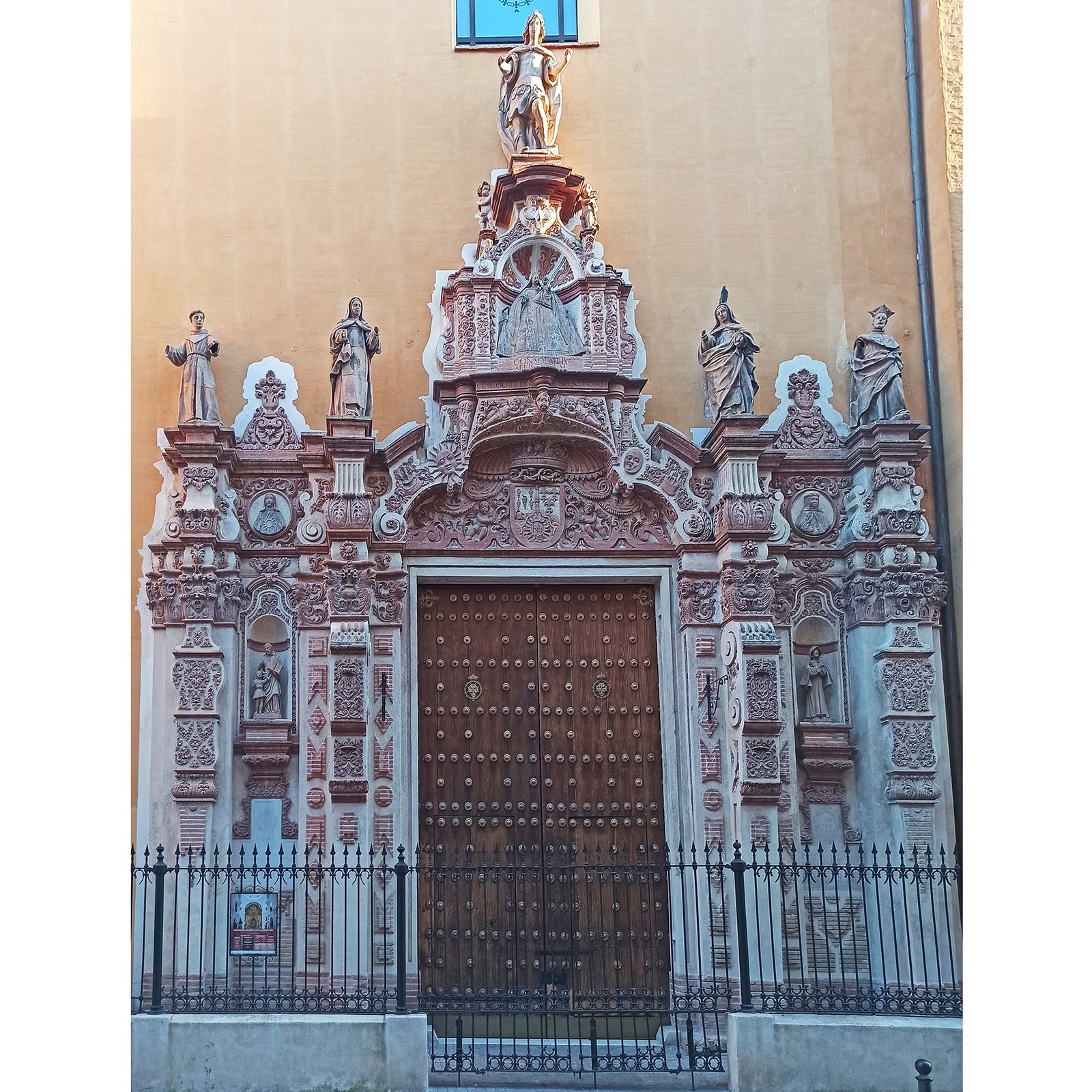
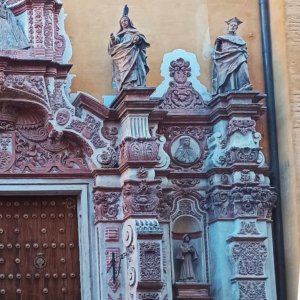
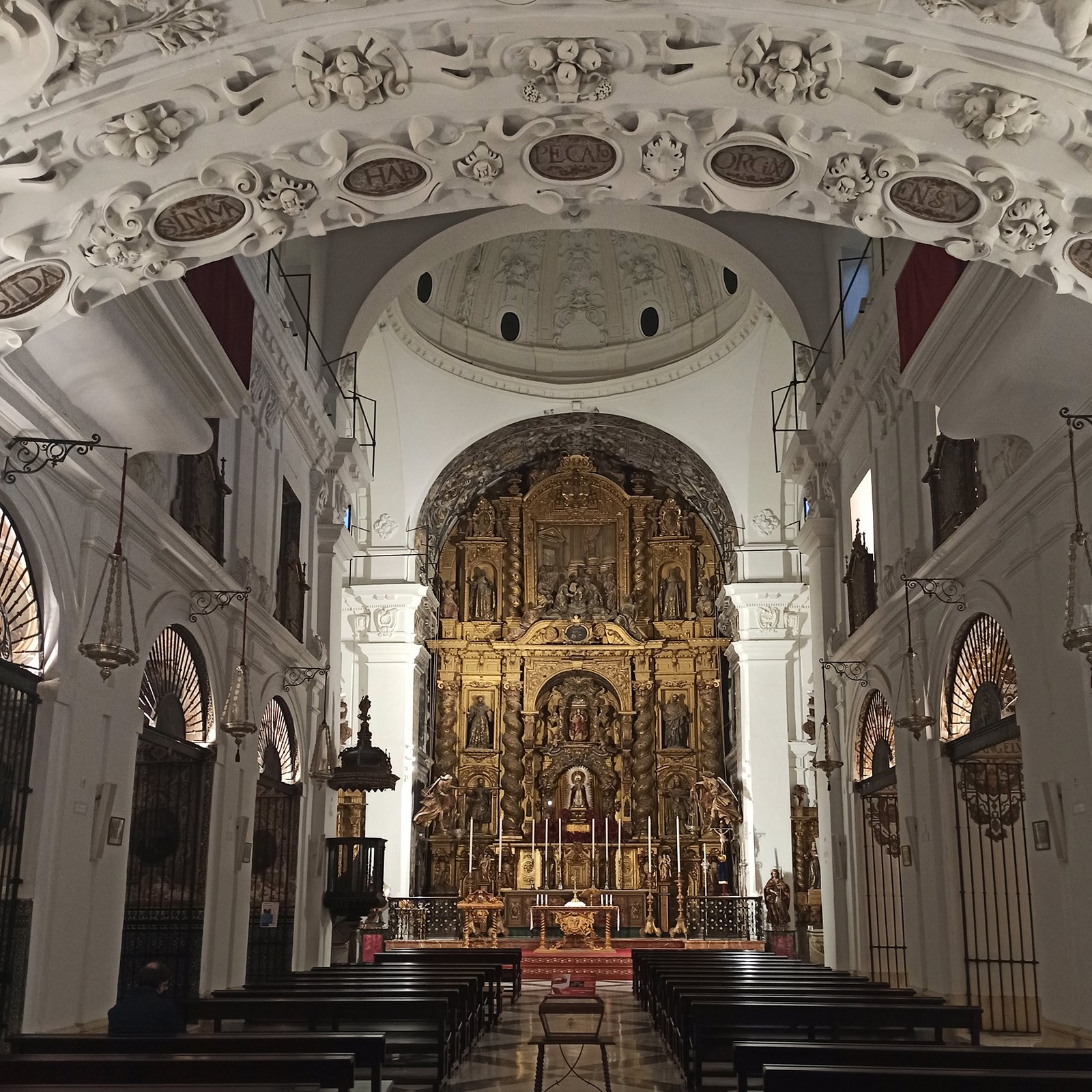
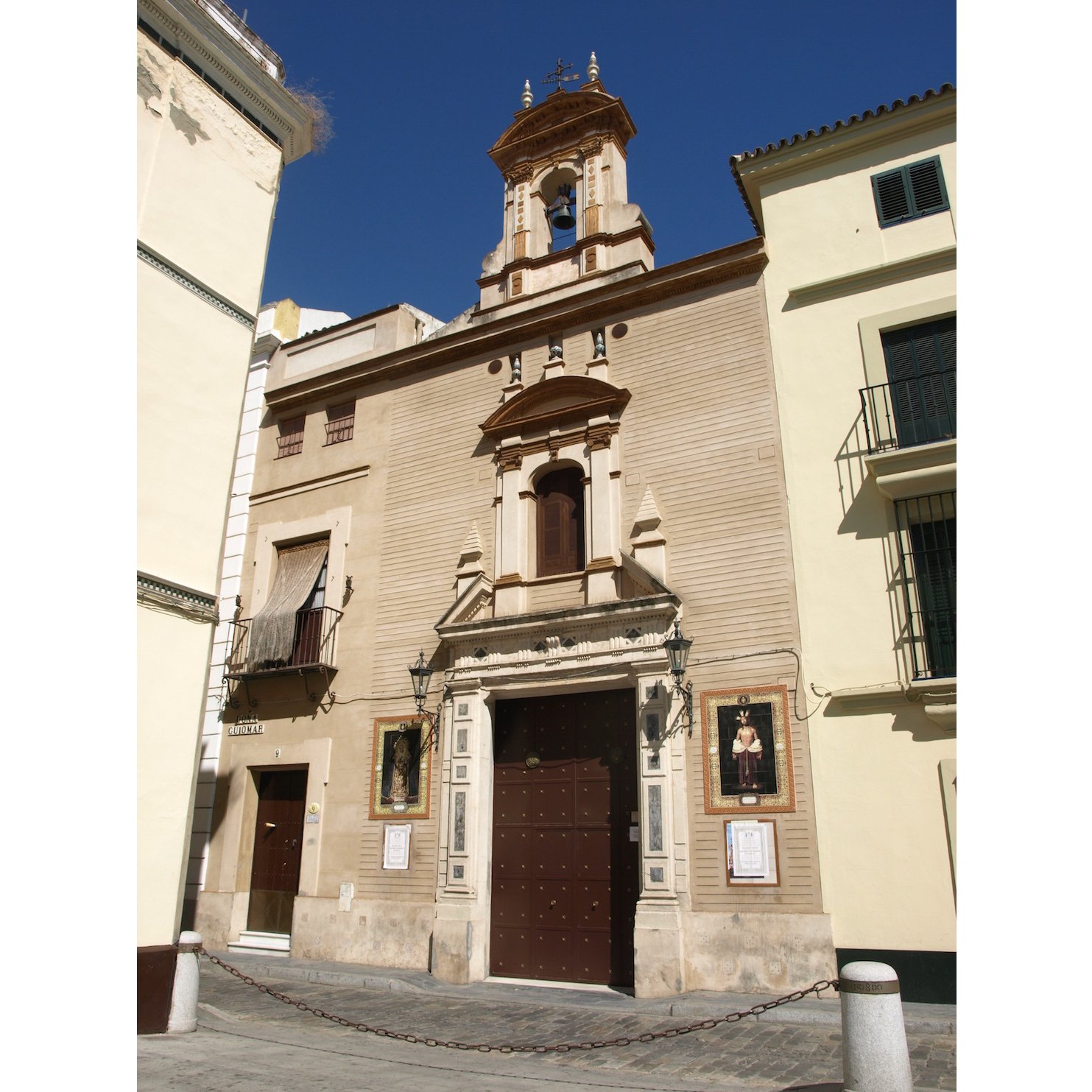
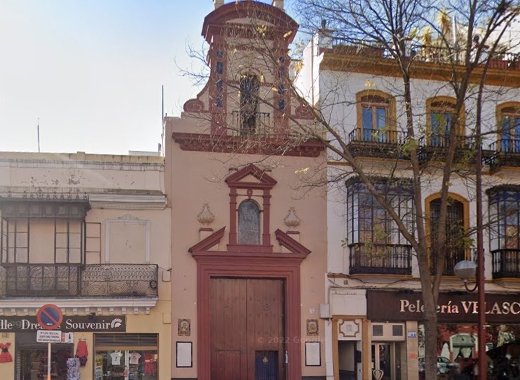
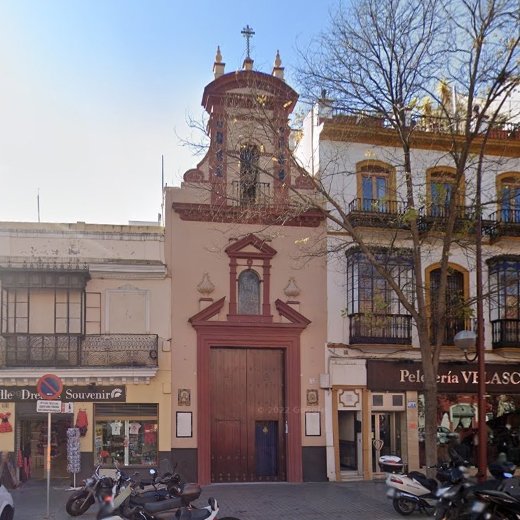
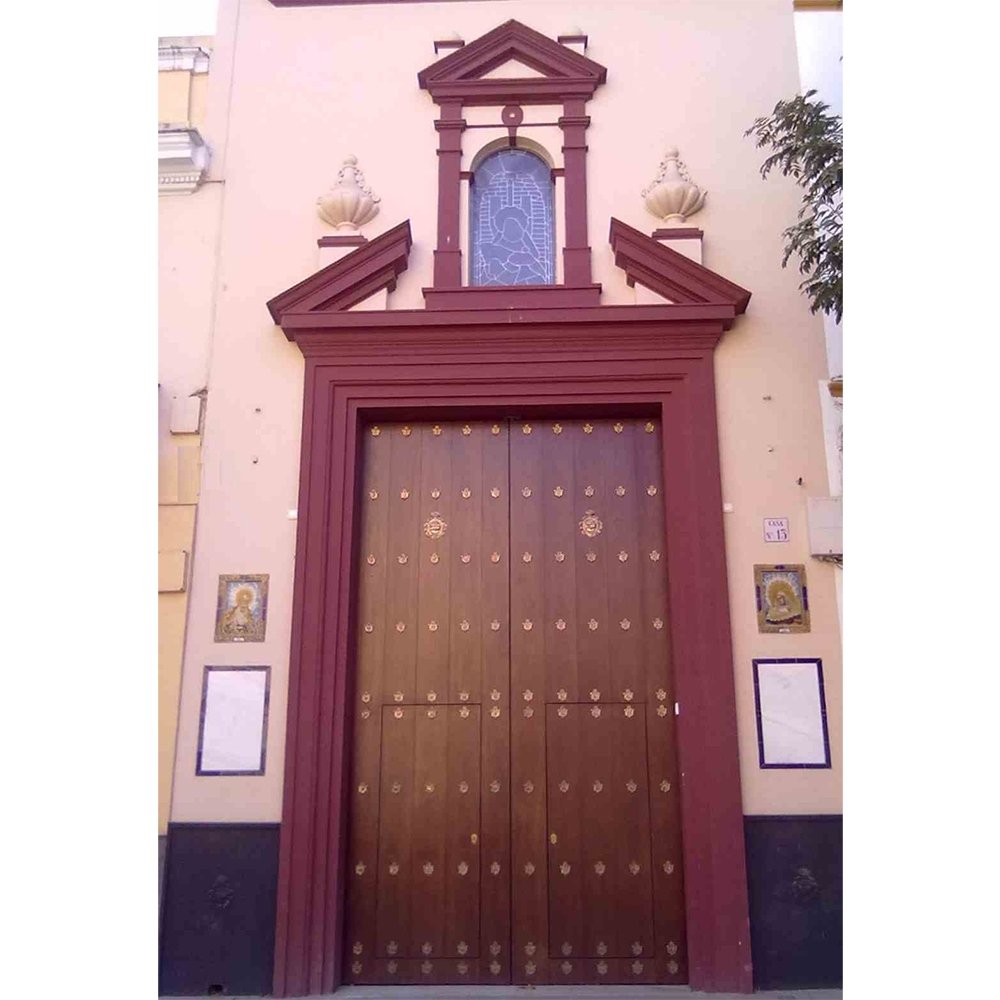
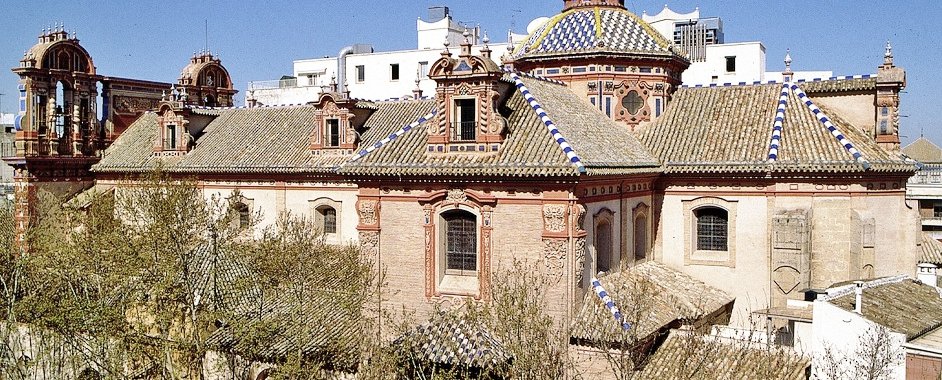
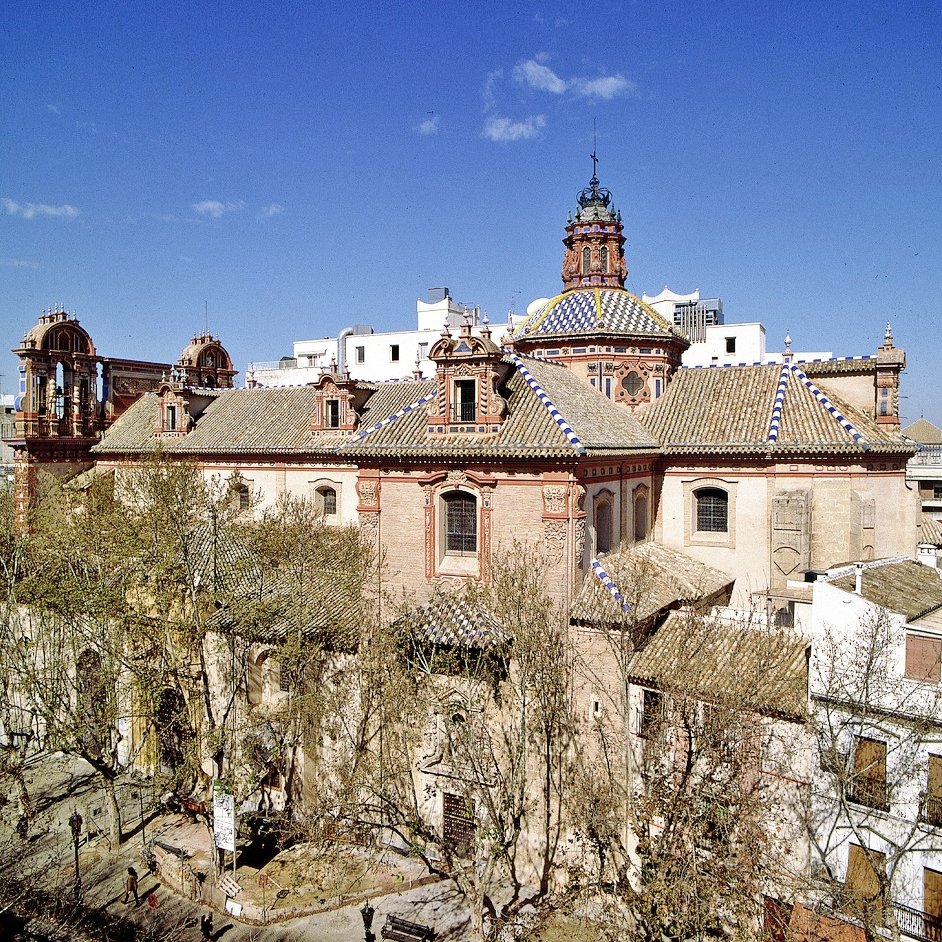
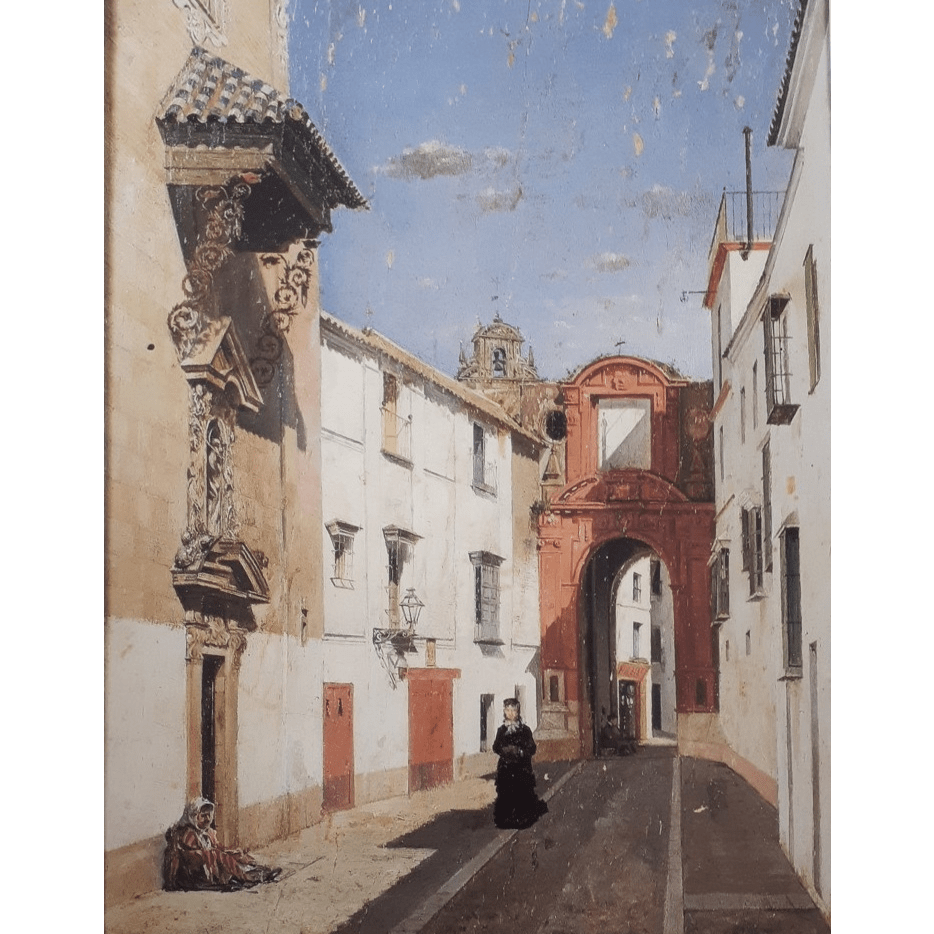
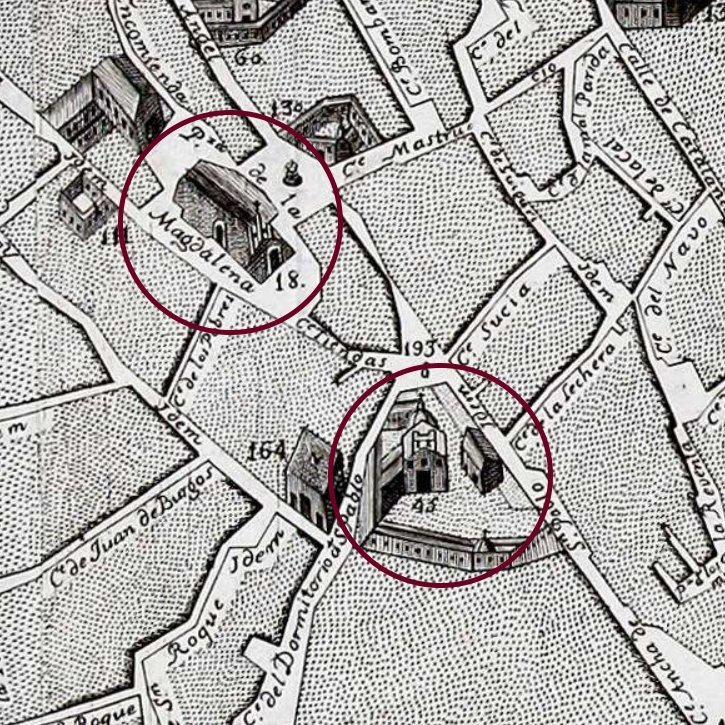
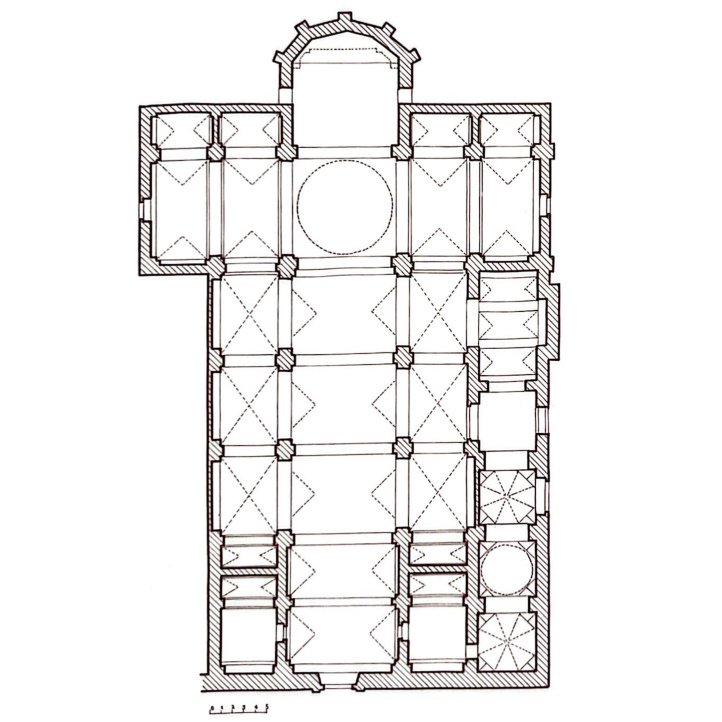
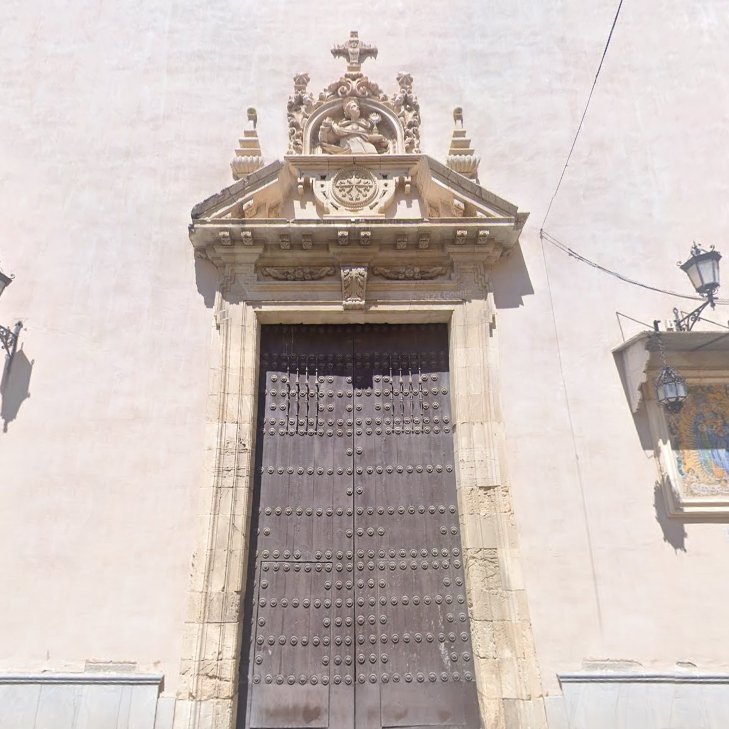
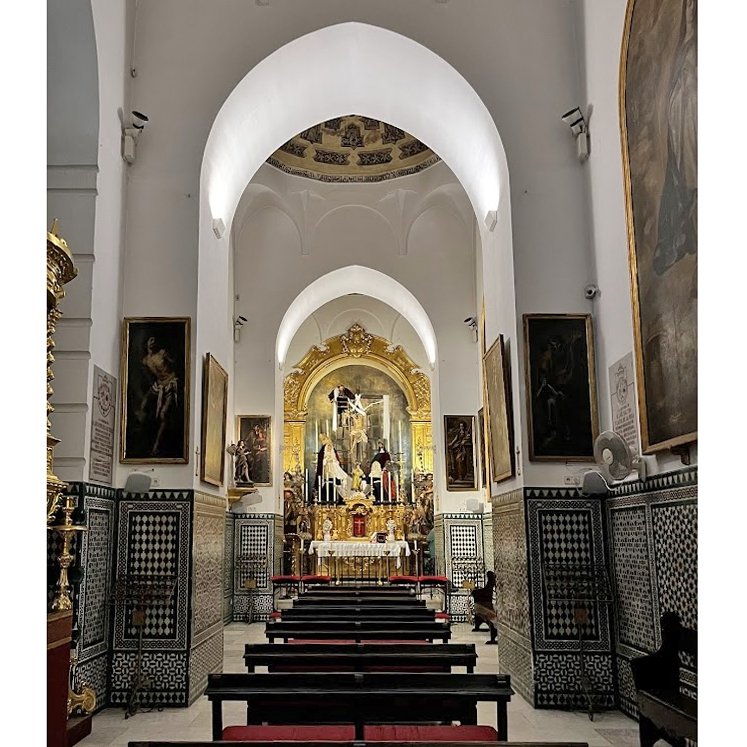
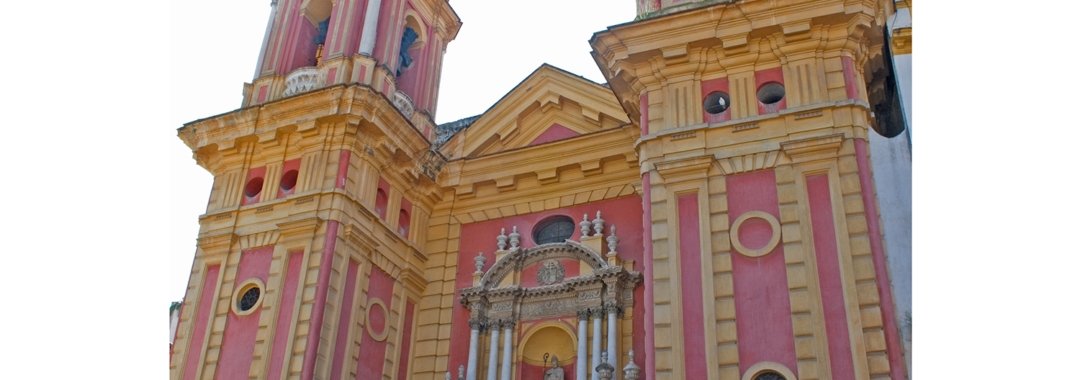
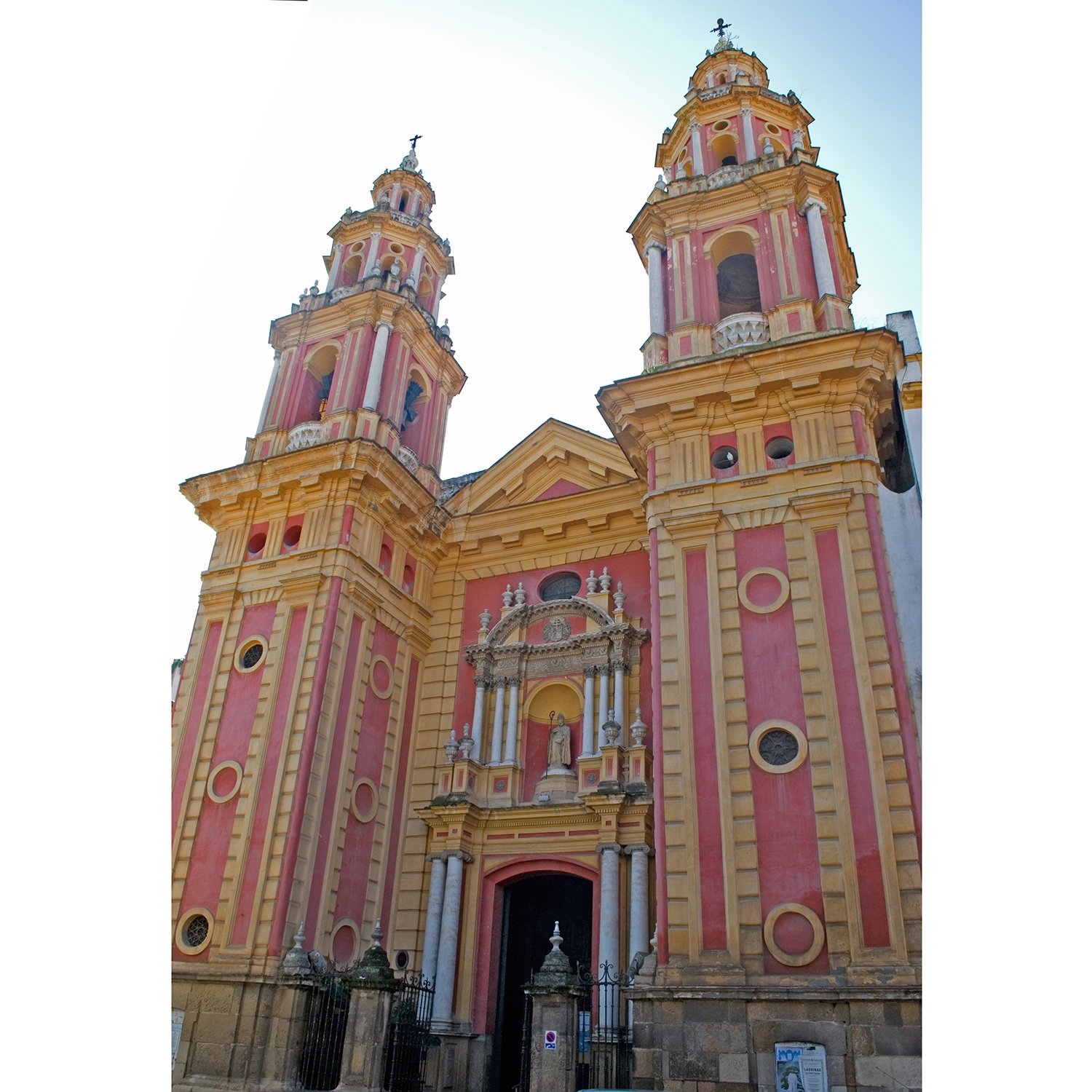
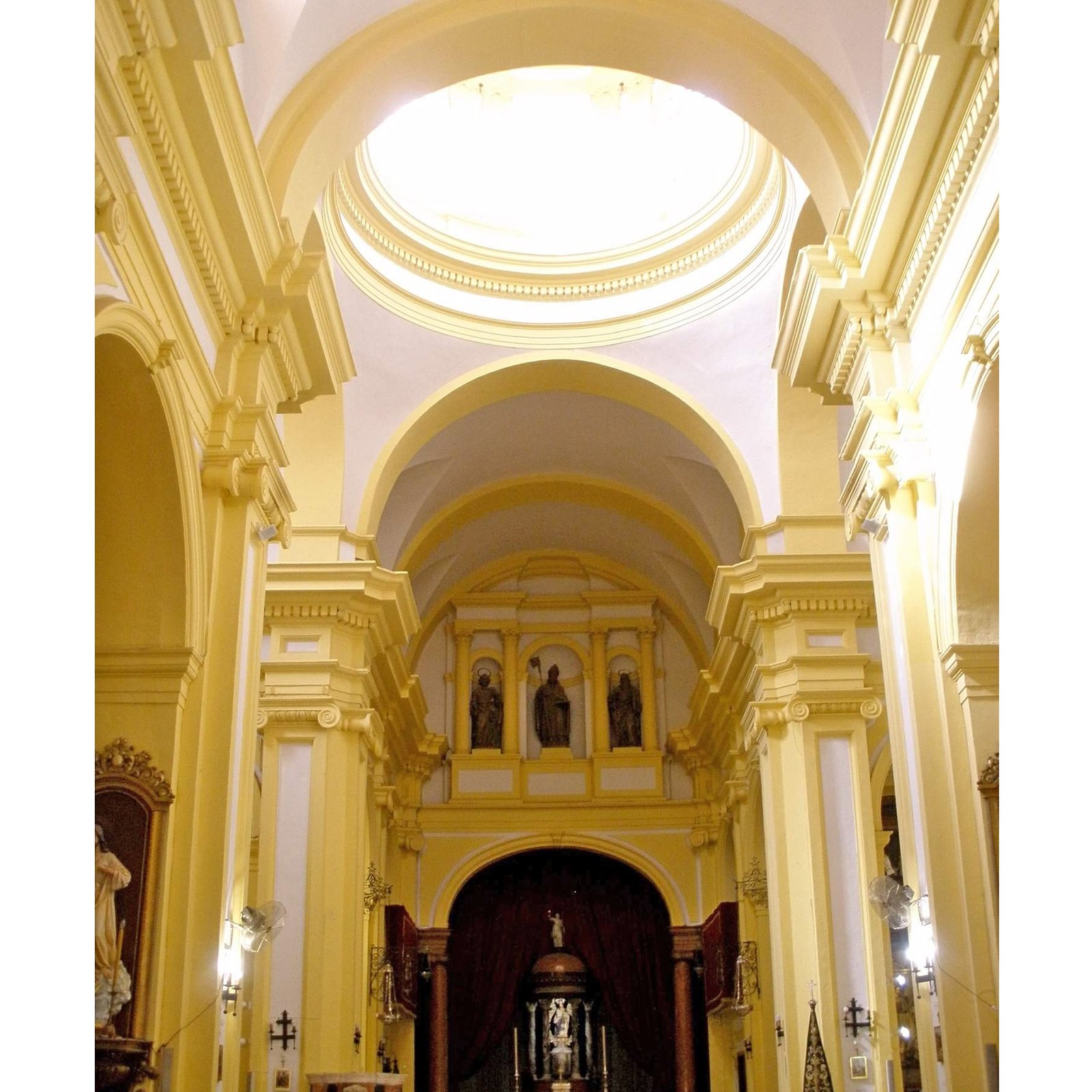
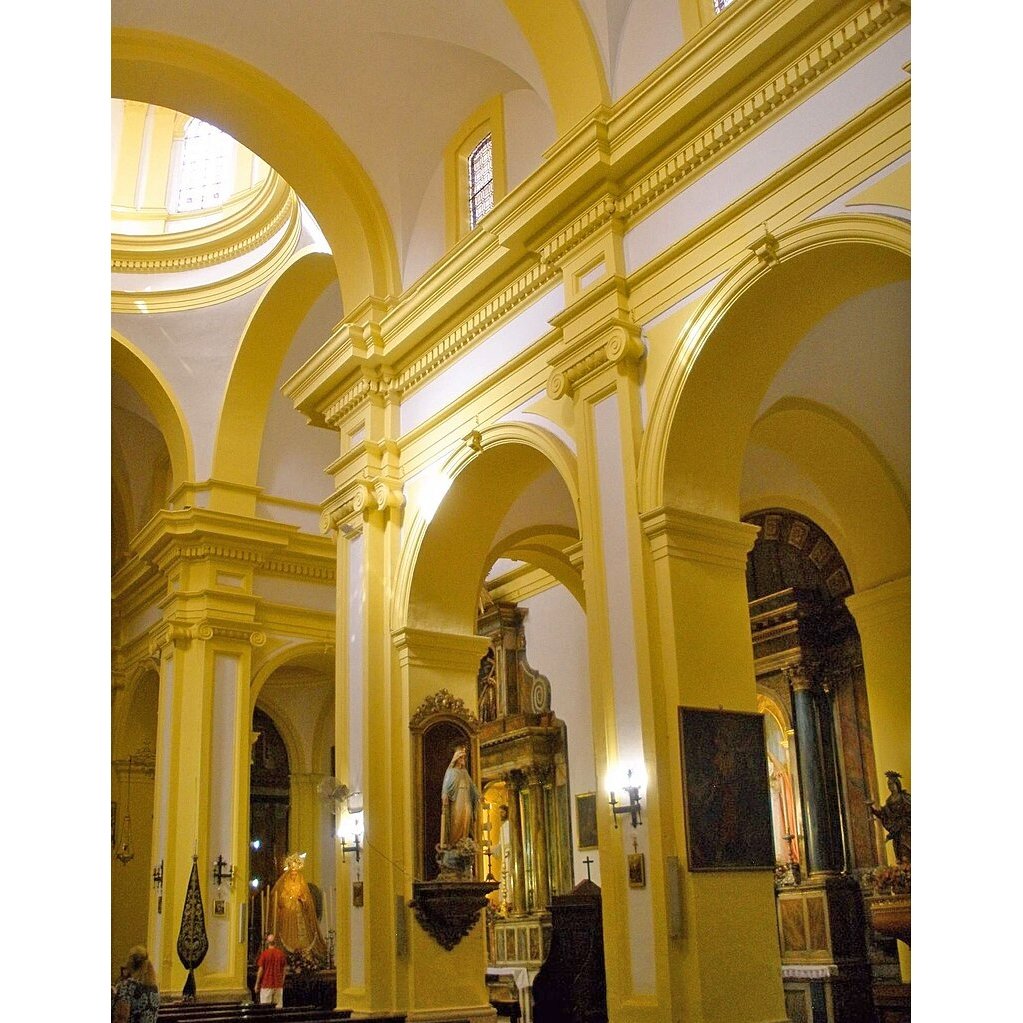
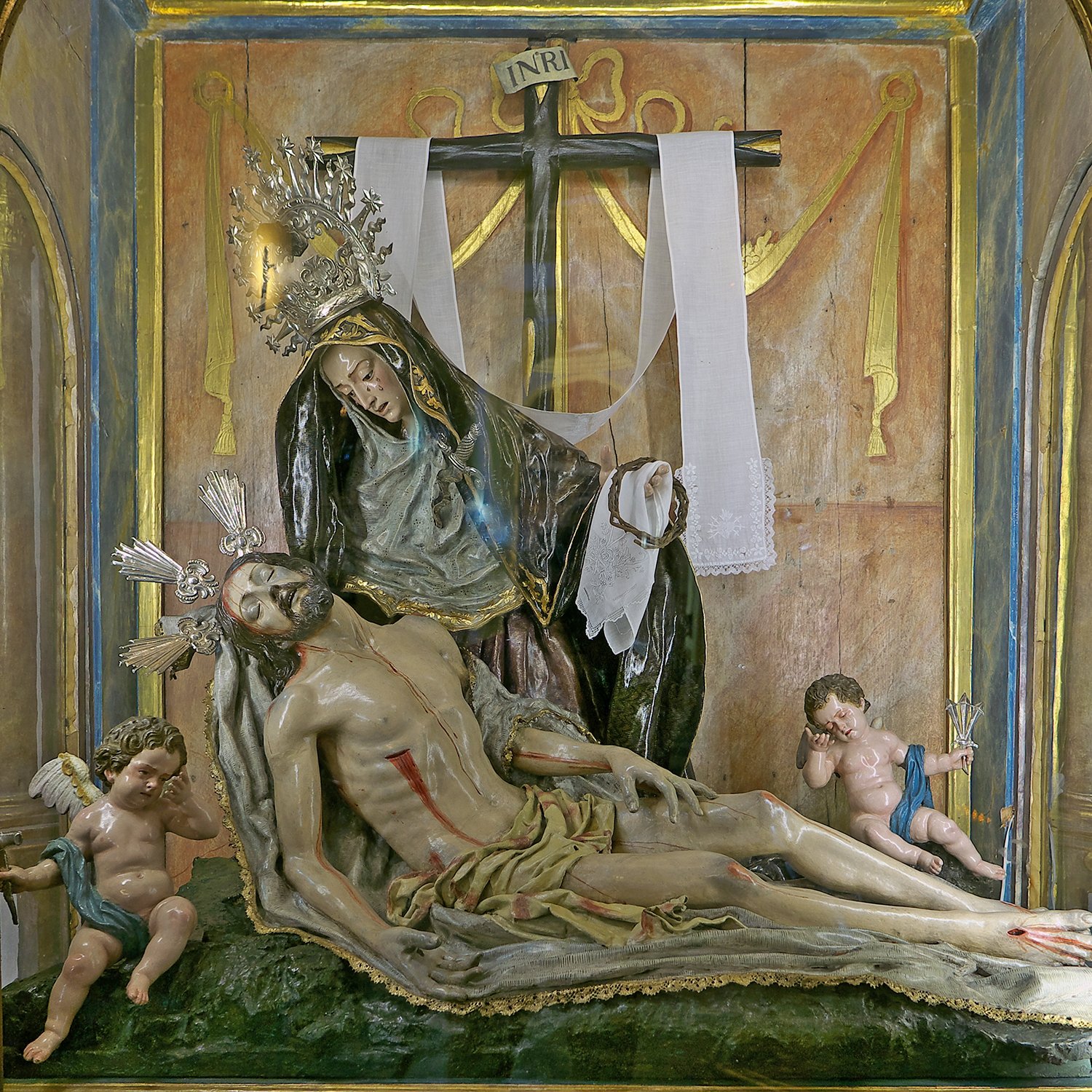
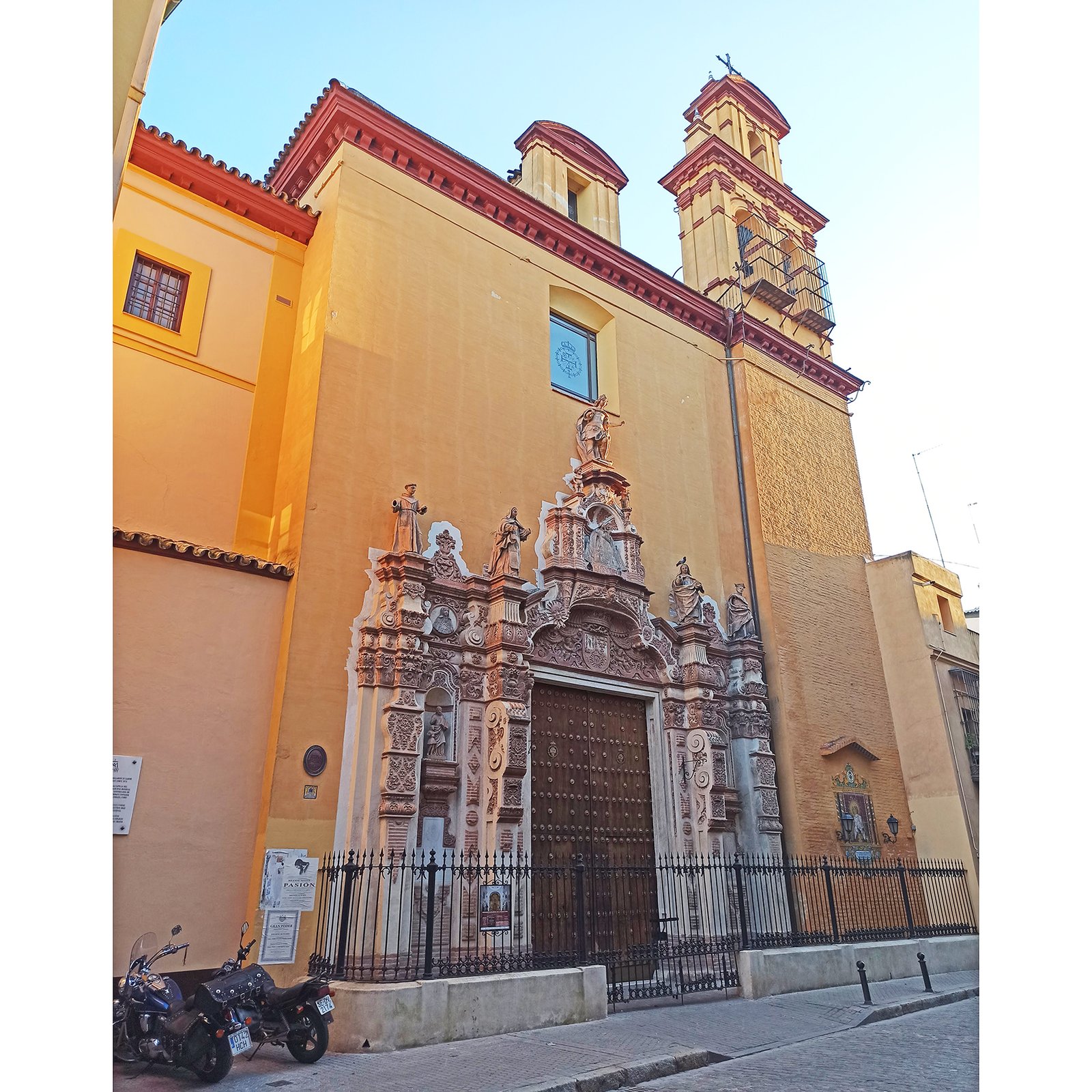
The Church of Our Lady of Consolation, generally known as "los Terceros", is a 17th century Baroque temple that stands on Calle Sol, in the Seville neighbourhood of Santa Catalina. Originally it was the church of the convent of the Third Order of Saint Francis that stood in this area and hence its popular name. It has a Latin cross plan, with a single nave and side chapels. It has only one façade on the outside, the one at the foot, which features an exuberant Baroque doorway. Since 1973 the church has been the headquarters of the Hermandad de la Cena, which processes on Palm Sunday.
History

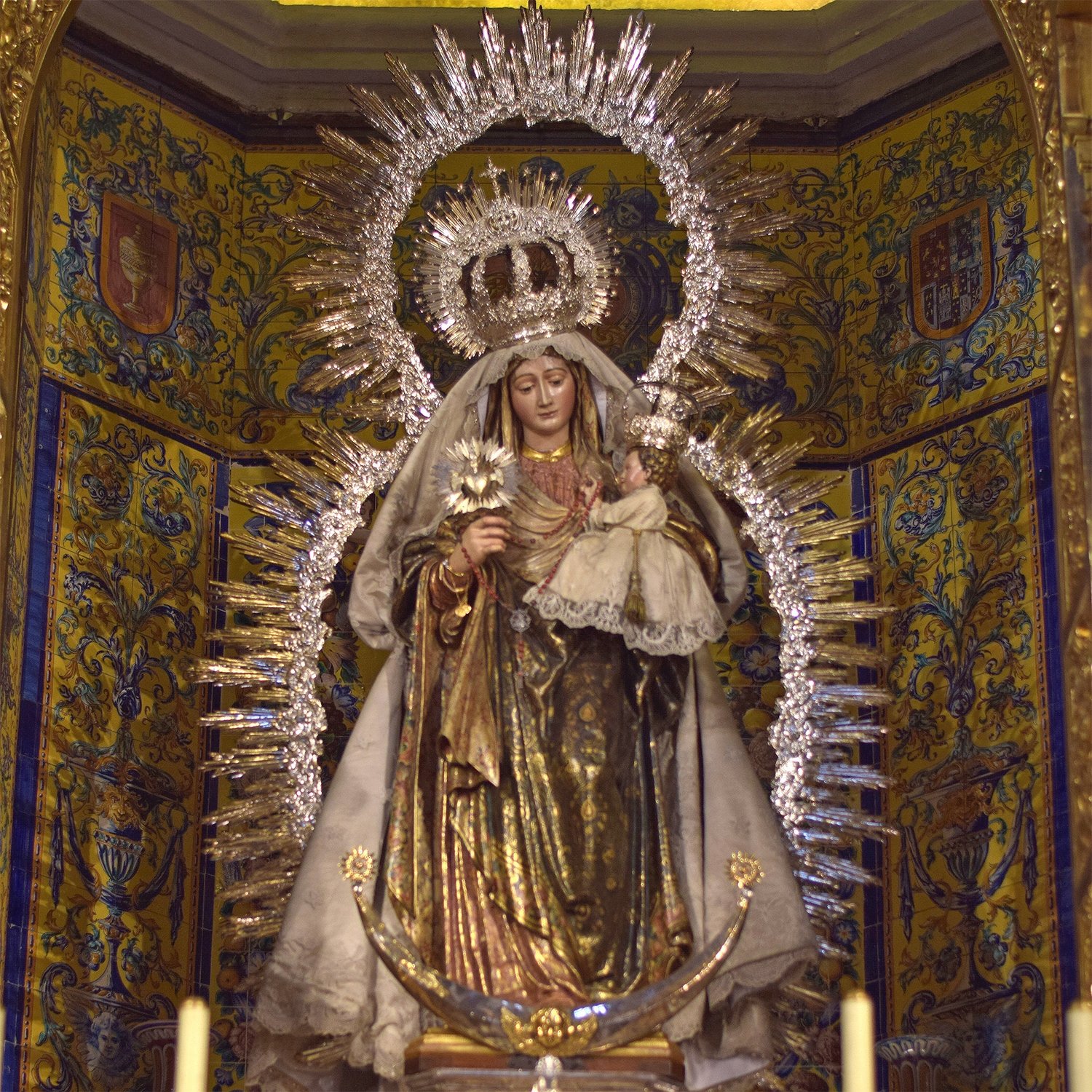
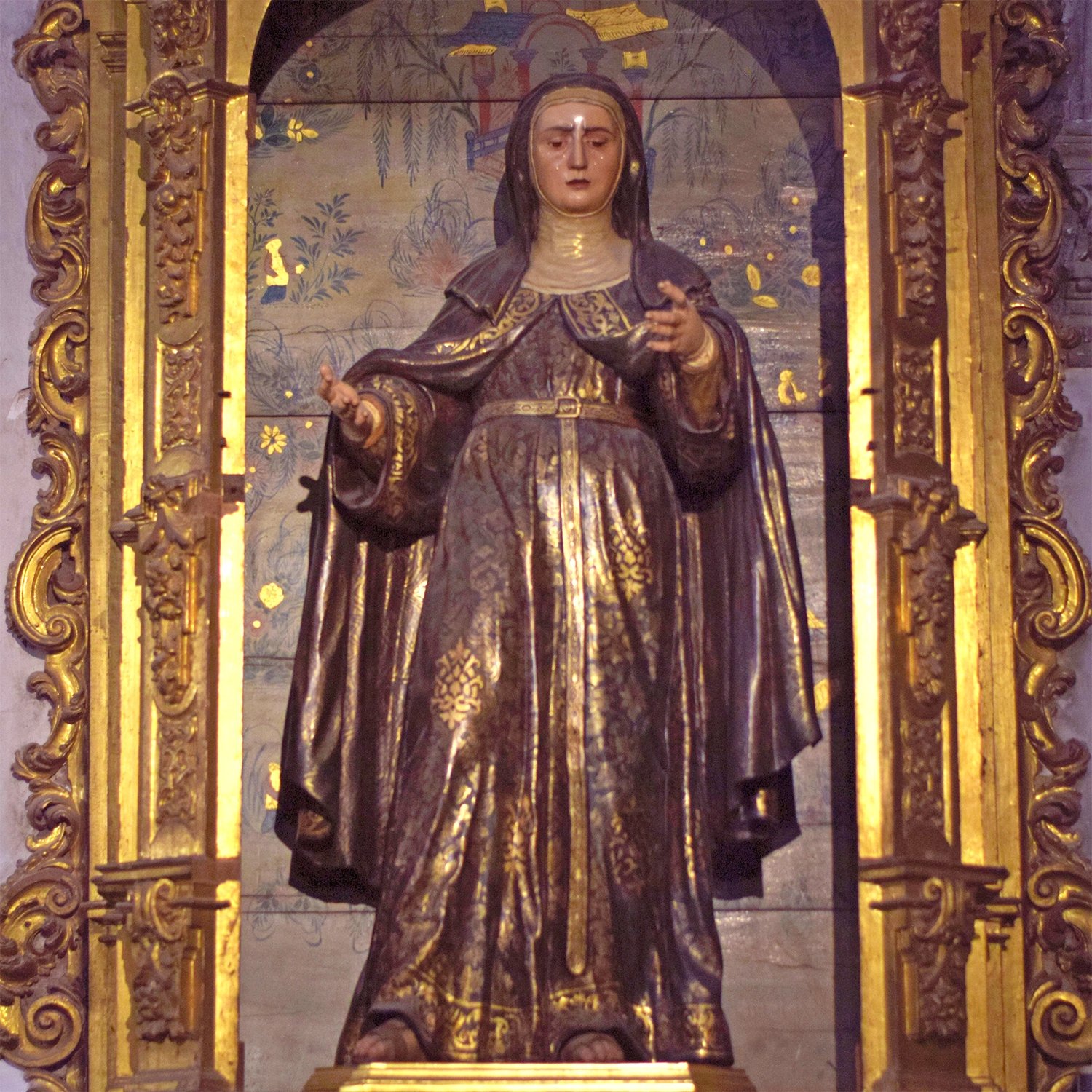
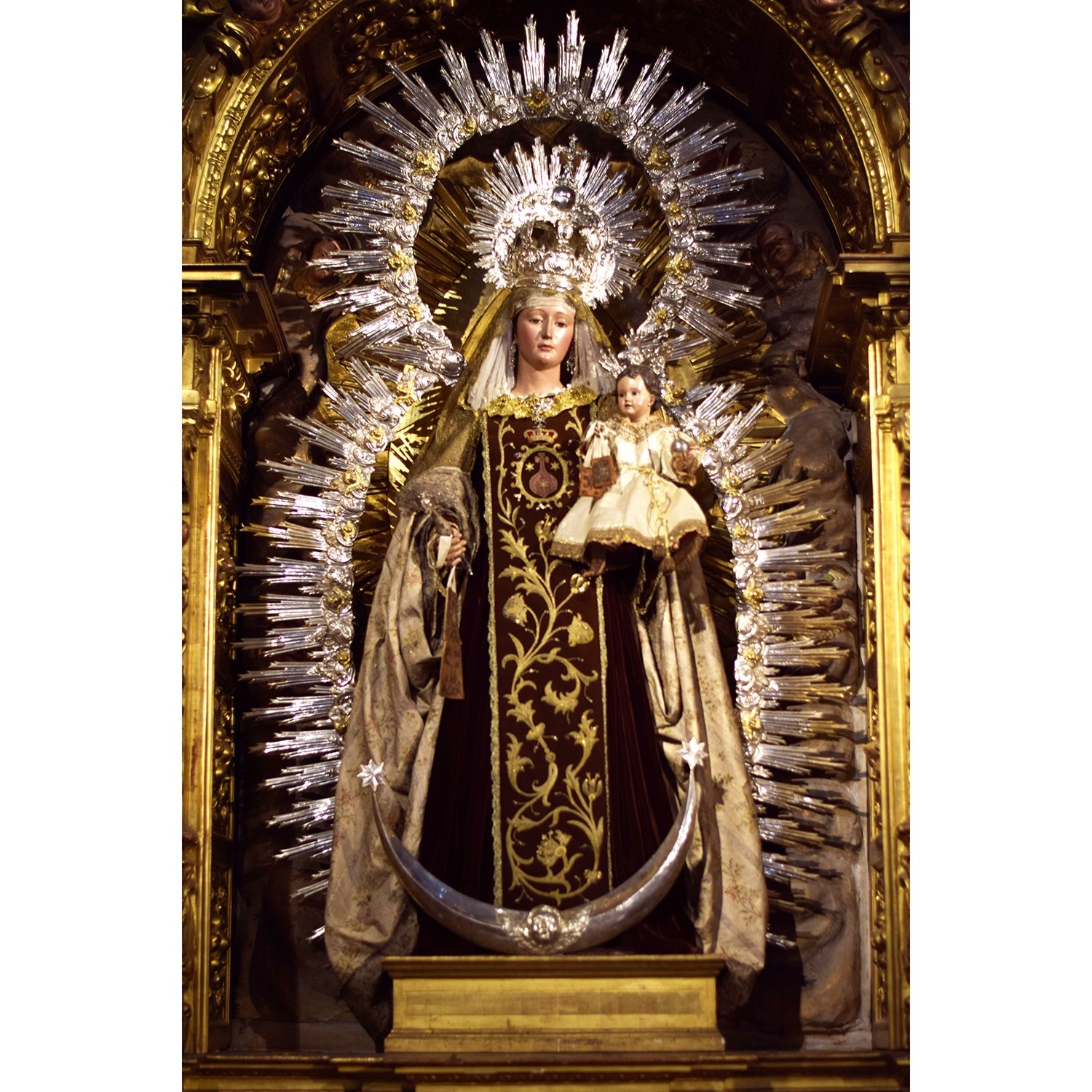
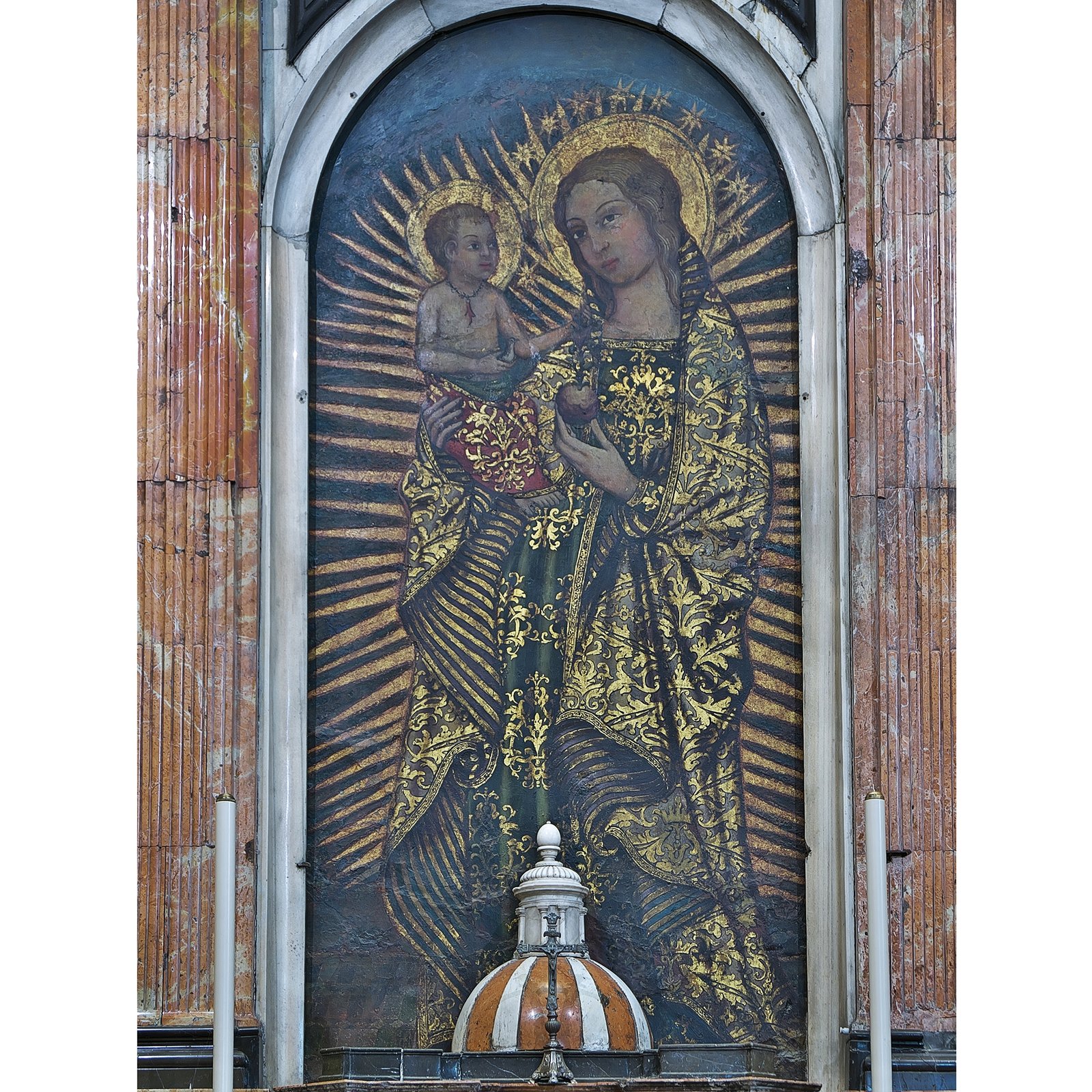
A group of Franciscan monks belonging to the Third Order moved to Seville from the now defunct convent of San Juan de Morañina, in Bollullos Par del Condado. After arriving in the city, they settled in this area, near an old hermitage dedicated to Saints Cosme and Damián. From their previous convent in Bollullos, the monks brought an image of the Virgin of Consolation that was already greatly worshipped in its place of origin. The popularity of the image continued after its arrival in Seville, becoming the object of growing veneration among the locals. It seems that this was the seed for the construction of the convent and its church to begin in 1648, logically dedicated to the Virgin of Consolation.

The construction of the convent and its church continued until the 18th century and the Franciscans ran it until the French occupation in 1810, when the Napoleonic troops used it as a barracks and proceeded to plunder a large part of its heritage. The following year it was handed over to the Augustinian nuns and in 1819 the Franciscans returned. However, it would not last long, since in 1835 they abandoned it definitively as a consequence of the famous Mendizábal confiscation. A period of abandonment then began, the worst consequence of which was the collapse of the church vaults in 1845.
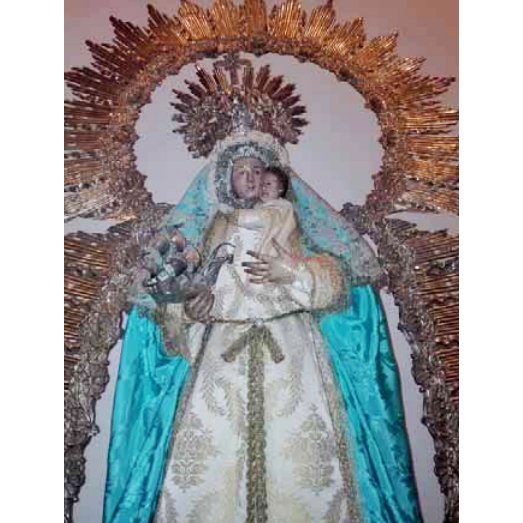
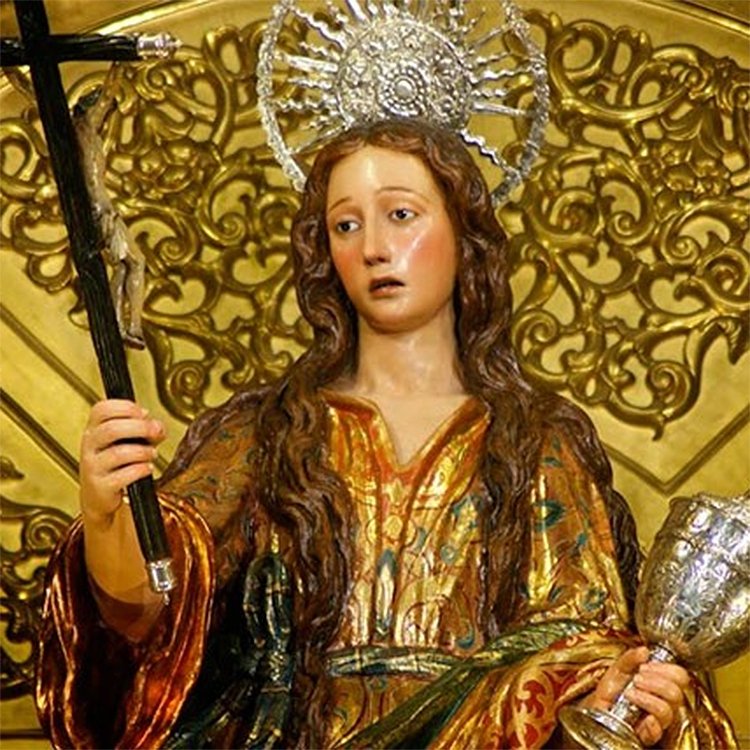
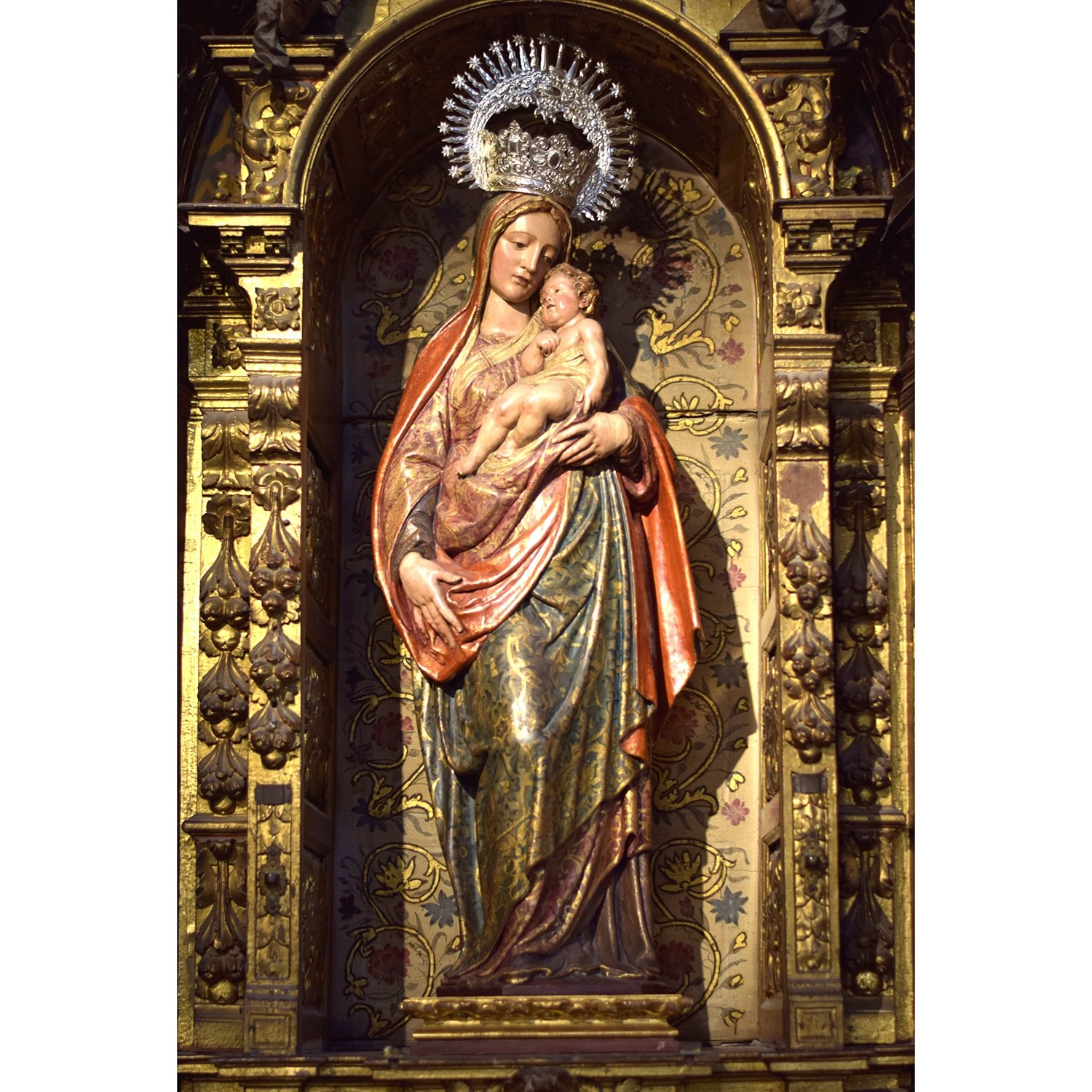
Image of the Virgin of Consolation, formerly the Virgin of Morañina. Image from the article by Adrián Bizcocho Olarte on “Popular religiosity...

A new episode in the history of this convent began in 1888 when the Piarist Fathers took charge of it, carrying out important educational work in the city. They managed it until 1973, when they moved to Montequinto. That same year, Cardinal Bueno Monreal gave the use of the convent church to the Hermandad de la Cena, which has since been responsible for its maintenance and has undertaken the various restorations that have been necessary, such as the renovation of the roofs in 1988.

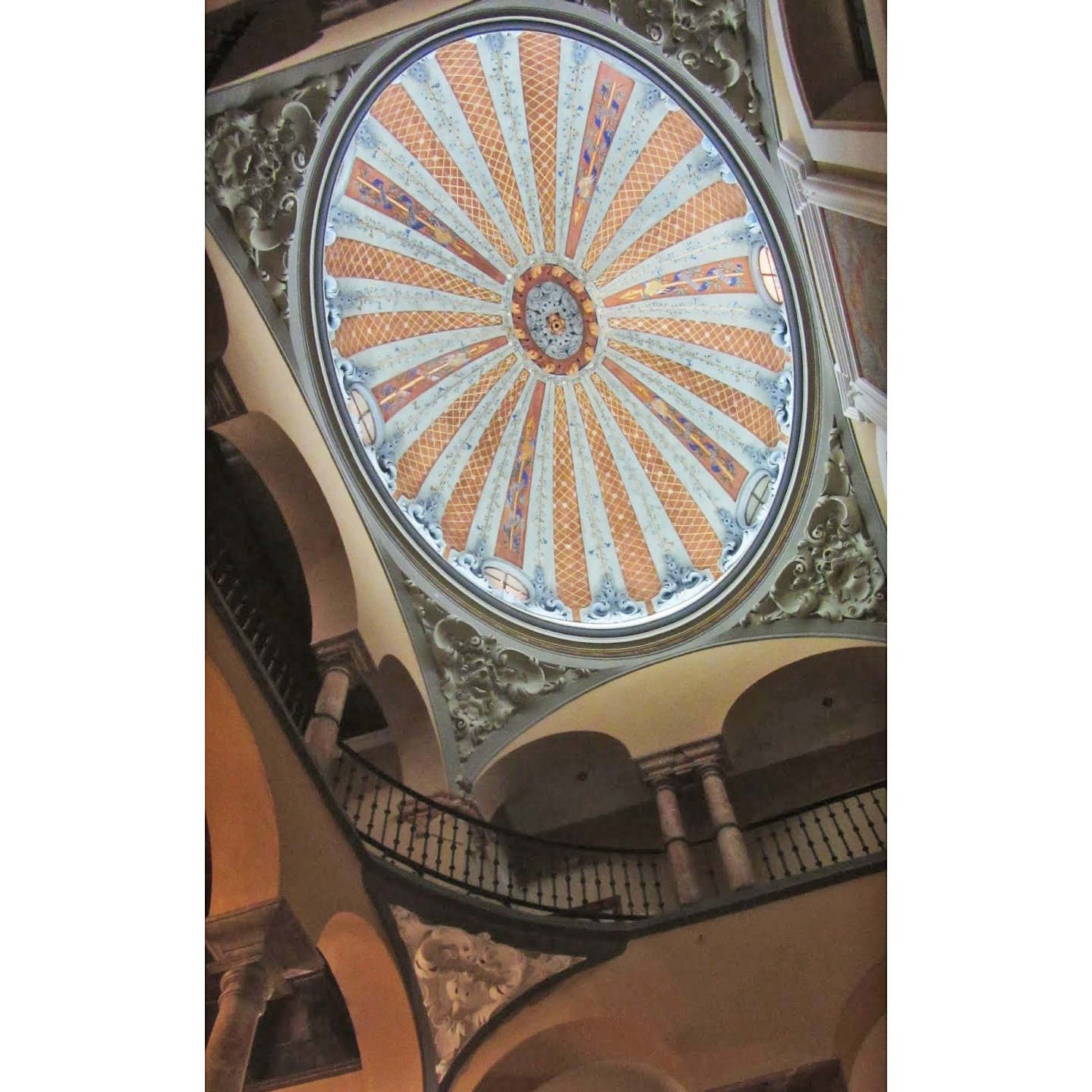
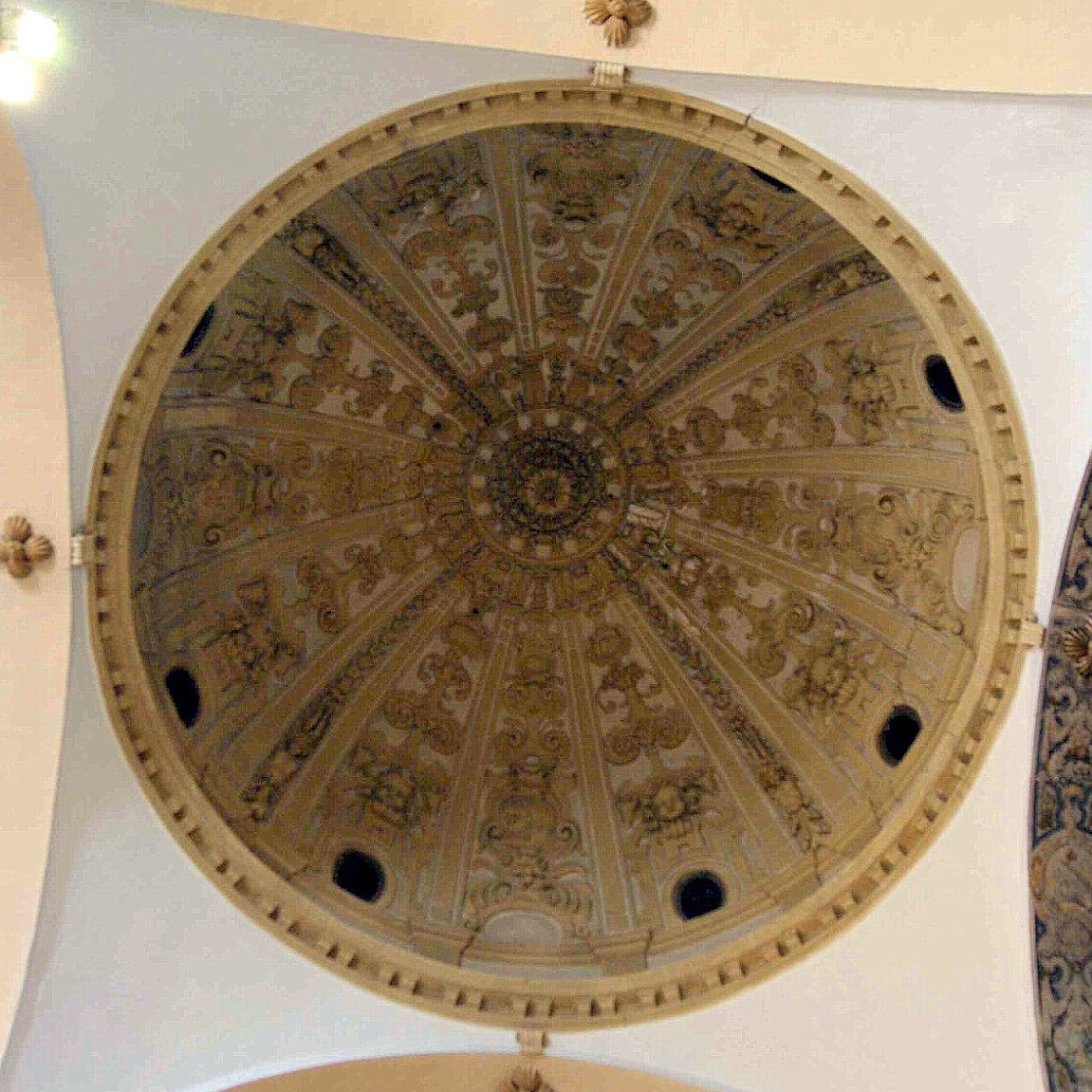
The rest of the convent currently serves as the headquarters of EMASESA, the public company for the management of water in the city. The two cloisters, the main one and a secondary one, are preserved, as well as a majestic monumental staircase designed by Fray Manuel Ramos at the end of the 17th century.
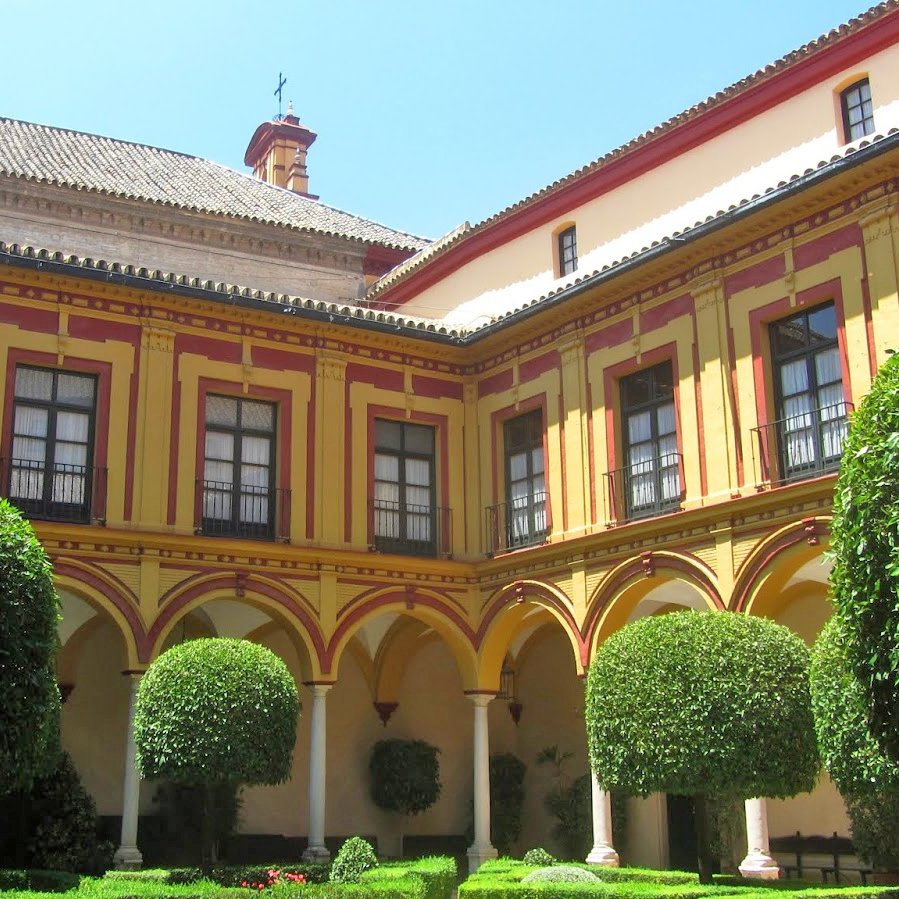
Former convent of the Terceros, today headquarters of EMASESA. Cloisters and dome over the staircase. Images from the blog Siglos de Sevilla.

Outside

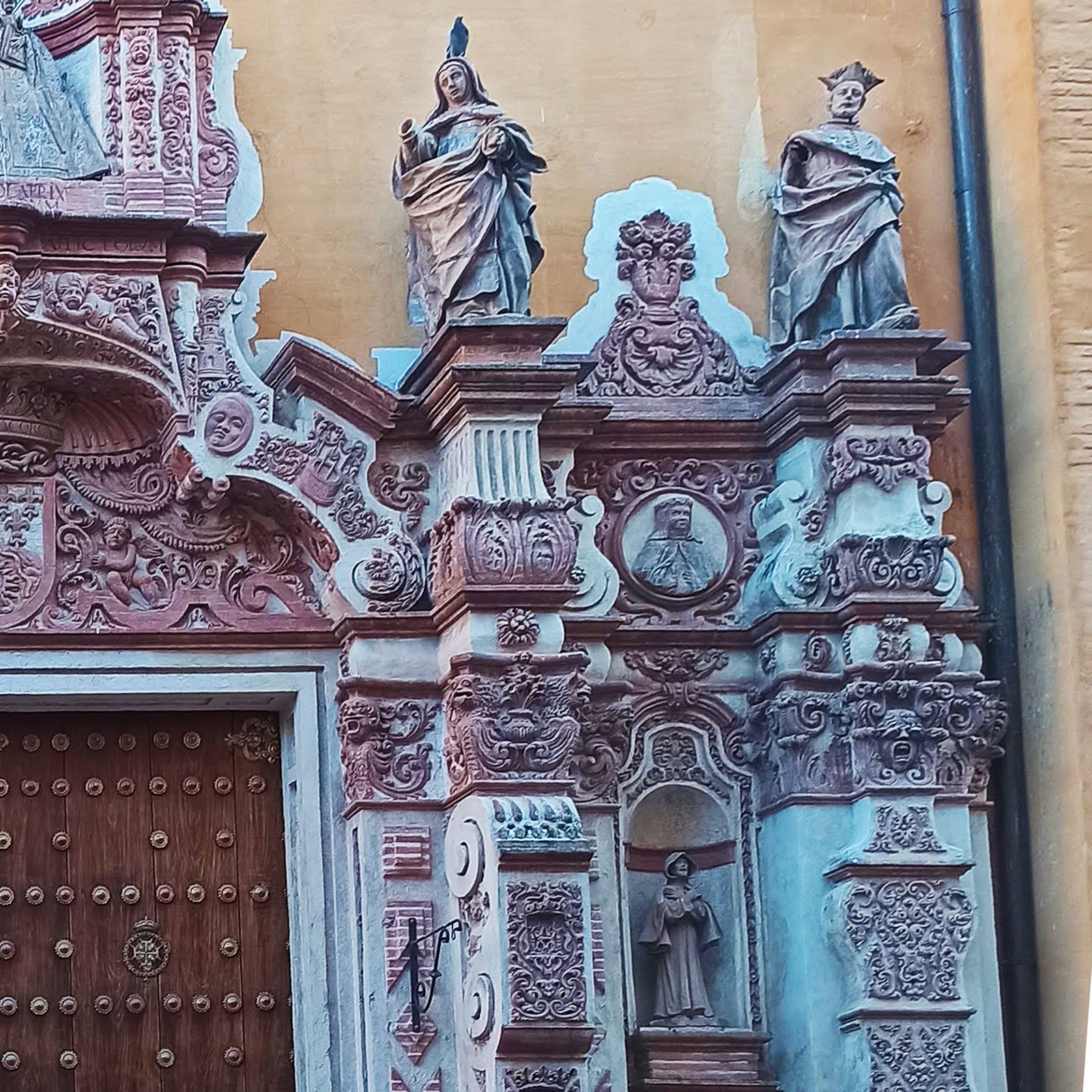
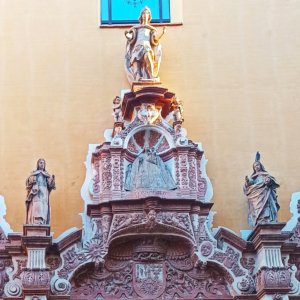
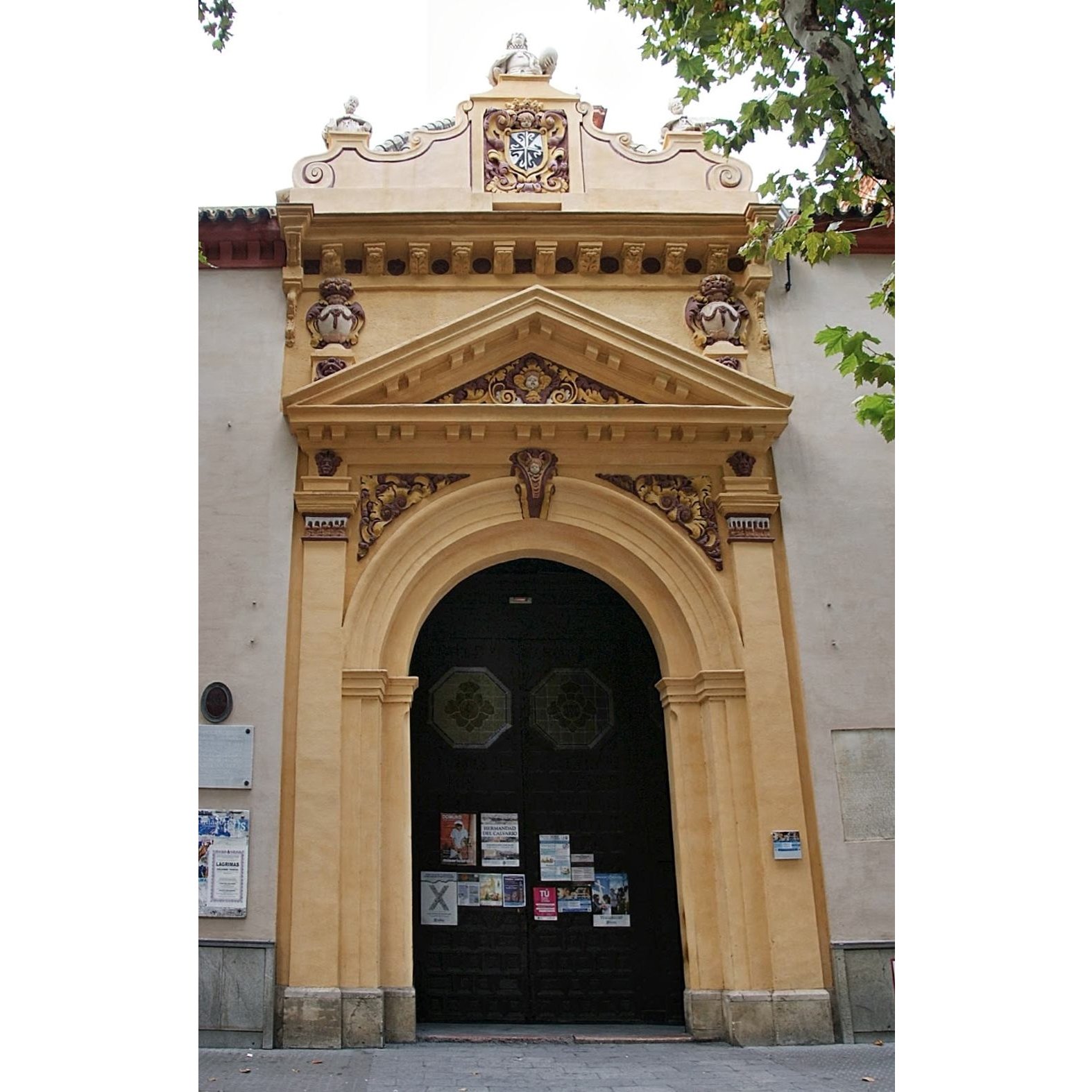
The church has only one façade, located at the foot of the temple, on Calle Sol. It has a very interesting doorway made at the beginning of the 18th century in a baroque style that is very reminiscent of the style developed at the same time in Hispanic America. The authorship of the design is unknown, although it has traditionally been attributed to Friar Manuel Ramos, the creator of the monumental staircase we mentioned when referring to the area of ​​the convent.

The doorway is arranged like a three-lane altarpiece, with the central street occupied by the lintelled opening that is the entrance to the temple itself. The decoration was made using baked clay and exposed brick, with certain characteristics that, as we said, directly allude to Hispanic American baroque: the architectural elements take on curious and imaginative shapes and are filled with meticulous decoration that includes a multitude of symbolic elements.

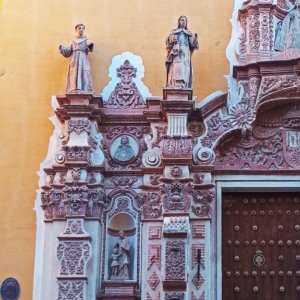
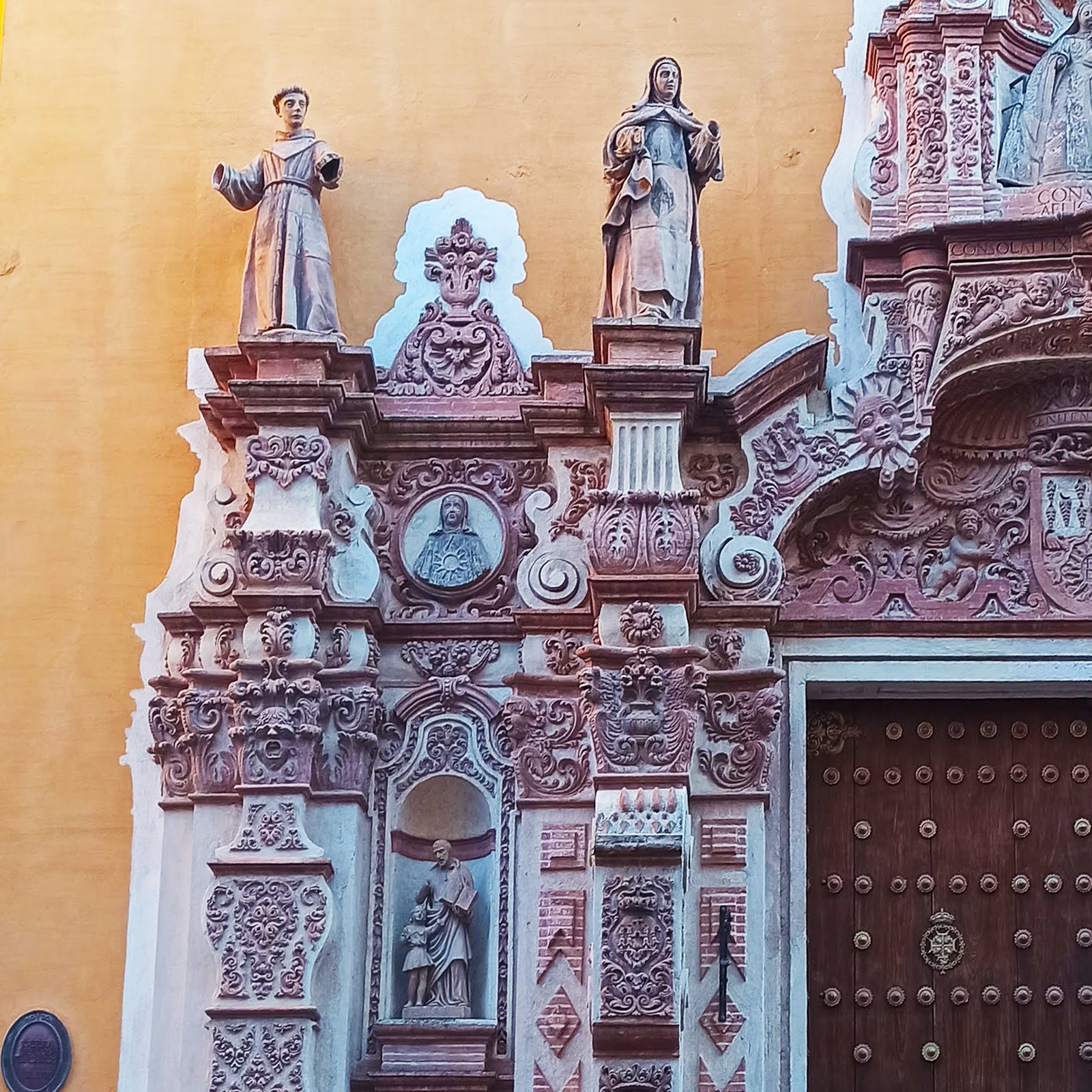
On the side streets there are two niches with the terracotta carvings of Saint Joseph of Calasanz on the left and Saint Francis on the right. The two saints allude to the two main religious orders that have succeeded one another in the management of this temple since its creation: Saint Francis to the religious of the Third Order, founders of the convent, and Saint Joseph of Calasanz to the Piarists, who managed it from the end of the 19th century. This indicates that the sculptures are not the originals of the doorway, but were added much later, most likely already in the 20th century. In addition, their size is somewhat smaller than what would correspond to them according to the niches they occupy.

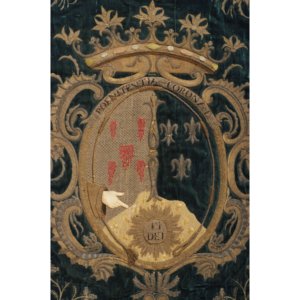
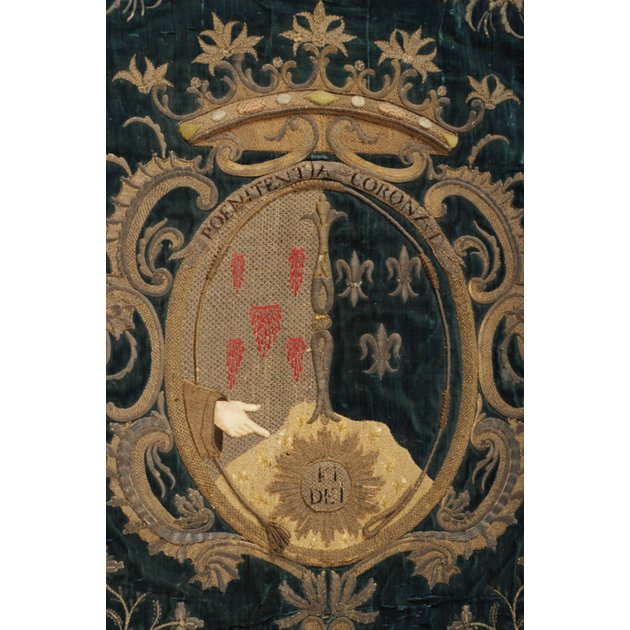
In the upper part of the side streets we find two medallions with the busts of two saints linked to the Franciscans, Saint Clara on the left and Saint Rose of Viterbo on the right. Above the door there is a space like a mixed-linear pediment in the centre of which there is a shield with Franciscan symbols. On the top left are the Five Wounds, the main symbol of the order, and on the right are three fleurs-de-lis. On the bottom, a hand points to a sun on which can be read "FIDEI" (Faith). Above the shield, an open royal crown at the base of which can be read "POENITENTIA CORONAT". We have no further information about the shield, although it must have been the one adopted by this convent as its own. In 2007 the Andalusian Institute of Historical Heritage undertook the restoration of a processional banner found in San Telmo with the same shield, so in all probability it was a banner representing the convent at official events.

On the four pillars that delimit the streets of the doorway are four Franciscan saints: on the left, Saint Anthony of Padua and Saint Elizabeth of Hungary, and on the right, Saint Elizabeth of Portugal and Saint Ivo of Kermartin, patron saint of lawyers. Crowning the central part of the doorway, a niche houses an image of the Virgin of Consolation, reproducing the original carving found inside. Above the Virgin appears a white dove with open wings, representing the Holy Spirit, and crowning the whole is a carving of Saint Michael.

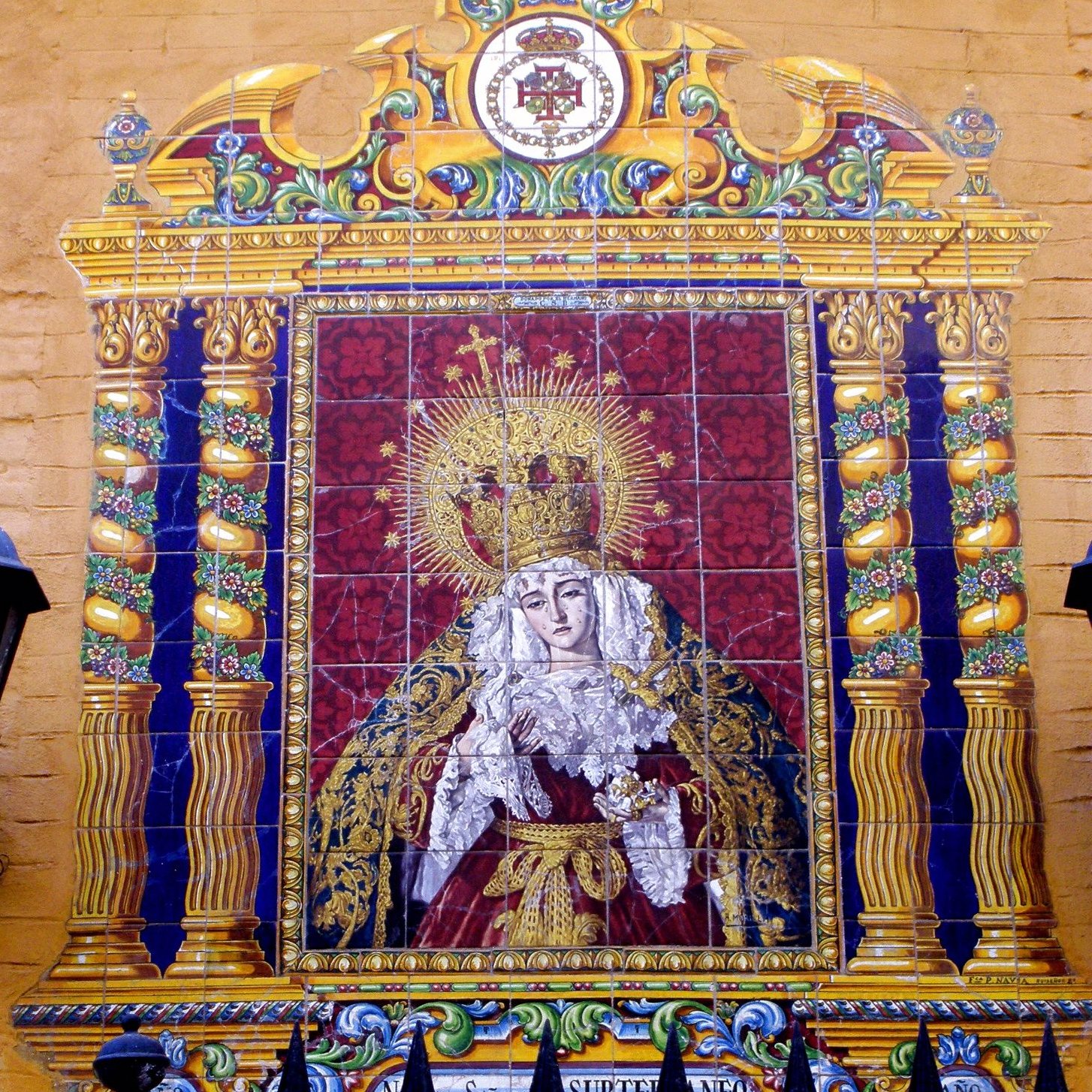
To the right of the doorway is a ceramic altarpiece with the image of the Virgin of the Underground, the Marian patron of the Brotherhood of the Supper. It was made in 1959 in the factory of Nuestra Señora de la Piedad by Antonio Morilla Galea and Manuel García Ramírez.

The façade has a tower on the right, topped by a two-body belfry with two openings for bells in the lower one and a single body in the upper one, topped by a curved pediment.

Inside

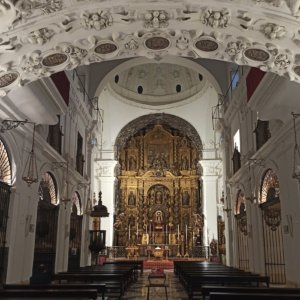
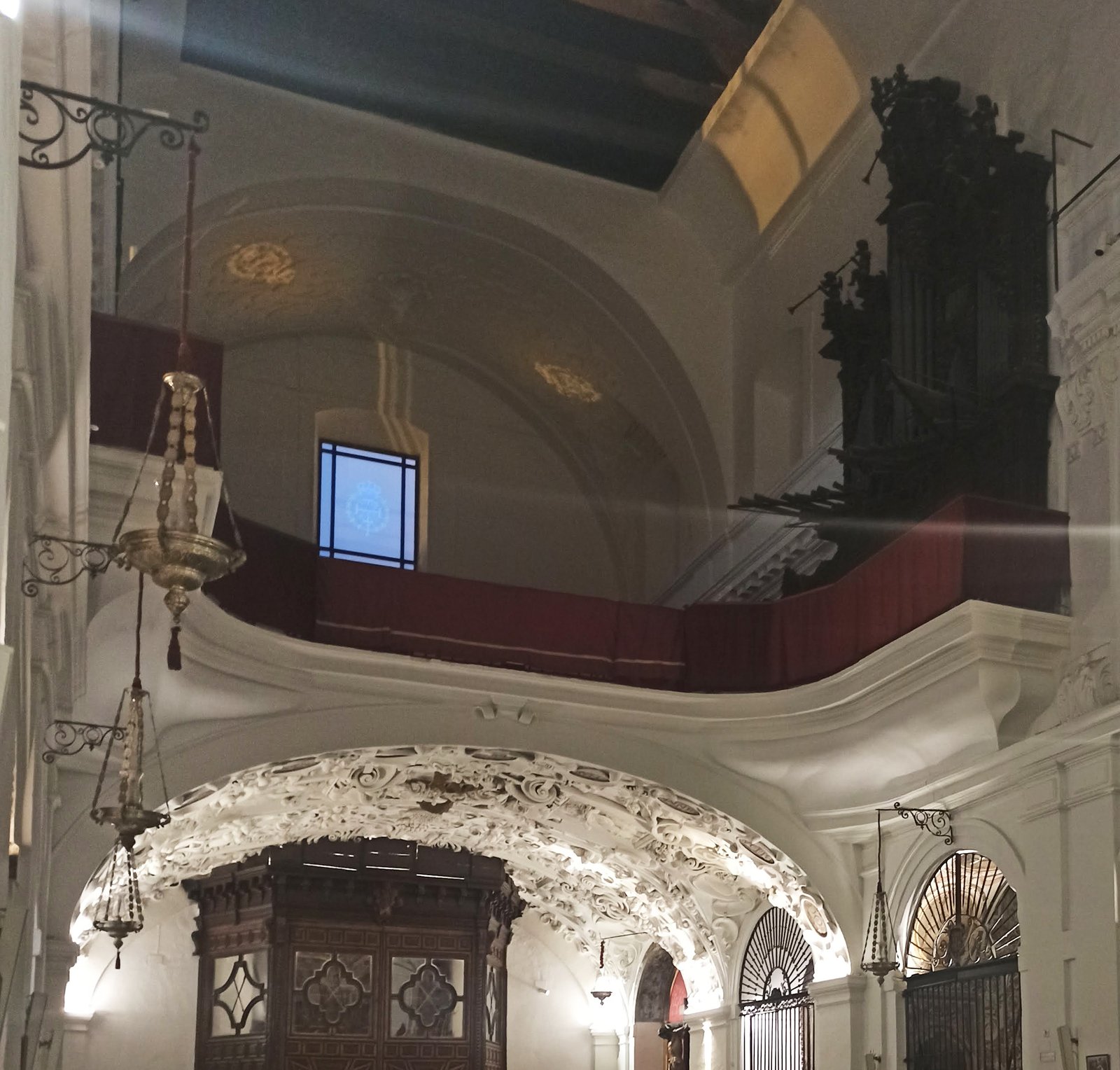
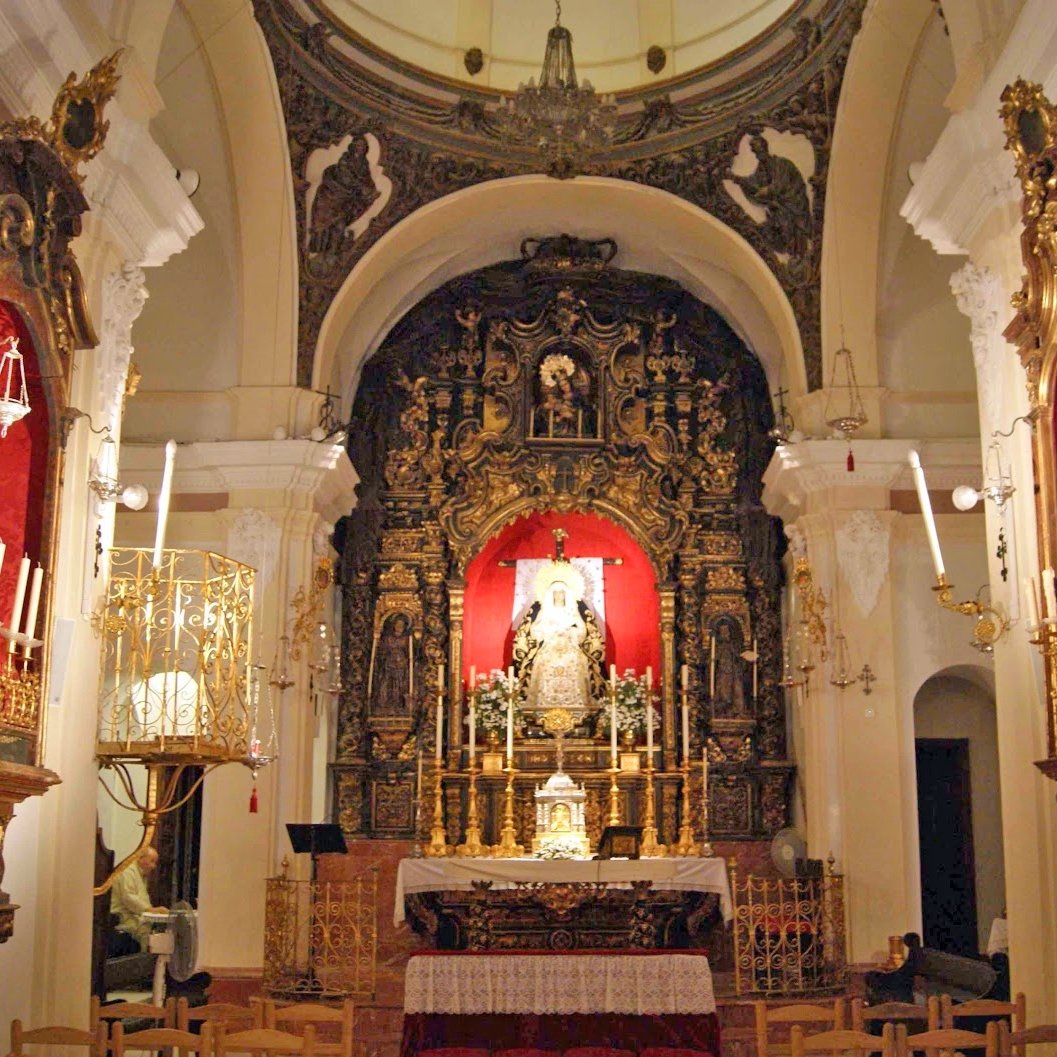
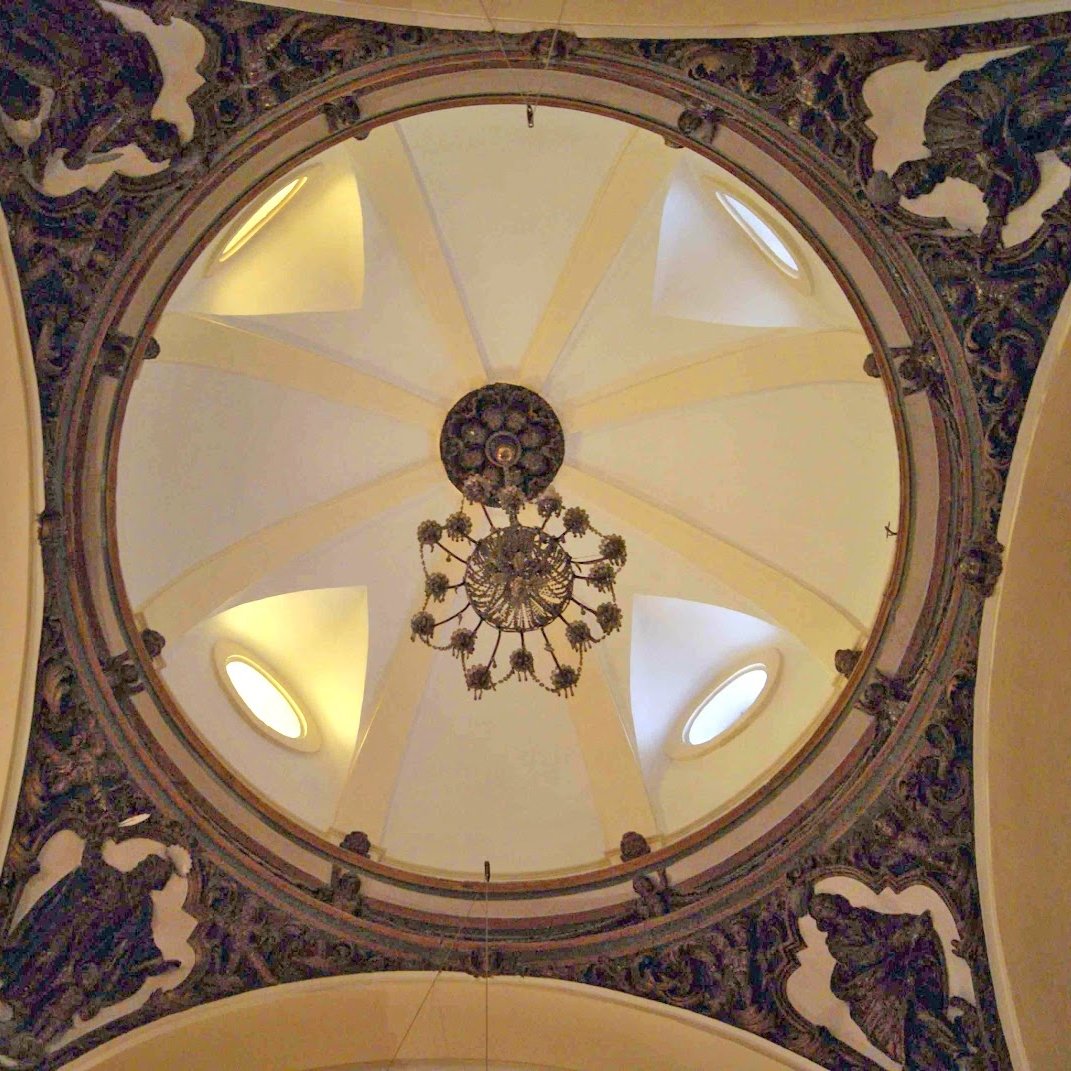
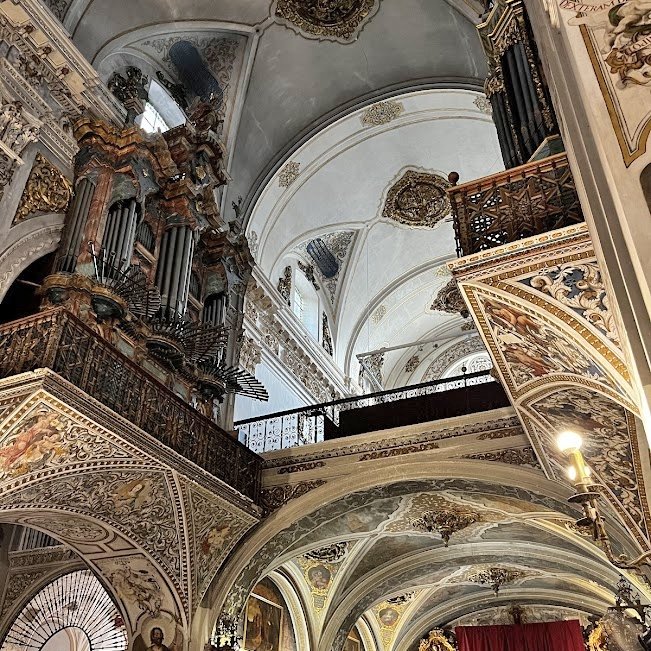
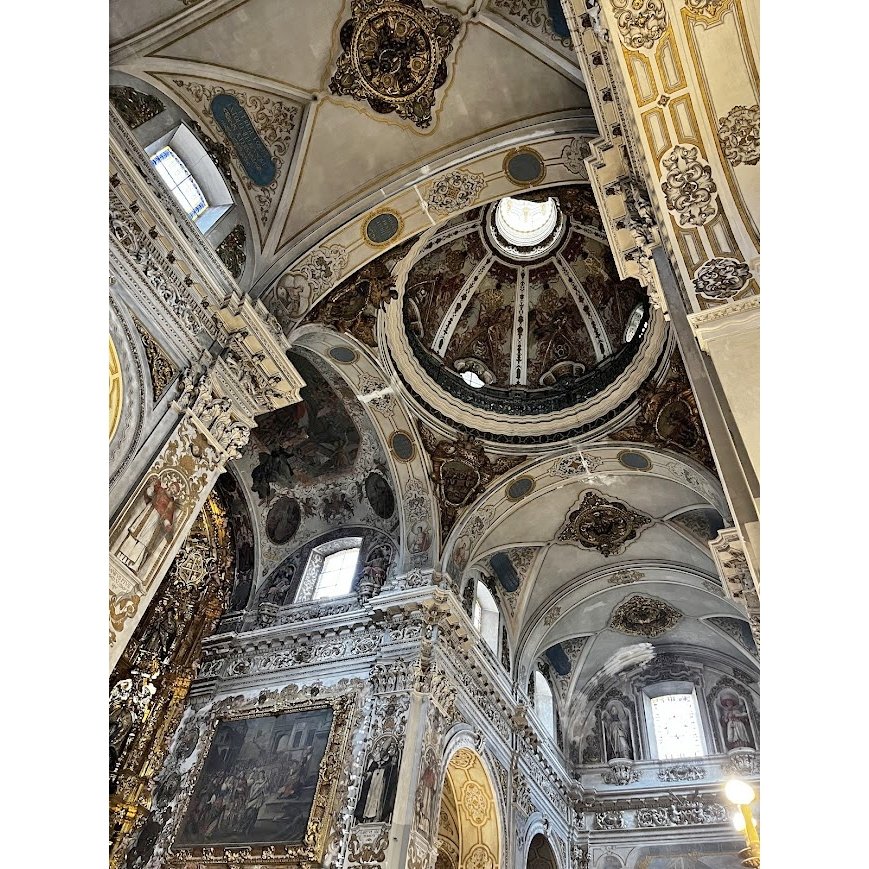
The first thing that catches your attention when you enter the Consolación church is its large size and monumentality, making it one of the most interesting examples of the convent churches of the Sevillian Baroque. It consists of a single nave of great width and in the shape of a Latin cross. On either side of the nave there are a series of side chapels which are accessed through semicircular arches closed by bars. At the foot of the church is the high choir, resting on a profusely decorated segmental vault. On one side of the choir is an organ, original from the first half of the 18th century, which according to Álvaro Cabezas García can be attributed to the altarpiece maker José Fernando de Medinilla. The original roof of the church was made by a large barrel vault that extended throughout the nave. However, this vault collapsed in the mid-19th century and today we find a flat roof. The barrel vault is preserved only over the choir, at the foot of the church, and over the presbytery area, at the head. Above the transept there is a hemispherical dome on pendentives, decorated with plasterwork that reproduces architectural elements, plant decoration, scrolls, angels' heads and other motifs characteristic of the Baroque.

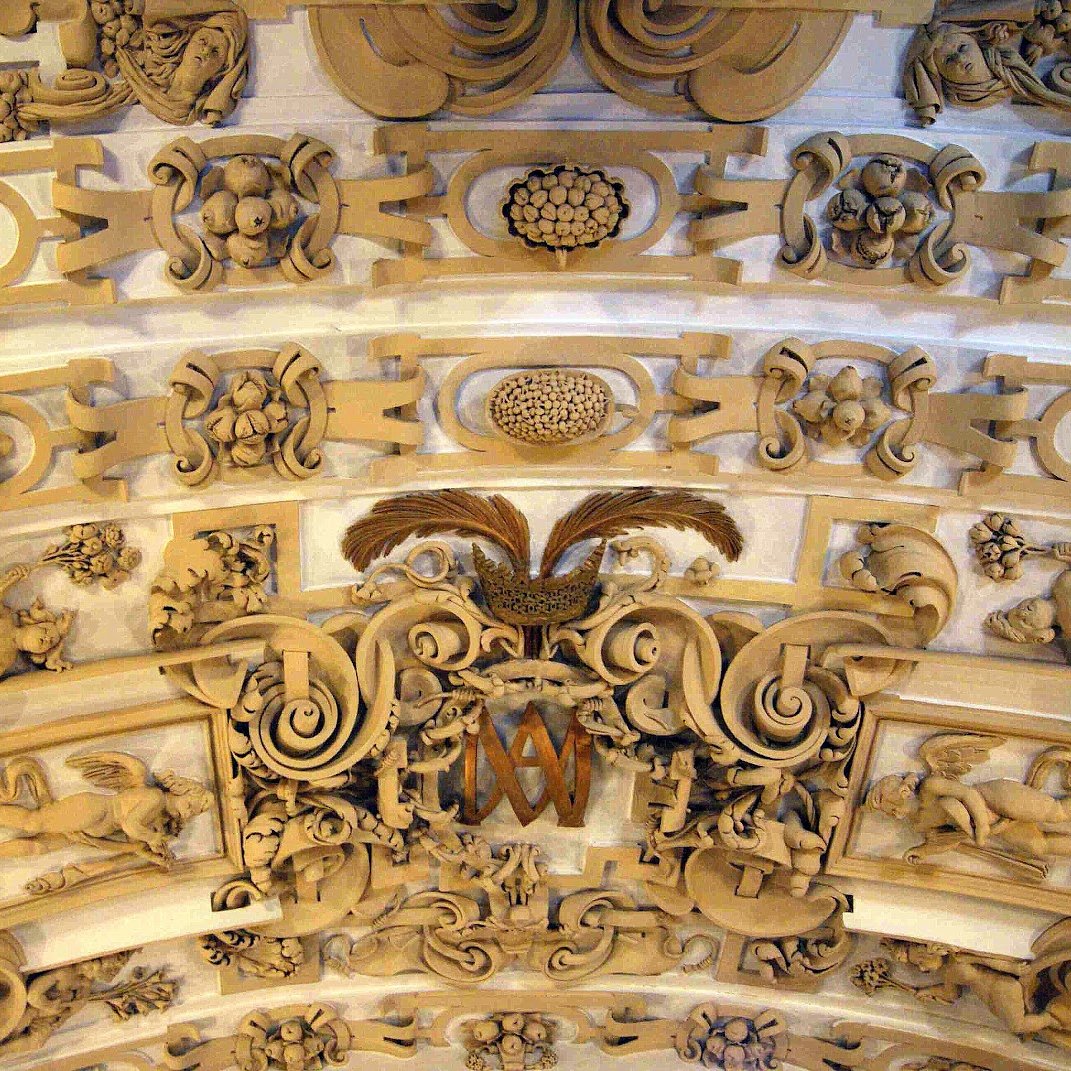
This type of decoration based on plasterwork must have originally extended throughout the vault of the church. The decoration of the vault that supports the choir is especially rich, and in it the curious bunches of various fruits stand out, in a composition articulated by latticework and plant motifs, in which little angels and Marian symbols are mixed. It clearly recalls the plasterwork that we find in Santa María la Blanca, also made in the 18th century.

Presbytery

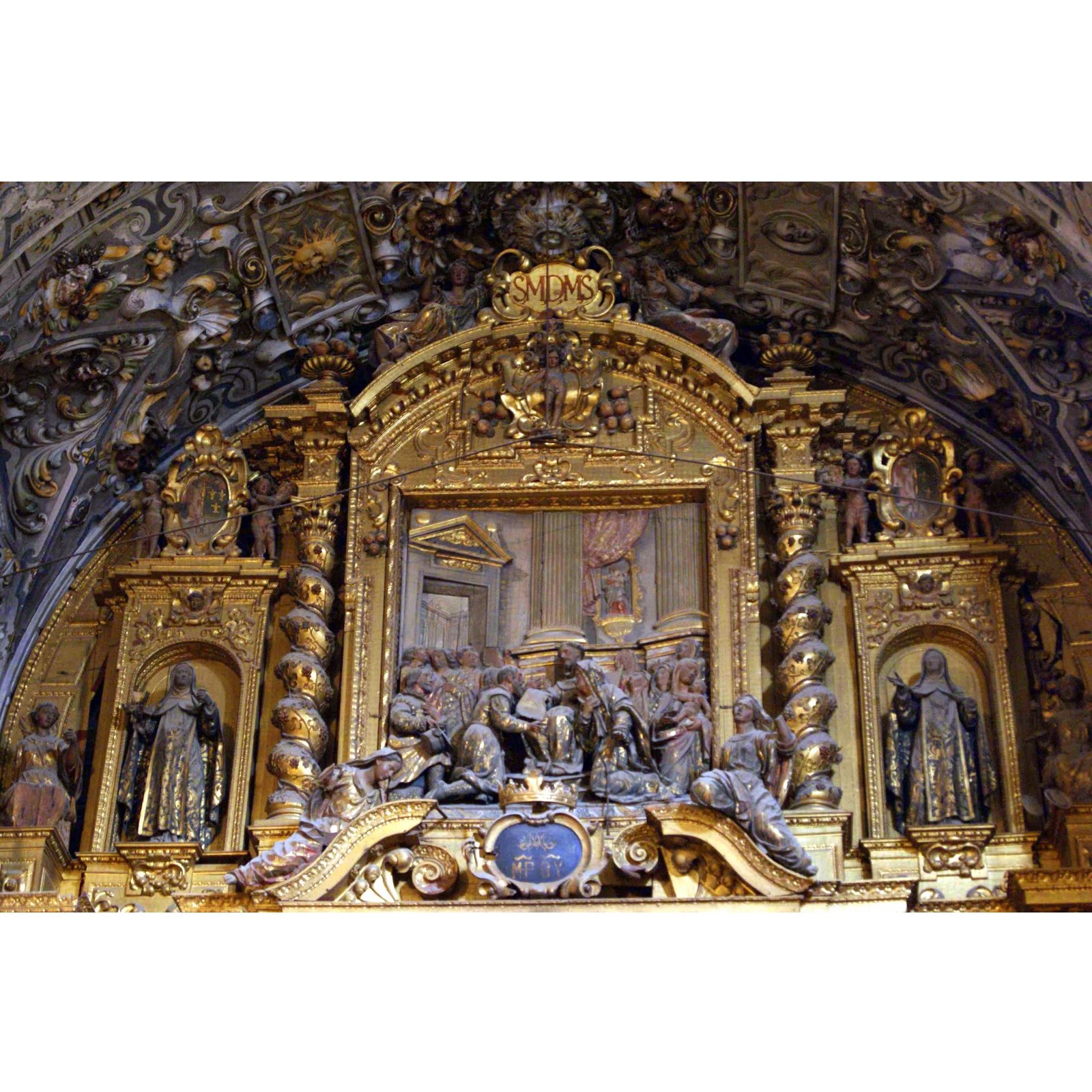
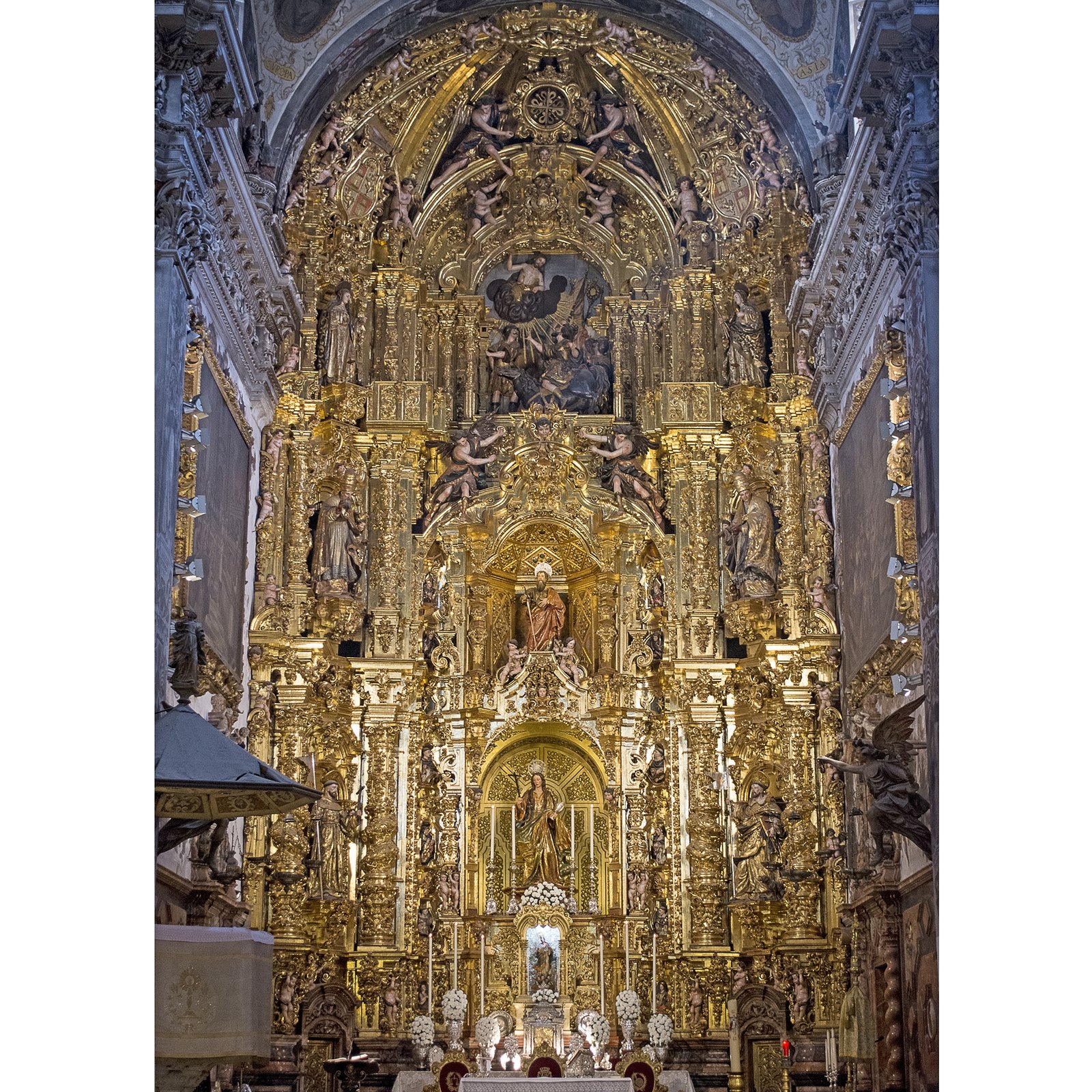
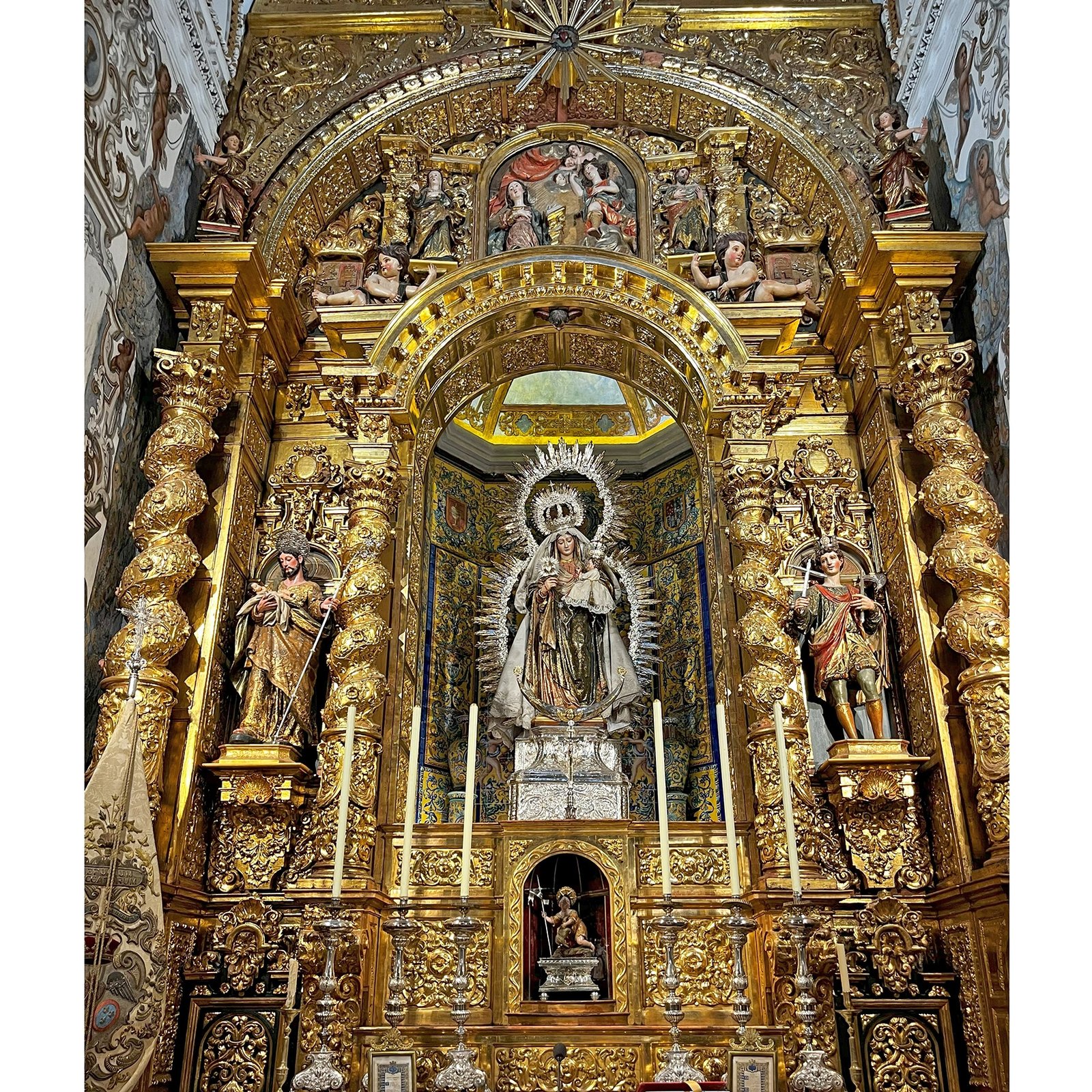
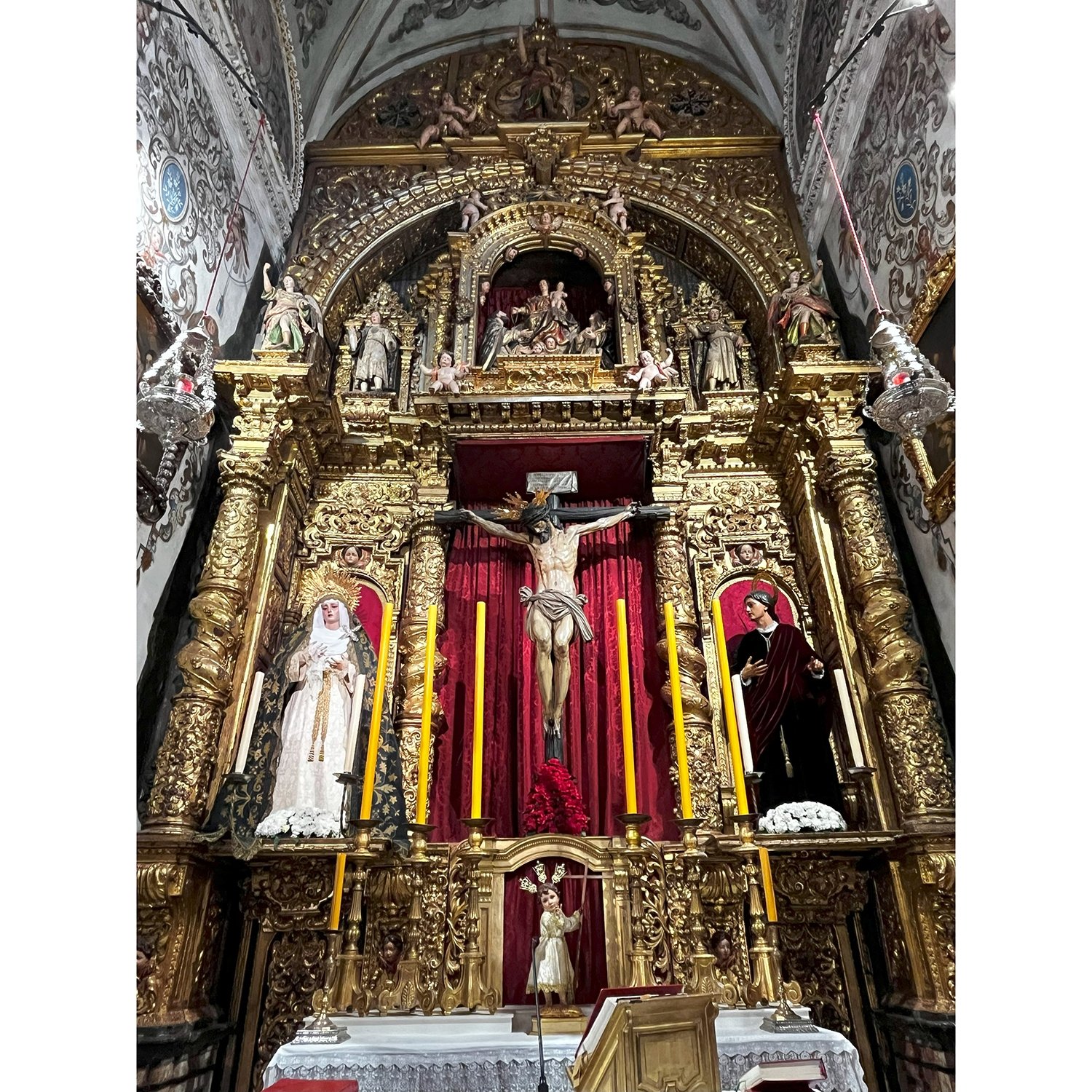
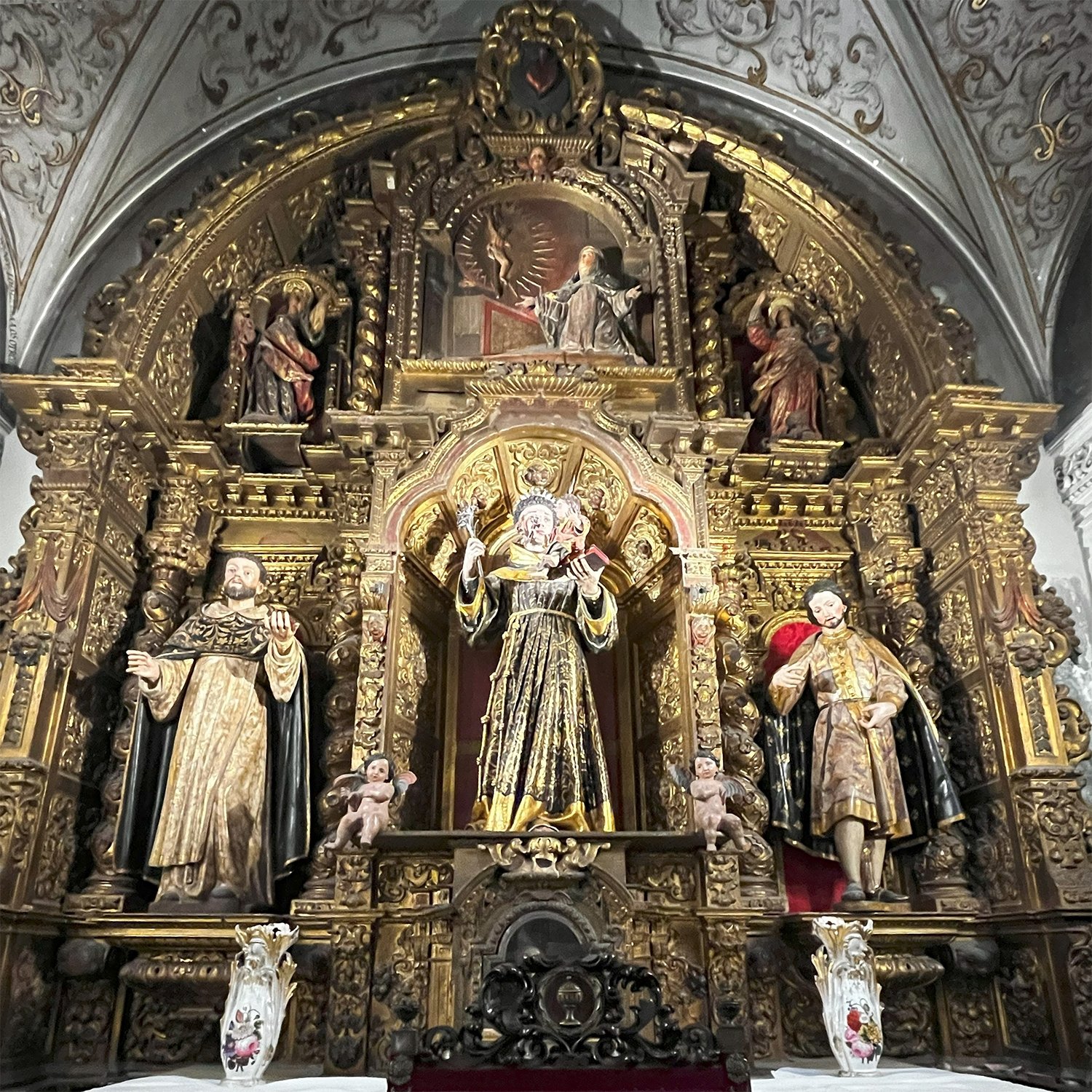
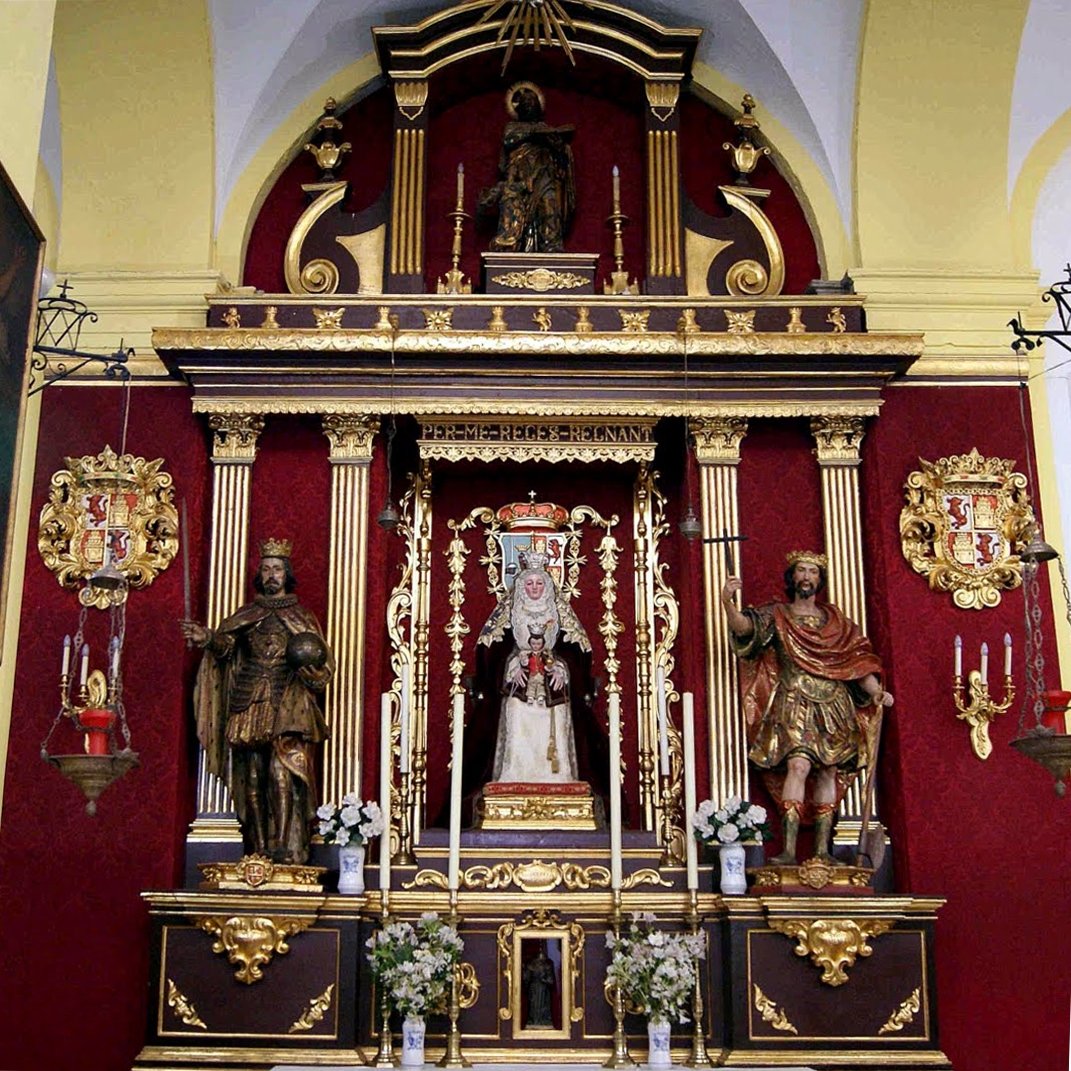
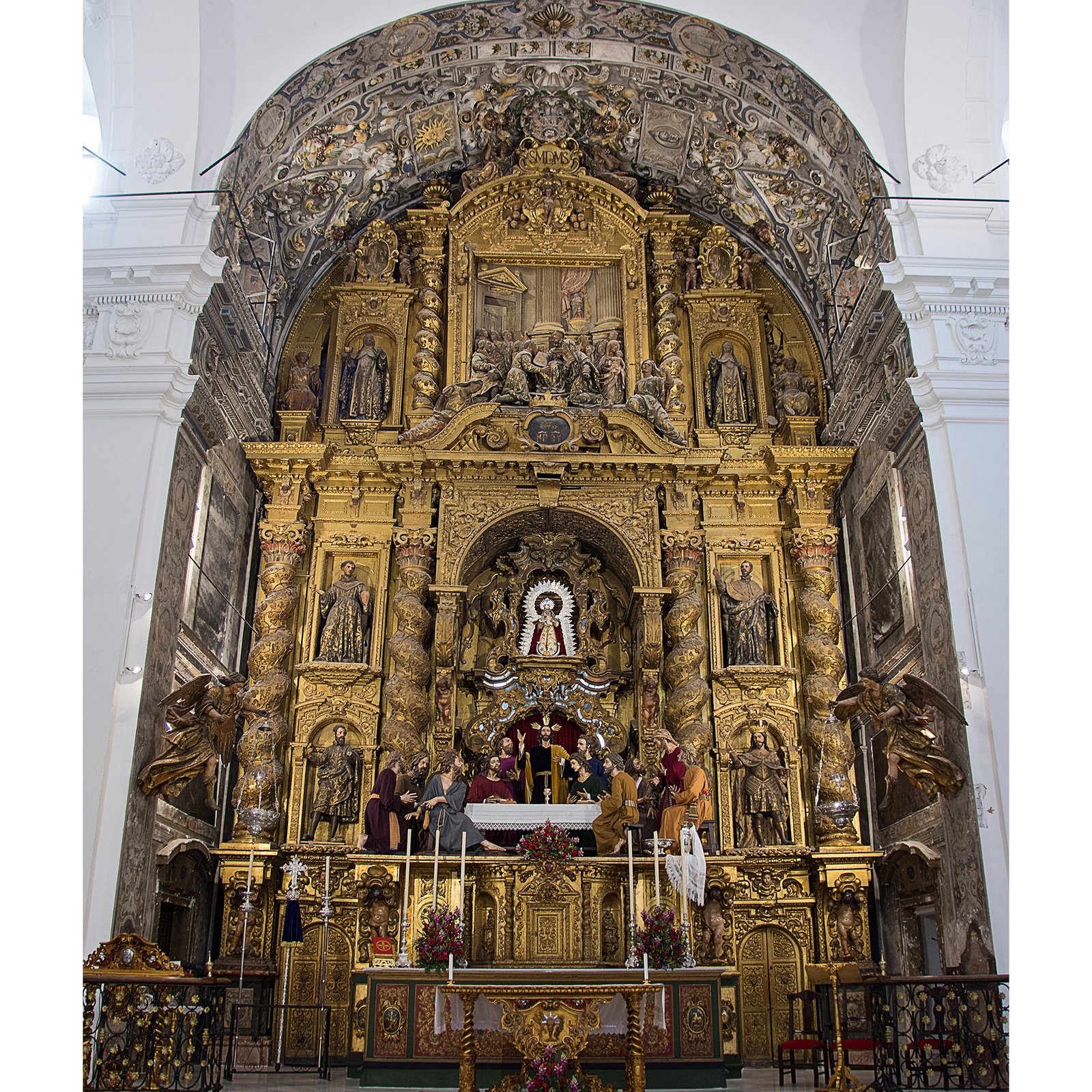
In the presbytery, the main altarpiece is a splendid baroque ensemble made by Francisco Dionisio de Ribas in 1669, which was subsequently renovated on several occasions. It can be considered one of the best examples of 17th century Sevillian altarpieces. It consists of two bodies and three sections, delimited by beautiful Solomonic columns with shafts delicately sculpted with plant motifs. The layout of the central space of the altarpiece was modified to accommodate the sculptural group of the Last Supper after the brotherhood was established in this temple. In the centre appears the figure of Jesus at the moment of the Eucharistic celebration. It was carved by Sebastián Santos Rojas in 1955 and its face is of such beauty that there are authors who point to it as the most beautiful image of Christ among those made for Holy Week in Seville in the 20th century. The apostles are the work of the Cadiz sculptor Luis Ortega Bru, one of the most original and outstanding figures of contemporary Spanish imagery. They were his last work, as they were first performed during Holy Week in 1983, a year after the sculptor's death. When the group is in the altarpiece, only eleven apostles accompany the Lord, as Judas Iscariot is excluded, who is part of the float on the day of the procession.

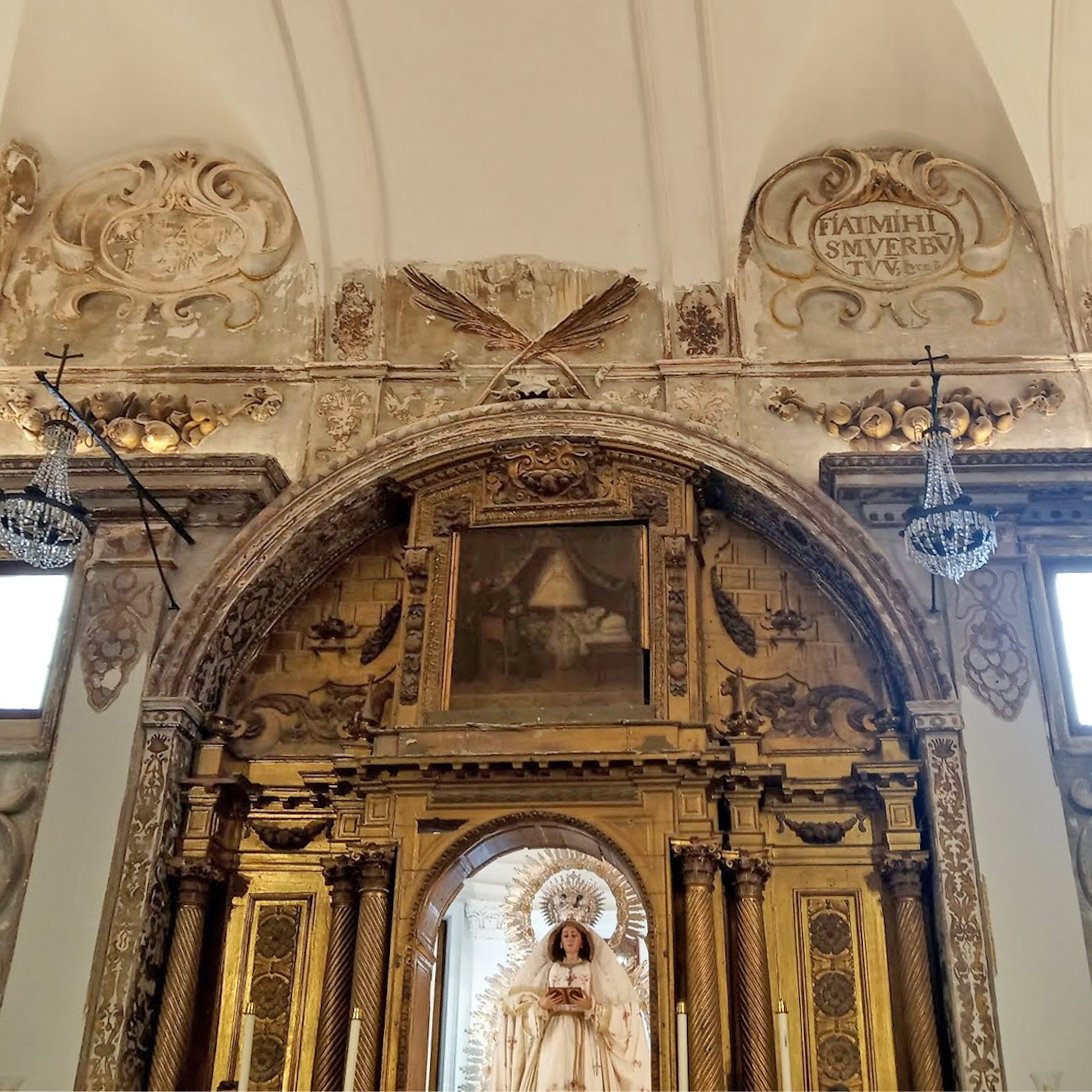
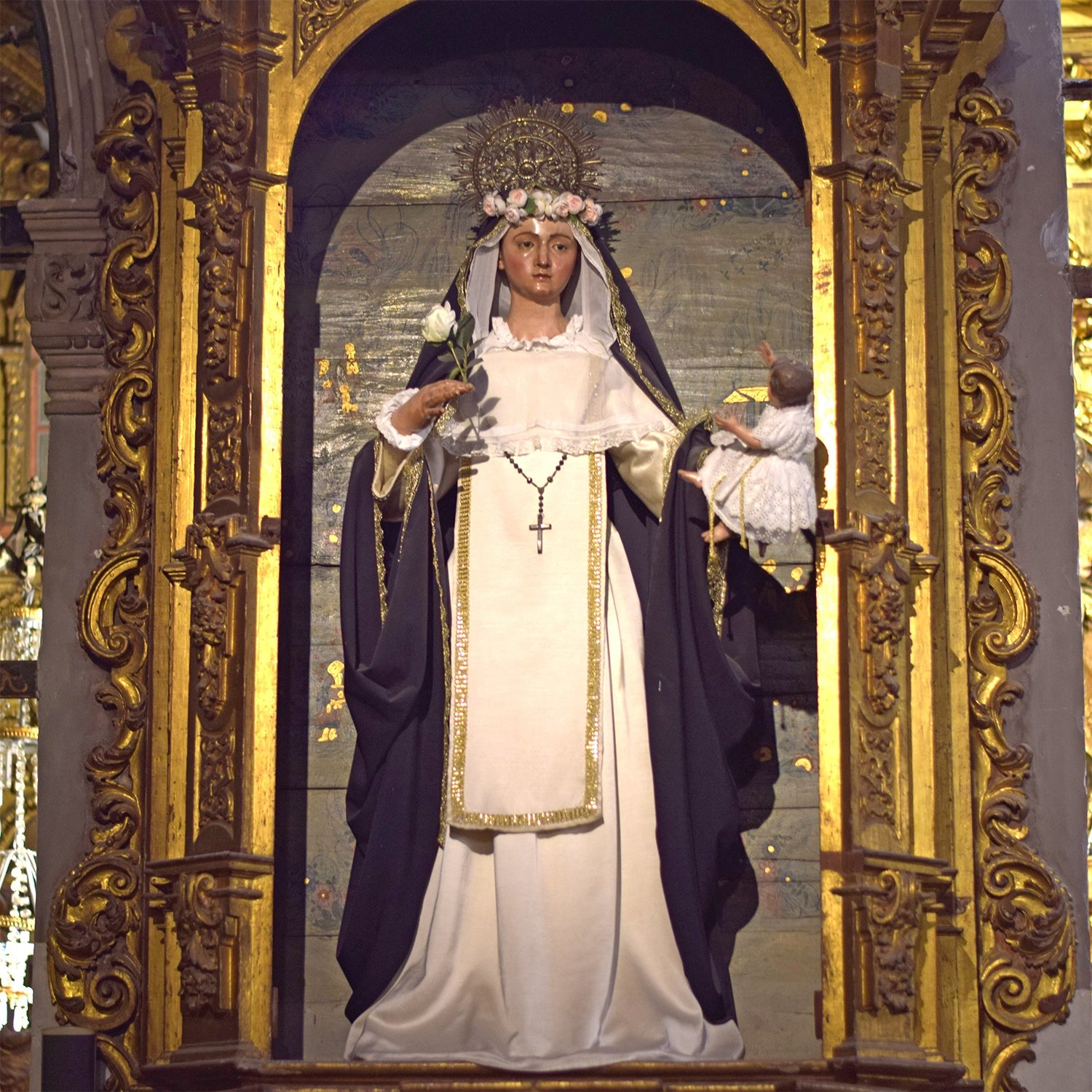
Above the group of the Last Supper, there is a niche with undulating shapes added to the altarpiece in 1700 to house the Virgin of Consolation, the titular of this temple. It is a small image of the Virgin with Child, which originally had the title of Our Lady of Morañina when it was worshipped in the convent that the Third Order ran in Bollullos Par del Condado before its transfer to Seville. The image dates back to the 14th century, but was thoroughly renovated to adapt it to the Baroque aesthetic, probably in the 18th century.

Continuing along the first level, on the left we find Saint Ivo of Brittany and Saint Elizario, while on the right we find Saint Conrad and Saint Louis of France. In the second level, in the centre there is a relief with "Saint Francis approving the rules of the Third Order". The relief is flanked by Saint Elizabeth of Portugal on the left and Saint Elizabeth of Hungary on the right.
Transept

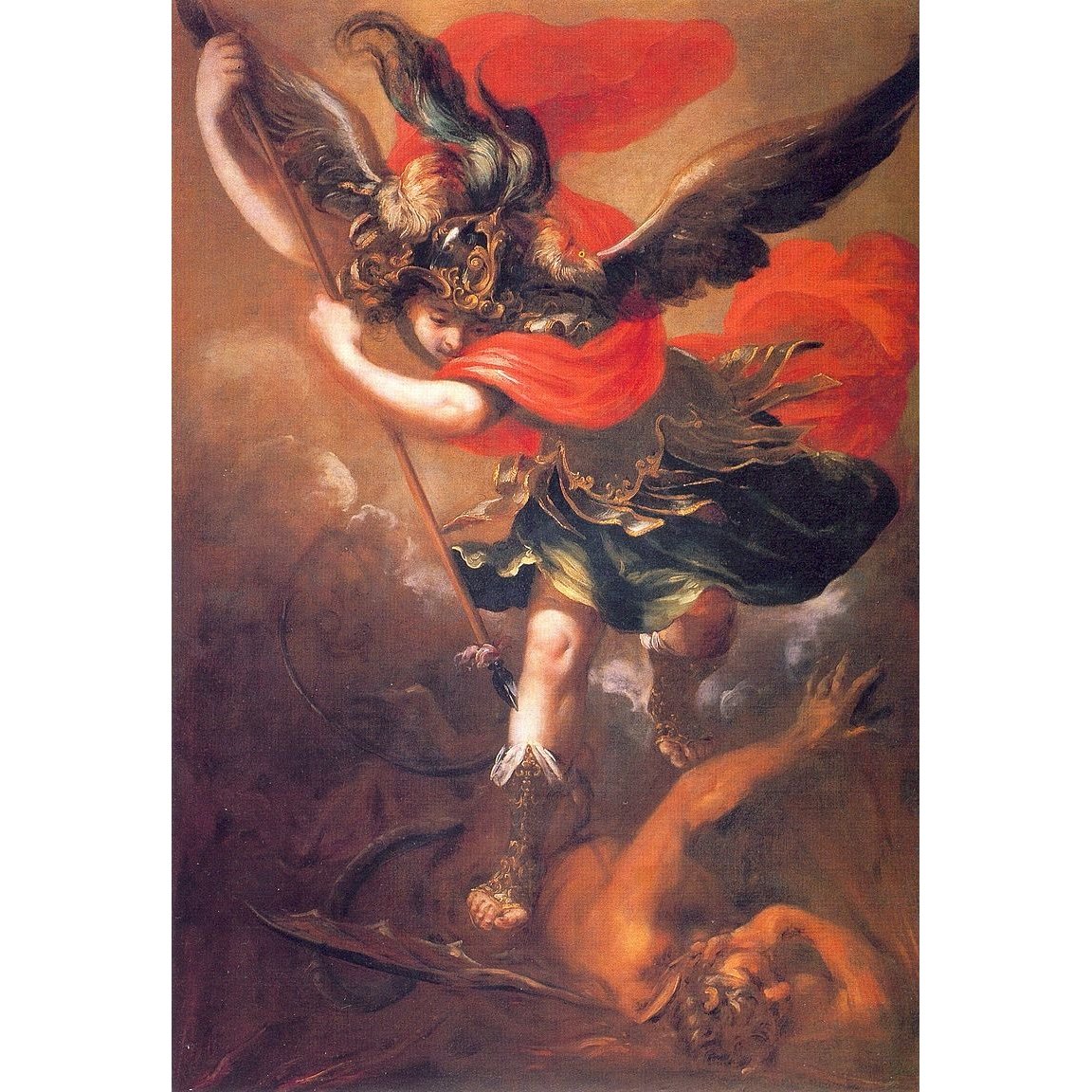
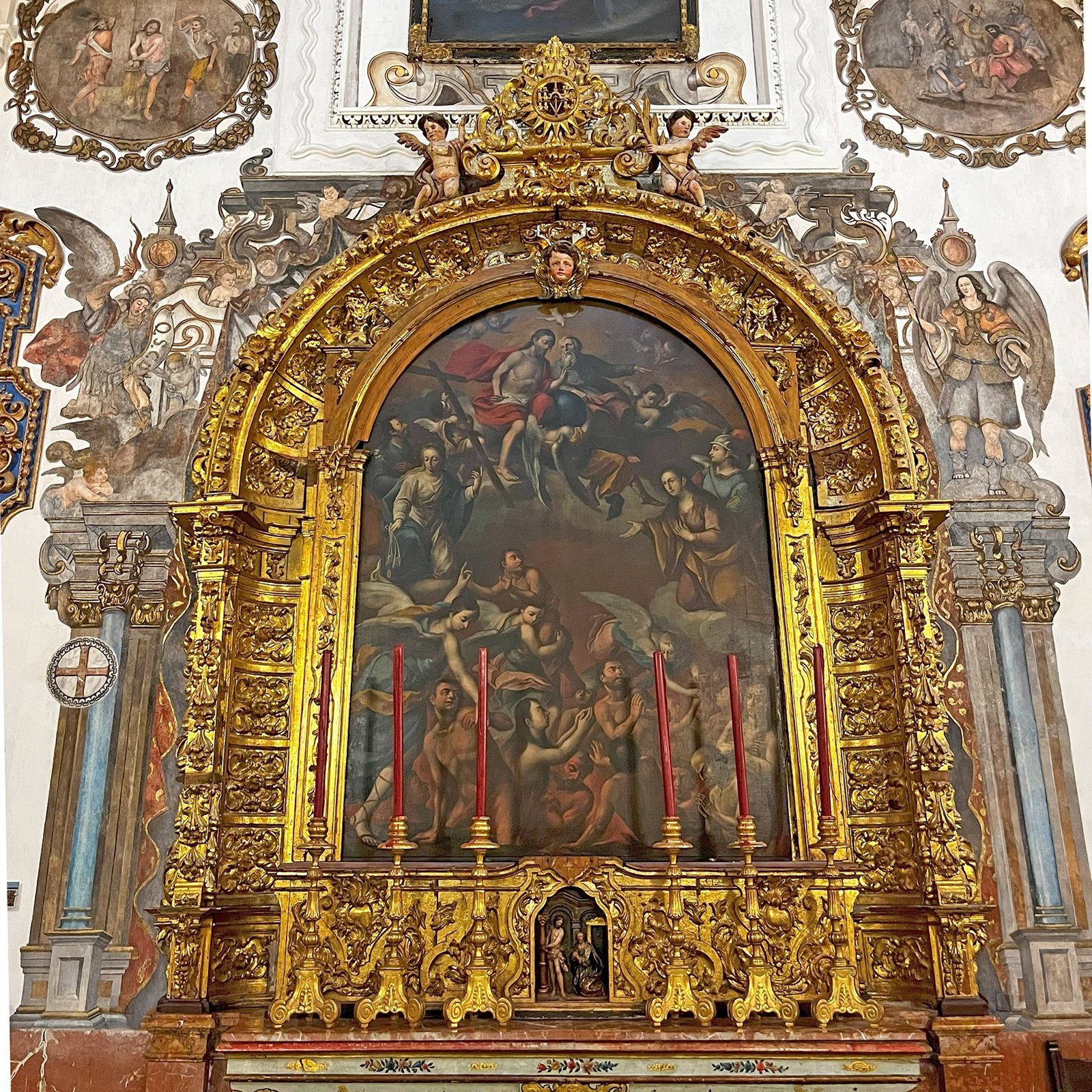
The presbytery is flanked by two other smaller altarpieces located in the arms of the transept. Both are from the first third of the 18th century and house an image of the Virgin and Child on the left and a Jesus of Nazareth on the right. Originally the altarpieces were dedicated to two high-quality images of Saint Michael and Saint Raphael that are currently usually located in the sacramental chapel.

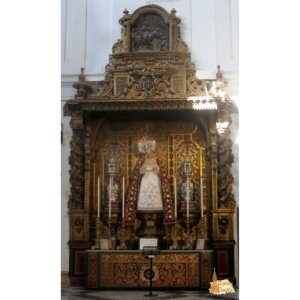
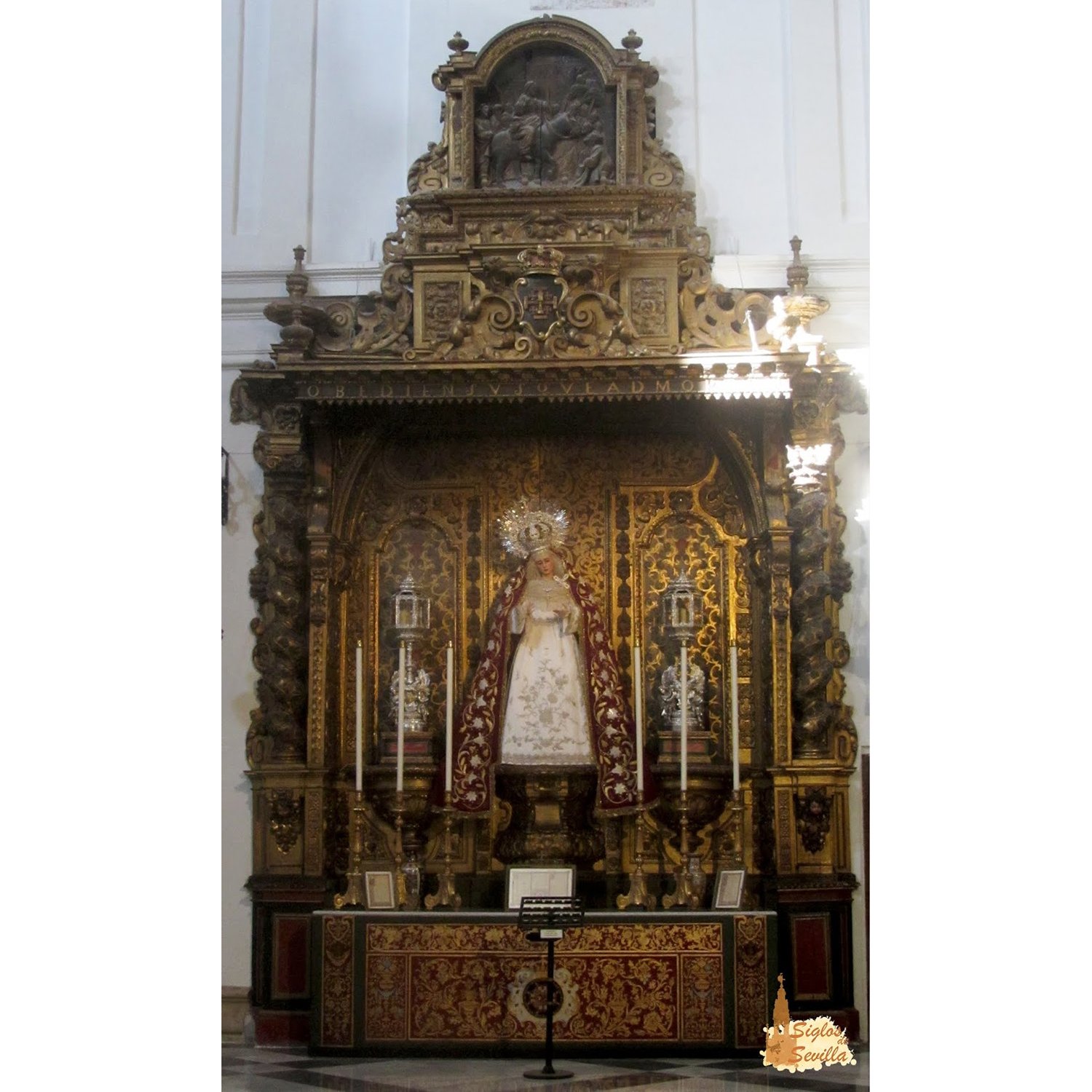
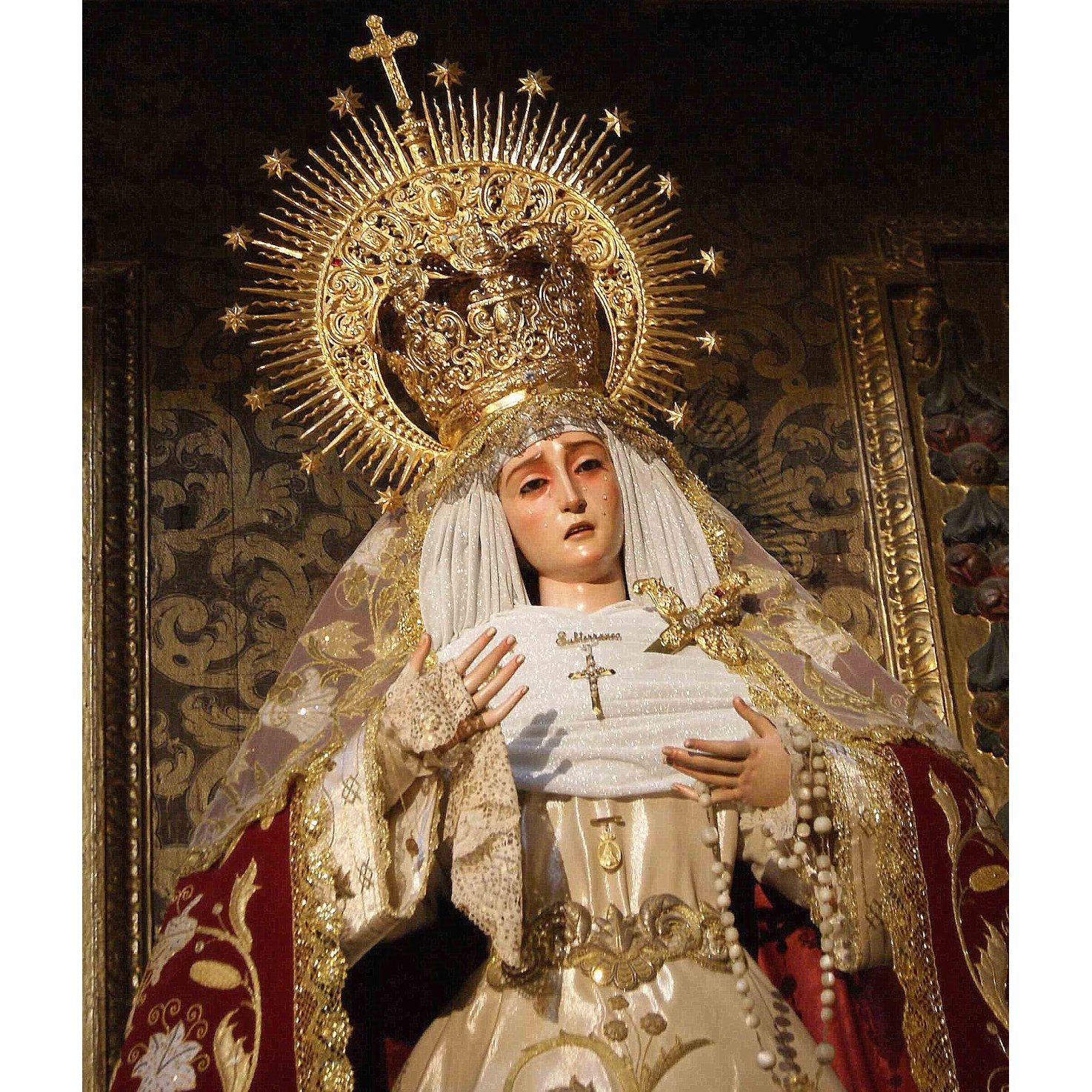
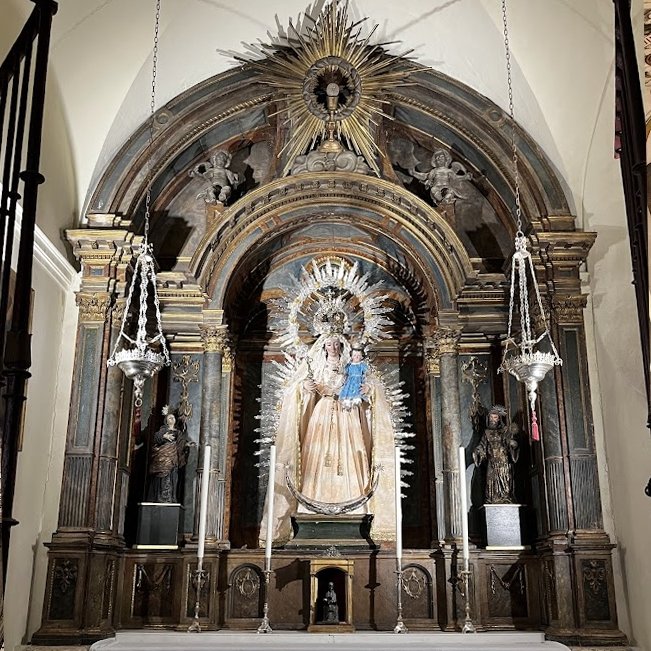
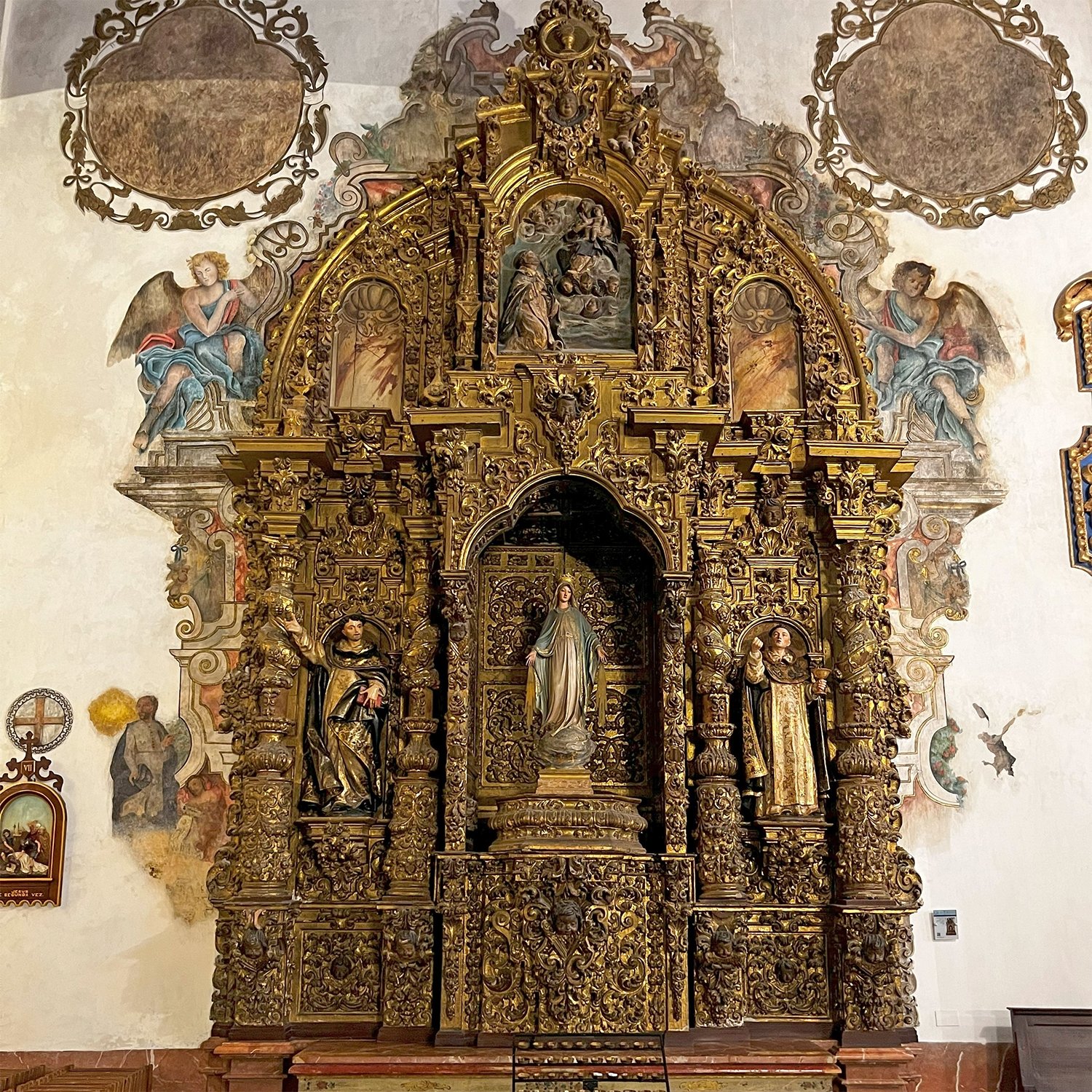
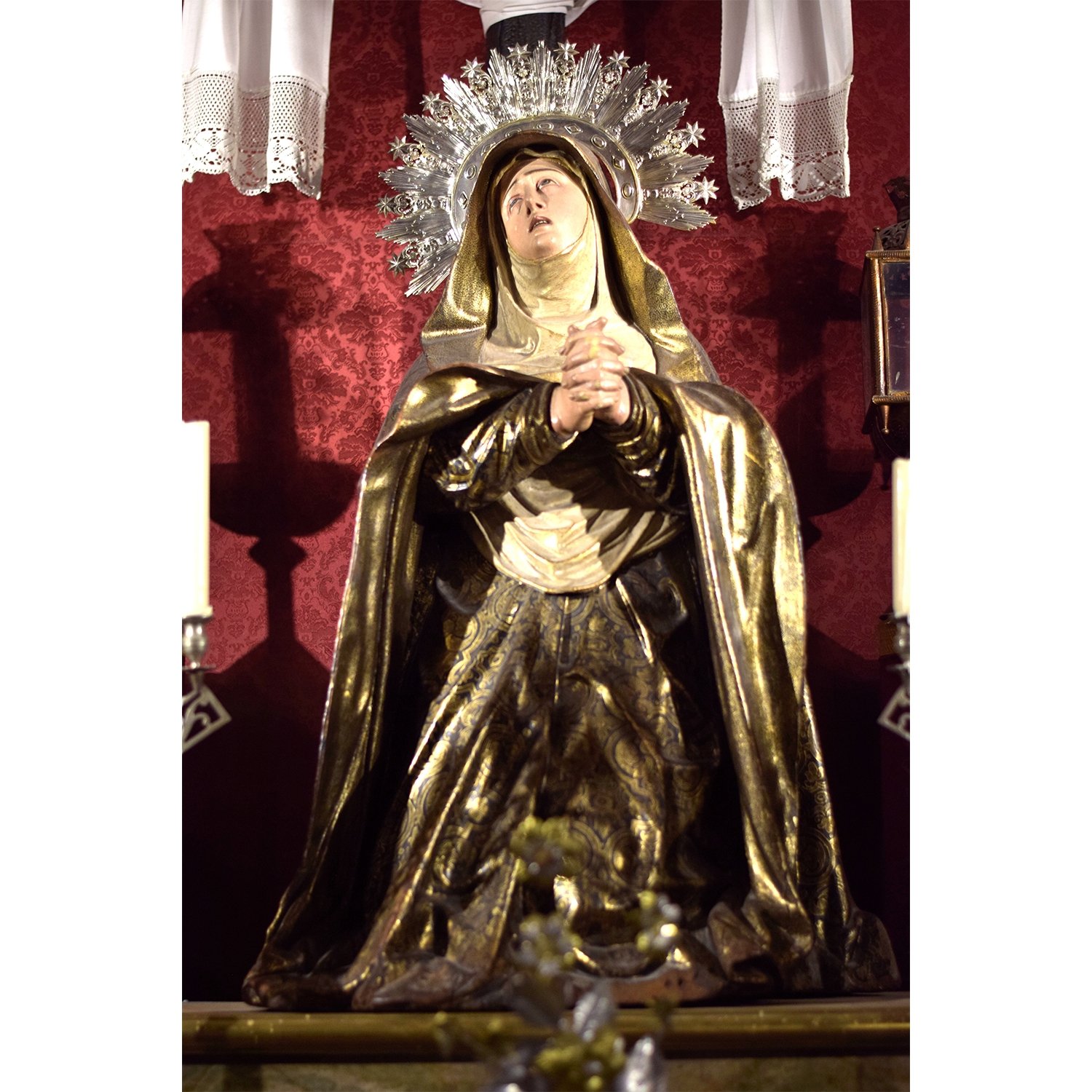
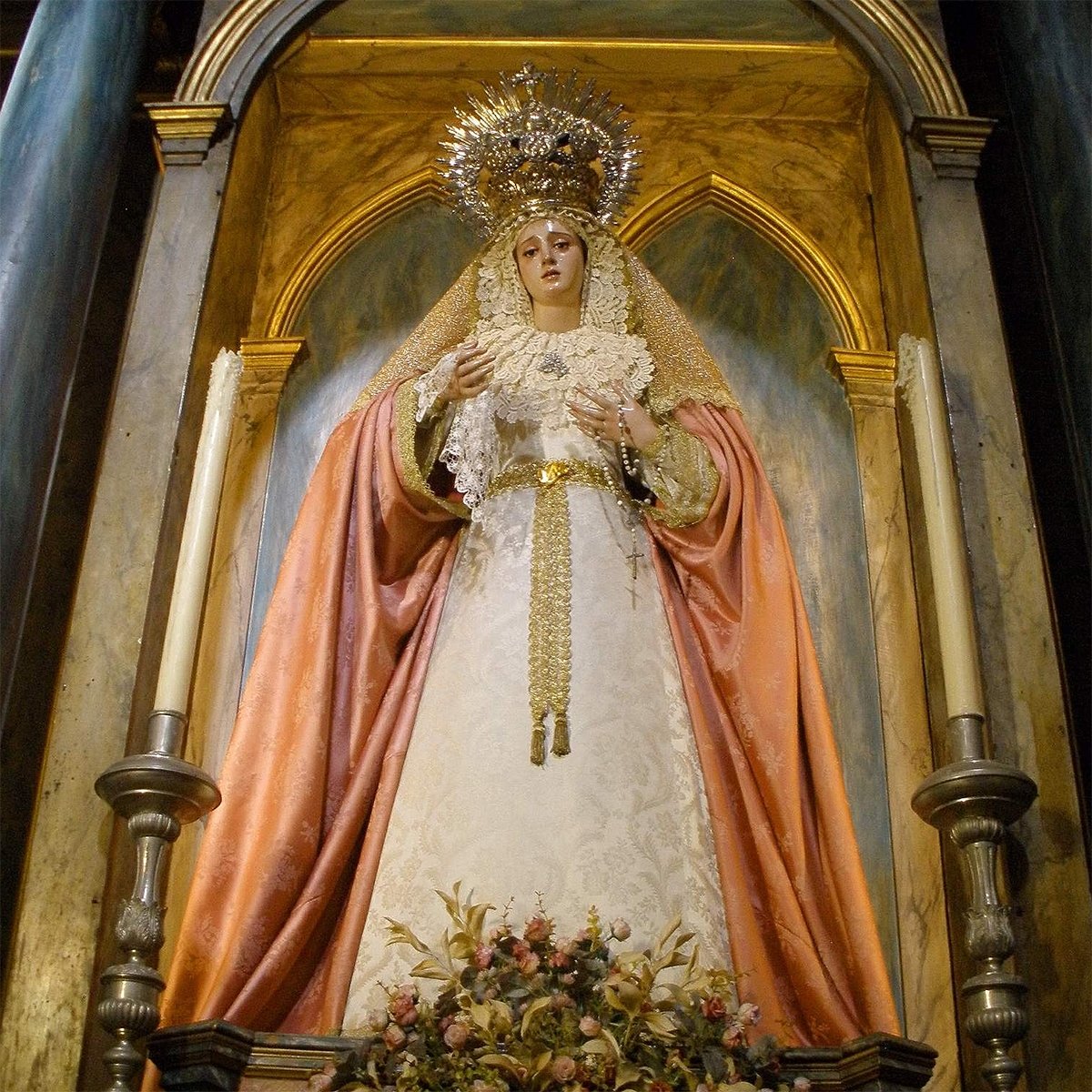
At the left end of the transept there is an altarpiece from the beginning of the 18th century that houses the image of Our Lady of the Underground, Queen of Heaven and Earth, titular of the Brotherhood of the Supper. The image is a painful one to dress that has traditionally been attributed to the 19th century sculptor Juan de Astorga, although due to its stylistic features it cannot be ruled out that it is an older image, probably from the 17th century. The altarpiece in which it is located once belonged to the Brotherhood of Love, which had its headquarters in this church. In fact, behind the Virgin, the shape of the cross that once housed the Christ of Love is visible. It is worth remembering that the Brotherhood of the Holy Entry into Jerusalem was also founded in this church and that it was here that both merged to give way to the Brotherhood of Love that we know today, based in the church of El Salvador. In fact, in the attic of the altarpiece there is a relief that represents precisely the scene of the Entry of Jesus into Jerusalem, riding the famous "little donkey".

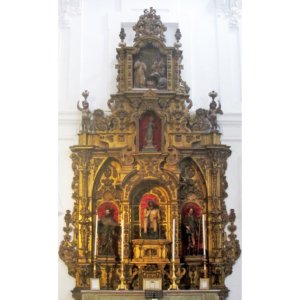
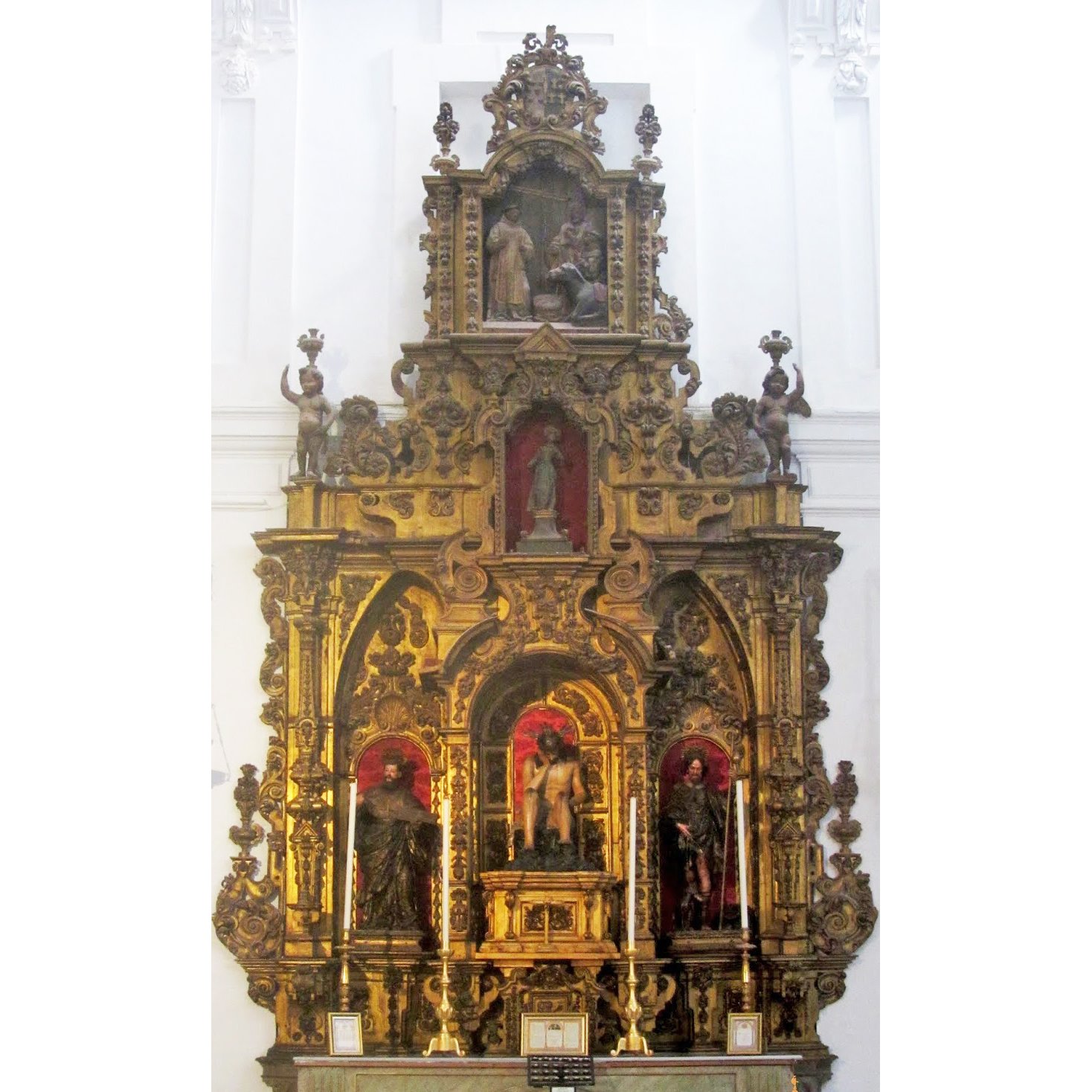
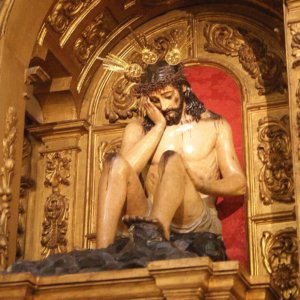
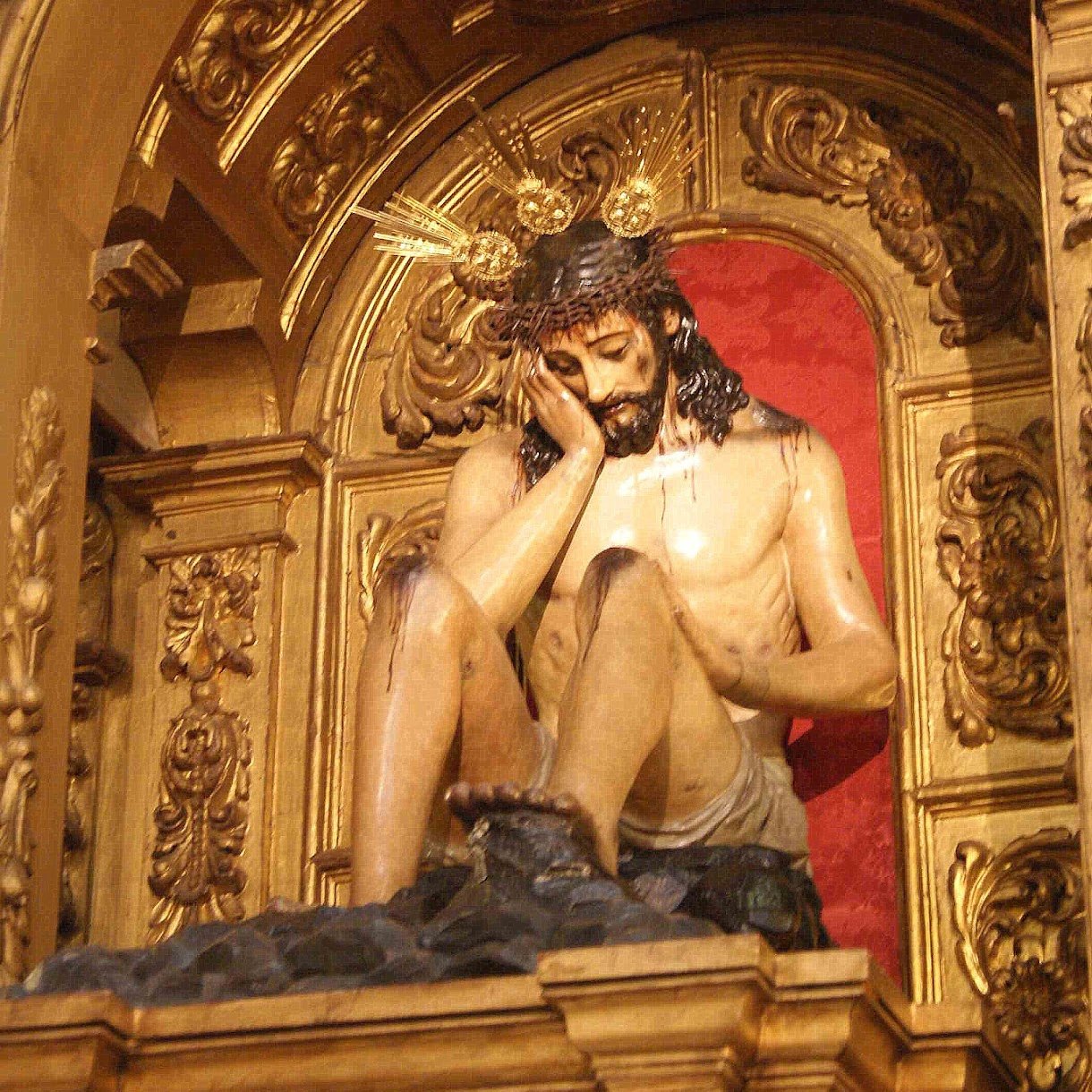
Opposite the altarpiece of the Virgin of the Underground, in the right-hand head of the transept, there is an altarpiece with very dynamic shapes carved by Fernando de Medinilla in 1727. It is presided over by the image of the Christ of Humility and Patience, which is also the titular of the Brotherhood of the Supper, also participating in the procession on its float. The image was made in the 16th century, making it one of the oldest images of Holy Week in Seville. It has the peculiarity of not being made of wood but of glued fabrics. It represents Christ sitting on a rock just before the crucifixion, resting his head on his right hand in a reflective attitude. This iconography has deep roots in Sevillian religiousness since the first carvings were made from an engraving by Dürer in 1511.

Chapels

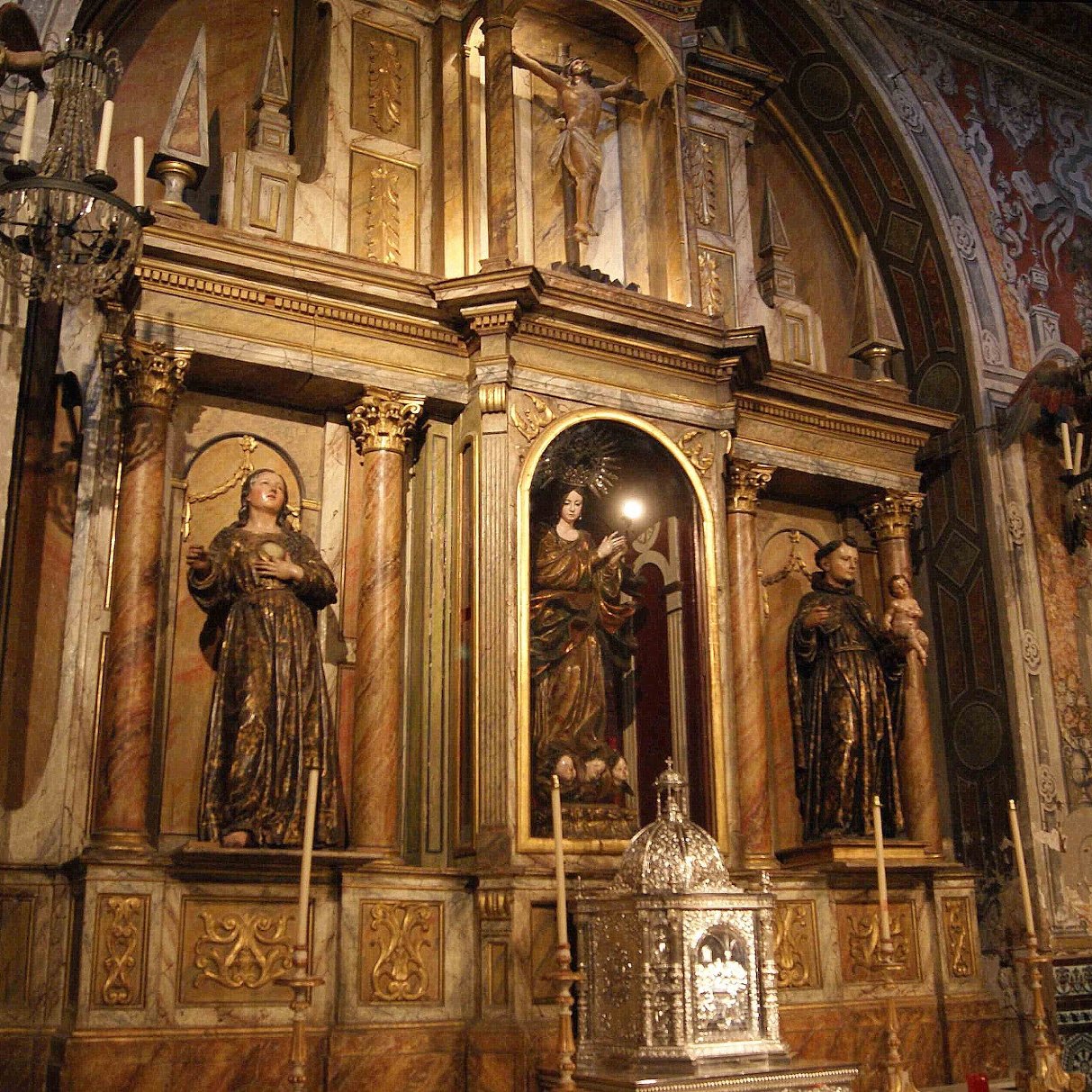
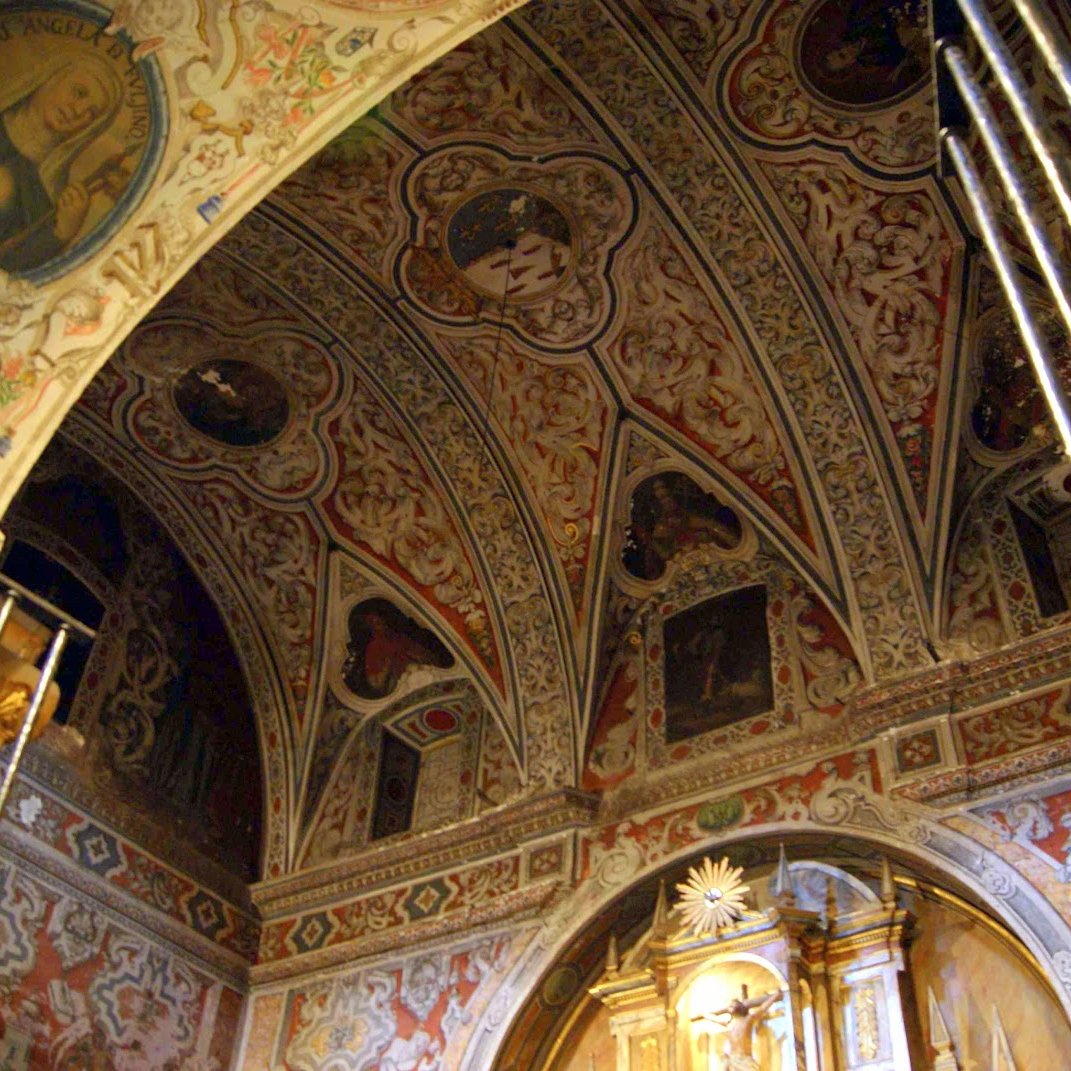
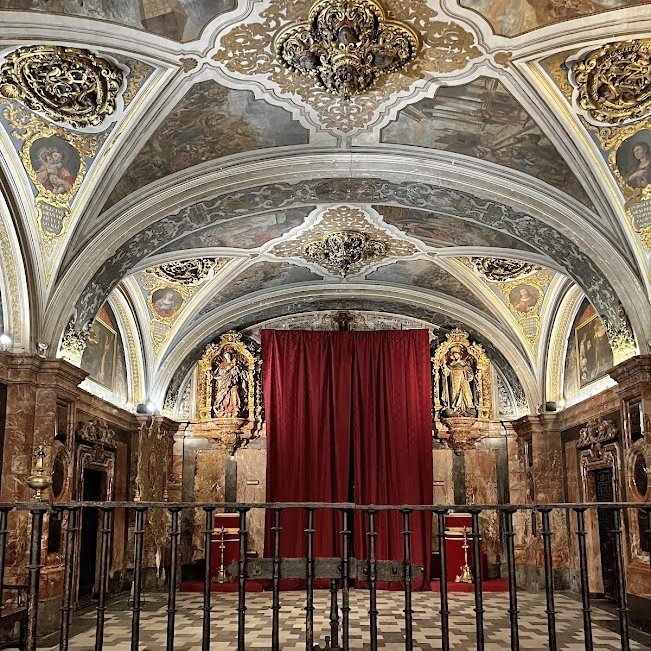
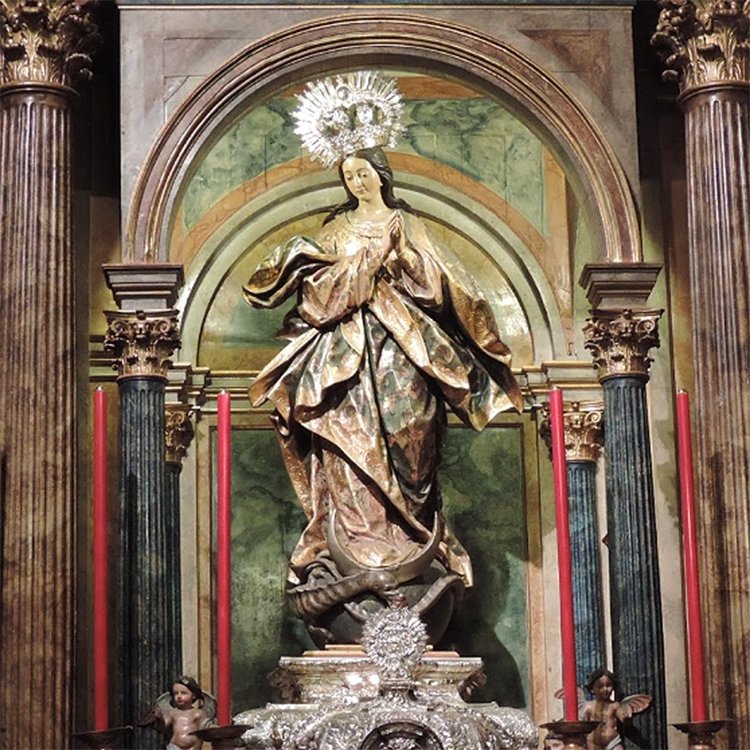
On the Gospel side (left) of the church is the Sacramental Chapel, with a rectangular floor plan and a barrel vault with lunettes. Both the walls and the vaults are profusely decorated with baroque ornamentation from the beginning of the 18th century. It is presided over by a neoclassical altarpiece from the 19th century presided over by an Immaculate Conception. It is flanked by carvings of Saint Mary of Egypt and Saint Anthony of Padua, and in the attic there is a Crucifix. All the carvings are approximately from the beginning of the 19th century, except for the Immaculate Conception, which is from the 17th century. On both sides of the chapel are two altarpieces, also neoclassical, which house the images of Saint Michael and Saint Raphael from the beginning of the 18th century. Also in this chapel is a dressed image of Saint Francis from the 17th century that apparently came out in procession through the streets of the neighbourhood. There is also a crucifix with the dedication of Christ of the Good Death, of remarkable quality, which has been dated to the beginning of the 18th century.

Opposite the sacramental chapel, on the Epistle side (right) is the chapel of Our Lady of the Incarnation. It is presided over by a neoclassical altarpiece that houses the image of the Virgin who is the titular glory of the Brotherhood of the Supper. It is a 17th century carving attributed to Juan de Mesa, although it was deeply renovated later. The chapel remained closed for a long time after suffering a collapse but can be returned to worship after its restoration in 2019.

CAPILLA DEL MAYOR DOLOR (VIRGIN OF THE GREATEST PAIN)

The chapel of the Mayor Dolor is a small 18th century temple located in the Plaza de Molviedro, which is why it is sometimes known as the Molviedro chapel. Today it is the headquarters of the Hermandad de Jesús Despojado, which processes on Palm Sunday.

The area where the chapel is located was known since the Middle Ages as the Laguna or Compás de la Laguna, since it was an unbuilt area within the walled enclosure in which an extension of water of this type was formed. It was also the area where the brothel was historically located, very close to the port, as is usual. This brothel was separated from the rest of the city by a wall, so the area of ​​the Compás was wedged between the city wall and this wall.

Very close to the current chapel there was a more modest hermitage, where a brotherhood dedicated to the Holy Cross and Our Lady of the Greatest Sorrow was based. The wrought iron cross on a marble column that is now in the square recalls the location of this primitive hermitage.

The chapel that has survived to this day was built in the second half of the 18th century, within the framework of the general urbanisation that took place in this area of ​​the city. Manuel Prudencio de Molviedro, a merchant from Viana settled in Seville, took over a large part of the neighbourhood and began its redevelopment during the mandate of Pablo de Olavide (1767-1776). Within this transformation, Manuel Prudencio promoted and financed the construction of the chapel, which would be consecrated in 1779. Since 1856 the old Plaza del Compás de la Laguna was renamed Plaza de Molviedro in honour of this Navarrese benefactor.

In 1956, the chapel was ceded to the Congregation of the Claretians, who in turn ceded it to the Brotherhood of Jesús Despojado in 1982.


Outside

The chapel has a rectangular floor plan with a single nave. It only has one façade on the outside, the one at the foot, which opens onto the square. It is very simple in composition. A large lintelled opening, framed by pilasters and covered by a split triangular pediment. In the centre of the pediment there is a second body, this time topped by a curved pediment, framing a window. In the upper part of the façade there is a simple but elegant belfry, with a single bell and also topped by a curved pediment. On both sides of the façade there are ceramic altarpieces dedicated to Jesús Despojado and to the Virgen de los Dolores y Misericordia, the titulars of the brotherhood that has its headquarters in the chapel. They were made in 2007 in the ceramic workshop of José Jaén in Mairena del Alcor.


Inside

The interior is divided into two sections by pillars: the presbytery and the nave itself, each covered by vaulted ceilings. The altarpiece is the original Baroque from the second half of the 18th century. Today it is presided over by the image of Jesus Stripped of his Garments, carved by Antonio Perea Sánchez in 1939.

It happens that it was made in the provincial prison of Seville, since the sculptor was in prison, accused of having helped the resistance when Franco's troops took Seville in 1936. The sculpture was reworked in 1974 by Antonio Eslava Rubio, who completely remade the body, keeping the head.

In the niche on the left, the image of the Virgin of Sorrows and Mercy is worshipped, made in 1962 also by Eslava Rubio. To the right is the image of Saint John the Evangelist made by Juan González Ventura in 1981. This carving accompanies that of the Virgin on her palanquin during her processional exit every Palm Sunday.

In the centre of the second body of the altarpiece there is a sculptural group with Saint Anne teaching the young Virgin to read. To the right is Saint Basilisca (identified by José Gestoso as Saint Gertrude) and to the left we find Saint Michael. All of them are anonymous carvings made in the 18th century, forming part of the original sculptural decoration of the altarpiece.

The image that presides over the small altarpiece located on the right wall of the nave is from the same century. It is Our Lady of the Greatest Sorrow, the titular image of the temple. It is also an anonymous sculpture that represents the Virgin kneeling at the foot of the Cross.

On the walls, the images of Saint Joseph with the Child, Saint Ferdinand and Saint Genoveva Torres are worshipped, as well as two canvases with copies by Murillo, one with the "Holy Family" and another with "Saint Anthony and the Child".

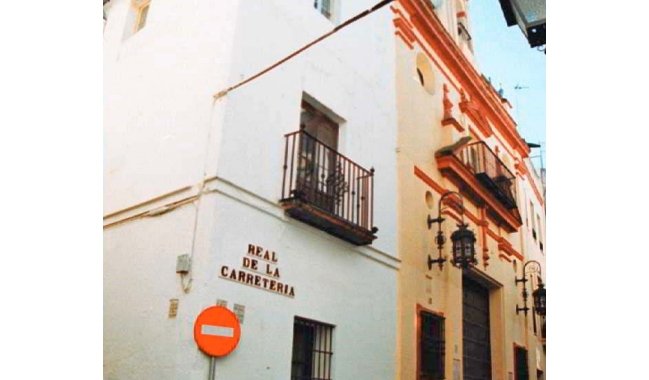
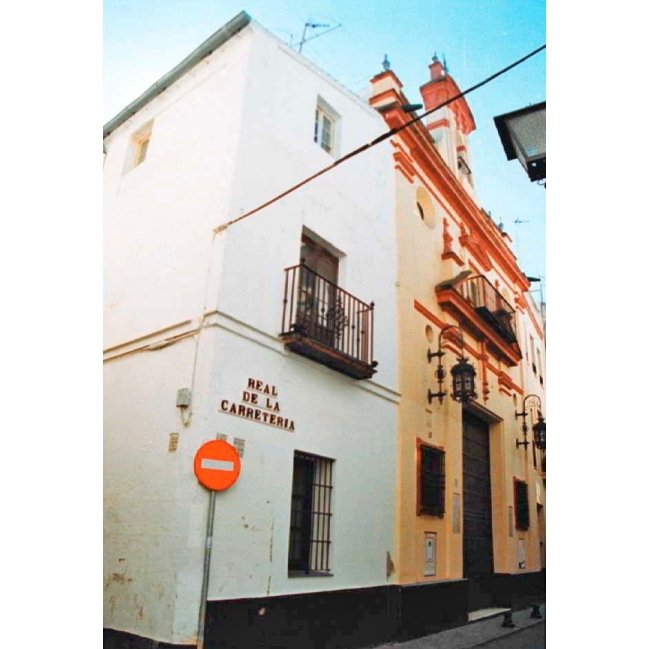
CHAPEL OF LA CARRETERÍA

The Carretería chapel is a small 18th-century temple located in the Arenal district of Seville. It is one of the smallest chapels in Seville, with less than 100 square meters. As its name indicates, it is the headquarters of the Carretería brotherhood, which processes on the afternoon of Good Friday.

The location of the temple responds to a miraculous event that tradition points to in this place. Apparently, in the mid-16th century, a member of the barrel guild found an image of the Virgin hidden behind a wall in this area. The image gave off a very bright light, which is why it received the invocation of Our Lady of Light. After this event, it was decided to found the brotherhood, whose germ would be the aforementioned barrel guild (1550).

The current chapel was built between 1753 and 1761 based on the plans of Juan Núñez. It has a single nave, covered by a groin vault, except in the presbytery, where the vault is groined. At the end of the 20th century, a new chapel was added to the right to house the image of the Virgin of the Greatest Sorrow in her Solitude.

The façade is neoclassical and very simple. Two pillars frame the entrance and support a split pediment, in the centre of which there is a niche, topped by a triangular pediment. In the centre of the upper part there is a single-bay belfry with the bell.

Inside the chapel, the members of the Carretería brotherhood receive worship. The Cristo de la Salud is an extraordinary carving by an anonymous author that has been dated to the beginning of the 17th century. Although no documentation has been preserved, based on its style, Francisco de Ocampo has been pointed out as its possible author. The Virgin of Light and Saint John are the accompaniers, works from the workshop of Pedro Roldán from around 1677.

In the side chapel there is the image of Our Lady of the Greatest Sorrow in her Solitude. Originally, it was the image of Mary that accompanied the Crucified Christ in the procession of mystery, although since 1885 it has been carried in its own procession of pallium. It is attributed to Alonso Álvarez Albarrán and has been dated to 1629.

We also find a dressed image of the Virgin with the Child, with the invocation of Our Lady of Light (of glory), which it shares with the aforementioned. Traditionally it has been identified with the image that miraculously appeared in this place around 1550. However, a stylistic analysis makes it clear that the image was made in the second half of the 18th century. It is possible that the current image was made from the remains of the original or that, for some reason and at some time that we do not know, it was decided to replace it.

CHAPEL OF LA PIEDAD DEL BARATILLO

The chapel of La Piedad del Baratillo is a small baroque-style temple located in the Arenal district of Seville. It is the headquarters of the Brotherhood of Baratillo, which takes part in a procession on Holy Wednesday afternoon with two floats (pasos), La Piedad and the Virgen de la Caridad.

Since the mid-17th century, in the place where the chapel is today, there was a small mound on which an iron cross was raised. In that same place, some of the victims of the 1649 epidemic had been buried, which in Seville killed more than half of the population. Around 60,000 people died of "plague" in the city that year.

The Baratillo Cross was awakening an ever-increasing devotion and in 1693 a brotherhood was founded around it and the construction of a chapel was decided.

Its works were completed in 1696 under the direction of Bernardo Bustamante, although in the mid-eighteenth century an extension was carried out directed by Marcos Sancho.

The chapel has a Latin cross plan, with the transept slightly raised, and a single nave. This is covered with a barrel vault and above the presbytery there is an octagonal dome on pendentives. On the outside, the dome is crowned by a metal cross, which is traditionally considered to be the primitive one that was raised on the Baratillo hill in the seventeenth century.

The exterior façade is very simple. It has a doorway with two bodies. In the lower one, the entrance opening is framed under a split pediment, in the centre of which there is a second body, smaller in size. It is flanked by pillars that support a triangular pediment and in its centre there is a contemporary stained glass window, donated to the brotherhood by the Austrian pavilion after Expo 92. The façade is topped by a bell gable under a curved pediment and with a single opening that houses the bell.

Inside are the titular images of the Brotherhood of Baratillo. In the main altarpiece, original from the late 17th century, the Virgin of Mercy is worshipped, a work by Manuel José Rodríguez Fernández-Andes from 1945. In her lap is the Christ of Mercy, made by the sculptor of San Roque Luis Ortega Bru in 1951. In an altarpiece on the right side is the image of the Virgin of Charity in her Solitude, made by the same sculptor as the Piedad, Rodríguez Fernández Andes, in 1931.

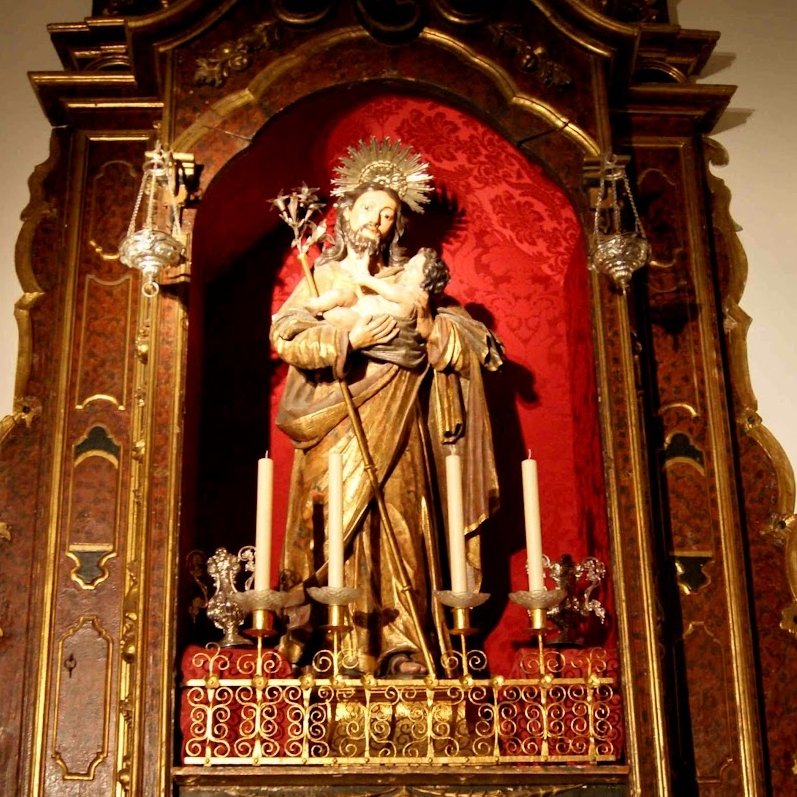
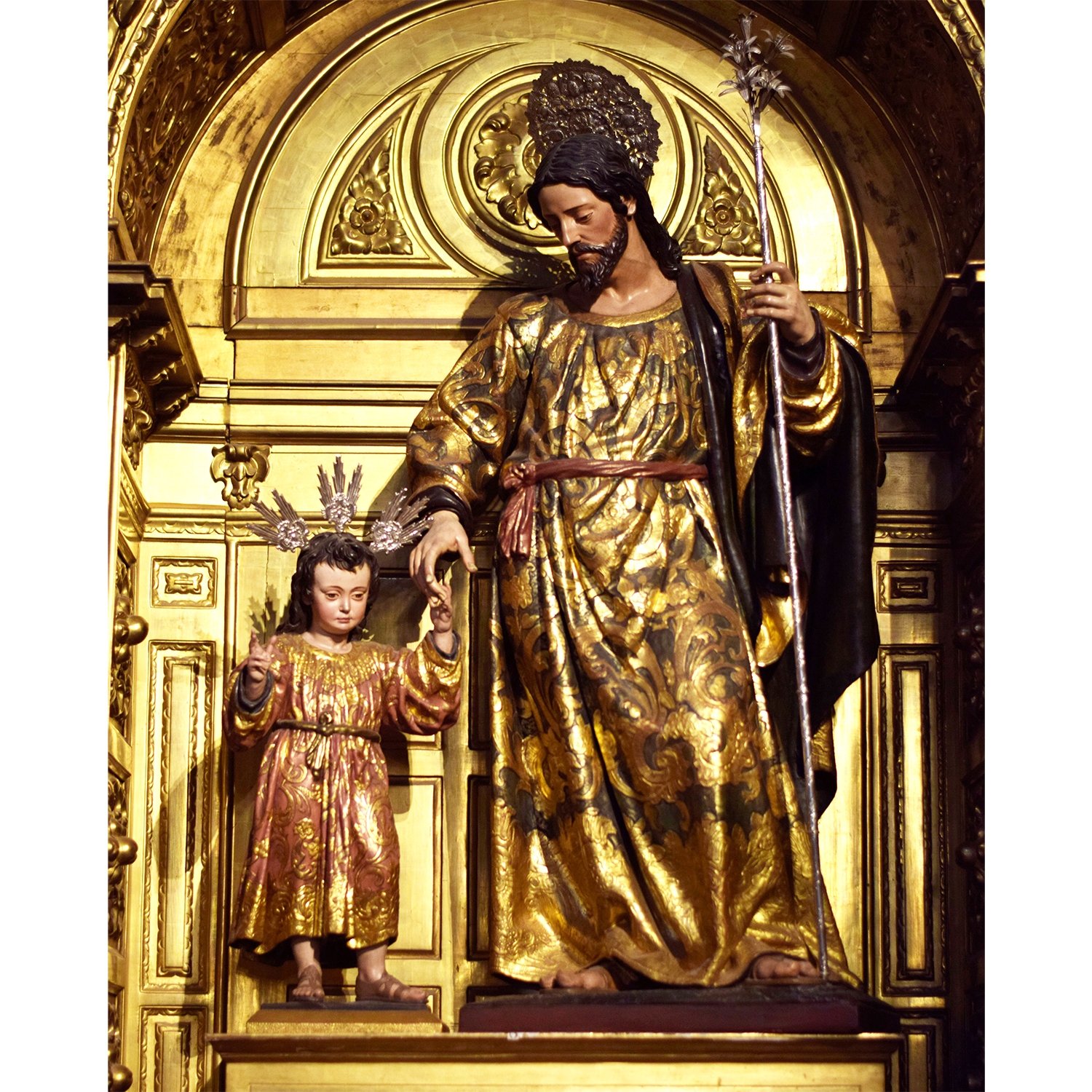
In an altarpiece on the left side is the carving of Saint Joseph with the Child, which is also the titular image of the brotherhood. It has been dated to the second half of the 18th century and, although it is an anonymous author, some authors attribute it to José Montes de Oca. It was donated in 1794 by the bullfighter Pepe Hillo. The brotherhood has historically been closely linked to the world of bullfighting, with many bullfighters linked to it, "either as brothers or out of deep devotion." It should be remembered that the temple is located just a few meters from the Maestranza bullring.

KING’S WOOD WAREHOUSES

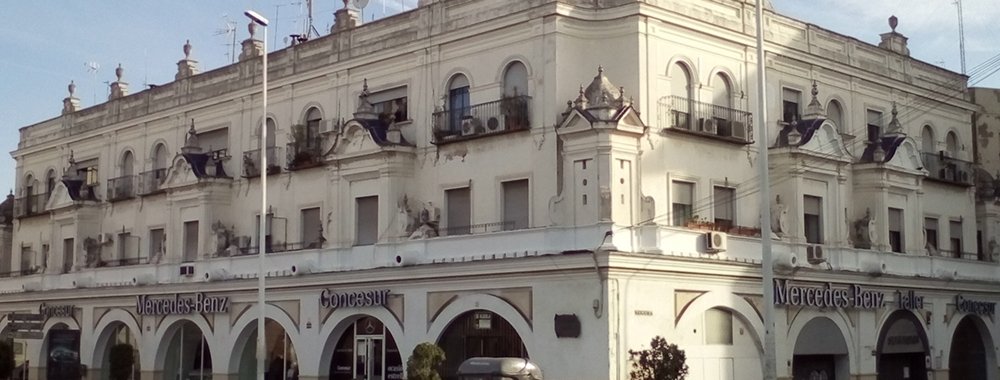
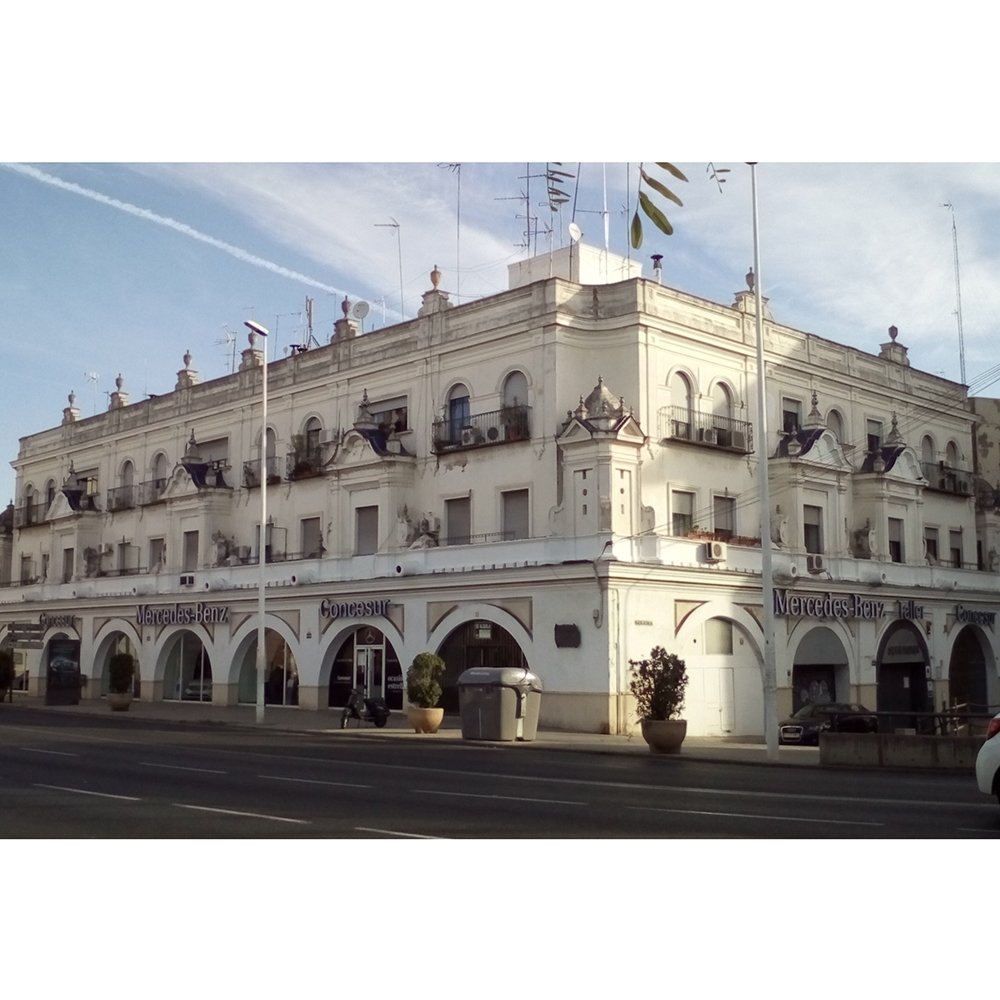
The so-called Almacén del Rey is an old building originally built around 1735. Its purpose was to house the wood that arrived in the city down the Guadalquivir from the Sierra del Segura (Jaén). Its current appearance is far from the original, since between 1950 and 1960 important reforms were undertaken: a floor for residential use was added and the ground floor was transformed for commercial use. The architects Alberto Balbontín de Orta and Antonio Delgado Roig were the architects of these transformations, after which it can be considered that only part of the original building remains.

The building has a rectangular floor plan. On three sides, there are “slightly lowered semicircular arches on the outside, finishing off the construction with towers like sentry boxes and with attic openings in the centre of each side. On the main front, between two of the aforementioned openings, there is a royal coat of arms”.

CALLIOPE FOUNTAIN

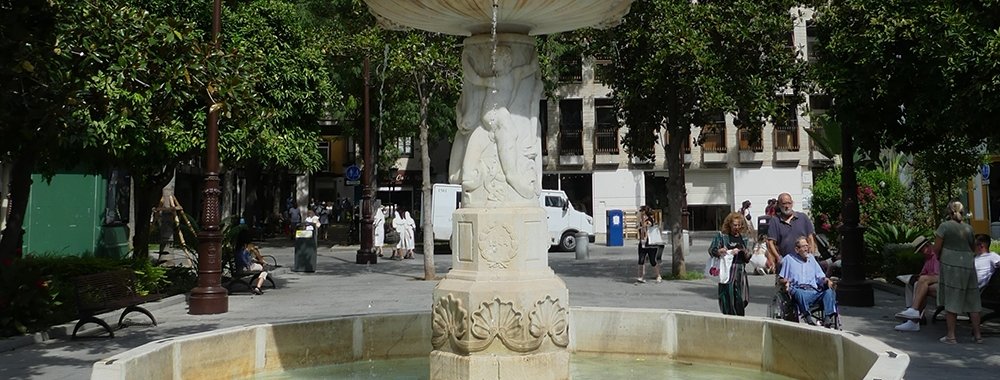
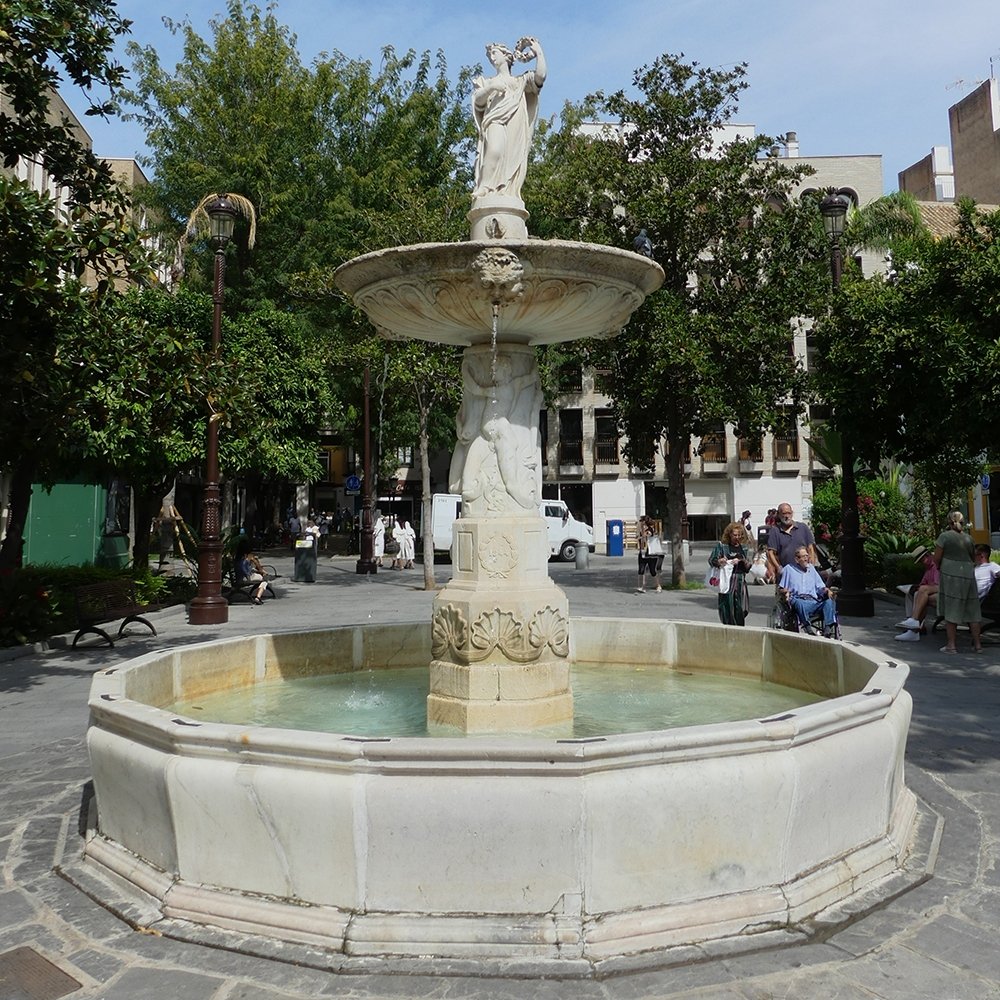
In the centre of the Plaza de la Magdalena there is a marble fountain from 1844, crowned by an 18th century sculpture representing the muse Calliope. The fountain is made up of a large polygonal vessel, in the centre of which there is a stem-shaft divided into two bodies by a second vessel, this time circular.

The first body of the shaft is decorated at its base with scallops, royal crowns, the symbol of the city (NO8DO) and the aforementioned date of the fountain's creation. In its cylindrical part there are several male mythological figures linked to the aquatic world (tritons). The circular vessel that supports this first body is ribbed and surrounded by four fountain masks through which the water falls to the sea of ​​the fountain.

Crowning the whole, we find a female sculpture holding a laurel wreath in her right hand. It could be the muse Calliope, protector of epic poetry and eloquence.

The square where the fountain is located was occupied by the primitive parish of La Magdalena, which today is located a few meters further west. This church was demolished in 1810, during the French occupation of the city. After the expulsion of the French, an attempt was made to rebuild the temple, but finally it was decided to open a square in its place, at which time the fountain was installed.

Elements from earlier sources were used for its construction. The main vessel comes from a fountain that was located in front of the Hospital de la Misericordia, in the current Plaza Zurbarán. It is probably of Italian origin and dates back to the Renaissance.

For its part, the first body of the central shaft and the circular vessel come from a mannerist fountain that was located in the Alameda in the 16th century. Finally, the female sculpture that tops the ensemble comes from the 18th century sculpture collection that the Archbishop's Palace of Umbrete held. A good part of the sculptures from this collection are now found decorating the Garden of Delights, in the south of the city.

This combination of origins gives the fountain a rather eclectic character, mixing the classicism of the Renaissance and the 18th century with the 19th century romanticism of the time when it was recomposed.

“Calliope, in Greek mythology, according to Hesiod’s Theogony, foremost of the nine Muses; she was later called the patron of epic poetry. At the behest of Zeus, the king of the gods, she judged the dispute between the goddesses Aphrodite and Persephone over Adonis. In most accounts she and King Oeagrus of Thrace were the parents of Orpheus, the lyre-playing hero. She was also loved by the god Apollo, by whom she had two sons, Hymen and Ialemus. Other versions present her as the mother of Rhesus, king of Thrace and a victim of the Trojan War; or as the mother of Linus the musician, inventor of melody and rhythm. Her image appears on the François Vase, made by the potter Ergotimos about 570 bce.”

Britannica, The Editors of Encyclopaedia. "Calliope". Encyclopedia Britannica, 1 Dec. 2023, https://www.britannica.com/topic/Calliope-Greek-Muse


* Wikimedia Commons

FOUNTAIN IN THE PLAZA DE LA ENCARNACIÓN

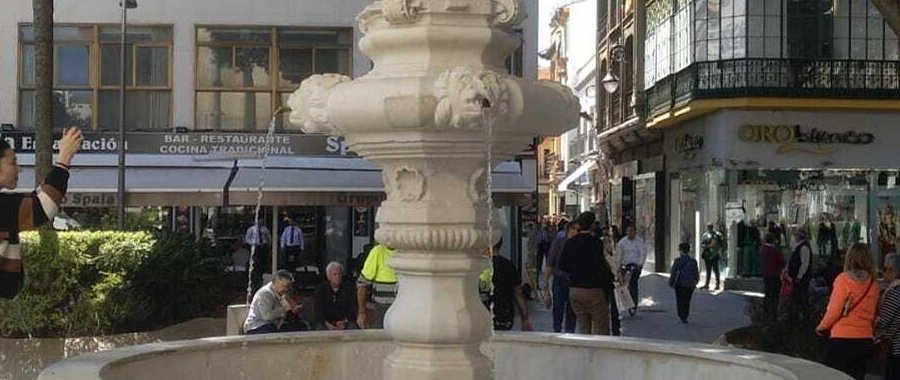
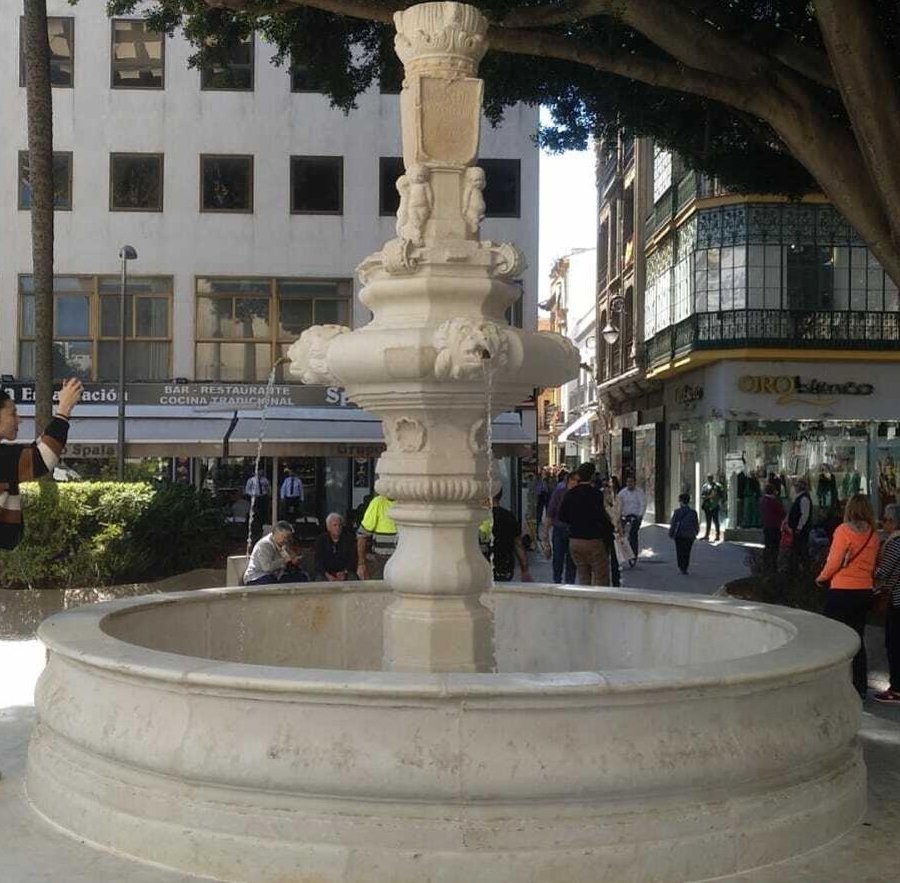
In the Plaza de la Encarnación there is an original marble fountain from the 18th century, considered the oldest of those preserved in Seville. It is made up of a large circular section vessel, in the centre of which stands a baroque-shaped fountain-shaft. In the middle there are some sort of zoomorphic masks that pour out the water, probably representing the four mythical rivers that watered the original Paradise. Crowning the fountain, four little angels hold a four-sided shield on which there are inscriptions narrating the various events in the history of the monument.
The square where it stands today was the site of the former Convent of the Augustinian nuns of the Encarnación since the end of the 16th century. The fountain was placed around 1720 in a small square at the entrance to this convent. It had a practical function, as it was one of the points through which the water that reached the city through the Caños de Carmona was dispensed.
In 1811, during the French occupation, the convent was demolished and, years later, it was decided to build a food market in the same place. The fountain then moved to a space next to the new market. A century later, around 1948, an urban remodelling of the area took place and the fountain was moved to its current location.

The fountain was built in the Baroque style, but, as it has come down to us, it includes some neoclassical elements, probably added in a restoration in 1861.


* Diario de Sevilla

FOUNTAIN OF THE GOD MERCURY

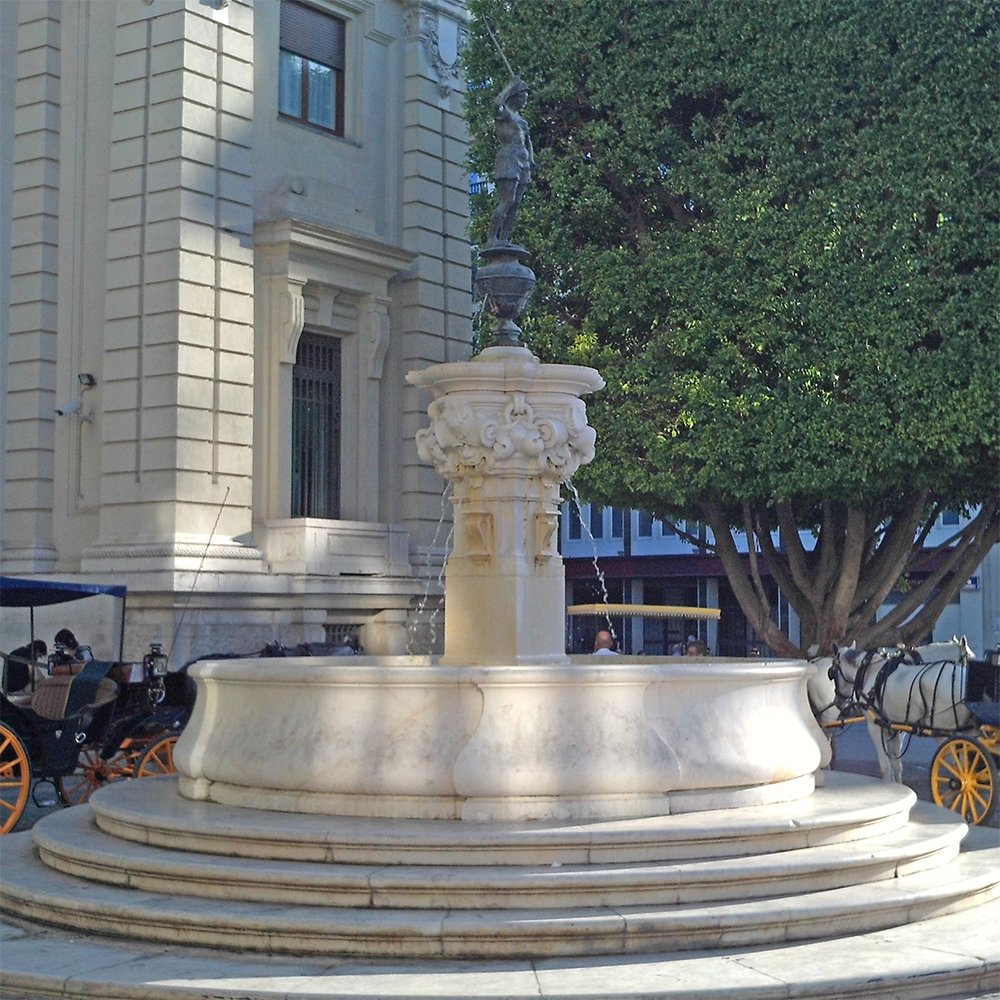
Located at one end of Plaza de San Francisco, opposite the main façade of the Bank of Spain, we find a fountain dedicated to the god Mercury. It has a circular basin raised on four steps, in the centre of which there is a pillar with neo-baroque decoration. On each of its sides there are "masks" that pour jets of water onto the sea of ​​the fountain.

The bronze statue that crowns the fountain represents Mercury, the Roman god of commerce, heir to the Greek Hermes. Specifically, due to its iconography, it can be said that it is a "Hermes Argifonte", since he holds a sword in one hand and a caduceus in the other, recalling the order he received from Zeus to kill the multi-eyed giant Argos Panoptes, who was watching the nymph Io in the sanctuary of Hera.

The fountain that we find today is the result of a reconstruction carried out by the architect Rafael Manzano in 1974. For its design he followed the model of a previous fountain that was in the same place, the work of Juan Fernández Iglesias. The statue of Mercury that we can still see today belonged to this 18th century fountain.

There was even a previous fountain in the same place and with the same theme, built around 1576 and in whose design Asensio de Maeda participated as architect and Diego de Pesquera as the author of Mercury. The sculpture was cast in bronze by Bartolomé Morel, who was also the founder of the "Giraldillo", the monumental weather vane that crowns the Giralda. This primitive fountain was destroyed during a disturbance in 1712.

It seems that there has been a fountain in this area at least since medieval times. In all likelihood it was not a monumental fountain but was intended to supply water to the residents.

The choice of Mercury as the theme of the fountain is related to the commercial splendour in which Seville lived, mainly after the Discovery of America, when the city became the "gateway and port of America", as its port was the only one authorised for commercial exchanges between Spain and the American territories.

In fact, it is not the only fountain dedicated to Mercury in the city. There is another one in the Gardens of the Alcázar. It was made by Diego de Pesquera and cast by Bartolomé Morel around 1576.


* Wikimedia Commons

CHURCH OF THE MAGDALENE

The Church of Santa María Magdalena in Seville is an imposing Baroque temple built in the transition between the 17th and 18th centuries under the direction of the architect Leonardo de Figueroa. It is one of the most outstanding churches in the city due to its size, monumentality, decorative richness and quality of the works of art it houses. Not in vain, it is possible to find inside works by some of the most outstanding authors in the history of art in the city, such as Jerónimo Hernández, Valdés Leal, Juan de Mesa or Pedro Roldán.

HISTORY

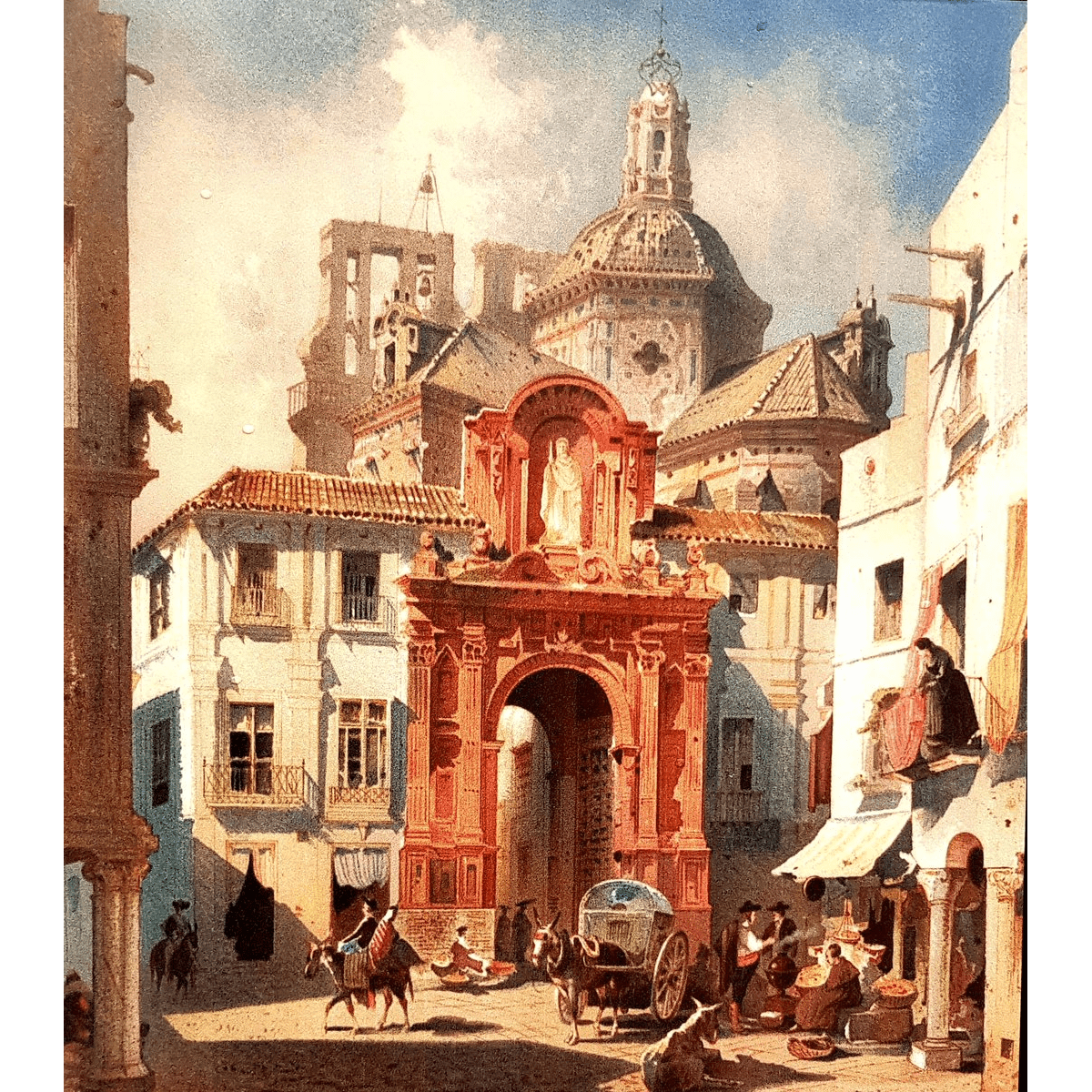
The building that currently houses the parish church of La Magdalena was originally the church of the convent of San Pablo el Real. This monastic centre belonged to the Dominican order and was founded in this place, close to the Puerta de Triana, shortly after the Christian conquest of the city in 1248. The land was donated by King Ferdinand III and the convent had the support of the Crown from the beginning. Hence the name royal and the numerous references to the monarchy found in its decoration.

The convent of San Pablo was the scene of important historical events, such as the founding of the Spanish Inquisition. On February 6, 1481, the first auto-da-fe in our history was held in its premises, in which six people were sentenced to death.

Later, the convent would play an important role in the process of evangelization of Hispanic America, since many of the religious people in charge of this task would leave from here. An example can be found on a marble plaque near the entrance on which the following inscription can be read:

"In this ancient Dominican convent of S. Pablo, on March 30, 1544, the Sevillian Fray Bartolomé de las Casas, protector of the Indians of the New World, was consecrated Bishop of Chiapas.”

The current temple is not the original one of the convent. In the same place there was previously a Mudejar church, some elements of which remain in the current building. This was in a state of ruin at the end of the 17th century and had to be demolished in 1691.

It was then that Leonardo de Figueroa was in charge of the project to build the current church. The works lasted until 1724 and some of the best artists in the city at that time worked on the ornamentation of the temple. The fresco paintings are mainly by Lucas Valdés, who worked together with a large group of painters. The altarpieces are practically all from the 18th century, by the best altarpiece makers of the time. Names of the stature of Jerónimo Hernández, Francisco de Ocampo, Juan de Mesa and Pedro Roldán were involved in their sculptural decoration.

The political and social turbulence of the 19th century meant that the convent church ended up as the parish of La Magdalena. With the disentailments of the 17th century, the church was converted into a parish church. In 1830, the convent was expropriated and the monks had to leave. On the other hand, the previous church of La Magdalena was demolished by order of the French during the Napoleonic occupation of the city. It was located right in the current Plaza de la Magdalena and the brilliant Juan Martínez Montañés was buried there. It is possible that the remains of the sculptor still rest today under the square, as commemorated by a plaque that can be read on the site.

After the expulsion of the French, the reconstruction of the church in its original location began. However, when the works were quite advanced, it was decided to abandon the project and demolish the building to leave the square. The solution for the parish was to move it in 1842 to the convent church of San Pablo, which was empty after the forced abandonment of its monks. The temple thus changed its name and became the church of La Magdalena, although numerous symbolic references to its previous owner persist.

As Santiago Montoto points out in “Parroquias de Sevilla”, “in this temple, among other illustrious Sevillians, are buried the president of the Junta de Defensa against the French, don Francisco Arias de Saavedra, later Regent of the nation, an illustrious man who deserves an extensive and complete monograph, and the unfortunate Count of Águila.

In the baptismal font of the parish, the immortal painter Bartolomé Esteban Murillo and the illustrious poet don Juan de Jáuregui received the regenerating waters. In the Archives, the marriage certificate of Juan Martínez Montañés and his burial certificate are preserved.”

At present, a total of four brotherhoods have their headquarters in this church:

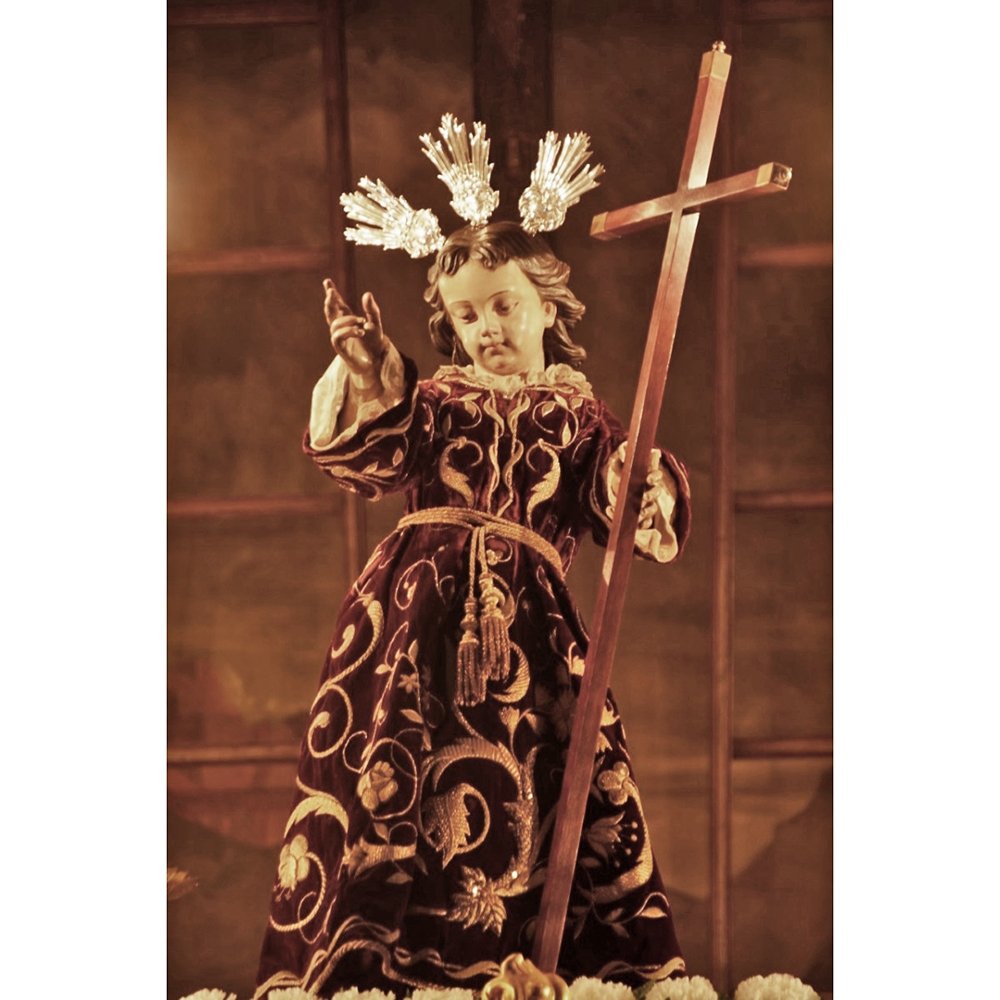
- Sacramental Brotherhood of the Magdalena, founded in 1575. It processes on Corpus Christi day with a magnificent monstrance from the 18th century, an Immaculate Conception by Benito de Hita y Castillo and a Child Jesus by Jerónimo Hernández.

- Brotherhood of Our Lady of Amparo, founded in the 16th century and re-founded in the 18th century. Its patron saint is a sculpture of the Virgin and Child made by Roque Balduque in 1535. The image is considered the patron saint of the Magdalena neighbourhood and takes part in the procession every second Sunday in November, the day of the Patronage of the Virgin.

- Brotherhood of Quinta Angustia, the result of the merger of two brotherhoods founded in the 16th century, that of Dulce Nombre de Jesús and that of Descendimiento. It makes a penitential station on Holy Thursday.

- Brotherhood of Calvary, founded in the 19th century in the church of San Ildefonso and moved to this parish in 1916. It takes part in the procession in the early hours of Good Friday with an imposing Christ made by Francisco de Ocampo in the 17th century.

DESCRIPTION

The church has a Latin cross plan with three naves, the central one being wider and higher than the side ones. At the head of the temple there is a deep polygonal presbytery, as well as four other rectangular chapels, two on each side. In addition, the plan is altered by four other chapels: two at the foot and two on the right side, the sacramental chapel and the chapel of Quinta Angustia.

It has four entrances from the outside, one at the foot and three on the right wall. The one at the foot would logically be the main one, but the truth is that it is currently in disuse, since that area ended up being configured as the upper and lower choir.

The roof is made by a barrel vault with lunettes in the central nave and the naves of the transept, and with a groin vault in the lateral ones. The center of the transept is covered by a large hemispherical dome on a drum, one of the most spectacular in the city.

Exterior

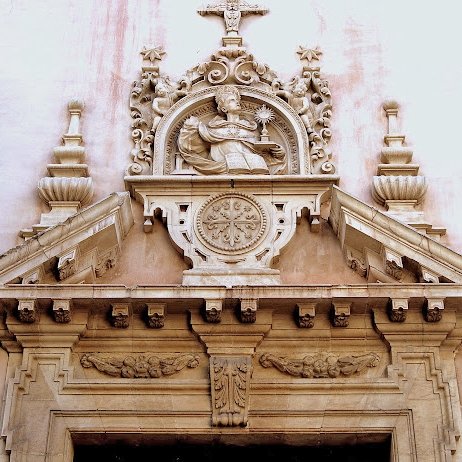
The church has several exterior doorways to frame its entrances, all of them from the beginning of the 18th century. The main doorway is located at the foot of the church, on Calle Cristo del Calvario, although as we mentioned it is practically in disuse today. It is a simple lintelled entrance topped by a broken pediment. In the centre of the pediment, an ornate niche houses a relief with a half-length representation of Saint Thomas Aquinas holding a monstrance with the Eucharist. The Dominican saint who lived in the 13th century is one of the most outstanding figures of Christian philosophy and theology during the Middle Ages.

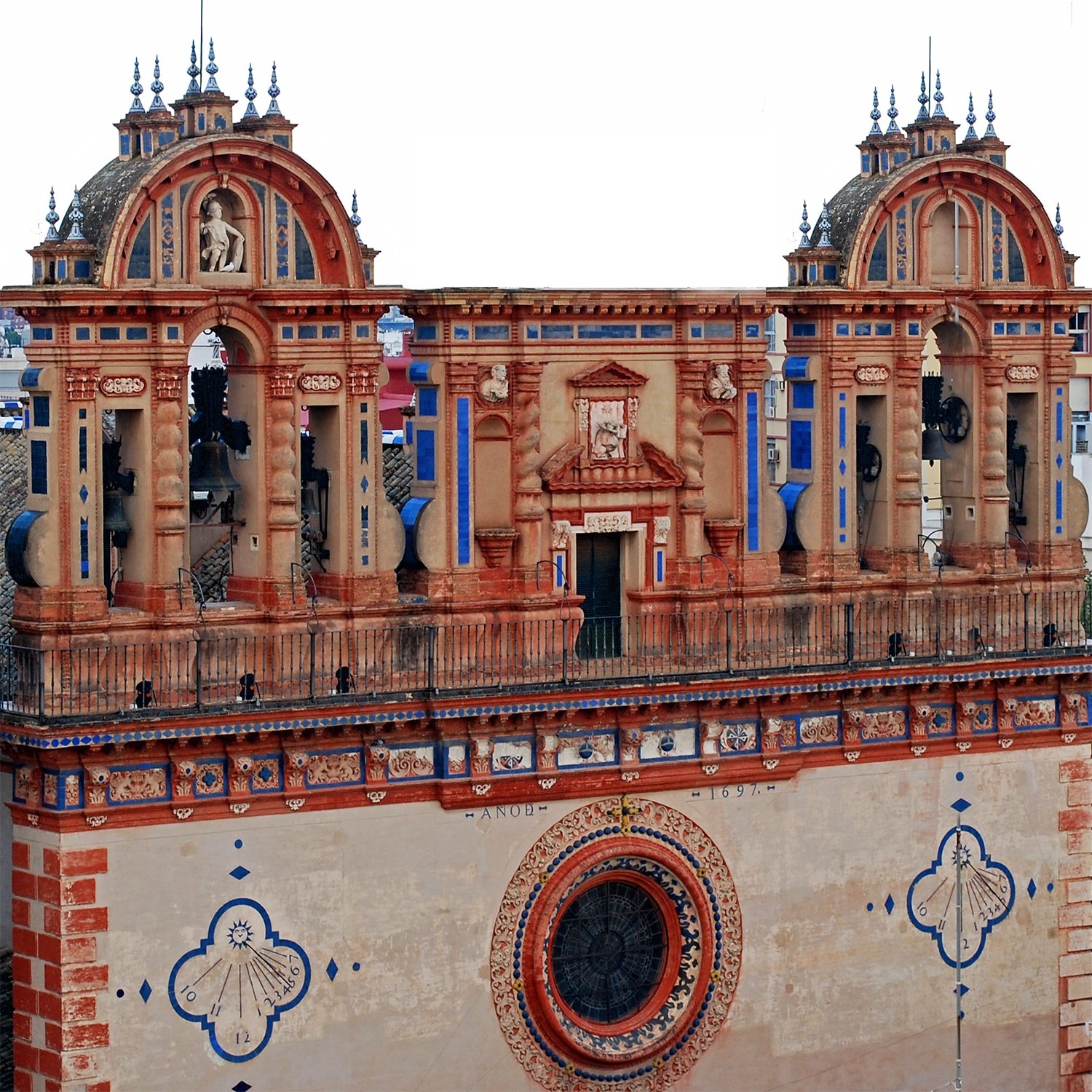
At a great distance above the doorway there is a large oval framed by an ornate baroque moulding. In it we can make out a series of small spheres that symbolise the beads of the Rosary. On either side we find two sundials.

At the top, the façade is crowned by a triple bell gable. On either side, there are two bodies that house three openings with bells each, while in the centre there is a small doorway like a balcony. In this central body there are two small busts of Saint Peter and Saint Paul and it is probably unfinished at the top. The ornamentation is focused on this area of ​​the façade, where we find Solomonic columns and geometric decoration based on blue glazed ceramics.

On the right side of the temple, we find three other entrances. The one closest to the feet is not decorated and is the one that serves as an independent access to the chapel of Quinta Angustia, which also has a direct connection to the rest of the church.

The central doorway is the largest and the one normally used to access the church. It has a very classical structure, with a semicircular arch flanked by pilasters that support a triangular pediment decorated with baroque rocaille. At the top, there is a cornice supported by corbels and above them a niche with the emblem of the Dominican order. Completing the ensemble, we find the bust of San Fernando, with orb and sword, recalling the royal foundation of the convent.

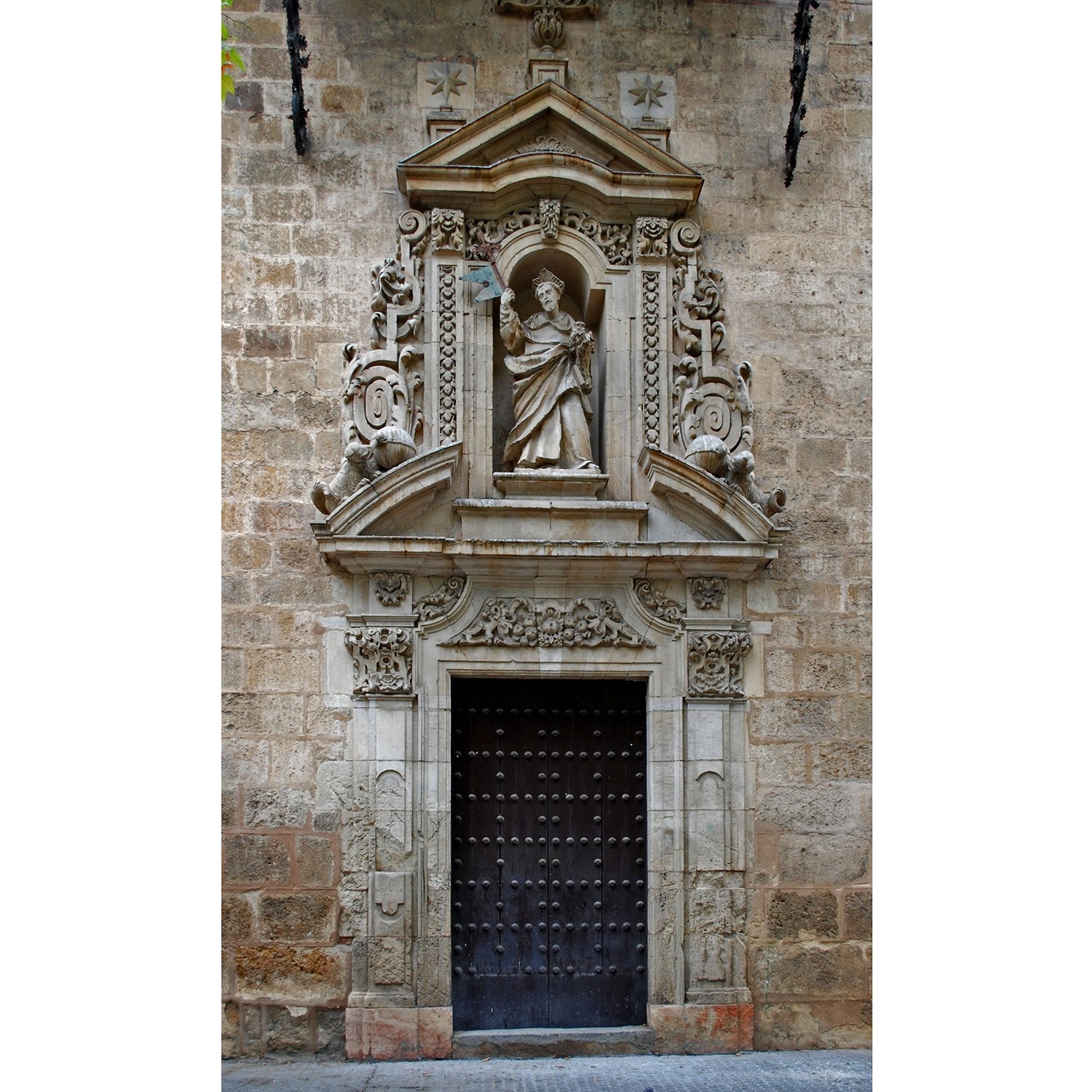
On the right is another doorway, smaller in size, through which one directly accesses the end of the right arm of the transept. As with the doorway at the foot, it is usually closed. It is a lintelled doorway with a curved pediment split in the centre, from which a niche with Saint Dominic opens. On the sides of the pediment, we find two dogs lying down, holding torches in their mouths, symbols of the saint and the order:

«The Legend (the first biography of Saint Dominic) tells of a vision that his mother, Blessed Juana de Aza, had before Saint Dominic was born. She dreamed that a little dog came out of her womb with a lit torch in its mouth. Unable to understand the meaning of her dream, she decided to seek the intercession of Saint Dominic of Silos, founder of a famous Benedictine monastery nearby. She made a pilgrimage to the monastery to ask the Saint to explain the dream to her. There she understood that her son was going to light the fire of Jesus Christ in the world through preaching. In gratitude, she named her son Domingo, like the saint of Silos. It is a very appropriate name, since Domingo comes from the Latin Dominicus, which means "of the Lord." From Dominicus (Sunday) comes Dominicanus (Dominican, which is the name of the Order of Saint Dominic). However, using a play on words, it is said that Dominicanus is a compound of Dominus (Lord) and canis (dog), meaning "the dog of the Lord" or the guardian of the Lord's vineyard.

In addition, other symbols related to the Dominican order appear in the decoration, such as stars or lilies.

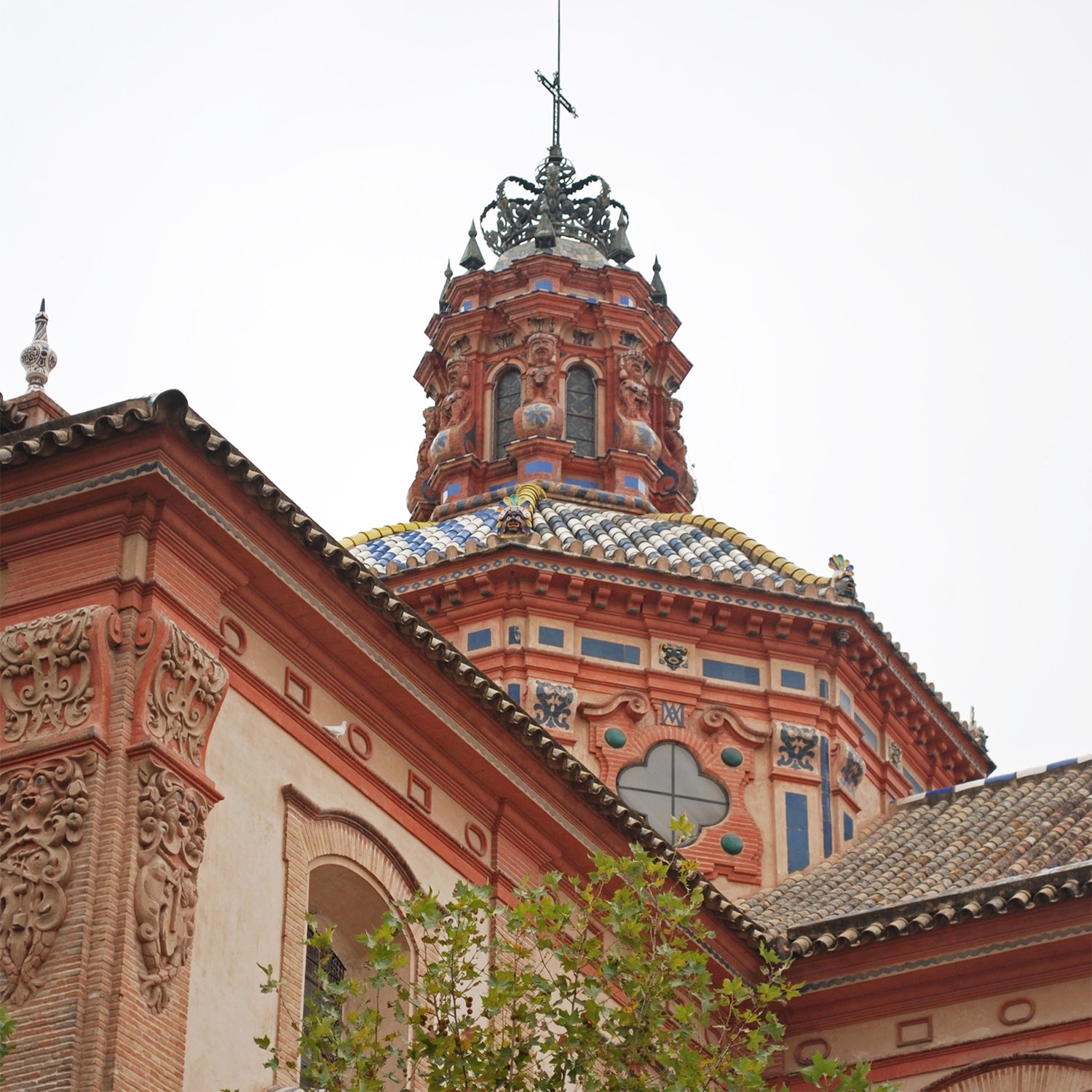
Despite the difficulty of seeing it from close up, the most characteristic element of the temple from the outside is its magnificent dome. It was the first one built in Seville on a drum, followed in this characteristic by those of El Salvador and San Luis de los Franceses, also designed by Leonardo de Figueroa. Specifically, it is an octagonal drum, on which rises the semisphere topped by a large lantern, also with an octagonal plan. To top it off is a huge royal crown of wrought iron, recalling the foundation of the convent by the royal initiative of Fernando III and its strong historical link with the Crown.

This is the first dome built by Leonardo de Figueroa and it already clearly shows some of the defining elements of his style, such as the rotundity of the lantern or the wealth of decorative elements, which also show a notable chromatic variety. These decorative elements have a clear iconographic reading linked to the evangelising work of the order in America. To make reference to this, a series of sculptural elements inspired by artistic representations of some of the pre-Hispanic cultures are included, reinterpreted in a picturesque way.

For example, the lantern is surrounded by a series of Amerindians who act as telamons, that is, they hold the cornice over their heads. In addition, the antefixes feature masks with very emphasized Negroid features, wearing curious feather headdresses in various colors. Other semi-fantastic characters appear in other parts of the façade, such as the pillars, inspired by pre-Hispanic art but in a very deformed way.

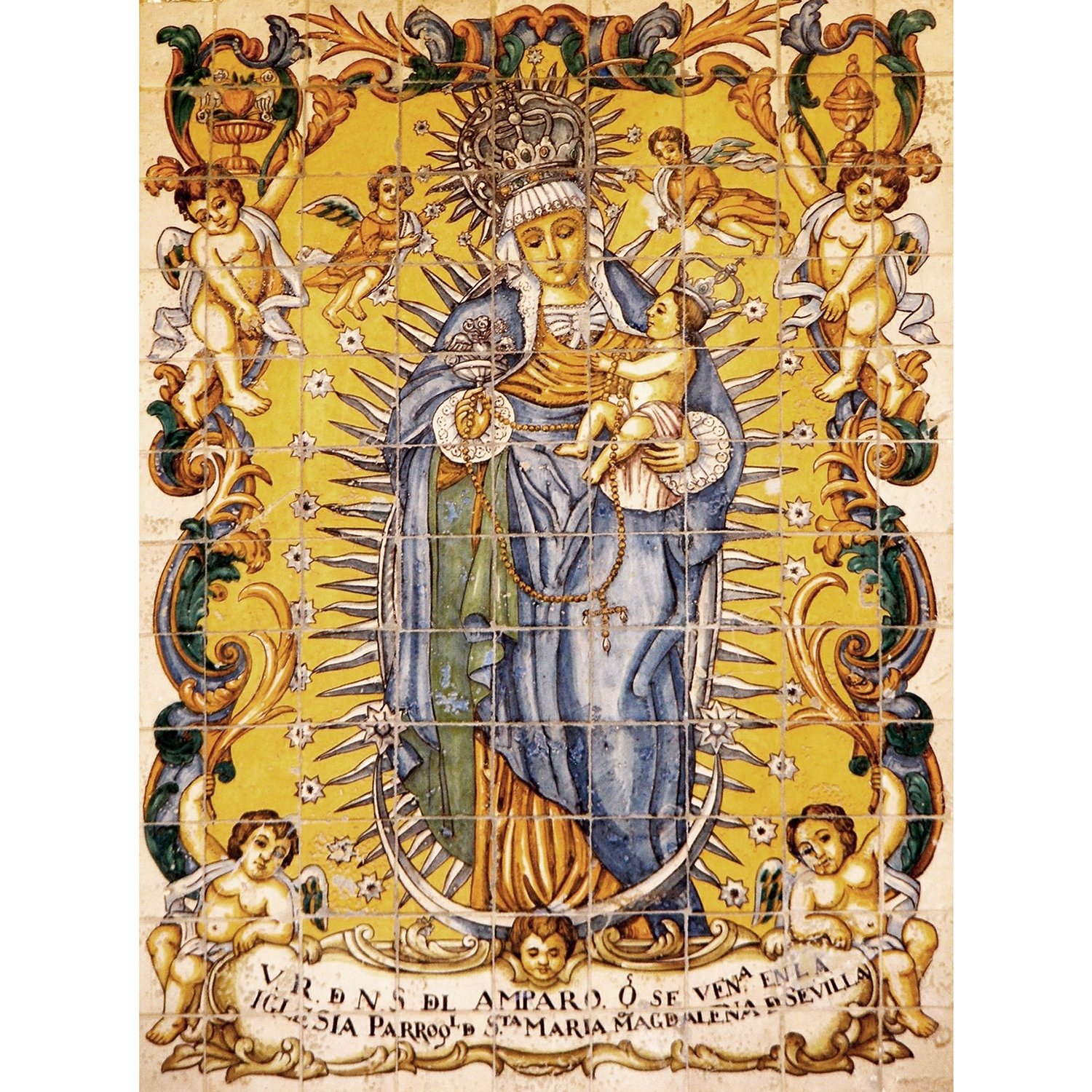
On the exterior façade, the church has two ceramic altarpieces. At the foot, on the façade on Cristo del Calvario Street, we find one dedicated to the Virgen del Amparo, patron saint of the parish. It was made in the 1940s by Antonio Muñoz Ruiz for the Mensaque factory and is protected by a small eaves illuminated by two beautiful wrought iron lanterns.

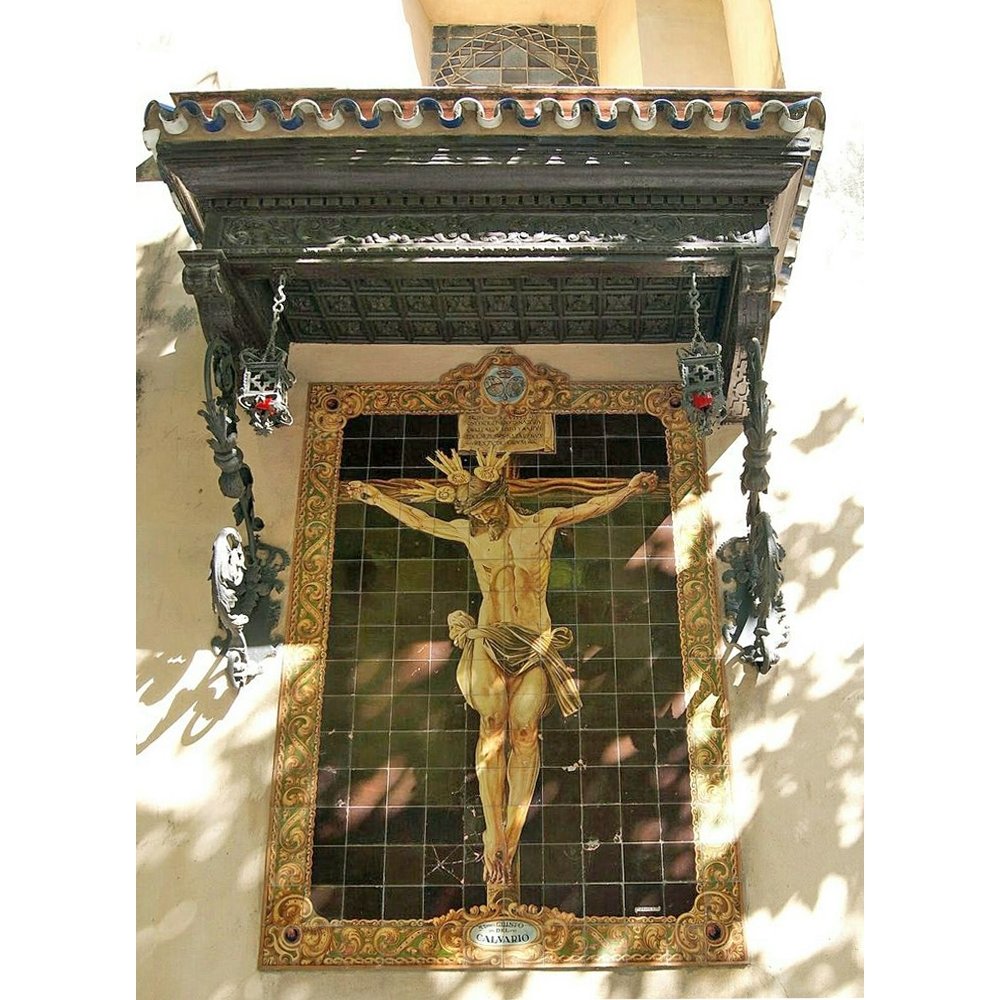
Towards San Pablo Street there is another ceramic altarpiece, dedicated in this case to Christ of Calvary. It was painted in 1942 by Alfonso Córdoba in the Pedro Navía factory in Triana. It is also protected by a roof, in this case of large dimensions. It is covered by glazed tiles and supported by two wrought iron corbels that imitate plant forms.

In addition, we find various commemorative plaques outside, such as the one we mentioned earlier in reference to Bartolomé de las Casas. The most beautiful is an elliptical marble piece surrounded by an impressive baroque moulding of curved shapes. It comes from the old convent of San Francisco, which was located in the current Plaza Nueva, and was moved to this parish after its demolition in the 19th century. It was probably originally a tombstone, as can be seen from the moving inscription, taken from a text by Saint Bernard of Clairvaux:

«NIHIL DULCIUS MIHI QUAM TECUM MURI, ET NIHIL AMARIUS QUAM VIVERE PORT MORTEM TUAM, JESU FILI MI. TU MIHI PATER, TU MIHI SPONSUS, TU MIHI FIUIUS, TU MIHI IMNIA ERAS. NUNO ORROR PATRE VIDUOR SPONSO DESOLOR PROLE, OMNIA PEDRO FILI MI, QUID ULTRA PACIAM?»

«There is nothing sweeter for me than to die with you and nothing more bitter than to live after your death. Jesus, my son. You are for me, father. You were for me, husband. You for me, son. You were everything for me. Now without my father I am an orphan. Without my husband, a widow. Without my son, alone. I lose everything, my son. What will I do from now on?»

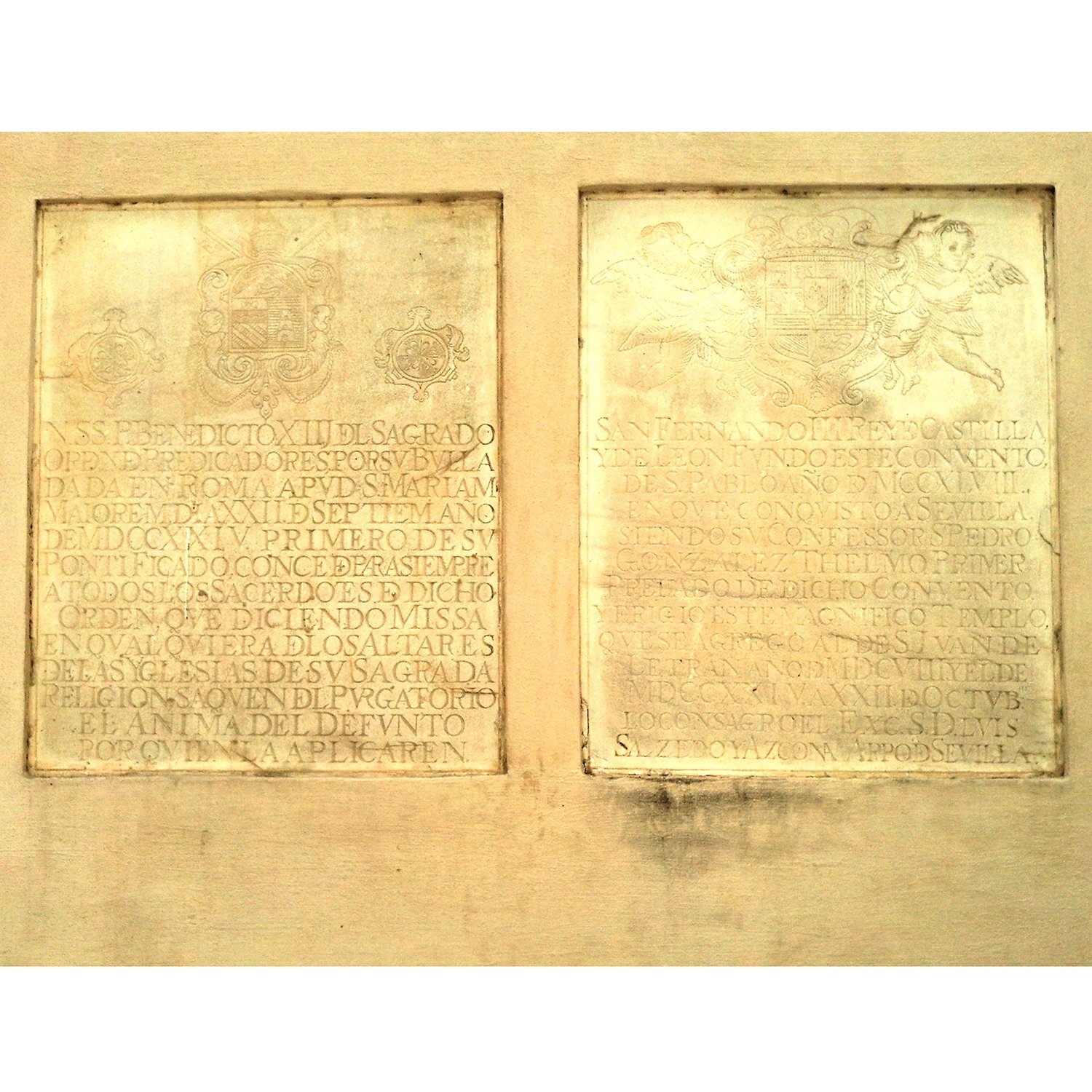
Another plaque alludes to the royal foundation of the convent by the hand of Saint Ferdinand himself:

«Saint Ferdinand III King of Castile and Leon founded this convent of St. Paul in the year MCCXLVIII when Seville was conquered, his confessor being St. Pedro Gonzalez Thelmo first prelate of said convent and he erected this magnificent temple which was added to that of St. John Lateran in the year MCCXLVIII and that of MDCCXXIV on October XXII was consecrated by His Excellency Mr. D. Luis Salzedo y Azcona Archbishop of Seville»

A final plaque refers to the granting of extraordinary indulgences on the occasion of the consecration of the temple in 1724:

«N. SSmo. P. Benedict XIII of the Sacred Order of Preachers by his Bulla given in Rome apud S. Mariam Maiorem on the XXII day of September, Year MDCCXXIV, first of his pontificate, grants forever to all priests of said Order that by saying Mass at any of the altars of the Churches of their sacred Religion they may take from Purgatory the soul of the deceased for whom they apply it.

Interior


Pictorial decoration

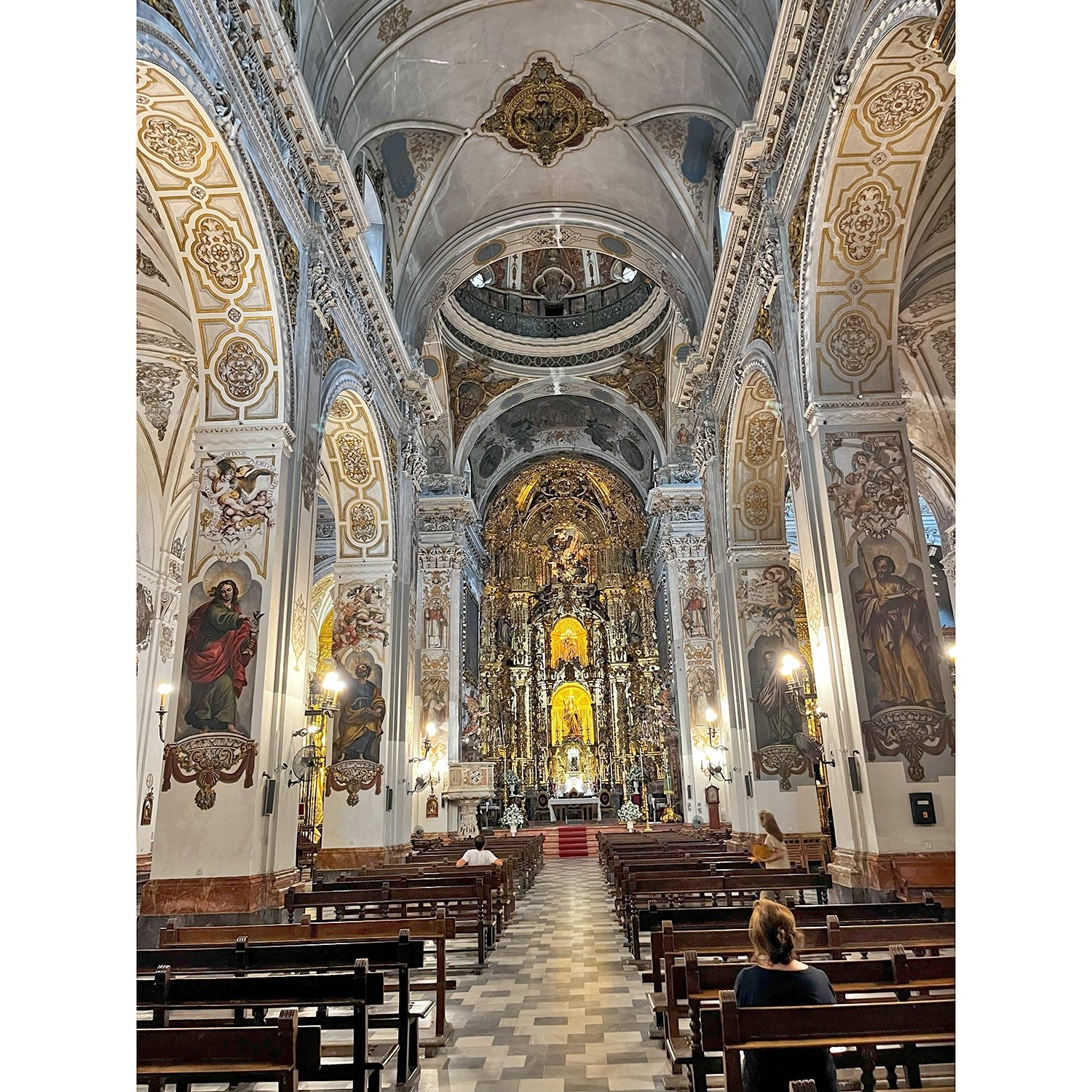
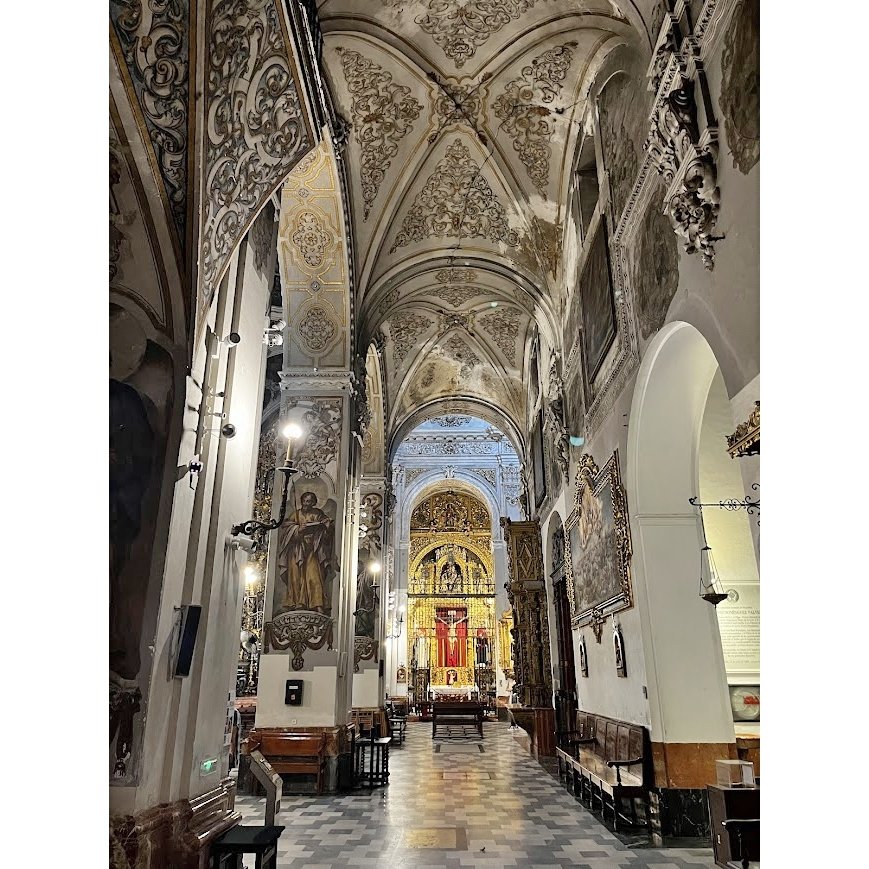
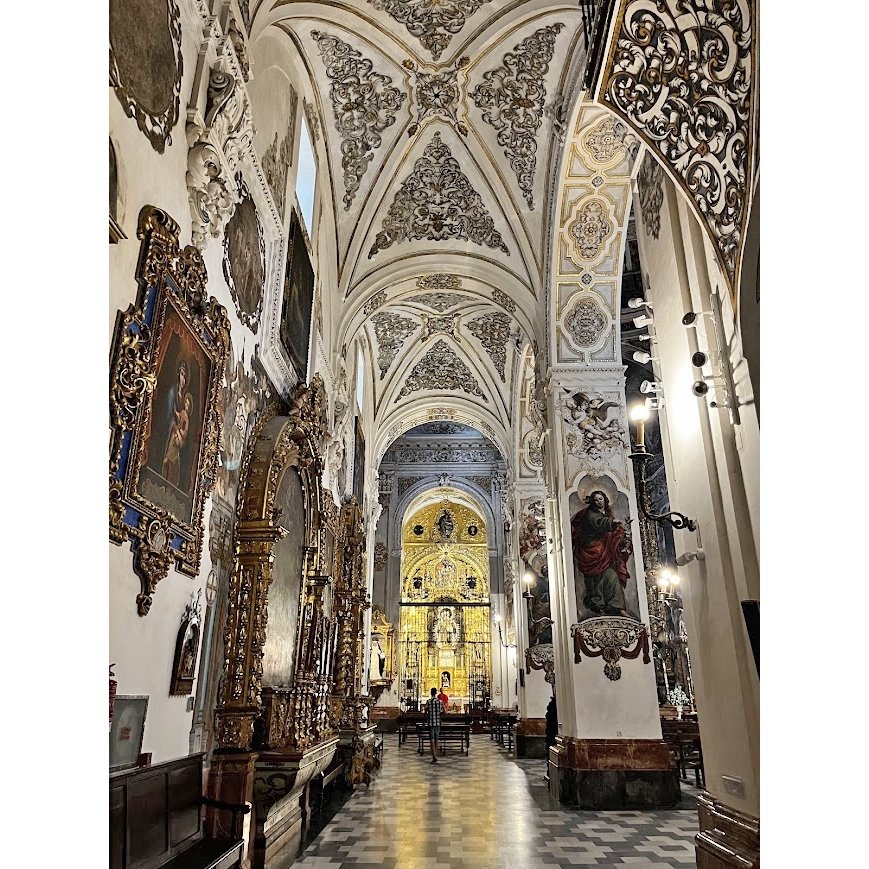
The first impression on entering the church is that of grandeur, due to its large size and its profusion of decoration. The walls are intensely decorated, with sculptural decoration concentrated mainly on the cornices and the profile of the arches, reproducing plant forms and baroque rocaille.

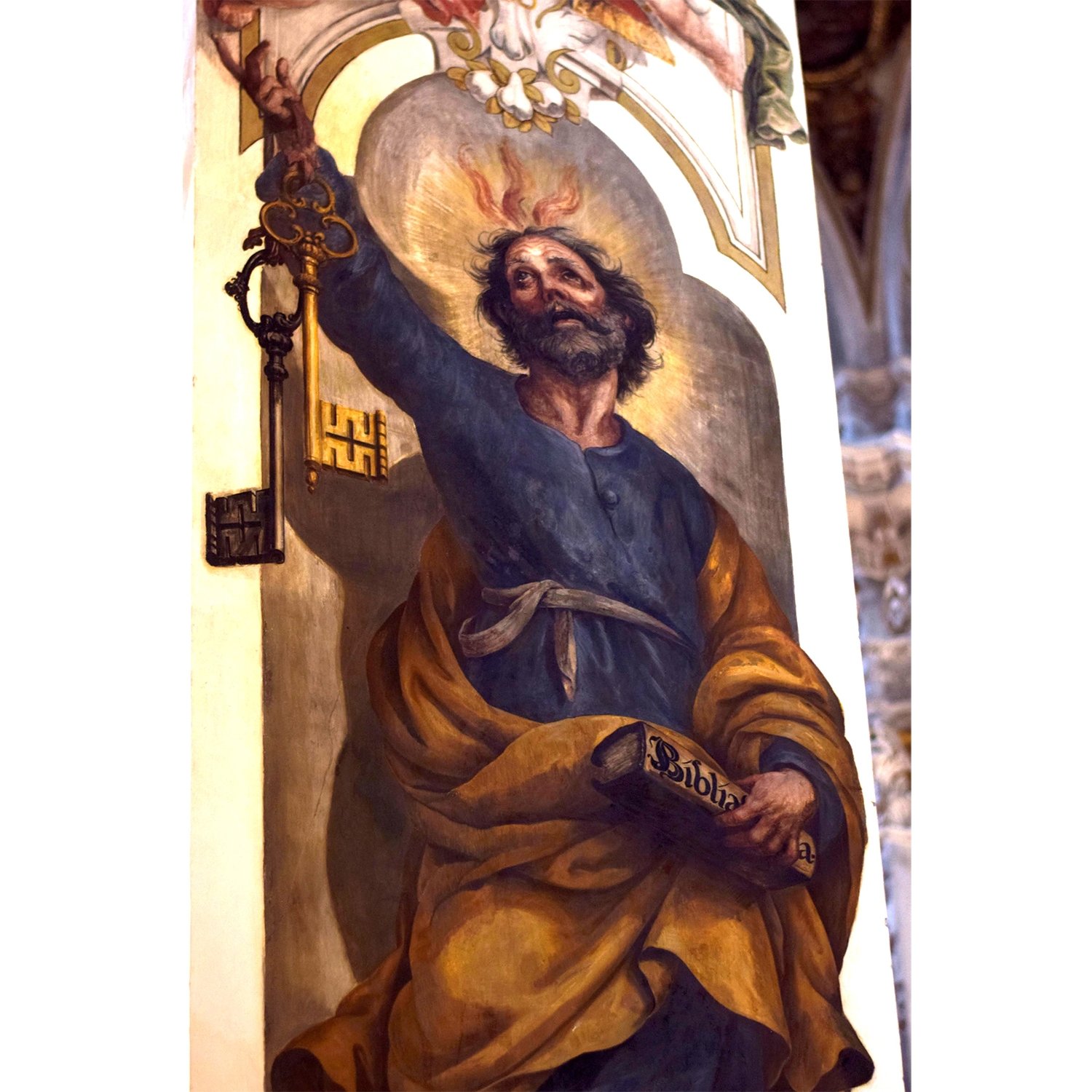
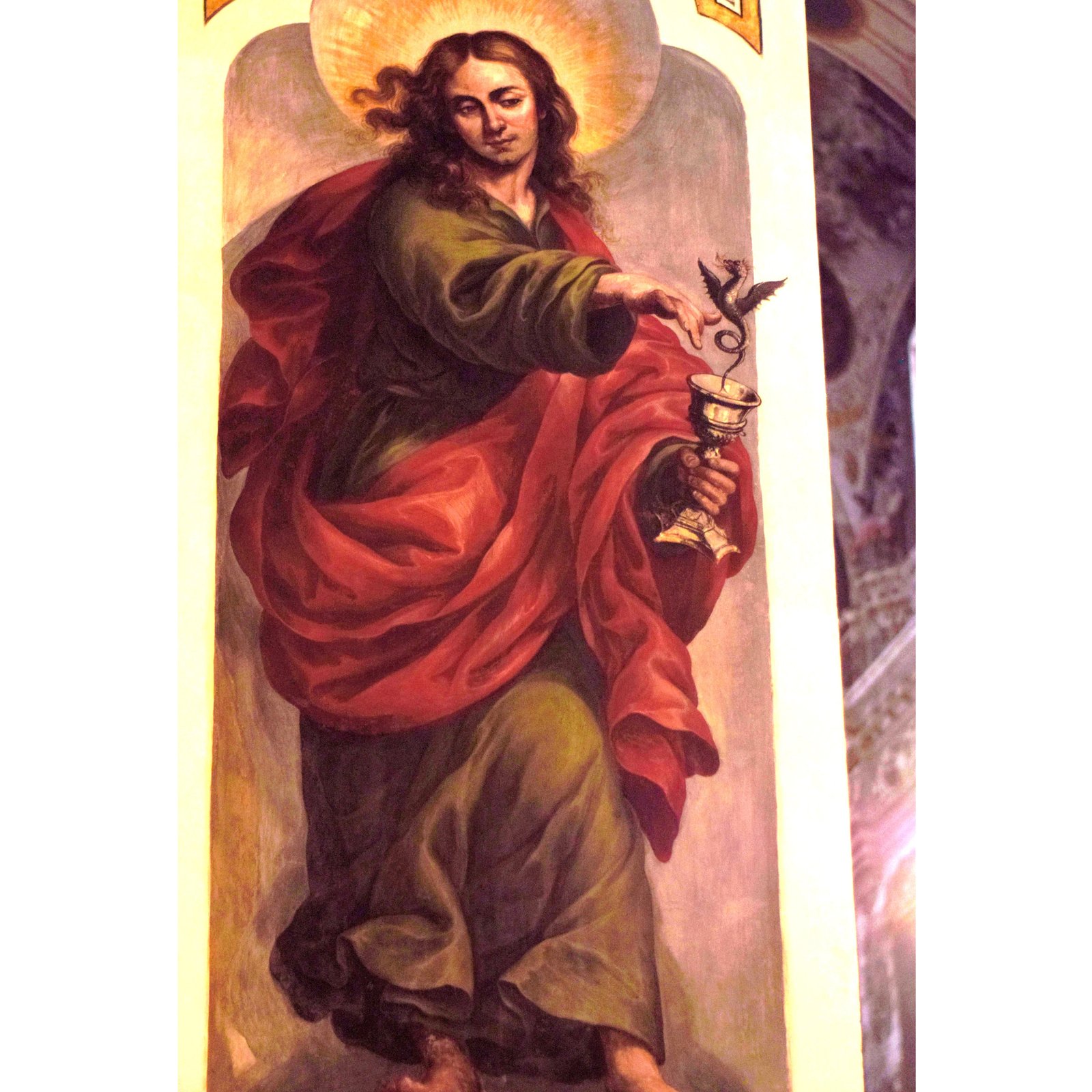
These same elements are repeated in the pictorial decoration, which covers almost the entire walls, in a complex iconographic programme directed by Lucas Valdés. On the pillars that separate the side naves from the central nave, there are representations of the apostles (with the exception of Judas Iscariot) and Saint Paul. Most of them were executed by Clemente Torres, although other artists such as Alonso Miguel de Tovar, Germán Lorente and Lucas Valdés himself also participated.

The pillars that delimit the transept space also represent a series of sixteen Dominican saints and blesseds: Benedict XI, Gonzalo de Amarante, Pedro Mártir, Antonino, Juan Martín de Coloma, Agustín Gaz Otto, Pío V, Alberto Magno, Jacinto, Jacobo de Meranía, Raimundo de Peñafort, Pedro González Telmo, Luis Beltrán, Enrique Susón, Vicente Ferrer and Ambrosio Sacedonio. According to Professor Enrique Valdivieso, “all of them show the characteristics of Lucas Valdés’ style.”

Lucas Valdés is also responsible for the large compositions that are arranged around the presbytery:

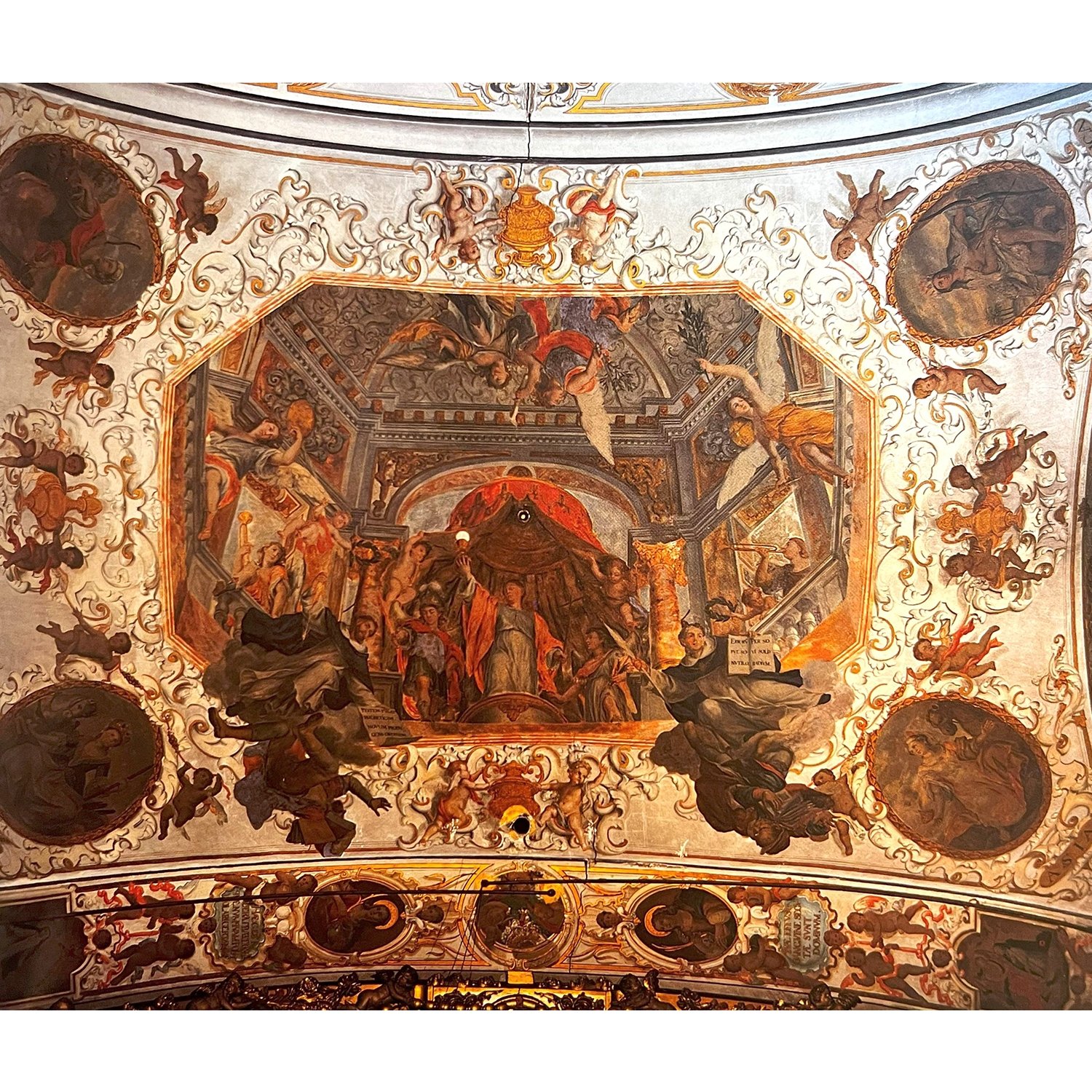
- “The Triumph of Faith”, in the vault above the main altar. The allegorical figure of faith appears framed by a showy frame of simulated architecture that imitates the sensation of depth. She appears escorted by Saint Michael, Saint Raphael and a whole court of angels who flutter and play musical instruments.

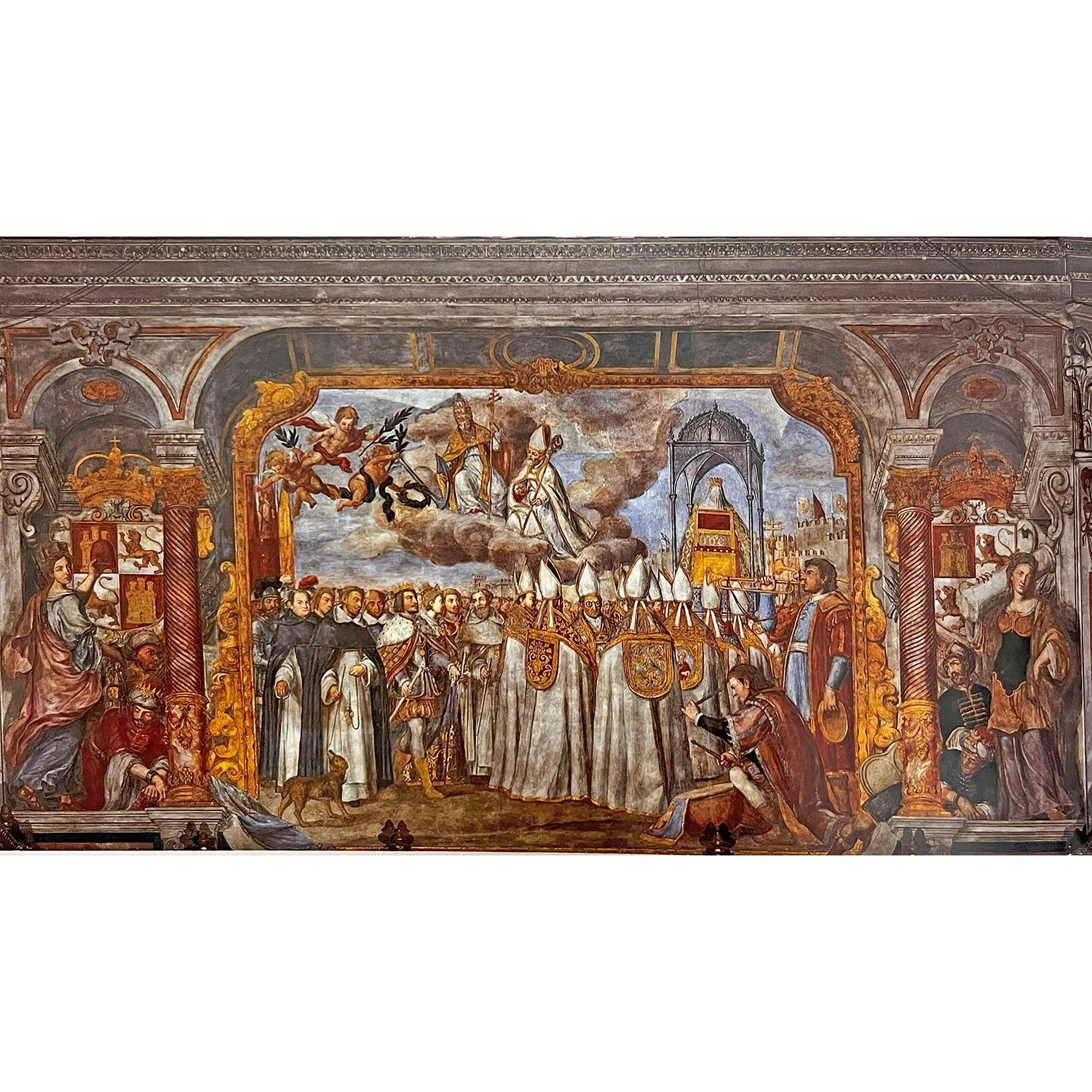
- “The Triumphal Entry of Saint Ferdinand into Seville”, in the upper part of the left end of the transept. The king appears accompanied by figures of the order, such as Saint Dominic himself. They participate in a procession of the Virgin of the Kings together with numerous prelates. On both sides, the allegorical figures of strength and temperance are represented. They are shown on royal shields and are accompanied by representations of bound Muslims who symbolise those defeated in the conquest. In the upper part of this same wall, two niches house two of the fathers of the Church: Saint Ambrose of Milan and Saint Gregory the Great.

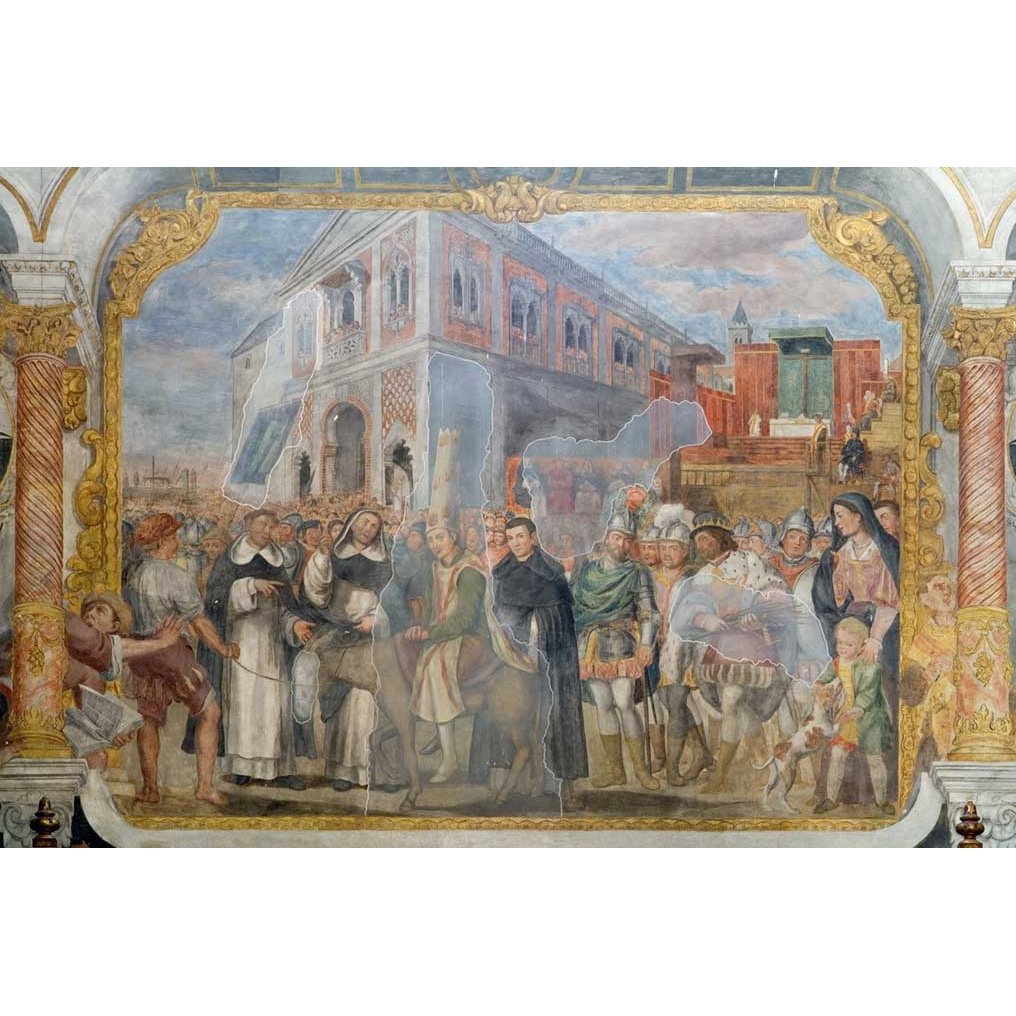
- “Auto de fe”, located just opposite the previous one, at the right end of the transept. It has been identified with the trial held in 1703 in which the merchant from Osuna, Diego Duro, was condemned. Enrique Valdivieso tells us that “this painting was partially destroyed later, in the figure of the condemned man to avoid his identification, around 1750, perhaps at the request of the descendants of the convict. In this painting of the Dominican order, her merits as a defender of faith and orthodoxy are once again praised, since it is precisely Dominican religious who accompany the convict who is riding on a donkey towards the scaffold”. On both sides there are two new allegorical figures, this time representing Religion and Justice crushing heresy, both backed by shields of the Dominican order. Again, at the top of the wall, we find the other two fathers of the Church: St. Augustine of Hippo and St. Jerome of Stridon.

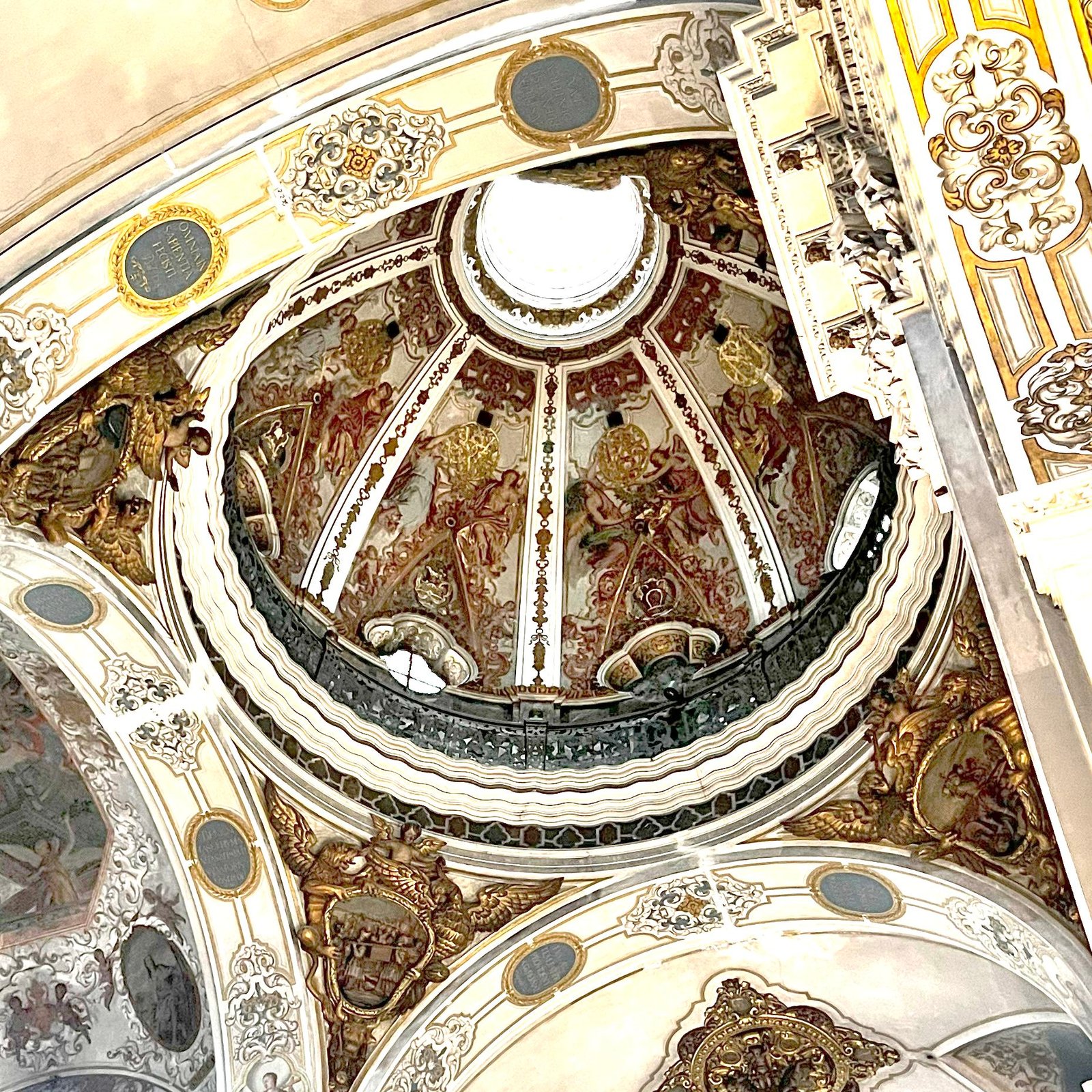
- The pictorial decoration of the interior of the dome is also the work of Lucas Valdés and is centred on the exaltation of the Virgin Mary. The interior of the dome is decorated with fresco paintings by Lucas Valdés. In each of the sections, a pair of angels hold a profusely decorated golden letter. Together they form the inscription AVE MARIA.

Inside the lantern, at the highest point of the entire space, a splendid golden sun appears on a dark blue background, around which can be read the Latin inscription ET CAEPISSE EST ALQUID, SED FINIS FACTA. That is to say, having started is something, but the end must be reached.

- On the side walls of the presbytery there are two large canvases with the themes “David before the Ark of the Covenant” and the “Offering of the High Priest Melchizedek”, both with scenes with Eucharistic connotations.

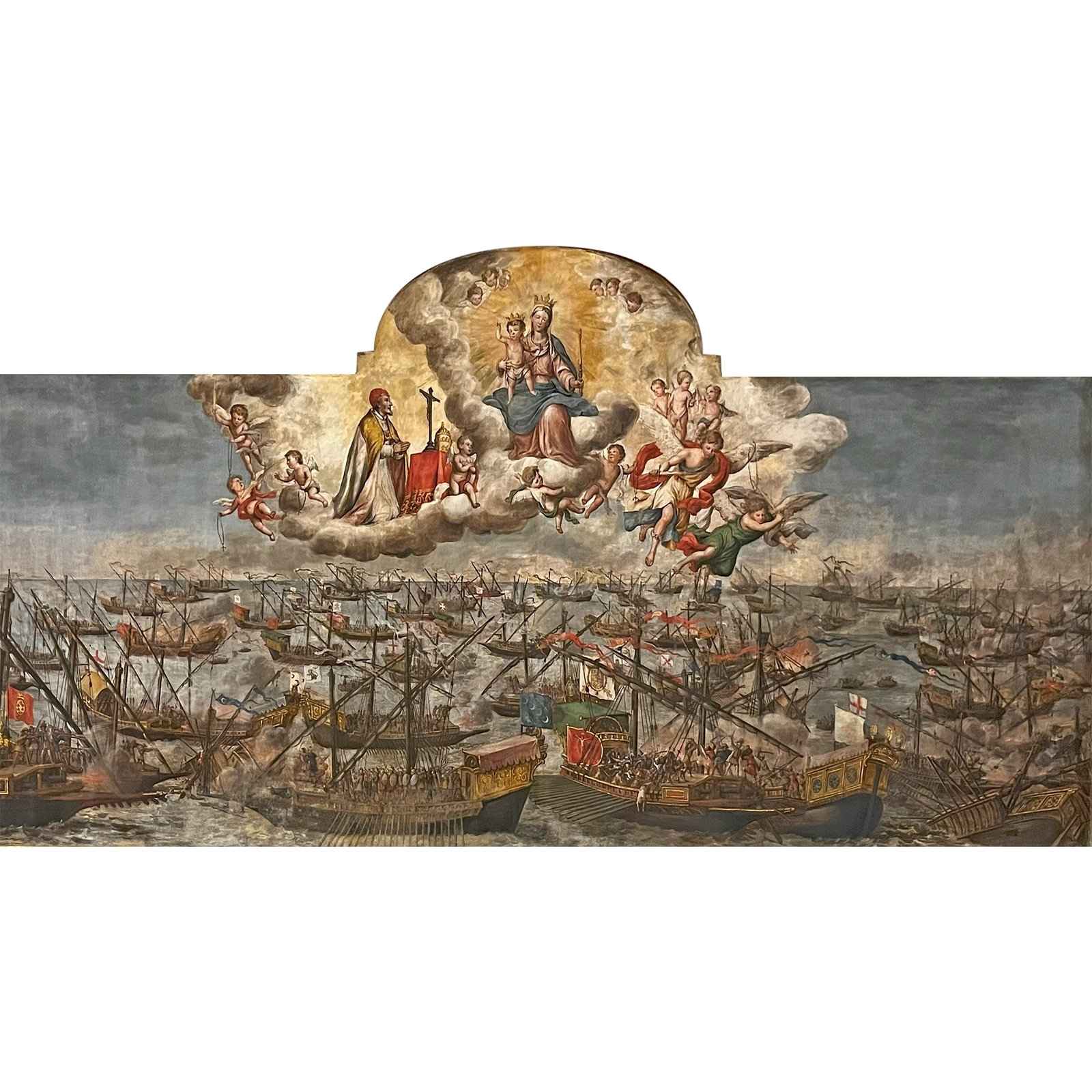
Finally, on the right wall of the church, next to the main entrance, we find one of the most interesting paintings in the church. It was made by Lucas Valdés around 1710 and represents the Battle of Lepanto. More specifically, "The Virgin of the Rosary protecting the Spanish ships in the battle of Lepanto." According to tradition, the Virgin of the Rosary interceded on behalf of the Christian troops on October 7, 1571 after the prayer of Pope Pius V, who would later establish this day as the day of the Holy Rosary.

Chapel of the Quinta Angustia

After entering the church through the main door, on the right is a large chapel that is currently the headquarters of the Brotherhood of the Quinta Angustia. It is the result of the union of three previous funeral chapels, which belonged to the Medina, Rosales and Gómez de Espinosa families. Some elements of them are preserved, such as the three beautiful octagonal vaults with Mudejar latticework decoration that cover the different sections of the chapel. They were built around 1400, so they are a surviving part of the primitive Gothic Mudejar temple before the current one.

The altar of the chapel is presided over by the mystery of the Lord of the Descent, the titular of the brotherhood. It is a group with works by various authors and chronology. The Christ is the work of Pedro Roldán around 1660 and the rest of the figures were carved in his workshop by one of his disciples. The exception is the Virgin of Fifth Anguish, a contemporary work by Vicente Rodríguez Caso (1934).

In front of the mystery of the Descent, we find a masterful Infant Jesus made by the Renaissance sculptor Jerónimo Hernández around 1580. It could be considered a precursor to the famous Infant Jesus that Martínez Montañés would make for the church of the Sagrario in 1606.

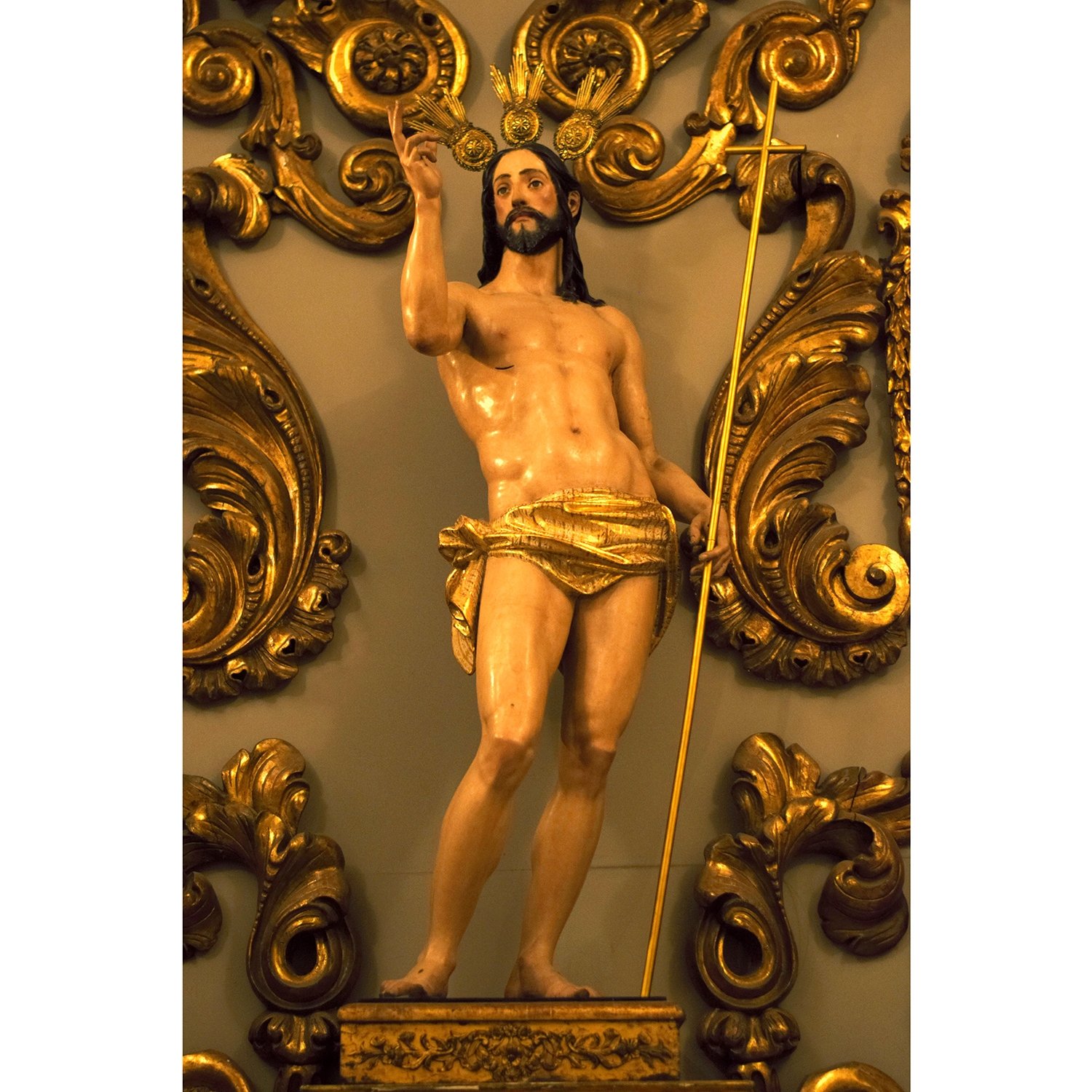
By the same author, the brotherhood preserves a Resurrected Christ with proportions, quality and serenity in its anatomy that make it one of the most distinguished sculptures of the Seville Renaissance. The exact date of its commission is known: 1582.

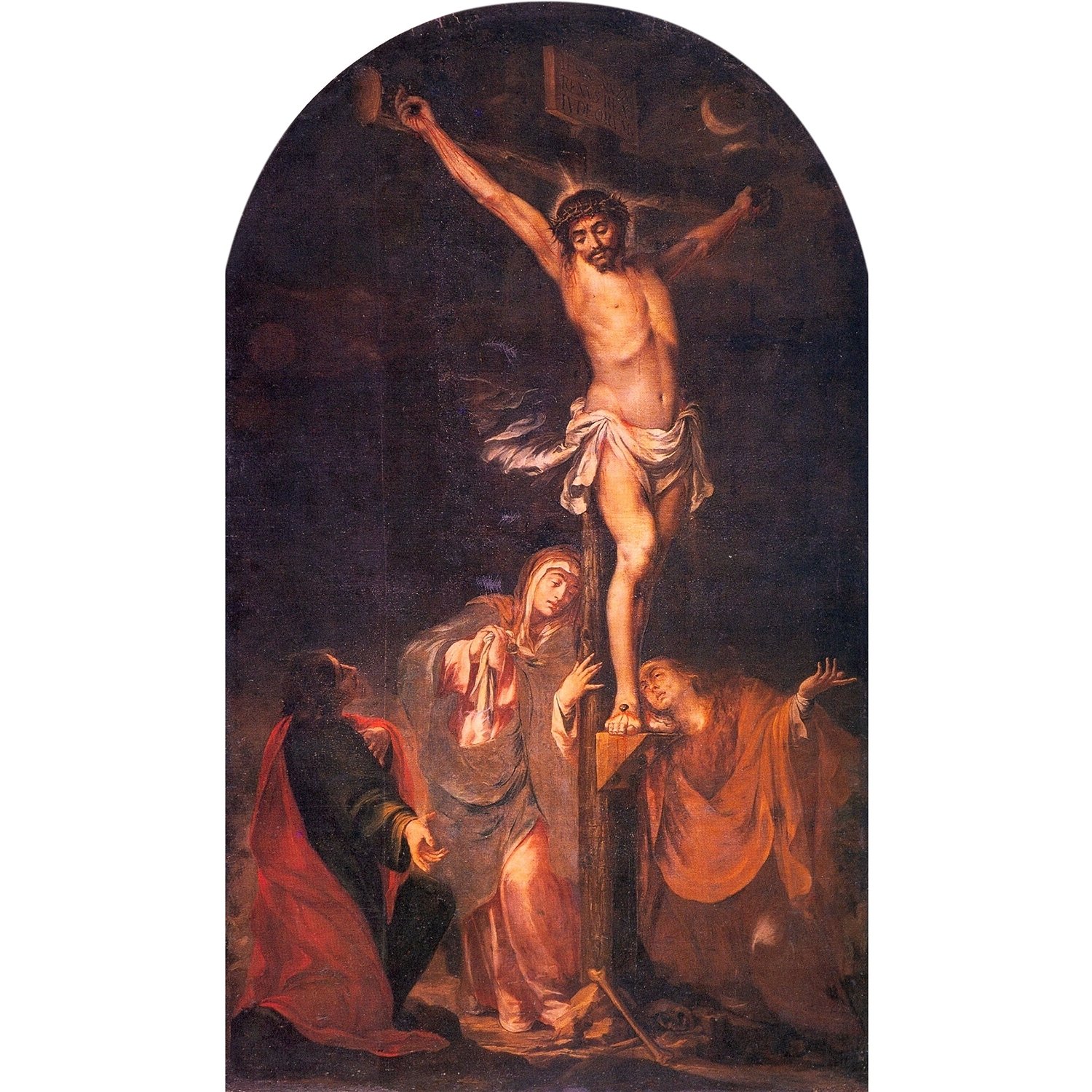
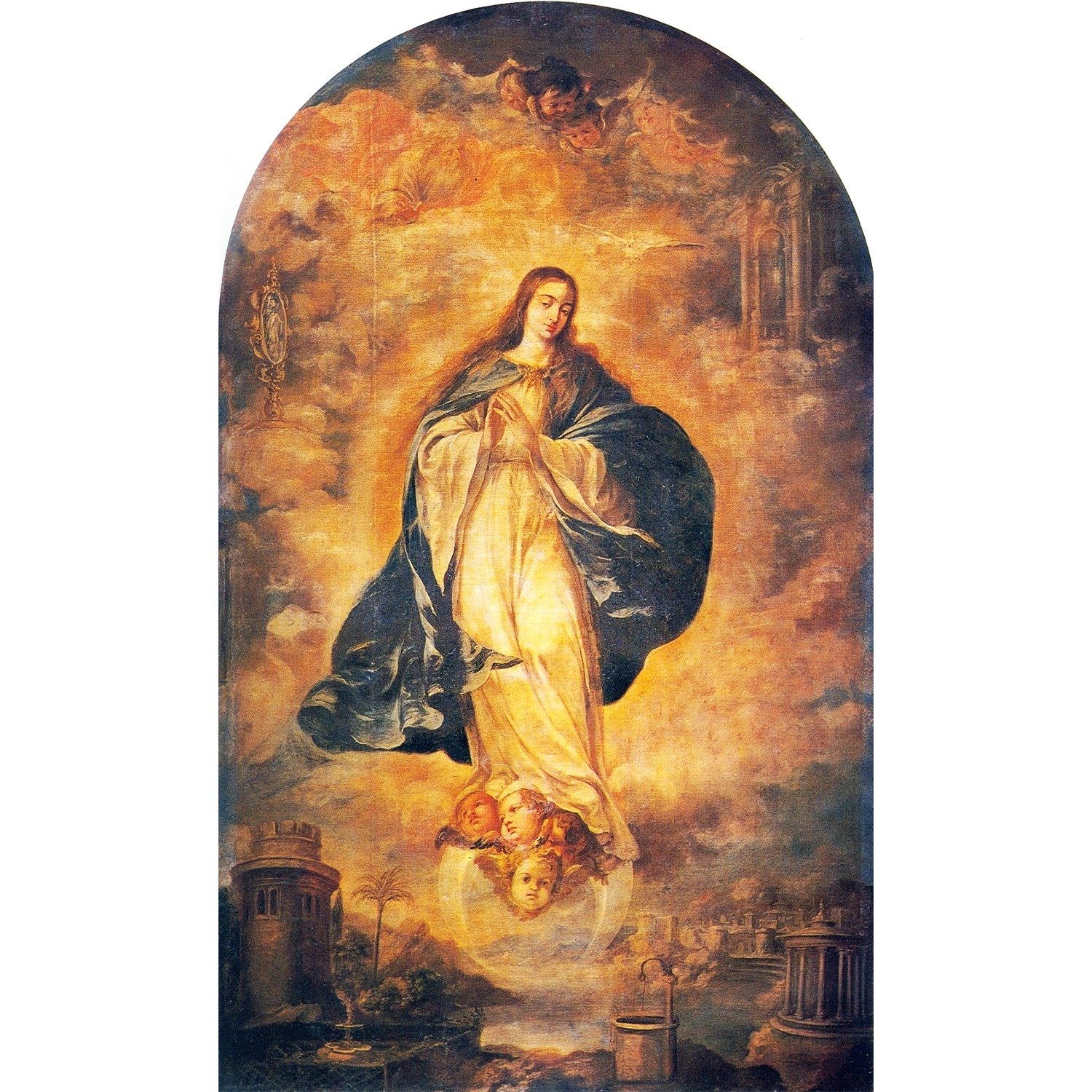
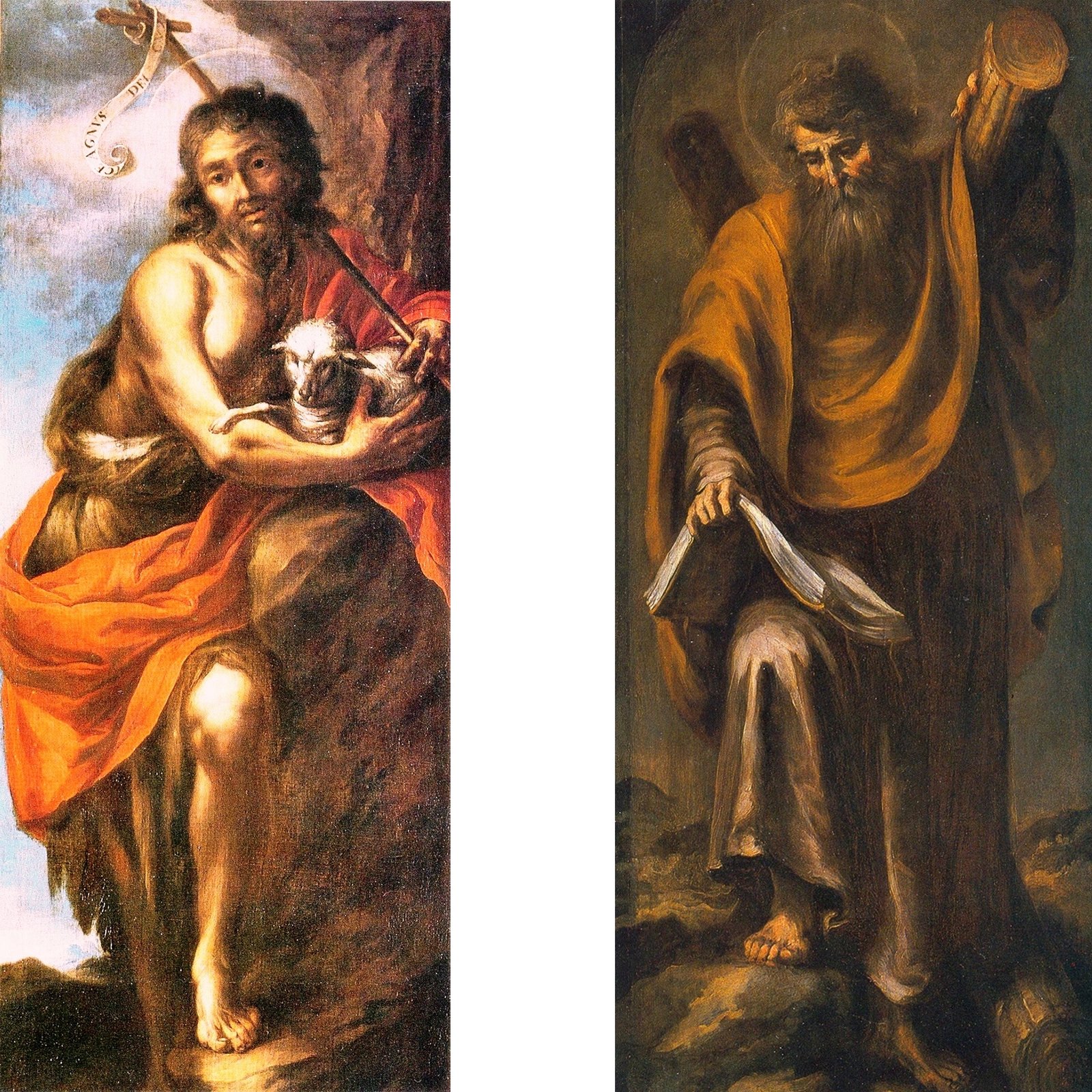
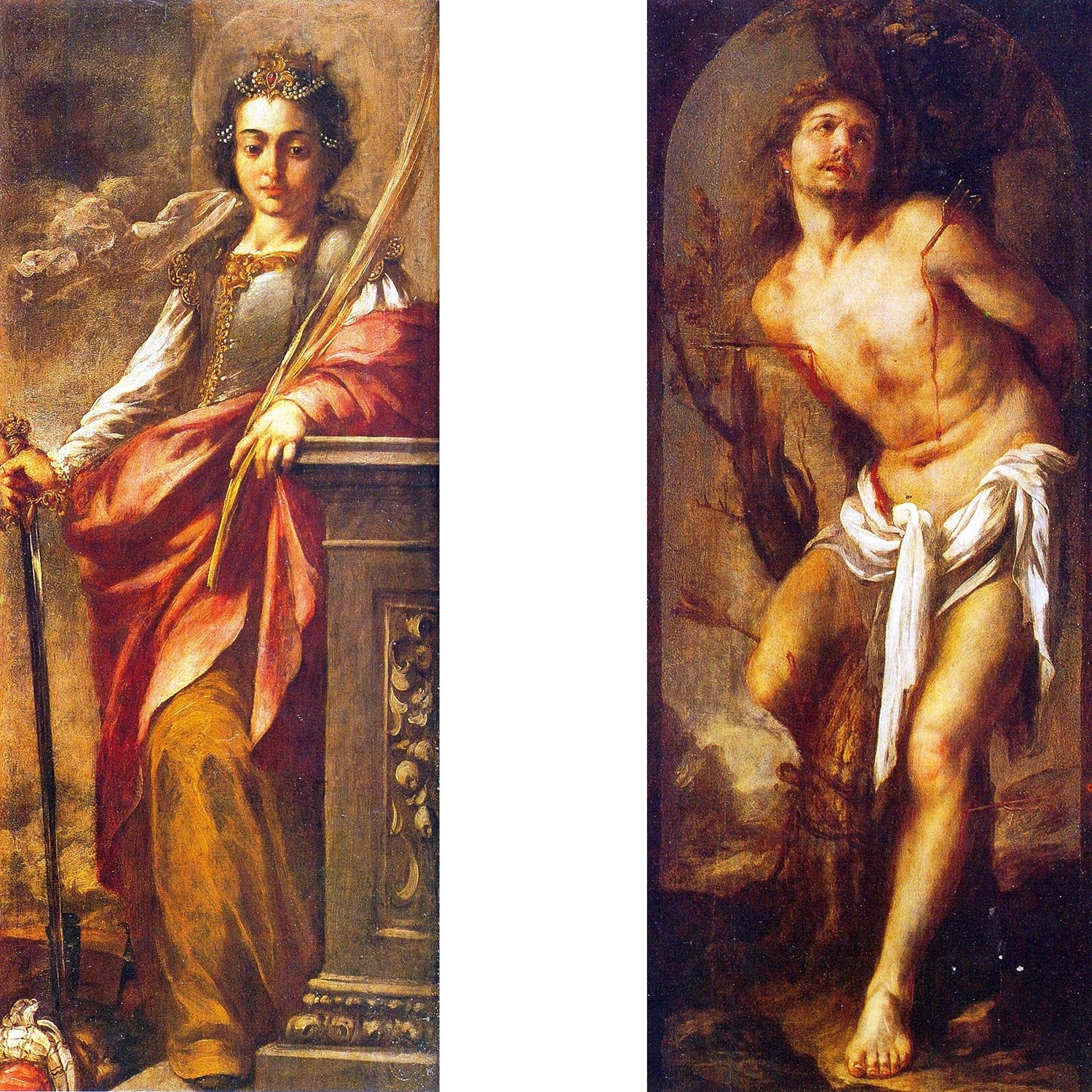
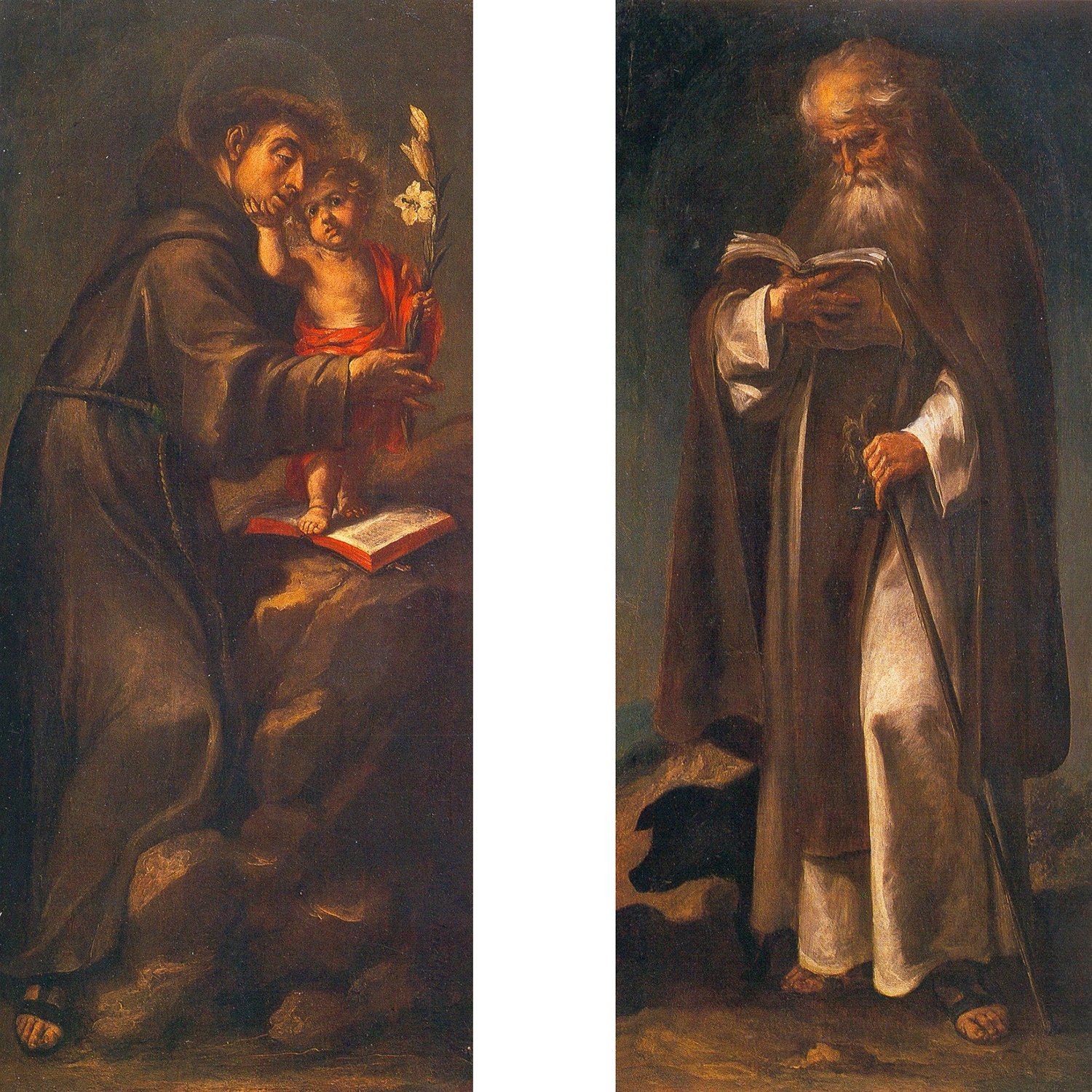
The chapel also has an exceptional collection of paintings. It is a series of canvases painted by Valdés Leal around 1660 and which originally formed part of the main altarpiece and two side altarpieces of the church of San Benito de Calatrava, which was located in a now-disappeared convent that this order had very close to the old door of the Barqueta. The side altarpieces were composed of a single painting each, with the “Calvary” and the “Immaculate Conception”. The main altarpiece consisted of two bodies and an attic. In the centre of the first body there was a representation of “The Virgin with Saint Bernard and Saint Benedict” which has not been preserved. On the sides were located "Saint John the Baptist", "Saint Andrew", "Saint Catherine" and "Saint Sebastian". In the centre of the second body was the "Saint Michael", flanked by "Saint Anthony of Padua" and "Saint Anthony the Abbot". In the attic there was a representation of “God the Father”, which has also been lost.

All the works were in the Museo del Prado in 1991 participating in the monographic exhibition on their author.

Presbytery

The presbytery is presided over by a magnificent altarpiece designed by Pedro Duque Cornejo at the beginning of the 18th century. Sixteen metres high, it is the second largest in the city, after the cathedral. It is divided into three sections separated by Solomonic columns, which are in turn articulated horizontally into a bench, two bodies and an attic. The sculptures are all the work of Duke Cornejo himself, with the exception of those representing Mary Magdalene and Saint Paul in the central niches.

In the central niche of the first section is the patron saint of the temple, Saint Mary Magdalene, with a notable carving made by Felipe Malo de Molina in 1704. It is flanked by Saint Dominic and Saint Francis of Assisi in the side sections. In the centre of the second section we find an anonymous carving from the 17th century representing Saint Paul, who, it should be remembered, was the original patron saint of this church. On either side of the presbytery are the Dominican Popes Benedict XI and Pius V.

In the attic we find Saint Paul again, this time in a relief depicting the scene of his Conversion. On either side are two Dominican saints, Saint Catherine of Siena and Saint Rose of Lima.

On either side of the presbytery, beneath the two large canvases by Lucas Valdés already mentioned, there are two marble portals, framed by Solomonic columns and topped by the allegorical sculptures of Faith and Charity.

Choir

It is located at the foot of the temple, separated from the rest of the church by a small fence. The choir loft is covered by a lowered barrel vault with lunettes that supports the high choir. It is richly decorated with eight frescoes by Lucas Valdés with scenes from the Old Testament.

Above the former arches next to the high choir, there are two balcony-like spaces on which two organs are located. The one on the Gospel side is a baroque case and “of unknown author, only the case and outer pipes remain, it is not in use. The organ located on the Epistle side was built by Juan Debono in 1795, this one works”. (Ayarra Jarne, J., Organs in the province of Seville, Ministry of Culture, Center for Musical Documentation of Andalusia, [Granada], 1998, date of consultation March 13, 2019)


Chapels and altarpieces on the Gospel side (left)

Let's take a tour of the church starting at the foot of the Gospel nave in a clockwise direction.

· Chapel of the Virgin of the Rosary, located at the foot of the Gospel nave, next to the choir. It has a neoclassical altarpiece from the 19th century, presided over by a carving of a dress, the work of Cristóbal Ramos in the 18th century. It is flanked by two small baroque carvings, most likely from a previous altarpiece, which represent Saint Francis of Paula and Saint Catherine of Siena.

· Next to the Chapel of the Rosary, at the foot of the right side, there is a baroque altarpiece from the 18th century which is currently presided over by a modern image of the Virgin of the Miraculous Medal. On the sides there are two carvings of holy monks who have lost some of the attributes that identified them. Given its connection with the Dominicans, it could be of Saint Thomas and Saint Dominic. In the centre of the attic, a relief represents “The Apparition of the Virgin to Saint Dominic”. The altarpiece is articulated by a series of beautiful banded Solomonic columns, very characteristic of the time in which it was built.

· Continuing along the left wall, we find a frame altarpiece that houses a canvas depicting “The Souls of Purgatory”. In it, a group of angels intercede for the souls burning in Purgatory, in the presence of the Holy Trinity, which presides over the canvas at the top. It was made around 1775 by Vicente Alanís Espinosa.

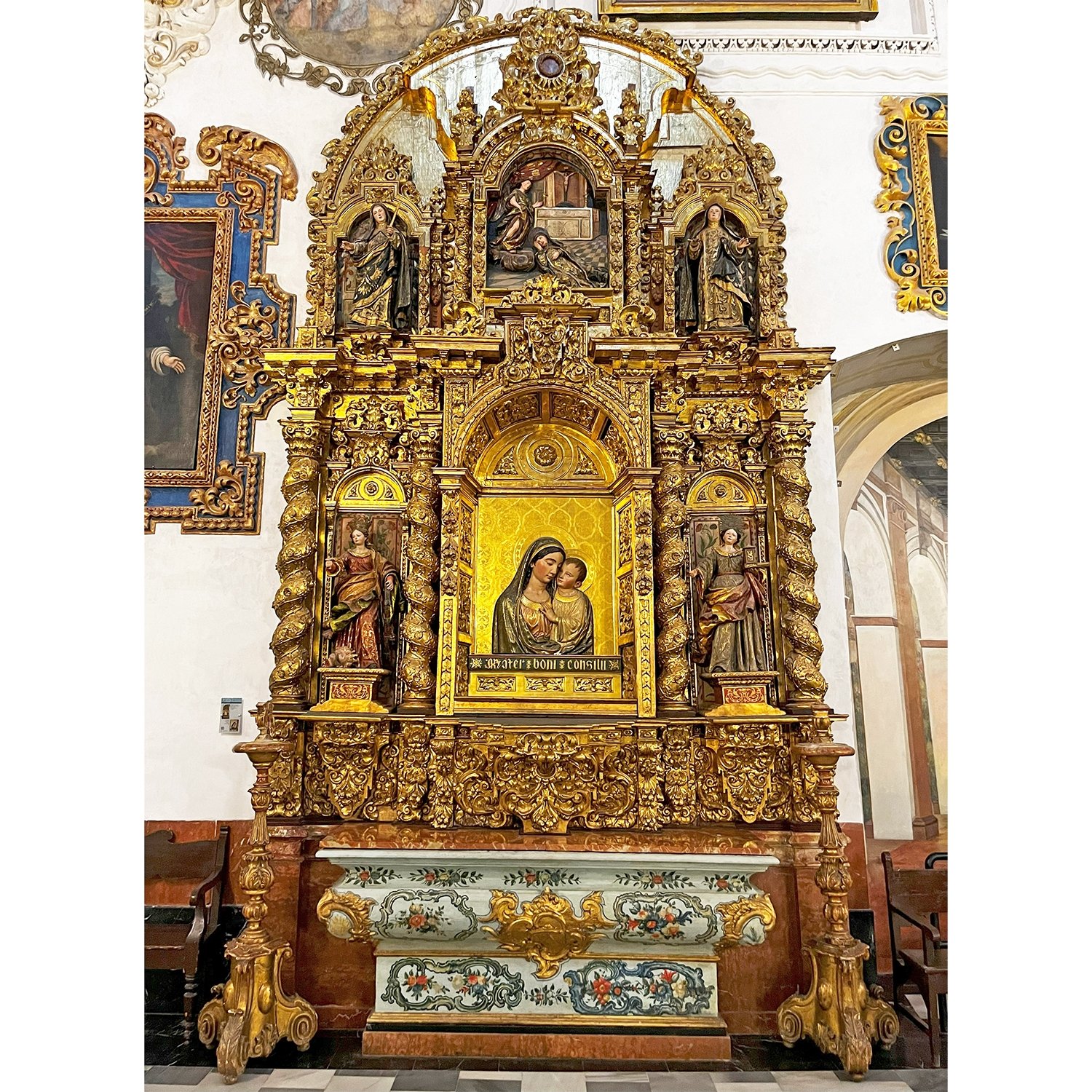
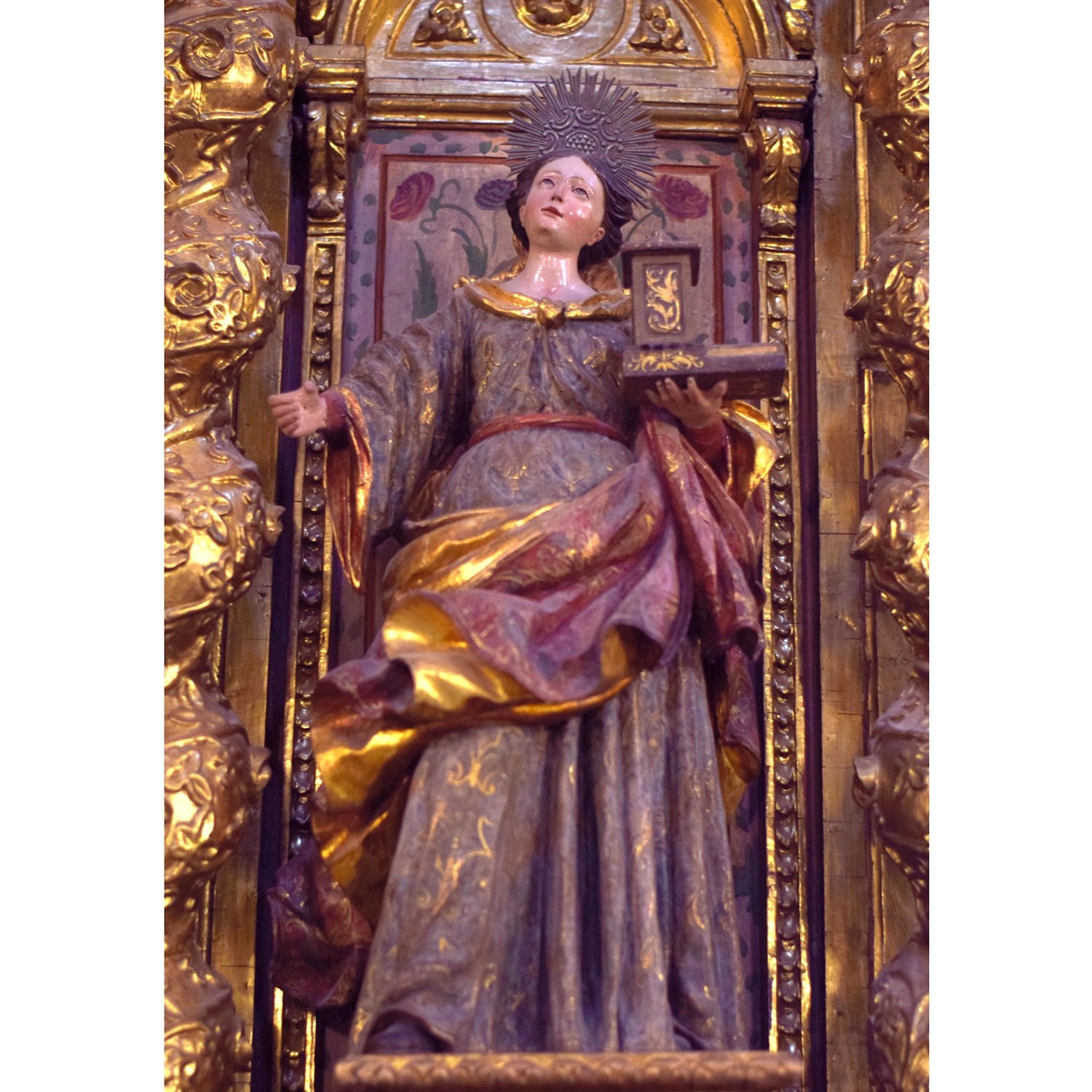
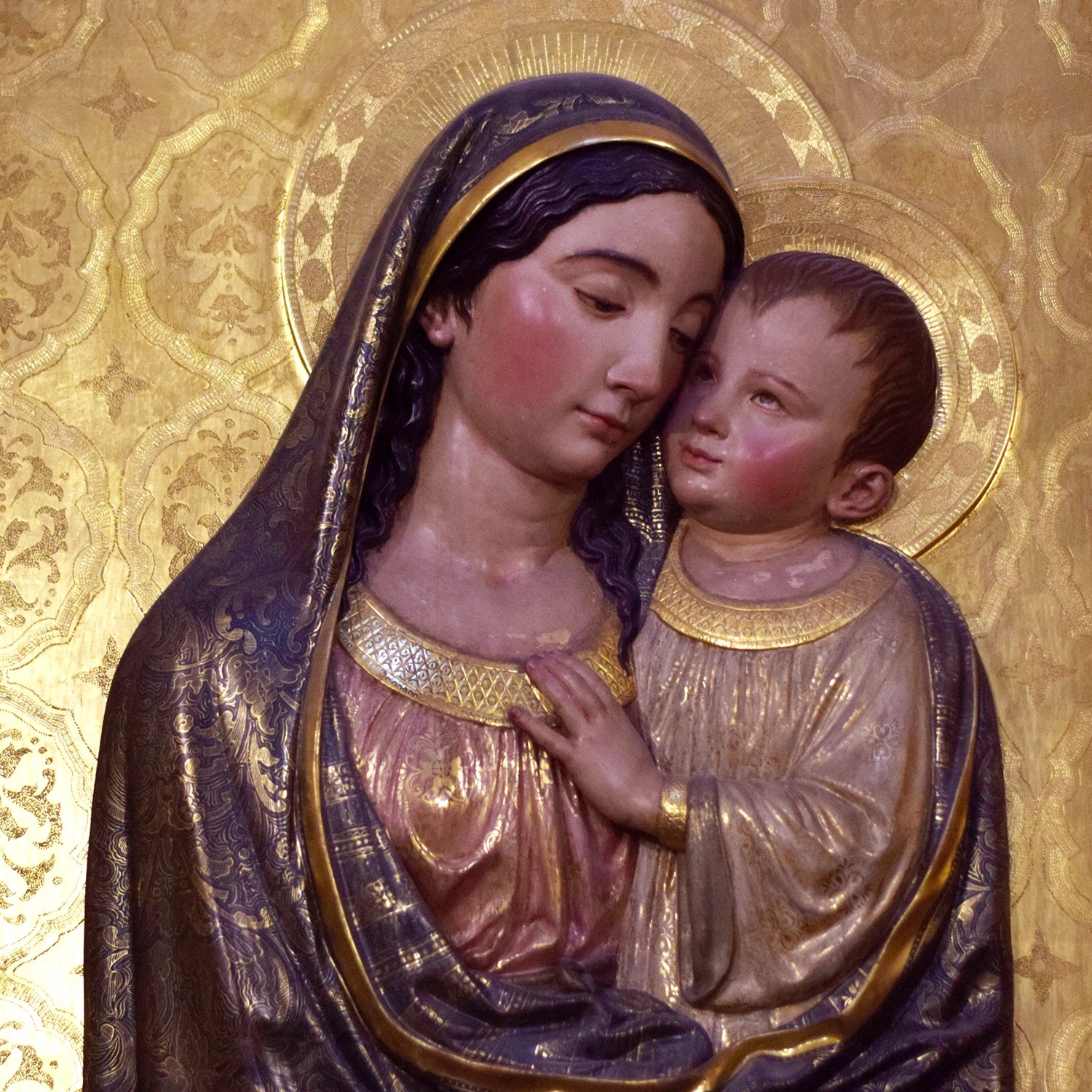
· The next altarpiece is also from the 18th century and is currently presided over by an image of the Virgin of Good Counsel, carved by Sebastián Santos Rojas around 1950. On the side streets, we find two beautiful sculptures of Saint Catherine and Saint Barbara. In the attic, a relief seems to represent the dream of the blessed Juana de Aza, mother of Saint Dominic. The scene has as its context a curious architectural frame in which depth is simulated. On both sides are two Dominican saints, probably Saint Catherine de Ricci and Saint Agnes of Montepulciano.

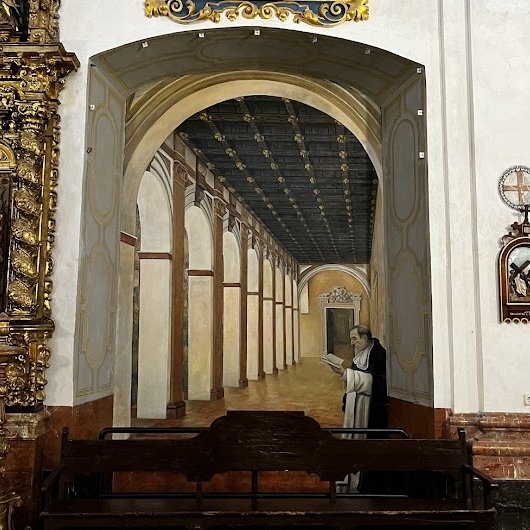
· Next to the altarpiece of the Virgen del Buen Consejo there is a curious painting on the wall that constitutes a trompe l'oeil or optical illusion. It was painted in 1996 and reproduces the entrance to the old cloister of the convent, which was located just in that direction, in the place that is now occupied by the Hotel Colón. The convent was being used as the headquarters of the Civil Government in Seville when it was destroyed by a fire in 1906.

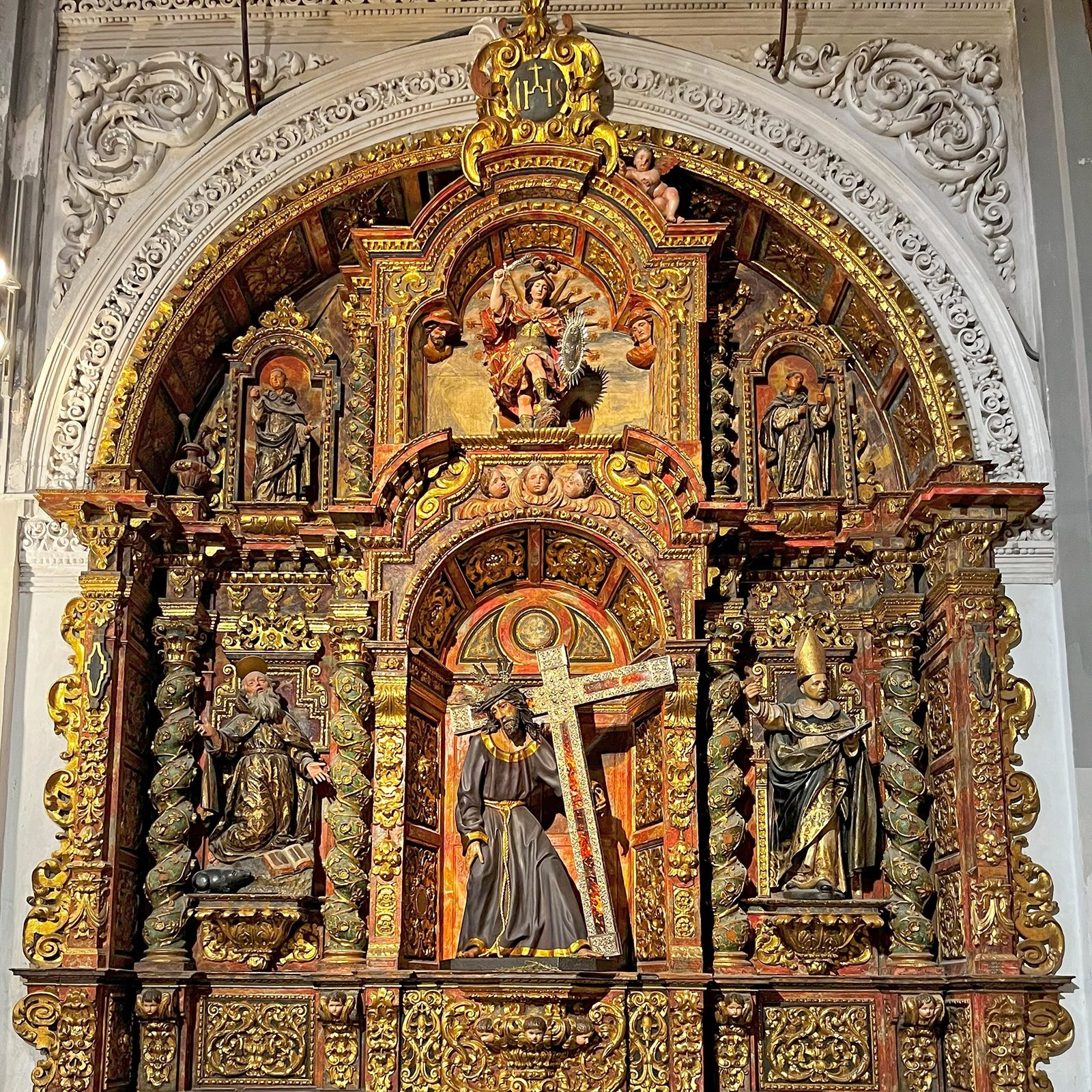
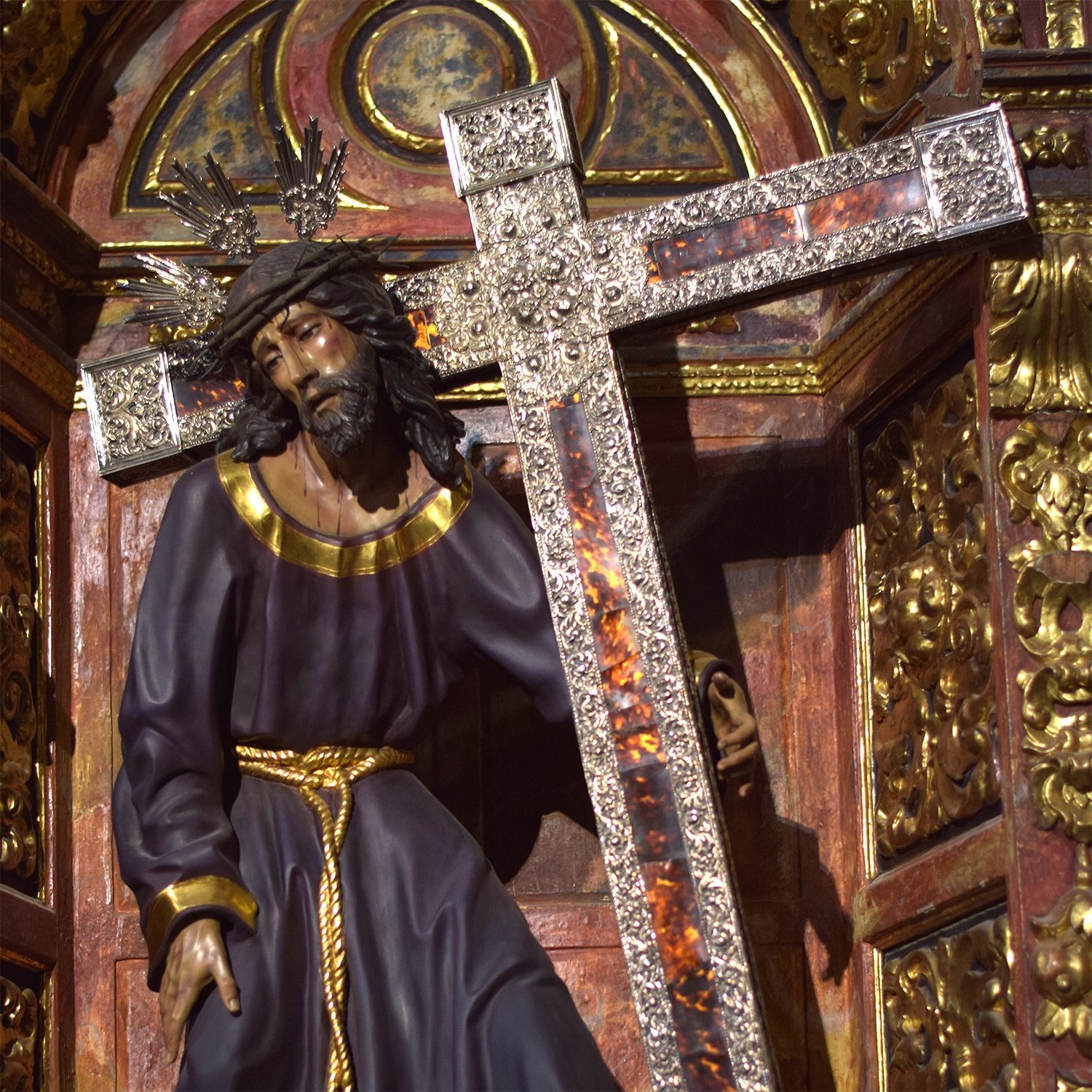
· In the arms of the transept we find several altarpieces. The first of them dates from the beginning of the 18th century and is attributed to Cristóbal de Guadix. It is presided over by the so-called Nazareno de las Fatigas, an image of Jesus holding the cross carved by the sculptor Gaspar del Águila and polychromed by the painter Antonio de Arfián in 1587. It was restored by Francisco Berlanga de Ávila in 2009. The cross is the original and is made of tortoiseshell edged in silver. On the side streets, between beautiful polychrome green and gold Solomonic columns, are located San Antón Abad and San Alberto. In the centre of the attic is San Miguel killing the dragon, flanked by two Dominican saints.

· Next to the entrance to the sacristy, at the far left of the transept, there is a baroque altar with the magnificent Renaissance sculpture of the Virgin of the Fevers. It is an image of the Virgin with Child, a work by the Salamanca sculptor Juan Bautista Vázquez "the Elder" from around 1565, considered one of the most outstanding examples of sculpture from this period in the city. The name "of the Fevers" comes from the fact that women who had recently given birth prayed to her to avoid the dreaded "fever", a historical cause of great mortality. The image replaced a previous one with the same dedication that was lost during a collapse.

According to tradition, the mother of King Pedro I prayed fervently before the previous image asking for the salvation of her son, who was seriously ill at the time. When the king recovered, the mother gave the church a silver sculpture of the monarch praying before the Virgin as a token of gratitude. Apparently, the effigy of the king was removed when he lost the throne in the war with his half-brother Enrique de Trastámara.

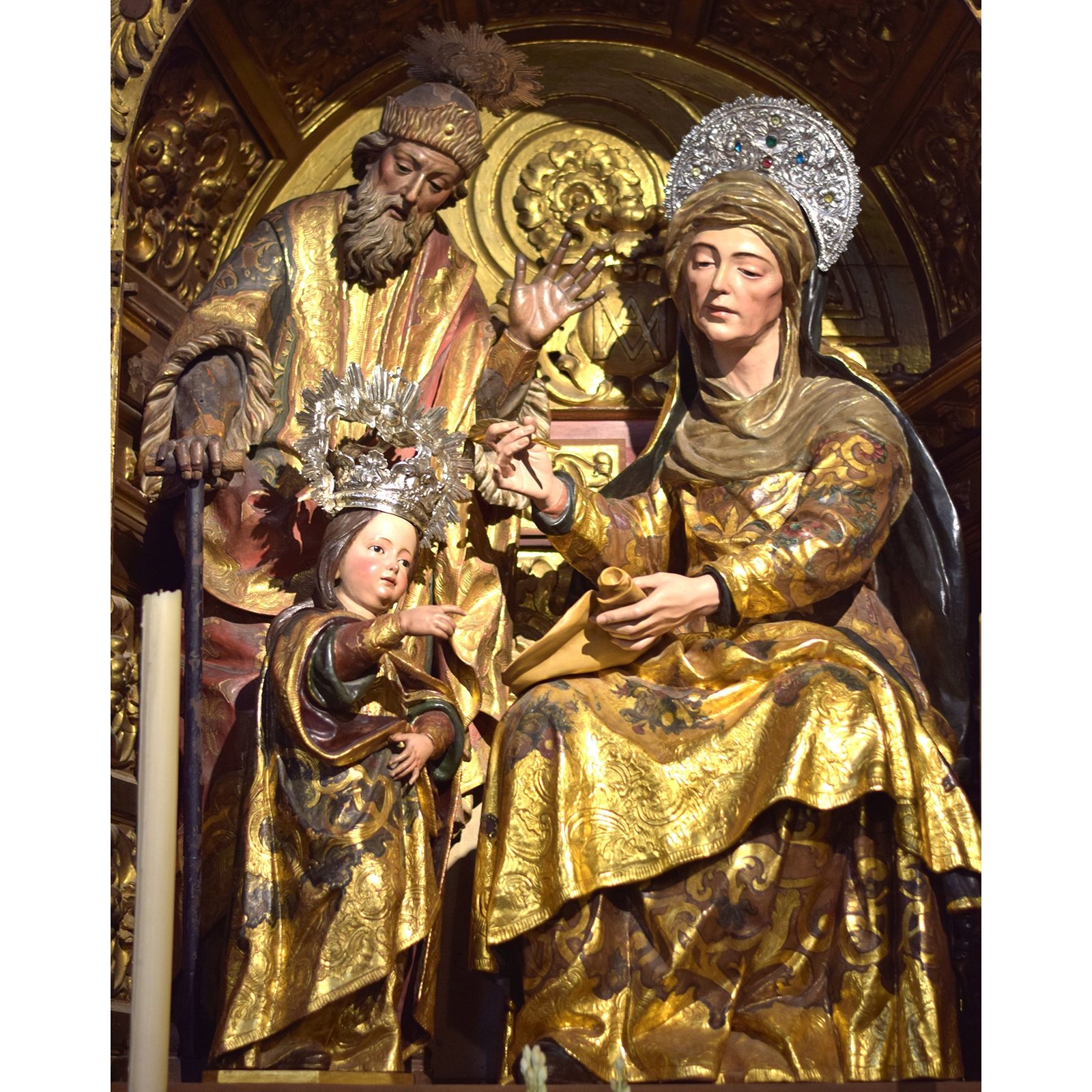
· On the other side of the entrance to the sacristy, an altarpiece houses a sculptural group with Saint Joachim, Saint Anne and the Virgin Mary. The original composition only had Saint Anne teaching the Virgin to read and was probably created by Francisco Antonio Ruiz Gijón around 1675. The image of Saint Joachim that appears in the background is an 18th-century work by Cristóbal Ramos and comes from another altarpiece, as evidenced by the difference in size.

· The next chapel, parallel to the presbytery, is dedicated to Our Lady of the Ancient and Seven Sorrows. It is an early work by Pedro Roldán (c. 1650) that is closer to Castilian models than to those common in Seville: Mary appears kneeling at the foot of the cross and looking up to heaven. In addition, it is a full carving and not dressed, as is usually the case in the city. The image was the titular of a brotherhood that became enormously popular. It had its headquarters in the current Chapel of Montserrat and the current Cristo de la Salud of the brotherhood of Candelaria also belonged to it.

The altarpiece in which it is located is from the 18th century and was originally dedicated to Saint Paul, as shown by the two reliefs on the side streets, which show his “Decapitation” and an “Apotheosis” of the saint, in which angels raise him to Heaven.

· On the pillar that separates the chapel of the Antigua from the next one, we find a small altarpiece with a dressed image of Saint Rose of Lima, a Dominican nun born in the Viceroyalty of Peru who was the first American canonized in the history of the church.

· The next chapel, next to the presbytery, is dedicated to the Virgen del Amparo, a magnificent Renaissance sculpture made by the Flemish sculptor Roque Balduque in 1555. It is one of the most beautiful images in the church and is considered the patron saint of the neighbourhood, through whose streets it is carried in procession every second Sunday in November.

The altarpiece is a work from the beginning of the 18th century and seems to have originally housed the Cristo del Gonfalón, which we will talk about later. On the side streets are located San José with the Child and San Hermenegildo, while in the centre of the attic is represented the Annunciation, flanked by San Joaquín and Santa Ana.

Chapels and altarpieces on the Epistle side (right):

· Next to the presbytery, on the right, the first chapel is that of the Santísimo Cristo del Calvario, the headquarters of the brotherhood that has it as its patron. The Cristo is a magnificent work by Francisco de Ocampo, made in 1611 following the model of the Cristo de la Clemencia by Martínez Montañés. On both sides, the images of the Virgen de la Presentación and San Juan Evangelista, both by Juan de Astorga from the 19th century. The altarpiece is from the 18th century and has a scene in the centre of the attic with the Virgin giving the Rosary to Santo Domingo and Santa Catalina de Siena.
· On the pillar that separates this chapel from the next, there is a small altarpiece with an image of Saint Monica from the 17th century, attributed to Pedro Roldán.

· The next chapel is dedicated to Saint Anthony of Padua, with an anonymous image of the saint from the 17th century. The altarpiece is from the 18th century and was originally dedicated to Saint Catherine of Siena, as can be read on the railing that closes the chapel. In fact, in the attic there is a relief with "The Stigmatization of Saint Catherine".

· At the right end of the transept there are two altarpieces, on either side of a box leading to the church that is always closed. The first is dedicated to the Virgin of Carmen, with a beautiful anonymous dressed image from the 18th century. The one on the right is dedicated to Saint Joseph, with a splendid carving attributed to Juan Martínez Montañés and dated around 1610. Traditionally there have been doubts about its authorship, but after the last great exhibition on the master, his authorship was established due to its similarity to another Saint Joseph that is preserved in the convent of Las Teresas and because of how similar the Child is to the one carried by Saint Christopher in the church of El Salvador.

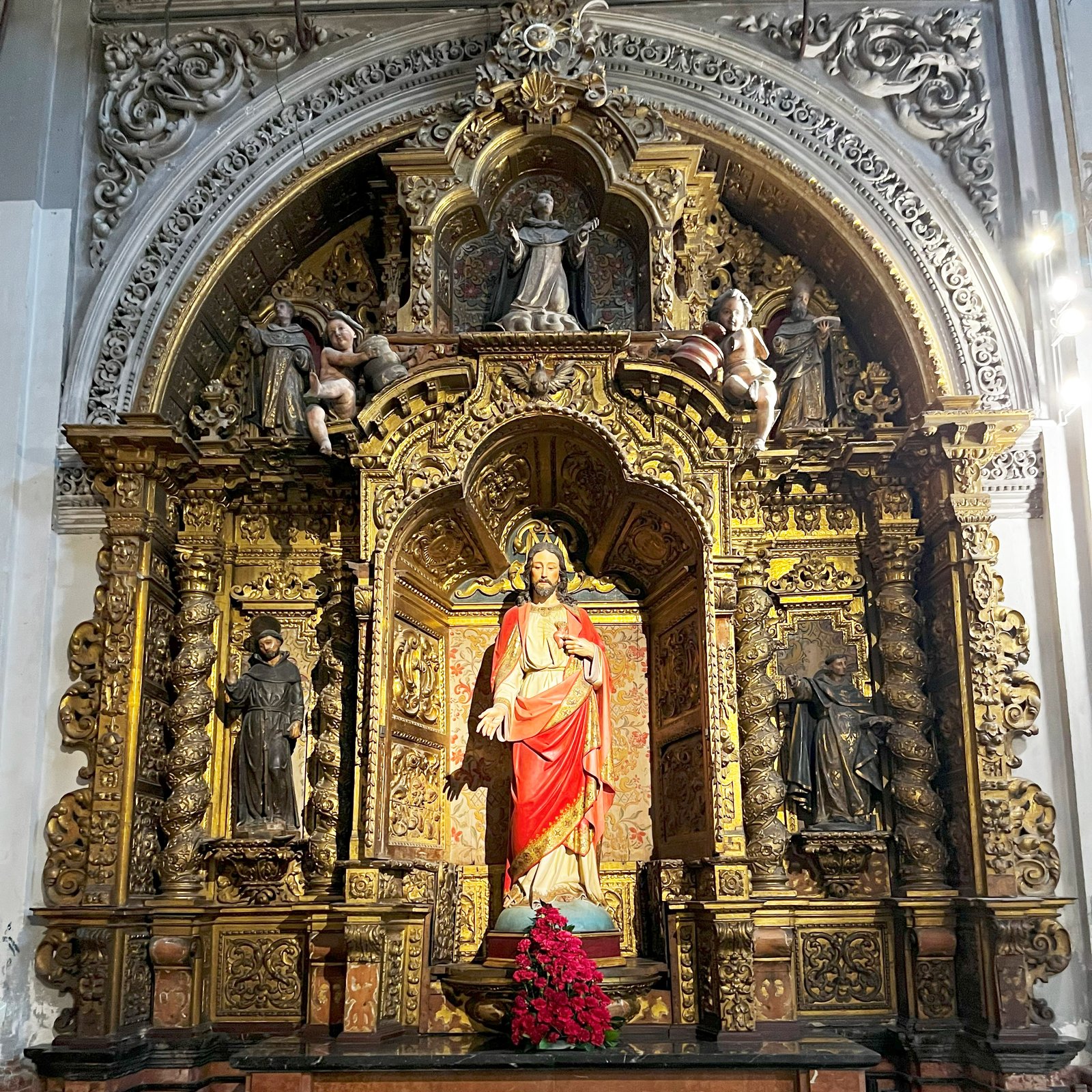
· On the corner next to the altarpiece of San José, we find an altarpiece from the 18th century that is currently presided over by a modern image of the Sacred Heart of Jesus. It is accompanied in the side naves by Saint Francis and Saint Dominic, original to the altarpiece. In the attic we find a Saint Thomas praying on his knees.

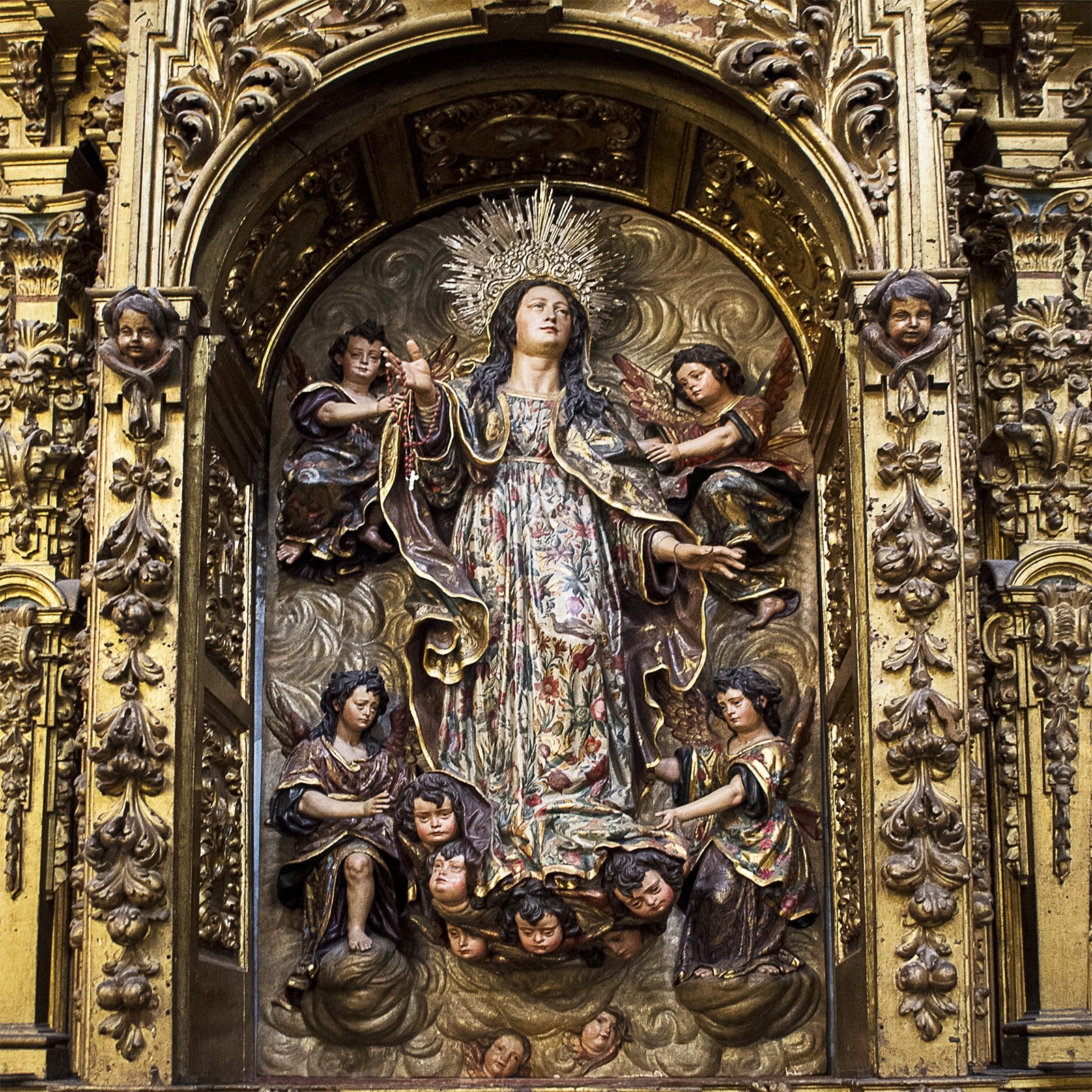
· Continuing along the right wall, next to the Sacramental Chapel, there is an altarpiece presided over by the relief of the Assumption of the Virgin, a work by Juan de Mesa from 1619. Despite some doubts expressed about its authorship, the contract in which the artist was commissioned has been preserved, where it is specified that four angels “are taking her up to heaven, with a throne of seraphim at her feet and her clouds around (…) with two more children as a finishing touch; more in half relief and the children in circles”. In the attic, another relief shows the Coronation of the Virgin.

· Halfway along the Epistle wall is the sacramental chapel, a rectangular space located next to the main entrance to the church. Right in front of the entrance, a display case houses a splendid silver processional monstrance measuring more than two metres in height. It was made in different phases between the end of the 17th century. “It is the work of three 17th century silversmiths, but following the design of the one who started it, Diego de León, in 1678. It was continued in 1679 by the silversmith Cristóbal Sánchez de la Rosa, and finished by Juan Laureano de Pina in 1692.” (Archbishopric of Seville)

The altarpiece is in neoclassical style, made in 1817. It houses in its central niche an Immaculate Conception from the 18th century attributed to Benito Hita del Castillo, which is carried in procession on Corpus Christi day accompanying the Custodia together with the Infant Jesus by Jerónimo Hernández. On the side streets of the altarpiece we find the carvings of San Miguel and San Rafael, made by Duque Cornejo also in the 18th century. In the attic, a painting from the time of the altarpiece represents the Holy Trinity.

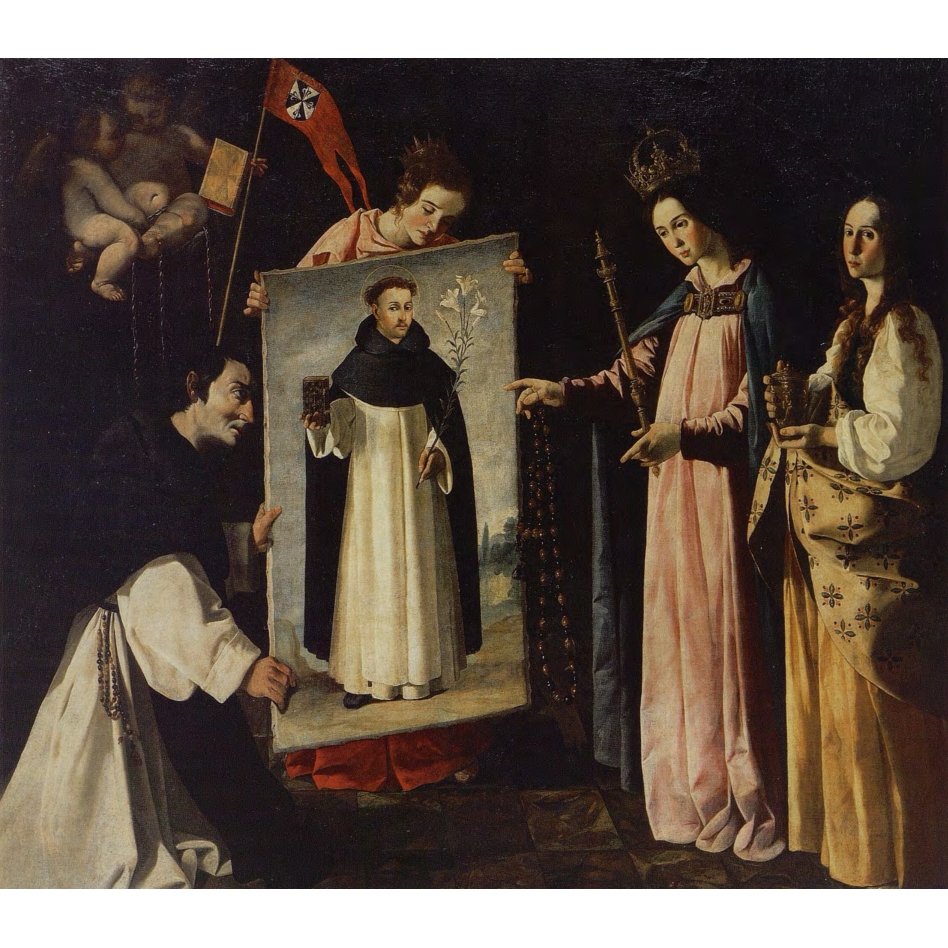
The Chapel houses the tomb of Francisco Arias de Saavedra, minister of Charles III, and two canvases by Zurbarán from around 1626. The first shows the "Miraculous Healing of Blessed Reginald of Orleans" and the second "Saint Dominic in Soriano". Odile Delenda, in her catalogue of Zurbarán's work, describes it thus:

"The miraculous delivery of the true portrait of Saint Dominic to the Monastery of Soriano is a popular theme of the Counter-Reformation, which was a considerable success throughout Catholic Europe in the 17th century. Each religious Order wanted to represent its saints with their 'true effigies'. A Dominican friar from the Convent of Soriano in Calabria, very devoted to the founder, wanted to know what his true features would be like. In the year 1530, while praying, the Virgin appeared to him, together with Saints Catherine and Magdalene who offered him a portrait of Saint Dominic. This miraculous portrait shows him standing, frontally, carrying the lily and a book of his rule. The supposed portrait is preserved in the Church of San Romano in Lucca and many copies and engravings circulated in the convents of the Order.

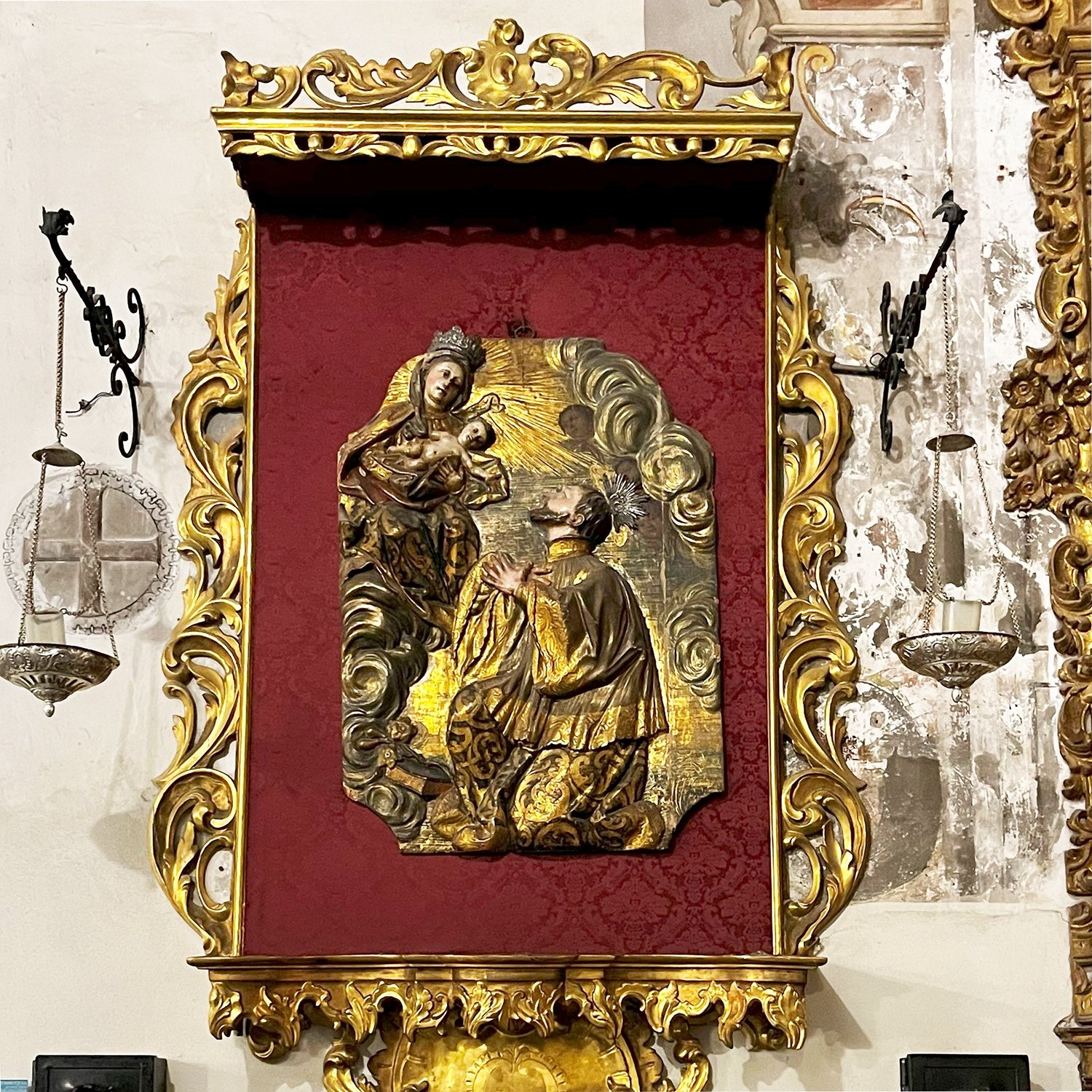
· On the same right wall, on the other side of the main entrance to the church, we find a baroque canopy frame that houses an 18th century relief with “The Apparition of the Virgin to Saint Cajetan”.

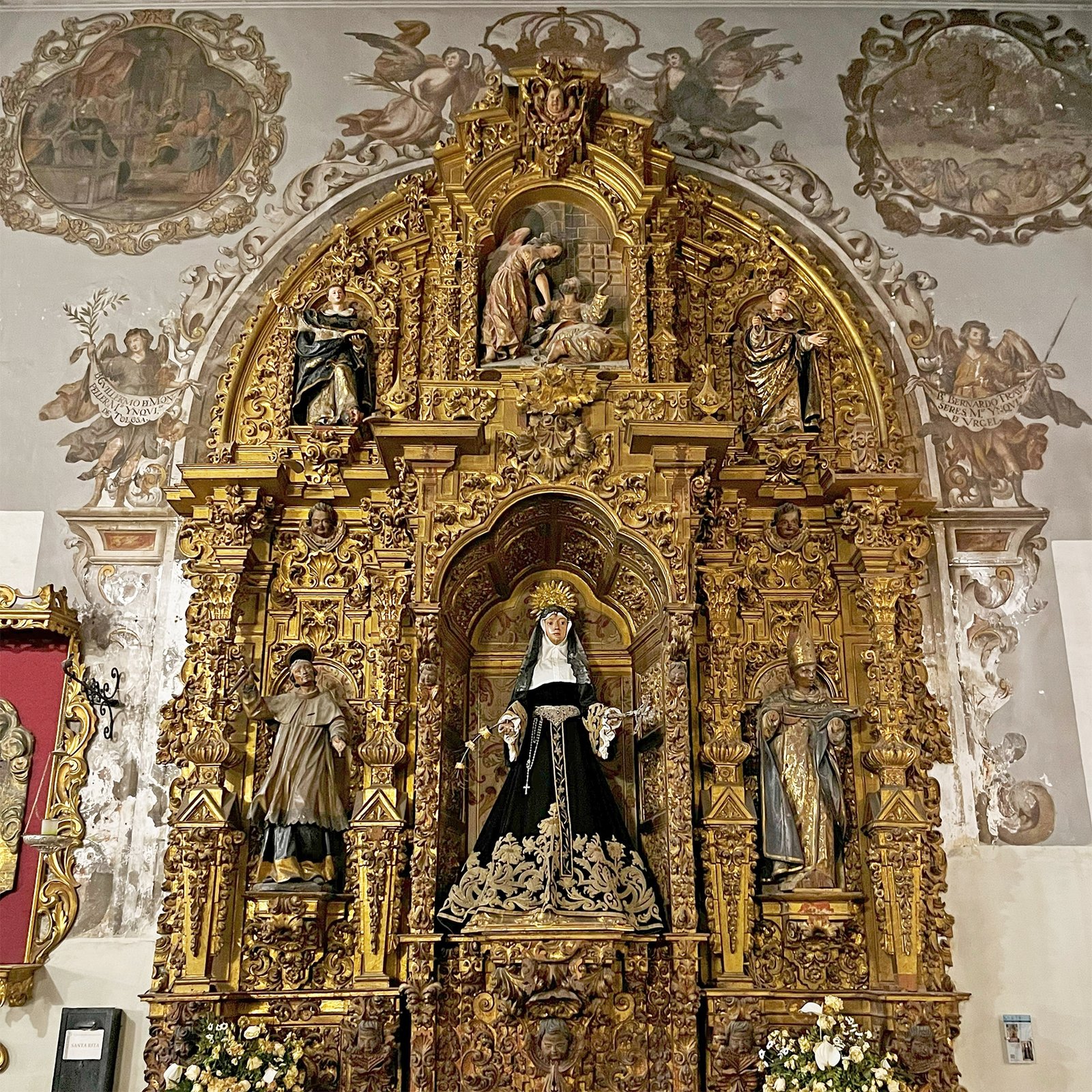
· Next, moving towards the feet, there is an altarpiece also from the 18th century, currently presided over by the image of Saint Rita of Casia, of great devotion in the Catholic world as an intercessor in difficult causes. On the side streets are located Saint John of Nepomuk and Saint Albert, while in the attic, a relief represents the “Liberation of Saint Peter”, flanked by two Dominican saints.

· At the foot of the Epistle nave is the Baptismal Chapel, which preserves the font in which Bartolomé Esteban Murillo was baptized on January 1, 1618, as recalled by a marble plaque on one of the walls. The chapel is now presided over by an interesting 16th-century crucifix known as Christ of Confalón or Gonfalón. It has rather archaic features that bring it closer to Gothic sculpture and transmit a moving pathos.
Originally it was the title of a brotherhood that was dedicated to works of mercy, following the example of a brotherhood with the same dedication based in Rome. The image has been attributed to Nicolás de León, since in the church of La Victoria in Écija there is a very similar crucifix by this author that also has the same dedication, and is currently one of the most prominent images of Astigitan Holy Week.
The crucified Christ is accompanied by a Dolorosa and a Saint John, forming a Calvary. They are of a similar chronology to Christ and could be works by the same author.

CHURCH OF SAN ILDEFONSO

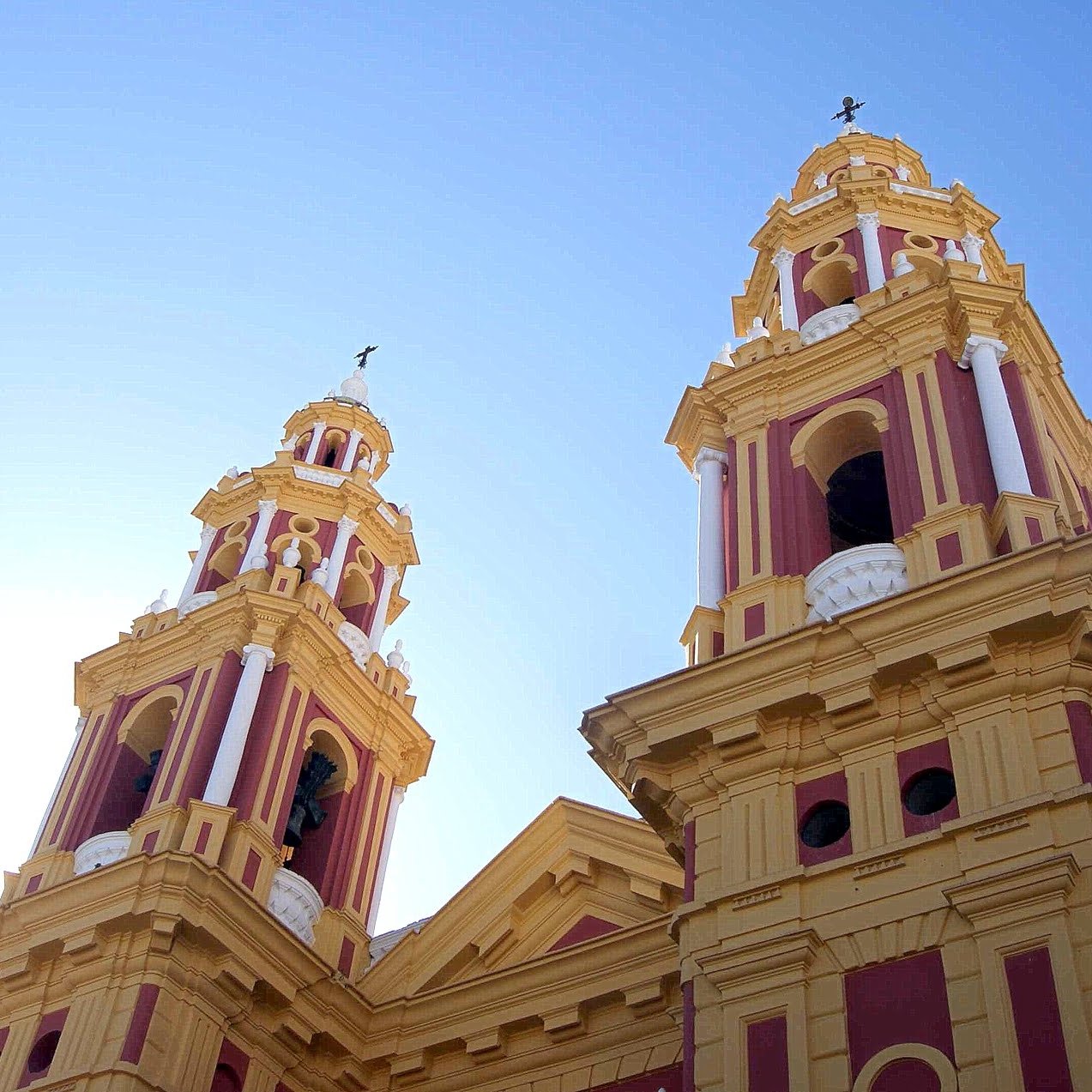
The church of San Ildefonso is an imposing neoclassical temple that stands right in front of the convent of San Leandro, in the Alfalfa neighborhood. Its construction began at the end of the 18th century and, from the outside, it is one of the most striking churches in Seville for various reasons. Firstly, there are very few neoclassical churches in the city. In addition, it has two tall twin towers that flank its entrance and is completely covered in the quintessential colors of Seville: albero and almagra.

History

The current temple began to be built at the end of the 18th century, replacing a previous one that was damaged after the Lisbon Earthquake in 1755. We know that San Ildefonso was one of the 24 parishes into which the city was divided after the Christian conquest. , so it is very likely that the previous temple was a medieval construction, probably of the Gothic Mudejar style so characteristic of Seville.

However, there is a tradition that tries to trace the origins of the parish to Visigothic times. It is based on a supposed tombstone that was preserved in the old church and that alluded to a priest named Saturninus who would have been buried in this place in 657. Diego Ortiz de Zúñiga, famous Sevillian historian of the 17th century, describes it this way in Book II of his famous “Ecclesiastical and Secular Annals”:

"...even as a primitive Christian Church, the Parish of San Ildefonso has singular signs, attested with the stone of the tomb of San Saturnino, which was inside it until the year 1649, when in the plague that this city suffered with the escape from opening graves, he was lost or buried there. Viola Ambrosio de Morales, Don Pablo de Espinosa and others, whose epitaph said: (…) Saturnino, Priest, servant of God, lived, more or less, 53 years. this life in peace on the 2nd of the Ides of November (it is the 12th) in the Era of 657, which is the year of Christ of 619. Call him Saint Saturninus' piety; but the epitaph only warns him of a Christian priest, a contemporary of our Archbishop and Patron San Isidoro. This tomb was in front of an altar of our Lady, whose painted effigy shows great antiquity, entitled Coral, and venerated with deep devotion."

Of note is the mention of the Virgen del Coral, a mural painting that fortunately is still preserved in the church today. Attempts to trace the origin of this venerated image to pre-Islamic times were also frequent, although currently its dating to the 14th century is certain, more or less contemporary with the Virgin of Antigua.

In any case, the works for the construction of the temple we are talking about today began in 1794 under the direction of José de Echamorro and in accordance with the neoclassical project of Julián Barcenilla. The monumentality of the building meant that the works lasted for almost fifty years. The church was inaugurated in 1816, but only with the left nave completed, so services were held at an altar presided over by the Virgen del Coral. Complete completion of the church would not take place until 1841.

DESCRIPTION

As we have pointed out in the introduction, the church of San Ildefonso is a neoclassical temple that fits perfectly with the academic aesthetic trend prevailing in the country since the 18th century and during the 19th century. It has a rectangular floor plan, divided into three naves, with the central nave and the transept being the widest. Protruding from the floor is a deep semicircular presbytery at the head and two large square towers at the foot.


Outside

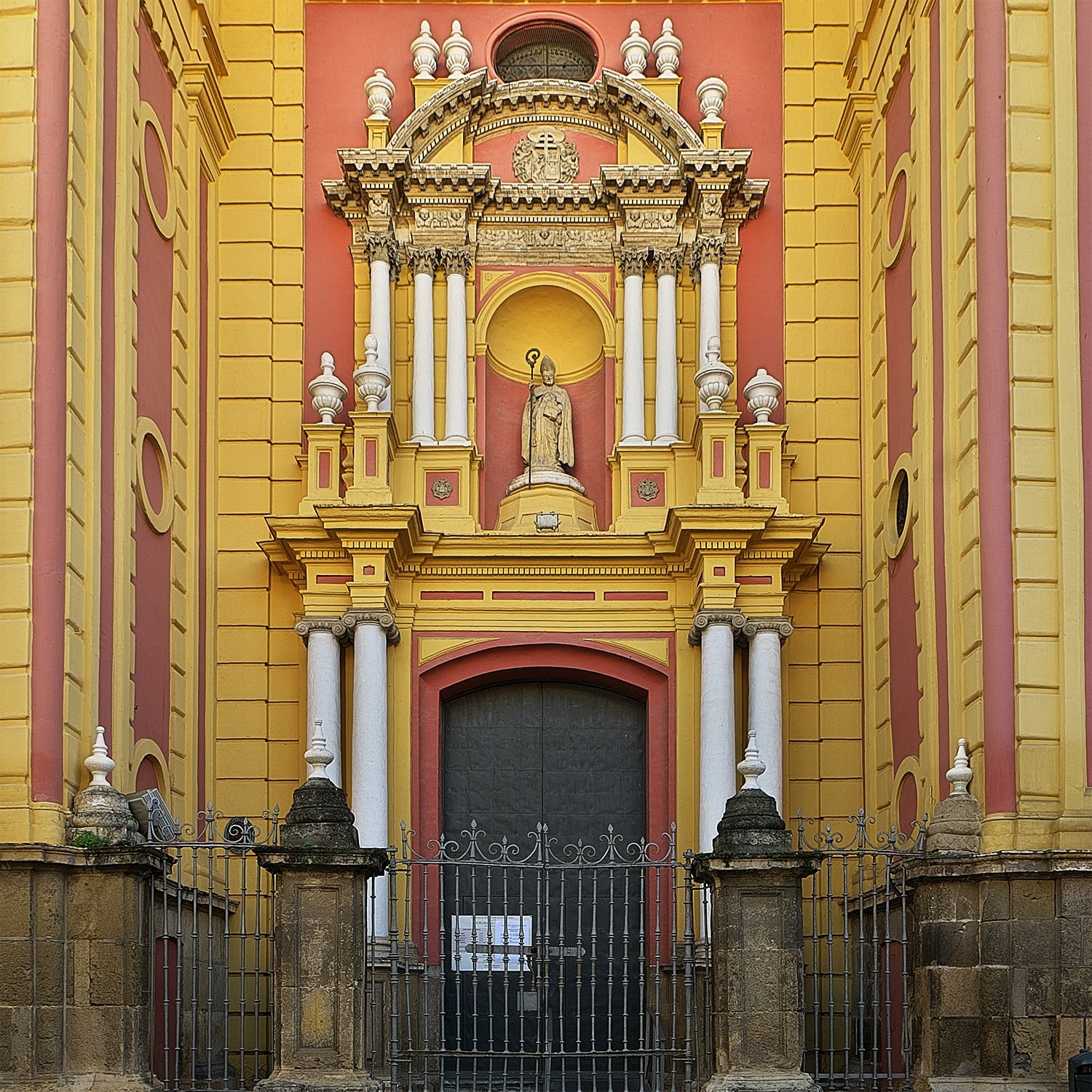
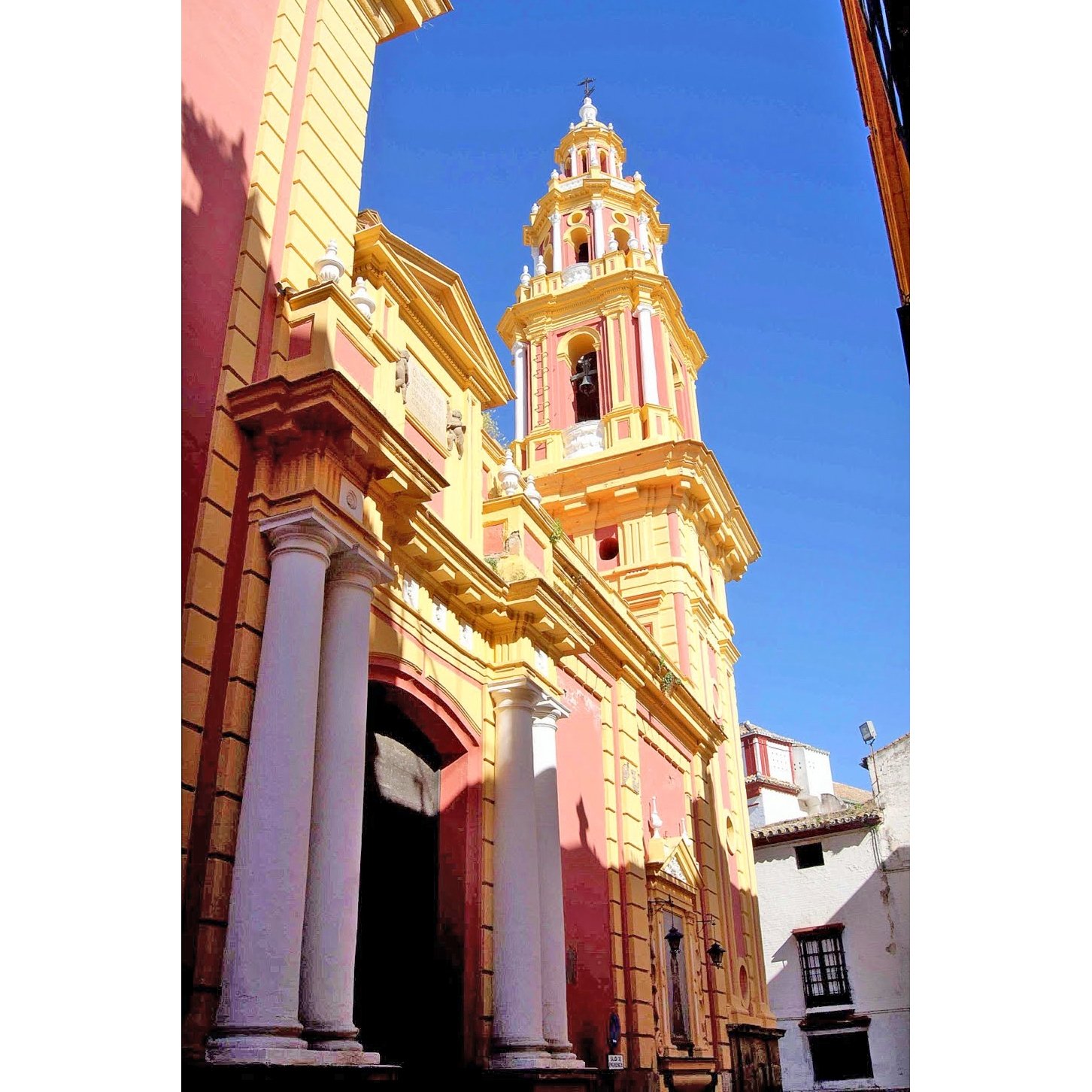
Possibly the first thing that catches your attention from the outside is the bright albero and almagra colors with which the church is painted. On the main façade, the two towers stand out, moving forward with respect to the line of the façade, creating a small atrium in front of the main entrance.

The towers are very tall and have four bodies of decreasing size. The first two are square in plan, the third is octagonal in plan and the last is circular. They are decorated with white stone elements that stand out against the albero and almagra background, such as the columns, balustrades and vases.

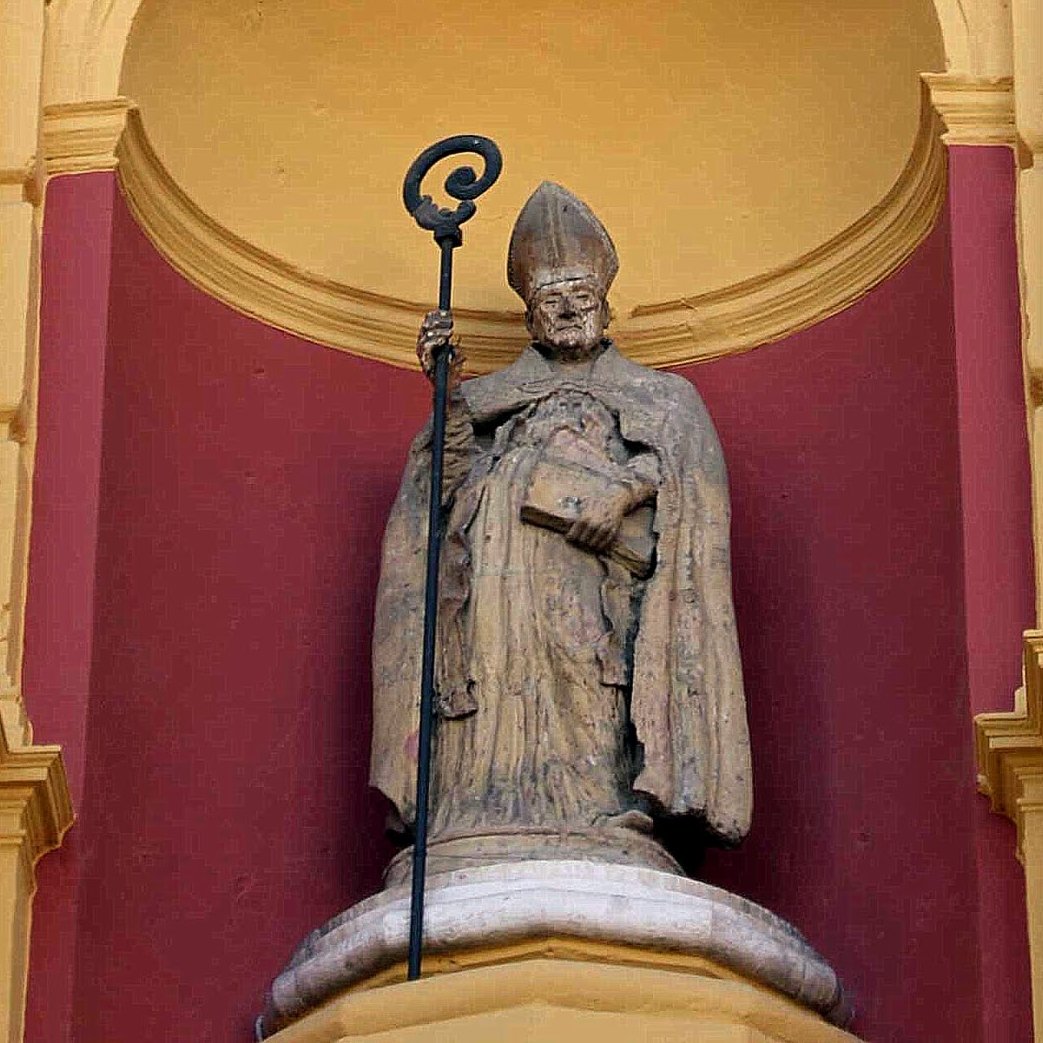
The cover has two bodies and a very classic structure. The first, framed by pairs of Ionic columns, houses the segmental arch that constitutes the main entrance. Above it, a niche houses a small stone sculpture of San Ildefonso, also framed by columns on the sides, in this case in a composite style. The niche is topped by a curved pediment in the center of which the episcopal shield of the titular saint is represented.

On the left side, on Rodríguez Marín Street, a second access door to the temple opens, with similar characteristics to the previous one but simpler. In this case, two pairs of simple Tuscan columns frame the entrance. They also serve to support the entablature on which a simple niche topped by a triangular pediment is located.

In this niche we see two little angels holding a marble inscription that reads: “O ILDEPHONSE PER TE VIVIT DOMINA MEA QUE COELI CULMINA TENET.” This is a phrase that tradition attributes to Saint Leocadia. Apparently, one day Bishop Ildefonso was praying before the tomb of the saint, when she appeared to him and uttered the phrase that can be translated as "Oh Ildefonso, my Lady, who supports the peaks of heaven, lives through you". In this way, the apparition recognized the important work of Saint Ildefonso as a defender of the Virgin Mary and promoter of her devotion to her.

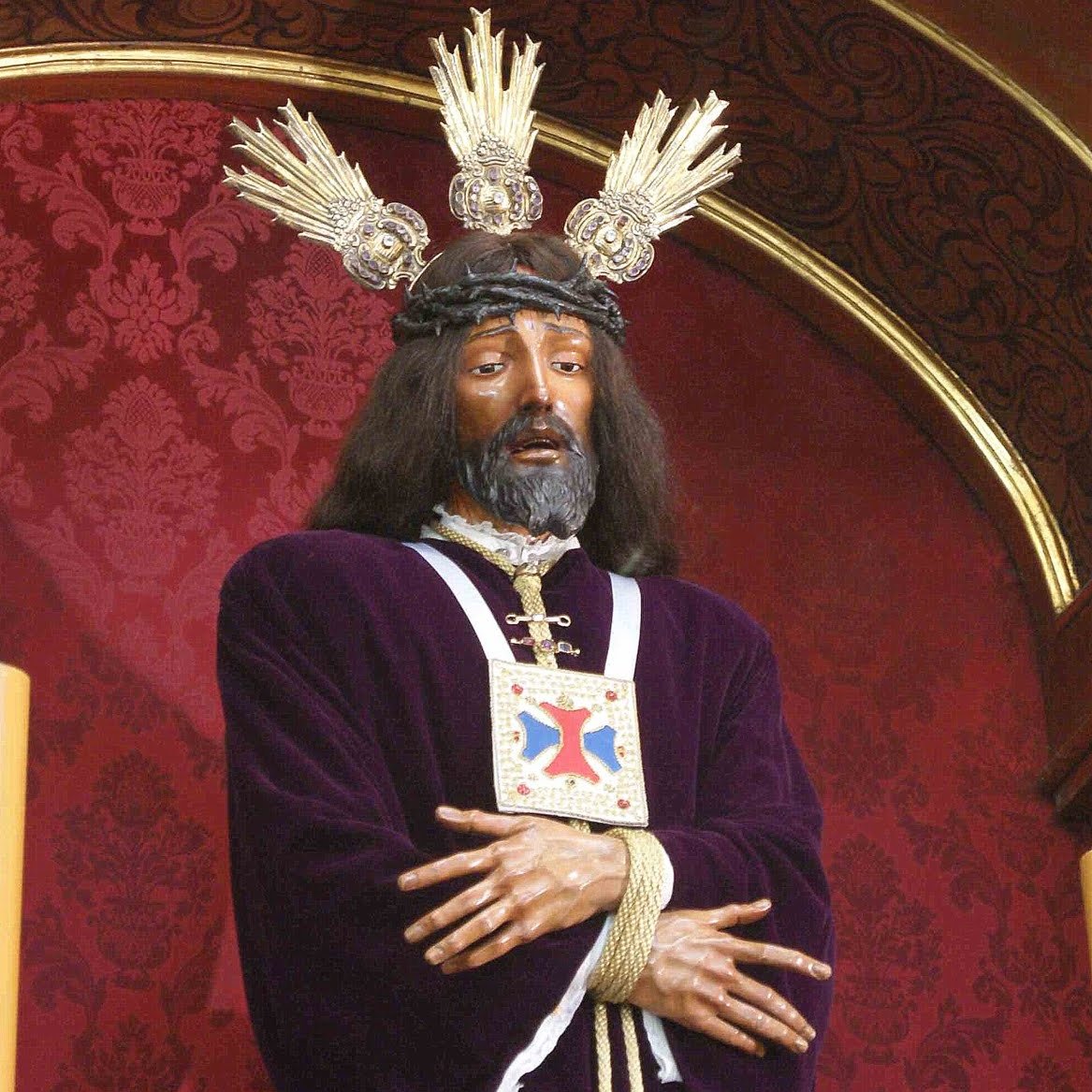
To the right of this side doorway, a molding with a classical structure but baroque decoration houses the ceramic altarpiece of Nuestro Padre Jesús Cautivo de Medinaceli. It is an image of great devotion that is venerated inside the temple and which we will talk about later. The tile was made by the great ceramist painter Antonio Kierman Flores in the Santa Ana factory in Triana (1955).

Inside

Inside, the church is divided into three naves by eight cruciform pillars. In the central nave and in the transept, the vaults are barrel vaults with lunettes and have transverse arches. The side naves, which are somewhat narrower, are covered by a groin vault, except in the chapels at the head of each nave, which are covered by hemispherical vaults. Above the transept there is a large dome, raised on a high circular drum and topped by a lantern. Both the drum and the lantern have semicircular openings that provide luminosity to the interior.

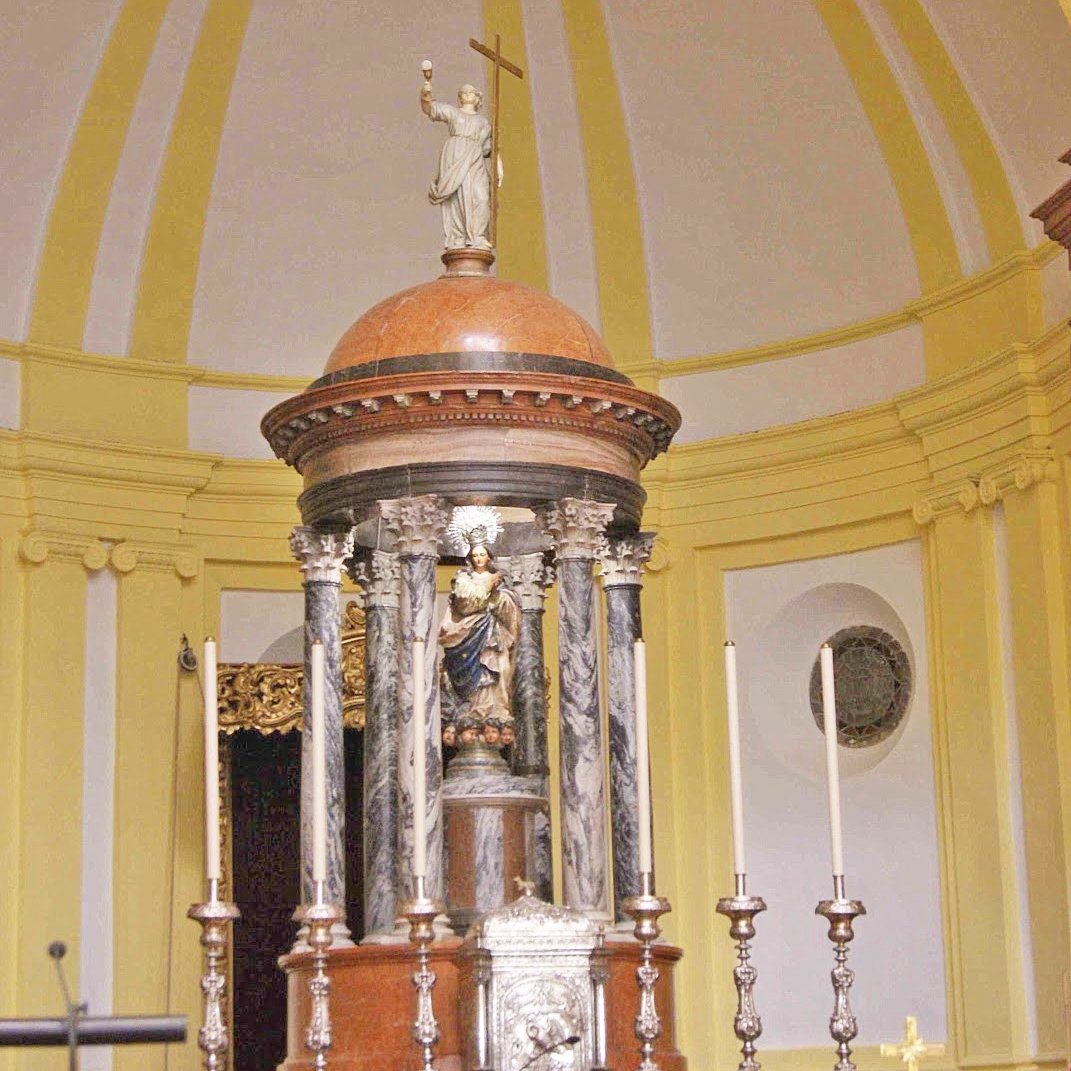
The presbytery area is quite unique in the context of Sevillian churches, since it does not have an altarpiece, following the dictates of the academic aesthetic to which the temple adheres. In its place, we find a classical style temple made by José Barrado in 1841. Six columns of black jasper support a hemispherical dome on which is located a small stone allegory of Faith. The temple houses a classic Immaculate Conception from the 18th century by the author a stranger.

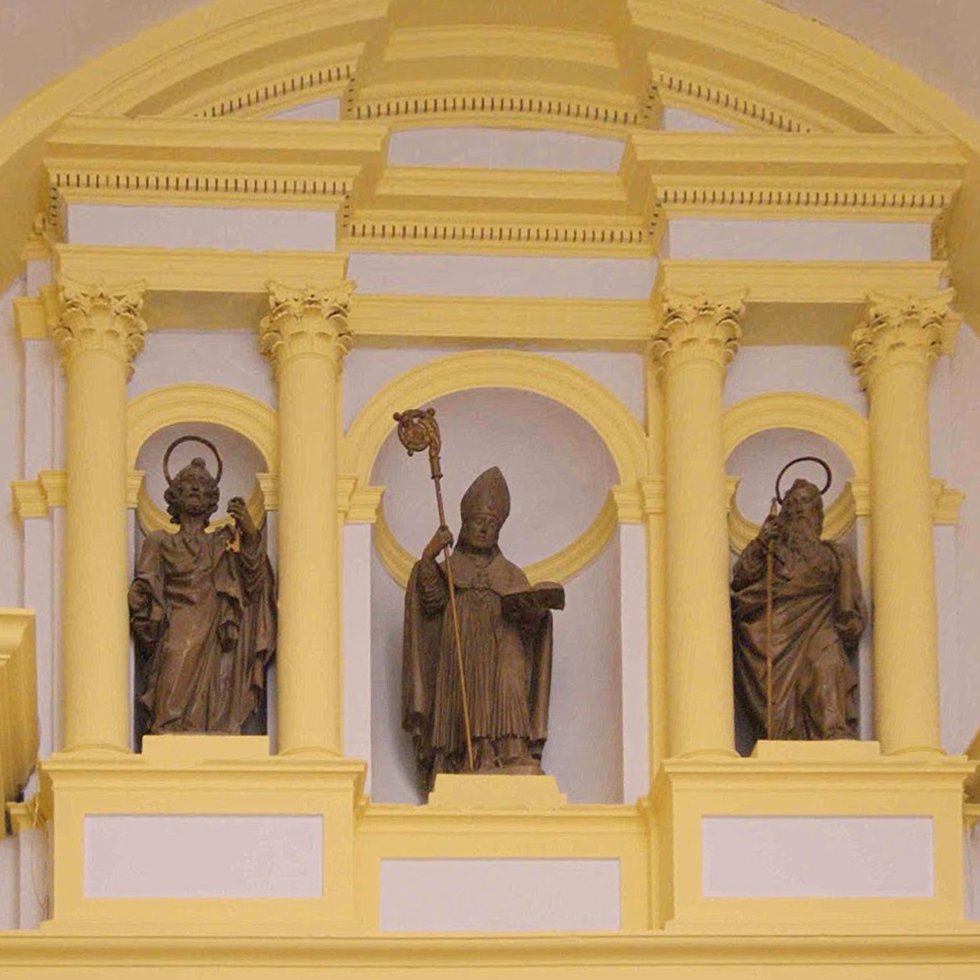
Above the main arch that frames the presbytery, there are three niches between Corinthian columns that house the sculptures of San Ildefonso, in the middle, flanked on the sides by San Pedro and San Pablo. These are carvings made by Felipe de Ribas around 1637 that belonged to the altarpiece of the church before the current one. Juan de Astorga intervened on them in the 19th century to adapt them to the new temple, thus completely altering their original baroque polychrome.

The altarpieces of the church are all from the 19th century, in line with the neoclassical aesthetics prevailing at the time and without much artistic interest. However, the church has a series that should be highlighted for its artistic and historical interest.


On the Epistle side (on the right):

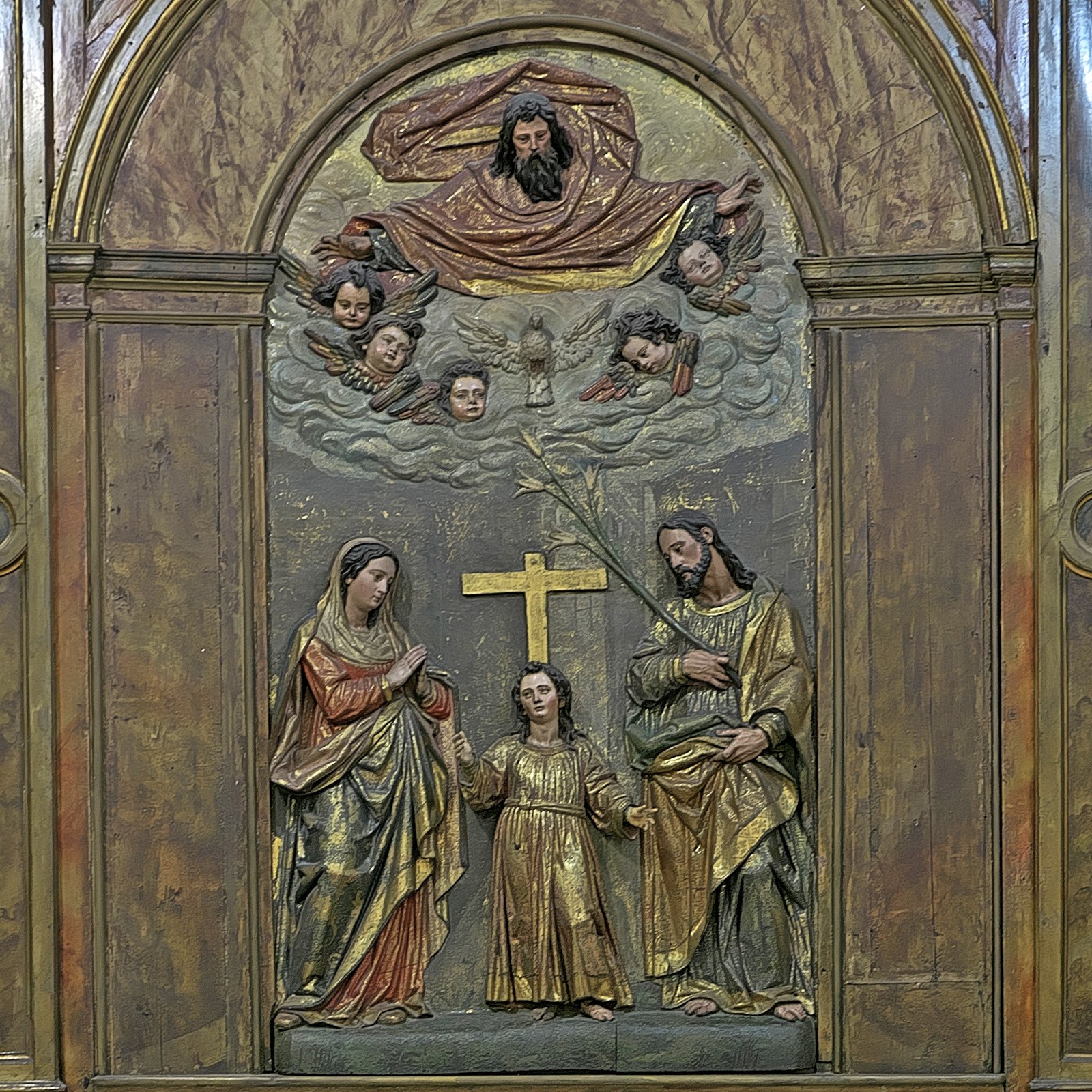
- Relief of the “Two Trinities”, made by Martínez Montañés around 1609. It is located in the Baptismal Chapel, at the foot of the Epistle nave (right). It is a beautiful relief in which the master combines the representation of the Trinity formed by the Father, the Son and the Holy Spirit, with that other trinity that would be formed by Jesus himself, along with Saint Joseph and the Virgin Mary. The Holy Family is located on a lower plane, and above them the Holy Spirit and God the Father. In the center, the figure of Jesus, still a child and in front of a Cross, serves as a union and link between the two planes.

- Sculptural group of “The Appearance of the Virgin to San Cayetano”, in one of the chapels on the right side. It has been dated to the 18th century and is probably by Cristóbal Ramos.

- The Virgin of Soledad presides over another of the altarpieces on the right side. This is a magnificent dress-painting made around 1844 by Juan de Astorga, probably the most prominent sculptor of the 19th century in Seville.

- Sculptural group of “The delivery of the chasuble to San Ildefonso”, which is located in a marble altarpiece at the head of the nave. This is a quite interesting group dating from the late 18th or 19th century, but whose authorship is unknown.

In the Gospel nave (left side):

- At the foot of the nave, next to the entrance, a showcase like a temple houses a beautiful small-format Pietà. This is an image from the 18th century, most likely the work of the sculptor Cristóbal Ramos.

- Also on the Gospel side is the altarpiece of the Virgin of the Kings, also called “of the Tailors”, as this guild was the one that originally commissioned the image. Traditionally the image has been considered one of the so-called “fernandinas”, that is, original from the early times after the Christian conquest (13th century). Today there is a tendency to think that the image is the work of the 16th century, with notable baroque transformations, such as the Child himself, which was added in the 17th.

The image is owned by the Brotherhood of Tailors, which has its origin in the old San Marcos hospital, which was located in the Alfalfa area. This is the reason why we find a small carving of Saint Mark in the attic of the altarpiece. In the side streets, we find San Fernando and San Hermenegildo, patron saints of the Spanish monarchy. They are carvings by Pedro Roldán dated around 1674.

- At the left end of the transept is the Cautivo altarpiece, which houses the image of Nuestro Padre Jesús Cautivo y Rescatado, also called Medinaceli because it reproduces the iconography of the image found in Madrid with the same dedication. It is an anonymous image from the 18th century that represents Jesus just before starting the path to Calvary. It is a dress size that makes use of natural hair, a resource that was very common during the Baroque as a way of giving images greater realism and drama.

This iconography was greatly promoted by the order of the Trinitarians, who were dedicated to collecting alms for the rescue of Christian captives in Muslim territory. It was the monks of this order who brought devotion to Seville. The image was originally in the church of his convent, which was located next to the Plaza del Cristo in Burgos. When the convent disappeared during the confiscation, the carving went to the church of San Hermenegildo and from there it was moved to its current location at the beginning of the 20th century. Currently it has great devotion in the city, with numerous devotees approaching its altar every Friday, especially during the Fridays of Lent.

- At the head of the Gospel nave is the altarpiece of the Virgen del Coral. The central image is a very interesting representation of the Virgin and Child, by an anonymous author, but belonging to the so-called international style of the late 14th century. It would, therefore, be contemporary with the Virgen de la Antigua that is venerated in the Cathedral. José Francisco Haldón Reina makes an interesting description of the image on the parish website:
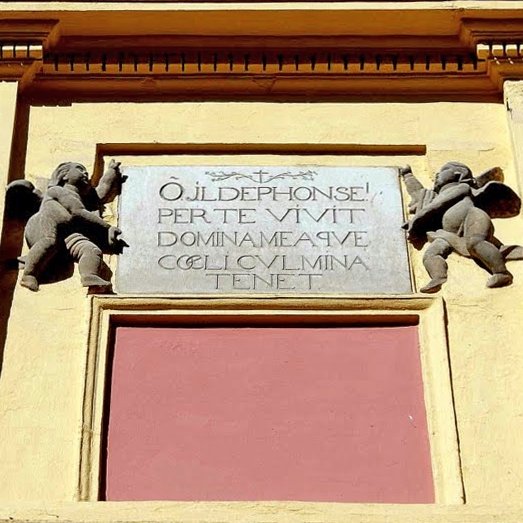
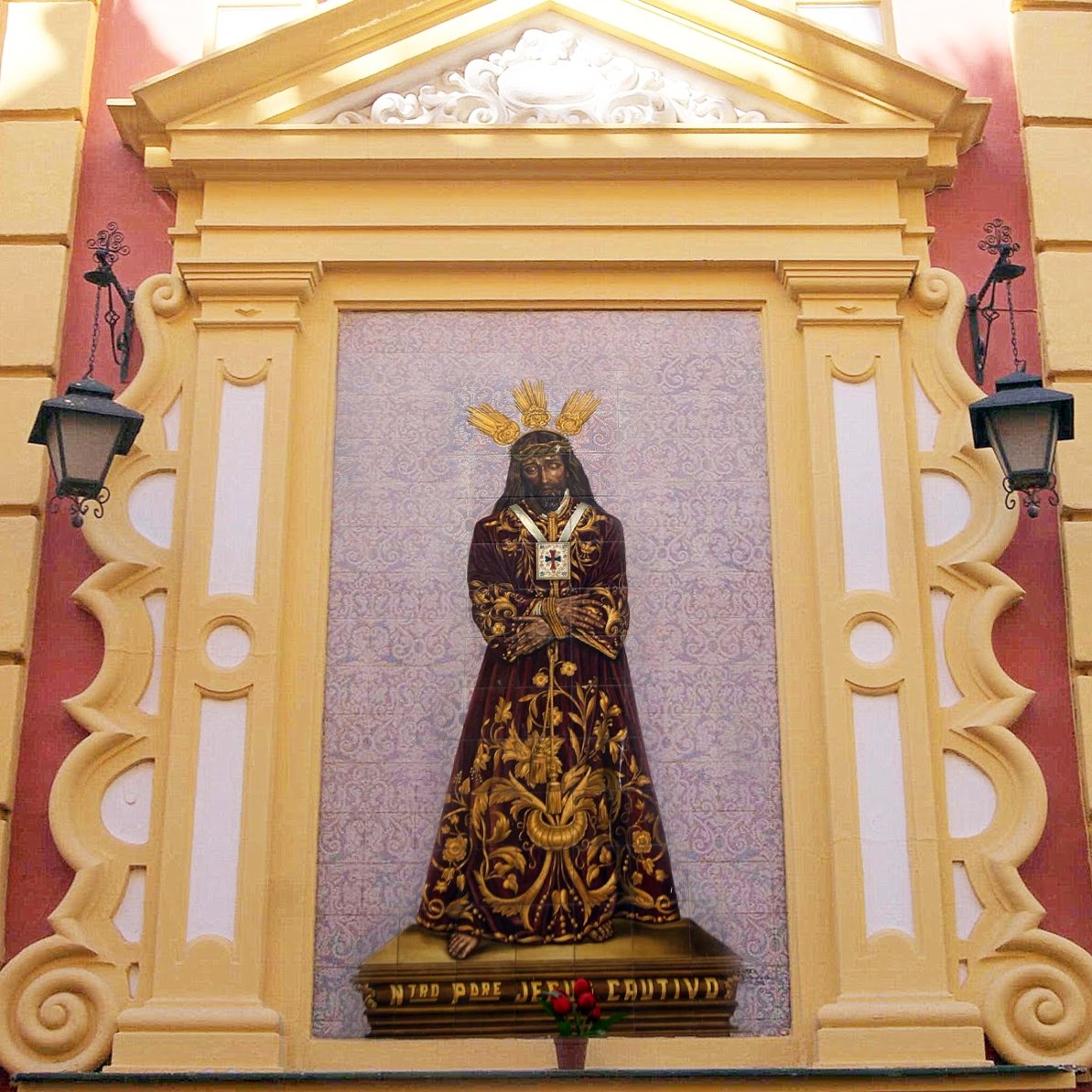
“It is a mural painting that follows the so-called international style, dating back to the last quarter of the 14th century. The dedication of the Coral is due to the fragment that hangs from the necklace that adorns the Child's neck. The red color of the coral appears here as a prefiguration of the Eucharist and the Passion of Christ. The Virgin is represented as "Hodegetria" (Bearer or Conductor). She is dressed in a purple tunic and mantle, decorated with golden lozenges, bands and plant motifs. The Virgin surrounds her head with a golden nimbus with stars. The head of the Child also has a golden nimbus. Both effigies are surrounded by golden glow. Mary carries the Child on her right arm, showing in her left hand a pomegranate, a symbol of the Church.

* : Leyendas de Sevilla   │   º : Wikimedia Commons