CHURCH OF SAINT SEBATIAN

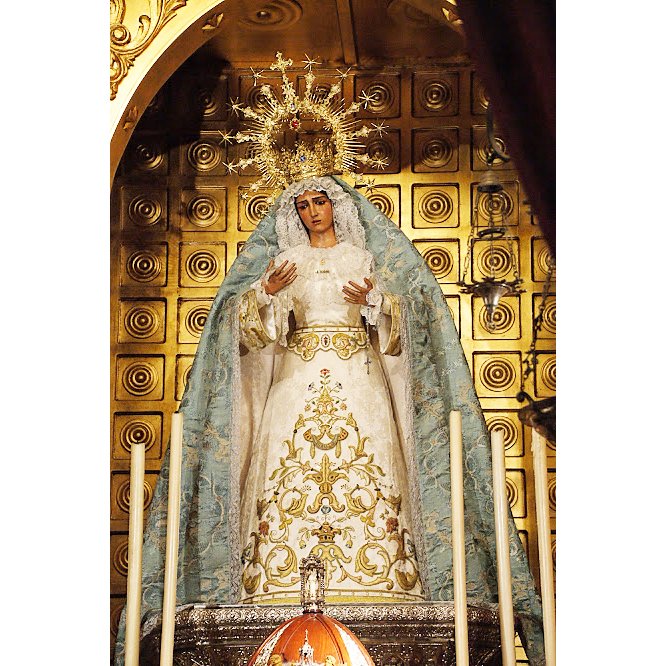
The church of San Sebastián is a Gothic-Mudejar temple originally built between the 15th and 16th centuries as a hermitage on the outskirts of the city. It has undergone profound transformations throughout its history, especially during the 19th and 20th centuries, in relation to the appearance of the Porvenir neighbourhood around it. It has a rectangular floor plan divided into three naves by pointed arches. The area of ​​the presbytery and the sacramental chapel stand out from the floor plan, at the head of the Epistle nave. The church is the headquarters of the Hermandad de la Paz, which processes on Palm Sunday.
History

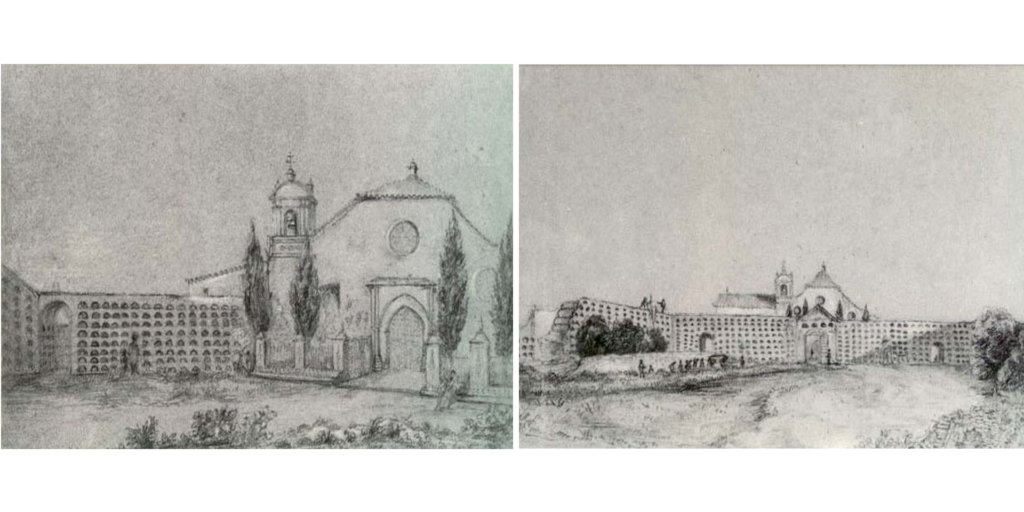
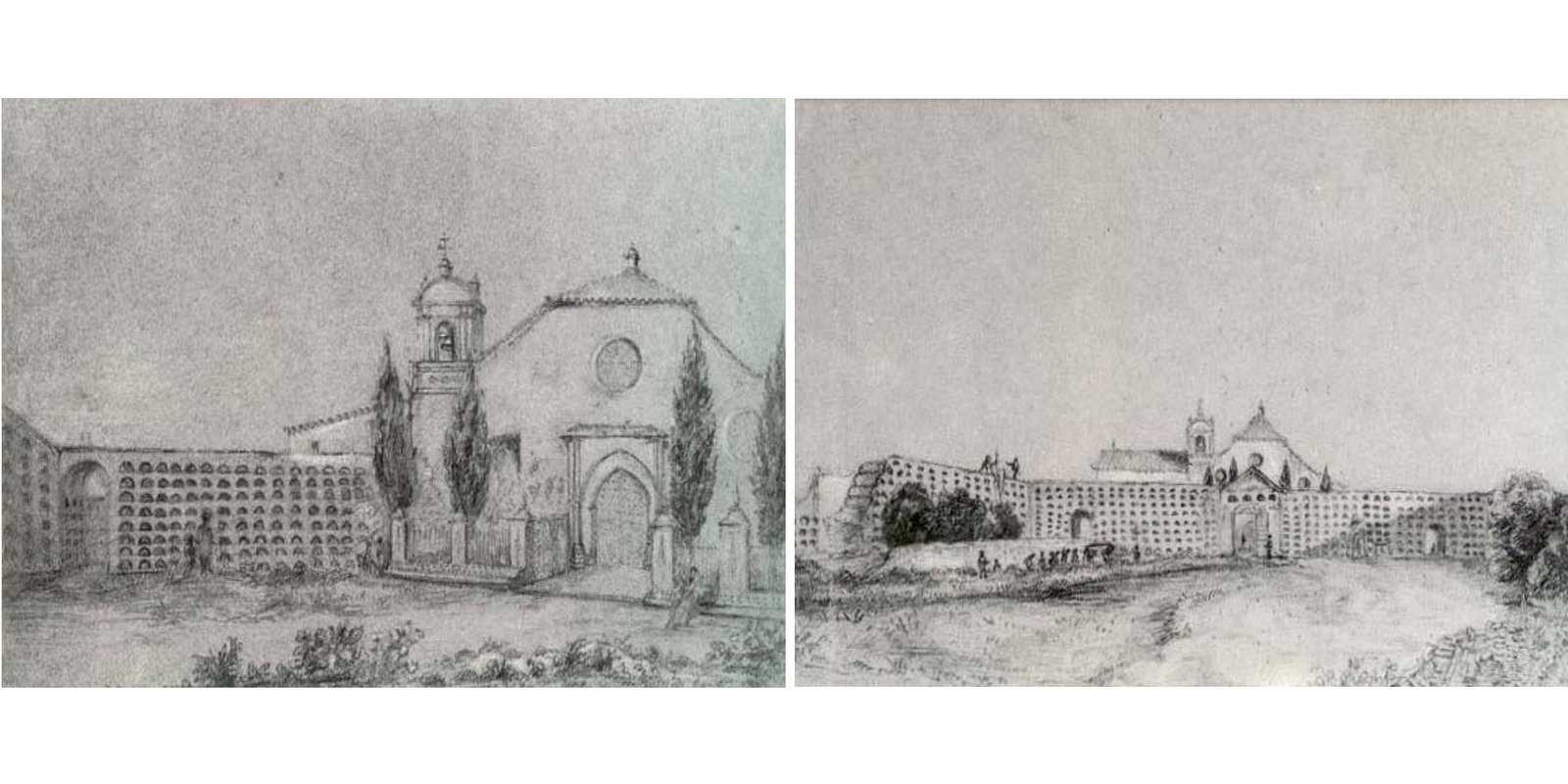
The origin of the church is a hermitage that was built on this site at the end of the Middle Ages in honour of San Sebastián, a saint who was asked for intercession in the event of epidemics. In the 19th century, the first cemetery outside the city walls was built near the hermitage. It should be remembered that for most of our history, burials took place in churches or in their surrounding areas, with the consequent health problems that this practice entailed. There are two drawings by the English traveller Richard Ford made in 1831 in which the cemetery and the primitive hermitage appear. The cemetery of San Sebastián lost importance after the construction of the municipal cemetery of San Fernando in 1852 and ten years later its demolition would begin, as recalled by an inscription at the foot of a cross that is currently located in front of the church as a commemorative monument. After the cemetery disappeared, a reform of the old hermitage was undertaken. It was probably at this time, in the mid-19th century, when the current presbytery was added, since it is known that there was originally a Gothic style one and the current one is covered by a hemispherical dome in the Baroque style.

From the beginning of the 20th century, with the preparations for the Ibero-American Exhibition of 1929, the creation of the Porvenir neighbourhood in the area of ​​the old hermitage was accelerated, with the result that the temple was reformed several times, as it gained importance as an auxiliary to the parish of San Bernardo.

In 1939 the Hermandad de la Paz was founded with headquarters in this church, which entailed new reforms, such as the opening of the south doorway for the exit of the floats or the construction of the brotherhood house, built under the direction of Rafael Arévalo y Carrasco in 1941. In 1956 the church was definitively established as a parish and has come down to our days consolidated as the centre of religious life in the neighbourhood.

Outside

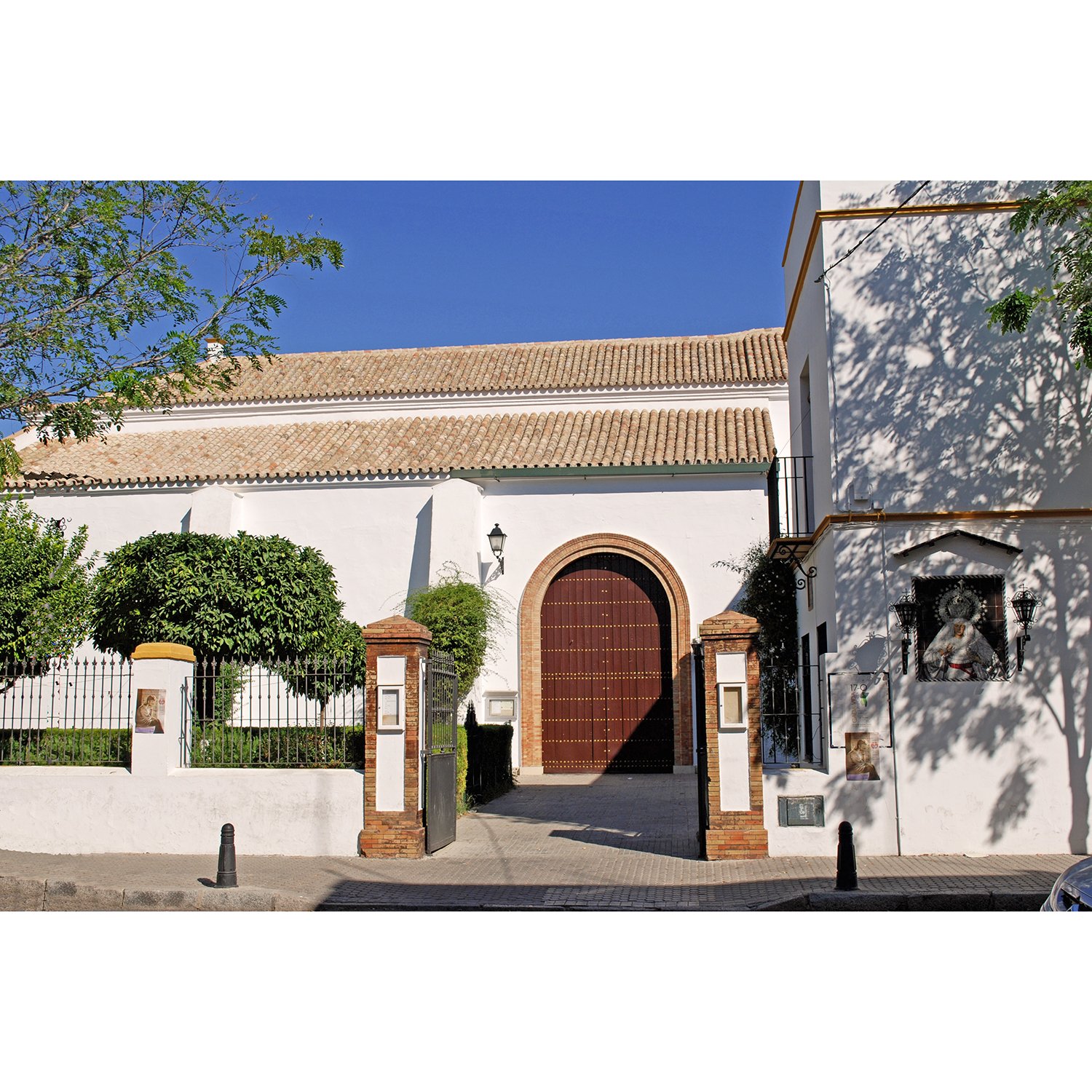
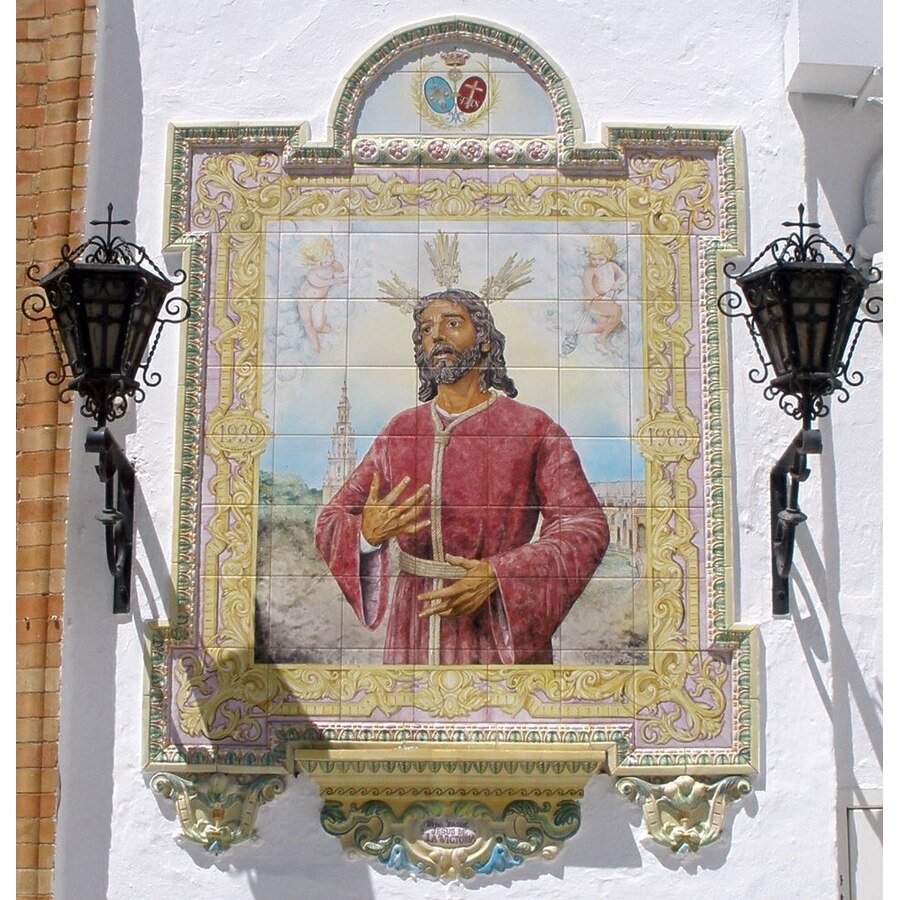
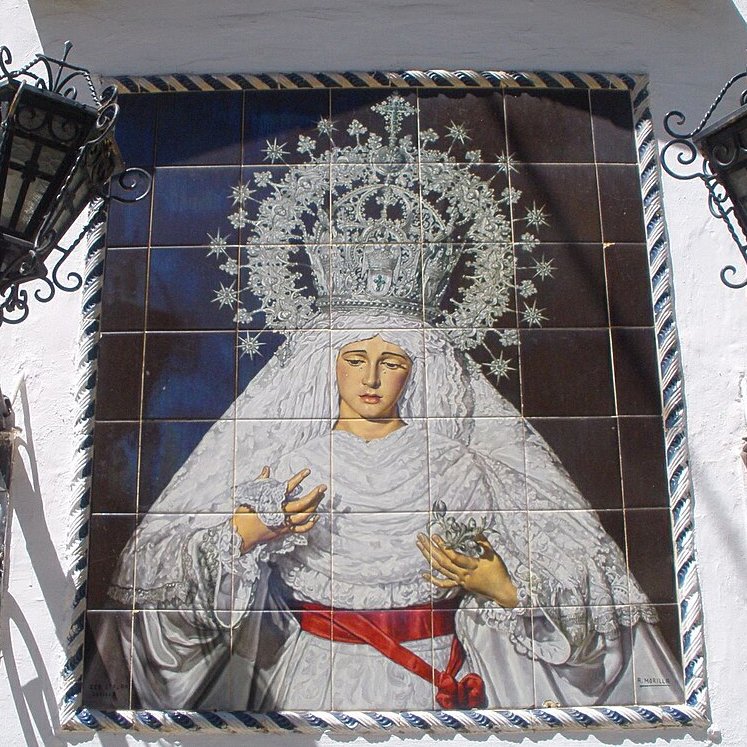
On the outside, the church is surrounded by annex buildings, with only the south and east façades remaining free. On the south side, the buttresses supporting the walls can be seen and it has a simple doorway in the area closest to the head. It was opened in 1940 to allow passage through and is made up of a simple semicircular arch framed by a moulding of exposed brick. To the right of the door is a beautiful ceramic altarpiece with the Christ of Victory, made by Alfonso Magüesín de la Rosa in 1989. In the background there is a landscape in which the silhouette of the Plaza de España can be distinguished. The ceramic altarpiece dedicated to the Virgin is very close, next to the entrance to the fenced area around the church. It was made by Antonio Morilla Galea in 1977 and it highlights the beautiful contrast between the whiteness of the figure of the Virgin and the black background.

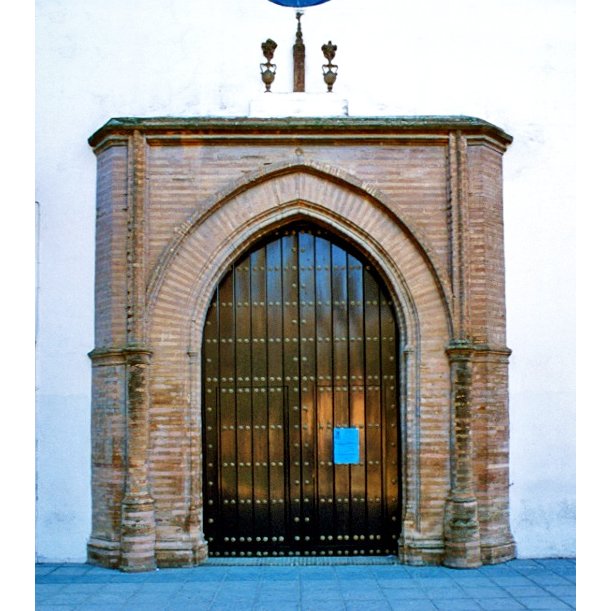
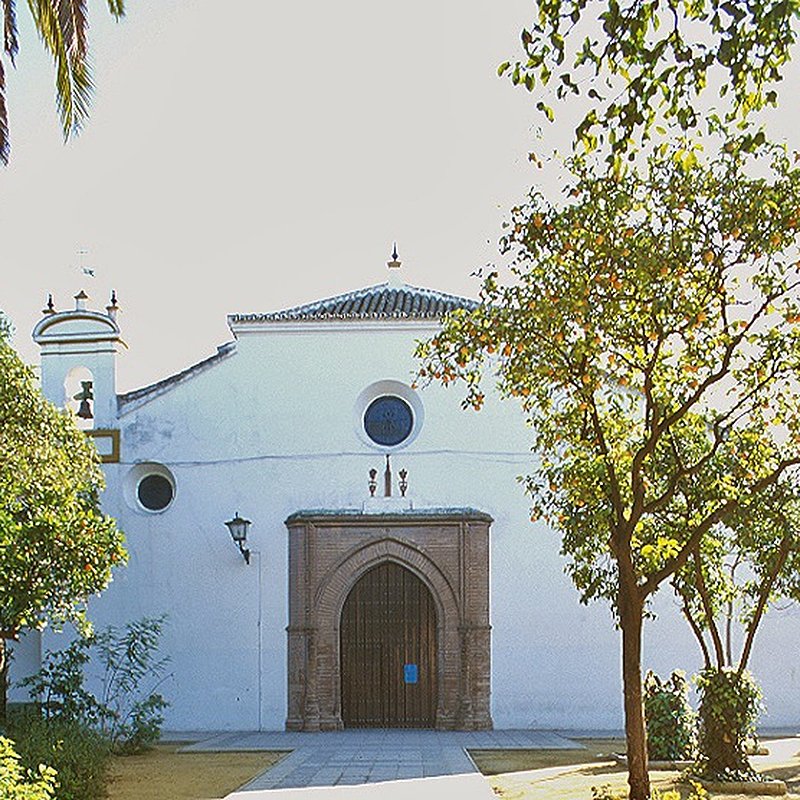
The main façade is the one facing east, at the foot of the church. In its centre we find a magnificent Mudejar doorway, probably built in the 15th century. It is formed by a pointed arch, framed by a structure that stands out from the rest of the façade, built from rows of bricks in alternating colours. It is very beautiful despite its simplicity and is clearly related to other similar doors that we find in Seville, such as that of the church of the convent of Santa Paula or that of the chapel of Santa María de Jesús. Above the door we find the coat of arms of the Cathedral, the Giralda between two jars of lilies, a symbol of the patronage of the cathedral chapter. This emblem does not appear in Richard Ford's drawing of 1831, so it must have been added later.

At the top of the façade there are three oculi, one in the centre and two on the sides, which serve to illuminate each of the naves. On the left stands a simple bell gable, with a single bell and topped with a curved pediment.

Interior

Inside, the space is divided into three naves, with the central one wider and higher than the side ones. Large pointed arches resting on cruciform pillars separate the naves. Another large pointed arch separates the central nave from the presbytery, like a triumphal arch. Most of the walls are plastered in white, with the area of ​​the pillars imitating ashlar and leaving the brickwork on the arches exposed. A 20th-century tiled plinth with geometric shapes runs throughout the interior. The roof is covered by wooden coffered ceilings in the neo-Mudejar style, with a pair and knuckle in the central nave and hanging in the side ones.
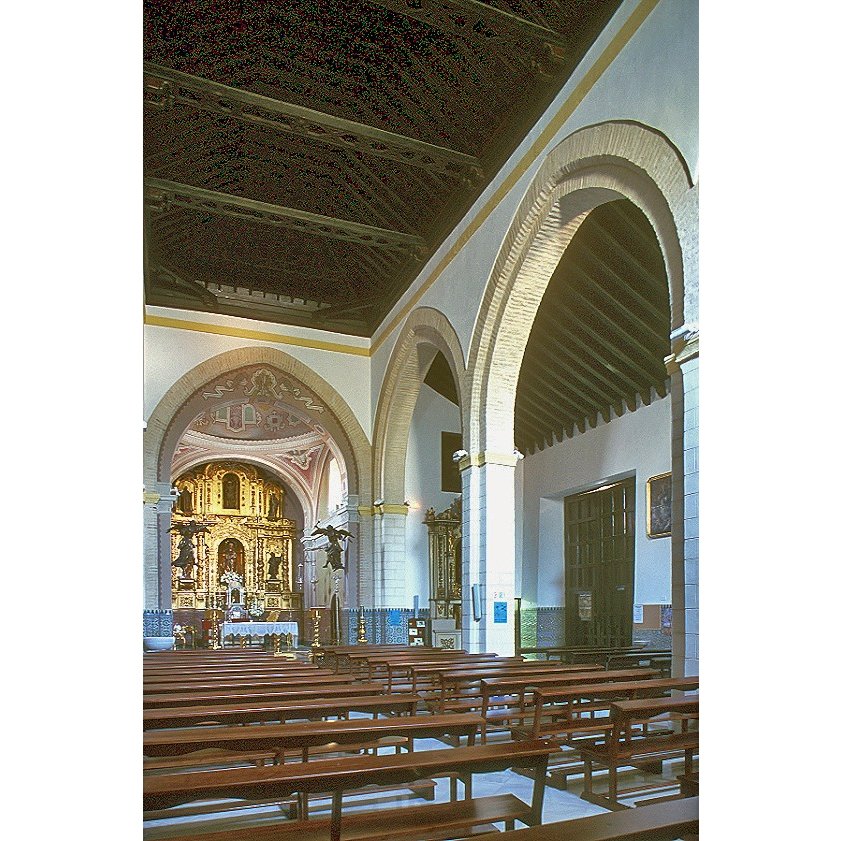
From the rectangular space formed by the naves, three spaces stand out at the head. The presbytery is located in the centre, the sacristy at the head of the right nave and the chapel occupied by the Brotherhood of Peace at the head of the Gospel nave.

The presbytery is a quadrangular space covered by a hemispherical dome on pendentives that is not visible from the outside of the temple. In all probability, it was originally covered by a pointed vault, as occurs in most of the Gothic-Mudejar churches in the city. The current dome must have been built during the reforms undertaken in the 19th century. The walls are decorated with contemporary paintings with geometric motifs, plants, fake architecture and angels. The pendentives follow the tradition of serving as a support to accommodate the Evangelists, who are represented by their symbols.

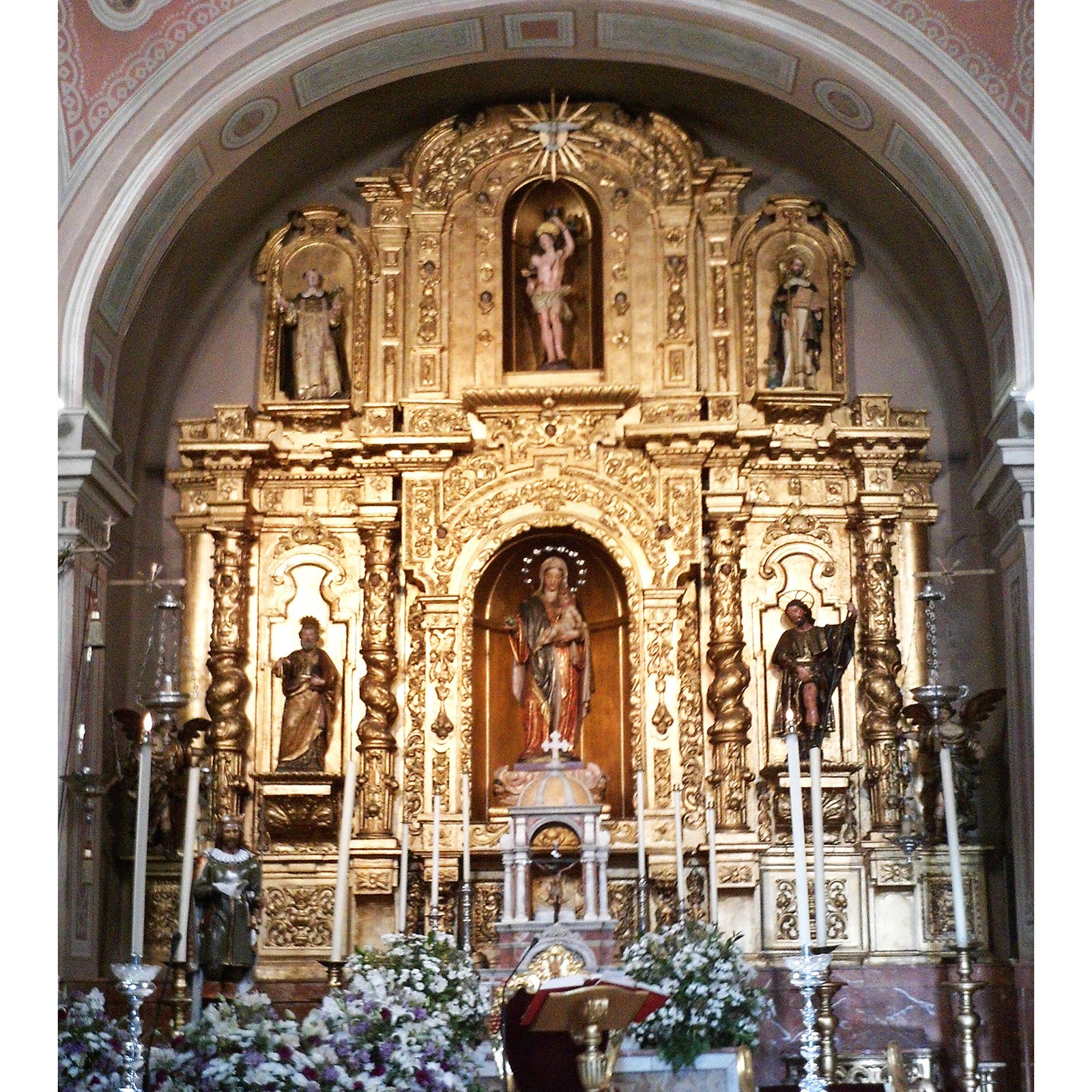
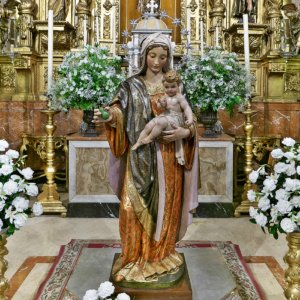
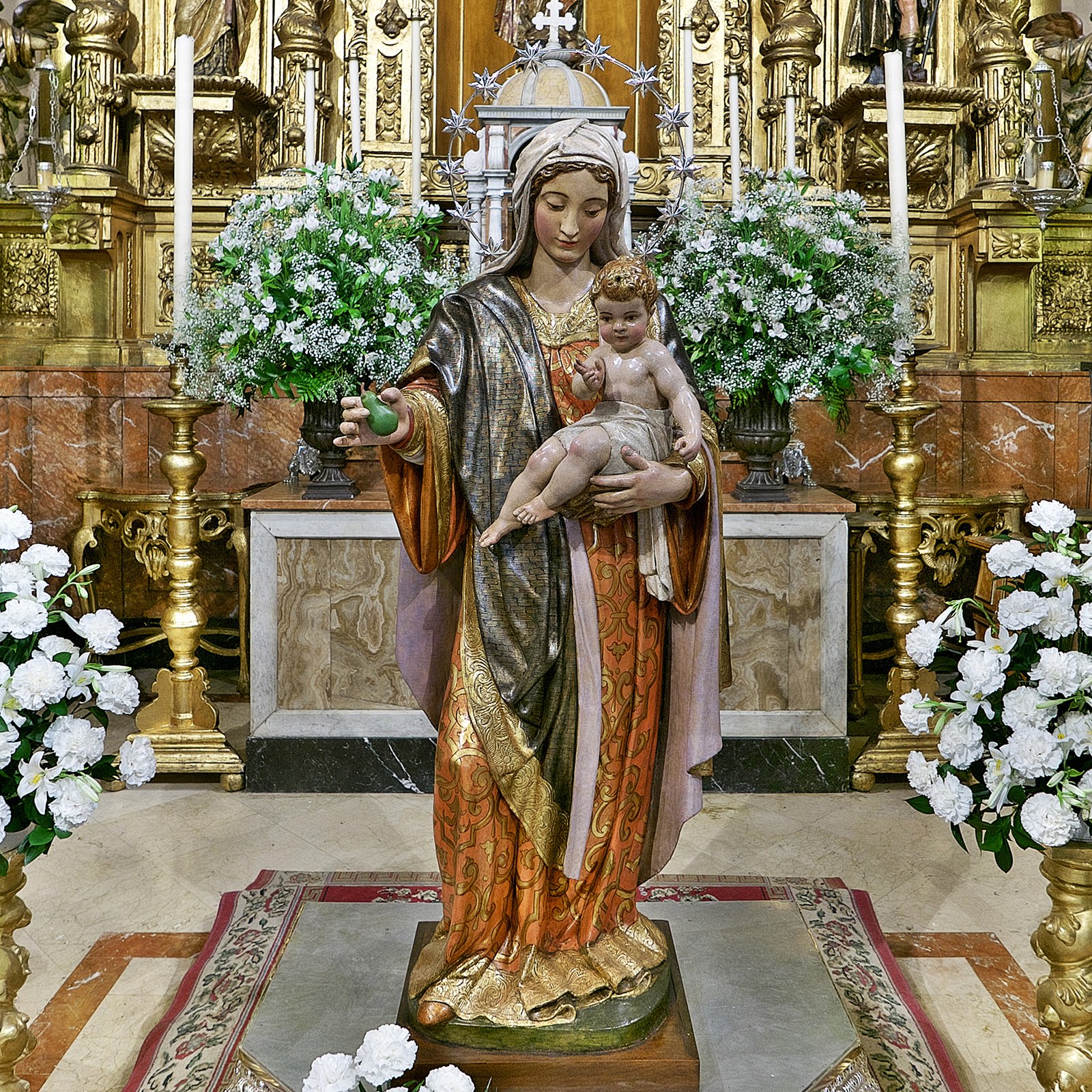
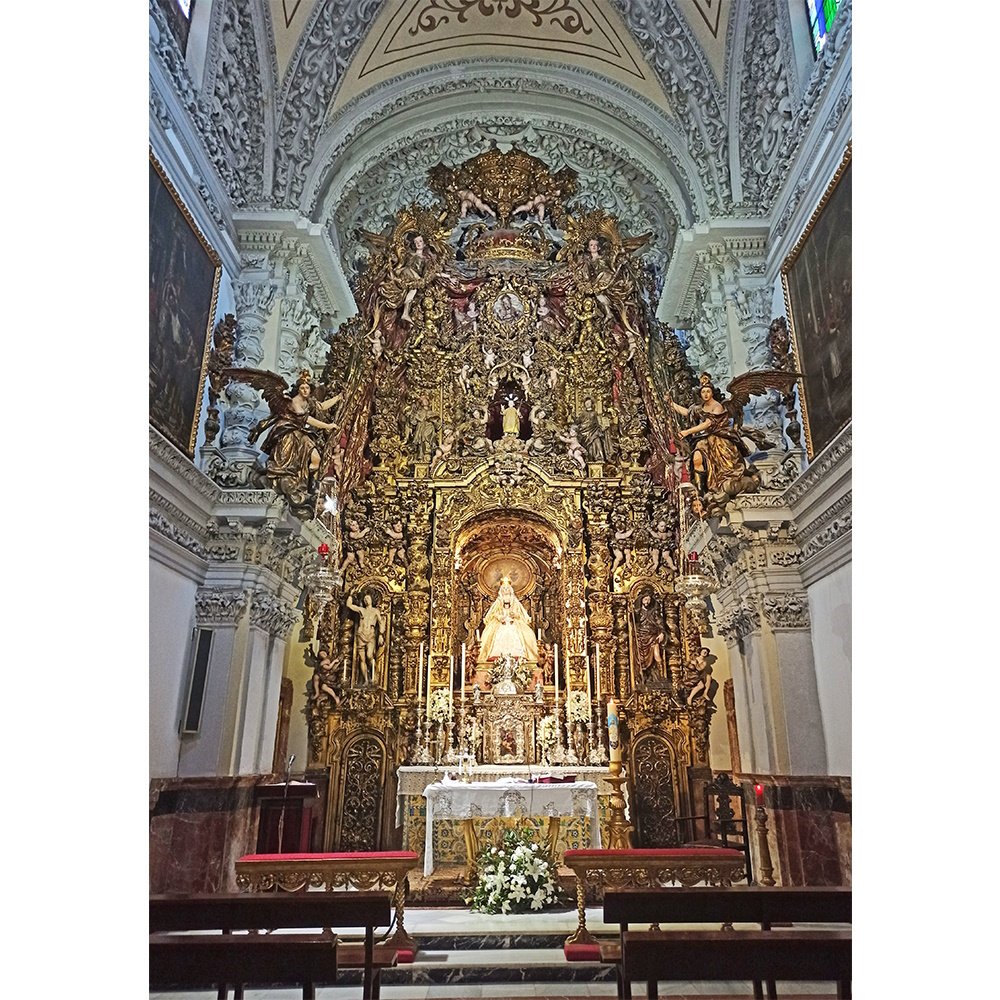
The altarpiece is in neo-baroque style, made in the 20th century. It is divided into three sections and two horizontal bodies. In the main niche we find a magnificent sculpture of the Virgin and Child, known as the Virgin of the Meadow. It was made by Jerónimo Hernández around 1577 and is an outstanding example of Renaissance sculpture in the city. The Child Jesus appears blessing with a sweet gesture while the Virgin holds a pear in her right hand. It should be remembered that this image acted as patron and protector of market gardeners and country people in this area of ​​Seville.

On the side streets are the sculptures of San Pedro and San Roque. In the centre of the second body is San Sebastián, the patron saint of the temple, flanked by San Jacinto and Santo Domingo de Guzmán. All the sculptures seem to be original from the 18th century, although they were probably re-painted later.

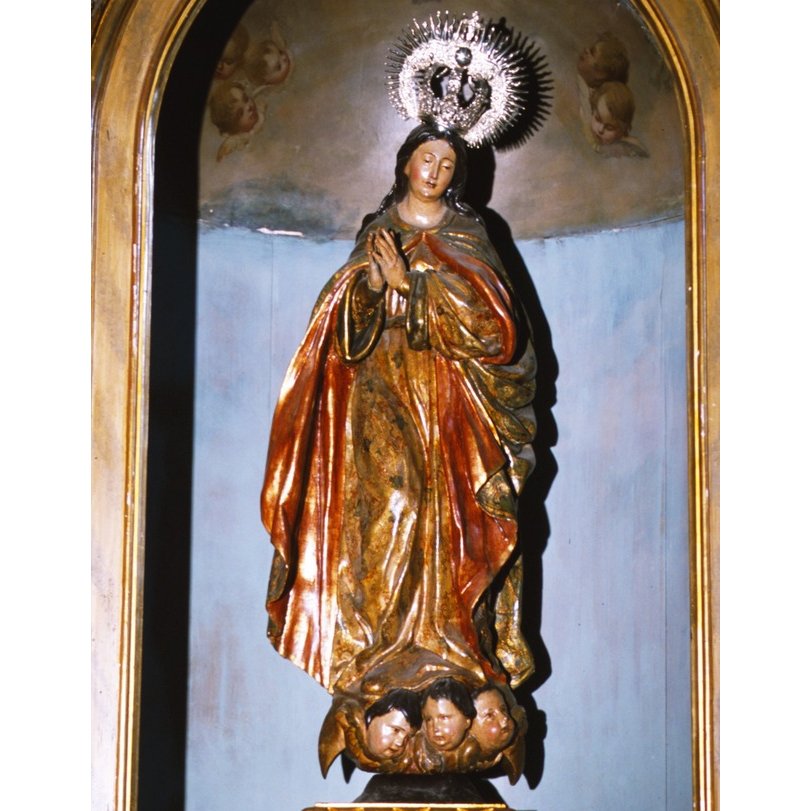
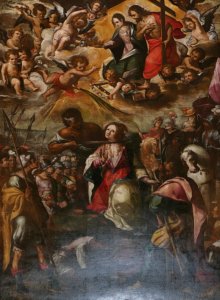
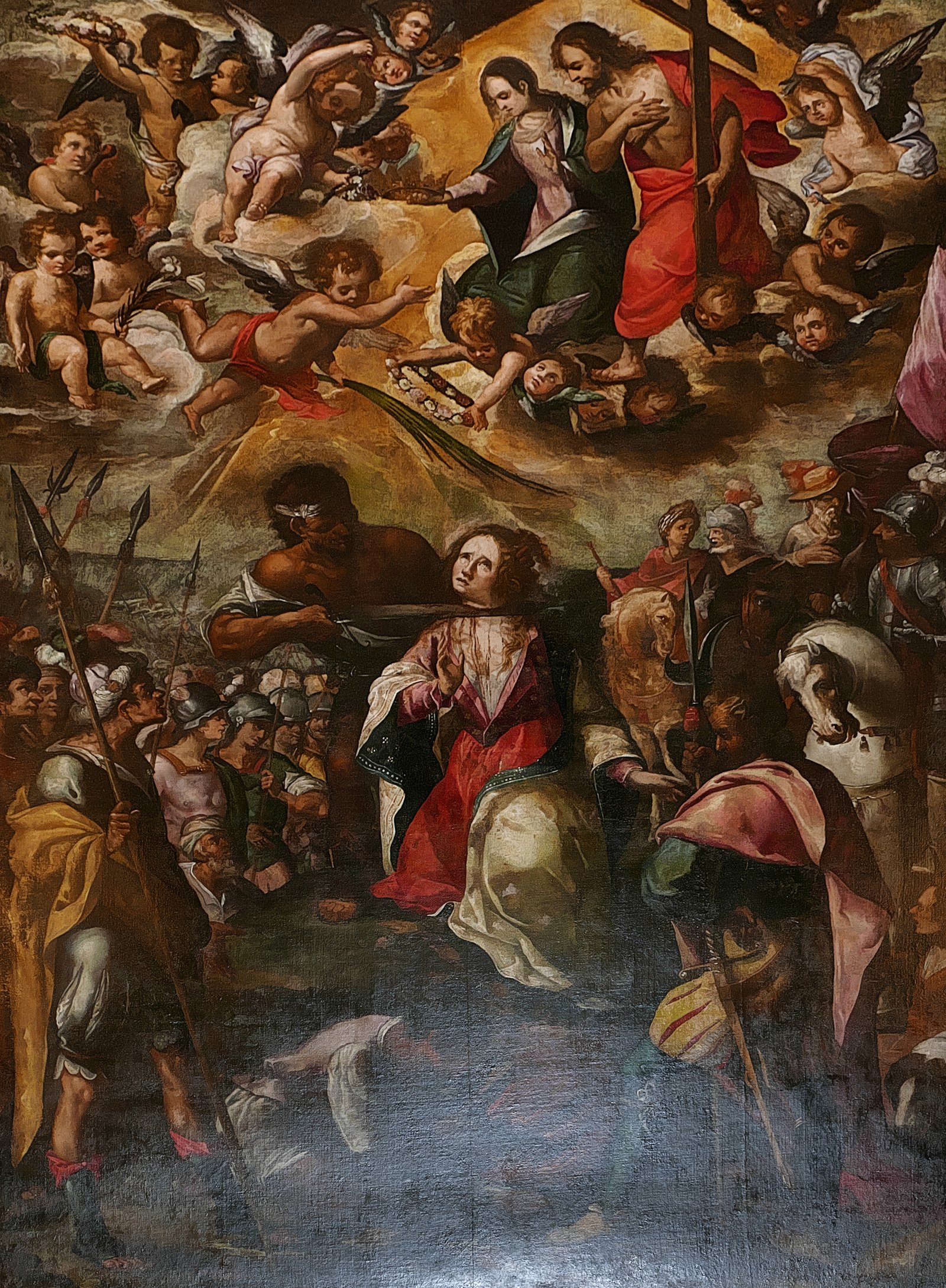
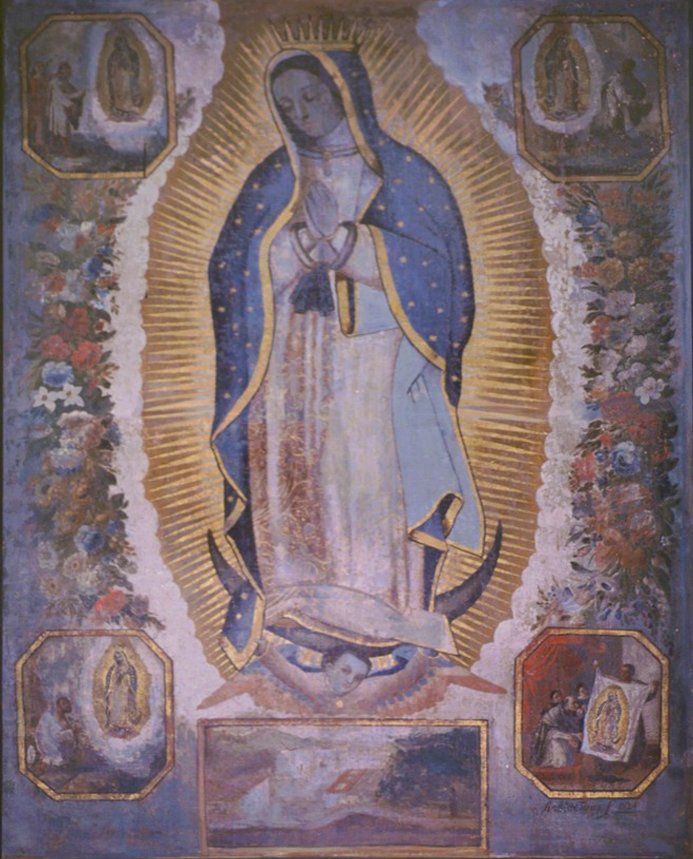
Other sculptures and paintings are displayed on the walls of the naves. One of the most notable is a carving of the Immaculate Conception from the 18th century, which presides over a stucco altarpiece in neoclassical style. There are also some carvings from the 20th century, such as the Sacred Heart, which presides over a neo-Baroque altarpiece. Among the paintings, we find several copies of originals by Murillo and some other Baroque paintings, such as the "Martyrdom of Saint Lucy" (Francisco Varela, c. 1637), the "Annunciation" or the "Marriage of the Virgin". From the same period there are representations of various saints, such as Saint Lawrence, Saint Agnes or Saint Sebastian, and an interesting "Virgin of Guadalupe", a copy of the Mexican original made by Antonio Torres in 1740.

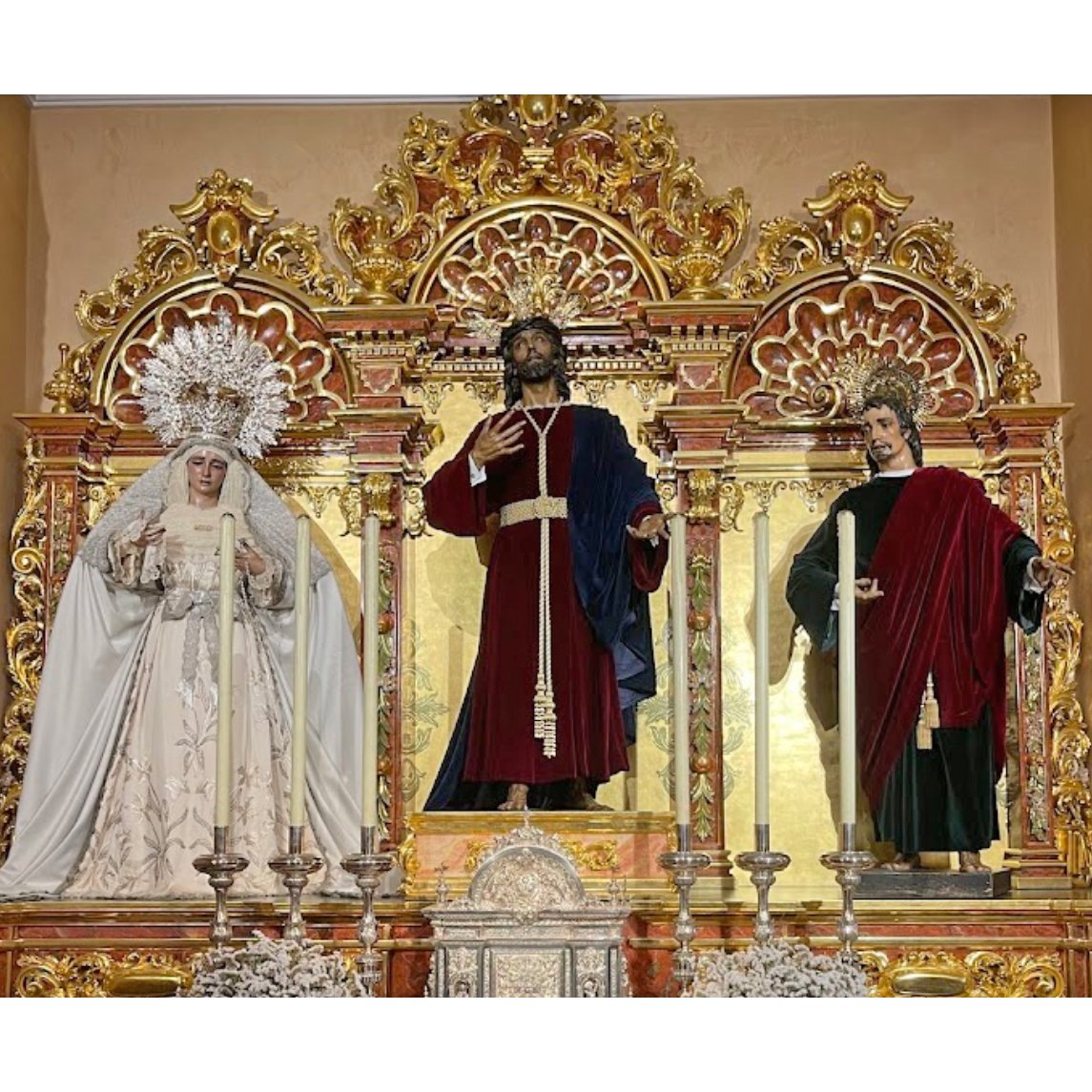
As we said, at the head of the left nave is the sacramental chapel, where the titular images of the Hermandad de la Paz are worshipped. The chapel is covered by a groin vault with a lantern in the centre and presided over by a neo-baroque altarpiece. In the centre we find Nuestro Padre Jesús de la Victoria, a sculpture made by Antonio Illanes Rodríguez in 1940. It forms part of a float in which Jesus is seen taking the cross to carry it on the way to Calvary, although when it is in its chapel the image is logically shown without the cross. On the left is the image of María Santísima de la Paz, made in 1939 also by Antonio Illanes, who is said to have been inspired for the face of the image by the facial features of his wife, Isabel Salcedo. When it comes to the procession, the image stands out for the white and silver tones of its float, both in the canopy and in the figure of the Virgin herself. This whiteness is a clear sign of the devotion to Peace and creates a very unique and iconic image during Holy Week in Seville. The same artist also made the sculpture of Saint John that occupies the niche on the right of the altarpiece.

CHURCH OF SAINT JULIAN

The church of San Julián is a Gothic-Mudejar temple, built mostly in the 14th century, although with important subsequent modifications. It is the headquarters of the Brotherhood of the Hiniesta, which takes part in the procession on Palm Sunday.

It has a rectangular floor plan and three naves, separated by pointed arches resting on pillars. The polygonal head, where the presbytery is located, stands out from the floor plan.

As it has survived to this day, the church is the result of a reconstruction carried out in the mid-20th century, as it was almost completely destroyed in a deliberate fire in 1932. At the end of that same century, the temple was completely restored to replace its roofs, which were in a ruinous state.

History

The church is one of the parish churches of the group of Gothic-Mudejar churches in Seville, built mainly in the northern area of ​​the historic centre between the 13th and 15th centuries. They all share a very similar structure and style and form a typological ensemble of extraordinary interest and beauty.

In the case of San Julián, it is known that it was built in the first half of the 14th century, dedicated to this saint who suffered martyrdom at the beginning of the 4th century together with his wife Basilisca, probably in Antinóopolis (Egypt).

The temple has undergone important modifications throughout its history. In the 17th century, the bell tower and the chapel on the left side occupied by the Brotherhood of the Hiniesta were added. The most complicated moments occurred in April 1932, when the church suffered an intentional fire that almost completely destroyed it. All its roofs and most of its movable heritage were lost, including the titular images of the Brotherhood. In 1989 it had to be closed again until 1994, given the poor condition of its roofs.


Outside

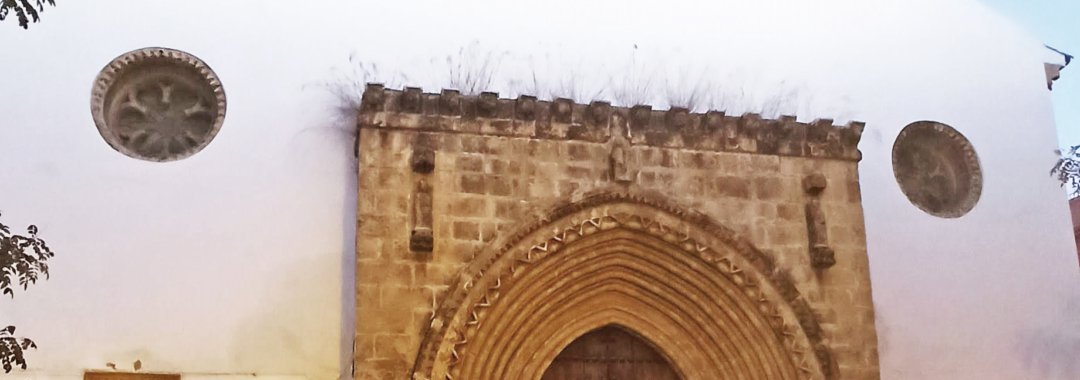
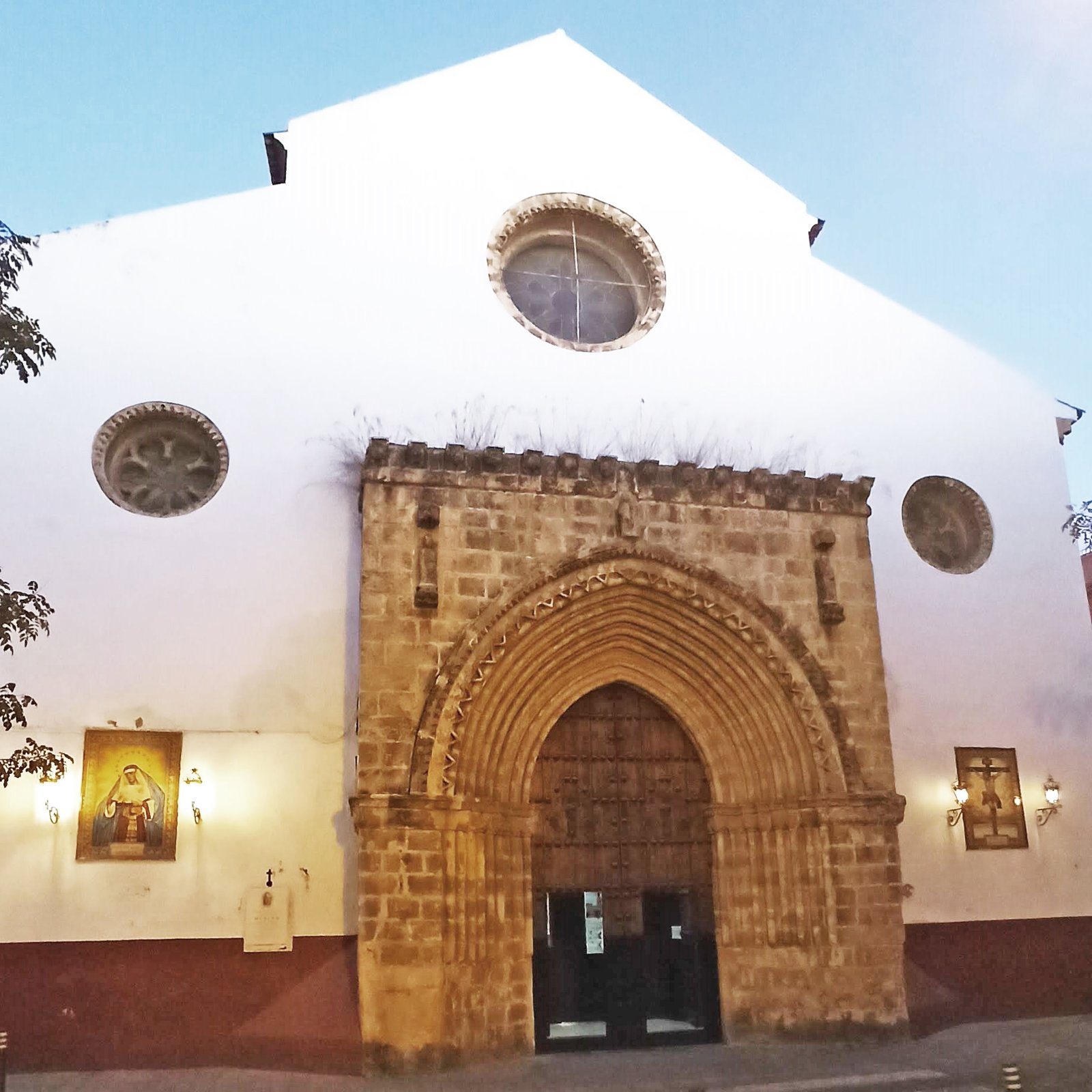
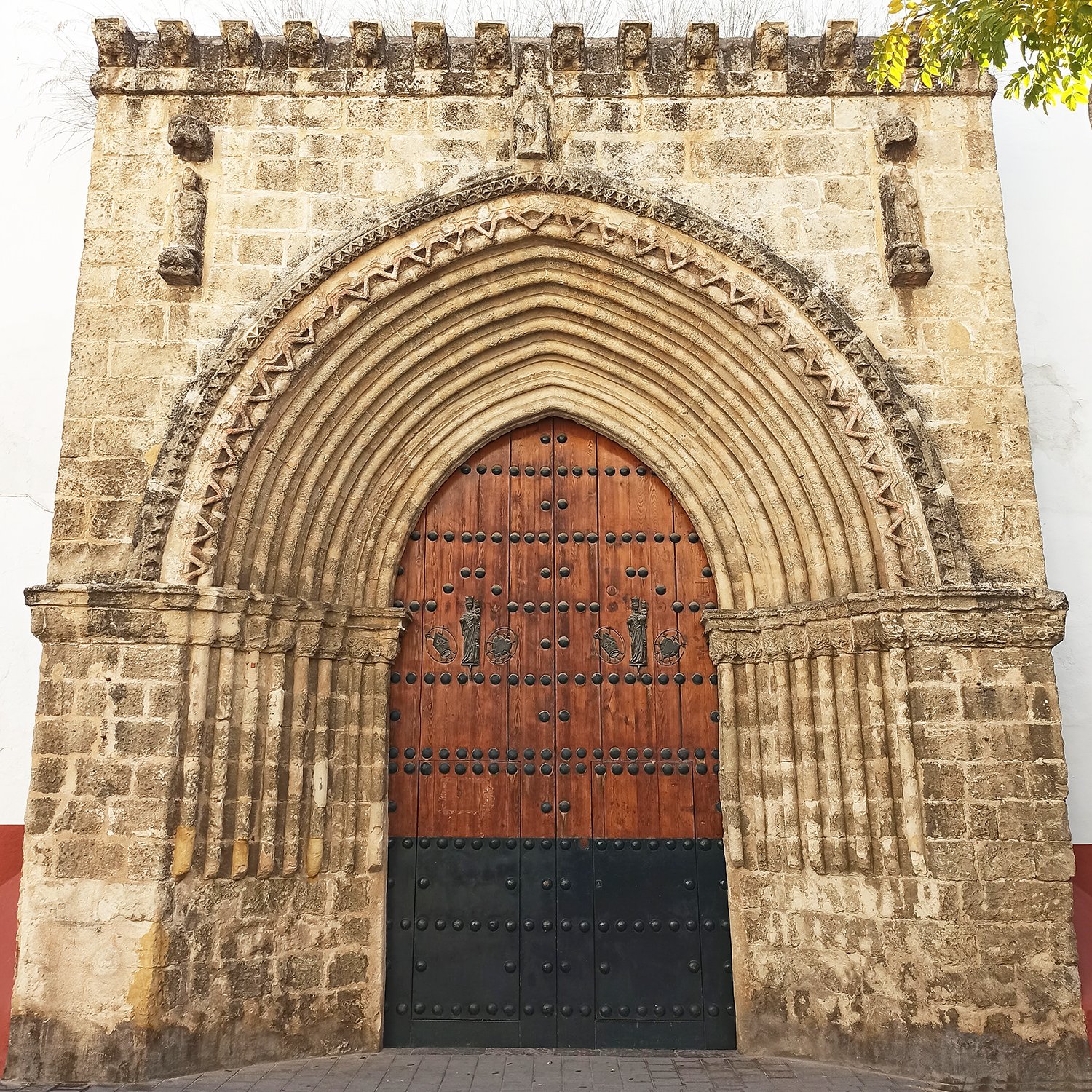
San Julián has two exterior doors, one at the foot and another on the left side, although the second is unfinished and has survived to this day flanked by a brick structure that was to serve as support for a door that was never built. The main door is at the foot and has the classic ogival, flared shape, framed by an alfiz that stands out from the rest of the façade. It has very simple and somewhat rough sculptural decoration, although the high degree of erosion of the stone makes it difficult to assess its original appearance. The arch is decorated on the outside by a moulding with zigzag motifs and another with diamond points. The capitals of the small columns on both sides have plant decoration of vine leaves, which continues outwards under the impost line. Around the entrance arch there are three small sculptures under Gothic canopies. According to art historian Rafael Cómez, the one at the top represents Christ as a judge, the one on the left represents Saint Julian the Bishop and the one on the right represents Saint Julian the Hospitaller. Confusions between saints have been common throughout history and elements of different saints have often been attributed to others with the same name or their characteristics have been different depending on the territory. (Rafael Cómez Ramos, "Iconología de la arquitectura religiosa bajomedieval en Sevilla: la iglesia de San Julián").

At the top there are a series of modillions decorated with lion heads, between which there are a series of horseshoe arches engraved in the stone. The lions symbolised, among other things, royal authority, and we find them in other Sevillian doorways from the same period, such as in San Esteban or in Santa Ana de Triana.

Above the doorway there are three oculi with diamond-shaped moulding, one larger at the top and two, somewhat smaller, one on each side.

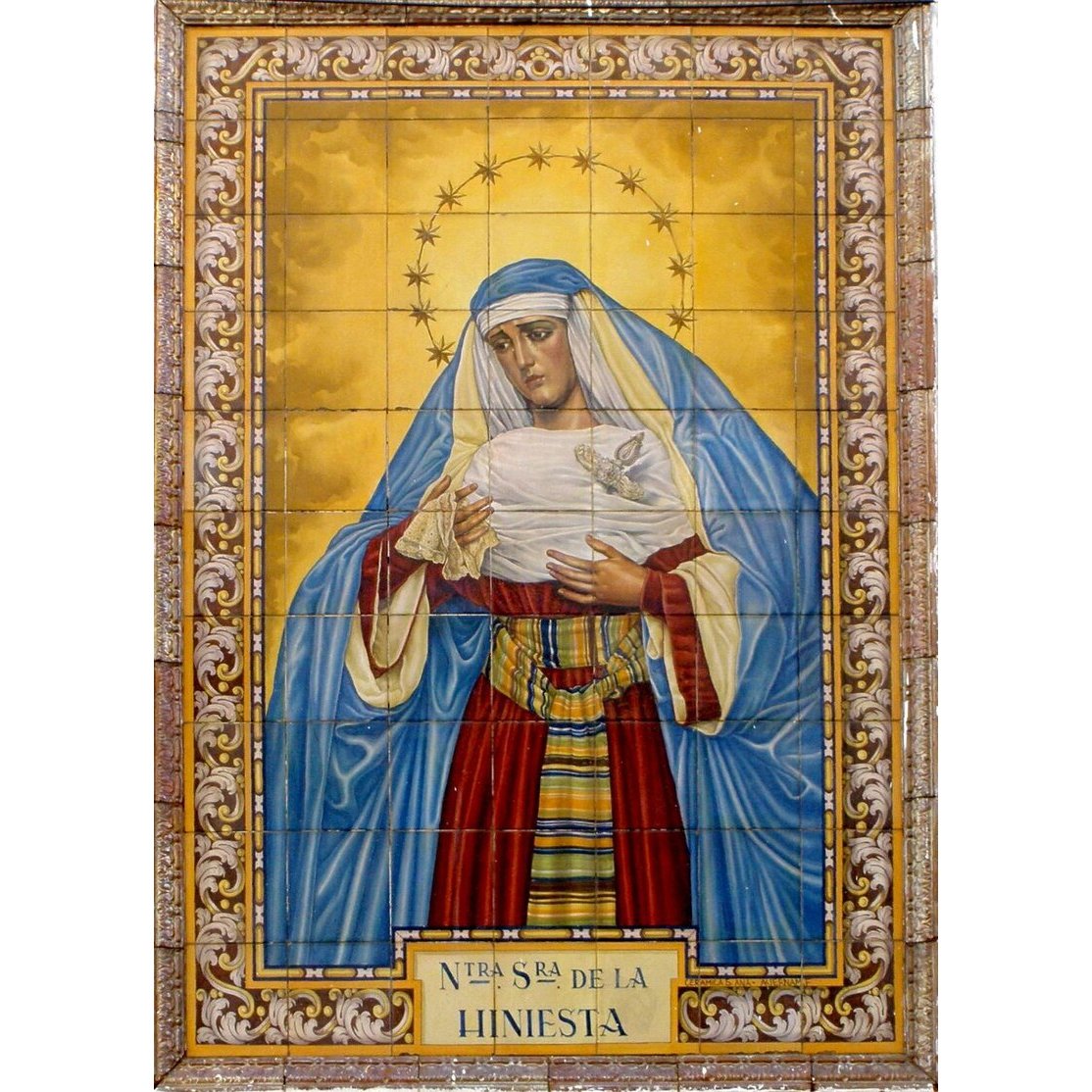
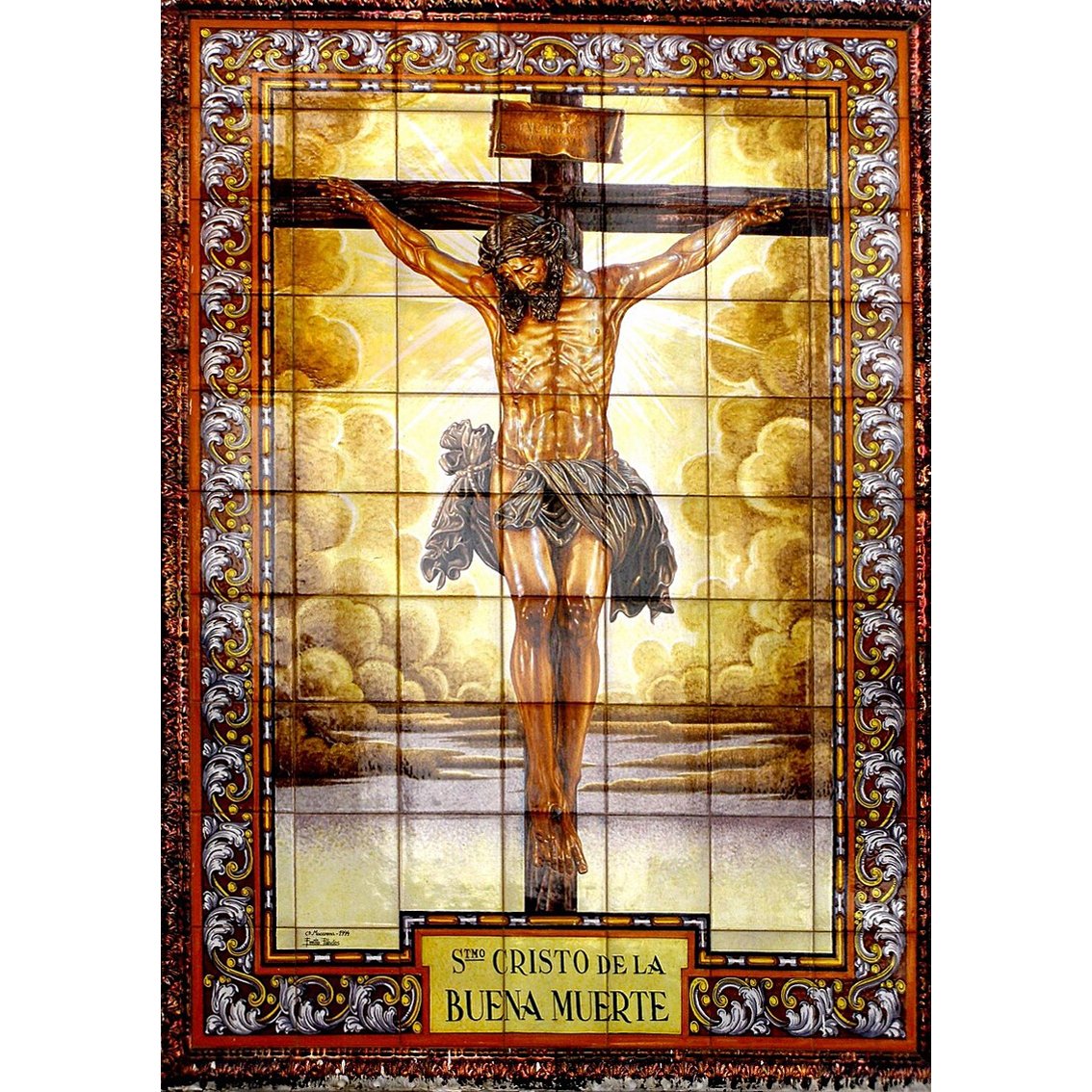
The decoration of this façade is completed by two ceramic altarpieces dedicated to the titulars of the Hermandad de la Hiniesta, which are located on both sides of the doorway. On the left is the one of the Virgin, made by Antonio Kierman Flores in the Santa Ana factory in 1962. On the right we find the Christ of the Good Death and it was made in 1994 by Emilio Sánchez Palacios in his family workshop, Cerámica Macarena.

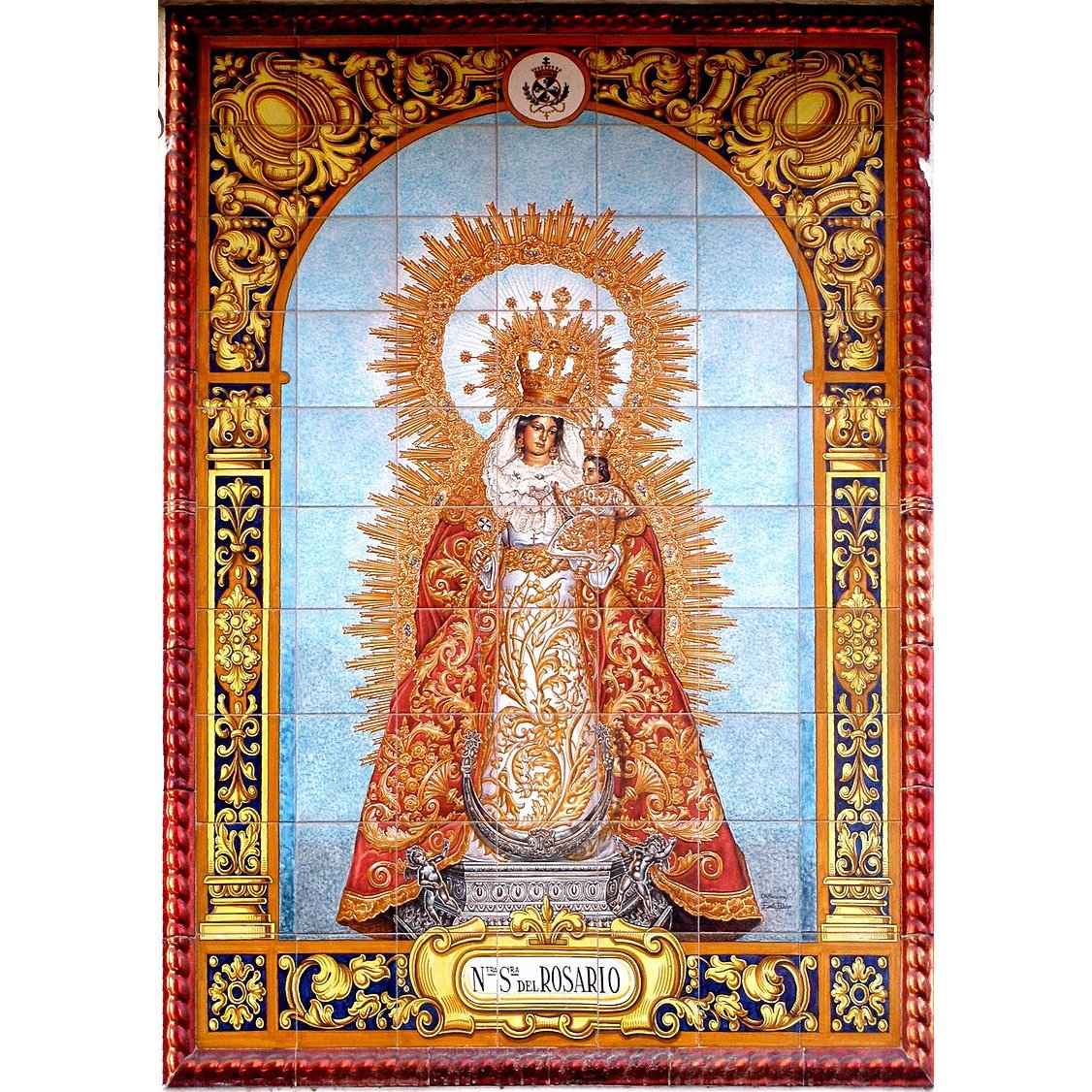
On the right-hand side, facing Duque Cornejo Street, we find another ceramic altarpiece with the same authorship and date as that of Christ. On this occasion it is dedicated to the Virgin of the Rosary, the titular of her own brotherhood, also based in this temple.

From this same side, the bell tower that stands next to the head of the church is visible. It has a square floor plan, with the body of the bells decorated by simple pilasters, and is topped by a hexagonal spire with ceramic decoration in white and blue.

Inside

The interior of the temple today is the result of the reconstructions that had to be carried out during the 20th century, although an attempt was made to recreate the original appearance as far as possible. The naves are covered by 20th century wooden coffered ceilings in the neo-Mudejar style, while the apse is covered by a ribbed vault that follows the Gothic model. This difference in the type of covering between the naves and the presbytery is very common in the Gothic-Mudejar churches of Seville. The walls are covered by tiled plinths with geometric motifs, also following models that come from the Middle Ages.

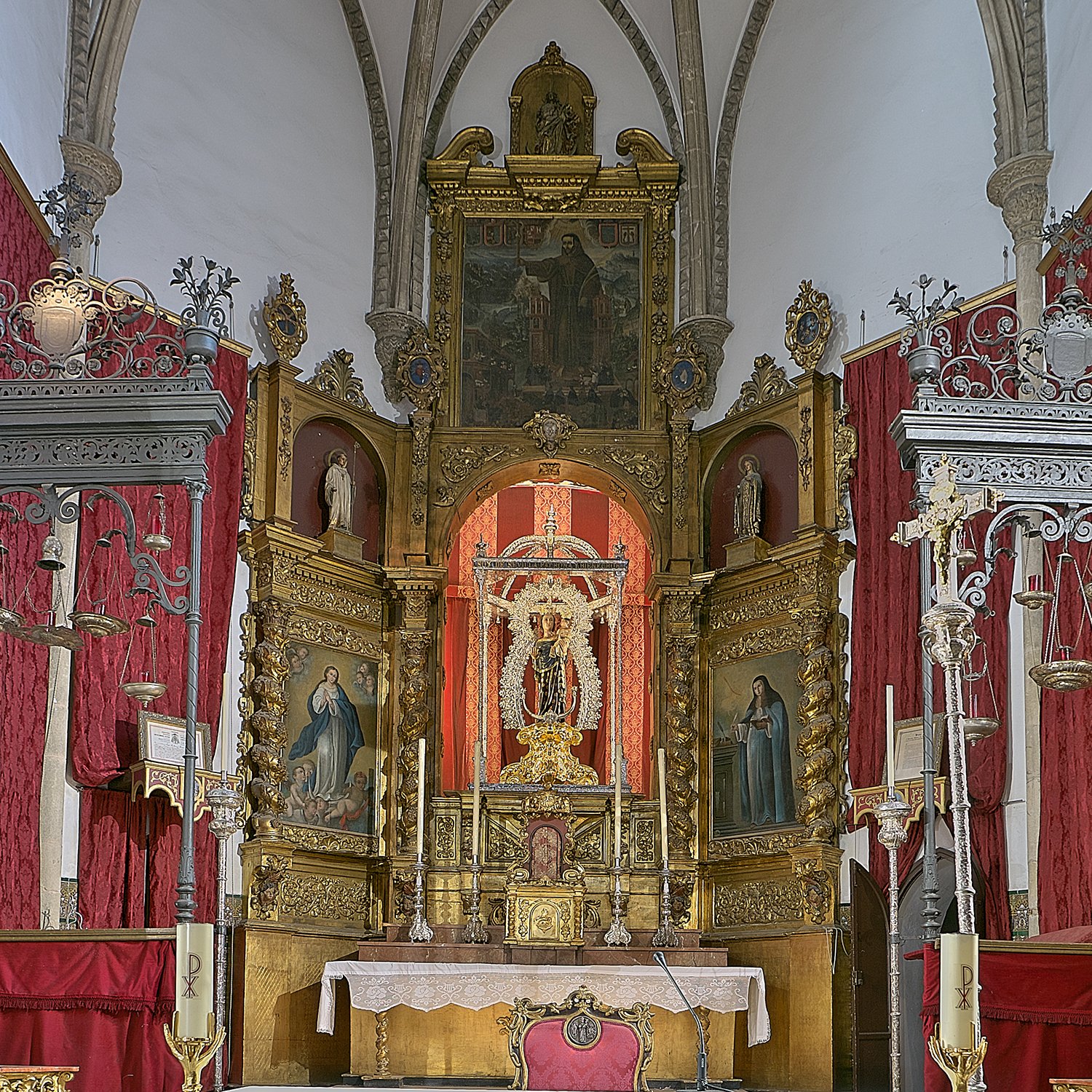
In the area of ​​the presbytery, the current altarpiece is the result of a reconstruction from fragments of altarpieces from the 17th and 18th centuries. This is because the previous one was lost in the fire of 1932. In the central niche, the image of Our Lady of the Glorious Hiniesta is worshipped, an image made in 1945 by Antonio Castillo Lastrucci to replace the original Gothic one, also destroyed in the fire. This devotion to the Hiniesta has a very interesting origin and is deeply rooted in the city, to the point that it is officially the patron saint of the City Council of Seville. Professor Francisco S. Ros González tells the legend thus:

…the Catalan knight, Father Per de Tous, was hunting in the mountains of his land one day at the end of the 14th century when his goshawk became paralysed in front of the gorse bushes where the partridges he was pursuing had taken refuge. Surprised by the bird’s behaviour, the knight dismounted from his horse, looked into the undergrowth and discovered an image of the Virgin with the Child in her arms with an inscription at her feet that, in the Latin version by Ortiz de Zúñiga, read: «Sum Hispalis de sacello ad portam quæ ducit ad Corduvam» («I am from Seville, from a chapel next to the gate that leads to Córdoba»). From the text it was deduced that the image was one of those that had been hidden during the Muslim invasion to prevent its desecration and that it had miraculously been preserved intact through the centuries despite being out in the open. Per de Tous took the image to Seville and placed it in the parish church of San Julián, as it was the temple closest to the door in the city walls leading to Córdoba at that time. The fact that the image of the Virgin was found hidden in some broom bushes led to it being called Santa María de la Hiniesta.

(Francisco S. Ros Gonzáles, “La Virgen de la Hiniesta de Sevilla y el movimiento concepcionista”. Universidad de Sevilla, 2005)

On either side we find two anonymous paintings from the 18th century, the one on the left with the Immaculate Conception and the one on the right with Saint Beatrice de Silva, founder of the Order of the Immaculate Conception. Above the paintings, two niches contain small carvings. The one on the left represents Saint Bernard of Clairvaux, while the one on the right could be Saint Therese of Lisieux. Above the central niche, in the upper part of the altarpiece, we find another anonymous painting from the 18th century with Saint Francis Solano. Above it, a small relief with the Immaculate Conception (17th century).

Also in the area of ​​the presbytery, two curious lampstands from around 1672 stand out. Fortunately they were saved from the fire of 1932 and from them hangs a splendid collection of eight silver lamps from the 16th and 17th centuries.


Left Nave

If we begin to describe the walls of the church at the foot of the left nave, the first thing we find is a carving of Saint Joseph with the Child, an anonymous work from the 18th century. Nearby is a ceramic panel in blue tones with the representation of the Baptism of Christ. It is a recreation of the exceptional canvas with the same theme that Murillo painted for the chapel of San Antonio in the cathedral of Seville. The ceramic altarpiece was made by Rafael Cantanero Mesón at the Mensaque Factory in Triana around 1920.

Continuing towards the apse we find a curious altarpiece - pedestal in neo-baroque style, formed by plant motifs. It houses a beautiful carving of Saint Angela of the Cross, a contemporary work by Ricardo Rivera.

The next altarpiece is also contemporary and is made of gilded plaster. It houses an image of the Virgin of the Miraculous Medal, made by Castillo Lastrucci around 1945.

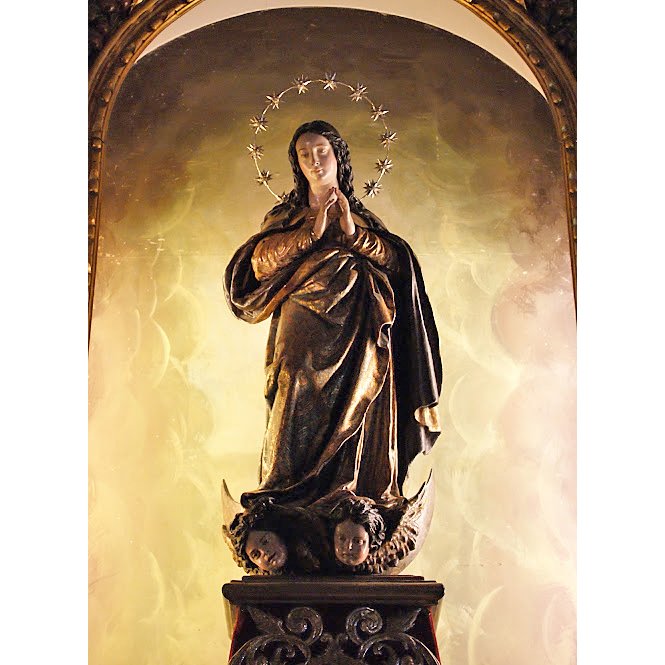
Continuing towards the head, the next altarpiece is also modern and very sober, but it houses one of the great artistic jewels of this temple. It is a carving of the Immaculate Conception, made in the first third of the 17th century and attributed to Alonso Cano. It has notable similarities with works by Martínez Montañés and, in fact, it has sometimes been attributed to him, given its resemblance to sculptures such as the famous "Cieguita" of the cathedral of Seville. Alonso Cano was training with the master Montañés and it is normal that he reproduced his models.

Finally, at the head of the Gospel nave we find a neo-Gothic altarpiece with the dressed image of the Virgin of the Rosary. The image is the title of its own brotherhood of glory and was made in 1937 by José Rodríguez Fernández-Andes.

Right Nave

At the head of the right nave is the sacramental chapel, where the image of Our Lady of the Sorrowful Hiniesta, the titular of the Brotherhood of the Hiniesta, is worshipped. It is the third image with this purpose that the Brotherhood has. The first was a baroque Virgin of the Sorrowful from the 17th century, attributed to Martínez Montañés, which was lost in the fire of 1932. To replace it, Castillo Lastrucci made a new Virgin of the Hiniesta, which was destroyed in the fire of San Marcos in 1936, since at that time the Brotherhood was based in this parish. The current one was also made by Castillo in 1937 to replace the missing sculpture that he himself had made.

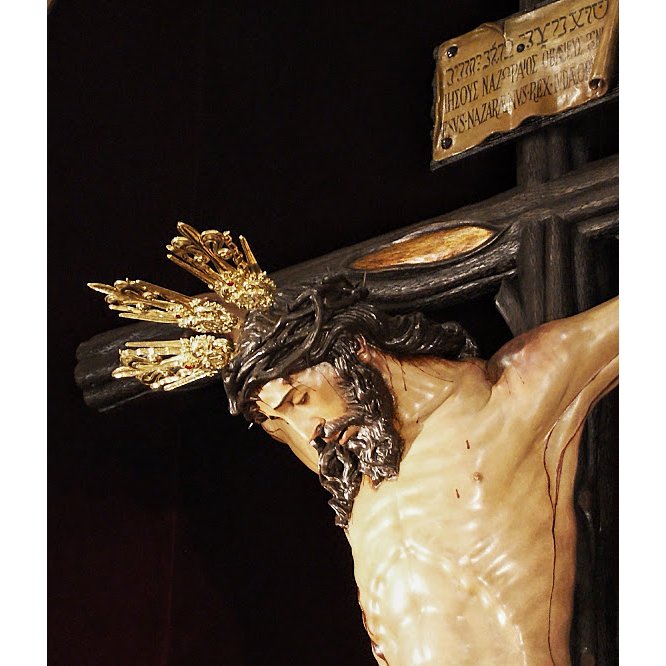
Next to the sacramental chapel, on the epistle wall, a simple arcosolium houses the Most Holy Christ of the Good Death, also the titular of the Hiniesta. It is an imposing crucified figure of 1.76 m. Also made by Castillo Lastrucci in 1938, replacing the original by Felipe de Ribas that disappeared in the fire.

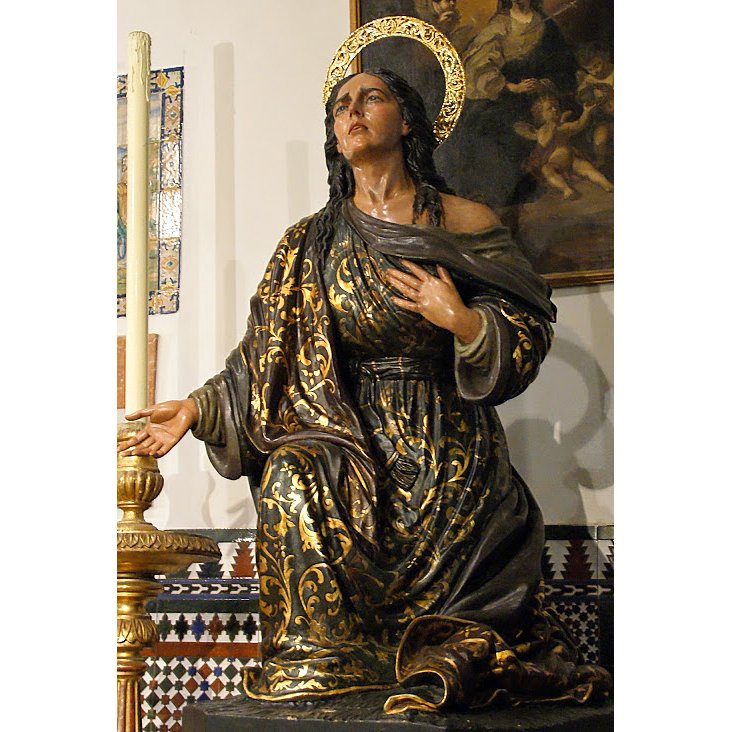
Continuing a little towards the feet, on a pedestal is the sculpture of the Magdalene that Castillo made in 1944 and that accompanies Christ in his procession.

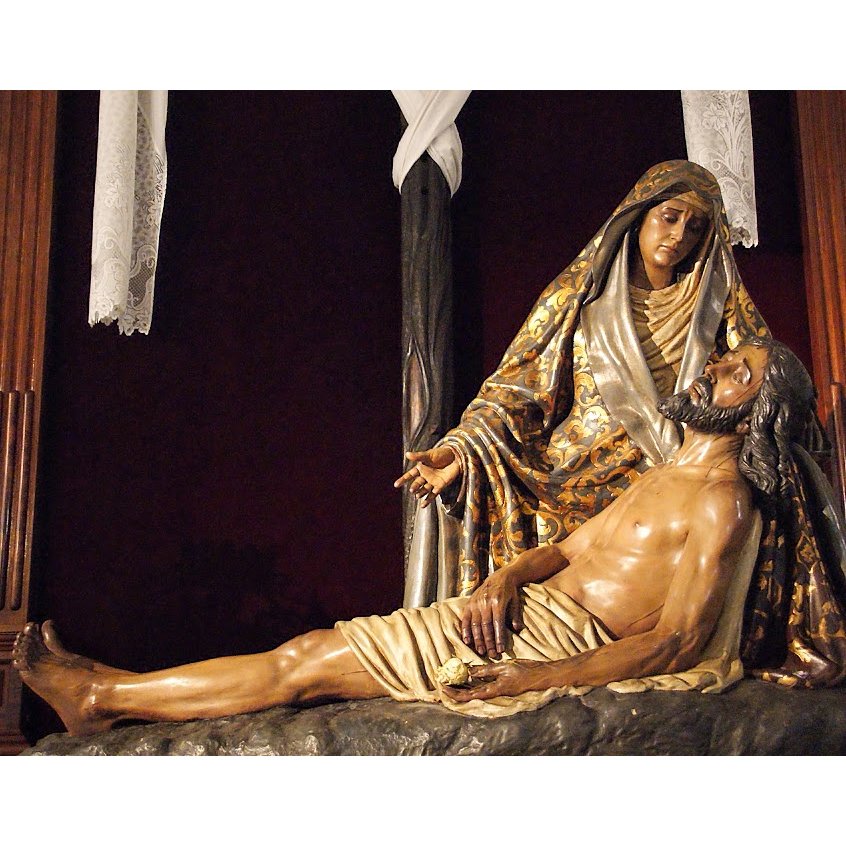
This sculptor so closely linked to the Brotherhood is buried precisely in this church. We find his funerary monument in this same nave of the Epistle. Above it is the sculptural group of the Pietà, which the sculptor made in 1949. On the plaque at the foot of the tomb you can read “Here beneath his most beloved images rests the most illustrious Mr. Antonio Castillo Lastrucci 1882-1967”.


REALES ATARAZANAS – ROYAL SHIPYARDS

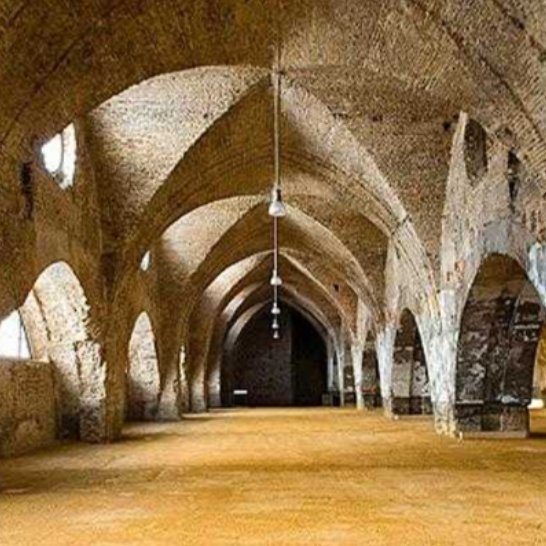
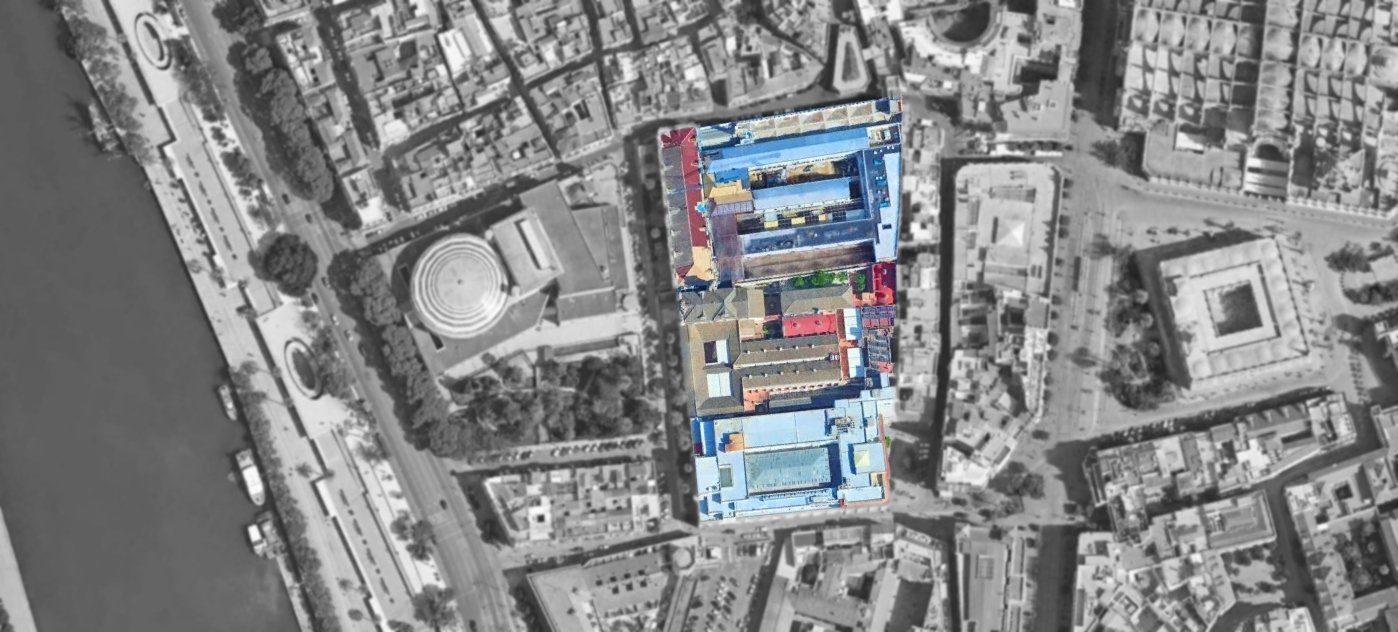
The Royal Shipyards were a large shipyard built in the port area of ​​Seville by order of Alfonso X the Wise (1252), becoming the most important naval base in the history of the Crown of Castile. Today, only a few of its original ships remain, immersed in a comprehensive rehabilitation process to be used for cultural and museum purposes. The author of the project is the Sevillian architect Guillermo Vázquez Consuegra.

The original building occupied a large area of ​​around two hectares and was made up of seventeen naves, separated by lines of monumental arches on pillars, all made of brick. These served not only to support the roof but also to channel the water collected by the ceilings, like aqueducts.

“The arches are slightly pointed and the pillars are rectangular in section, measuring 2.50 m by 1.80 m, spanning 8.5 m, with a height up to the base of the arches of 5 m. Each row of these pillars rests on a continuous footing foundation, the foundation of which is reached at 2 m below the original ground level.”

On its eastern side, the construction rested on the outer wall of Seville, while on the southern side it rested on part of the section of wall that joined the Alcázar and the Torre del Oro. This type of wall, built to join a main fortification with an external point, is known as coracha.

The ships were arranged perpendicular to the river, to facilitate the entry and exit of ships from it.

Throughout history, as the shipyards of Seville lost importance, a good number of its ships were used for other purposes:

- Around 1580 the Customs Office was installed in ships 13, 14 and 15, starting from Dos de Mayo Street towards Santander Street.

- In the mid-17th century, ships 8 to 12 were demolished to build the Hospital de la Caridad, following the designs of Sánchez Falconete and Leonardo de Figueroa.

- During several phases throughout the 18th century, the remaining part of the building underwent a major renovation to house the Artillery Workshop, used for the manufacture and repair of weapons and ammunition. In 1762, a major renovation began, including the construction of the current façade facing Calle Temprado, following an academicist layout.

- In 1945, the five remaining naves to the south were demolished, including those that had been transformed into customs in the 16th century, to build the current building of the Treasury Delegation.

CHURCH OF SAN ISIDORO

The church of San Isidoro is one of the medieval parishes of Seville. Several authors much later than its foundation say that it was built on the site that would have been occupied by the family house of San Isidoro during the Visigothic period. Naturally, absolutely nothing could be verified about these statements.

History

We do know that its construction must have begun in the first third of the 14th century, since the cover on the Epistle side is closely linked to that on the side of the Gospel of Saint Anne of Triana, for which the chronology is documented. In this way, both would be among the oldest churches in the city. Furthermore, the urban area in which it is located is the highest with respect to the river and, therefore, the one with the oldest settlement. The forum of Roman Hispalis has traditionally been located in its vicinity, although it is true that without any archaeological basis.

Since the Christian conquest, wealthy families from the city settled in this area and merchants of the most diverse origins settled there from the 16th century onwards. In this way, San Isidoro will be a "rich" parish and this has an inevitable reflection in the architecture and ornament of the temple.

The original 14th century building was notably altered between the 16th and 17th centuries, mainly in the presbytery area. Also in the 18th century, reforms were undertaken, such as the construction of the chapels on the left side.

As it has come down to us, San Isidoro is a rectangular church with three naves, a transept, a choir at the foot and side chapels, which are different in size, style and layout.

Outside

On the outside, the temple has three doors. The one located at the foot is very simple, in the Mudejar style. It consists of a slightly pointed arch framed by an alfiz. Apparently, the arch was initially horseshoe-shaped and was "simplified" to adopt its current appearance sometime between the 16th and 18th centuries.

The door that opens to the left side is the most recent, added in the 18th century in a neoclassical style. It is lintel, with two pilasters supporting a simple entablature. Next to it, we find the most ornamentally rich façade fragment in this church. This is the exterior part of the sacramental chapel, added as we said in the 18th century, which in some way functions as a separate façade. It is made of exposed brick, with a baroque style with very classic lines, and stands out for its reddish color, different from the rest of the temple. It is topped by a triangular pediment and in the center of the wall there is a lobed medallion with an allegorical scene of the “Adoration of the Holy Sacrament”.

Right at the other end, on the Epistle side, the other door opens, dated to the 14th century. It presents the classic forms of the Sevillian Gothic-Mudejar doorways. It consists of a pointed arch with archivolts, the two outermost ones at the top being decorated with geometric motifs: one with saw teeth and the other with diamond points. It is framed by a double alfiz, the first triangular and a larger square one.

At the apex of the triangular alfiz we find a sculpted star of David or Solomon, historically linked to the Hebrew religion. It is the only church in Seville in which we can see this element, which has been the subject of the most diverse interpretations. However, the truth is that this six-pointed star is a symbol that appears quite frequently in medieval religious buildings, apparently as an element of protection. In an article about this cover, Rafael Cómez tells us that "with a talismanic meaning and a spell against the forces of evil, the six-pointed star, inscribed in a circle, must have been made, which is shown to us on the cover of the nave of the Epistle. ".

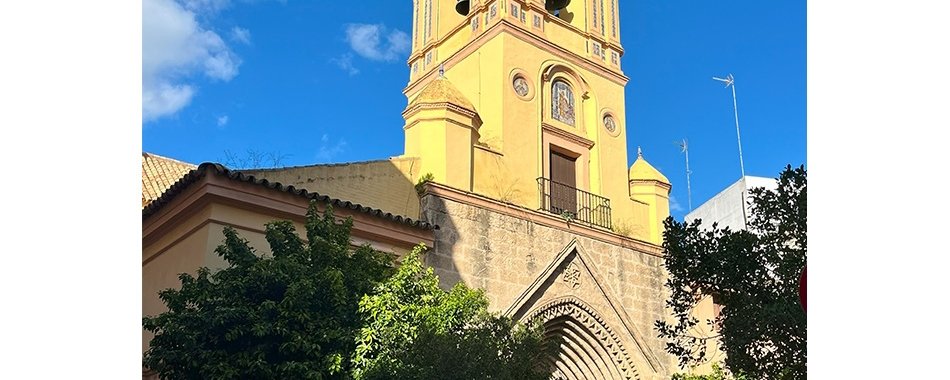
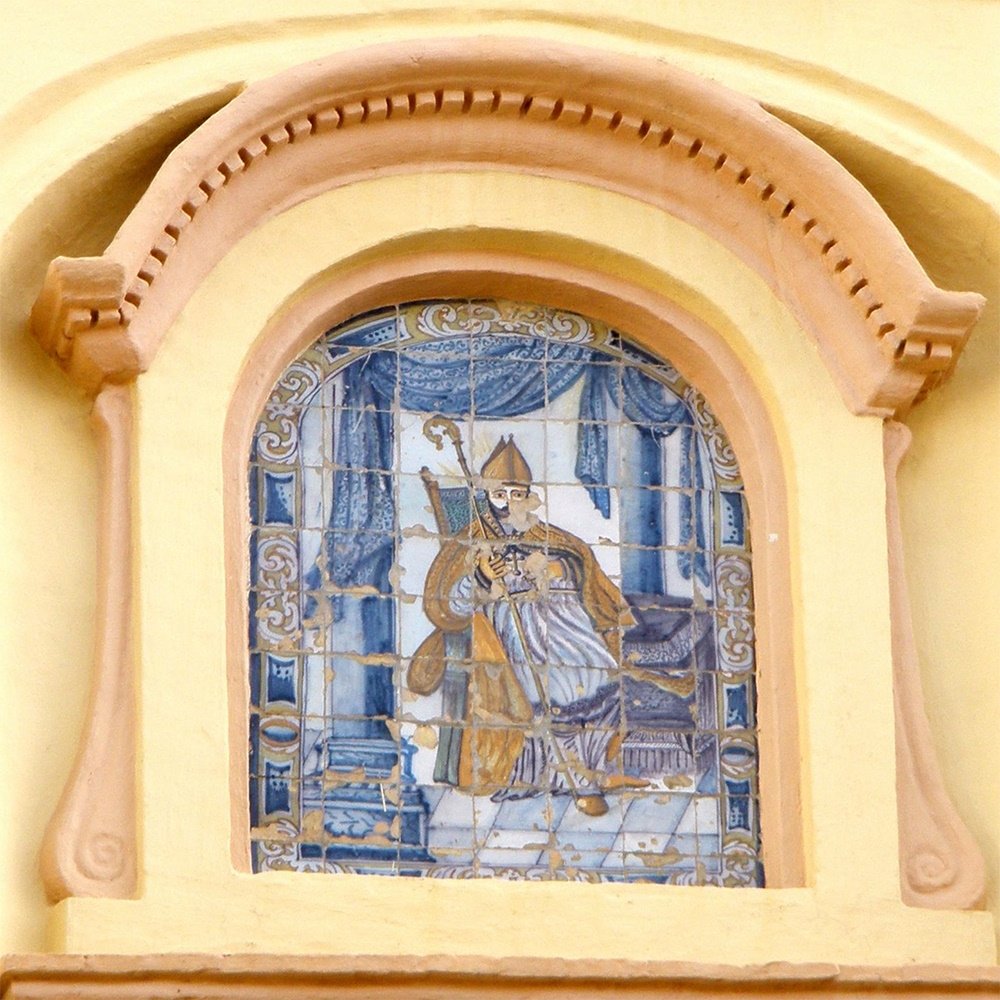
Above this door, a bell tower was built much later, and already in the Baroque style, which preserves the 18th century tiles depicting Saint Isidore and Saint Leandro.

Inside

Inside, the naves are divided by pointed brick arches that rest on cruciform pillars. The roofs are wooden coffered ceilings in the Mudejar style, with the central trough shaped and the side ones hanging. As an exception, the transept is covered with a hemispherical dome on pendentives in its center and with barrel vaults on each of its sides.

The main altarpiece is mainly made up of an excellent canvas that represents the "Transit of San Isidoro", a work by Juan de Roelas from 1613. The frame-altarpiece that houses it is later; It was made around 1752 by Felipe del Castillo. The paintings in the vaults date from the mid-18th century and have been related to the work of Juan de Espinal. They represent fake architectures in which San Fernando and San Hermenegildo are framed.

To the left of the main chapel, at the head of the Gospel nave, is the Maestres chapel, which has an interesting tiled plinth original from the 17th century. A 19th-century neoclassical altarpiece houses the image of the Christ of the Blood, a moving Gothic carving from the mid-14th century. It is the oldest Crucified of those preserved in Seville, comparable only to the Christ of the Million in the Cathedral.

Just on the other side of the main altar, at the head of the Epistle nave, is the Villampando chapel, from the beginning of the 17th century, the date in which the tile plinths and the grille that closes it were made. It is presided over by a baroque altarpiece dedicated to Saint Albert.

On the wall of this same nave there is another baroque altarpiece, this time from the mid-18th century. In its center, an image of Saint Joseph from the same period, the work of José Montes de Oca.

On this right side the church has a single chapel, dedicated to the Virgin of Health. It is the most clearly Mudejar style. It has a hemispherical vault, decorated with geometric motifs and set on squinches. The image of the Virgin has been dated to the beginning of the 16th century, with a transitional style between Gothic and Renaissance. She is full size, although she is generally presented dressed in the baroque style.

On the other side of the church, in the Gospel nave, next to the entrance is the Chapel of Our Father Jesus of the Three Falls, the titular image of the brotherhood based in this church that processions every Good Friday. The Christ is a carving by Alonso Martínez from around 1667. The Virgin of Loreto is the image that accompanies him in this chapel and on his processional exit. It is an anonymous dressing room from the 18th century, although deeply renovated by Sebastián Santos in the mid-20th century. Although it is not found in this chapel, the brotherhood has another image of great value. This is the Cyrenean who helps Jesus with the cross on his path. It is a magnificent carving from 1687 by Francisco Antonio Gijón, an illustrious name in the history of Sevillian art, forever linked to the overwhelming "Puppy" of Triana. The Cirineo of San Isidoro is considered one of the best "secondary" carvings of Holy Week in the city and is generally located in the Epistle nave, close to the entrance.

The most prominent chapel of the church, and one of the most notable in the Sevillian baroque, is the sacramental chapel. It has its origins in the 16th century, the date on which the gate that closes it is dated, although as it has come down to us it is a work from the 18th century.

Above the access to the chapel there is a canvas with the "Allegory of the Eucharist", an interesting work attributed to Lucas Valdés. Once inside, the walls are covered with a series of canvases, mainly with themes related to the Eucharist, such as "The Transfer of the Ark of the Covenant" or "The Delivery of the Propitiation Bread", works also linked to the style by Lucas Valdes.

The cornices and upper part of the walls have a profuse decoration of plasterwork, which reproduces plant and architectural motifs, such as Solomonic columns.

But the element that attracts most attention in the chapel is its spectacular altarpiece, one of the most exuberant examples of Sevillian altarpieces. It is a work by Jerónimo Balbás and Pedro Duque Cornejo, made at the beginning of the 18th century by order of Juan Bautista Melcampo, a merchant of Flemish origin buried in the same chapel. The decorative profusion is such that it is difficult to distinguish the architectural structure. Countless child and youth angels intermingle with vegetal motifs, garlands, stipes and Solomonic columns in a motley and dazzling ensemble.

In the central niche, the Virgin of the Snows is venerated, a seated image that reproduces the scheme of the "Fernandine" Virgins, such as that of the Kings of the Cathedral or that of the Waters of El Salvador. However, it seems that that of San Isidoro is later, at least from the 16th century. On both sides are San Sebastián and San Roque.

In the center of the second body of the altarpiece there is a Child Jesus with the style of Juan Martínez Montañés. On his sides, Saint Thomas Aquinas and Saint Ignatius of Loyola, and above him the figure of God the Father appears from a medallion in an attitude of blessing.

SANTA MARÍA LA BLANCA

The church of Santa María la Blanca, in the San Bartolomé neighbourhood, is a precious jewel of Sevillian Baroque. It is known that a mosque was built in this same place during the Islamic period and some authors have pointed out that this mosque could have been built on top of a previous Christian church from the Visigothic period. The columns that today frame the small side doorway of the church on Calle Archeros come from this primitive Visigothic temple, although this possibility has not been archaeologically verified.

What is known with certainty is that the mosque was transformed into a synagogue after the Christian conquest of the city. By order of Alfonso X, a Jewish quarter was established in this area of the city, which approximately occupied the area of the current neighborhoods of Santa Cruz and San Bartolomé. In Santa María Blanca one of the three or four main synagogues of the Jewish quarter would be found.

For a long time it was thought that the current temple was completely built in the 17th century, without conserving anything from the previous building. However, various archaeological and restoration work on the building in recent decades have refuted this claim. Apparently, although the baroque reform of which we have spoken completely masked any decorative aspect of the primitive temple, the truth is that the floor plan of the current church and that of the synagogue on which it stands coincide in essentials. And apparently a good part of the walls and arches of the current church also correspond to the primitive work, although their aesthetics were intensely altered by the Baroque reform. This is how the architect Óscar Gil Delgado explains it in “A unveiled synagogue in Seville: architectural study” (2011):

“These prescriptions clearly imply that the walls of the naves of the church were not demolished and that, for this reason, the Mudejar blind arches are found today in the coronation of said walls. No new arches were turned over the new "red jasper" columns, the arches of the central nave were simply lowered, the old columns, which had no stylistic relationship with the new work, were removed and the new ones were placed. Surely the arches of the nave are the same as those of the "Mudejar" synagogue, trimmed, rounded and covered with plaster mouldings, according to the new taste”.

The synagogue would be transformed into a Christian church at the end of the 14th century, after the violent assault on the Jewish quarter in 1391. It would be at this time that the Gothic doorway would be added, which is still accessed today. However, the church that has come down to us responds mostly to the project for its remodeling promoted by Canon Justino de Neve. The works began in 1662 under the direction of Pedro Sánchez Falconete, who undertook the complete remodeling of which resulted in the baroque temple that we can see today.

It is a church with three naves divided by ten Tuscan columns that support semicircular arches. It is accessed through a tower entrance that opens at the foot of the central nave and has a rectangular floor plan. This is altered by a protruding front, in which the main altar is located, and by three side chapels: the baptismal one at the foot of the temple, the sacramental one on the epistle side, and that of San Juan Nepomuceno on the of the gospel of the head.

The main façade of the church is occupied on its first level by a Gothic portal, with the classic characteristics that this type presents in Sevillian churches: archivolts and diamond-tipped decoration. On this body, you can read the Latin inscription "HAC EST DOMUS DEI ET PORTA COELI 1741" (This is the House of God and the Gate of Heaven). The year 1741 refers to the date of certain minor reforms undertaken in the church, when the façade was also embellished and the inscription was added.

On this first level, in a second body, there are two long windows topped by semicircular arches. Above them is a classic belfry with two levels and behind openings for the bells.

The church has a much simpler front facing Archeros street. It is a simple semicircular arch supported by two stone columns with Late Antique capitals, clearly carried and probably used successively in the preceding mosque and synagogue.

Inside, what most attracts our attention is its intense decorative program, in which every last corner is covered with a combination of plasterwork, painting and sculpture, until configuring a space that as a whole appears as the clearest definition of the famous "horror vacui" of the baroque.

Justino de Neve entrusted the pictorial decoration to Murillo himself and the elaboration of the plasterwork to the brothers Pedro and Borja Roldán. The work begins shortly after the Pontifical Brief of Alexander VII of 1661 was promulgated, in which the devotion and cult of the Immaculate Conception was reaffirmed.

In this way, the iconographic program is as a whole an exaltation of the Eucharist and the Immaculate Virgin, as can be seen as soon as you enter the arch that supports the choir, where it reads Without original sin in the first moment of its being. . Murillo intervened with the realization of five canvases, of which only the oldest, "La Santa Cena", is preserved in the church. The others came to complete the iconographic program we have been talking about, with the "Immaculate Conception", "The Triumph of Faith" and two canvases that narrated the history of the foundation in Rome of the basilica of Santa María de las Nieves, a dedication to which is also dedicated to our church.

Today magnificent copies of the originals can be seen in situ, which unfortunately were the object of the savage looting suffered by the city with the arrival of Napoleonic troops in 1810. Among the stolen works were the four that he stole from Santa María la Blanca . Most of what was looted never returned to the city and is now scattered in museums around the world.

The main altarpiece of the church is Baroque and dates back to around 1690. Its main architectural element is two large Solomonic columns, so characteristic of the Sevillian altarpieces of the 17th century. In the central niche is the titular image of the temple, Nuestra Señora de las Nieves, a dress image made by Juan de Astorga at the beginning of the 19th century.

At the lateral ends, the eighteenth-century carvings of Saints Justa and Rufina, patron saints of the city, are located on corbels. In the center of the attic there is another niche that currently houses a rich golden cross, at the foot of which you can see a representation of the Giralda.

At the head of the right hand side we find a Baroque altarpiece from the mid-18th century presided over by the image of "San Pedro en la Cátedra". We see the saint with all the attributes that identify him as the first pontiff of the Church, framed by two child angels holding two of his attributes: the patriarchal cross of the popes and the keys of the Church.

On the wall on this same right side there is a neoclassical altarpiece from the 19th century, presided over by an imposing ensemble of the Trinity. It is the work of the Valencian-born sculptor Blas Molner. On the bench is an interesting small-format Pietà dating from the 18th century.

Also on the right is the sacramental chapel, presided over by an 18th century altarpiece that generally has an image of Saint Joseph from the 17th century in its central niche. On both sides and on a smaller scale, we find the images of Santa Ana and San Joaquin. The altarpiece bench houses a touching "Nativity Scene" made in terracotta, attributed to Cristóbal Ramos.

In the same chapel there is an altarpiece made up of pieces from a previous retable that had been readapted. It houses the images that originally belonged to the old brotherhood of the Sacred Lavatory, which disappeared in 1672 when it merged with the Sacramental of this church. In the center, the Cristo del Mandato, a work in pulp wood, made by Diego García de Santa Ana at the end of the 16th century. On both sides, Nuestra Señora del Pópulo and San Juan, both anonymous images from the 17th century.

In the center of the wall of the left nave (or of the Gospel) we find a valuable original altarpiece from the 16th century, although quite reformed in the 18th century. It frames a large canvas with the representation of "La Piedad", although it has also been identified at times as a "Descent". It is one of the most outstanding artistic pieces in the church, the last known work of Luis de Vargas, one of the most outstanding painters of the Renaissance in Seville. It is dated 1564 and the altarpiece is framed by paintings of San Juan Bautista and San Francisco, also works by Luis de Vargas. At the foot of the altarpiece you can see the tombstone of the family that financed it.

On the same wall is the only work by Murillo that has been preserved in the church: "La Santa Cena", dated 1650. It is possible that the French did not take it away because the truth is that the work is quite far from the traditional painter's style. Here Murillo uses a powerful chiaroscuro, which makes the canvas a tenebrist painting, with the light of the candles as the only illumination on the faces.

On the same wall we find another altarpiece with a modern Sacred Heart and at the bottom of this Gospel nave there is a small chapel behind a grill. In it there is a Baroque altarpiece from the 17th century, with a central image of San Juan Nepomuceno from the same period. On the walls of the chapel there is an interesting "Ecce Homo" from the 16th century, made by an anonymous follower of Luis de Morales. In front of him, an "Annunciation" by Domingo Martínez from the first third of the 18th century.

[mapsmarker map="2"  lat="37.386589" lng="-5.987513" zoom="18" height="300" heightunit="px"]

ROYAL ALCÁZAR

The Alcazar of Seville is one of the most fascinating royal residences in Spain. This is due to the fact that it does not respond to a single project undertaken at a given moment, but rather is the result of numerous construction phases that have taken place throughout its history.

It has been used continuously as a royal palace since its Muslim origins, back in the 10th or 11th century, until today, in which it is still the oldest royal palace in use in Spain and Europe. Throughout its history, the different monarchs who have inhabited here have been adapting the different palaces, courtyards and gardens to the tastes of each era, until configuring the marvelous and diverse complex through which we can walk today.

Although its origin is a set of Muslim palaces, very little remains of this early period of the Alcázar. Most of the palaces that we are going to see correspond to the reforms undertaken in Christian times by:

- Alfonso X the Wise, who built the so-called Gothic Palace in the 13th century.

- Pedro I, called by some the Cruel and by others the Justiciero, who built the wonderful that is the true heart of the Alcázar. It was built in the middle of the 14th century and constitutes the peak of the Mudejar style.

- In the reign of the Catholic Monarchs, the so-called Casa de Contratación was built, of which we will also see some rooms on this side, intended to centralize and organize trade with the Indies, after the discovery of America in 1492.

All this is surrounded by a magnificent set of patios and gardens, which have been added and reformed until very recent times. It must be remembered that a part of the Palace of Pedro I, specifically the upper floor, is still used as the residence of the kings of Spain when they are in Seville.

Thanks to all this, its long history, its beauty and its architecture, the Real Alcázar of Seville was declared a World Heritage Site by UNESCO in December 1987, together with the nearby cathedral and Archivo de Indias.

[mapsmarker map="2"  lat="37.384222" lng="-5.991888" zoom="18" height="300" heightunit="px"]

CATHEDRAL OF SEVILLE

The Cathedral of Seville is probably the most emblematic monument of the city. Unesco declared it a World Heritage Site in 1987, along with the Alcázar and the Archivo de Indias. It is considered the largest Gothic temple in the world.

Most of its work was done in the late Gothic style during the 15th century, although it retains elements of the 12th-century Almohad mosque on which it sits, such as the Patio de los Naranjos or the Giralda. In addition, in the 16th century the Royal Chapel, the Chapter House and the Greater Sacristy were added in the Renaissance style. Later, during the Baroque period and practically up to the present day, various elements of the cathedral would be added and remodeled, until it became a true compendium of the history of art in the city.

Its floor plan is one of the hall calls, with a flat head and five naves, the central one being taller and wider than the rest. It has numerous side chapels located between the buttresses.

The supports are enormous pillars with a rhomboid section, made of brick and masonry and covered with ashlars. Rib vaults sit on them, so characteristic of Gothic. They are sexpartite in the chapels, quadripartite in the naves, and those corresponding to the transept, in the central part of the temple, are star-shaped.

On the side chapels and on the main axes there is a narrow gallery in the form of a clerestory.

Its construction was approved by the cathedral chapter in 1401. Legend has it that the project would be inspired by the phrase "Let's make a church so beautiful and so great that those who see it carved will consider us crazy" and according to the capitular act of that day the new work should be "one such and so good, that there is no other like it."

In detail: Cathedral of Seville

1. Giralda, 2. Puerta de Palos, 3. Capilla Real,

4. Puerta de Campanillas, 5. Sala Capitular, 6. Sacristía Mayor,

7. Sacristía de los Cálices, 8. Puerta del Príncipe,

9. Sepulcro de Cristóbal Colón, 10. Altar Mayor, 11. Coro,

12. Puerta de San Miguel, 13. Puerta de la Asunción,

14. Puerta del Bautismo, 15. Parroquia del Sagrario,

16. Puerta del Perdón, 17. Patio de los Naranjos.

MORE ABOUT THE CATHEDRAL:

Tumba de Cristóbal Colón, Catedral de Sevilla

THE LAST VOYAGE OF COLUMBUS

Christopher Columbus is one of the most famous characters in the history of mankind. It is true that in the last century the almost epic narrative of his achievements has been nuanced, giving way to a more critical view of the figure of the admiral ...
Santas Justa y Rufina en la Puerta del Bautismo

THE SAINTS JUSTA AND RUFINA IN THE DOOR OF THE BAPTISM

Seville Cathedral is a splendid display of the history of art in the city. It ranges from the Almohad style of the 12th century in which the original mosque was built, and which is visible above all in the first sections of the Giralda, to ...
Portada del Perdón de la catedral de Sevilla

‘CLEANSING OF THE TEMPLE’ AT THE PUERTA DEL PERDÓN

The Puerta del Perdón of the Cathedral of Seville and its surroundings constitute an enclave of great artistic and aesthetic value in which it is possible to read about some of the most significant episodes in the history of the city. To begin with, it ...
GATES OF THE CATHEDRAL OF SEVILLE

GATES OF THE CATHEDRAL OF SEVILLE

The Cathedral has numerous portals towards the exterior:– On the west side, three on the façade at the foot, towards the Avenida de la Constitución, called Baptism, Asunción and San Miguel.– Two on both sides of the transept, called de la Concepción and San Cristóbal ...
Puerta de la Asunción de la Catedral de Sevilla

THE DOOR OF THE ASSUMPTION IN THE CATHEDRAL OF SEVILLE

The Puerta de la Asunción, on Avenida de la Constitución, is the main entrance to the Cathedral of Seville. However, its completion was not addressed until well into the 19th century, at the initiative of Cardinal Cienfuegos Jovellanos. In a first phase, between 1827 and ...
Dibujo de la giralda de Sevilla con detalle del campanario de Hernán Ruiz

THE GIRALDA OF SEVILLE

It measures about 100 meters high, making it the tallest cathedral tower in Spain and was for centuries the tallest building in the country. The lower two thirds of the tower are from the Islamic period, Almohad from the 12th century. It began to be ...

OLD CASTLE OF SAN JORGE

In the place where the Triana Market is located today, a castle was built in the Almohad period (XIII) that would later be known as the castle of San Jorge. It may have been built on previous constructions, even Roman or Visigothic, and that it was refortified after the Muslim defeat in the battle of Las Navas de Tolosa (1212).

‘Annales d'Espagne et du Portugal’, 1741

It had ten towers that articulated a robust fortified space with a rectangular plan. The Christians would establish the headquarters of the Inquisition in Seville there in 1480, so it is certain that it was the scene of numerous episodes of imprisonment and torture throughout its history. Some of the events that occurred there have been narrated as brilliant as the one offered by Beethoven in his opera "Fidelio", which is set in this castle.

It continued to be the seat of the Inquisition until the end of the 18th century, when it was abandoned. Already at the beginning of the 19th century it was demolished and a market was built on its site. At the end of the current market, in the part that faces Castilla street, some of the great walls that belonged to the primitive castle can still be seen today.

[mapsmarker map="2"  lat="37.385606" lng="-6.003191" zoom="18" height="300" heightunit="px"]

HOUSE OF EL REY MORO

The House of the Moorish King is a construction dating from the fifteenth century, which makes it one of the oldest houses that we can find in Seville. It is currently the headquarters of the Blas Infante Foundation.

Virtually nothing is known about the history of this house, so we do not know where the nickname by which it is known comes from. The researcher Celestino López Martínez pointed out in his day that it could refer to the 'King of Niebla and the Algarve D. Abenmafor, in the mid-13th century'. However, no remains can be found in the house from before the 15th century, so the most widespread hypothesis today is that the Mudejar, 'arabesque' decoration of the house caused the neighbors to spontaneously identify it as Casa del Moro. .

The house has a rectangular floor plan, with a main façade facing Sol street and a lateral one through which the orchard was originally accessed. The rooms are distributed around a patio, which is the best preserved and most interesting space. It is porticoed on two of its sides on the ground floor and on three on the top. The arches are made of exposed brick, peralted on the ground floor and lowered on the top, and rest on brick pillars. It should be noted that originally most of the houses of the Mudejar tradition in Seville used to use this type of pillars, but very few have reached our days. This is because, with the arrival of Renaissance taste in the city, most of these brick pillars were replaced by marble columns, often brought directly from Italy. In addition, the pillars of this house are especially interesting because they adopt a great variety of sections, including on the upper floor some of the 'Solomonic' type, with the body twisted in a spiral.

[mapsmarker map="2"  lat="37.396136" lng="-5.984053" zoom="18" height="300" heightunit="px"]

CAÑOS DE CARMONA

The 12th century aqueduct that carried water from the nearby town of Alcalá de Guadaira to the city is known as Caños de Carmona. The name 'de Carmona' comes from the fact that the aqueduct reached the city next to the Puerta de Carmona. From there, some clay pipes that ran inside the walls carried the water to the Alcázar.

It seems that the pipes were built reusing the layout of an ancient Roman aqueduct, in the Almohad period, during the reign of Yusuf. Originally they were about 17 kilometers long and would have around 400 arches, raised on robust brick pillars. Depending on the unevenness of the terrain, in some areas a simple arcade was arranged and in others a double one was necessary. Currently, only a few scattered fragments remain along the axis of Luis Montoto street. The remains are frequently misidentified with a Roman aqueduct.

[mapsmarker map="2"  lat="37.387713" lng="-5.981322" zoom="18" height="300" heightunit="px"]