BUILDING OF THE SEVILLE CHARITY ASSOCIATION

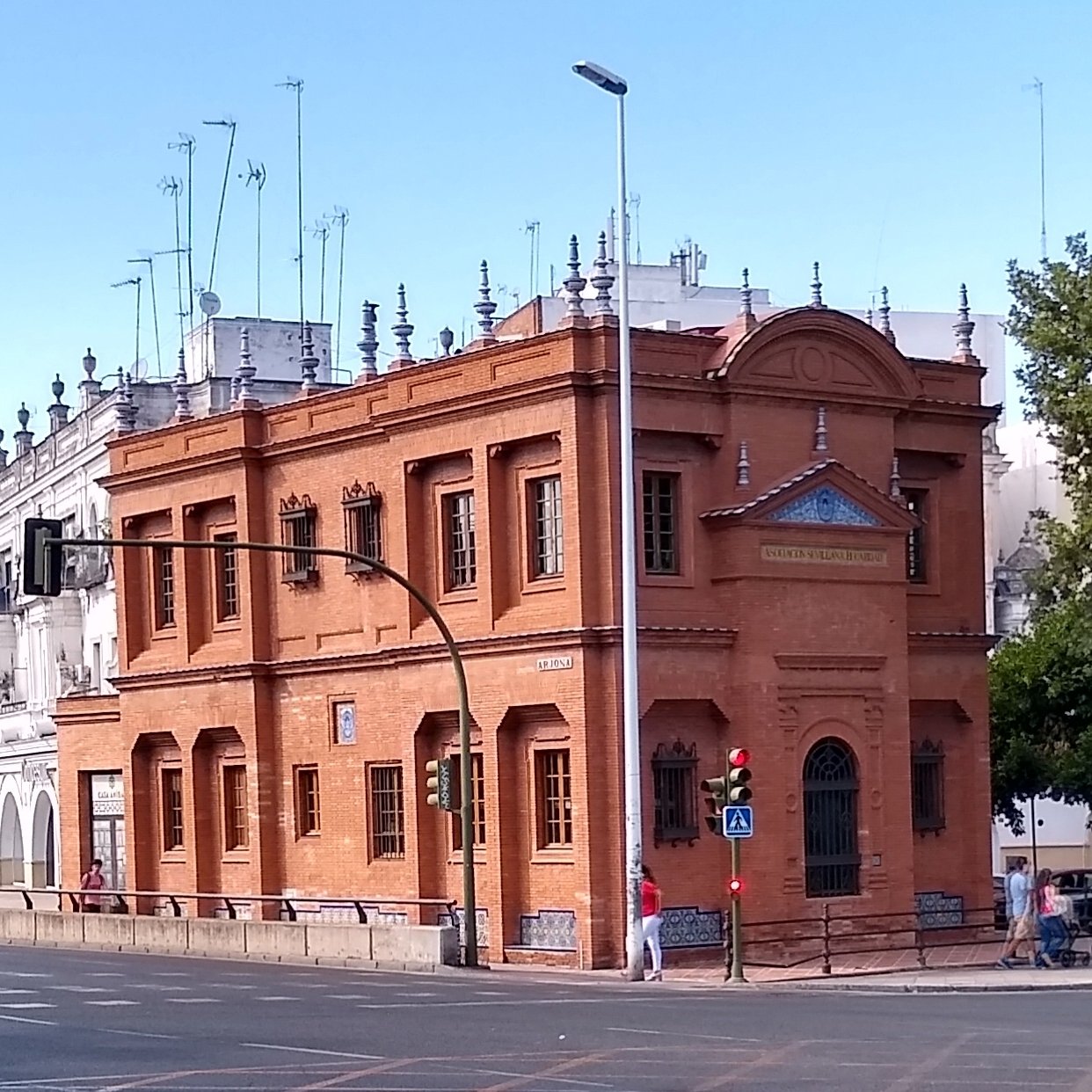
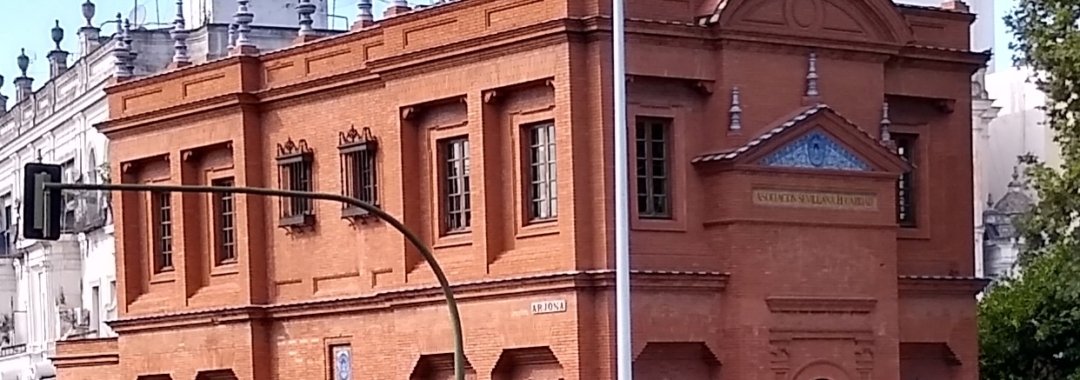
This regionalist building designed by Aníbal González stands at the intersection of Arjona and Reyes Católicos streets. It is known by the name of the organisation that commissioned its construction, the Asociación Sevillana de Caridad. It was built between 1912 and 1914 and originally had only one floor. In 1937, the architect Aurelio Gómez Millán was commissioned to build the upper floor, respecting the original layout as much as possible.

From the outside, the main feature of all the facades is exposed brick, which is abundantly used as one of the most characteristic elements of regionalist architecture. In the upper part, decorative ceramic elements help to break up the monochrome of the whole.

The two main entrances are framed by very classical structures. The one facing Reyes Católicos is flanked by pilasters and topped by a triangular pediment decorated with glazed ceramics. The entrance on Calle Segura is framed by columns, also made of brick, which support an entablature with a curved pediment, also with ceramic decoration.

Today, the building houses a restaurant and a hospitality school, both known as “Casa Aníbal”, in reference to the architect who created the original project.

HOUSE OF FLIES

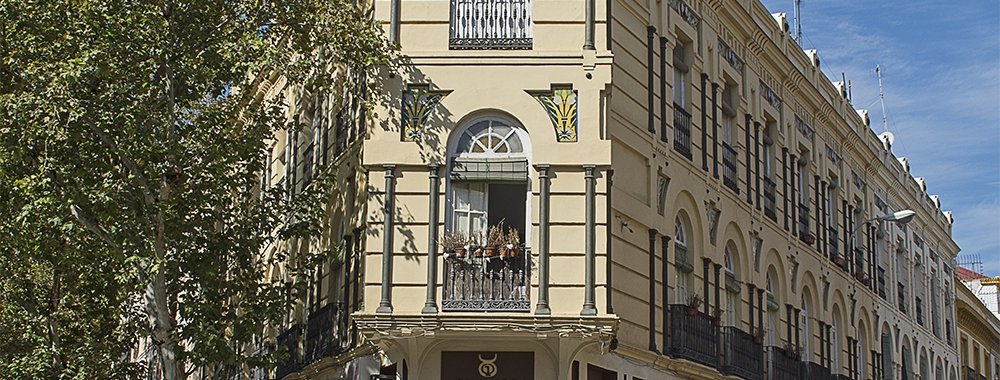
The residential and commercial building located on the corner of Adriano and Pastor y Landero streets is one of the few examples of modernist architecture in Seville. Its design was by the Sevillian architect Antonio Gómez Millán and it is popularly known as the “House of Flies” due to its ceramic decoration featuring insects.

Its design posed the challenge of having to adapt to the characteristics of a completely triangular plot, with two sides forming a façade to the outside and a third adjoining the building next door. The entire space is articulated around a central courtyard, also rectangular in shape, with the sides that have a façade wider than the dividing wall. The corner where the streets meet is harmoniously highlighted with a simple chamfer that stands out from the triangular plan.

The facade is notable for its horizontality and the superposition of semicircular and lintelled openings, which is also found in other works by the same author. Its imaginative decorative elements mean that the building can be classified as modernist. As we said, this style is quite rare in the city, since at the time when this style was developed in other European cities (early 20th century), Seville decidedly opted for Regionalism.

Among the modernist elements, the tile decoration stands out. On a yellow background, very common in Seville workshops, stylised natural elements are arranged, which, on the contrary, are not at all common in the city. Thus, in the spandrels and on the lintels, stylised and beautiful designs are arranged based on natural elements such as leaves, flowers, dragonflies, butterflies and bees.

MERCADO DEL POSTIGO – POSTIGO’S MARKET

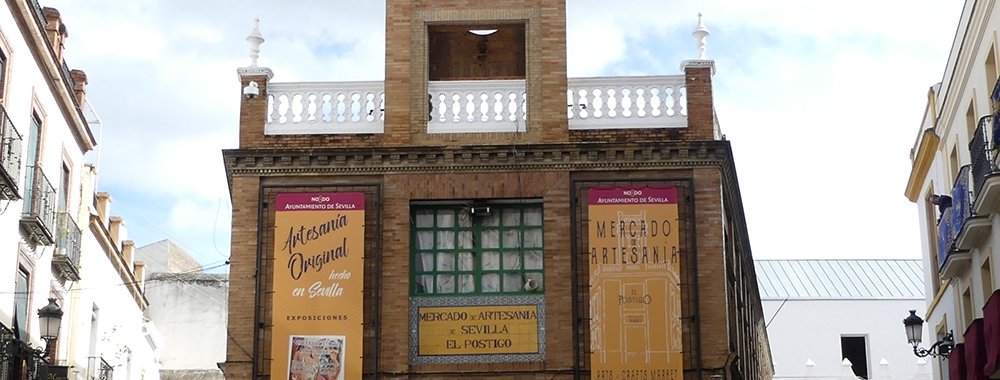
The Postigo Market is an interesting regionalist-style building designed by Juan Talavera y Heredia around 1926. Today it houses the El Postigo Craft Market, where around twenty local artisan workshops sell their products.

The building occupies a small block between streets, so it adopts a triangular shape with chamfered corners. It has two floors, in addition to the basement, which are arranged around a central space covered by skylights that allow light to pass through.


On the outside, we find exposed pressed brick and on the second floor there is a concrete balustrade that surrounds the terrace. Its main façade is the one facing north (Arfe Street). As it is the shortest, the architect emphasises its importance by erecting a simple square-shaped viewing tower above it, also topped by a balustrade.

* : Wikimedia

DUCK FOUNTAIN

Located in the Plaza de San Leandro, this fountain is known as the Pila del Pato (Duck Fountain) because of the bronze spout in the shape of this bird that crowns it. It is made up of three vessels of decreasing size, all of them circular in section. The second and third vessels are supported by baluster-shaped shafts. In the central vessel there are four zoomorphic masks that serve to pour the water.

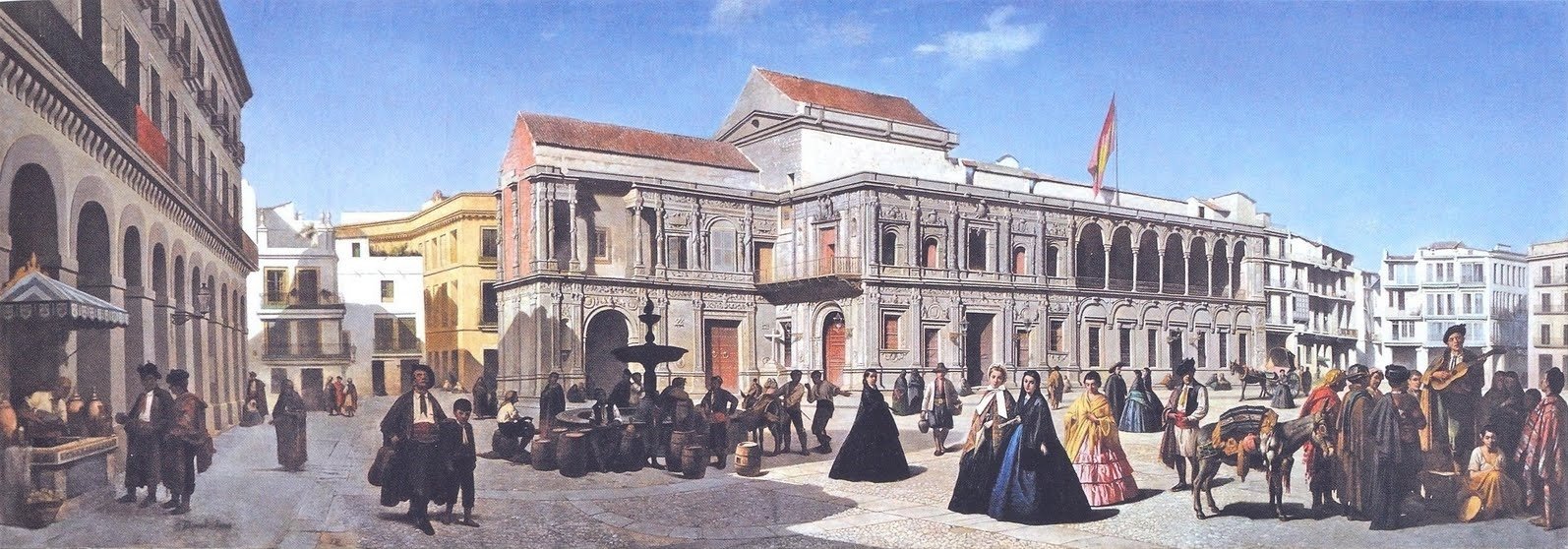
The fountain has been in its current location since the mid-twentieth century, but it is not the place for which it was conceived. In fact, it has occupied various locations in various parts of the city.

In 1850 it was located in the Plaza de San Francisco, in the place where the Fountain of Mercury is today. It remained there only for a few years, since in 1855 it was moved to the northern end of the Alameda de Hércules, near where the monument to the Niña de los Peines is located. From there it was moved to the vicinity of the Prado de San Sebastián, close to the Courthouse building. Its next location would be the Plaza de las Mercedarias, in the San Bartolomé neighborhood, from where it was moved to its current location in 1965.

It is likely that some elements from the previous Fountain of Mercury that it replaced were used to build the fountain in 1850. This was designed by Juan Fernández Iglesias at the beginning of the 18th century.


* Wikimedia Commons

Painting from around 1850 where you can see the Duck Fountain (Pila del Pato) in its original location, at one end of the Plaza de San Francisco

MURILLO GARDENS

The Murillo Gardens and the Catalina de Ribera promenade form one of the most interesting garden areas in the city of Seville, both historically, artistically, scenically and environmentally. They are fully involved in the life of the city and preserve interesting botanical species as well as architectural and sculptural samples and original street furniture elements from the time of their formalisation in the first quarter of the 20th century.

Juan Talavera y Heredia, a well-known representative of regional historicism, designed the Murillo Gardens in 1911 on land donated by the Crown, which had previously formed part of the Huerta del Retiro del Alcázar. They have a more secluded layout and a more intimate air, in contrast to the longitudinal layout of the Paseo de Catalina de Ribera.

The composition of this space is based on grid-like paths formed by hedges and paving which, at their intersections, create octagonal roundabouts in which there are central fountains and factory benches covered with tiles. The resulting flowerbeds are occupied by dense masses of vegetation that give the area an intimate atmosphere.

Among the open spaces, the gazebo dedicated to the painter José García Ramos stands out. It is bordered by entrance arches and low walls with tiled panels that recreate famous works by the artist, executed by other painters in the master's circle such as Miguel del Pino, Santiago Martínez, Alfonso Grosso, Manuel Vigil, and Diego López.

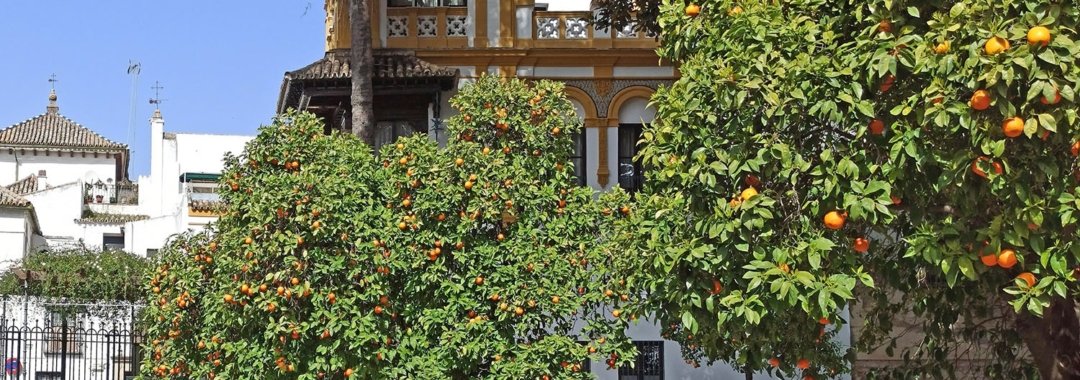
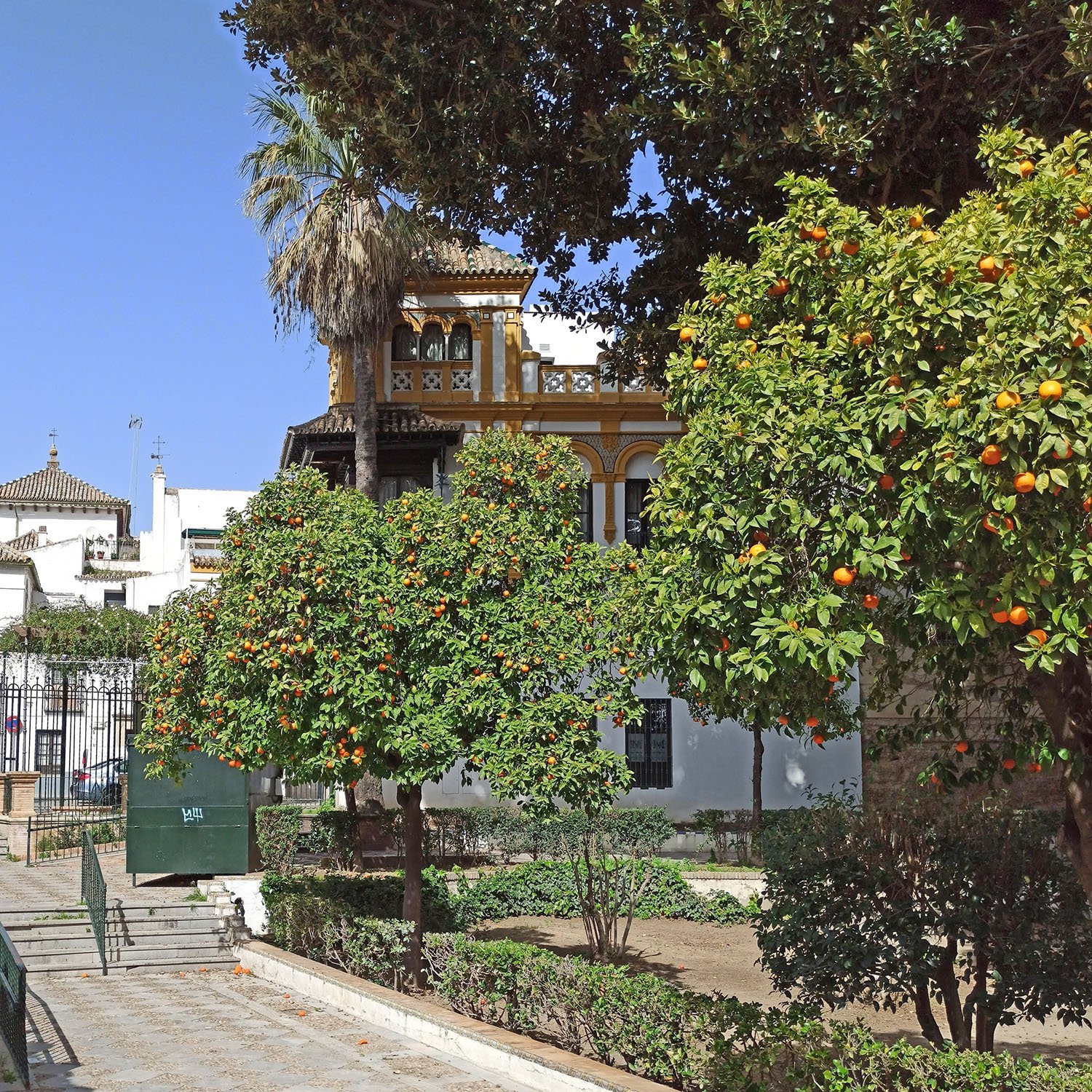
Nearby there is a regionalist style building used as a home. In these gardens you can find a great variety of plant species, with Magnolia Grandiflora, Cupresus Sempervivens Estricta, Ficus Magnoloides Religiosa, Platanus Hibrida, etc. standing out for their age and development.

Text of the BIC declaration, 12-03-2002.

! The Murillo Gardens appear by mistake as "Jardín de las Tres Fuentes" on Google Maps, while where you can read "Jardines de Murillo" it is actually the Paseo Catalina de Ribera.

CATALINA DE RIBERA PROMENADE

The Paseo de Catalina de Ribera (promenade) and the Murillo Gardens make up one of the most interesting garden areas in terms of history, art, landscape and environment in the city of Seville. They are fully involved in the life of the city and preserve interesting botanical species as well as architectural and sculptural samples and original street furniture elements from the time of their formalisation in the first quarter of the 20th century.

The current Paseo de Catalina de Ribera has its remote origin in the transfer, in 1862, of part of the Huerta del Retiro del Alcázar. This new public space, which was intended to attenuate the narrowness of the urban layout of the neighbouring neighbourhoods, did not yet have a special layout. At the end of the 19th century, a first project was undertaken for landscaping and furnishing what was then called the "Paseo de los Lutos" and, in 1920, on the occasion of the interventions carried out in view of the Ibero-American Exhibition, the architect Juan Talavera y Heredia, formalised the layout preserved today.

This same architect, a well-known representative of regionalist historicism, had designed a few years earlier the adjacent Murillo gardens, also the result of a transfer (1911) of another portion, located to the north-west, of the Huerta del Retiro del Alcázar. The layout of the Paseo de Catalina de Ribera has a clear longitudinal arrangement, designed for traffic, while the Murillo Gardens respond, due to their location and design, to a more secluded enclosure.

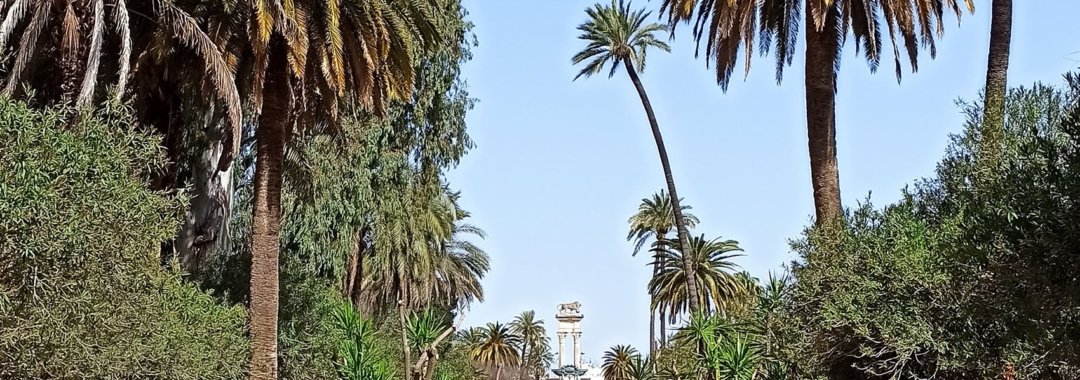
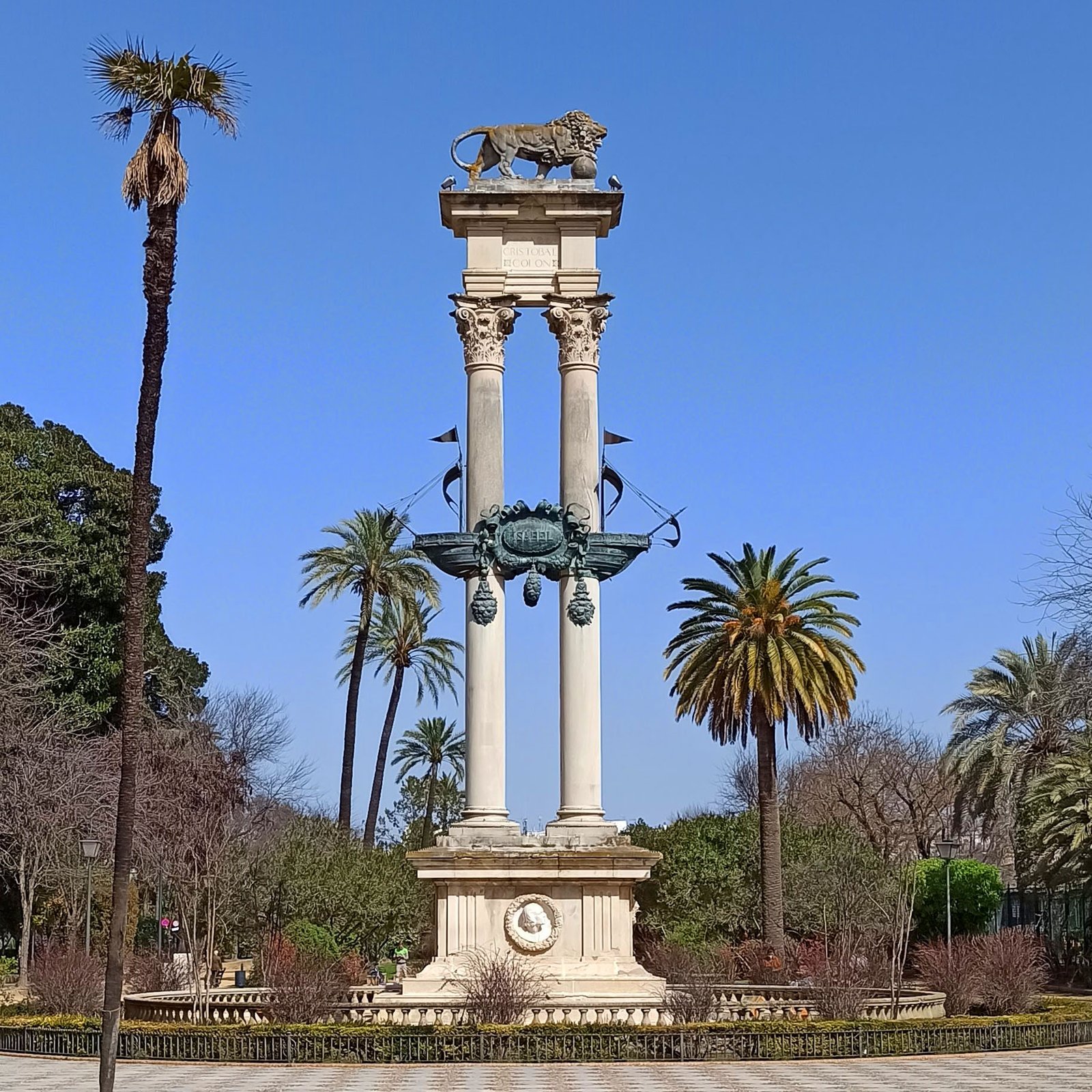
The walk is structured by a central axis and two secondary axes, parallel to the latter and arranged on both sides, which are made up of flowerbeds delimited by factory and tiled parapets. The central axis is interrupted at its midpoint by a large circular space centred by a fountain, also circular, on which, above a pedestal with busts of Columbus and the Catholic Monarchs, two columns stand, supporting an entablature crowned by the figure of a lion and, at mid-shaft, the prows of the caravels.

The monument, which provides the vertical element of compositional compensation to the promenade, was designed by the architect Talavera and executed by the sculptor Lorenzo Coullaut-Varela, and is dedicated to Christopher Columbus, in keeping with the events of the Ibero-American Exposition of 1929, when it was held.

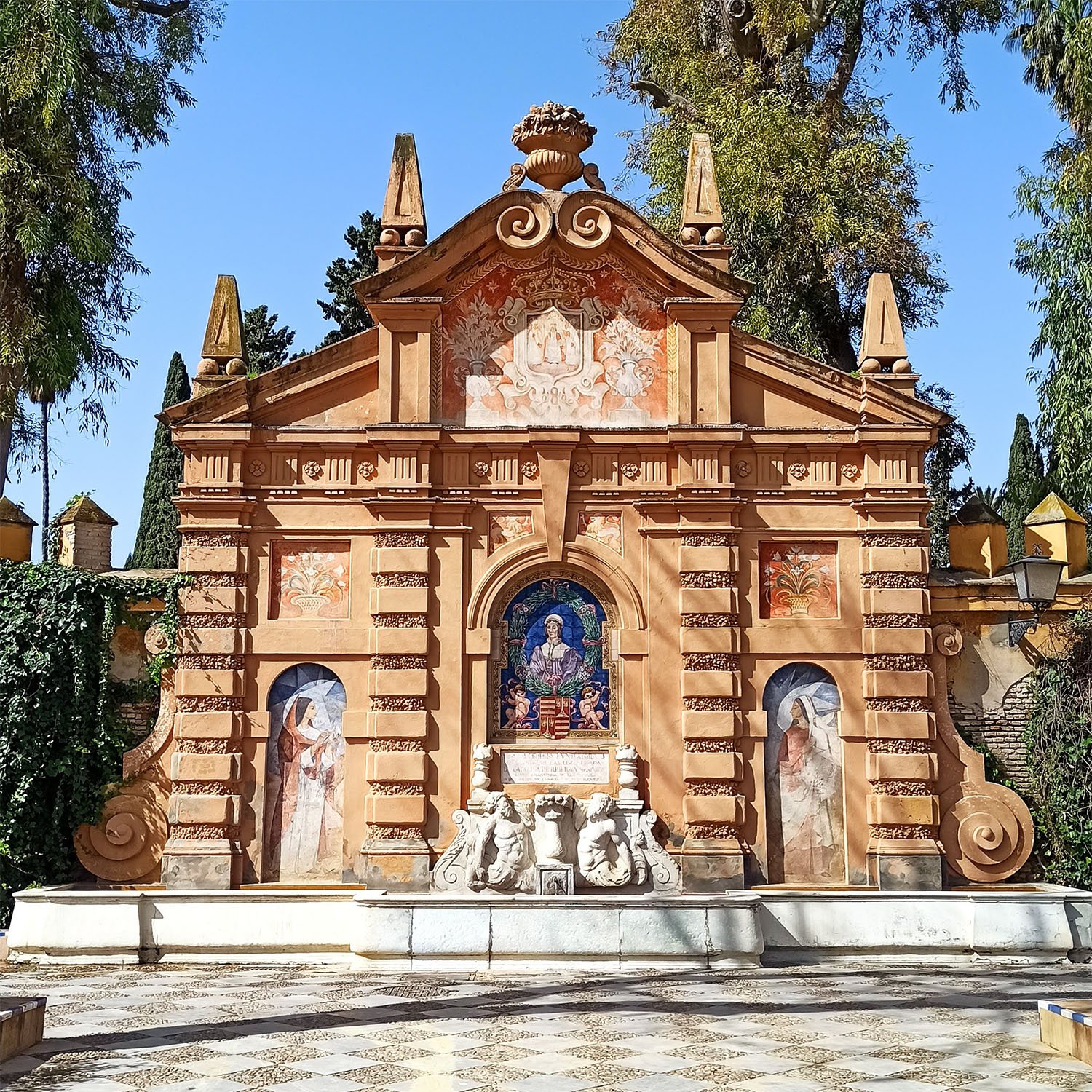
Very close to the monumental fountain is the parietal fountain, attached to the enclosure wall of the Alcázar gardens, dedicated to Catalina de Ribera, benefactor of the city with the foundation of the Hospital de las Cinco Llagas. It has an architectural structure in neo-mannerist style designed by Talavera and Heredia himself with paintings alluding to the lady, plus the remains of another fountain from the 16th century.

Text of the BIC declaration, 12-03-2002.

FOUNTAIN IN GLORIETA DE SAN DIEGO

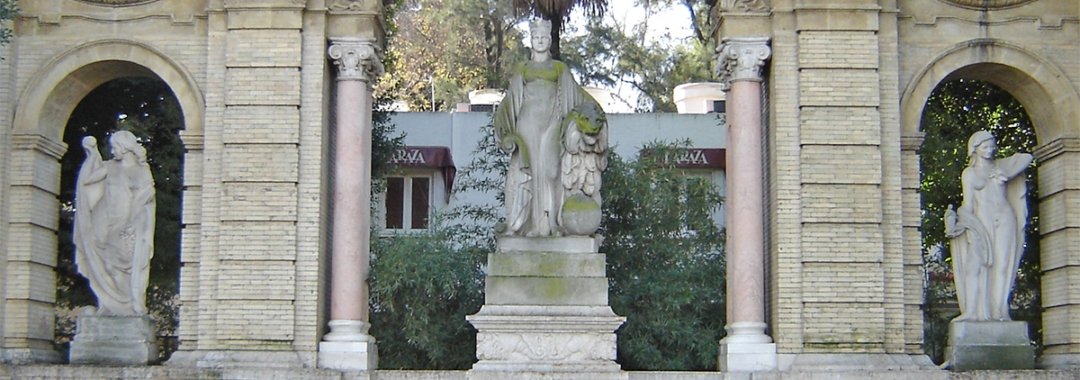
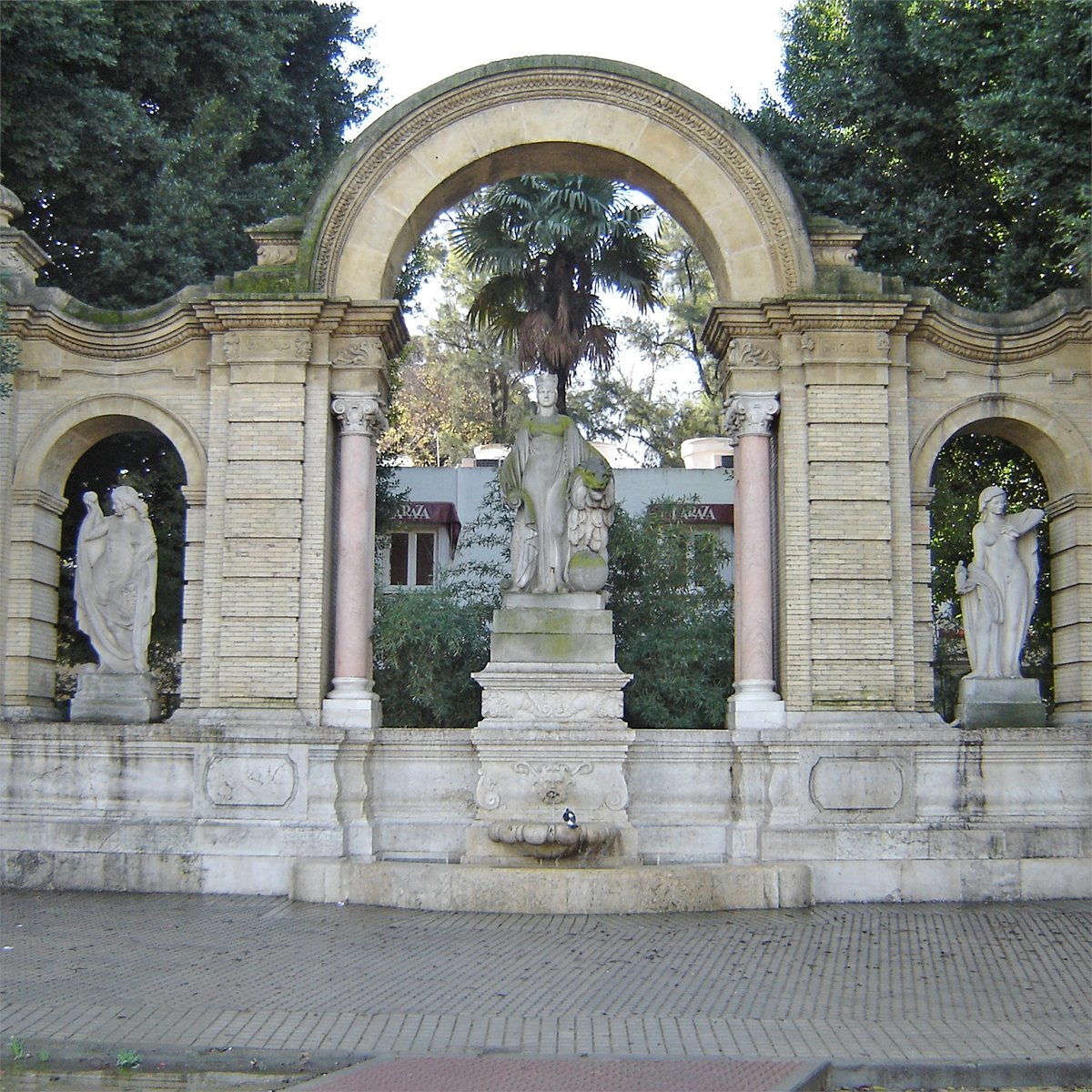
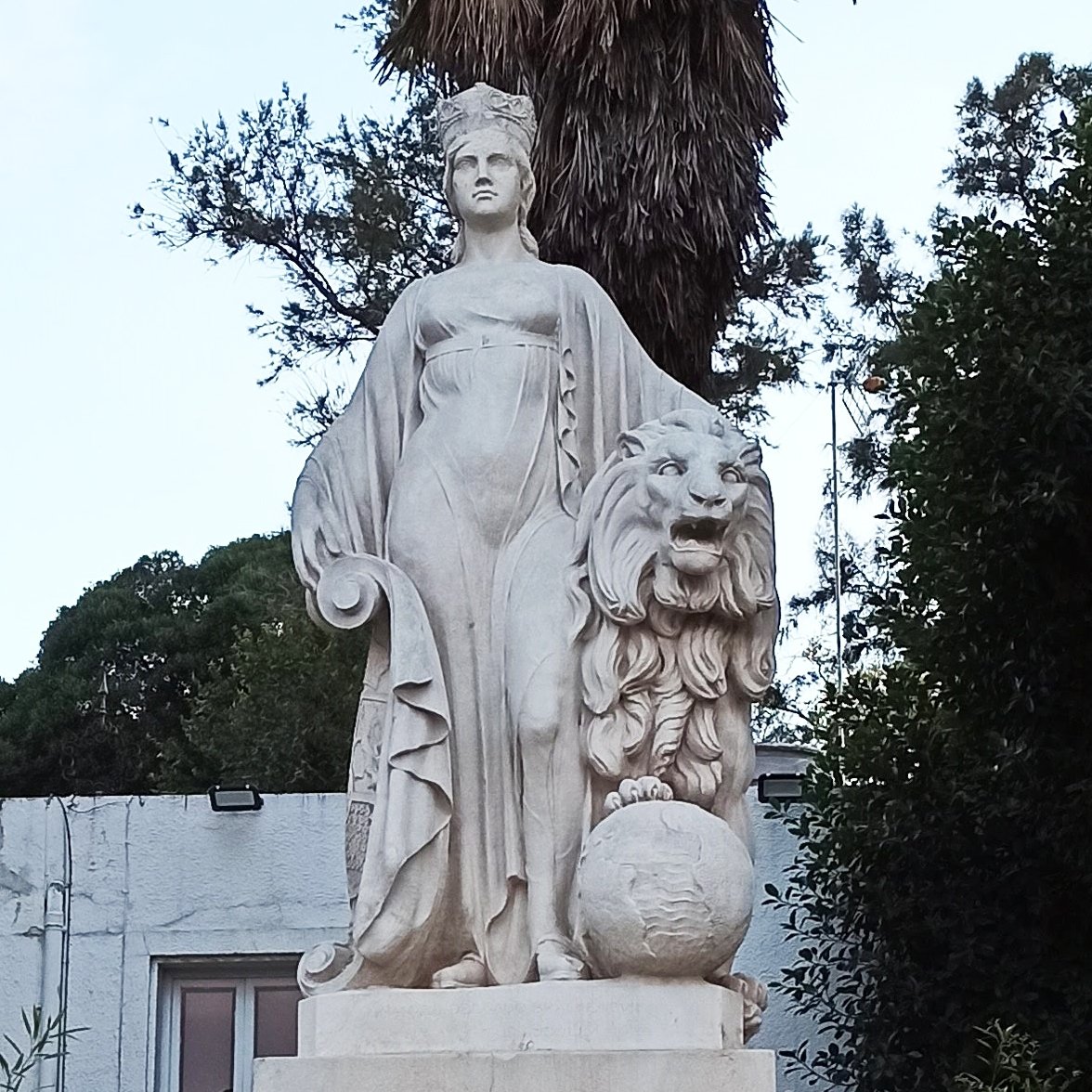
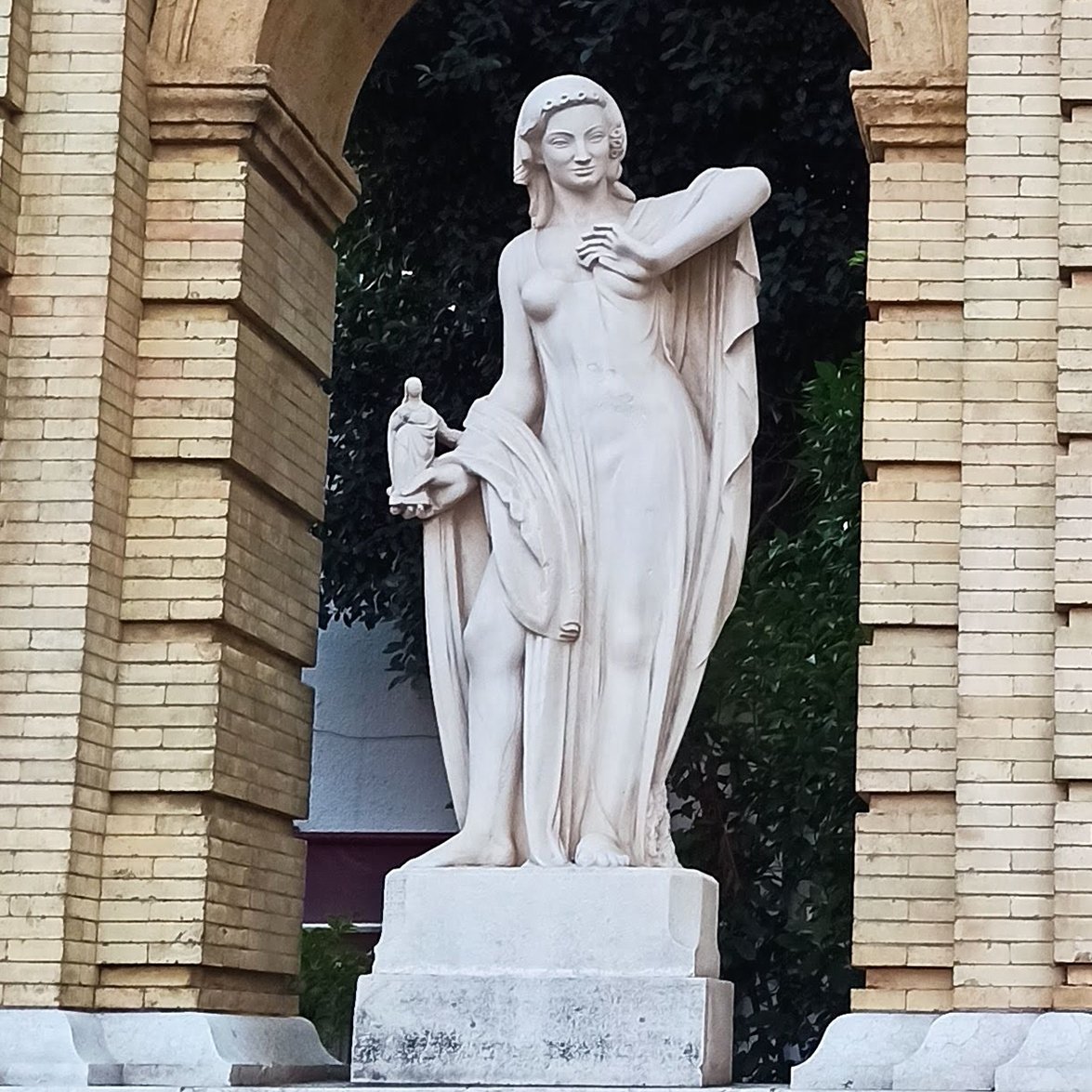
In the San Diego roundabout, at the northern end of the María Luisa Park, a structure in the shape of a triumphal arch is preserved with three openings that house the allegorical figures of Spain, in the center, and the city of Seville in its center. material and spiritual dimension, on both sides. The sculptures were made by Enrique Pérez Comendador and Manuel Delgado Brackenbury. In the central part of the plinth there is a fountain, whose spout, under the pedestal of the central sculpture, is a bearded character who spouts water from his mouth.

It was the central axis of the main entrance to the 1929 Ibero-American Exhibition site and was designed by the architect Vicente Través. The entrance actually had four doors, which faced the avenues of Portugal and Isabel la Católica on the left, and the avenue of María Luisa and the Seville Pavilion on the right.

This triumphal arch was conceived as the center of the monumental entrance to the exhibition site. In this way, the aforementioned allegories of Spain and Seville were placed, somehow symbolizing the welcome offered by the city and the nation as a whole.

Enrique Pérez Comendador, a young sculptor from Cáceres who was barely 28 years old at the time, was chosen to create the side sculptures. The work of this sculptor was quite prolific throughout his life, specializing above all in public monuments, since his style fit very well with the purpose of extolling the characters represented, by combining a realism of very classic forms with the simplification of the volumes and a renunciation of detail, which were considered to be typical of the “modern” style. He was always quite faithful to the academic opinions of the time in the execution of his works and showed a special ability to develop allegorical themes and the aggrandizement of heroic characters, so popular in official art during the Franco regime.

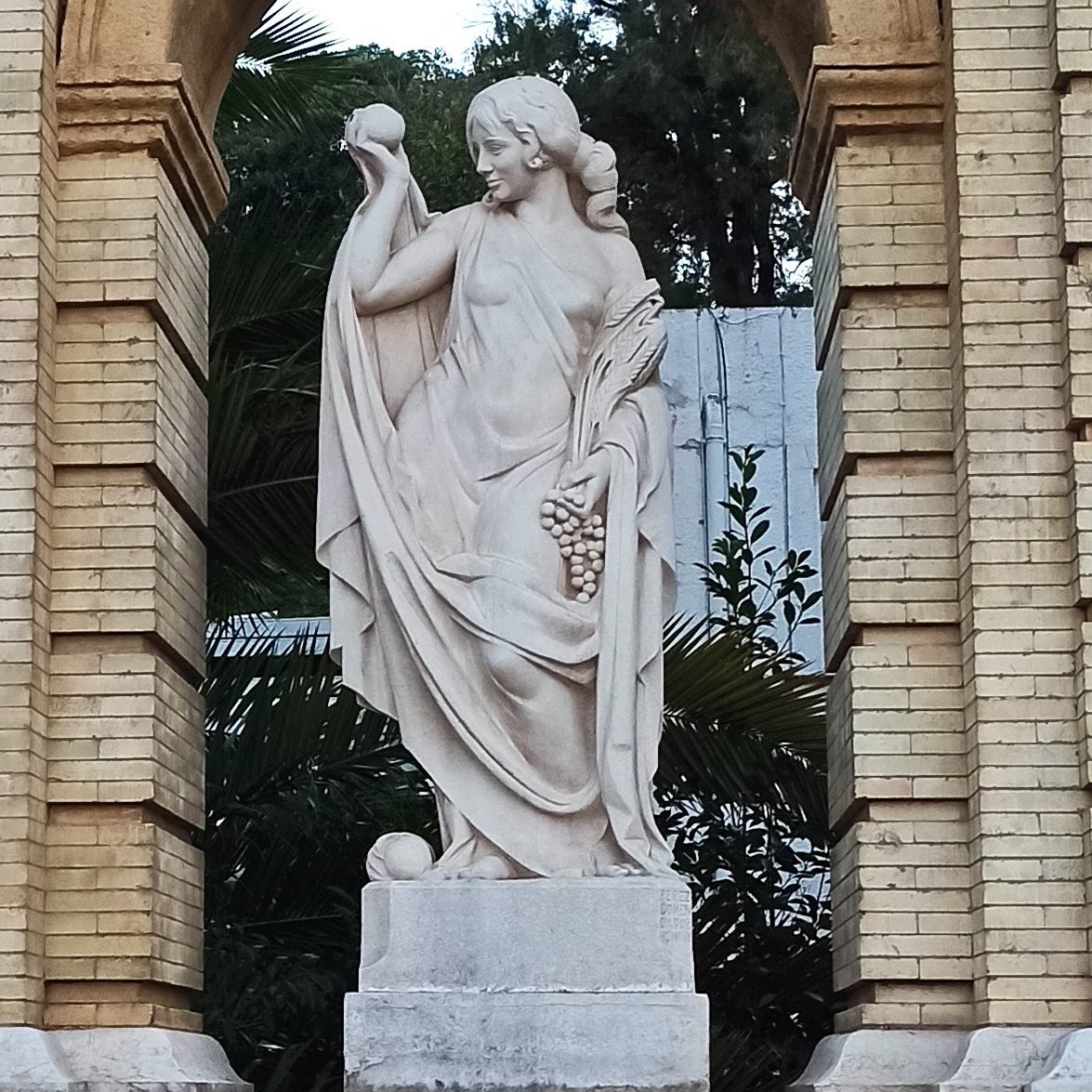
The artist called the two sculptures “The spiritual and material wealth of Seville”, although they were renamed in an article written by the poet Alejandro Collantes de Terán as “The sky and the earth of Seville” (el cielo y la tierra de Sevilla). These are two female figures with clear classical reminiscences, dressed in tunics that very clearly show the effect of wet cloths, so the round shapes of the bodies are perfectly visible.

The figure located to the viewer's left is the material wealth of Seville. His shapes are more rounded and he has more ease in his posture. He holds an orange raised in his right hand and in his left he holds a bunch of grapes and a bunch of ears of wheat, as symbols of the fertility of the earth. His face has an expression between mischievous and friendly, framed by semi-tied hair with a certain Andalusian air, as shown by the loose locks that form snails around his face.

The other figure is the one that represents the spiritual wealth of Seville. Her main attribute is a small Inmaculada with mountain features that she holds in her right hand. With it, reference is made to the fierce defense that the city always made of the dogma of the Immaculate Conception and in general to its profound Marian character. In this case, the allegorical figure shows a somewhat forced posture, with more rigid features and less naturalism, probably seeking greater solemnity. Her face is reminiscent of sculptures from the archaic period of Greek art, due to the lack of expressiveness and that characteristic frozen half smile. Although she also shows some little snails of hair around her forehead, most of her hair appears covered, surely as a sign of respect for the image she carries and what it symbolizes.

Both images flank a majestic allegory of Spain, the work of the Sevillian sculptor Manuel Delgado Brackenbury. His features are more naturalistic and classic than those of Pérez Comendador, although both coincide in the use of some stylistic resources, such as the use of the wet cloth technique to reveal the shapes of the body. The figure appears standing, with one leg slightly forward, in a posture that gives it great solemnity. He wears a tunic tight under the chest and over his collected hair he wears an open royal crown, a symbol of the Spanish monarchy. She rests her right arm on a large shield of Spain and her right arm on a lion, which in turn rests its paw on a globe, a symbol of Spanish sovereignty. It must be remembered that the lion and not the bull has been the animal that has most symbolized our country throughout its history, appearing profusely since the Middle Ages on a multitude of supports, such as coins, pictorial representations or architectural elements.
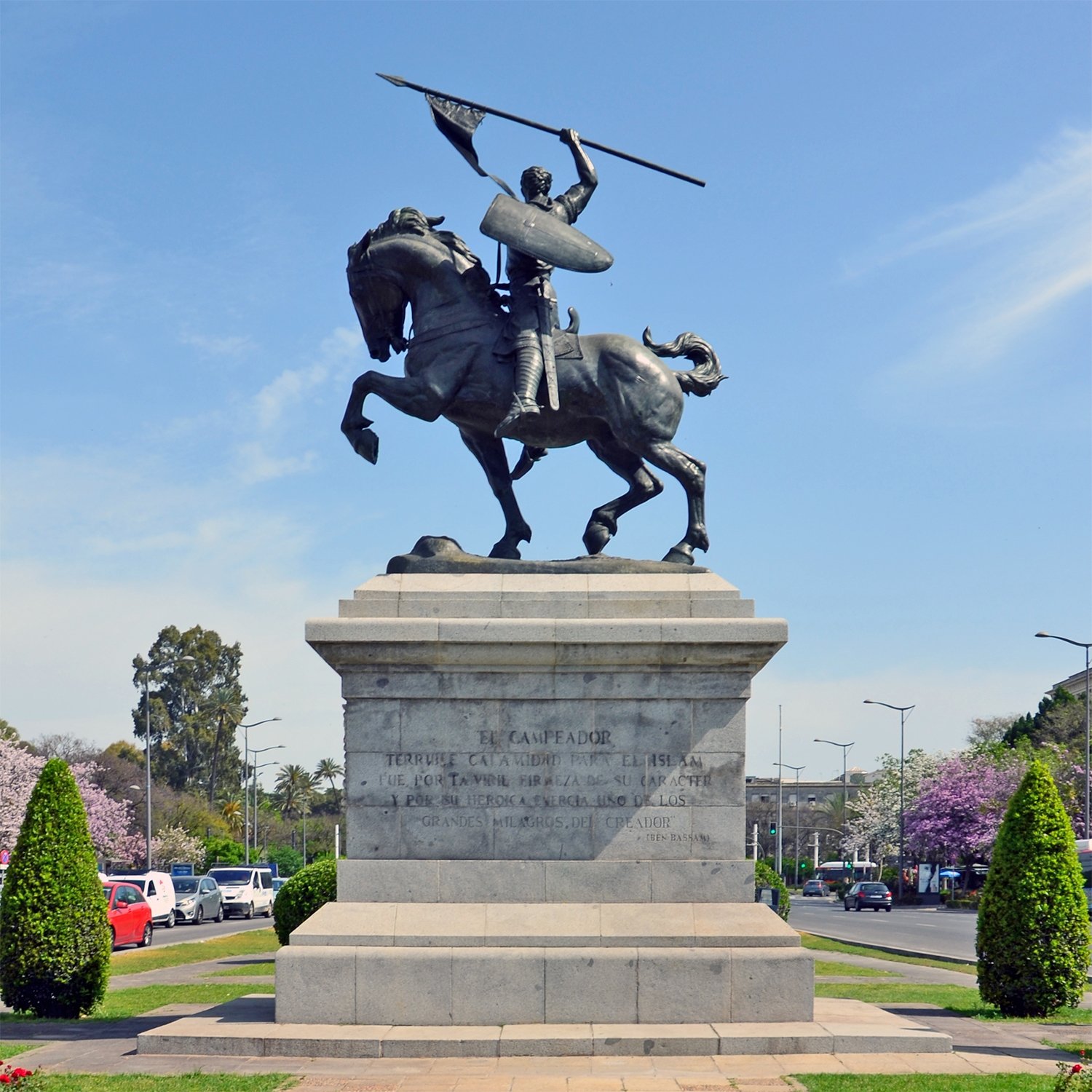
MONUMENT TO THE CID CAMPEADOR

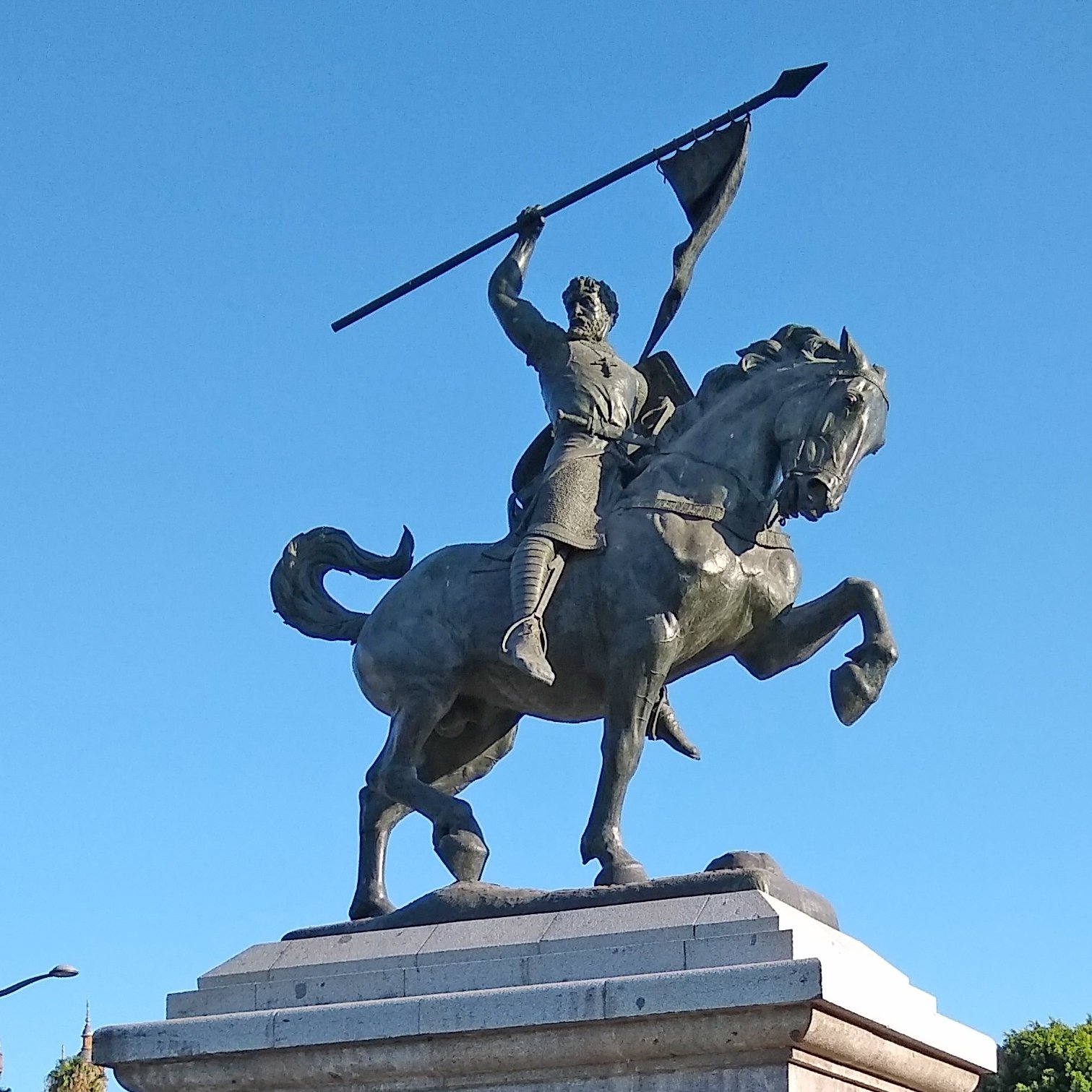
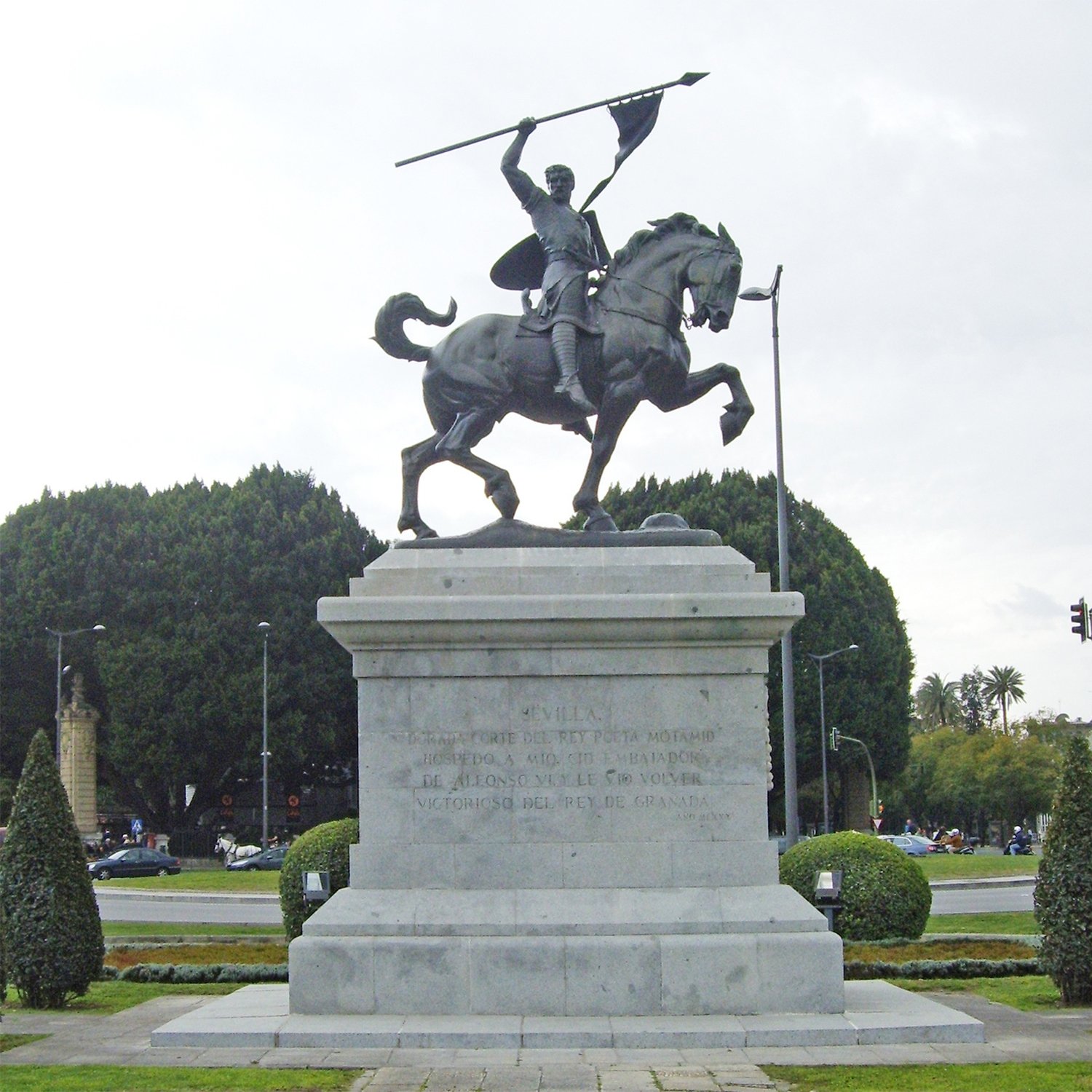
Located in the center of Avenida del Cid, it is an equestrian statue by the American artist Anne Hyatt Vaugh. It was a gift from the New York Hispanic Society to the city of Seville on the occasion of the celebration of the Ibero-American Exposition of 1929. In fact, it was decided to place it right in front of what was the main entrance to the venue, between the Portugal Pavilion and the old Tobacco Factory.

Its author stood out above all for her monumental bronze sculpture, frequently representing historical figures and specializing above all in the recreation of animals. In this field she achieved great mastery, especially with the figure of the horse, of which Huntington was truly in love.

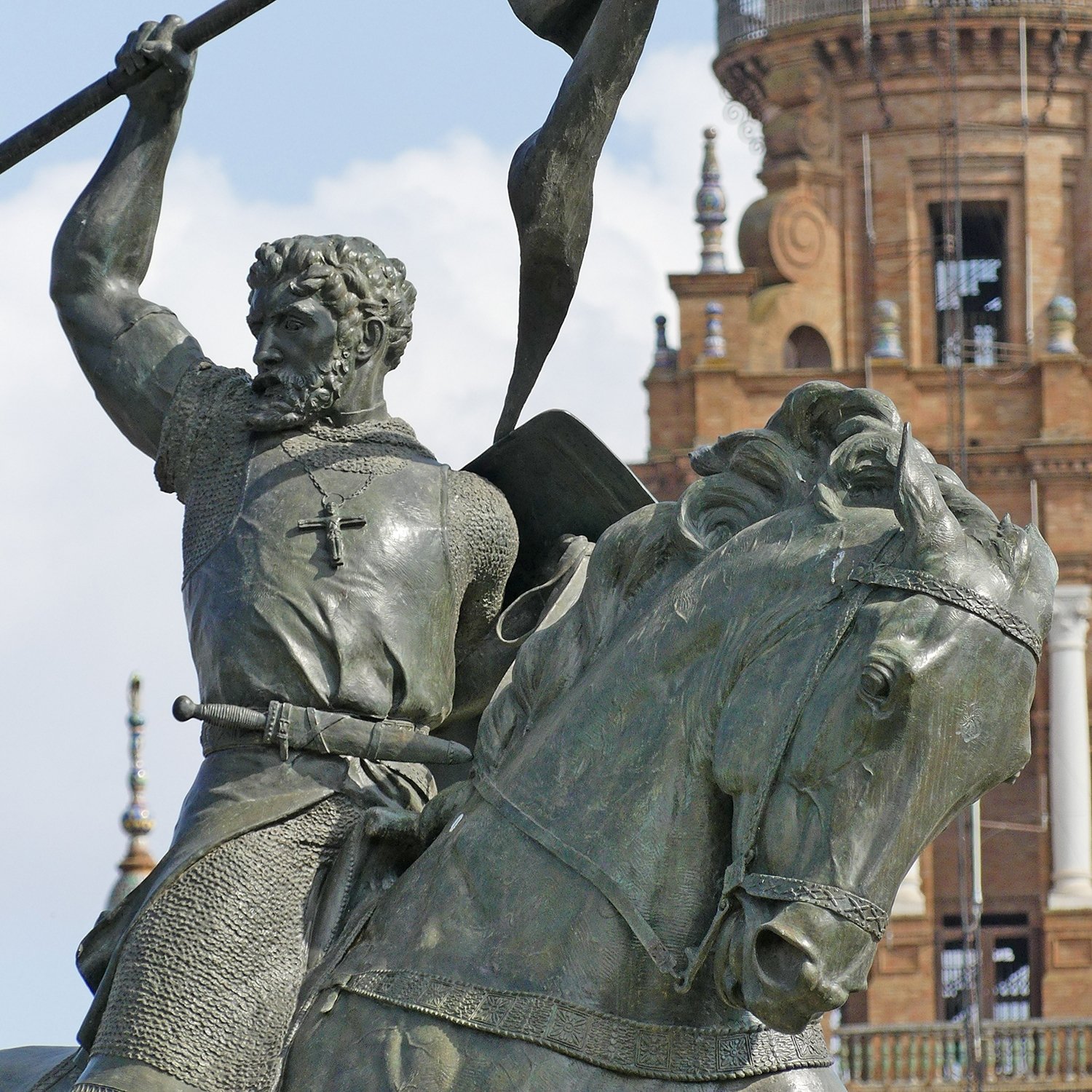
These qualities are clear in the example of her statue for Seville. The Cid's horse is represented with great anatomical realism and transmitting a strong sensation of movement, which gives the entire work a great dynamism that does not detract from its solemnity.

The posture of the figure of Rodrigo, turned to one side with respect to the axis of the horse, contributes to this dynamism. He wears warrior mail and raises one arm holding a spear, in an attitude of haranguing the troops. In the other arm he carries a shield and his sword.

It is a magnificent example of 20th century equestrian sculpture, which from the beginning enjoyed the recognition and admiration of both the people of Seville and the artistic circles of the time. The original sketch of the work was made in the same year, 1927, and is today in Brookgreen Gardens in South Carolina. The success of the Sevillian monument led to various copies being made that are spread throughout various points of Spanish and American geography, such as New York, Buenos Aires, San Francisco and Valencia.

El Cid is the nickname by which Rodrigo Díaz de Vivar was known, a Castilian knight who lived during the 11th century and who ended up being one of the most famous characters of the Spanish Middle Ages. He was first a vassal of King Sancho II and, after his death, of his brother, Alfonso VI.

By order of this king, the Cid traveled to Seville in 1079 to collect the pariahs from King Al Mutamid. During Rodrigo's stay in Seville, the kingdom suffered an attack by order of the Granada king Abdalá ibn Buluggin. El Campeador collaborated with Al Mutamid in his fight against the Granadans, who were defeated in the battle of Cabra. This fact is alluded to in the inscription found on the pedestal of the monument: “Seville, home and court of the poet King Motamid, hosted Mio Cid, ambassador of Alfonso VI, and saw him return victorious from the King of Granada.” On the other side of the pedestal one can read: “The Campeador, a firm calamity for Islam, was, due to the virile firmness of his character and his heroic energy, one of the great miracles of the Creator. “Ben Bassam.”

In detail: El Cid in Seville

HEADQUARTERS OF THE REAL MAESTRANZA

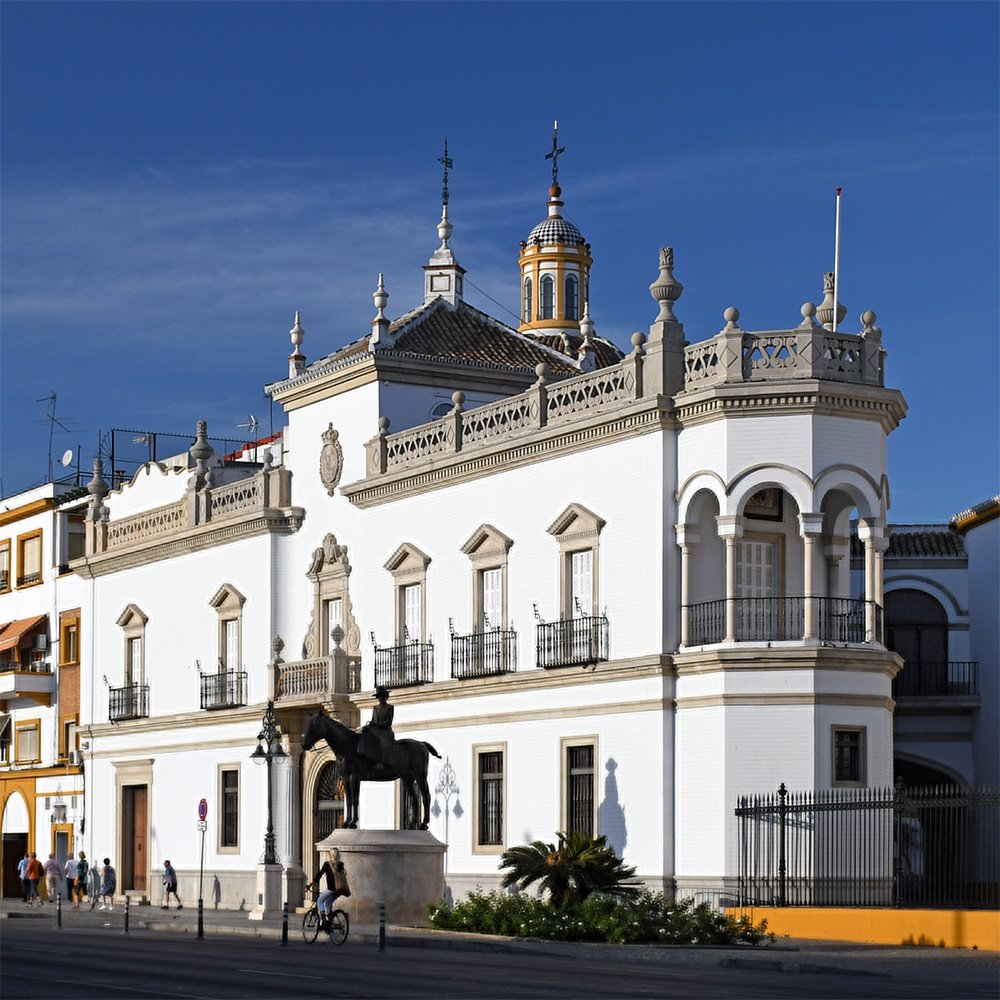
The headquarters of the Real Maestranza de Caballería is located next to the Plaza de Toros, of which this institution is the owner. It is a regionalist building in the neo-baroque style, designed by Aníbal González in 1929.

However, the property would undergo successive renovations and expansions in the following decades. In 1956 the chapel was inaugurated, the construction of which was directed successively by Gómez Millán, Medina and Barquín Barrón. It has a Latin cross plan, with a single nave covered by a barrel vault with lunettes. The central space of the transept has been covered by a lowered dome with a drum and lantern, sitting on pendentives.

The main altarpiece is recomposed taking parts of the primitive altarpiece that occupied the chapel that the Maestranza had in the church of the disappeared convent of Regina Angelorum. It was originally made under the direction of Francisco Dionisio de Ribas in 1668 and its sculptures are the work of Pedro Roldán. In its central niche, a dress image of the Virgin of the Rosary is venerated, a work by Cristóbal Ramos from the 18th century, considered the official patron saint of the corporation.

ELECTRICITY SHED OFF THE 1929 PARK

This small electricity booth, with its Neo-Baroque style, is the only remainder that has survived to this day from the great amusement park that was built for the Ibero-American Exposition of 1929. It occupied an area of almost 43,000 square meters between the avenues of La Raza and de la Palmera and at the time it was considered in quality to be on par with the best in the world. Unfortunately, despite initial plans to keep it, the park was eventually dismantled and sold. Some parts of its attractions are still preserved today in the historic amusement park of Monte Igueldo, in Bilbao.

CC BY-SA 4.0

[mapsmarker map="2"  lat="37.366091" lng="-5.988101" zoom="18" height="300" heightunit="px"]