SAN JOSÉ CHAPEL

This small church was built at the initiative of the city's carpenters' union, and hence its dedication to Saint Joseph, patron saint of woodworkers. It is known that the carpenters already had a temple in this area in the 16th century, but its dilapidated state meant that it had to be demolished. The current temple was built in two phases during the 18th century.

CC BY-SA 4.0

The first of these was directed by Pedro Romero and concluded in 1717 with the construction of the only nave of the chapel. The second was completed in 1766 under the direction of Esteban Paredes, completing the main chapel and the exterior of the temple. The church reached the 20th century in a state of practical ruin and in 1931 suffered a fire in which it lost the roof and part of its wall paintings. Fortunately, she was able to be rehabilitated and returned to the cult.

As we said, it is a small church, with a single nave and transept slightly marked in plan. It has two exterior doors, one at the foot and another on the Gospel side.

The main doorway is made of brick with a showy Baroque style that manages to convey the sensation of monumentality despite its small dimensions. Two pilasters support a divided curved pediment, in the center of which opens a niche with the image of San José, designed by Lucas Valdés in 1716. On both sides, two richly framed medallions with the busts of San Fernando and San Hermenegildo, and on the central niche, a third medallion with a representation of San Juan Bautista in youth.

On both sides of the door, two niches housed the images of San Joaquin and another saint, identified as San Jason or San Teodoro de Amasea. To avoid damage, both are currently kept in the sacristy of the church, being replaced by two images made in resin by the contemporary sculptor Jesús Curquejo Murillo. One of them is a copy of the previous San Joaquín, while the other is a tender representation of Santa Ana with the girl Virgin.

The side doorway can be dated to the same period as the main one and its central element is a beautiful relief that represents the Betrothal of the Virgin and Saint Joseph, attributed to the great eighteenth-century sculptor Cristóbal Ramos. On the molding that frames this scene, four high-quality images gracefully rest despite their profound deterioration. On the first level, Saint Peter (today headless) and Saint Paul, and on the main scene, two allegorical figures representing virtues attributed to Saint Joseph: Meekness, holding a lamb, and Chastity.

Inside, the only nave of the temple is covered with a barrel vault resting on transverse arches, and an elliptical dome with a blind lantern rises over the transept. The profuse sculptural and pictorial decoration of the temple make the Chapel of San José an exquisite little jewel of Sevillian Baroque.

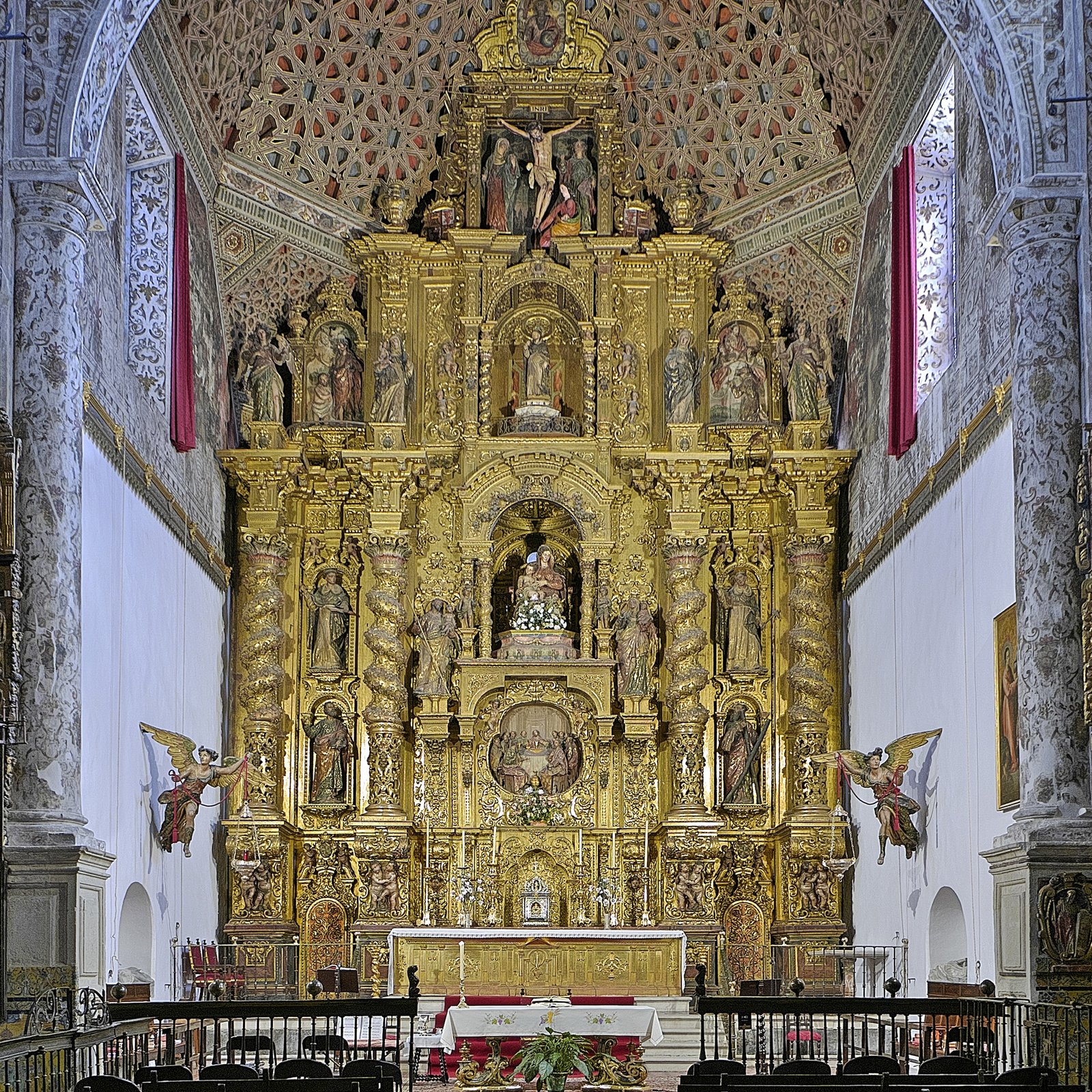
The main altarpiece was designed by the Portuguese-born sculptor Cayetano de Acosta, one of the most outstanding artistic figures of the 18th century in the city. On the bank, the main body is divided into three streets by means of stipes, although the profuse decoration that covers practically every centimeter makes it difficult to distinguish this structure. In the central niche is located the head of the temple, San José, in a sculpture of the circle of Pedro Roldán. In the stipes that frame this niche are the figures of San Joaquín and Santa Ana, parents of the Virgin, attributed to Pedro Duque Cornejo, another of the great sculptors of the 18th century in Seville.

On the Tabernacle, there is an image of the Immaculate Conception, and on both sides, in the side streets of the altarpiece, we find San Juan Bautista and San Juan Evangelista, under two medallions with high reliefs of San Sebastián and San Roque.

In the upper part of the altarpiece, a series of children and young angels complete the composition, and in the center of the attic is the image of God the Father in an attitude of blessing.

On both sides of the transept there are two altarpieces, with the same chronology as the main one and also with profuse decoration. The one on the right gives access to the sacristy and the one on the left is presided over by a sculptural group with the Coronation of the Virgin.

On the sides of the nave, framed under semicircular arches, there are two other altarpieces. Both have been dated to the 18th century. The one on the right has in its center a beautiful set with The Betrothal of the Virgin on an interesting and classic architectural background, while the one on the left is presided over by an image of Santa Ana.

The paintings that decorate the vaults and arches have been dated to the last third of the 18th century, a century to which the various canvases on the canvas walls also belong. As an exception, we find a beautiful painting from the 17th century that represents Rest on the flight to Egypt. It is by an anonymous author who seems to follow in style the work of the Italian Paolo Veronese.

[mapsmarker map="2"  lat="37.390028" lng="-5.994639" zoom="18" height="300" heightunit="px"]

CHURCH OF THE OLD HOSPITAL OF OUR LADY OF PEACE

The Hospital of Nuestra Señora de la Paz is a welfare foundation belonging to the Order of Hospitaller Brothers of San Juan de Dios, settled in Seville since 1543 and in the location they currently occupy since 1574. It was founded as a center for the care of sick with few resources and later began to also deal with convalescent former soldiers. With the Confiscation, the Hospital was expropriated in 1836 but the hospital brothers returned to their old home in 1880. Since then, the order has continued to be in charge of the Hospital, which currently functions as a nursing home.

The most artistically interesting part, and the only one open to the general public, is the church of Nuestra Señora de la Paz, which overlooks the Plaza del Salvador. It is a temple originally built in the first half of the 17th century, although deeply reformed during the 18th century.

It is a church with three naves, with a transept not marked in plan and a flat head.

On the outside, its only façade at the foot has a design that has originally been attributed to the late-Renaissance architect Vedmondo Resta. It is divided into three levels

In the first, four Doric columns support a frieze of metopes and triglyphs. Between the lateral ones there are two oculi and between the central ones, the lowered semicircular arch that gives access to the temple.

In the center of the second level, four columns again, but this time surrounded by profuse decoration with plant motifs, rockeries and child angels, elements probably added in the 18th century. They frame three niches that house the images of San Agustín, the Virgin with the Child and San Juan de Dios. The side niches are profusely decorated, while the central one is extremely simple. In addition, the stylistic features of the central image of the Virgin are clearly different from those of the lateral images, which indicates that this central space was reformulated after the rest of the cover. The whole set is framed by two pilasters, also with abundant ornamentation.

On the third level, the doorway is completed with a niche framing a modern stained glass window, flanked by abundant and meticulous sculptural decoration. Above the stained glass window, two angels hold a crown over the symbol of the brothers of San Juan de Dios, a pomegranate, which recalls the founding of this order in the Andalusian city of the same name in 1572.

Above the whole, a curved and divided pediment rises in the center of which an oculus opens. On both sides of the façade, we find two bell towers topped by stylized spiers covered in tile.

Inside, we find the three naves of the church divided by semicircular arches on marble columns, with the central one notably higher than the lateral ones. The side naves are covered with barrel vaults, like the central one, which also includes lunettes. At the foot of the temple, there is a high choir decorated with abundant rococo-style plasterwork decoration. Above the transept, there is a dome with a lantern, decorated with plasterwork with geometric motifs, original from the 17th century.

The tile base that runs along the walls of the temple is especially interesting for its originality in Seville. It has been dated back to 1771 and has a beautiful 'candelieri' decoration in blue and white, with some yellow motifs in prominent areas.

The main altarpiece is neoclassical in style and dates from around 1800, when it replaced a previous one in the Baroque style. In the central niche, a dressed image of the Virgin of Peace, head of the temple, is venerated, flanked by San Juan de Dios and San Juan Grande, all sculptures from the same period as the altarpiece.

Two of the most artistically interesting images in the temple are located in the headers of both side naves. These are the representations of San Rafael and San Juan de Dios, both attributed for their great quality to the great Martínez Montañés.

On the walls of the church there is a series of eight Baroque altarpieces, dating from the 17th and 18th centuries, which house an interesting set of sculptures. Among the religious images, we could highlight the following for their interest:

- An image of San Andrés from the 17th century attributed to Francisco de Ocampo, from the previous main altarpiece of the church, now disappeared.

- San Carlos Borromeo, carved by Juan de Mesa in 1618.

- An image of the Cristo de la Humildad, dated around 1600, which reproduces the iconography of Christ grieving in the moments before the Crucifixion. This representation has its origin in an engraving by Dürer and is widespread in Sevillian churches.

- An Immaculate Conception by the Valencian sculptor Blas Molner, from the late 18th or early 19th centuries. Due to its great dynamism and originality, it could also be identified as an Assumption of the Virgin.

[mapsmarker map="2"  lat="37.390175" lng="-5.993683" zoom="18" height="300" heightunit="px"]

CHURCH OF THE DIVINE SAVIOR

The Church of the Divine Savior of Seville is the second largest temple in the city, only after the Cathedral. It is one of the great architectural jewels of the city and inside it houses a magnificent sculpture collection, with works by the most prominent authors of the Sevillian Baroque.

CC BY-SA 4.0

We know that in the space it occupies today was the so-called Ibn Adabbas Mosque, created around 830 as the main or aljama mosque of the city. It held this rank until the new great mosque was built in the 12th century, in the place now occupied by the Cathedral.

Some elements of the mosque that was located in El Salvador have been preserved, such as part of its patio and the start of its minaret, which corresponds to the lower part of the tower that we find at the north end, on Córdoba street.

Once the city was conquered by the Christians in 1248, the mosque was used as a church, although maintaining the essentials of its structure. It remained like this for centuries, with the architectural characteristics of an Islamic temple but serving for Christian worship, as is still the case today, for example, with the Mosque-Cathedral of Córdoba.

However, already in the 17th century, it seems that its state was quite dilapidated and it was decided to build a new temple. The works began around 1674, but when the closure of the vaults was underway, there was a resounding collapse that forced a good part of the project to be reconsidered.

The direction of the works ended up being entrusted to Leonardo de Figueroa, the best architect of the Sevillian Baroque, who also took part in other projects such as San Luis de los Franceses or La Magdalena. In this case, Figueroa was in charge of closing the vaults, building the great dome and finishing the interior of the building. The works were not completed until 1712.

The result is a huge and majestic temple with three naves. The transept stands out notably in height from the rest, although it is not perceptible in the plan of the building, which is what is called a living room.

The main façade has very classic baroque lines, close to Renaissance forms. The succession of stone pilasters and reddish brick panels achieve the classic bichrome that is so characteristic of many Sevillian buildings since the Lonja, today the Archivo de Indias, was built in the 16th century. Despite its monumentality, the El Salvador façade stands out for its sparse decoration, which contrasts sharply with the interior. The decoration with a Plateresque air that covers the pilasters and some of the moldings is relatively recent, from the end of the 19th century.

But in addition to its architecture, the Church of El Salvador, which was Collegiate until 1852, stands out for the magnificent art collection that it treasures. It has some of the most outstanding works of Sevillian altarpieces, beginning with the main altarpiece, dedicated to the Ascension of the Lord. It is a work directed by Cayetano de Acosta around 1779, who conceived an exuberant altarpiece, with a baroque profusion close to rococo.

Also magnificent is the altarpiece of the Virgen de las Aguas, on the right side of the transept, a work by José Maestre from 1731 presided over by this Marian image of the so-called “fernandinas”, dated around the 13th century but much remodeled later. These are just two examples of the large collection of altarpieces that this church houses.

And it is that the representation in the temple of great masters of sculpture is exceptional. In all probability, the two great figures of the Sevillian baroque are Juan Martínez Montañés and his disciple Juan de Mesa.

From the first, El Salvador preserves a colossal sculpture of San Cristóbal, reminiscent of Michelangelo due to its monumentality and beauty. But the most outstanding work of this author in El Salvador is surely Nuestro Padre Jesús de la Pasión, a moving image of the Lord with the cross on his back, which marvelously shows the classicism of the Montañés baroque, managing to convey all the feeling and the emotion of the moment, but in a contained, elegant and solemn way. It presides over the silver altarpiece of the Sacramental Chapel and goes out in procession every Holy Thursday. We do not exaggerate when saying that it is one of the most accomplished representations of Jesus Nazareno in the Spanish Baroque.

From the other great master of the Sevillian baroque, Juan de Mesa, we find the Cristo del Amor, who also takes a procession from this temple during Holy Week, this time on Palm Sunday. It is an exceptional size of the crucified, already dead, with a masterful treatment of the anatomy, hair and cloth. An exceptional work within the production of its author, who seems to have taken into account for its realization the model that his teacher Montañés made a few years before with the Cristo de la Clemencia that we found in the Cathedral.

Along with these teachers, the list of great artists with works in this church of El Salvador is almost innumerable. We could cite, for example, Duque Cornejo, José Montes de Oca or Antonio Quirós. But for now we end here this small sketch about the authentic living museum of the Sevillian baroque that is the old collegiate school of El Salvador. We will tell more in future deliveries.

[mapsmarker map="2"  lat="37.389956" lng="-5.992897" zoom="18" height="300" heightunit="px"]

ARCHBISHOP’S PALACE

The Archbishop's Palace of Seville stands on the land that has occupied the bishop's residence since the Christian conquest of the city in the 13th century. However, nothing has survived from the primitive palace to the present day and the oldest preserved remains date from the 16th century.

Elements of the chapel are preserved from the first half of this century, such as the wooden roof and the tile frieze, as well as a gallery with marble columns dating from around 1530.

However, it can be considered that the configuration of the palace as it has come down to us corresponds to the reconstruction undertaken under the direction of Vedmondo Resta between the end of the 16th century and the 17th century. It was then that the distribution of the different rooms and rooms around two main patios was configured.

The magnificent Baroque doorway that faces the Plaza Virgen de los Reyes was carved by Lorenzo Fernández de Iglesias around 1704. It stands out for its great dynamism and decorative richness, constituting one of the best examples of this style in Seville.

In the main courtyard there is a fountain presided over by a sculpture representing 'Hercules with the Nemean Lion'. In the same courtyard, a beautiful Baroque doorway dating from 1666 gives access to the Archbishop's Archive, which houses valuable documentary collections.

From an artistic point of view, the most interesting rooms are located on the top floor around the second patio. They are accessed by a monumental staircase, with a single shot and three sections, which is crowned by a dome with the shield of Archbishop Antonio Paino. The pictorial decoration of the staircase was carried out by Juan de Espinal, with the exception of the paintings of the pendentives and the semicircular areas, which were already made in the 20th century.

The main hall of the palace is covered with a ceiling divided into sixty squares with a series of paintings from the Old Testament interspersed with emblems and shields. They were made at the beginning of the 17th century by two authors who have not been identified. As a whole, they make up a moralizing message about the values and virtues that prelates should possess.

In addition to the paintings on the ceiling, the living room exhibits a very interesting collection of paintings by various authors. We find, for example, an apostolate attributed to Sebastián Llanos Valdés, a series of sixteen Biblical-themed paintings by Juan de Zamora and another ten on the Passion of Christ by Juan de Espinal. To these must be added a series of paintings of saints from Zurbarán's workshop, a work by Murillo representing 'The Virgin delivering the Rosary to Saint Dominic' and a 'Slayed Saint John the Baptist' by Mattia Pretti.

Also of great value are the works of the so-called Gallery of the Prelate, presided over by one of the oldest works in the Palace, an Immaculate Conception from the end of the 16th century by Cristóbal Gómez. Next to it, a series of paintings from Venetian workshops and copies by various Italian authors dating from around 1600 are exhibited. They represent allegories of the elements and the seasons, as well as episodes from the story of Noah.

The collection of portraits of Sevillian archbishops also deserves mention for its historical value, with the representation of more than seventy archbishops from the 17th century to the present.

In other smaller rooms there is a large collection of Sevillian painting, with works by authors such as Herrera el Viejo, Juan de Espinal, Francisco Pacheco or Murillo. They are interspersed with works by various foreign authors, such as the Dutch Abraham Willaert or Carel Van Savoy, who produced a series on the life of David.

The main chapel of the palace is presided over by a main altarpiece from the 18th century made by the great sculptor of Portuguese origin, Cayetano de Acosta. It is presided over by a beautiful image of the Immaculate Conception made by the same author, who also carried out the four side altarpieces of the chapel, dedicated to Saint Peter, Saint Paul, Saint John the Baptist and Saint John the Evangelist.

In addition to the main chapel, the palace has an oratory designed by Pedro Sánchez Falconete in the mid-17th century. In it, the vault stands out above all, decorated with plasterwork attributed to Pedro de Borja.

[mapsmarker map="2"  lat="37.386375" lng="-5.992093" zoom="18" height="300" heightunit="px"]

ROYAL ALCÁZAR

The Alcazar of Seville is one of the most fascinating royal residences in Spain. This is due to the fact that it does not respond to a single project undertaken at a given moment, but rather is the result of numerous construction phases that have taken place throughout its history.

It has been used continuously as a royal palace since its Muslim origins, back in the 10th or 11th century, until today, in which it is still the oldest royal palace in use in Spain and Europe. Throughout its history, the different monarchs who have inhabited here have been adapting the different palaces, courtyards and gardens to the tastes of each era, until configuring the marvelous and diverse complex through which we can walk today.

Although its origin is a set of Muslim palaces, very little remains of this early period of the Alcázar. Most of the palaces that we are going to see correspond to the reforms undertaken in Christian times by:

- Alfonso X the Wise, who built the so-called Gothic Palace in the 13th century.

- Pedro I, called by some the Cruel and by others the Justiciero, who built the wonderful that is the true heart of the Alcázar. It was built in the middle of the 14th century and constitutes the peak of the Mudejar style.

- In the reign of the Catholic Monarchs, the so-called Casa de Contratación was built, of which we will also see some rooms on this side, intended to centralize and organize trade with the Indies, after the discovery of America in 1492.

All this is surrounded by a magnificent set of patios and gardens, which have been added and reformed until very recent times. It must be remembered that a part of the Palace of Pedro I, specifically the upper floor, is still used as the residence of the kings of Spain when they are in Seville.

Thanks to all this, its long history, its beauty and its architecture, the Real Alcázar of Seville was declared a World Heritage Site by UNESCO in December 1987, together with the nearby cathedral and Archivo de Indias.

[mapsmarker map="2"  lat="37.384222" lng="-5.991888" zoom="18" height="300" heightunit="px"]

CHURCH OF EL SAGRARIO

The church of the Tabernacle was attached to the Cathedral between 1618 and 1662, following the plans of the architects Miguel de Zumárraga, Alonso de Vandelvira and Cristóbal de Rojas. It is an imposing Baroque temple with a single nave with side chapels, on which stands are placed between buttresses. In them are a series of eight colossal stone sculptures of evangelists and doctors of the church, made by José de Arce. It has a wide transept that is not noticeable from the outside, covered by a large dome with a lantern. The rest of the nave is covered with vaults, so characteristic of the Baroque.

CC BY-SA 4.0

On the outside, the façade is divided into three floors decorated with attached pilasters in the three classical orders: Doric on the first floor, Ionic on the second and Corinthian on the third. The decoration, apart from these pilasters, is practically non-existent, with the exception of the parapet that finishes off the entire building, on which a series of striking flamers are arranged. It has three main entrances, one from the Patio de los Naranjos, another from the Cathedral at the foot and another from Avenida de la Constitución, on the Evangelio side, which is generally used to access the church. The latter has a very simple classical portal, with two pairs of Tuscan columns supporting a pediment. In its center is the coat of arms of the Cathedral Chapter, with the Giralda between vases of lilies. On it, the allegories of Faith and Charity appear reclining.

Also very classical but more monumental is the doorway through which one enters from the cathedral. It was designed by Pedro Sánchez Falconete and in its central niche we see San Fernando, framed by Saints Justa and Rufina and the brother bishops San Isidoro and San Leandro.

Inside, the sculptural decoration of the vaults was carried out around 1655 by the brothers Miguel and Pedro de Borja, who also made the relief with the Allegory of Faith that is located above the entrance of the feet.

The main altarpiece comes from the Vizcaínos Chapel of the now-defunct Casa Grande de San Francisco Convent, which was located in the current Plaza Nueva. The structure was made by Dionisio de Ribas and the sculptures by Pedro Roldán, who got one of his masterpieces here. In the center, there is the scene of the Descent, with the body of Jesus already resting on his Mother's lap. On both sides, there are two beautiful young angels, full of dynamism, and in the attic a Veronica shows her cloth with the Holy Face, also accompanied by angels. The set is finished off with a representation of San Clemente, who is the official owner of the temple. This image of San Clemente comes from the original altarpiece that preceded the current one. Apparently it was a spectacular set made at the beginning of the 18th century. With the expansion of neoclassicist taste in the 19th century and a certain phobia of what was considered excessive ornamentation, it was decided to destroy it in 1824. The current altarpiece would be located in this location in 1840.

On both sides of the transept there are two large reddish marble altarpieces made in the mid-18th century. The one on the left side is presided over by a Christ on the Cross from the beginning of the 17th century, made by the sculptor of the Madrid school Manuel Pereira. La Dolorosa at its feet is the work of the brilliant 18th century sculptor Cayetano de Acosta, who also made the sculptures that decorate the altarpiece on the other side of the transept. In this case, we see in the central niche a beautiful Virgin with Child.

As for the side chapels, from the presbytery towards the feet and on the Gospel side, we find the following:

- Chapel of Cristo de la Corona, with a neoclassical altarpiece from the 18th century, presided over by a Nazarene dedicated to Cristo de la Corona. It is an emotional image from the 16th century that is the owner of his own Brotherhood, taking a procession on Friday of Sorrows through the surroundings of the parish.

- Chapel of San Millán, with an 18th century altarpiece, in which, in addition to San Millán, Santa Catalina, the Immaculate Conception, San Roque and Santa Gertrudis appear.

- Chapel of Saint Joseph. It has an altarpiece from the late 17th century, presided over by an image of San José by Pedro Roldán or his circle.

- Chapel of Saints Justa and Rufina, with an 18th century altarpiece presided over by an image of the Sacred Heart from 1948, flanked by images of the Saints, from the same period as the altarpiece.

Also from the presbytery to the feet, but on the Epistle side, we find:

- Chapel of the Virgen del Rosario, presided over by an image made by Manuel Pereira at the beginning of the 17th century, although re-polychromed in the 18th century.

- Chapel of San Antonio, with an altarpiece dated 1667 and made by Bernardo Simón de Pineda, one of the most outstanding altarpiece artists of the Sevillian Baroque. On the altar is an ivory Crucified from the 17th century from the Philippines.

- Chapel of the Immaculate. In it there is a beautiful image of the Immaculate Conception, anonymous from the beginning of the 18th century. The chapel is also the seat of the Sacramental Brotherhood and in it we find the magnificent baby Jesus made by Martínez Montañés around 1606. This sculpture would set the pattern for the most widespread representation of the Baby Jesus during the Baroque. There are innumerable representations that have taken place in the city since the 17th century and that today are spread throughout the city's churches, convents and private collections, all of them having as their starting point this masterful work by Martínez Montañés for the Tabernacle. The image parades every year in the Corpus Christi procession that leaves from the Cathedral.

- Chapel of Santa Bárbara, with a Baroque altarpiece from around 1680 presided over by the head of the chapel, flanked by Santa Teresa and Santa Elena.
In the upper part of the walls there is a good collection of baroque canvases, among which the nine made by Matías de Arteaga around 1690 stand out. The painter was a member of the Sacramental Brotherhood and the paintings represent themes from the Old Testament related in a way symbolic with the Eucharist, such as 'The parable of the wedding guests' or 'The adoration of the Mystic Lamb'.

[mapsmarker map="2"  lat="37.386356" lng="-5.993871" zoom="18" height="300" heightunit="px"]

CONVENT OF LAS TERESAS (SAN JOSÉ DEL CARMEN)

This community of Discalced Carmelites settled in Seville in 1575 at the hands of Saint Teresa herself, who traveled to the city to supervise the foundation. They first settled in some houses on Calle Alfonso XII and later on Calle Zaragoza, until in 1586 they moved to the location where we find them today, in the heart of the Barrio de Santa Cruz. San Juan de la Cruz himself participated in this transfer of the nuns to their new location, who was in the city supervising the operation.

CC BY-SA 4.0

It was decided to buy the house of a Sevillian banker named Pedro de Morga. His was a classic Sevillian palace from the 16th century, so it was decided to use the patio of the house as a cloister for the new convent.

In this way, the cloister of the convent of Las Teresas is a Renaissance-style porticoed courtyard around which all the cloistered rooms are articulated. The patio has a rectangular floor plan and presents arches on marble columns, semicircular in the lower gallery and lowered in the upper one, a fairly common feature in other Sevillian palaces.

To the outside, the access facades to the church and the access to the convent are attached, both with lintelled and very simple entrances. On the one that gives access to the convent we see a small mural painting as the only decoration, representing the shield of the order flanked by two cherubs.

As for the façade of the church, the enormous roof that covers the entrance stands out, held in place by wrought iron braces. In its inner part, some original paintings from the 17th century have been preserved, with representations of various symbols and saints alluding to the Carmelite order.

Artistically, the most interesting part of the convent is its church, dating from the early 17th century, with a design attributed to the late-Renaissance architect Vedmondo Resta. It has a rectangular plan with a single nave and a square head. The nave is covered with a barrel vault with lunettes and the presbytery with a hemispherical vault. On the sides there are large niches in which altarpieces are embedded as lateral chapels.

The main altarpiece is the work of the assembler Jerónimo Velázquez from around 1630 and combines paintings on canvas and sculptures in a fairly classic late-Renaissance composition, inspired by notable models such as Martínez Montañés or Alonso Cano.

In the central niche, a beautiful representation of Saint Joseph with the Child, the work of Juan de Mesa, is venerated. The iconography in which the Child Jesus leads and indicates the way to Saint Joseph is followed here. On both sides, the main saints of the order, San Juan de la Cruz and Santa Teresa de la Cruz, in two anonymous sculptures from the 17th century. The paintings on canvas that complete the altarpiece are anonymous and deal with themes also related to the Carmelites.

Also by Juan de Mesa is the magnificent Immaculate Conception that occupies the center of one of the side altarpieces. The Virgin appears with the classic layout of her iconography but dressed in the Carmelite habit. It is flanked by Saint John the Baptist and the Prophet Elias, and in the attic there is a relief with the mystical Betrothal of Saint Teresa. With the exception of the Immaculate Conception by Juan de Mesa, the rest of the sculptures in the altarpiece are anonymous, although they are considered very close to the style of Pedro Roldán.

In the rest of the altarpieces there is a good collection of Sevillian painting and sculpture, mainly from the 17th and 18th centuries.

Unfortunately, the free visit to the convent church is very restricted and it is practically only possible to do so during mass hours.

[mapsmarker map="2"  lat="37.385805" lng="-5.989016" zoom="18" height="300" heightunit="px"]
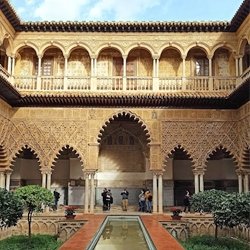
CONVENT OF SAN AGUSTÍN (OLD)

The Convent of San Agustín was one of the great Sevillian convents during the Middle and Modern Ages, founded according to Ortiz de Zúñiga already in the 13th century, shortly after the Christian conquest of the city. It seems that the religious settled here at the end of the same century and the Augustinian community remained here until 1835, the year in which they were exclaustrated.

After the expropriation of the convent, the property has been put through various uses and gradually reduced its original dimensions. The church and one of the cloisters have disappeared and today only a few rooms remain around what was the main cloister, all in a dilapidated state.

Although the convent had a long construction history between the 13th and 19th centuries, the remains of the cloister that have survived to this day date from the end of the 16th or beginning of the 17th century. It is an enormous porticoed cloister, with semicircular arches on brick pillars on the first floor and carpanel arches on paired columns on the second. ´

In the center of the courtyard are the stone remains of what appears to be a great gate or triumphal arch, deposited there after being dismantled from its original location. It is probably access to the compass of the convent that was designed by the great architect of the Sevillian Renaissance Hernán Ruiz II.

There is currently a project to build a hotel on what remains of the old convent, maintaining the cloister façades.

[mapsmarker map="2"  lat="37.389726" lng="-5.983682" zoom="18" height="300" heightunit="px"]

CONVENT MADRE DE DIOS

Convent of Dominican nuns founded at the end of the 15th century, when Queen Isabella the Catholic ceded a large plot of the old Jewish quarter of Seville to the nuns. Some authors maintain that the convent was partly based on one of the old synagogues in the neighborhood, but this information has not been confirmed. The building that has survived to this day dates from the second half of the 16th century.

The main elements of the convent can be dated to that date: the church, a small patio that acts as a cloister and another larger one that is used as a garden.

The temple is one of the largest convent churches found in Seville and the architects Juan de Simancas and Pedro Díaz Palacios were involved in its construction. It has a rectangular plan, with a square head and high and low choirs at the feet.

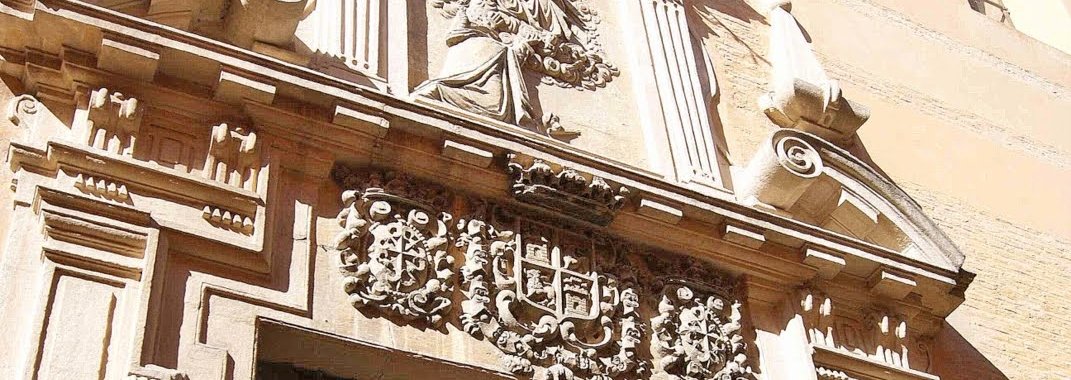
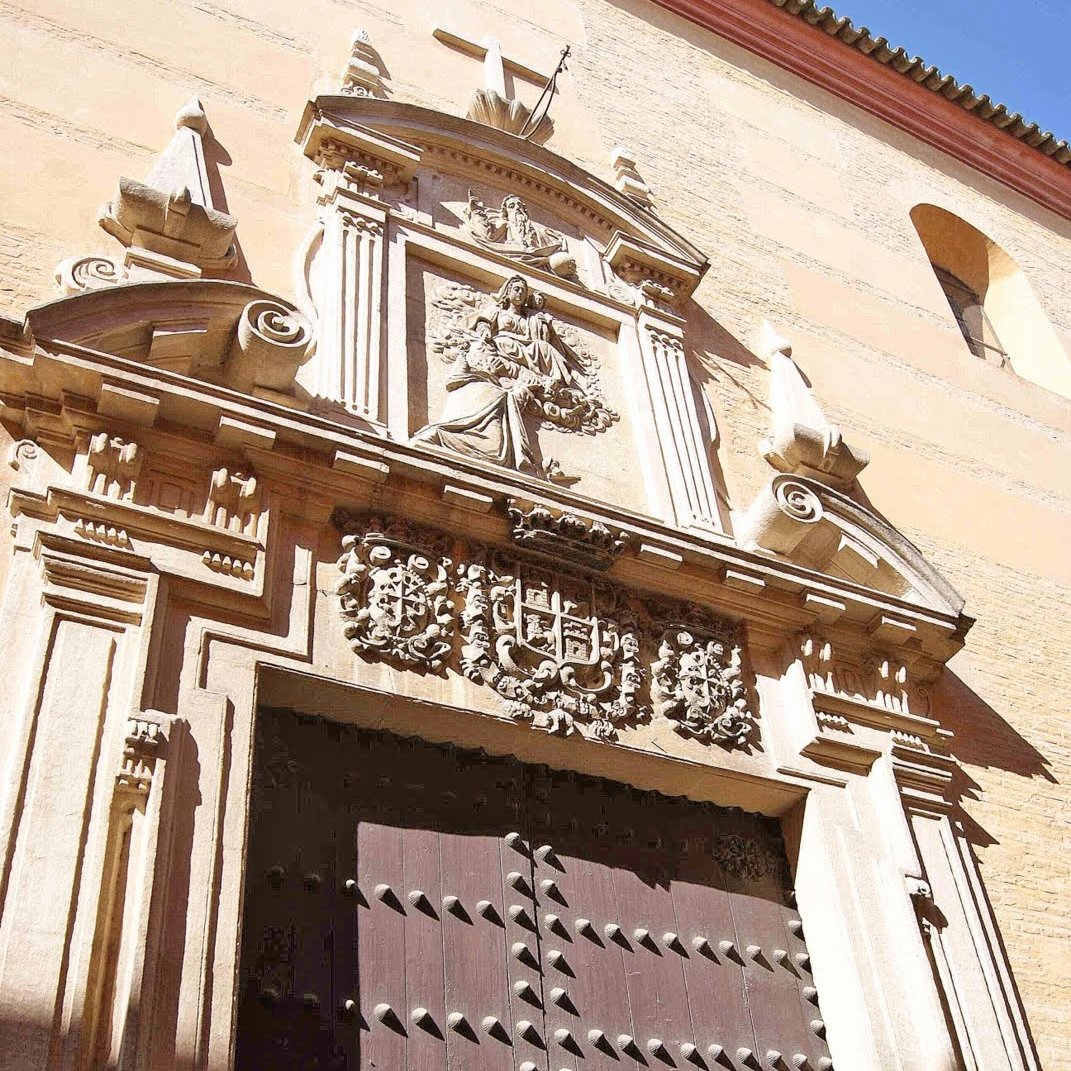
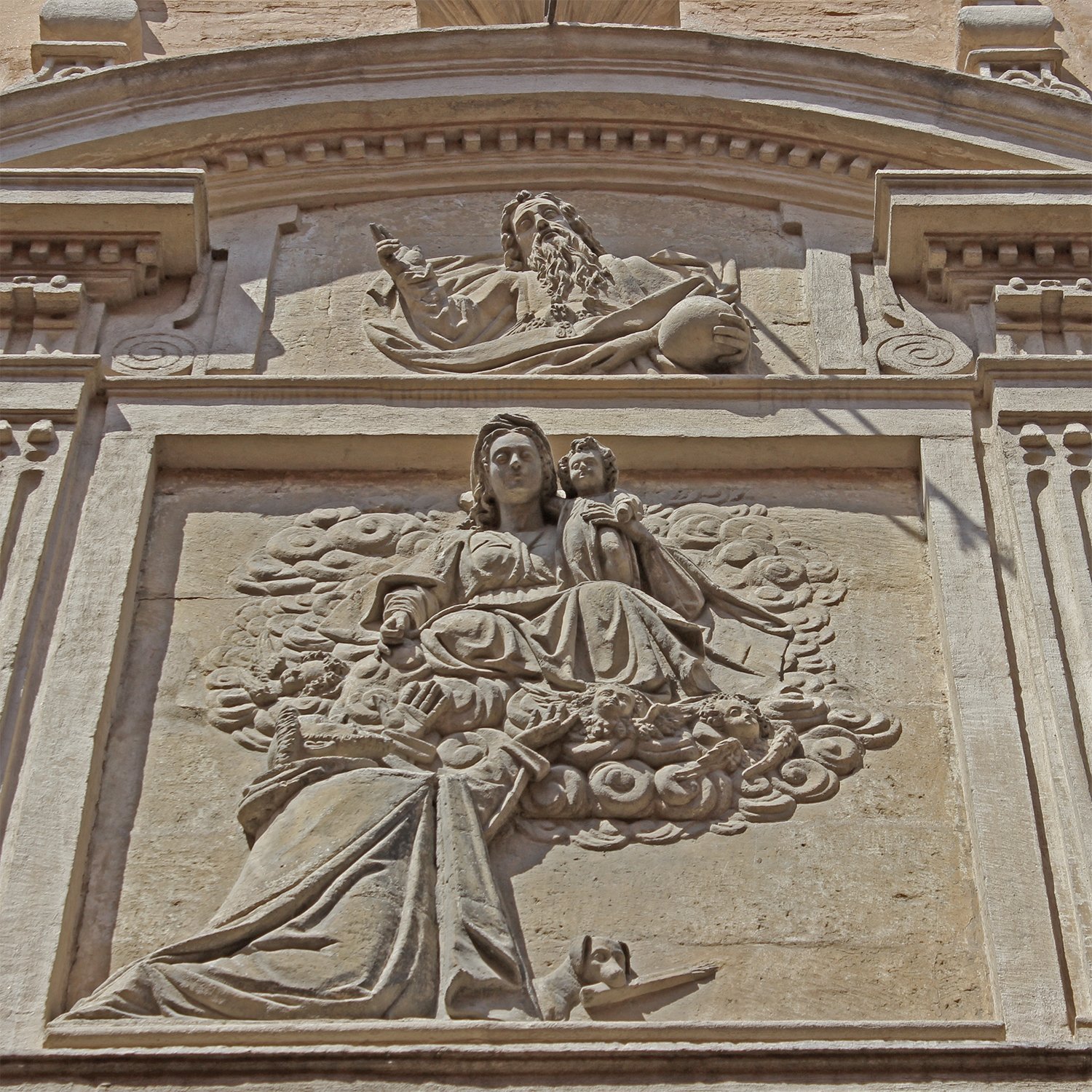
The façade is on the Gospel side, accessed through a late Renaissance doorway. The royal coat of arms appears on the lintel, flanked by that of the Dominicans, a symbol of the patronage of the Crown. In the central niche, we see a relief by Juan de Oviedo with a beautiful representation of the Virgin and Child giving a rosary to Saint Dominic de Guzmán, founder of the order. Next to it appears the iconographic element that traditionally identifies it: a dog holding a torch in its mouth. In the attic there is an image of God the Father in an attitude of blessing.

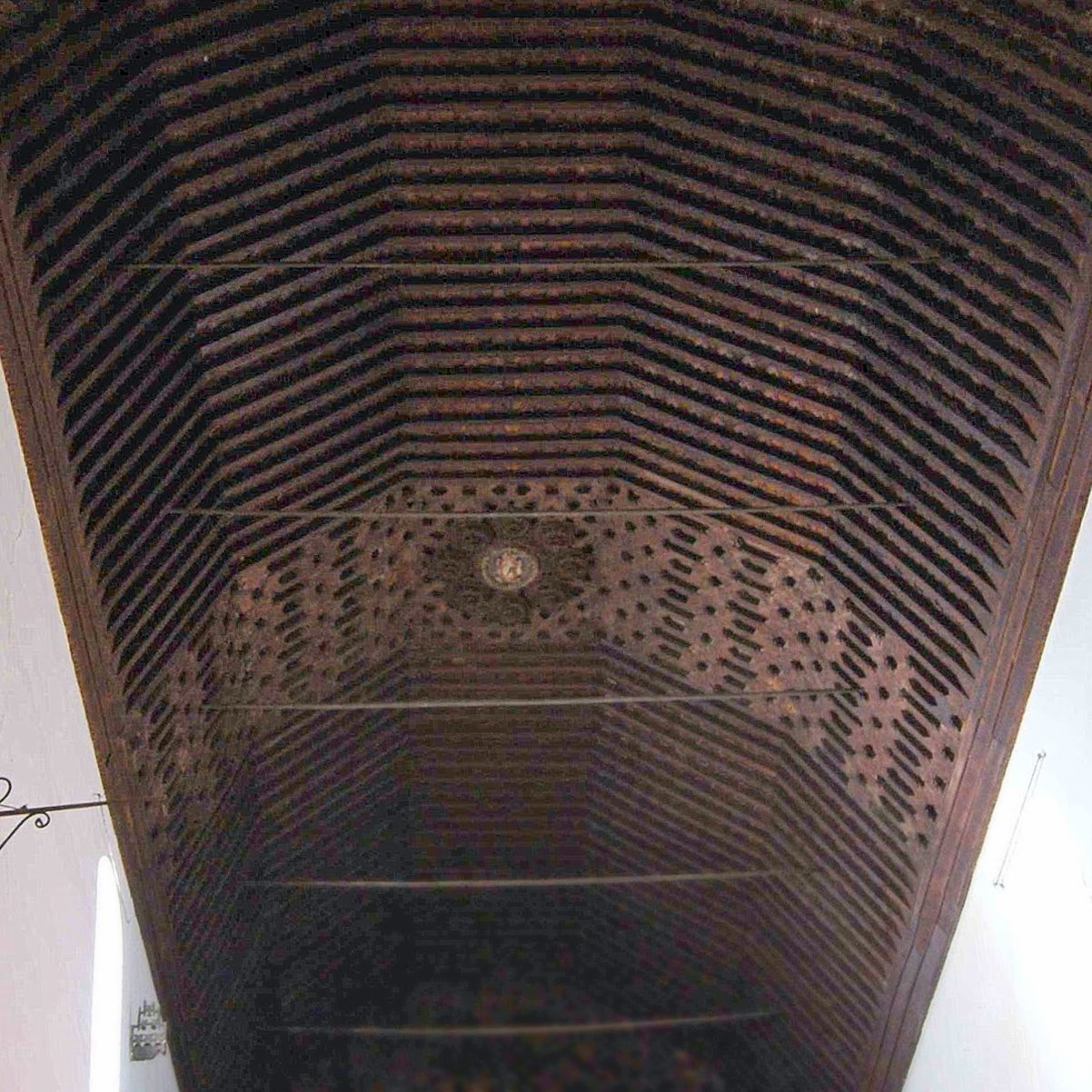
Inside, a large wooden coffered ceiling covers the nave, while a magnificent octagonal vault on tubes, also made of wood, covers the presbytery area. The nave and the presbytery are separated by a large, richly polychrome main arch, a very characteristic element of the Sevillian conventual churches as well.

In the church there are more than twenty burials, among which those of Hernán Cortes's wife, Juana de Zúñiga, and two of her daughters, which are found on the sides of the presbytery, stand out.

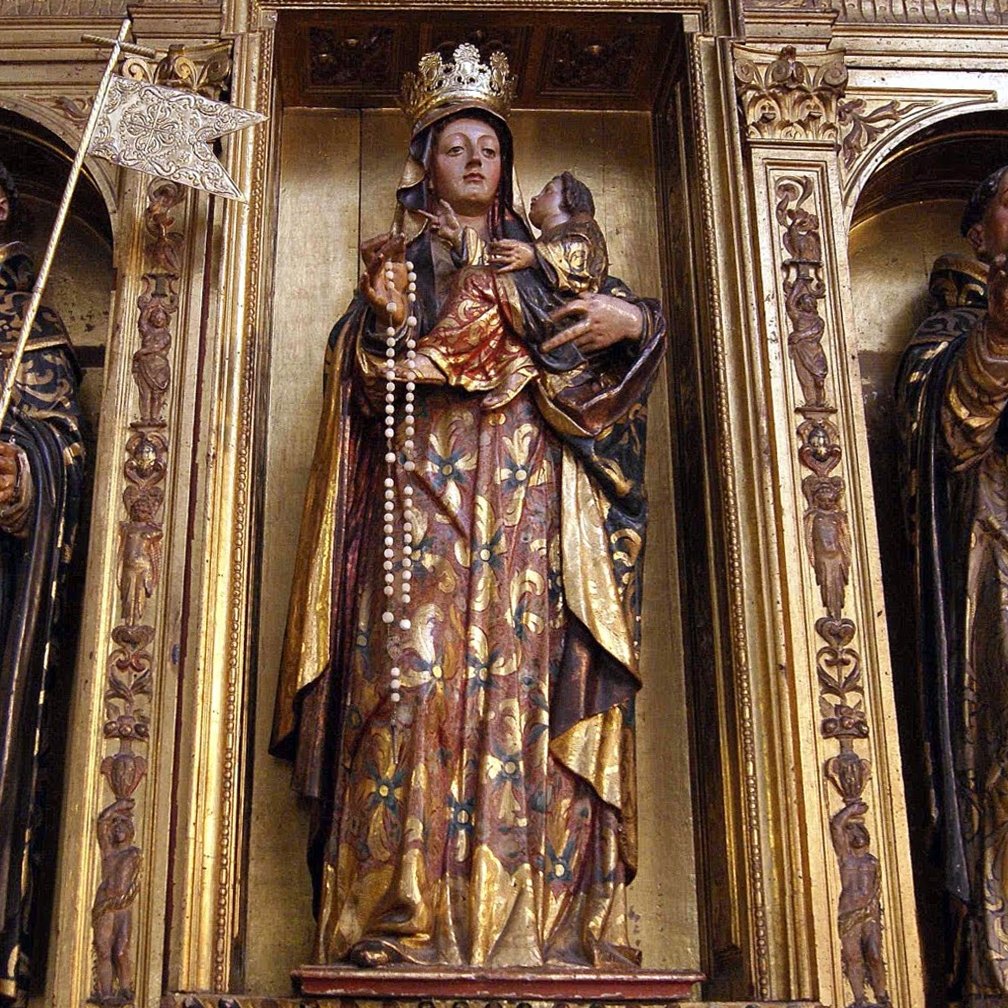
The main altarpiece is the work of Francisco de Barahona from the beginning of the 18th century, made to replace a previous one from the 16th century. Some images of Jerónimo Hernández were preserved from the original, such as the Virgin of the Rosary in the central niche, also called Madre de Dios de la Piedad.

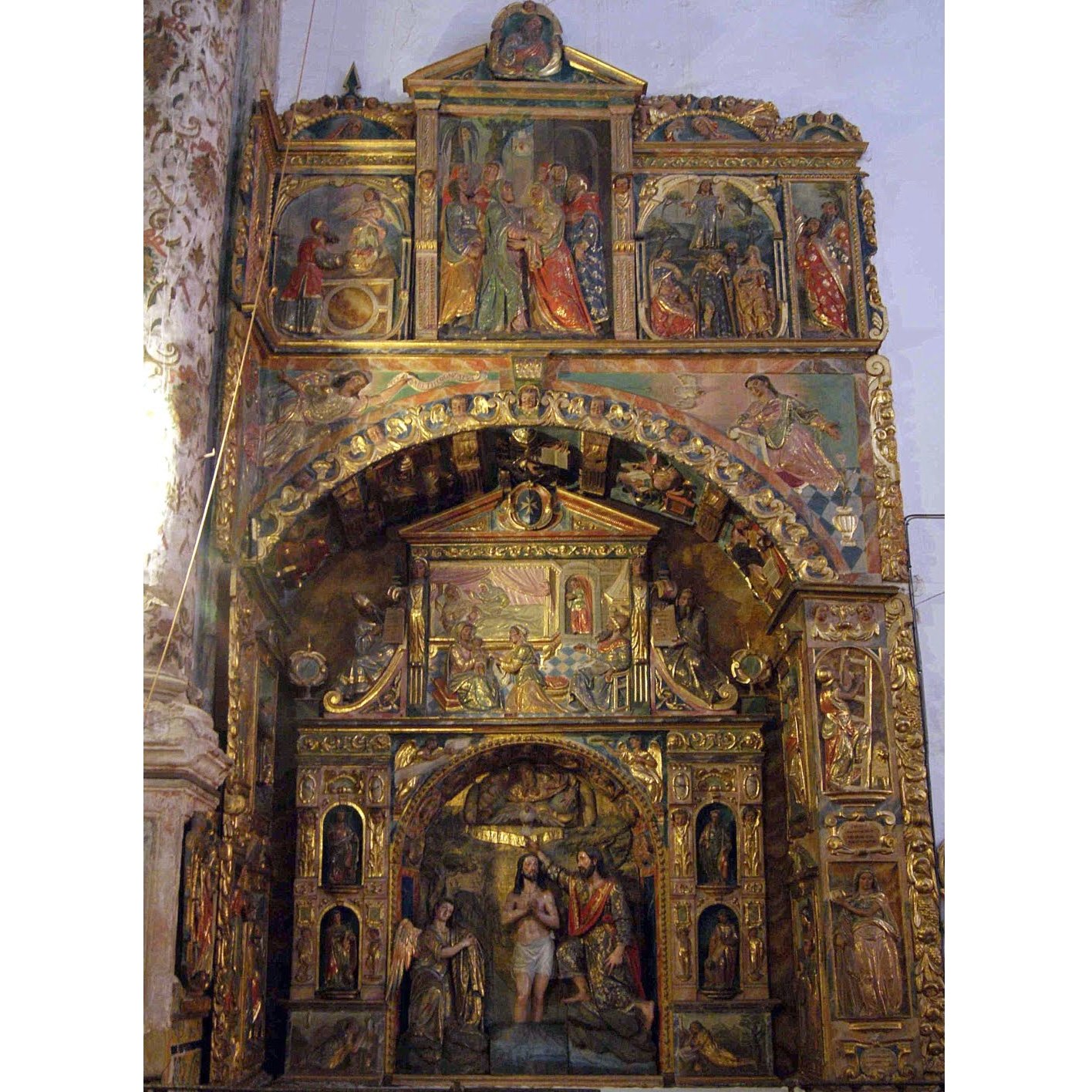
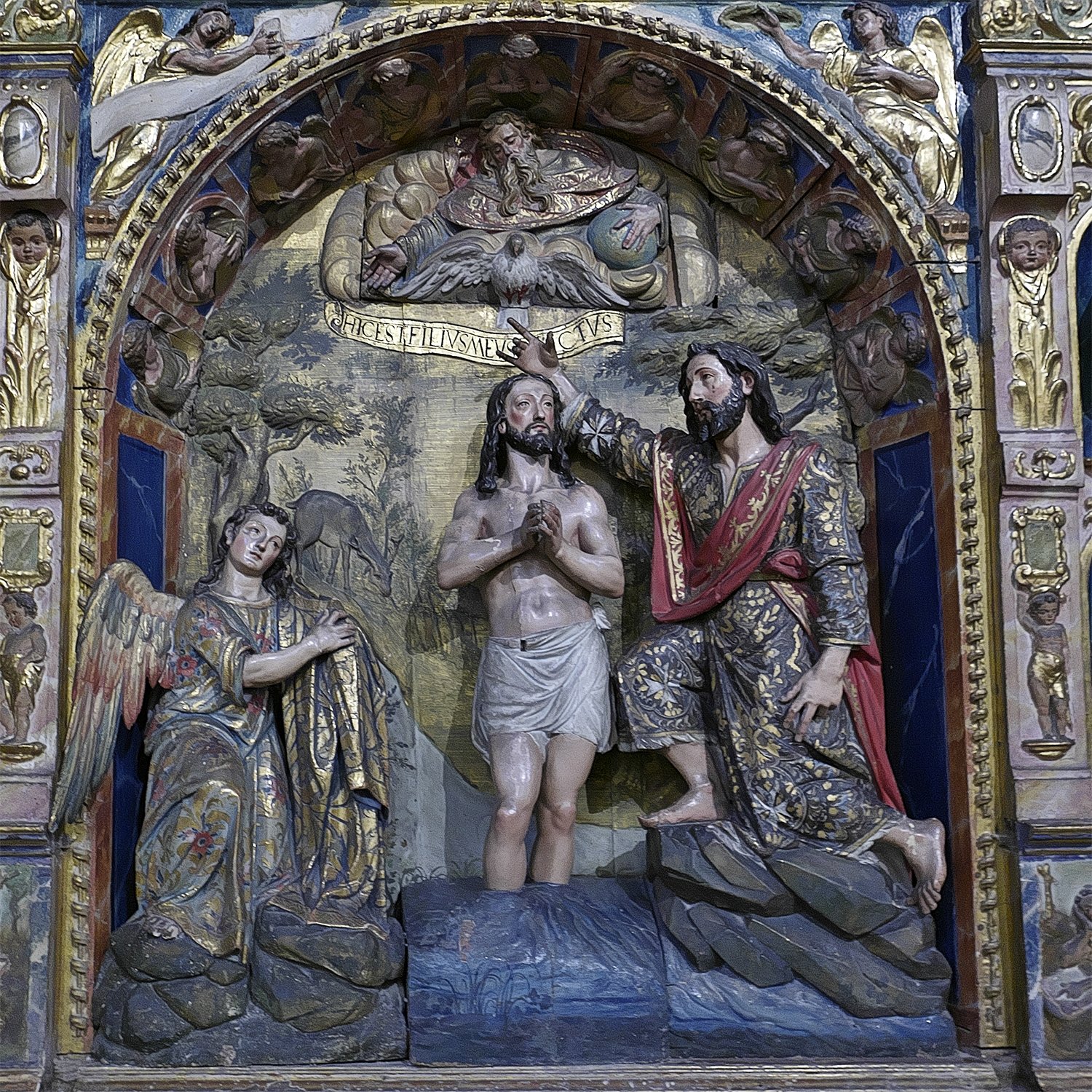
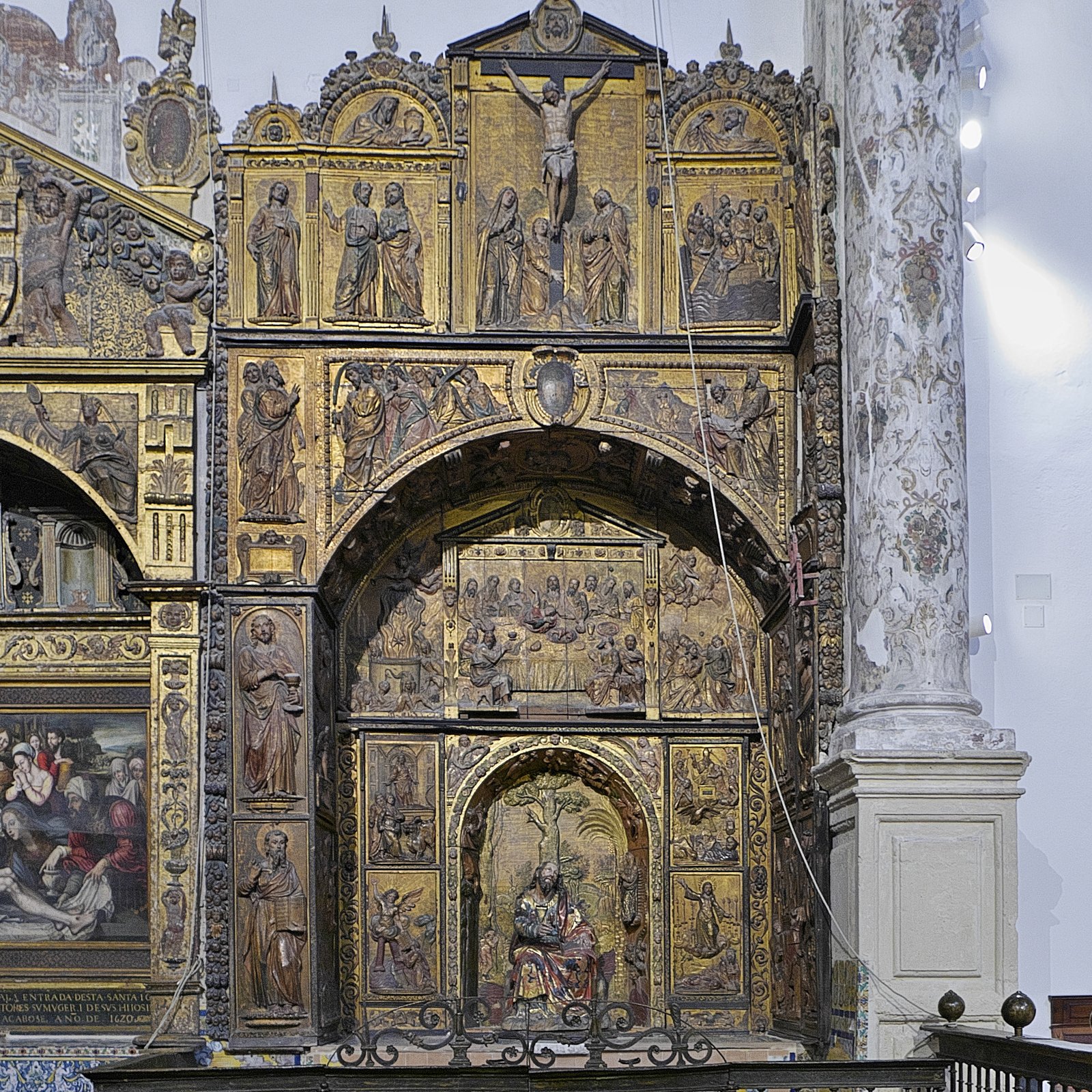
On each side of the presbytery there are two valuable Renaissance side altars from the second half of the 16th century. As usual in Sevillian convent churches, they are dedicated to the 'Santos Juanes', that is, to Saint John the Baptist and Saint John the Evangelist, both the work of the sculptor and altarpiece artist Miguel Adán. However, it was Jerónimo Hernández who carved the image of Saint John the Evangelist, whom he represents at the end of his life, on Patmos, the place where he wrote the Apocalypse. The one dedicated to San Juan Bautista is just opposite and has a very similar structure to the previous one. In its central niche, Miguel Adán represented the scene of the Baptism of Christ.

They are not the only Renaissance altarpieces that the church has.

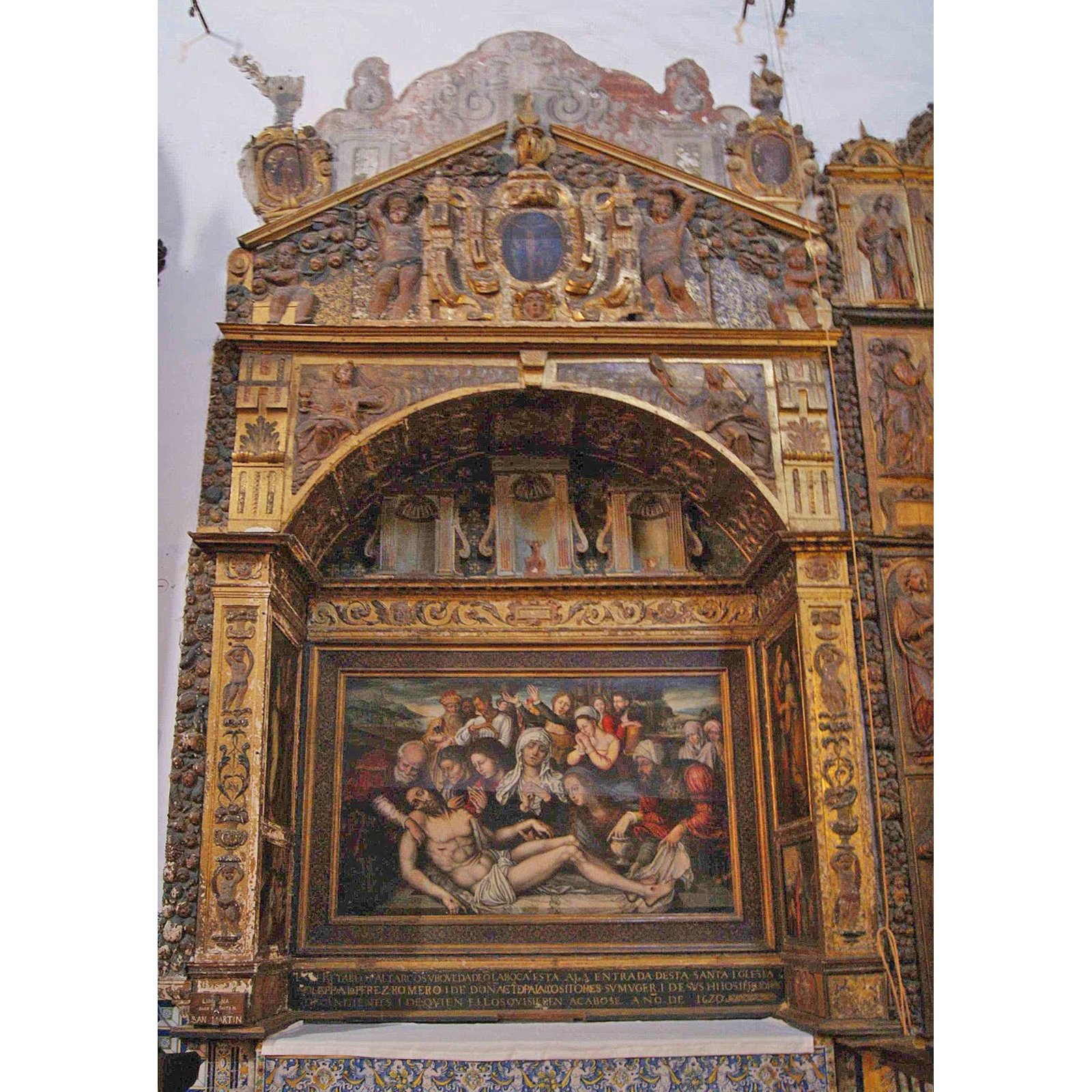
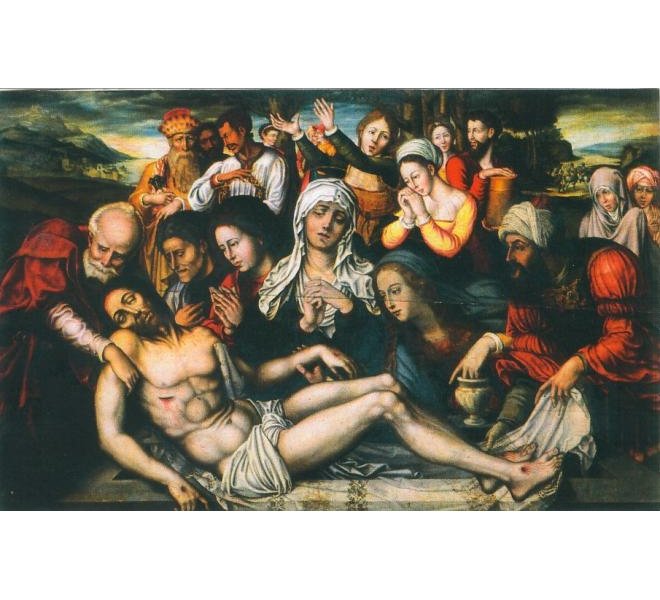
The one next to that of the Evangelist frames a beautiful panel painting with a Flemish-inspired Burial of Christ.

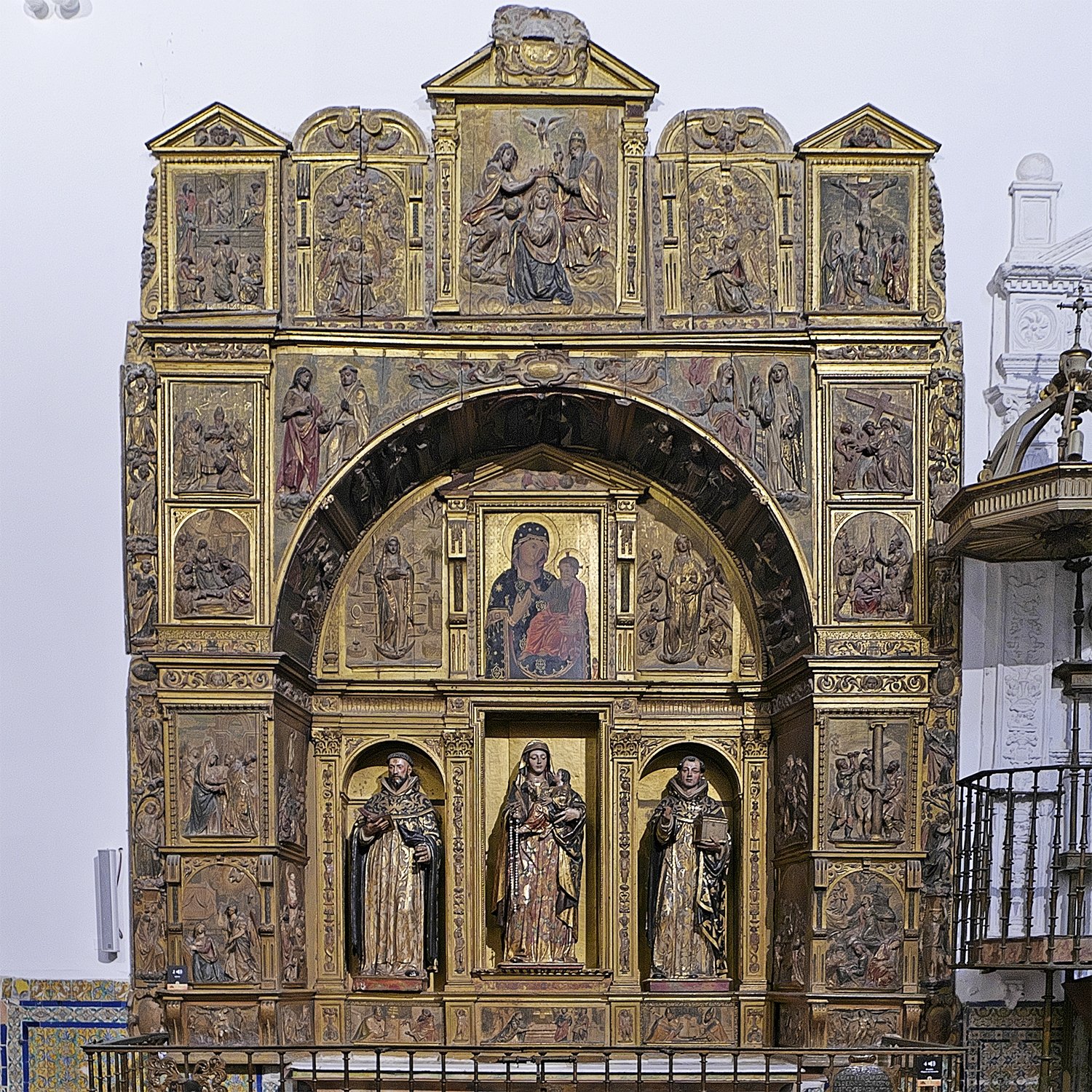
On the opposite side we find the altarpiece of the Virgen del Rosario, anonymous from the 16th century and of great quality. The image of the Virgin, in the center, appears flanked by Santo Domingo and Santo Tomás, while the rest of the altarpiece has a series of reliefs with different scenes from the life of Christ and the Virgin.

In the upper and lower choir space of the church, the nuns have set up a museum space in which a series of high-quality artistic pieces are exhibited, mainly sculptures from the 16th and 17th centuries. To cite just a few of them, we can mention the Virgin and Child by Mercadante de Brittany, a Risen One by Jerónimo Hernández or a Calvary by Cristóbal Ramos.

With the entrance to the museum, you collaborate with the large expenses that the convent has to face for the maintenance of the property and its valuable artistic heritage.

❋ : Leyendas de Sevilla     ✧ : Wikimedia Commons     ✢ : Archidiócesis de Sevilla


CONVENT OF LA ENCARNACIÓN

This convent was built at the end of the 14th century as Hospital de Santa Marta, a name by which many Sevillians still know it. At the end of the 19th century it became a convent, when the community of Augustinian nuns who occupied the original convent of La Encarnación, which was located in the square of the same name ('las Setas'), moved here.

What remains of the Hospital was the chapel, which became a convent church after the arrival of the nuns. It has a single nave and its presbytery stands out, which has the traditional square shape of the Islamic and Mudejar 'qubbas', covered by a vault with eight panels on tubes. The rest of the church is covered with a Gothic ribbed vault, supported on four interesting corbels with the symbols of the evangelists.

With the reconditioning of the 19th century, some reforms were made to the old hospital. It was then that the door leading to the Plaza Virgen de los Reyes was opened, the choirs were built and the vault was fitted with a lantern.

The main altarpiece was formed with sculptures from the disappeared convent, made around 1675 and by an anonymous author. From there come the group of the Incarnation or Annunciation that is located in the central niche and the two 'Santos Juanes' on the sides (San Juan Evangelista and San Juan Bautista). The presence of these two saints in the conventual churches of the city was a constant throughout the Modern Age. In the attic there is a small image of Santa Marta, of a different authorship and that would probably already be in the church before the arrival of the Augustinians.

On the sides of the main altar there are two neoclassical altarpieces from the 19th century, not of great artistic quality. In them and throughout the rest of the church a series of saints from the 18th and 19th centuries are distributed.

[mapsmarker map="2"  lat="37.385916" lng="-5.992040" zoom="18" height="300" heightunit="px"]