ROMAN COLUMNS ON “CALLE MÁRMOLES”

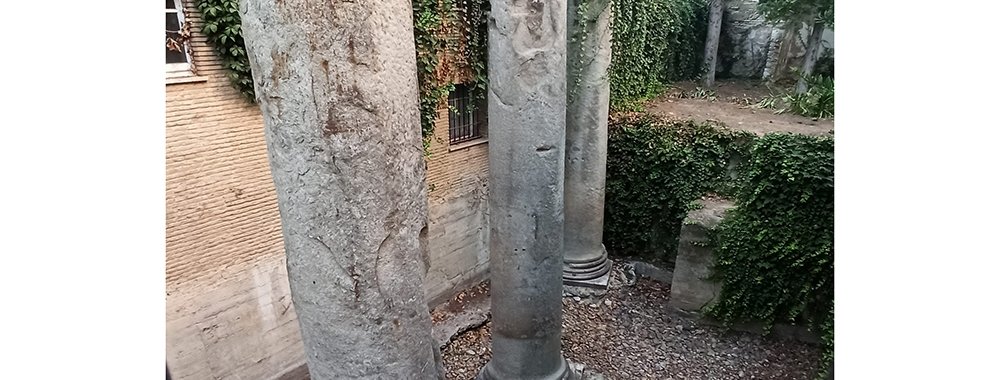
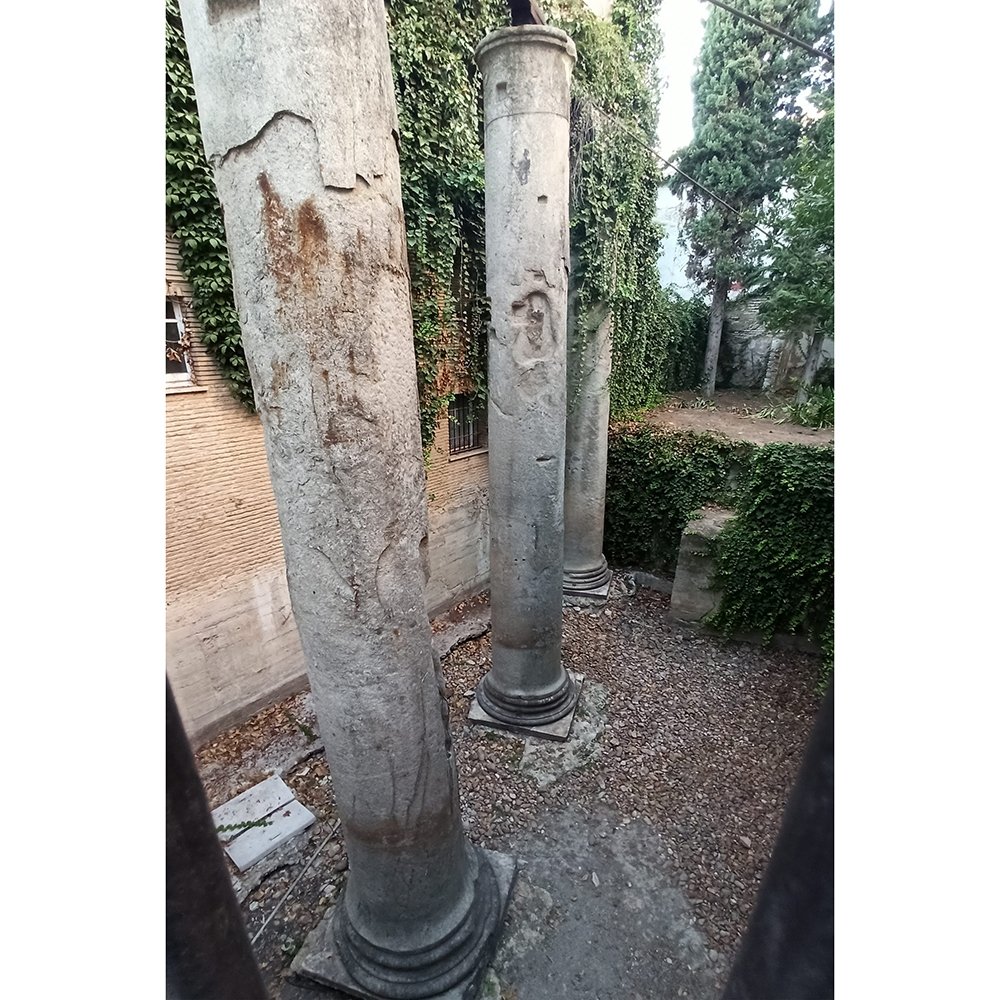
In a plot of land at the beginning of Calle Mármoles, three Roman columns are preserved, aligned in a northwest-southeast direction. They are at their original level, which means that they are about 4.50 metres below the current level of the city. Traditionally, they were identified with the mythical columns that Hercules erected to mark the place where Seville would be located. Today, they are usually dated to the 2nd century AD and it is believed that they could have formed part of the portico of a temple.

Its granite shafts are about 8 metres high and two of its bases are in the Attic style, while the third is Ionic.

For a long time there were three more columns in the same place. One of them broke when it was being moved to the Alcázar in the time of Pedro I. The whereabouts of its remains are currently unknown. The other two were moved to the Alameda in the 16th century to serve as supports for the statues of Hercules and Julius Caesar, in what was one of the first landscaping projects for a public space in Europe. They remain there today.

It is not known for certain which building the columns originally belonged to, although the Andalusian Institute of Historical Heritage states:

"Assuming that the six columns were from the façade, we can think that it would be a hexastyle and prostyle temple, with a front of about 20 metres and a depth of about 40 metres, which seems to be revealed by the current plot. In this we observe how the south side in the direction of San Nicolás has been perpetuated by Mármoles Street, while the north is drawn by the bottom of Gandesa Alley and another alley, now non-existent, which was located on Abades Street, penetrating right up to the supposed side of the temple. (…)

As for its chronology, the ceramic material found points to the end of the 1st century or beginning of the 2nd century AD. The Roman Republican level under the pavement was of little power, perhaps due to the construction of the temple that would cause its disappearance."

DUCK FOUNTAIN

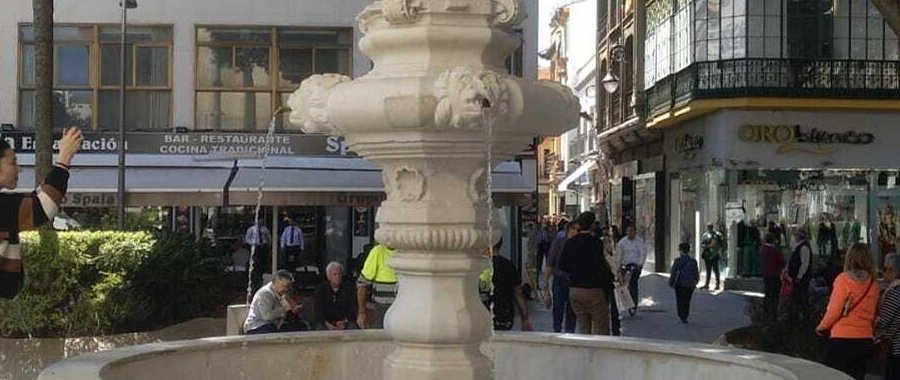
Located in the Plaza de San Leandro, this fountain is known as the Pila del Pato (Duck Fountain) because of the bronze spout in the shape of this bird that crowns it. It is made up of three vessels of decreasing size, all of them circular in section. The second and third vessels are supported by baluster-shaped shafts. In the central vessel there are four zoomorphic masks that serve to pour the water.

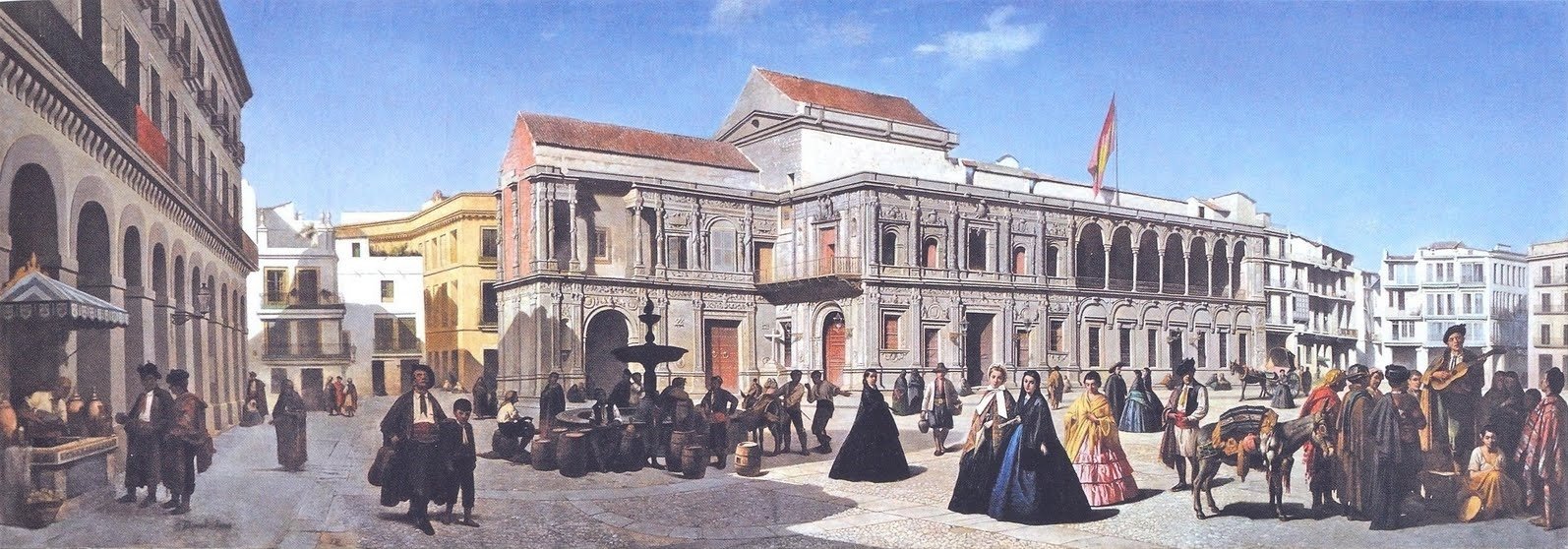
The fountain has been in its current location since the mid-twentieth century, but it is not the place for which it was conceived. In fact, it has occupied various locations in various parts of the city.

In 1850 it was located in the Plaza de San Francisco, in the place where the Fountain of Mercury is today. It remained there only for a few years, since in 1855 it was moved to the northern end of the Alameda de Hércules, near where the monument to the Niña de los Peines is located. From there it was moved to the vicinity of the Prado de San Sebastián, close to the Courthouse building. Its next location would be the Plaza de las Mercedarias, in the San Bartolomé neighborhood, from where it was moved to its current location in 1965.

It is likely that some elements from the previous Fountain of Mercury that it replaced were used to build the fountain in 1850. This was designed by Juan Fernández Iglesias at the beginning of the 18th century.


* Wikimedia Commons

Painting from around 1850 where you can see the Duck Fountain (Pila del Pato) in its original location, at one end of the Plaza de San Francisco

CALLIOPE FOUNTAIN

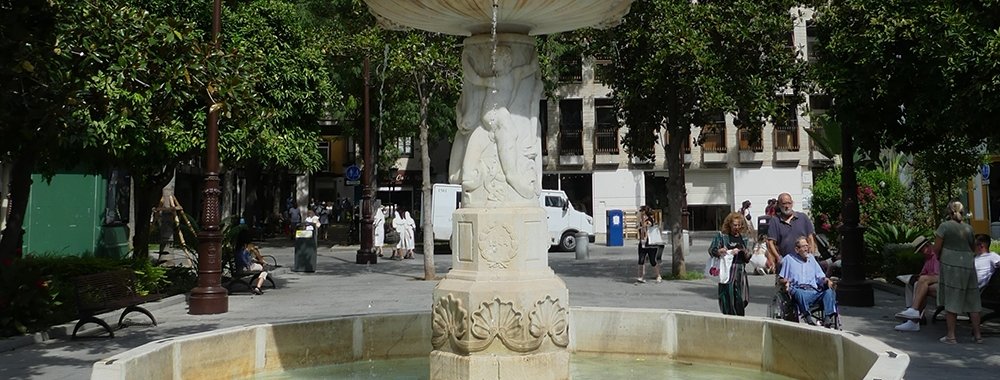
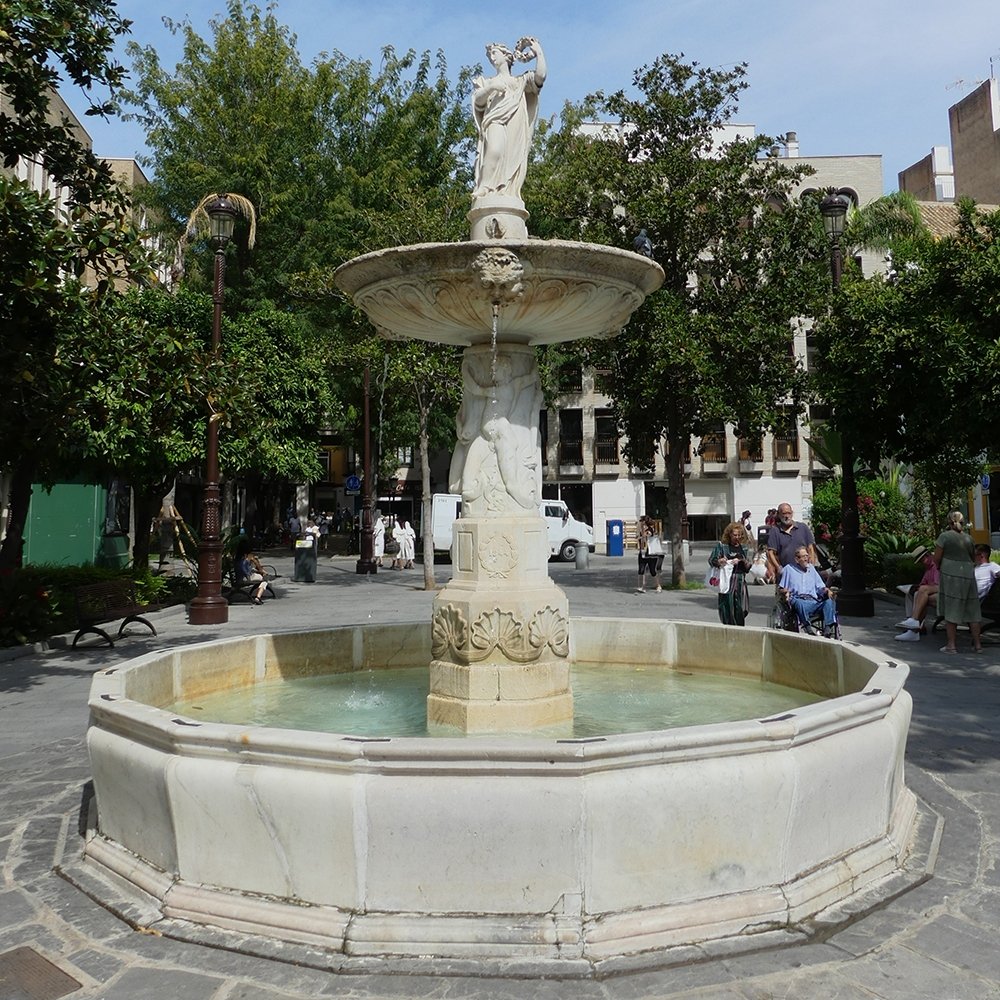
In the centre of the Plaza de la Magdalena there is a marble fountain from 1844, crowned by an 18th century sculpture representing the muse Calliope. The fountain is made up of a large polygonal vessel, in the centre of which there is a stem-shaft divided into two bodies by a second vessel, this time circular.

The first body of the shaft is decorated at its base with scallops, royal crowns, the symbol of the city (NO8DO) and the aforementioned date of the fountain's creation. In its cylindrical part there are several male mythological figures linked to the aquatic world (tritons). The circular vessel that supports this first body is ribbed and surrounded by four fountain masks through which the water falls to the sea of ​​the fountain.

Crowning the whole, we find a female sculpture holding a laurel wreath in her right hand. It could be the muse Calliope, protector of epic poetry and eloquence.

The square where the fountain is located was occupied by the primitive parish of La Magdalena, which today is located a few meters further west. This church was demolished in 1810, during the French occupation of the city. After the expulsion of the French, an attempt was made to rebuild the temple, but finally it was decided to open a square in its place, at which time the fountain was installed.

Elements from earlier sources were used for its construction. The main vessel comes from a fountain that was located in front of the Hospital de la Misericordia, in the current Plaza Zurbarán. It is probably of Italian origin and dates back to the Renaissance.

For its part, the first body of the central shaft and the circular vessel come from a mannerist fountain that was located in the Alameda in the 16th century. Finally, the female sculpture that tops the ensemble comes from the 18th century sculpture collection that the Archbishop's Palace of Umbrete held. A good part of the sculptures from this collection are now found decorating the Garden of Delights, in the south of the city.

This combination of origins gives the fountain a rather eclectic character, mixing the classicism of the Renaissance and the 18th century with the 19th century romanticism of the time when it was recomposed.

“Calliope, in Greek mythology, according to Hesiod’s Theogony, foremost of the nine Muses; she was later called the patron of epic poetry. At the behest of Zeus, the king of the gods, she judged the dispute between the goddesses Aphrodite and Persephone over Adonis. In most accounts she and King Oeagrus of Thrace were the parents of Orpheus, the lyre-playing hero. She was also loved by the god Apollo, by whom she had two sons, Hymen and Ialemus. Other versions present her as the mother of Rhesus, king of Thrace and a victim of the Trojan War; or as the mother of Linus the musician, inventor of melody and rhythm. Her image appears on the François Vase, made by the potter Ergotimos about 570 bce.”

Britannica, The Editors of Encyclopaedia. "Calliope". Encyclopedia Britannica, 1 Dec. 2023, https://www.britannica.com/topic/Calliope-Greek-Muse


* Wikimedia Commons

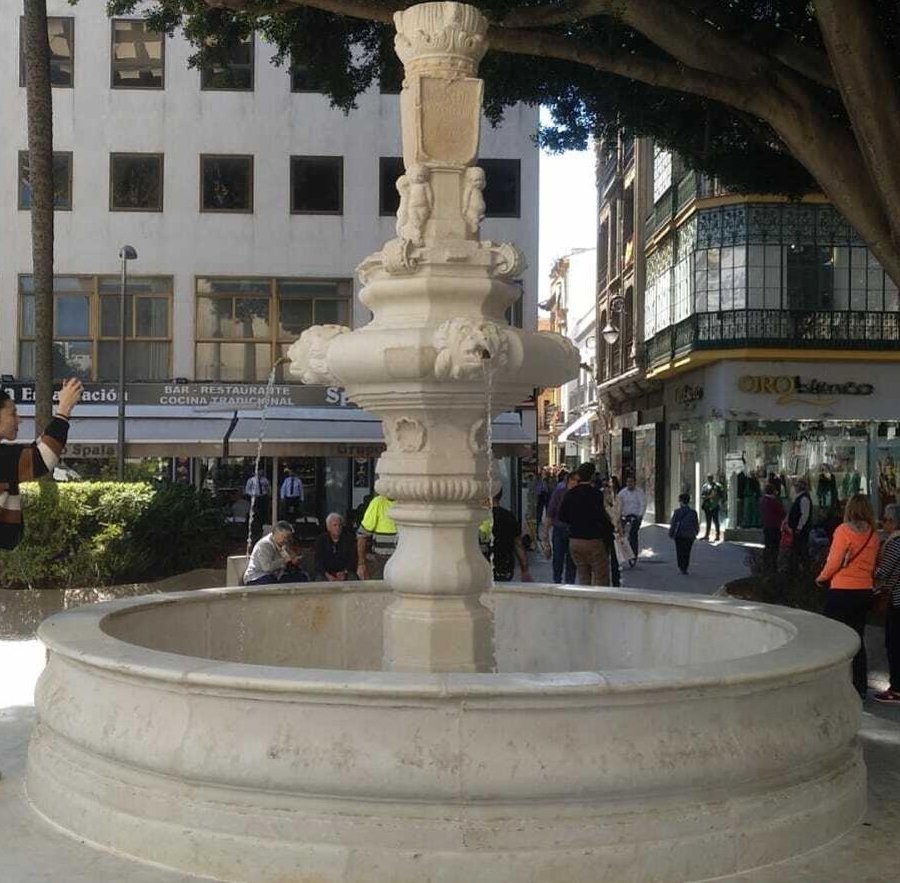
FOUNTAIN IN THE PLAZA DE LA ENCARNACIÓN

In the Plaza de la Encarnación there is an original marble fountain from the 18th century, considered the oldest of those preserved in Seville. It is made up of a large circular section vessel, in the centre of which stands a baroque-shaped fountain-shaft. In the middle there are some sort of zoomorphic masks that pour out the water, probably representing the four mythical rivers that watered the original Paradise. Crowning the fountain, four little angels hold a four-sided shield on which there are inscriptions narrating the various events in the history of the monument.

The square where it stands today was the site of the former Convent of the Augustinian nuns of the Encarnación since the end of the 16th century. The fountain was placed around 1720 in a small square at the entrance to this convent. It had a practical function, as it was one of the points through which the water that reached the city through the Caños de Carmona was dispensed.

In 1811, during the French occupation, the convent was demolished and, years later, it was decided to build a food market in the same place. The fountain then moved to a space next to the new market. A century later, around 1948, an urban remodelling of the area took place and the fountain was moved to its current location.

The fountain was built in the Baroque style, but, as it has come down to us, it includes some neoclassical elements, probably added in a restoration in 1861.


* Diario de Sevilla

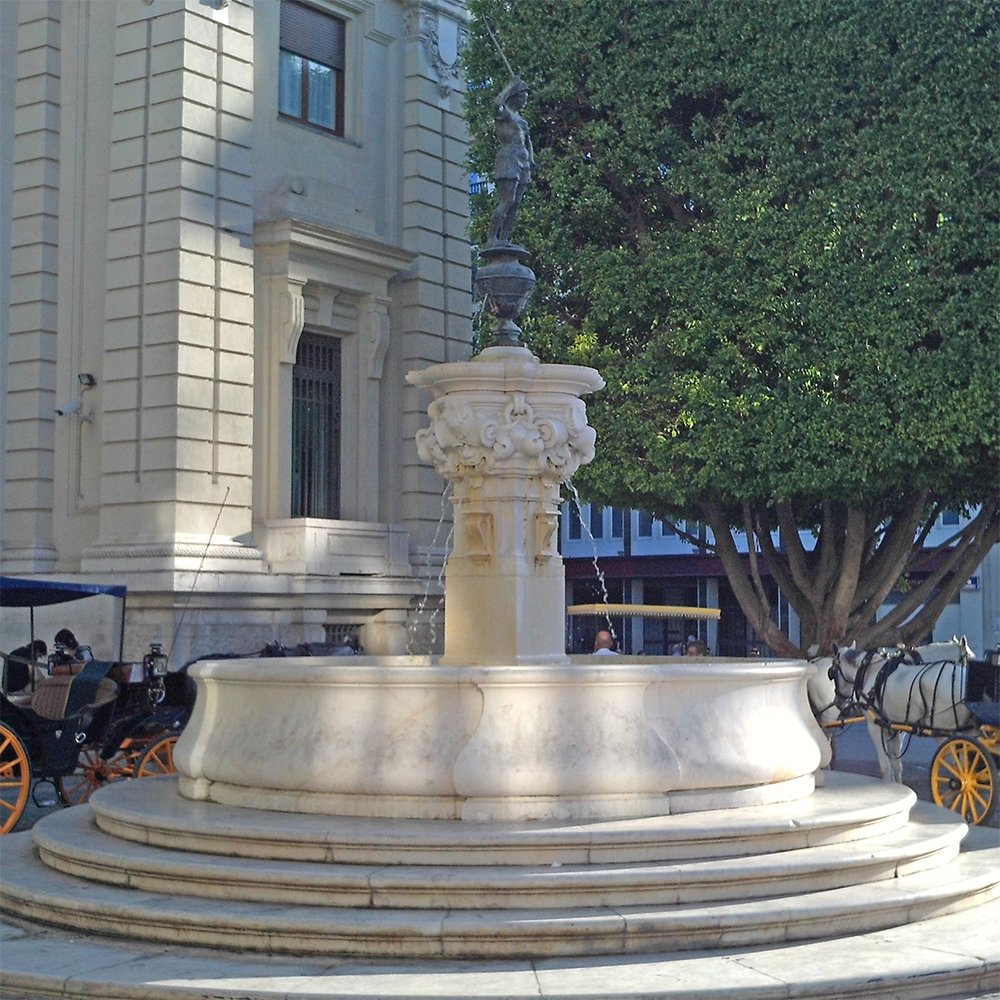
FOUNTAIN OF THE GOD MERCURY

Located at one end of Plaza de San Francisco, opposite the main façade of the Bank of Spain, we find a fountain dedicated to the god Mercury. It has a circular basin raised on four steps, in the centre of which there is a pillar with neo-baroque decoration. On each of its sides there are "masks" that pour jets of water onto the sea of ​​the fountain.

The bronze statue that crowns the fountain represents Mercury, the Roman god of commerce, heir to the Greek Hermes. Specifically, due to its iconography, it can be said that it is a "Hermes Argifonte", since he holds a sword in one hand and a caduceus in the other, recalling the order he received from Zeus to kill the multi-eyed giant Argos Panoptes, who was watching the nymph Io in the sanctuary of Hera.

The fountain that we find today is the result of a reconstruction carried out by the architect Rafael Manzano in 1974. For its design he followed the model of a previous fountain that was in the same place, the work of Juan Fernández Iglesias. The statue of Mercury that we can still see today belonged to this 18th century fountain.

There was even a previous fountain in the same place and with the same theme, built around 1576 and in whose design Asensio de Maeda participated as architect and Diego de Pesquera as the author of Mercury. The sculpture was cast in bronze by Bartolomé Morel, who was also the founder of the "Giraldillo", the monumental weather vane that crowns the Giralda. This primitive fountain was destroyed during a disturbance in 1712.

It seems that there has been a fountain in this area at least since medieval times. In all likelihood it was not a monumental fountain but was intended to supply water to the residents.

The choice of Mercury as the theme of the fountain is related to the commercial splendour in which Seville lived, mainly after the Discovery of America, when the city became the "gateway and port of America", as its port was the only one authorised for commercial exchanges between Spain and the American territories.

In fact, it is not the only fountain dedicated to Mercury in the city. There is another one in the Gardens of the Alcázar. It was made by Diego de Pesquera and cast by Bartolomé Morel around 1576.


* Wikimedia Commons

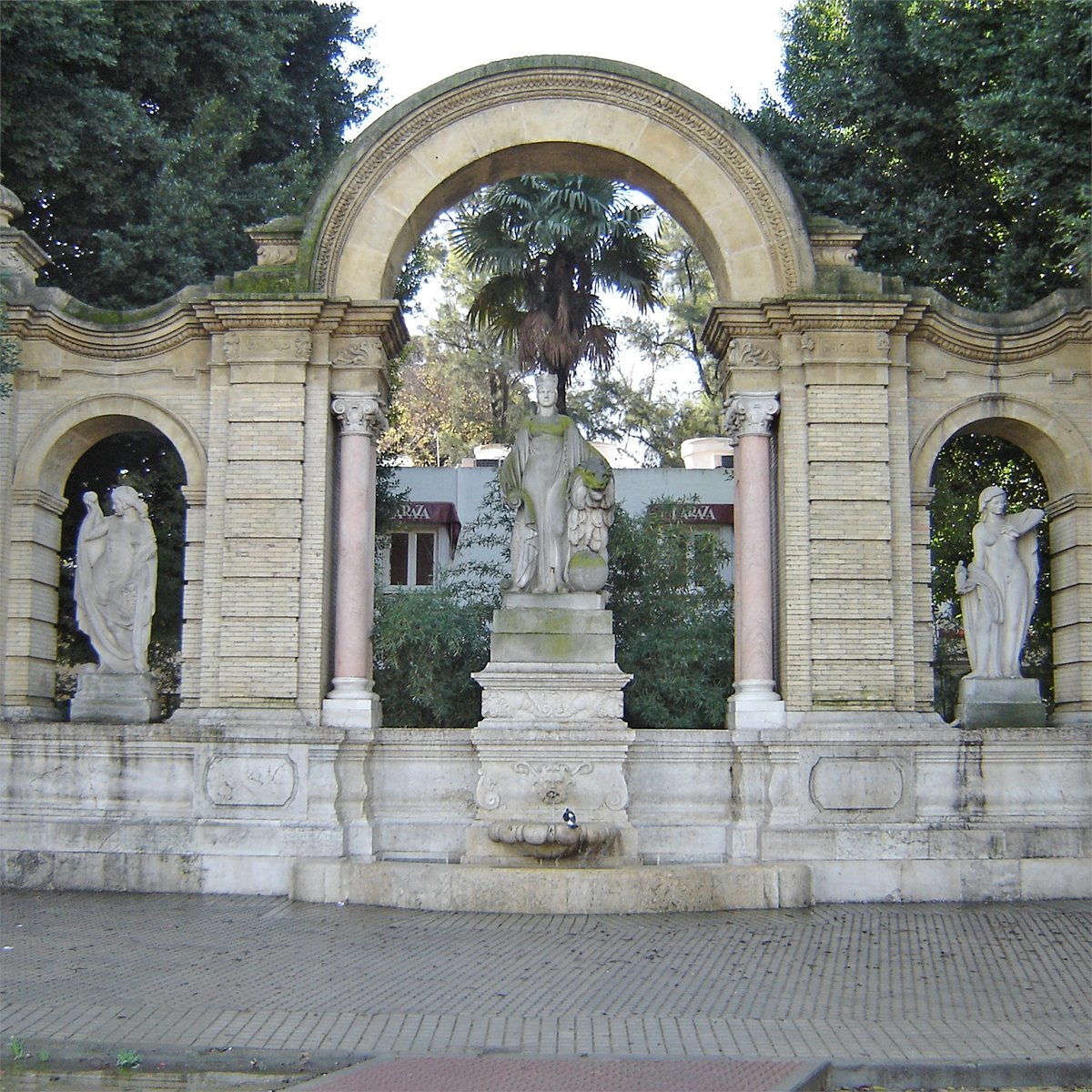
FOUNTAIN IN GLORIETA DE SAN DIEGO

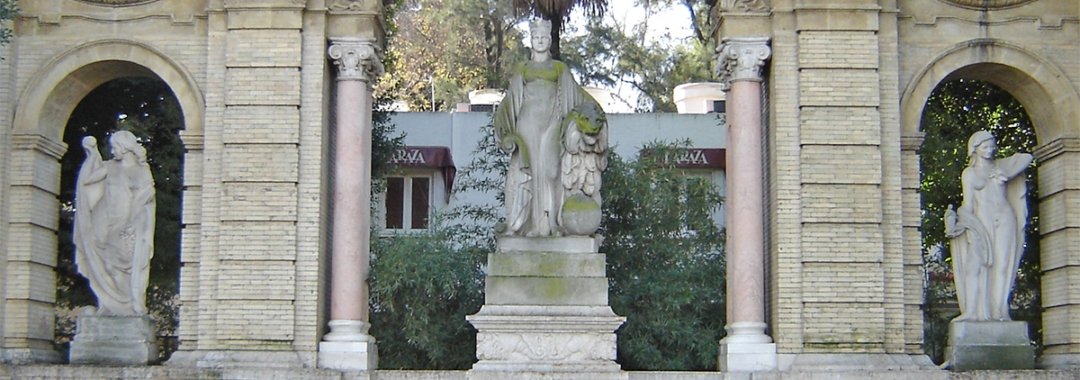
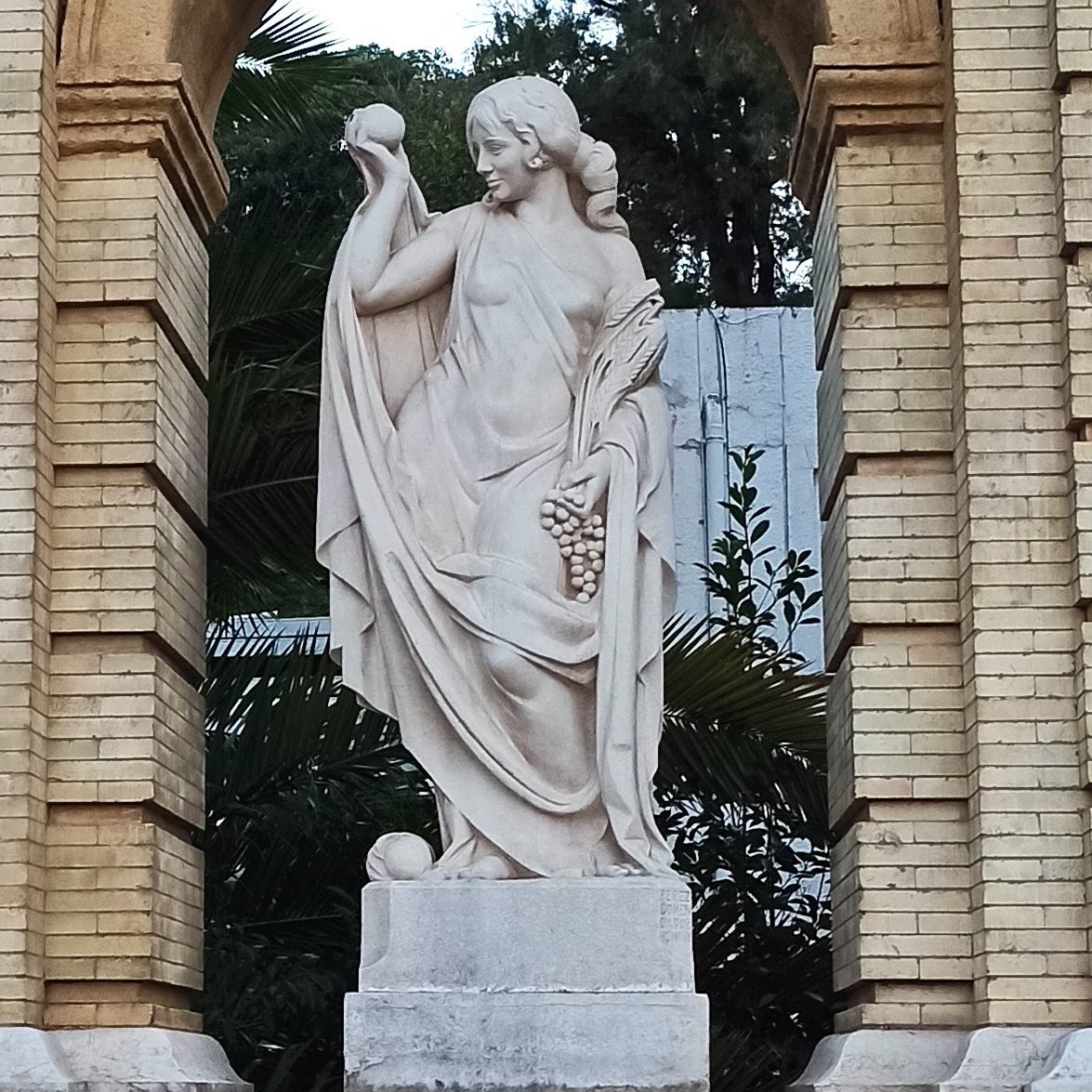
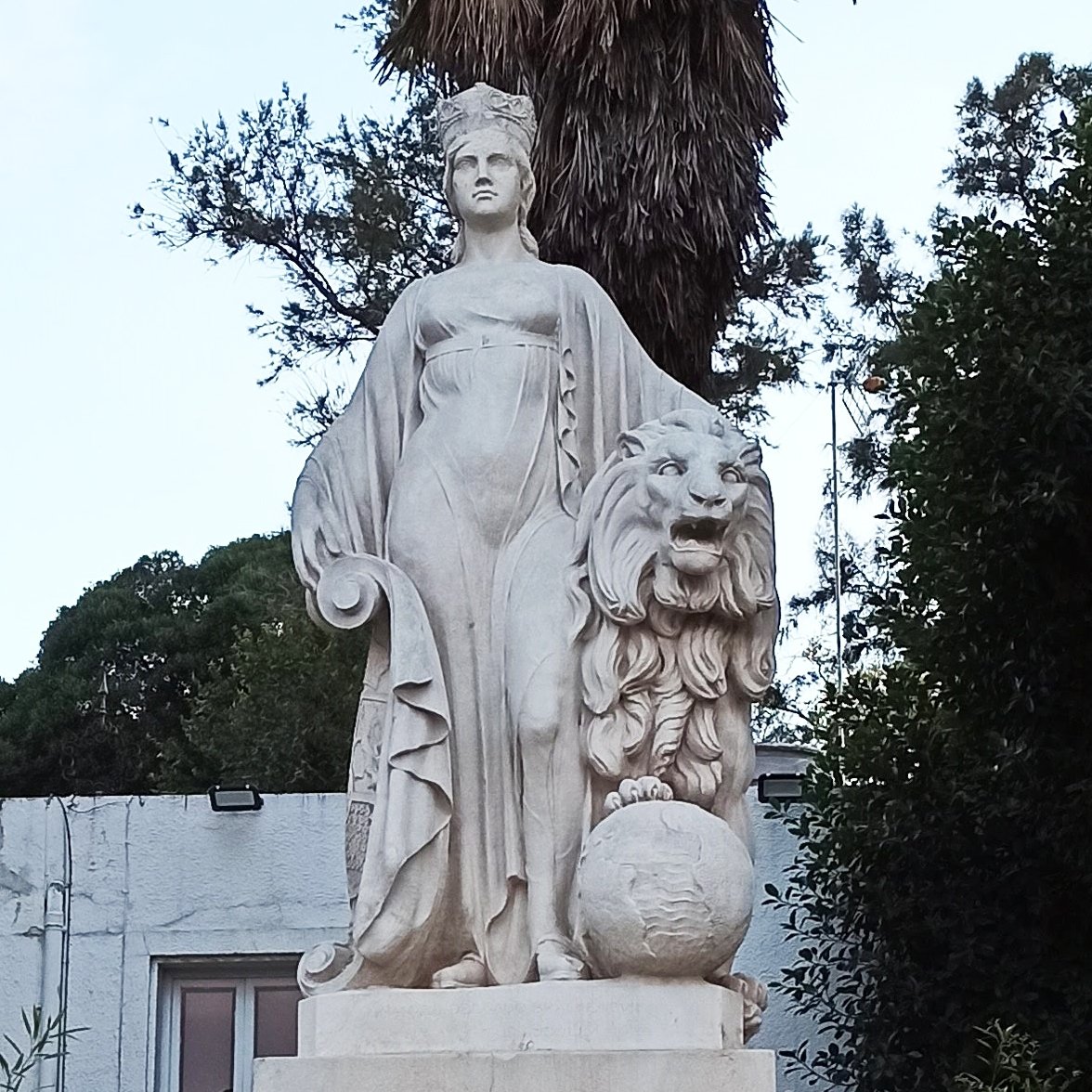
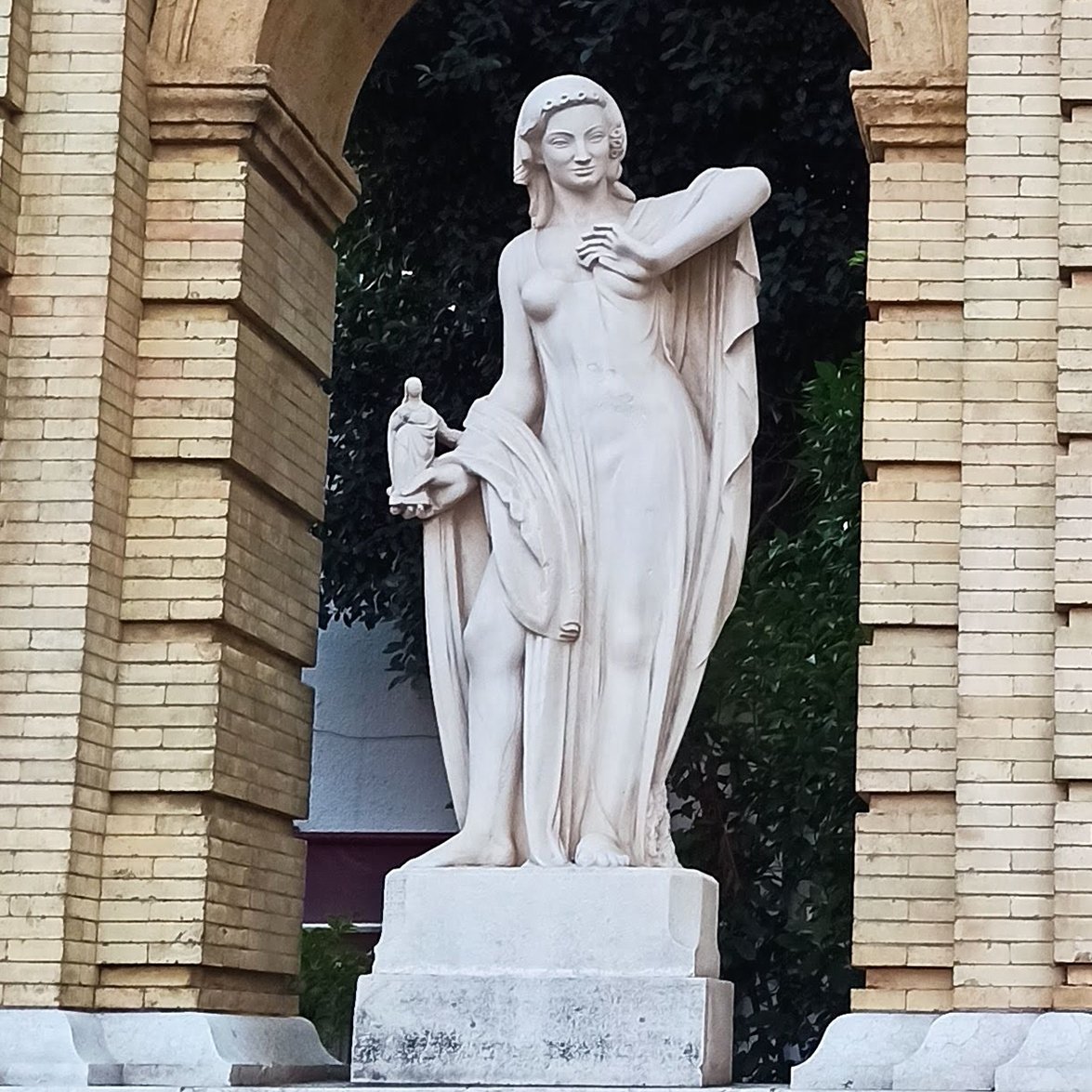
In the San Diego roundabout, at the northern end of the María Luisa Park, a structure in the shape of a triumphal arch is preserved with three openings that house the allegorical figures of Spain, in the center, and the city of Seville in its center. material and spiritual dimension, on both sides. The sculptures were made by Enrique Pérez Comendador and Manuel Delgado Brackenbury. In the central part of the plinth there is a fountain, whose spout, under the pedestal of the central sculpture, is a bearded character who spouts water from his mouth.

It was the central axis of the main entrance to the 1929 Ibero-American Exhibition site and was designed by the architect Vicente Través. The entrance actually had four doors, which faced the avenues of Portugal and Isabel la Católica on the left, and the avenue of María Luisa and the Seville Pavilion on the right.

This triumphal arch was conceived as the center of the monumental entrance to the exhibition site. In this way, the aforementioned allegories of Spain and Seville were placed, somehow symbolizing the welcome offered by the city and the nation as a whole.

Enrique Pérez Comendador, a young sculptor from Cáceres who was barely 28 years old at the time, was chosen to create the side sculptures. The work of this sculptor was quite prolific throughout his life, specializing above all in public monuments, since his style fit very well with the purpose of extolling the characters represented, by combining a realism of very classic forms with the simplification of the volumes and a renunciation of detail, which were considered to be typical of the “modern” style. He was always quite faithful to the academic opinions of the time in the execution of his works and showed a special ability to develop allegorical themes and the aggrandizement of heroic characters, so popular in official art during the Franco regime.

The artist called the two sculptures “The spiritual and material wealth of Seville”, although they were renamed in an article written by the poet Alejandro Collantes de Terán as “The sky and the earth of Seville” (el cielo y la tierra de Sevilla). These are two female figures with clear classical reminiscences, dressed in tunics that very clearly show the effect of wet cloths, so the round shapes of the bodies are perfectly visible.

The figure located to the viewer's left is the material wealth of Seville. His shapes are more rounded and he has more ease in his posture. He holds an orange raised in his right hand and in his left he holds a bunch of grapes and a bunch of ears of wheat, as symbols of the fertility of the earth. His face has an expression between mischievous and friendly, framed by semi-tied hair with a certain Andalusian air, as shown by the loose locks that form snails around his face.

The other figure is the one that represents the spiritual wealth of Seville. Her main attribute is a small Inmaculada with mountain features that she holds in her right hand. With it, reference is made to the fierce defense that the city always made of the dogma of the Immaculate Conception and in general to its profound Marian character. In this case, the allegorical figure shows a somewhat forced posture, with more rigid features and less naturalism, probably seeking greater solemnity. Her face is reminiscent of sculptures from the archaic period of Greek art, due to the lack of expressiveness and that characteristic frozen half smile. Although she also shows some little snails of hair around her forehead, most of her hair appears covered, surely as a sign of respect for the image she carries and what it symbolizes.

Both images flank a majestic allegory of Spain, the work of the Sevillian sculptor Manuel Delgado Brackenbury. His features are more naturalistic and classic than those of Pérez Comendador, although both coincide in the use of some stylistic resources, such as the use of the wet cloth technique to reveal the shapes of the body. The figure appears standing, with one leg slightly forward, in a posture that gives it great solemnity. He wears a tunic tight under the chest and over his collected hair he wears an open royal crown, a symbol of the Spanish monarchy. She rests her right arm on a large shield of Spain and her right arm on a lion, which in turn rests its paw on a globe, a symbol of Spanish sovereignty. It must be remembered that the lion and not the bull has been the animal that has most symbolized our country throughout its history, appearing profusely since the Middle Ages on a multitude of supports, such as coins, pictorial representations or architectural elements.
MONUMENT TO THE CID CAMPEADOR

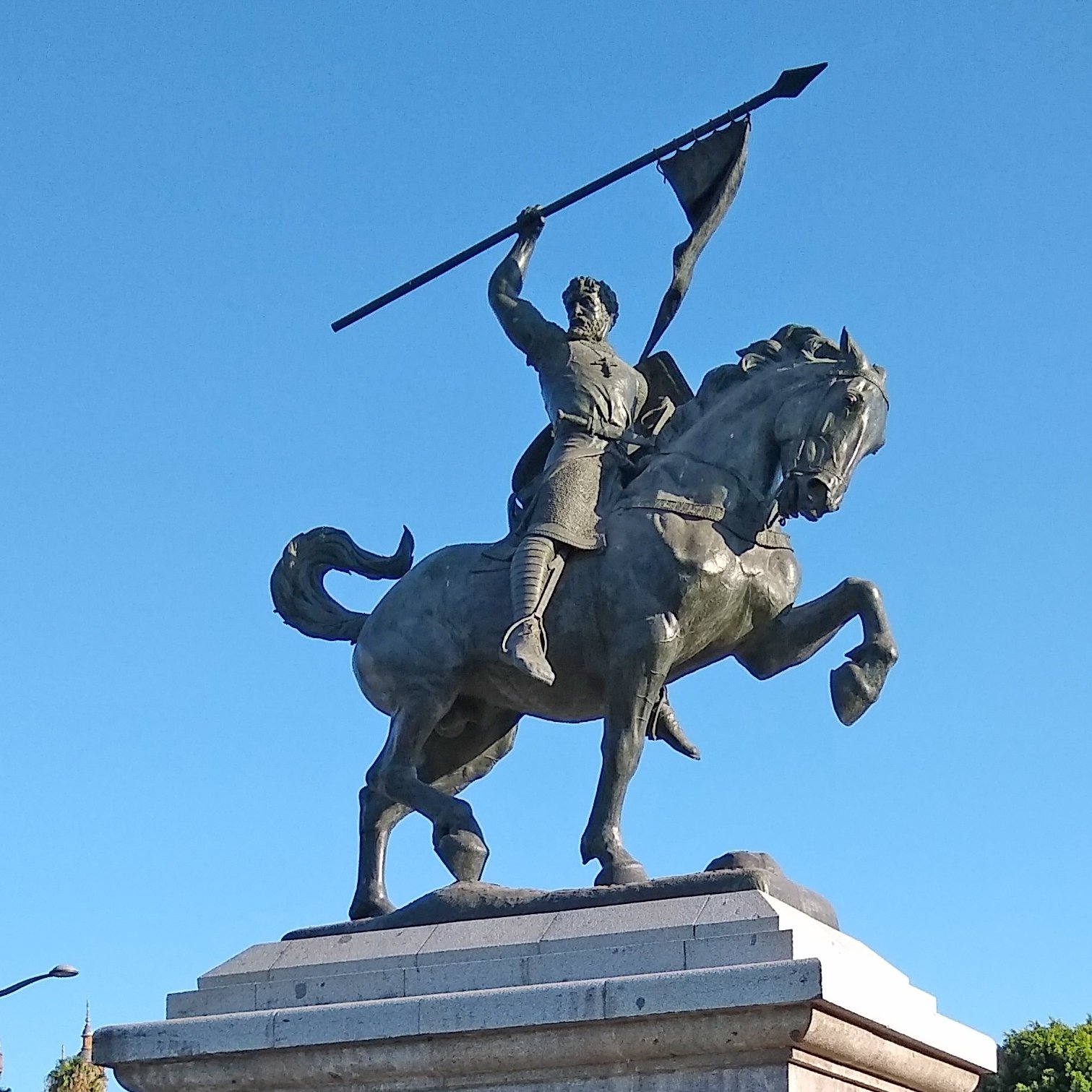
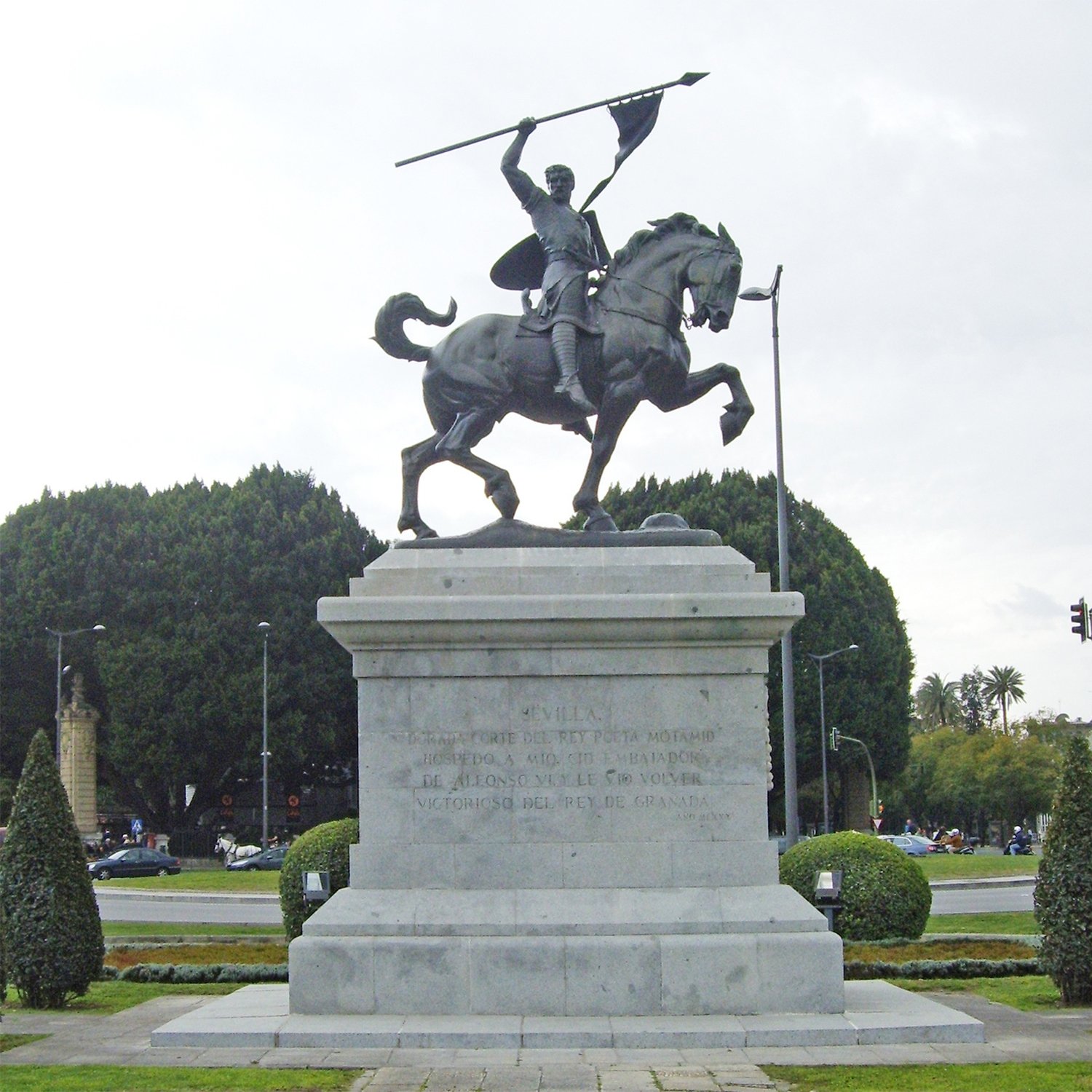
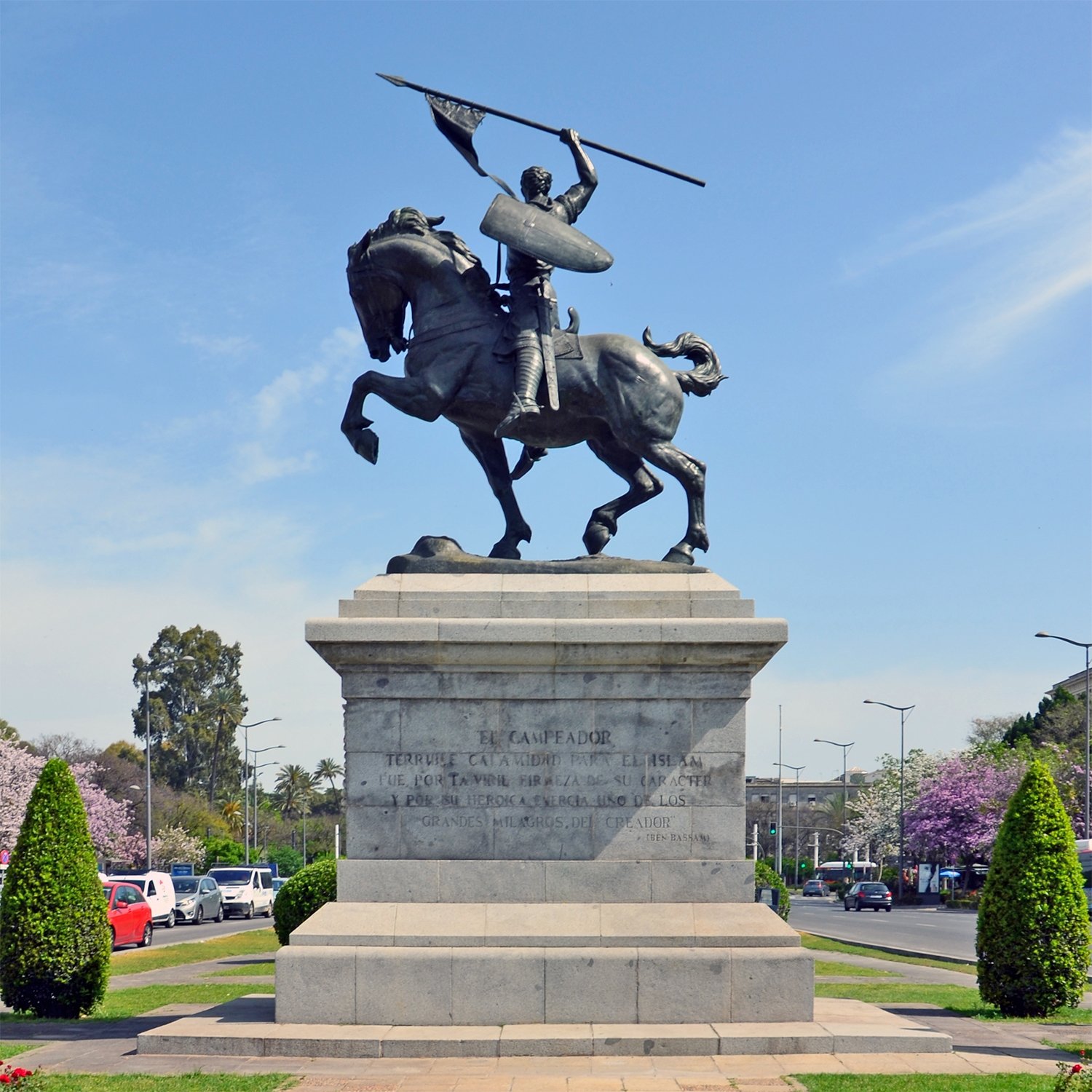
Located in the center of Avenida del Cid, it is an equestrian statue by the American artist Anne Hyatt Vaugh. It was a gift from the New York Hispanic Society to the city of Seville on the occasion of the celebration of the Ibero-American Exposition of 1929. In fact, it was decided to place it right in front of what was the main entrance to the venue, between the Portugal Pavilion and the old Tobacco Factory.

Its author stood out above all for her monumental bronze sculpture, frequently representing historical figures and specializing above all in the recreation of animals. In this field she achieved great mastery, especially with the figure of the horse, of which Huntington was truly in love.

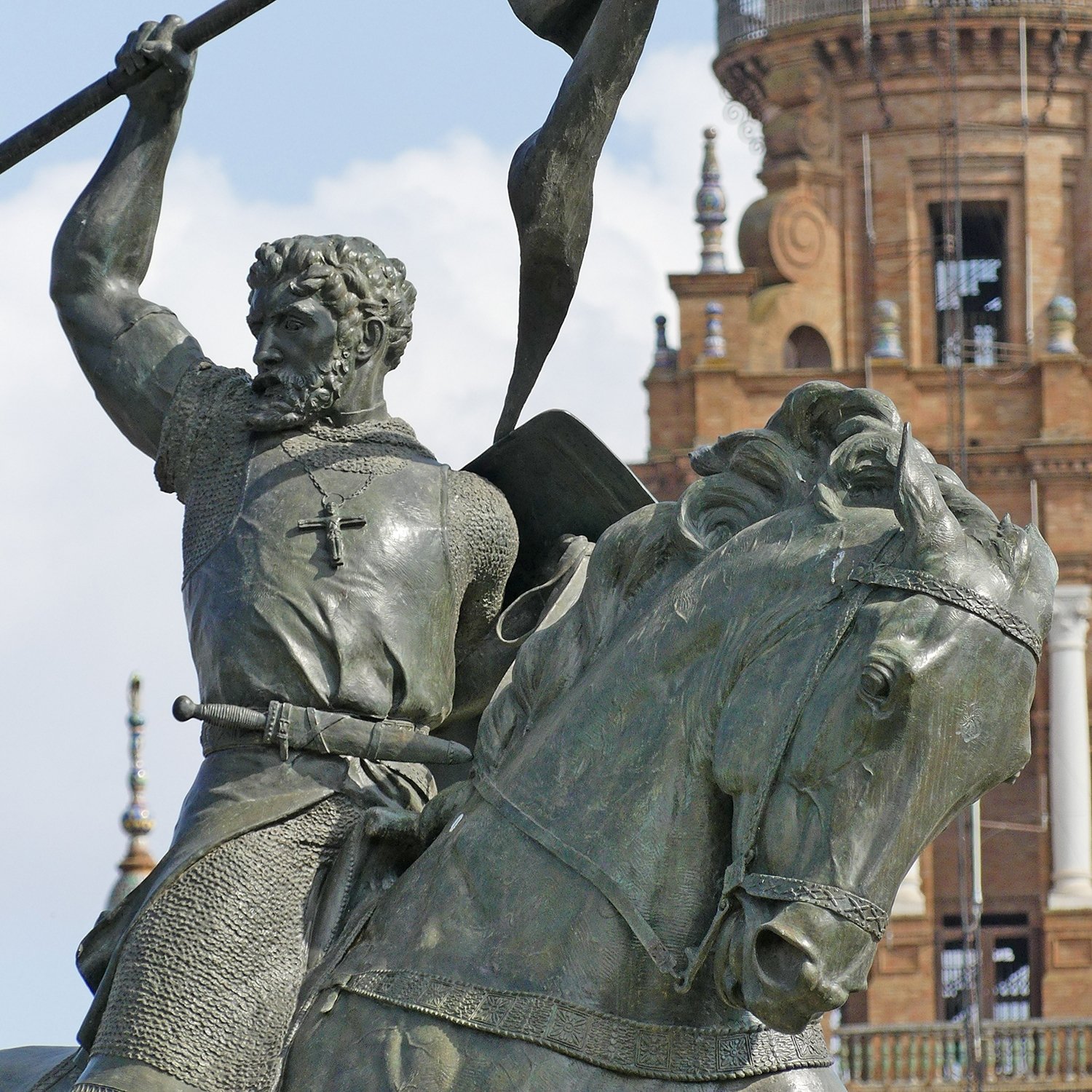
These qualities are clear in the example of her statue for Seville. The Cid's horse is represented with great anatomical realism and transmitting a strong sensation of movement, which gives the entire work a great dynamism that does not detract from its solemnity.

The posture of the figure of Rodrigo, turned to one side with respect to the axis of the horse, contributes to this dynamism. He wears warrior mail and raises one arm holding a spear, in an attitude of haranguing the troops. In the other arm he carries a shield and his sword.

It is a magnificent example of 20th century equestrian sculpture, which from the beginning enjoyed the recognition and admiration of both the people of Seville and the artistic circles of the time. The original sketch of the work was made in the same year, 1927, and is today in Brookgreen Gardens in South Carolina. The success of the Sevillian monument led to various copies being made that are spread throughout various points of Spanish and American geography, such as New York, Buenos Aires, San Francisco and Valencia.

El Cid is the nickname by which Rodrigo Díaz de Vivar was known, a Castilian knight who lived during the 11th century and who ended up being one of the most famous characters of the Spanish Middle Ages. He was first a vassal of King Sancho II and, after his death, of his brother, Alfonso VI.

By order of this king, the Cid traveled to Seville in 1079 to collect the pariahs from King Al Mutamid. During Rodrigo's stay in Seville, the kingdom suffered an attack by order of the Granada king Abdalá ibn Buluggin. El Campeador collaborated with Al Mutamid in his fight against the Granadans, who were defeated in the battle of Cabra. This fact is alluded to in the inscription found on the pedestal of the monument: “Seville, home and court of the poet King Motamid, hosted Mio Cid, ambassador of Alfonso VI, and saw him return victorious from the King of Granada.” On the other side of the pedestal one can read: “The Campeador, a firm calamity for Islam, was, due to the virile firmness of his character and his heroic energy, one of the great miracles of the Creator. “Ben Bassam.”

In detail: El Cid in Seville

ALLEGORIES OF IBERIA, THE GUADALQUIVIR RIVER AND THE MAGDALENA RIVER

In a small meadow inside the Garden of Earthly Delights we find these three allegorical sculptures made around 1928. They were originally made as part of a large monumental fountain that was located in what was called Plaza de los Conquistadores, in the southern sector of the city. Ibero-American Exhibition of 1929. This space was redeveloped after the Exhibition, the square and the fountain disappearing, and it is currently occupied by part of the Reina Mercedes university campus.

The allegory of Iberia occupied the central space of the fountain. It was made by the Valencian Francisco Marco Díaz-Pintado, who conceived Iberia as a female figure carved in stone about 3.5 m high. With an attitude between hieratic and solemn, she appears dressed in a wide tunic and a headdress and some jewels of clear Iberian inspiration. She seems to be directly inspired by Iberian sculptures, especially the Ladies of Elche and Baza. With her left arm she holds a large garland of flowers and fruit, symbolizing the agrarian wealth of the Peninsula.

On both sides of Iberia were the allegories of the Guadalquivir and Magdalena rivers, which today are also found in this area of the Garden of Earthly Delights. Both rivers are represented as two men, who appear naked and reclining, each showing some element that allows them to be identified.

The Allegory of the Guadalquivir River was made by Agustín Sánchez Cid and next to him we see a bull's head and a cornucopia. For its part, the Allegory of the Magdalena River is the work of José Lafita Díaz. She rests on a small alligator, a very abundant animal in this Colombian river, and we can also see various American fruits, such as pineapples.

[mapsmarker map="13"  lat="37.370656" lng="-5.989923" zoom="18" height="300" heightunit="px"]

HAITI ROUNDABOUT

This gazebo has kept its original appearance since it was placed in the Garden of Earthly Delights around 1864. It was made up of a series of 18th-century sculptures and pedestals from the Archiepiscopal Palace of Umbrete. It has an elliptical shape and delimiting its contour there was a continuous marble bench with a metal back. The pedestals are in the Rococo style and were made by the eighteenth-century sculptor of Portuguese origin, Cayetano de Acosta. The busts are replicas of the Italian originals that were here for more than a century and that were returned to Umbrete in 2006. They represent a series of Roman characters depicted in a beautiful baroque style. In the center of the gazebo there is a marble fountain with an octagonal vase. The fountain is a replica of the original from the 18th century that is now in the Fuente del Estanque, in this same garden.

[mapsmarker map="13"  lat="37.370915" lng="-5.989953" zoom="18" height="300" heightunit="px"]

SCULPTURE TO THE GOD PAN

Pan was the Greek god of shepherds and flocks, especially revered in the Arcadian region. He was identified with Faun in Roman mythology. He was depicted mixing human and animal features, with legs, tail, and ram's horns. Here we see him resting on a trunk, with striking hooves for feet, in an Italian sculpture from the 18th century from the Archbishop's Palace in Umbrete. It is made of marble and measures approximately 1.60 m. It sits on a pedestal also made in the 18th century by Cayetano de Acosta, about 2 m high and in a Rococo style.

[mapsmarker map="13"  lat="37.370673" lng="-5.989008" zoom="18" height="300" heightunit="px"]