DUCK FOUNTAIN

Located in the Plaza de San Leandro, this fountain is known as the Pila del Pato (Duck Fountain) because of the bronze spout in the shape of this bird that crowns it. It is made up of three vessels of decreasing size, all of them circular in section. The second and third vessels are supported by baluster-shaped shafts. In the central vessel there are four zoomorphic masks that serve to pour the water.

The fountain has been in its current location since the mid-twentieth century, but it is not the place for which it was conceived. In fact, it has occupied various locations in various parts of the city.

In 1850 it was located in the Plaza de San Francisco, in the place where the Fountain of Mercury is today. It remained there only for a few years, since in 1855 it was moved to the northern end of the Alameda de Hércules, near where the monument to the Niña de los Peines is located. From there it was moved to the vicinity of the Prado de San Sebastián, close to the Courthouse building. Its next location would be the Plaza de las Mercedarias, in the San Bartolomé neighborhood, from where it was moved to its current location in 1965.

It is likely that some elements from the previous Fountain of Mercury that it replaced were used to build the fountain in 1850. This was designed by Juan Fernández Iglesias at the beginning of the 18th century.
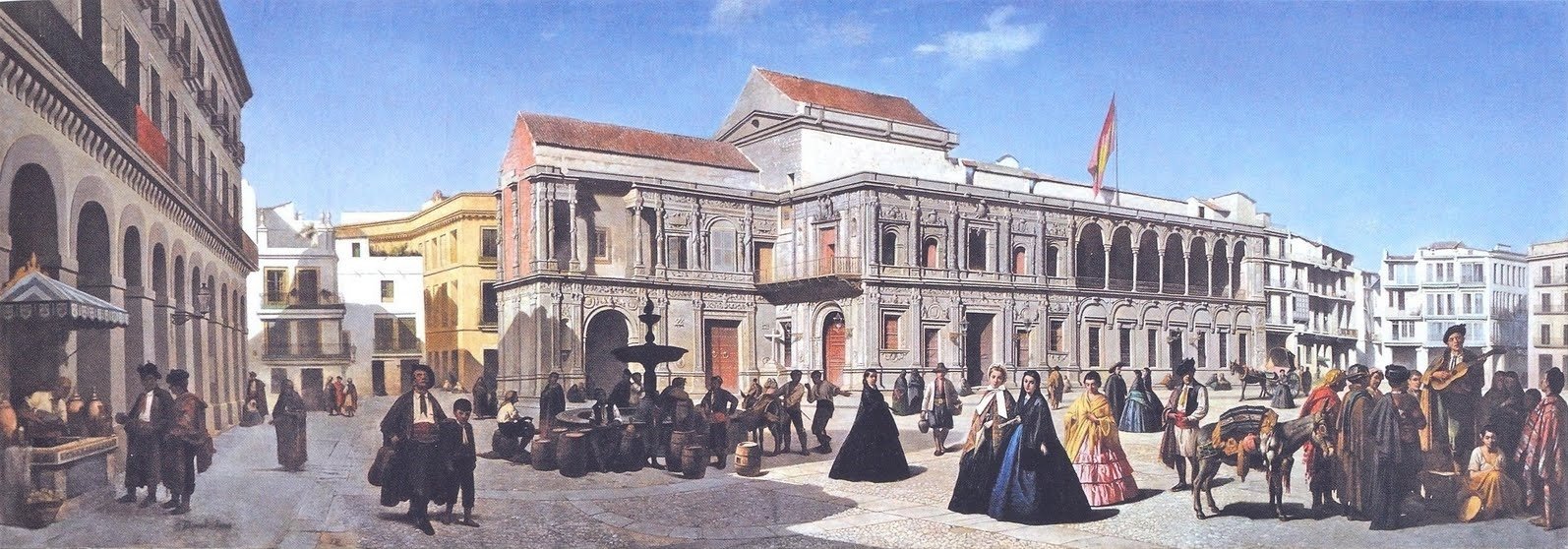
 

* Wikimedia Commons

Painting from around 1850 where you can see the Duck Fountain (Pila del Pato) in its original location, at one end of the Plaza de San Francisco
CALLIOPE FOUNTAIN

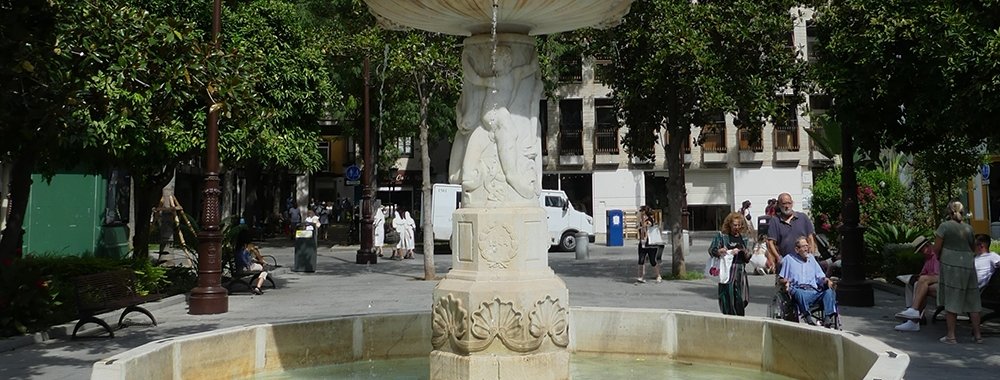
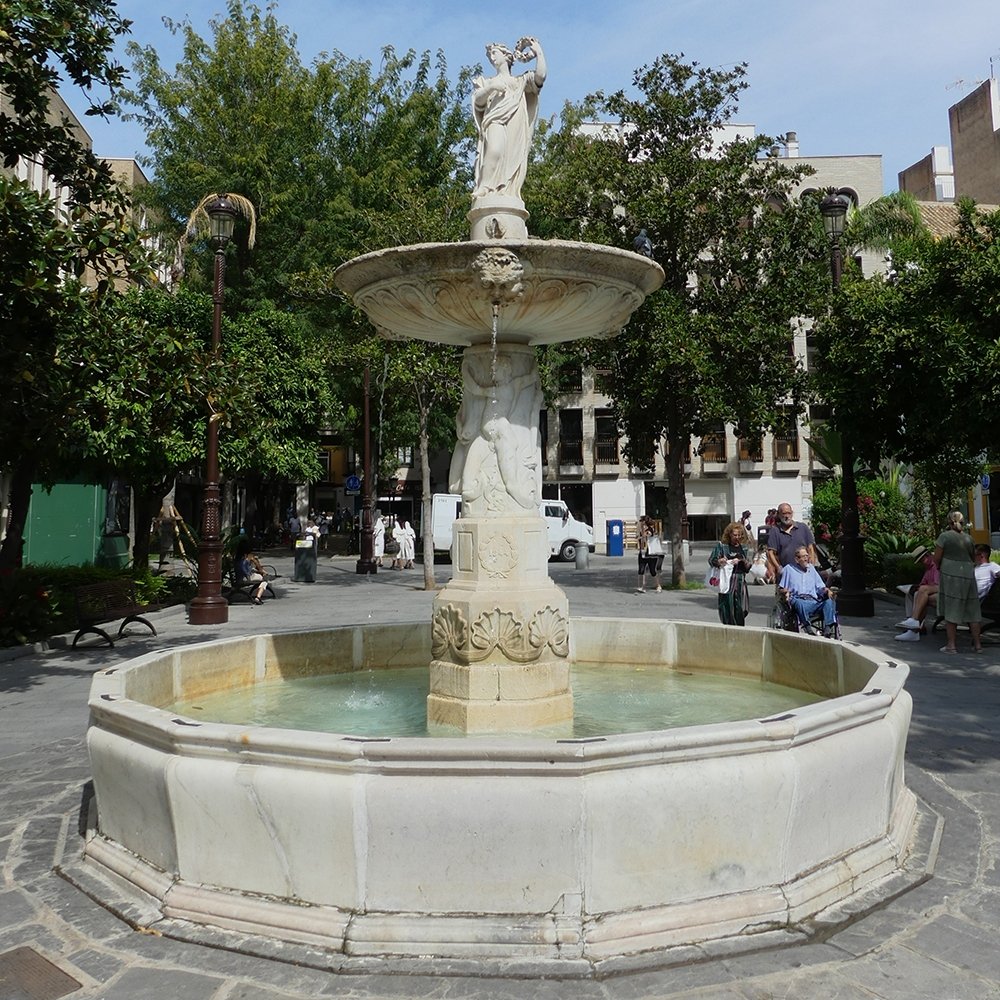
In the centre of the Plaza de la Magdalena there is a marble fountain from 1844, crowned by an 18th century sculpture representing the muse Calliope. The fountain is made up of a large polygonal vessel, in the centre of which there is a stem-shaft divided into two bodies by a second vessel, this time circular.

The first body of the shaft is decorated at its base with scallops, royal crowns, the symbol of the city (NO8DO) and the aforementioned date of the fountain's creation. In its cylindrical part there are several male mythological figures linked to the aquatic world (tritons). The circular vessel that supports this first body is ribbed and surrounded by four fountain masks through which the water falls to the sea of ​​the fountain.

Crowning the whole, we find a female sculpture holding a laurel wreath in her right hand. It could be the muse Calliope, protector of epic poetry and eloquence.

The square where the fountain is located was occupied by the primitive parish of La Magdalena, which today is located a few meters further west. This church was demolished in 1810, during the French occupation of the city. After the expulsion of the French, an attempt was made to rebuild the temple, but finally it was decided to open a square in its place, at which time the fountain was installed.

Elements from earlier sources were used for its construction. The main vessel comes from a fountain that was located in front of the Hospital de la Misericordia, in the current Plaza Zurbarán. It is probably of Italian origin and dates back to the Renaissance.

For its part, the first body of the central shaft and the circular vessel come from a mannerist fountain that was located in the Alameda in the 16th century. Finally, the female sculpture that tops the ensemble comes from the 18th century sculpture collection that the Archbishop's Palace of Umbrete held. A good part of the sculptures from this collection are now found decorating the Garden of Delights, in the south of the city.

This combination of origins gives the fountain a rather eclectic character, mixing the classicism of the Renaissance and the 18th century with the 19th century romanticism of the time when it was recomposed.

“Calliope, in Greek mythology, according to Hesiod’s Theogony, foremost of the nine Muses; she was later called the patron of epic poetry. At the behest of Zeus, the king of the gods, she judged the dispute between the goddesses Aphrodite and Persephone over Adonis. In most accounts she and King Oeagrus of Thrace were the parents of Orpheus, the lyre-playing hero. She was also loved by the god Apollo, by whom she had two sons, Hymen and Ialemus. Other versions present her as the mother of Rhesus, king of Thrace and a victim of the Trojan War; or as the mother of Linus the musician, inventor of melody and rhythm. Her image appears on the François Vase, made by the potter Ergotimos about 570 bce.”

Britannica, The Editors of Encyclopaedia. "Calliope". Encyclopedia Britannica, 1 Dec. 2023, https://www.britannica.com/topic/Calliope-Greek-Muse


* Wikimedia Commons

Jardín de las Delicias de Sevilla con el Pabellón de Argentina al fondo

JARDÍN DE LAS DELICIAS (GARDEN OF DELIGHTS)

The Garden of Earthly Delights is one of the oldest public gardens in Seville. It was called Arjona's Garden of Earthly Delights, since it was set up during the mandate of the Seville Mayor José Manuel de Arjona y Cubas, between 1825 and 1835.

They were made within the general remodeling process of the eastern bank of the river. With the same objective, the wall that linked the Torres del Oro and Torres de la Plata crossing the current Paseo Colón was demolished, and the Jardines de Cristina were created in front of the Palacio de San Telmo.

Since their creation they have undergone various modifications. Artistically, the most significant occurred around 1864, when a series of Italian sculptures from the 18th century were brought in. They came from the Archiepiscopal Palace of Umbrete, which had suffered a fire in 1862. Some of them can still be seen in the garden, but most of them were replaced by replicas in 2006, while the originals were returned to Umbrete. For the arrangement of the sculptures in the palace, the Portuguese-born sculptor Cayetano de Acosta made a series of pedestals that we can also see today in the Garden.

The Garden gained great prominence as a result of the celebration of the Ibero-American Exhibition of 1929, since it became one of the landscaped spaces around which the event was held. In fact, it lost part of its original dimensions when the pavilions of Argentina and Guatemala were arranged to the North and that of Morocco to the South, pavilions that fortunately have survived to this day.

[mapsmarker map="4"  lat="37.370967" lng="-5.989689" zoom="18" height="300" heightunit="px"]