SAMUEL HA LEVÍ
(1320 - 1360)
A prominent Jewish financier and politician who became chief treasurer and member of the Royal Council during the reign of Pedro I. He was born in Toledo, a city to which he was always linked. However, Don Pedro's court was based mainly in Seville, so his treasurer spent long periods in our city. He came to own a splendid palatial residence located on the current Calle Levíes, in the heart of the Jewish quarter.
He was born into the Abulafia family, a prominent aristocratic lineage. Shortly after Pedro I came to the throne in 1350, Samuel was named his chief chamberlain thanks to the support provided by Juan Alfonso de Alburquerque, one of the king's most trusted people. From the beginning, he was in charge of the financial and economic problems of the royal agency, successively accumulating the positions of chief treasurer of the kingdom, member of the Royal Council and probably, judge of the Royal Court.
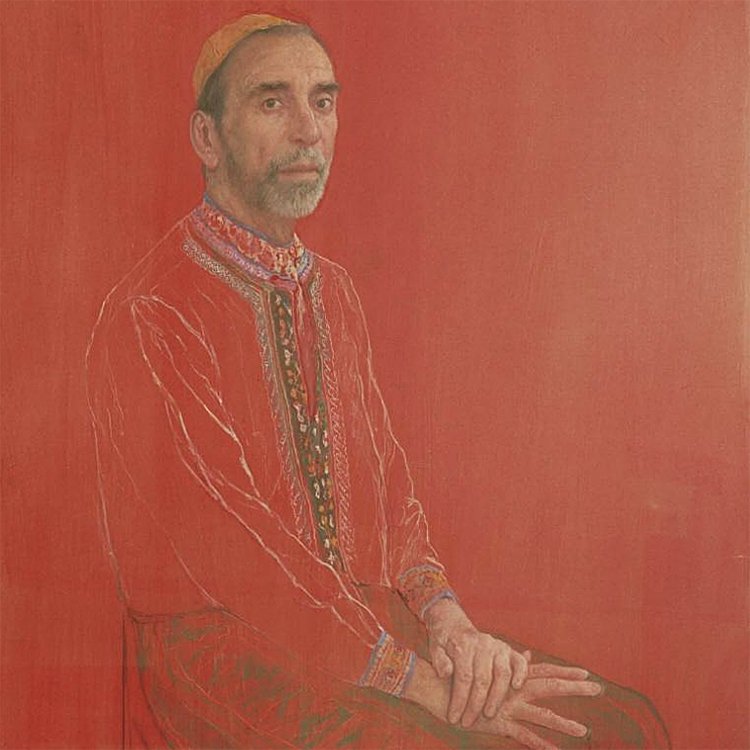
Imaginary portrait of Samuel ha Levi made by the Malaga painter Daniel Quintero around 2000 (mixed technique on wood). It is currently in the Sephardic Museum of Toledo. (📸)
For about ten years, Samuel ha-Levi played a leading role in the court of Castile, intervening in practically all matters that had to do with public revenues. But his role was not limited to the economic sphere; he became a kind of chief minister of the king. For example, in 1358 he went to Portugal to mediate between the two kingdoms, reaching an agreement that was embodied in the Treaty of Évora.
In Toledo he lived in a splendid residence known as the Palacio del Judío, preserved today as the Casa Museo de El Greco. It is known that he helped members of his community on numerous occasions. In this same city, for example, he sponsored the construction of the synagogue of El Tránsito, a splendid Mudejar temple that preserves inscriptions in Hebrew praising the king and Samuel himself. In one of them it is stated that "since the day of our exile no son of Israel has reached such a high state."
Such a prominent position in the kingdom ended up attracting him numerous enemies. In addition, it is worth remembering the complicated situation that existed during most of this reign, with the so-called first Castilian civil war between King Pedro and his half-brother Enrique de Trastámara. Enrique's supporters often mocked their opponent by calling him "king of the Jews" and criticized the high levels of power that the Hebrews were reaching in the kingdom.

VView of the interior of the Synagogue known as "del Tránsito", built thanks to the impetus and patronage of Samuel ha Levi in Toledo. Today it is the headquarters of the Sephardic Museum. (📸)
The numerous defamations of which Ha-Levi was the object of his enemies, ended up causing his imprisonment on charges of embezzlement. He was imprisoned in the Atarazanas of Seville and was finally executed, apparently by order of the king.
According to tradition, the monarch ordered him to be tortured until he revealed the hiding place where the allegedly embezzled funds were located, but the treasurer resisted the torment without breaking. The specific circumstances of his conviction and execution are not clear today and it has been pointed out that they were probably caused by the financial asphyxiation that Castile was going through due to the civil war. It is possible that the Crown was ambitious to get hold of the enormous personal fortune of its treasurer.
In any case, Samuel Ha-Levi was certainly one of the most influential Jews in the history of medieval Spain, concentrating in his hands an enormous power, which ended up earning him numerous enemies.

Interior of the Royal Shipyards of Seville. Samuel ha Levi, a prisoner, died in one of the rooms of this immense complex in 1360. (📸)