The convent of San Leandro is a convent of Augustinian nuns that occupies a large sector of the Alfalfa neighborhood, a place where they have settled since the 14th century. It is famous among Sevillians for the baking work of its nuns, who prepare the coveted yemas de San Leandro. The convent complex has a large number of rooms, with several cloisters and a very complex structure. However, its magnificent church is the only element that can be visited regularly, so we will focus on its analysis.
History
The Augustinian order arrived in Seville at the end of the 13th century and initially settled on land outside the city walls, near the Puerta de Córdoba. Apparently, it was a very unhealthy area and one of great insecurity, even being cited as “Degolladero de Cristianos”.
A century later, King Pedro I facilitated the transfer of the order to premises on current Melgarejos Street (1367). But the new location did not meet the necessary conditions either and from there they moved to the place they occupy today just a few years later.
The convent initially had a church, probably a Mudejar Gothic temple, but at the end of the 16th century it was decided to replace it and construction of the current one began. Francisco Pacheco, Velázquez's famous father-in-law, stated that the design of the new building corresponded to Juan de Oviedo. However, documentary evidence has only been able to confirm the participation in the project of Asensio de Maeda as architect and Juan de los Reyes and Juan Miguel, as master bricklayers.
DESCRIPTION
The temple is a classic “box church”, the most common type in Sevillian convents. It has a rectangular floor plan, with a single nave and a high and low choir at the foot.
Exterior
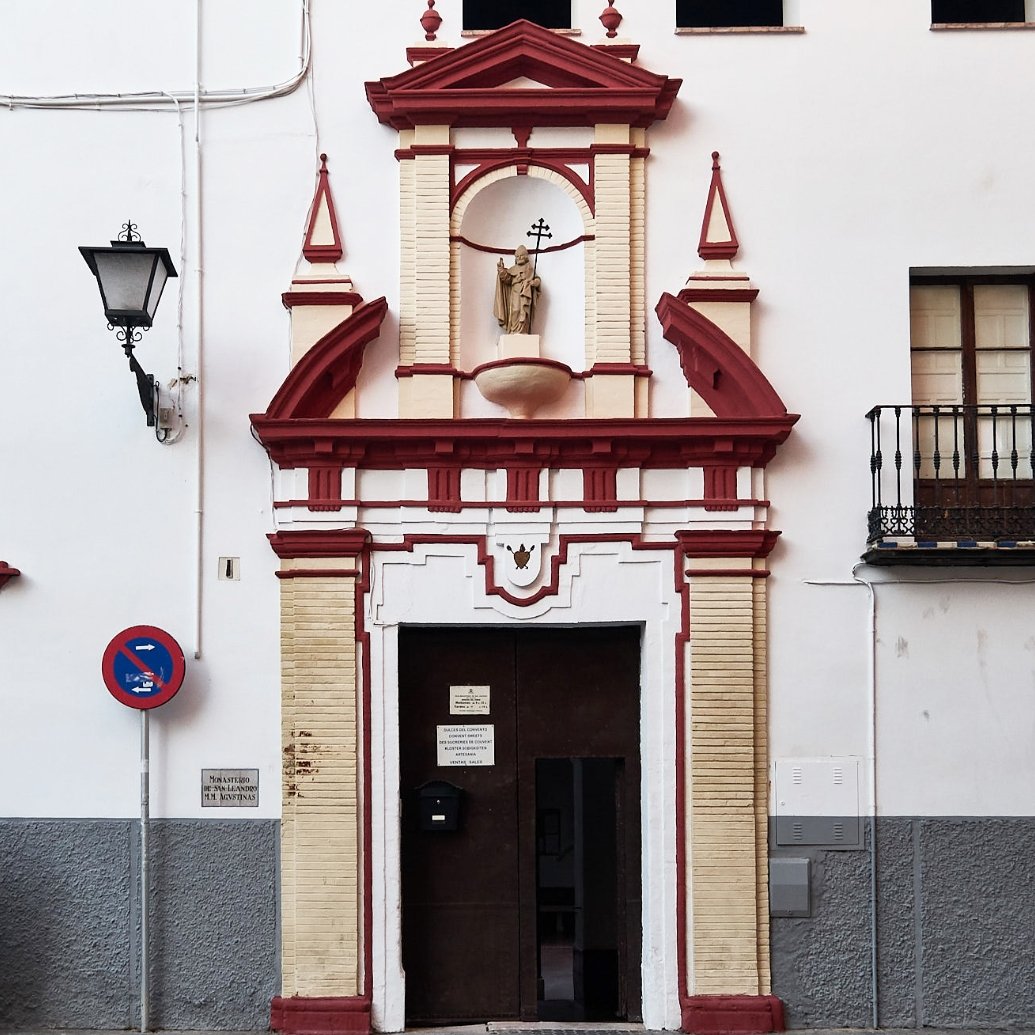
The convent has two exterior doors. The first is located in the Plaza de San Ildefonso and gives access to the cloister. It has a simple Mannerist form, with a lintel entrance framed by pilasters. These support a split pediment with a niche in the center that houses a small terracotta sculpture of Saint Augustine. This is the entrance through which the famous San Leandro yolks are generally shipped.
Next to the cover, since 2002, a small marble plaque has been located on which a fragment of a prose poem by Luis Cernuda can be read. It is taken from her book "Ocnos" and seems to allude to this convent: "In the Gallery after discreetly knocking on the convent's lathe, a female voice sounded like an old shearing: 'Deo gratias' she said. 'To God be given ', we responded. And the spun egg yolks..."
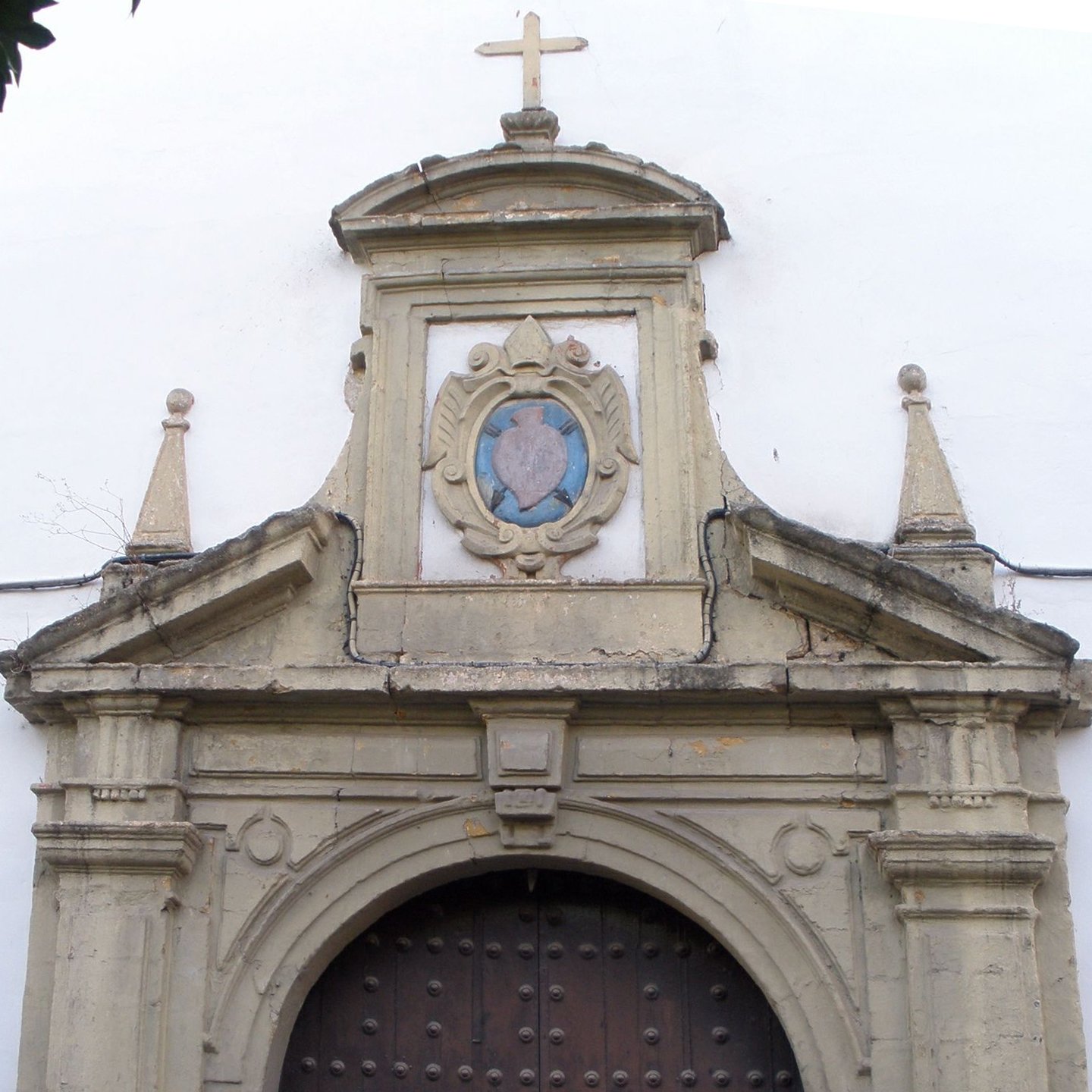
In the nearby Plaza de San Leandro the door opens that gives access to the church through its left wall. It is very similar to the previous one, but in this case the opening is a semicircular arch and the upper niche houses a burning heart, a symbol of the Augustinian order.
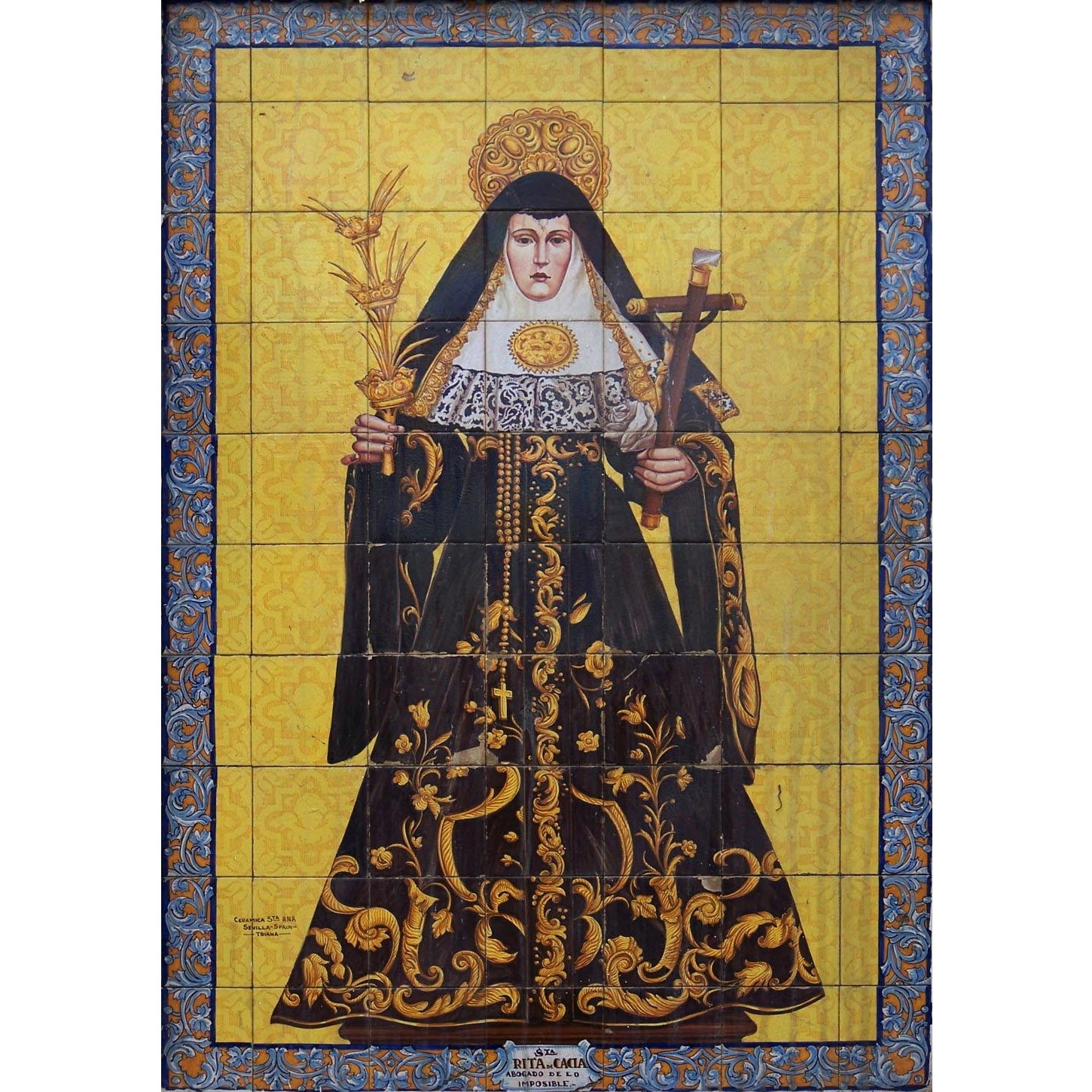
A few meters to the right is a ceramic altarpiece in which Saint Rita of Casia is presented. This saint was in life an Italian nun of the Augustinian order who lived at the end of the Middle Ages. She is usually represented with a small wound on her forehead, since according to tradition she had a stigma that recalled Christ's crown of thorns and that it miraculously reopened every night. Today she is one of the most popular saints in the Catholic world and she is known as an intercessor in impossible causes.
The tile that we find in our convent was made in the 1950s in the Santa Ana de Triana factory, although its author is unknown.
-
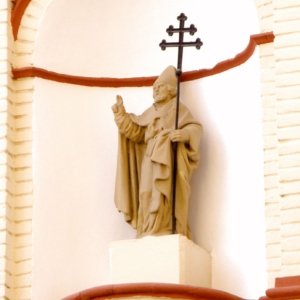
- Detalle de la portada de acceso al convento º
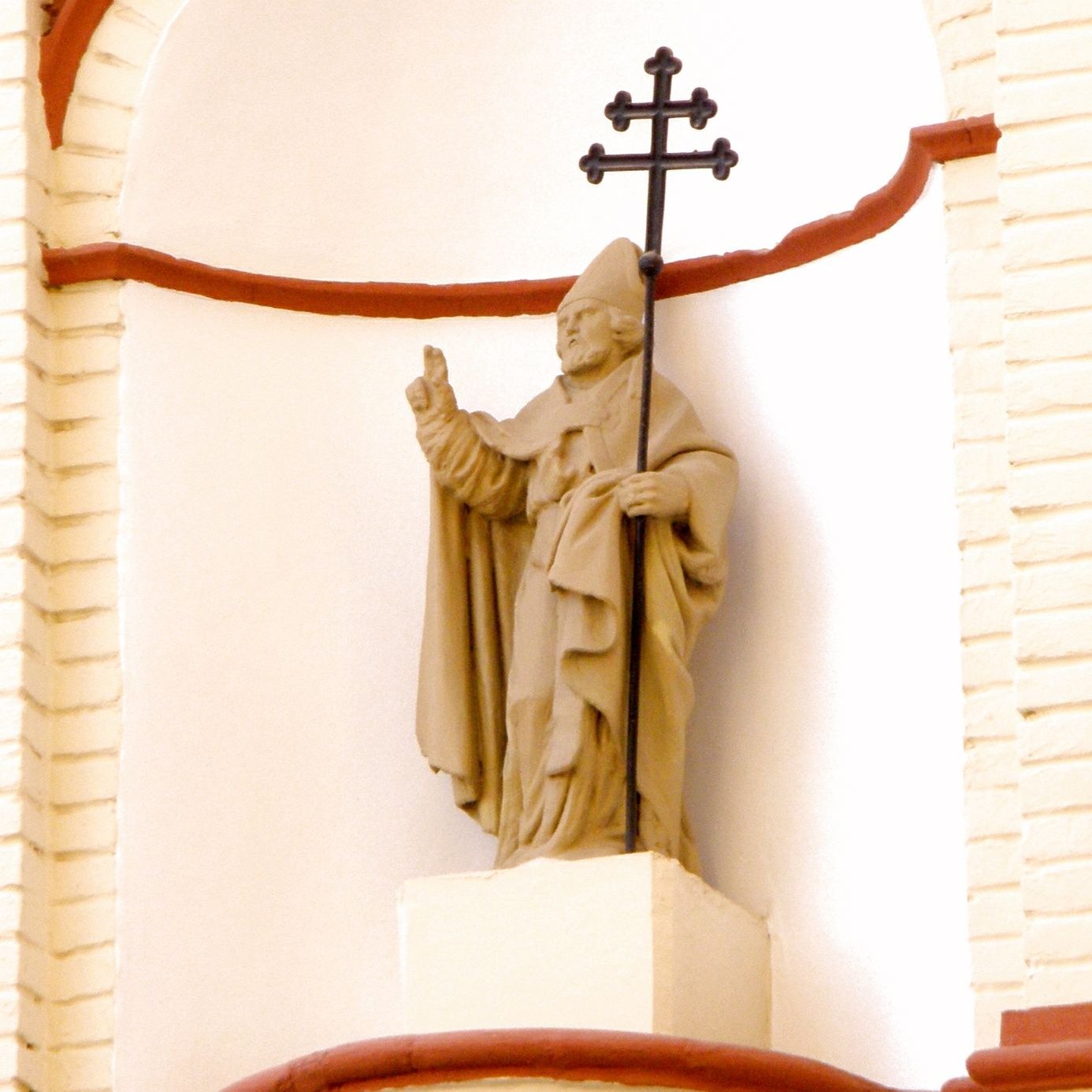
-
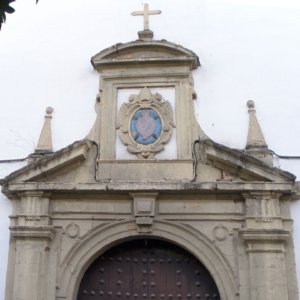
- Detalle de la portada de la iglesia con el corazón en llamas símbolo de los agustinos
-
- Retablo cerámico de Santa Rita º
Inside
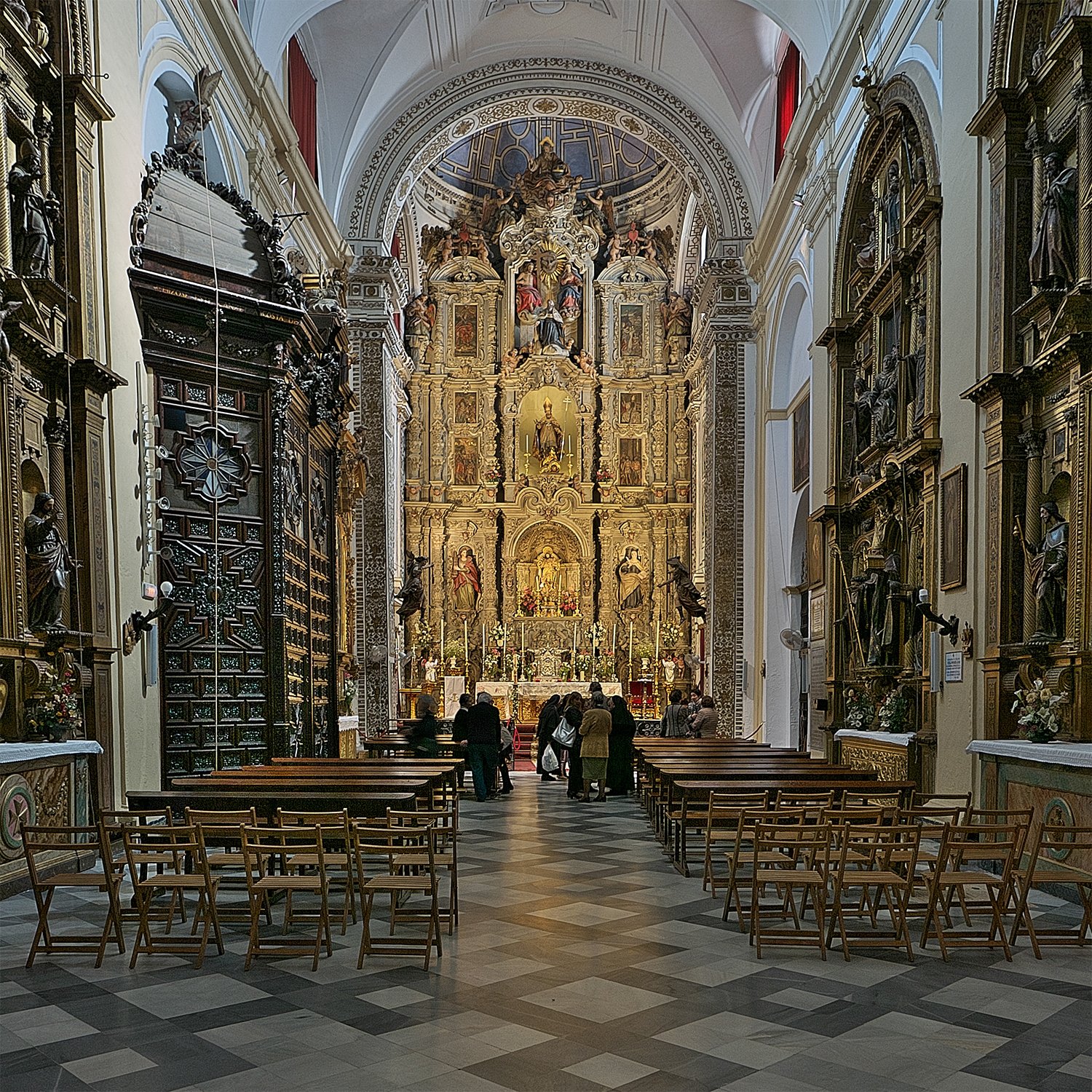
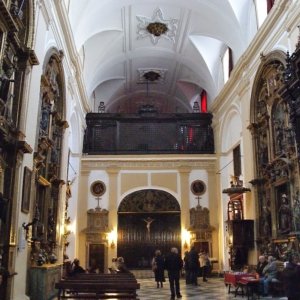
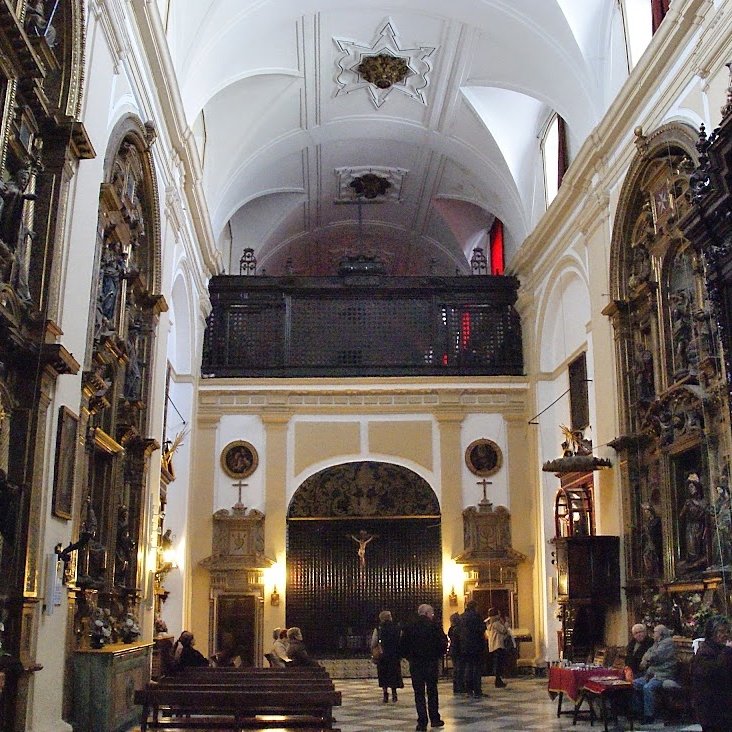
The church is accessed through a splendid gate richly decorated with sculptural decoration in the Baroque style. Upon entering, we find that the nave is divided into four sections through pilasters attached to the walls. Among them are the different side altarpieces of the church. A large main arch serves to separate the presbytery area at the head, while at the foot, a wall in which a large lattice opening opens, serves to separate the choir area, reserved for the cloister.
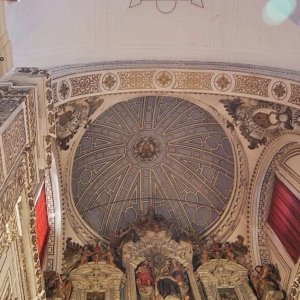
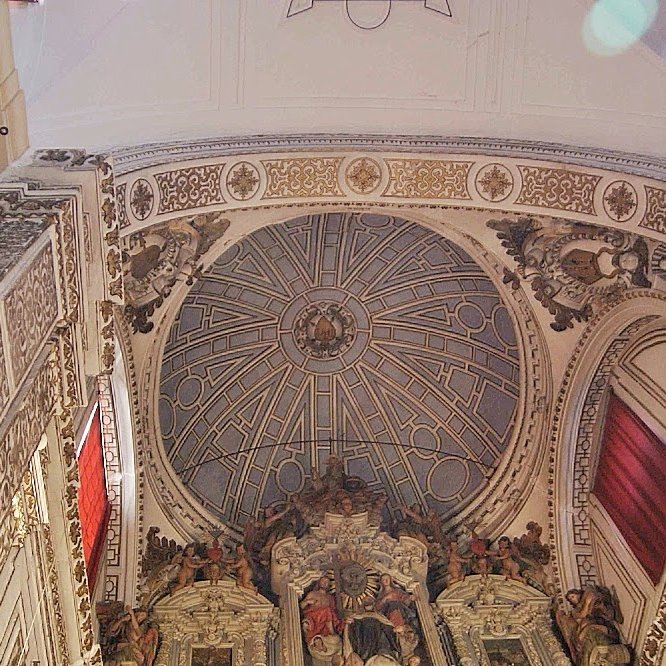
The nave is covered with a barrel vault with lunettes, divided into sections by transverse arches. The chancel area is covered by a hemispherical dome that is only visible from the inside.
Main nave divided into four sections by transverse arches and covered with a barrel vault with lunettes. Cruise covered by a hemispherical dome decorated with geometric paintings and only visible from the inside.
The pictorial decoration on the walls is not very abundant. We find it especially on the walls of the presbytery and in the dome, where geometric motifs very typical of Mannerism can be seen. In the center of each of the sections of the vault there are a type of rosettes like stalactites. They are framed by moldings that also form curious geometric motifs.
-
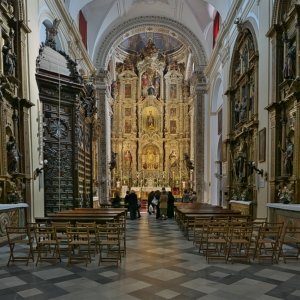
- Vista interior hacia el presbiterio *
-
- Vista interior hacia el coro º
-
- Cúpula sobre el presbiterio º
Main altarpiece
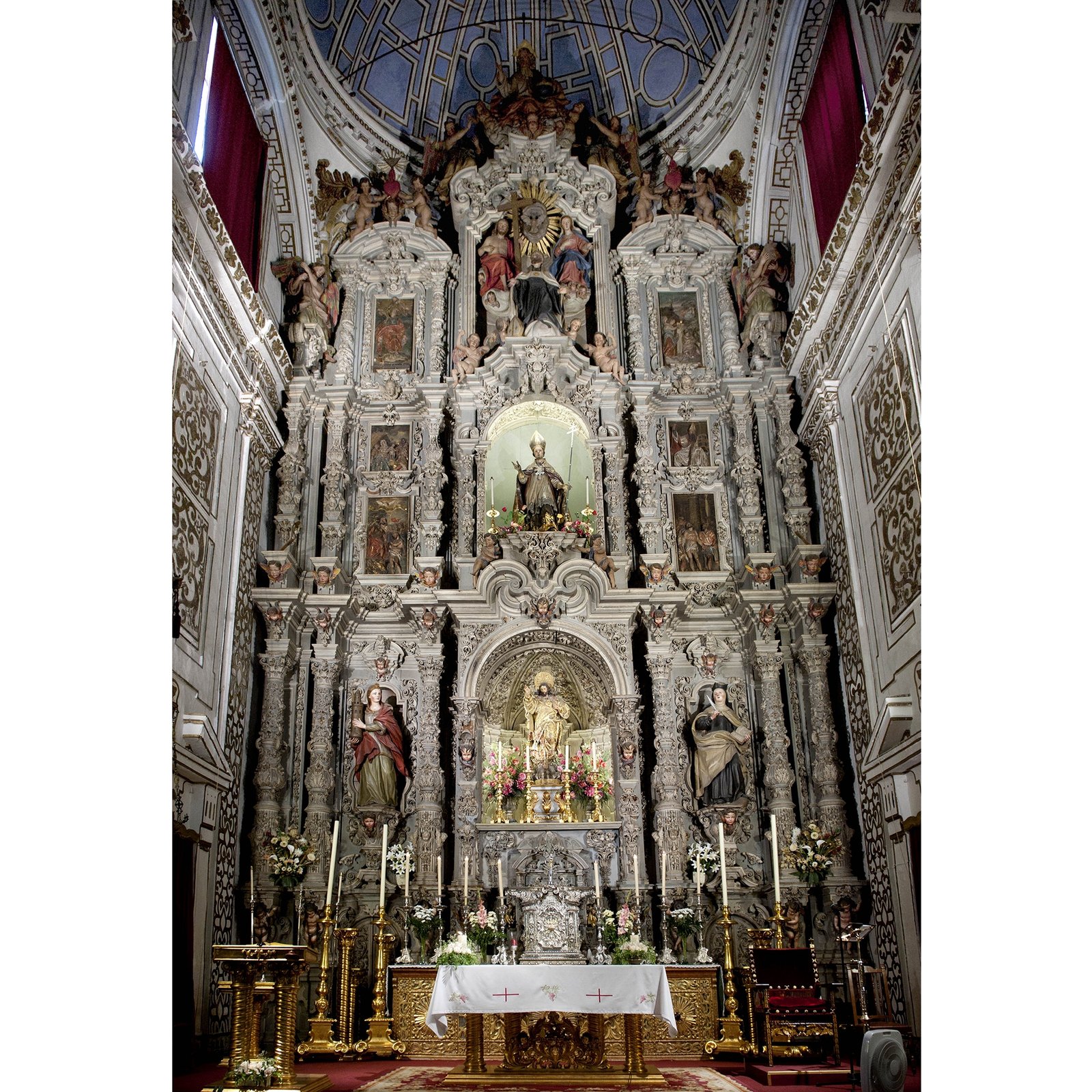
The current baroque altarpiece was built in the mid-18th century to replace a previous one made in the 16th century in the Mannerist style. The previous one had sculptural decoration by Jerónimo Hernández and, in fact, some of the old reliefs are preserved in the current one.
This has generally been attributed to Pedro Duque Cornejo and Felipe Hernández and has some characteristics that make it particular. For example, it is quite tall compared to most Sevillian altarpieces and is very compartmentalized, a fact that is not usually common in larger altarpieces. Perhaps the most original feature is that it is not gilded, but rather covered in light tones.
It is divided horizontally into two bodies and an attic, which are in turn divided vertically into three streets. To separate them, various types of columns are used, such as stipes or composite columns, all of them with profusely decorated shafts.
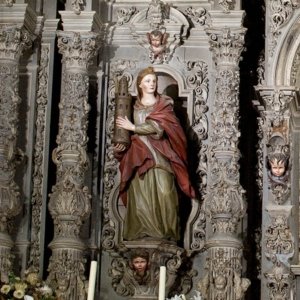
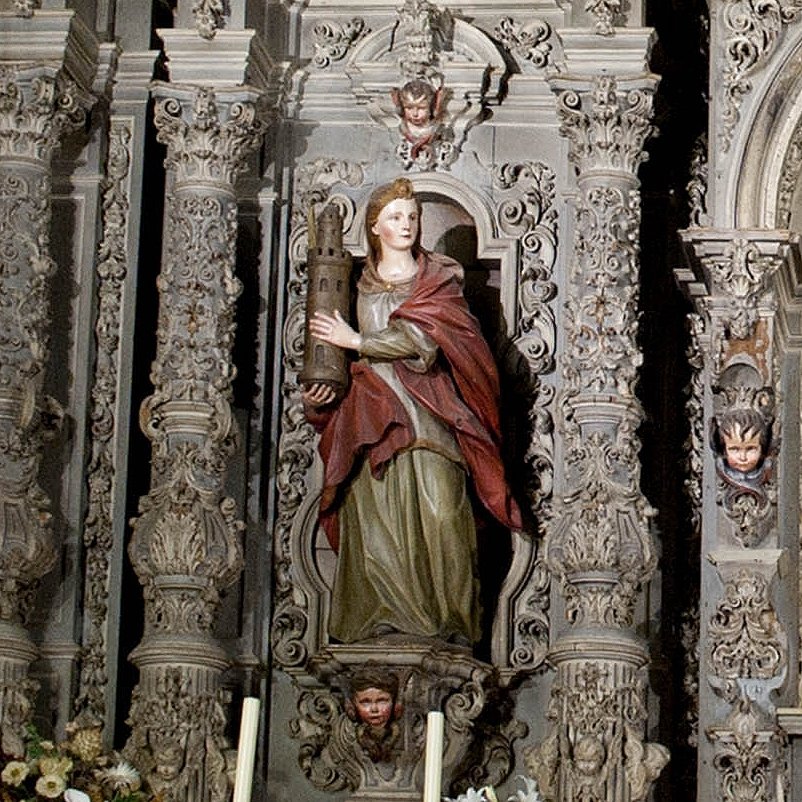
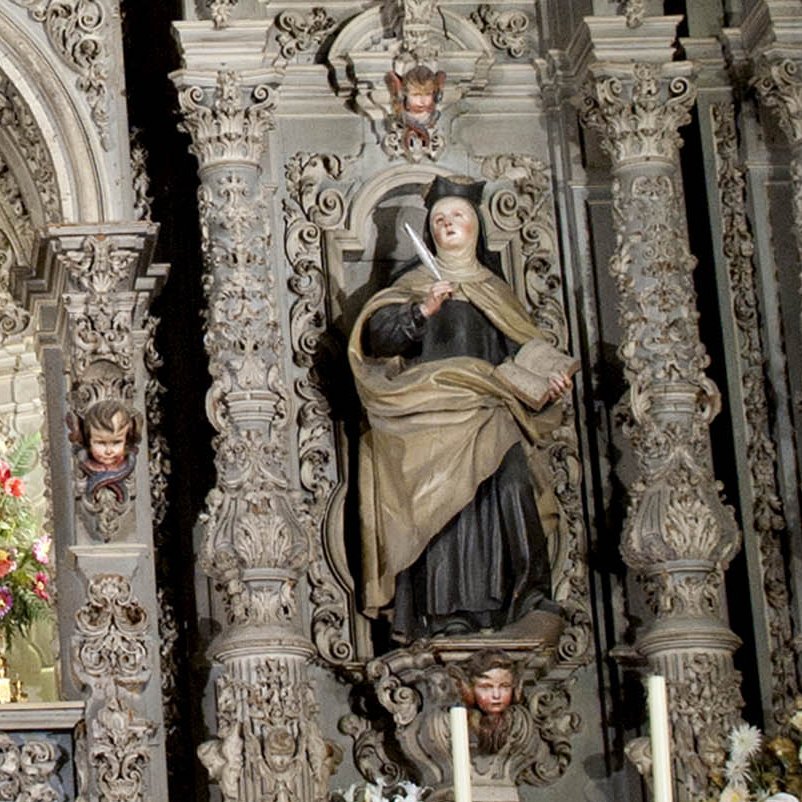
In the first body, the niche houses a contemporary image of the Sacred Heart of Jesus, which is apparently the first of its kind to be worshiped in Seville. On both sides, two beautiful sculptures represent Saint Barbara and Saint Teresa, who appears as a Doctor of the Church.
The central niche of the second body houses the owner of the temple, San Leandro. He was bishop of Seville at the end of the 6th century, during the times of the Visigoths. In fact, he played an important role in their conversion from Arianism to Catholicism. He was the brother of the Sevillian bishop San Isidoro, probably the most prominent personality of this historical period in the peninsula.
Two scenes represented in relief occupy the side streets, probably works by Jerónimo Hernández coming from the previous altarpiece. On the left we have “The Adoration of the Magi” and the “Baptism of Christ”, and on the right we see Saint Augustine and “The Flagellation”.
In the center of the attic there is an interesting sculptural group, with Saint Augustine kneeling in the center and, behind him, Christ, the Virgin and the Holy Spirit observe him from Heaven. The whole, on the altarpiece, is crowned by a representation of God the Father in an attitude of blessing, surrounded by angels. In the side streets we find two reliefs also coming from the previous one: “The Assumption of the Virgin” and “The Prayer in the Garden”.
In addition to the main altarpiece, the church has a series of altarpieces that are attached to the side walls, some of them with enormous artistic interest.
-

- Retablo mayor *
-
- Santa Bárbara
-
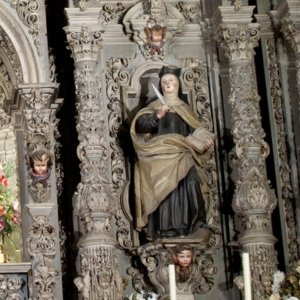
- Santa Teresa
Altarpieces on the right side:
- Next to the presbytery, a small chapel houses a simple neoclassical altarpiece from the 19th century. It houses a small dress image of the Virgin and Child, probably from the same period as the altarpiece.
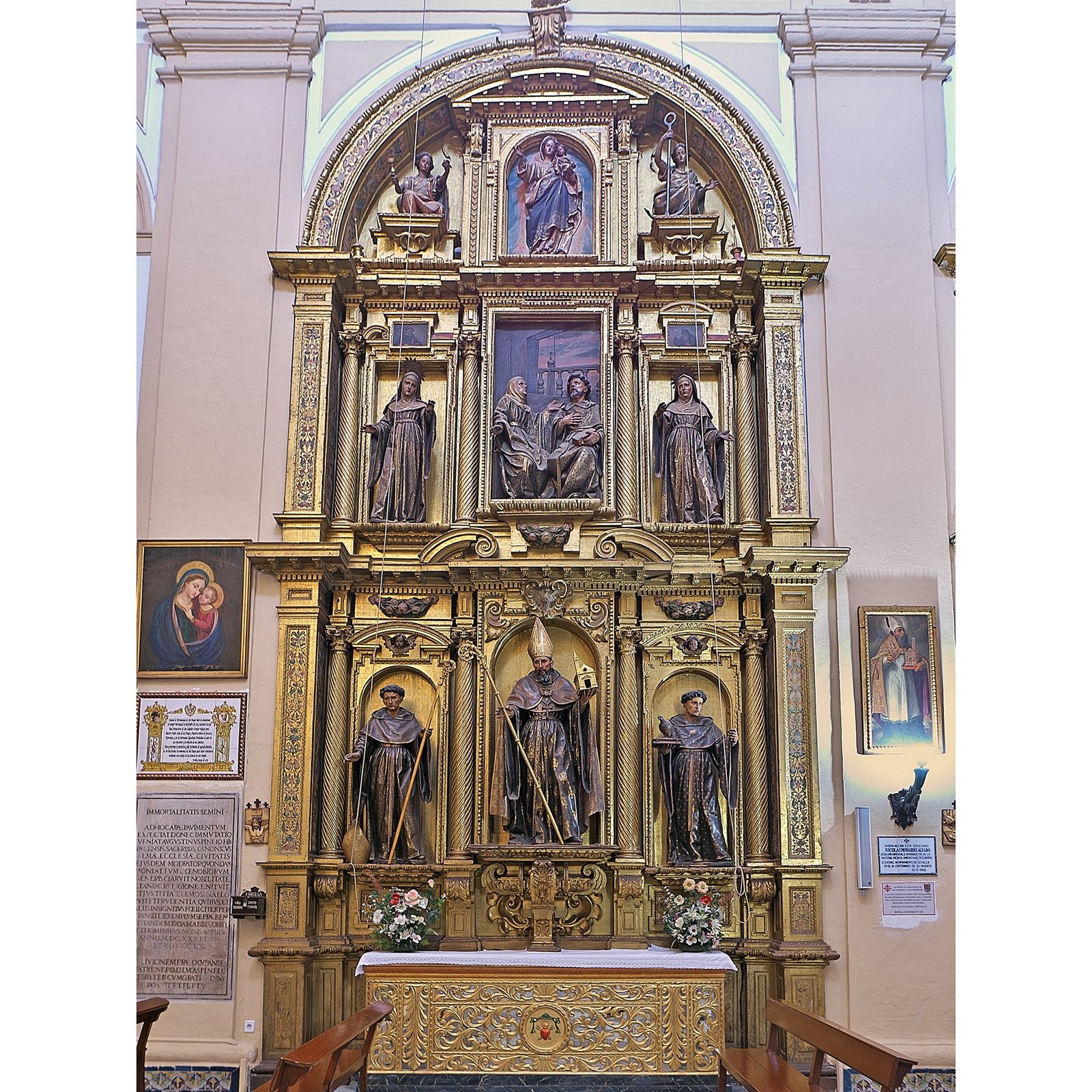
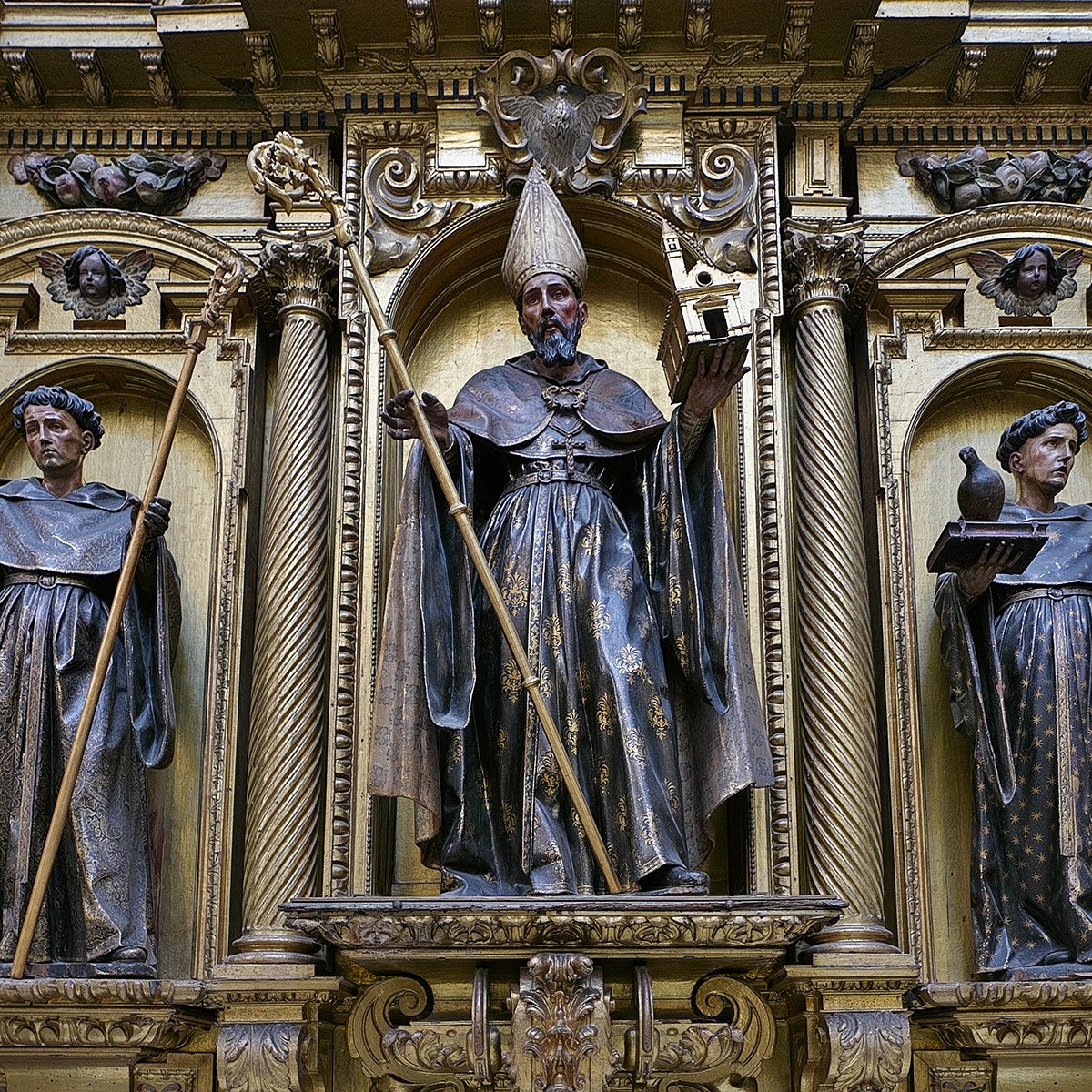
- Next we find the altarpiece of San Agustín, made by Felipe de Ribas around 1650. It has a very classic structure, similar to that usual in the altarpieces of Martínez Montañés, with two bodies, an attic and three streets. In the center of the first body is Saint Augustine, with episcopal attributes, since he was bishop of Hippo, and holding the model of a church, which alludes to his consideration as one of the four fathers of the Church. On its sides appear Saint Thomas of Villanueva and Saint Nicholas of Tolentino. In the center of the second body, a relief represents Saint Augustine and Saint Monica in the port of Ostia. Santa Clara de Montefalco and Santa Rita de Casia appear in the side streets. Finally, in the attic we find the Virgin and Child flanked by the allegories of Faith and Hope.
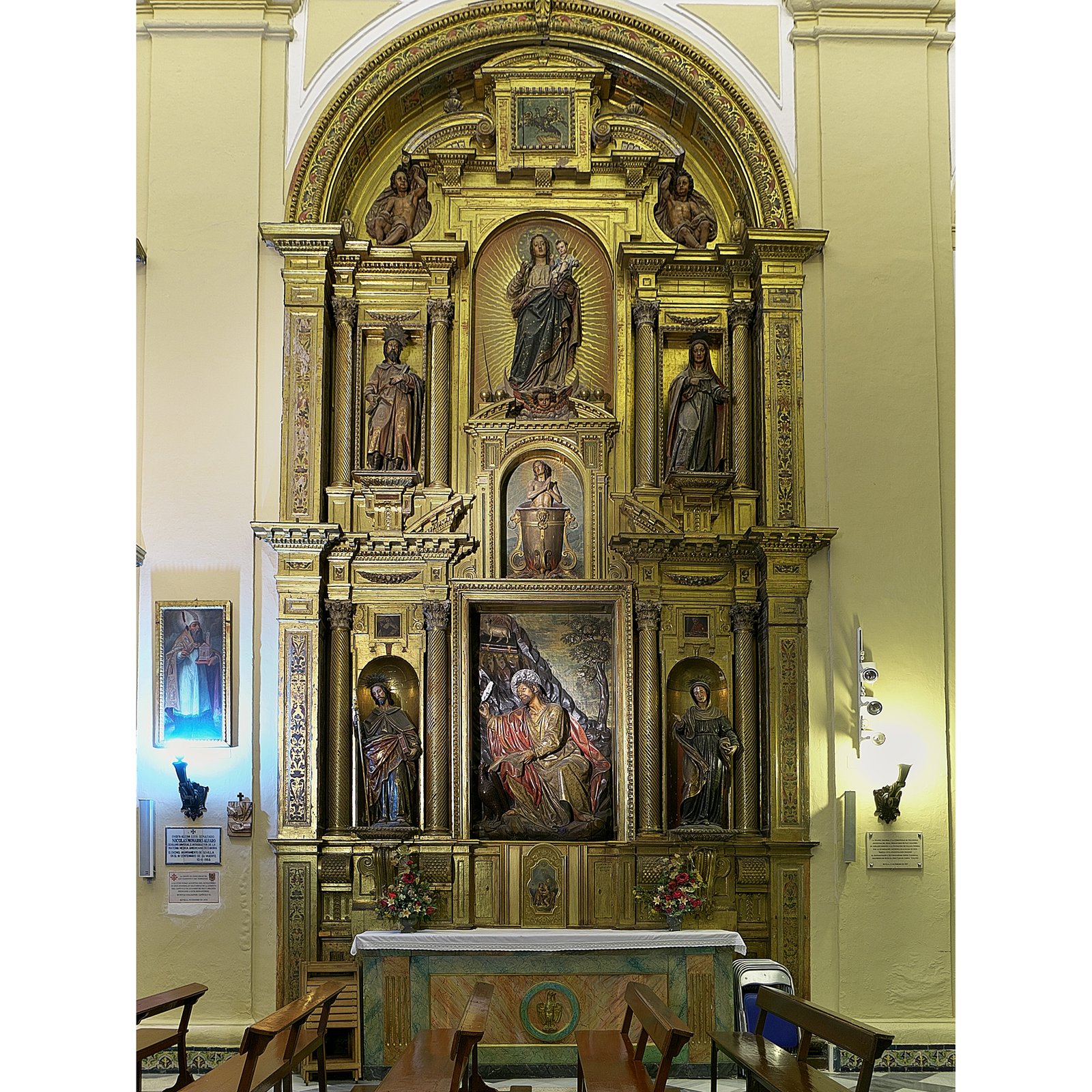
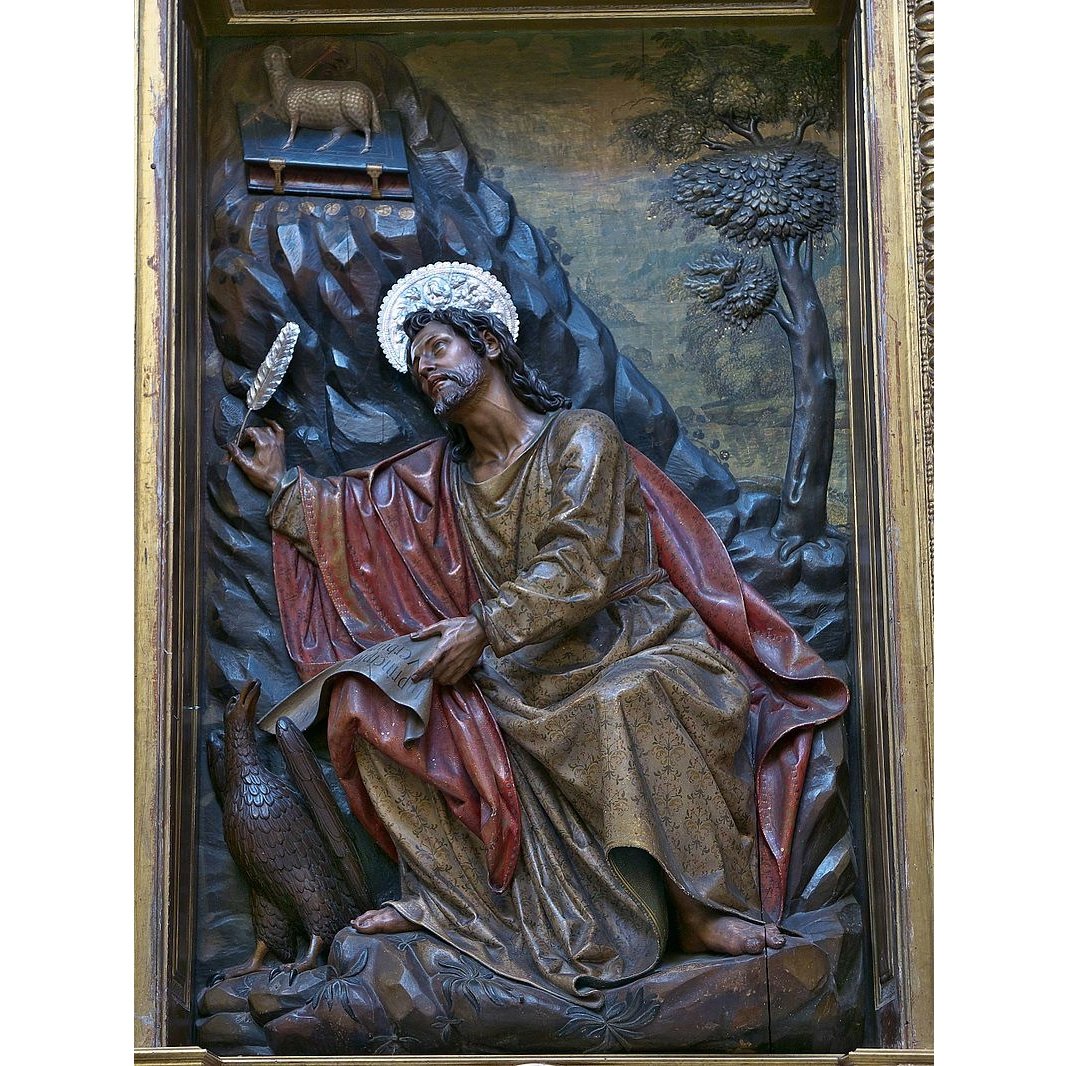
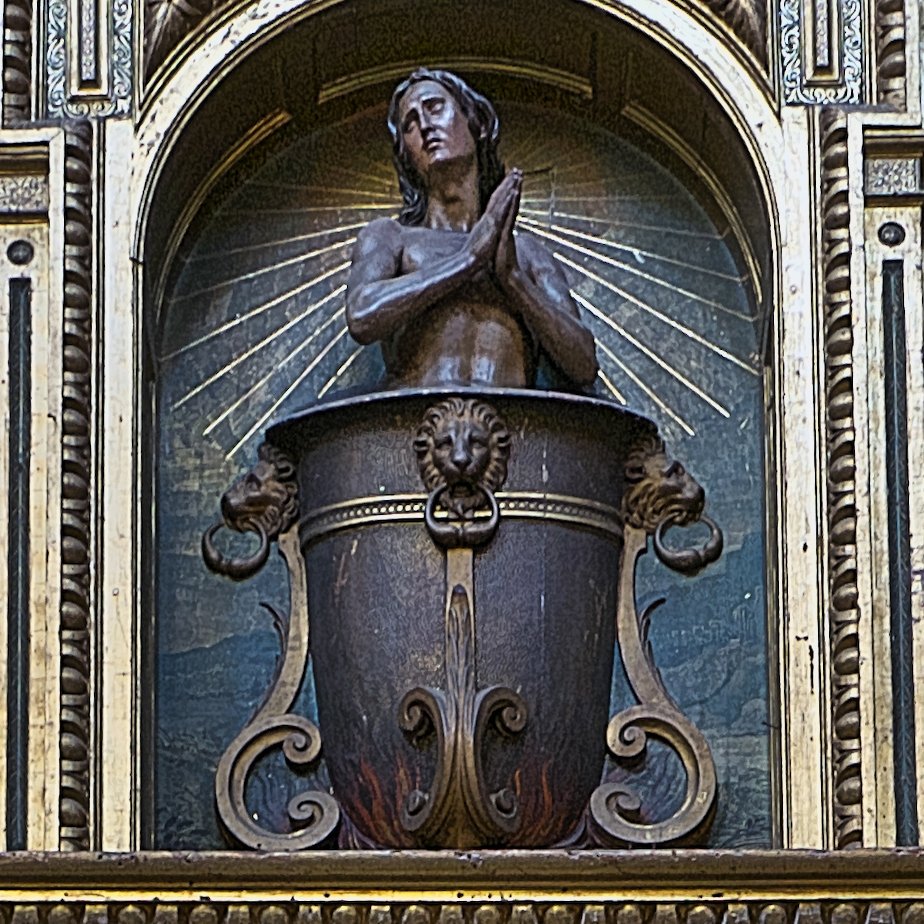
- Altarpiece of Saint John the Evangelist. It is located right in front of the one dedicated to San Juan Bautista, following a very common tradition in Sevillian convents, which used to place the altarpieces dedicated to the “holy johns” facing each other on both sides of the nave. This altarpiece of the Evangelist is a work by Martínez Montañés and his workshop, completed in 1632. In the center of the first body we find a magnificent relief with the representation of Saint John on Patmos, where the apostle wrote the Apocalypse according to tradition. This relief is considered to be the only personal work of Martínez Montañés, with the rest of the altarpiece being the work of his workshop. Above it, a small niche houses another relief with the representation of the martyrdom of John, following Tertullian's story in his “De praescriptione haereticorum XXXVI”, according to which the saint was thrown into a cauldron of boiling oil but was miraculously unharmed. The relief is the work of Francisco de Ocampo, who was an apprentice in the workshop of Martínez Montañés. In the center of the second body is a Virgin and Child dedicated to Our Lady of Good Counsel. On its side streets it is flanked by Santiago el Menor and Santa María Cleofás.
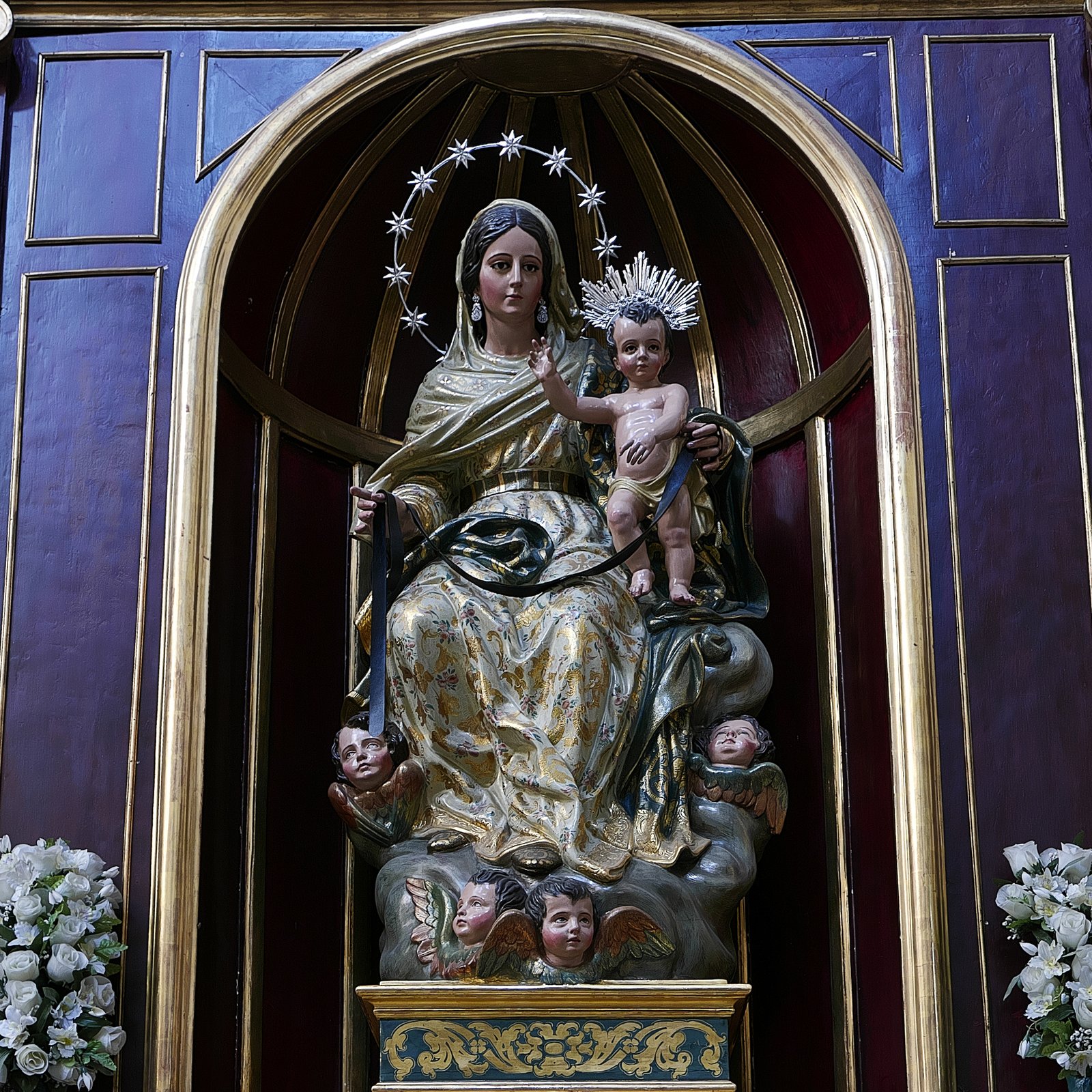
- Altarpiece of the Virgin of Consolation and Correa. It is a simple neoclassical altarpiece that houses in its central niche an image of the Virgin and Child made by Sebastián Santos Rojas in 1932. This curious dedication, “Consolación y Correa”, is legendary linked to the figure of Saint Monica , mother of Saint Augustine. Apparently, the saint was going through moments of great grief due to the sinful life of her son Augustine, which was added to the death of her husband. One day she was absorbed in meditation when the Virgin appeared to her, girded with a strap, and said: “Monica, my daughter, this is the dress I wore when I was with the men, after the death of my son. You will wear the same dress as a sign of your devotion to me.” The Virgin with this dedication is considered today the patron saint of the Augustinians. On two small side pedestals there are two contemporary carvings of San Francisco de Paula and San Juan de Sahagún.
-
- Retablo de San Agustín (Felipe de Ribas, c. 1650) *
-
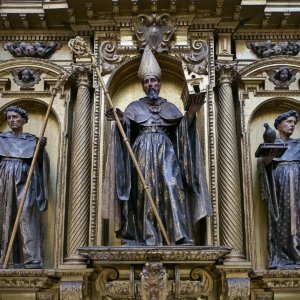
- San Agustín (Felipe de Ribas, c. 1650) *
-
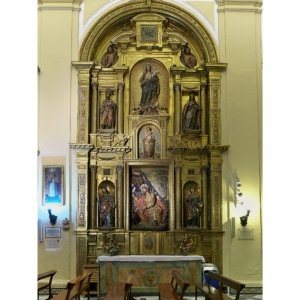
- Retablo de San Juan Evangelista (Martínez Montañés, 1632) *
-
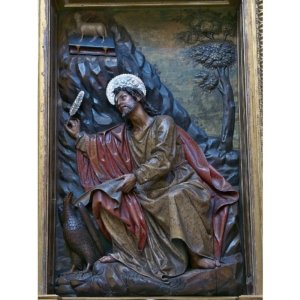
- San Juan Evangelista en Patmos (Martínez Montañés, 1632) *
-
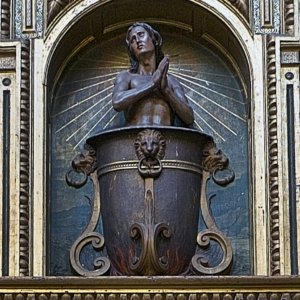
- Martirio de San Juan (Martínez Montañés)
-
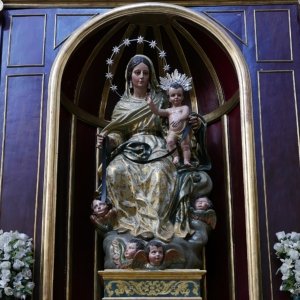
- Virgen de la Consolación y Correa (Sebastián Santos Rojas, 1932) *
Altarpieces on the Gospel wall:
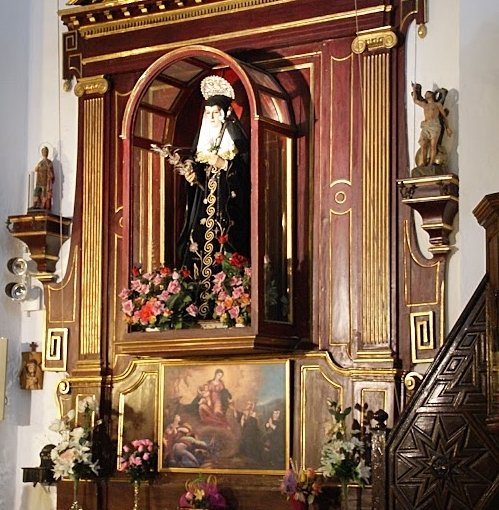
- Altarpiece of Saint Rita of Casia. It is a simple neoclassical altarpiece with a 19th century dress image as the title. Saint Rita has great popularity among parishioners, linked to the popular consideration of her as a lawyer in impossible causes. On the bench of the altarpiece there is a painting, also from the 19th century, that again represents the passage from “The Virgin giving the cingulum to Saint Monica.”
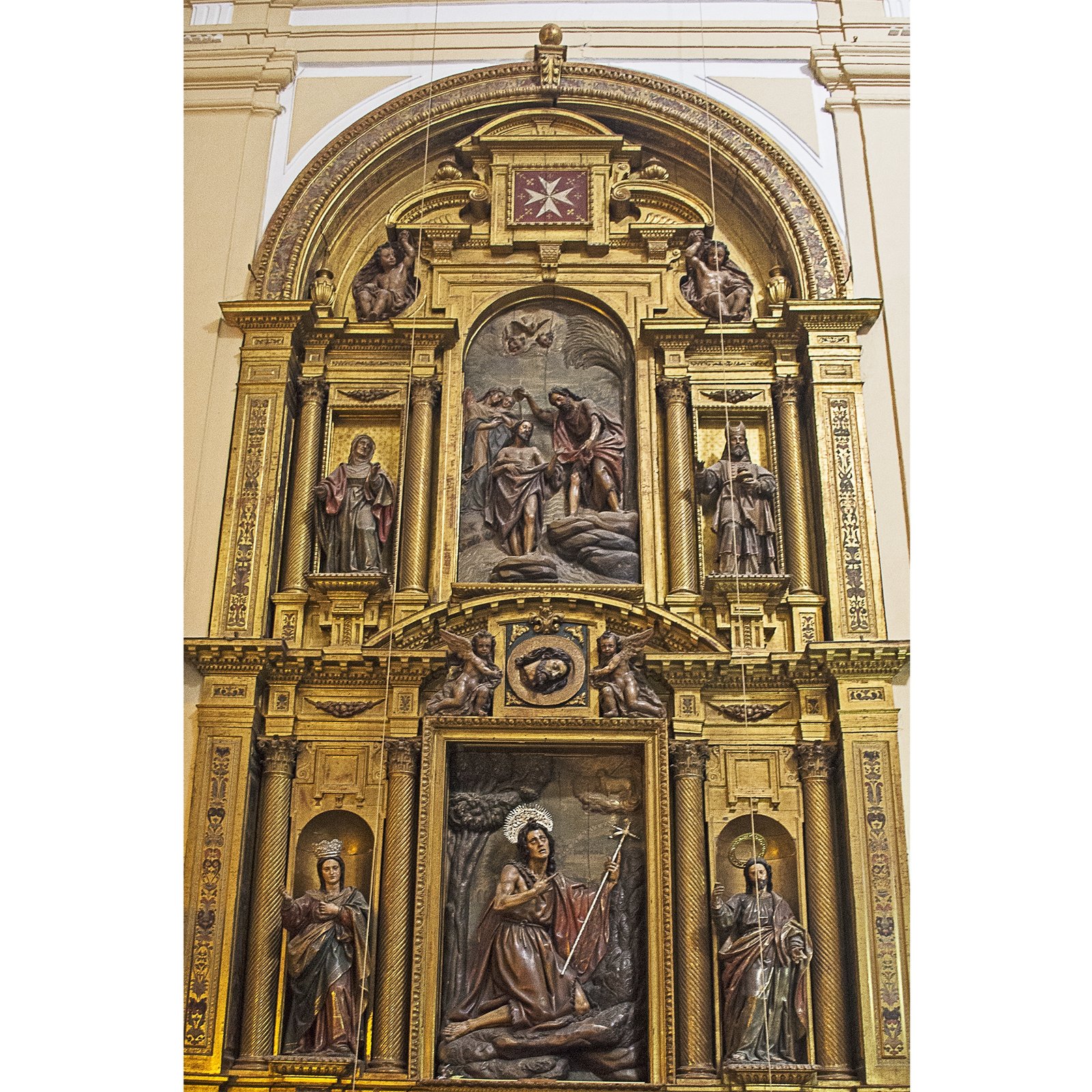
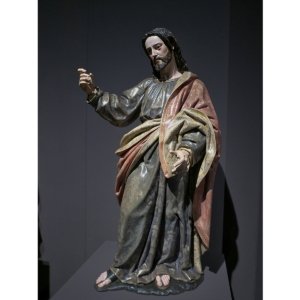
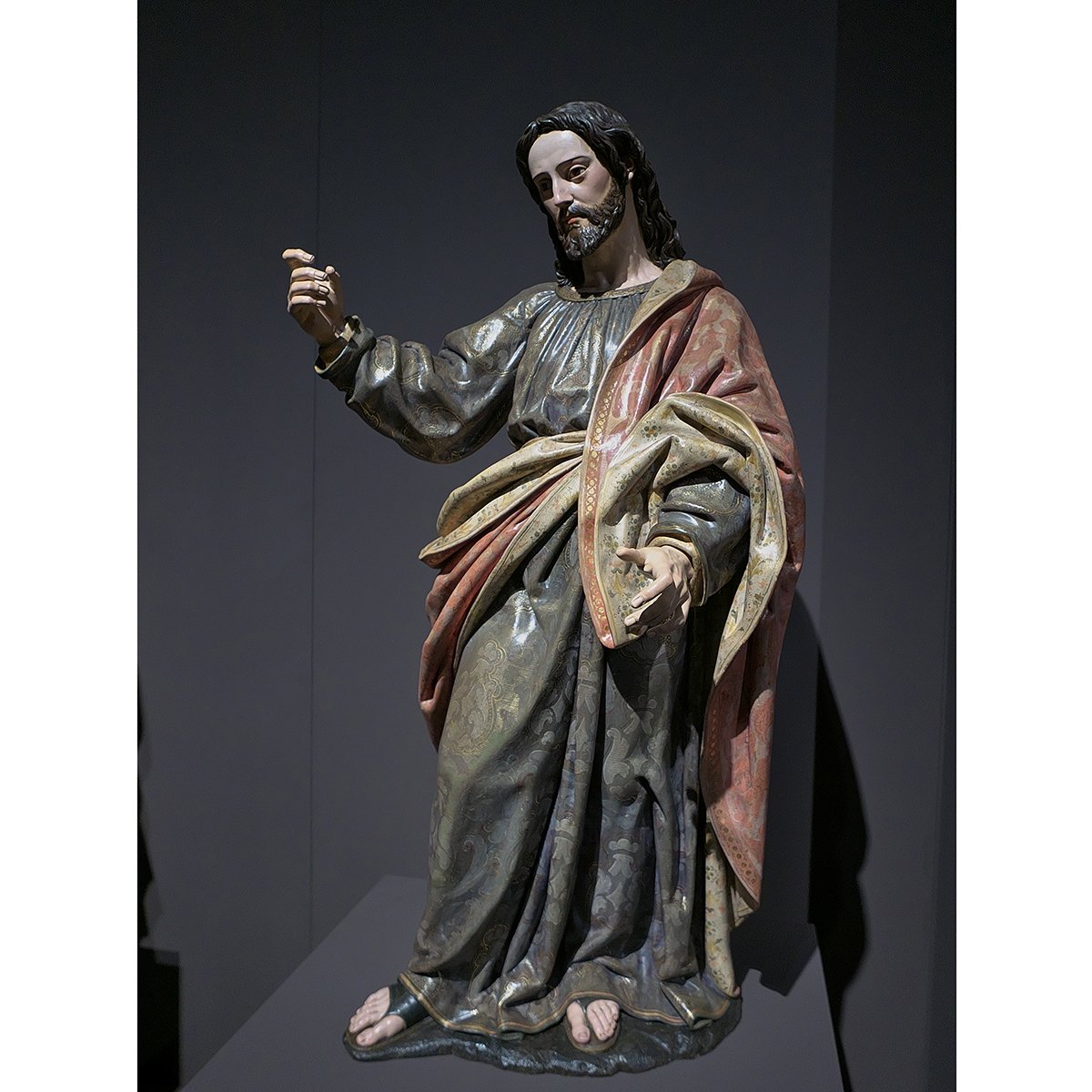
-Altarpiece of San Juan Bautista, contracted to Martínez Montañés in 1621, although most of the sculptures are the work of his workshop and not of the master personally. Once again we find the classic structure of the mountain altarpieces. In the central niche of the first body we see a splendid relief that shows the Baptist kneeling and pointing to the Lamb of God who appears in the upper right corner on a cloud. It alludes to the famous phrase uttered by John upon seeing Jesus: “This is the Lamb of God who takes away the sin of the world.” According to its quality and characteristics, this part of the altarpiece is considered the personal work of Martínez Montañés. On both sides we find the Virgin Mary and Saint Joseph.
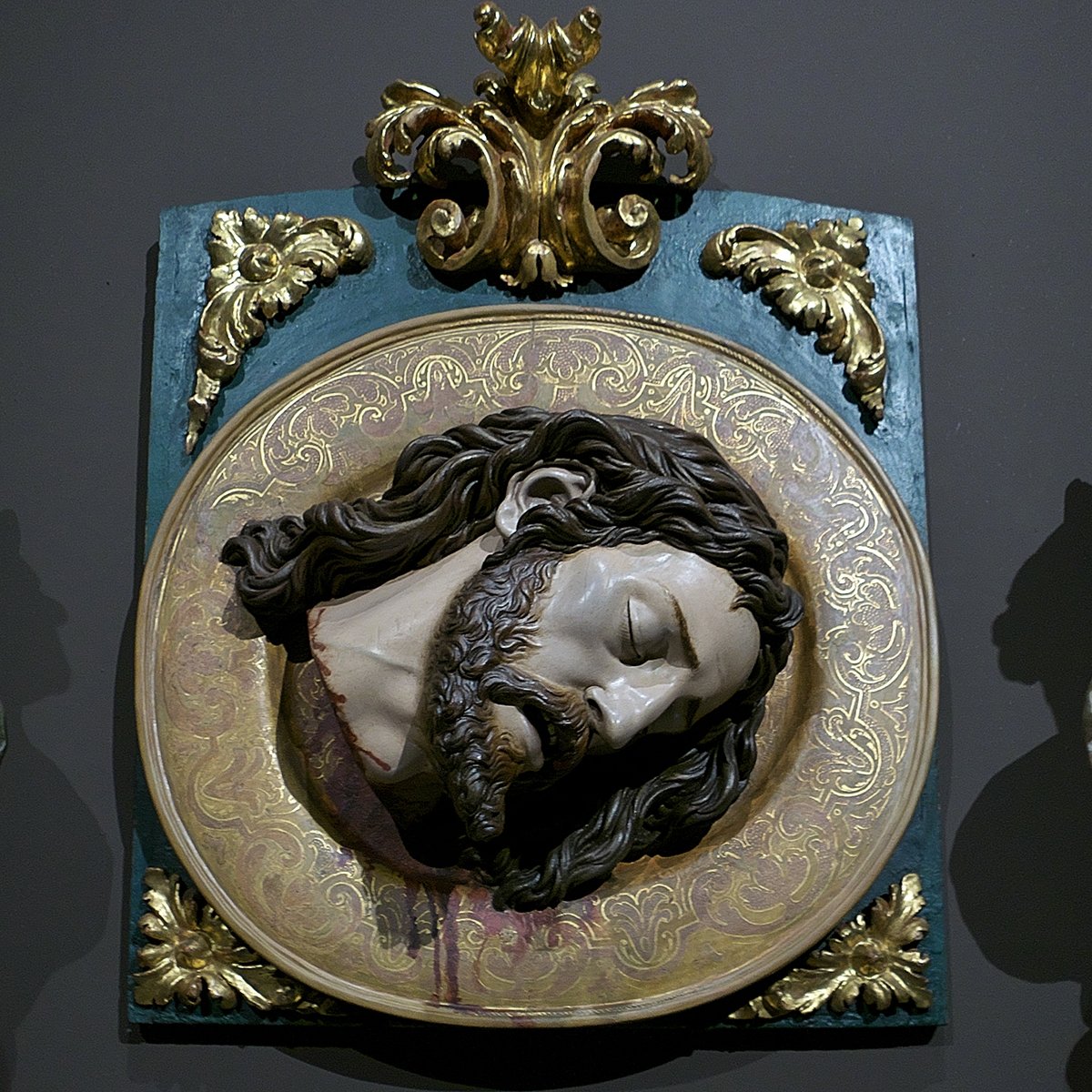
On the relief of the Baptist, two angels support the masterful representation of the saint's head, also considered to have come from the master's gouge. In the center of the second body we find a Baptism of Christ, with a composition very similar to what we can find in the altarpiece with the same theme and workshop found in the church of the Annunciation. On the left is Saint Elizabeth and on the right is her husband Zechariah. In the attic, the Maltese cross or the Order of Saint John of Jerusalem refers to the dedication of the altarpiece.
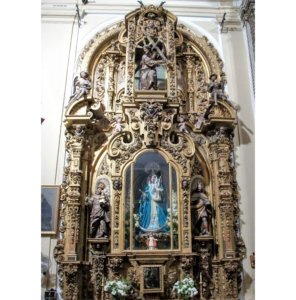
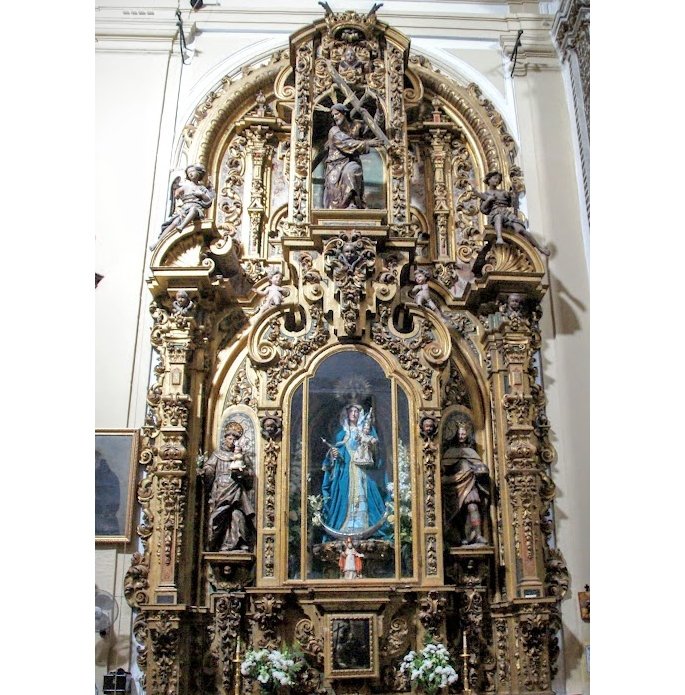
- Next to the presbytery there is an interesting baroque altarpiece made by José Maestre in the second half of the 18th century. For a long time it housed the image of Saint Rita, but today it houses in its central niche a dress image of the Virgin and Child, probably also from the 18th century. In the side streets we find San Antonio de Padua and San Fernando. An expressive and beautiful Nazarene Jesus stands out in the attic, who seems about to fall exhausted from the weight of the cross.
-
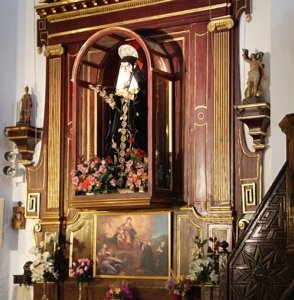
- Retablo de Santa Rita de Casia (XIX) º
-
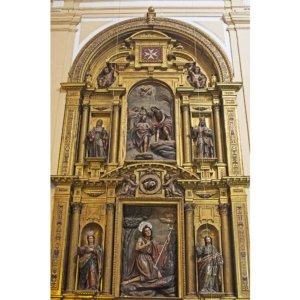
- Retablo de San Juan Bautista (Martínez Montañés, c. 1621) *
-
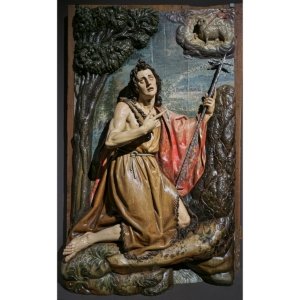
- San Juan Bautista (Martínez Montañés, c. 1621) *

-
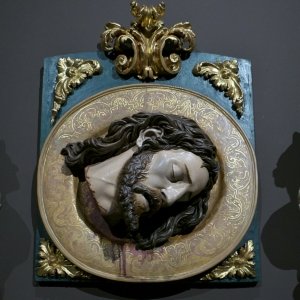
- Cabeza de San Juan Bautista (Martínez Montañés, c. 1621) *
-
- San José (taller de Martínez Montañés, c. 1621) *
-
- Retablo de la Virgen con el Niño (José Maestre, segunda mitad del XVIII) º
📷 * : Wikimedia Commons │ º : Leyendas de Sevilla