ROYAL ALCÁZAR

The Alcazar of Seville is one of the most fascinating royal residences in Spain. This is due to the fact that it does not respond to a single project undertaken at a given moment, but rather is the result of numerous construction phases that have taken place throughout its history.

It has been used continuously as a royal palace since its Muslim origins, back in the 10th or 11th century, until today, in which it is still the oldest royal palace in use in Spain and Europe. Throughout its history, the different monarchs who have inhabited here have been adapting the different palaces, courtyards and gardens to the tastes of each era, until configuring the marvelous and diverse complex through which we can walk today.

Although its origin is a set of Muslim palaces, very little remains of this early period of the Alcázar. Most of the palaces that we are going to see correspond to the reforms undertaken in Christian times by:

- Alfonso X the Wise, who built the so-called Gothic Palace in the 13th century.

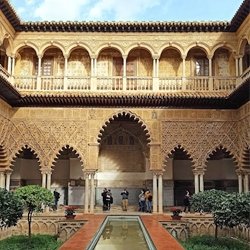
- Pedro I, called by some the Cruel and by others the Justiciero, who built the wonderful that is the true heart of the Alcázar. It was built in the middle of the 14th century and constitutes the peak of the Mudejar style.

- In the reign of the Catholic Monarchs, the so-called Casa de Contratación was built, of which we will also see some rooms on this side, intended to centralize and organize trade with the Indies, after the discovery of America in 1492.

All this is surrounded by a magnificent set of patios and gardens, which have been added and reformed until very recent times. It must be remembered that a part of the Palace of Pedro I, specifically the upper floor, is still used as the residence of the kings of Spain when they are in Seville.

Thanks to all this, its long history, its beauty and its architecture, the Real Alcázar of Seville was declared a World Heritage Site by UNESCO in December 1987, together with the nearby cathedral and Archivo de Indias.

[mapsmarker map="2"  lat="37.384222" lng="-5.991888" zoom="18" height="300" heightunit="px"]

OLD CASTLE OF SAN JORGE

In the place where the Triana Market is located today, a castle was built in the Almohad period (XIII) that would later be known as the castle of San Jorge. It may have been built on previous constructions, even Roman or Visigothic, and that it was refortified after the Muslim defeat in the battle of Las Navas de Tolosa (1212).

‘Annales d'Espagne et du Portugal’, 1741

It had ten towers that articulated a robust fortified space with a rectangular plan. The Christians would establish the headquarters of the Inquisition in Seville there in 1480, so it is certain that it was the scene of numerous episodes of imprisonment and torture throughout its history. Some of the events that occurred there have been narrated as brilliant as the one offered by Beethoven in his opera "Fidelio", which is set in this castle.

It continued to be the seat of the Inquisition until the end of the 18th century, when it was abandoned. Already at the beginning of the 19th century it was demolished and a market was built on its site. At the end of the current market, in the part that faces Castilla street, some of the great walls that belonged to the primitive castle can still be seen today.

[mapsmarker map="2"  lat="37.385606" lng="-6.003191" zoom="18" height="300" heightunit="px"]

WALL OF THE JEWISH QUARTER

In Fabiola street we find a fragment of the wall barely ten meters long, which constitutes the only visible remains of the Jewish quarter wall that have come down to us. This wall was built in the 13th century to separate the Jewish community of Seville from the rest of the city, surrounding the current neighborhoods of Santa Cruz and San Bartolomé. This fence had a series of gates that were closed at night, trying to guarantee the safety of the Jewish community in the city. However, the monumentality of this wall did not prevent violent episodes, such as the dramatic assault in 1391 that killed hundreds of Seville Jews.

CC BY-SA 4.0

The fragment that we see here is made of mud and at its base we can see the characteristic millstones inserted, so common in many of the buildings in the neighborhood. Its original purpose was to avoid possible damage caused by the axles of the wheels of the carts, especially on narrow roads like this one.

[mapsmarker map="2"  lat="37.387470" lng="-5.989484" zoom="18" height="300" heightunit="px"]

REAL DOOR OR GOLES DOOR

In this space was located one of the gates of the walled enclosure of the city. Today disappeared, only the canvas of the wall that had an annex has come down to us. It was called Puerta de Goles at least since the Christian conquest of the city until the 16th century. It became known as the Royal Gate after Philip II visited Seville in 1570, being the first king to enter the city through this gate. Until then, the monarchs entered the city through the Puerta de la Macarena.

CC BY-SA 4.0

[mapsmarker map="2"  lat="37.393339" lng="-6.001456" zoom="18" height="300" heightunit="px"]

WALL OF THE CABILDO SQUARE

We can see here a fragment of about 60 meters of wall, built in the 13th century creating a fortress that was located in this area as part of the complex defensive framework that surrounded the Alcázar and the great mosque at the end of the Islamic period.

CC BY-SA 4.0

It is built with mud wall and preserves the walkway and the battlements. To the north, a tower has also been preserved, but it is not visible from the part of the Cabildo as it has lost its upper part and is therefore covered behind the wall.

At the exit from the square towards Arfe street, inserted between the residential building, another fragment of the wall can be seen, with the same dating and characteristics.

[mapsmarker map="2"  lat="37.385618" lng="-5.994709" zoom="18" height="300" heightunit="px"]

GATE OF OIL

It is one of the few gates of the walled enclosure of the city that have survived to this day. Its original construction has been dated to the Almohad period, probably in the 12th century, and it has been identified with the 'bab al-Qatai' or 'Gate of the Ships', which is mentioned in Muslim sources. This name would come from its proximity to the Almohad shipyards, also built in the 12th century.

The current name already appears in Christian times, in relation to the market and the oil warehouses that were located in the vicinity.
Its current appearance is far from the original and is mostly due to the reform undertaken by Benvenuto Tortello in the 16th century, focused on facilitating vehicle traffic through the shutter.
Also from the 16th century seems to be the monumental shield of Seville that is located on the opening towards the center of the city. It has been attributed to the Renaissance sculptor Juan Bautista Vázquez el Viejo.
Next to the Postigo is the small Chapel of La Pura y Limpia, built in the 18th century. There a small image of the Immaculate attributed to Pedro Roldán is venerated.

[mapsmarker map="2"  lat="37.385232" lng="-5.995009" zoom="18" height="300" heightunit="px"]

WALLS OF ALCAZAR

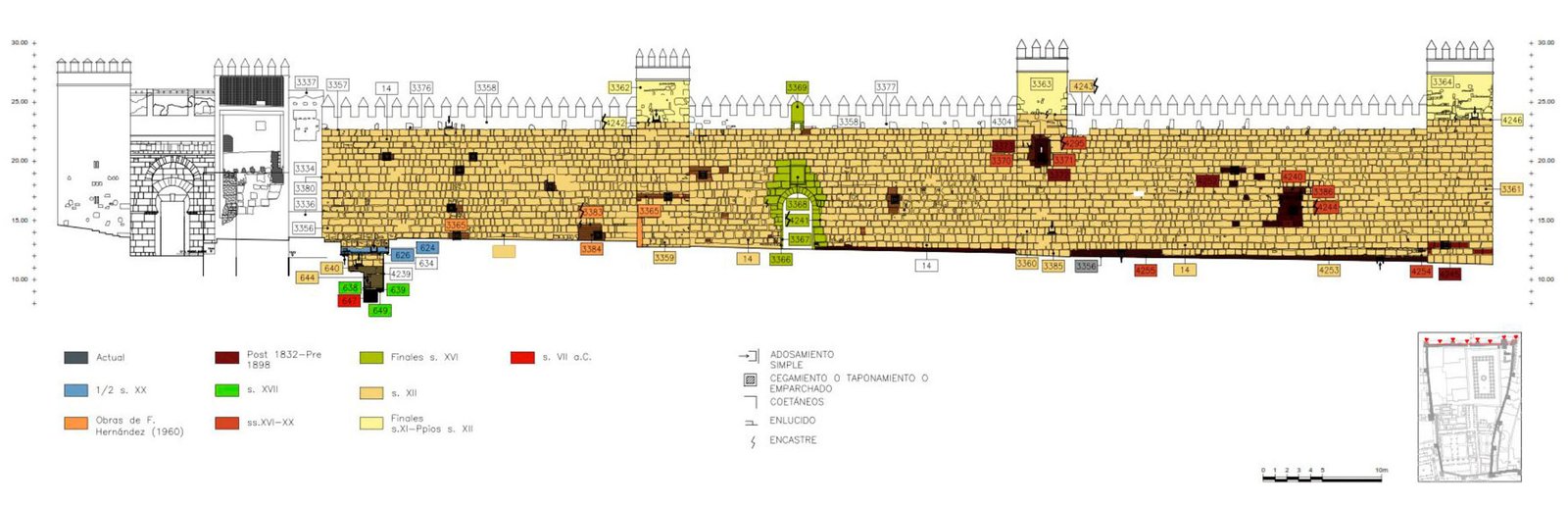
The walls that enclose the Alcázar of Seville on its northern side, towards the Plaza del Triunfo, are the most monumental and beautiful of those preserved in the city. Unlike the rest of the walls of Seville, here they were built using enormous stone ashlars, many of them from the old Roman walls, which were not in use due to the differences in height and dimensions between the Roman and Islamic city.

The exact chronology of this stretch of walls has been the subject of academic debate on numerous occasions. Traditionally, they have been identified with those that protected the "Dar al Imara" or "House of the Governor", a fortified palace that some sources mention was built in Seville during the Caliphate period (20th century).

However, archaeological research and study of the materials, led mainly by Professor Miguel Ángel Tabales Rodríguez, place the construction of this northern wall of the Alcázar in the Taifa period, already in the 11th century.

It is true that the use of ashlars to build defences in the cities of Al Andalus was a common practice, especially during the Caliphate period. But when the disintegration of the Caliphate took place, the resulting taifa kingdoms "saw in the construction of large walls imitating the caliphal ones an argument to reinforce their aspirations for domination, showing in each case the limitations in the use of the characteristic technique of each region in the absence of state programs and the decrease in the personnel and resources of a large state, now reduced to the control of municipalities and small states that were very deficient.

This is the case of Seville, a city with aspirations during the Abbadi dynasty, but very limited by its size and population, at least at the beginning of the works; yes, with the enormous advantage of having as construction material the magnificent quarry of blocks, already carved, as was the Roman wall of the city. In any case, the construction and implementation systems used were of proven solvency and resorted to solutions already known since Antiquity." (Tabales Rodríguez, M.A., Gurriarán Daza, P. "The construction of the Alcázar of Seville". Construction reports, nº563, 2021)

A series of seven rectangular towers, also built with ashlars, have been preserved in the wall. In both the towers and the wall, the section that was later raised but still in the Islamic period, probably in the 12th century, can be seen at the top. The upper part, including all the crenellations topped by pyramidal pieces, seems to be a recent addition, from the 19th century.

In this section of wall we find two doors. The closest to the Plaza de la Alianza is the Puerta de la Herradura, now blocked off. It owes its name to its horseshoe arch shape, framed by an alfiz. Apparently, it originally gave access to a guard post or tower.

In the Plaza del Triunfo we find the Puerta del Patio de Banderas, probably opened in the Almohad period (12th-13th century), as the two columns with capitals from this period that flank it on the patio side seem to attest. However, the materials that make up this entrance today seem to come from a reform undertaken at the end of the 16th century.

The wall in which the Puerta del León is located today was also built in the Almohad period. The towers that flank this door are, therefore, from different periods. The one on the left side, built with ashlars, is from the Taifa period (11th century), while the one on the right was built in the Almohad period (13th century), mostly in brick. Next to this second one, and facing Miguel de Mañara street, you can see the original entrance to the Almohad Alcázar, blocked when it was replaced by the current Puerta del León, opened during the reign of Pedro I (14th century).

TOWER OF ABDELAZIZ

Also called Torre de Santo Tomás. It was built in the Almohad period, in the 13th century, as part of the canvas of the wall that linked the Alcázar with the Torre del Oro. It has a hexagonal floor plan and is about 15 meters high, being solid in the first 8 meters.

It is built with brick, reinforced with ashlars at the base and at the corners. In its upper half, it is crossed by the two horizontal stripes so characteristic of the Almohad towers. Each wall is decorated at the top with polylobed blind arches framed by alfices.

[mapsmarker map="2"  lat="37.384020" lng="-5.993563" zoom="18" height="300" heightunit="px"]

GATE OF ABDELAZIZ

Also called Arco de la Plata or Arco de Mañara. It is one of the entrance doors through which the walled enclosure that surrounded the Alcázar was accessed. It was built in the Almohad period, probably already in the 13th century, like the Torre del Oro. From the Islamic construction, the original horseshoe arch, framed by an alfiz, can still be seen from the Avenida de la Constitución.

However, most of what has come down to us responds to the reform undertaken in the fourteenth century, in Christian times. It was then that the Gothic rib vault that covers it today was arranged.

[mapsmarker map="2"  lat="37.383801" lng="-5.993399" zoom="18" height="300" heightunit="px"]

WALL OF SAN GREGORIO STREET

This fragment of barely 20 meters of wall was built in the Almohad period, in the middle of the 12th century, forming part of the so-called third enclosure of the Alcázar. It was built when the Alcázar was enlarged to be configured as a citadel, doubling its original surface. It is built in mud, like most of the Sevillian walls, although in this case we can see how the original construction was increased at some later time with brick.

[mapsmarker map="2"  lat="37.383193" lng="-5.993023" zoom="18" height="300" heightunit="px"]