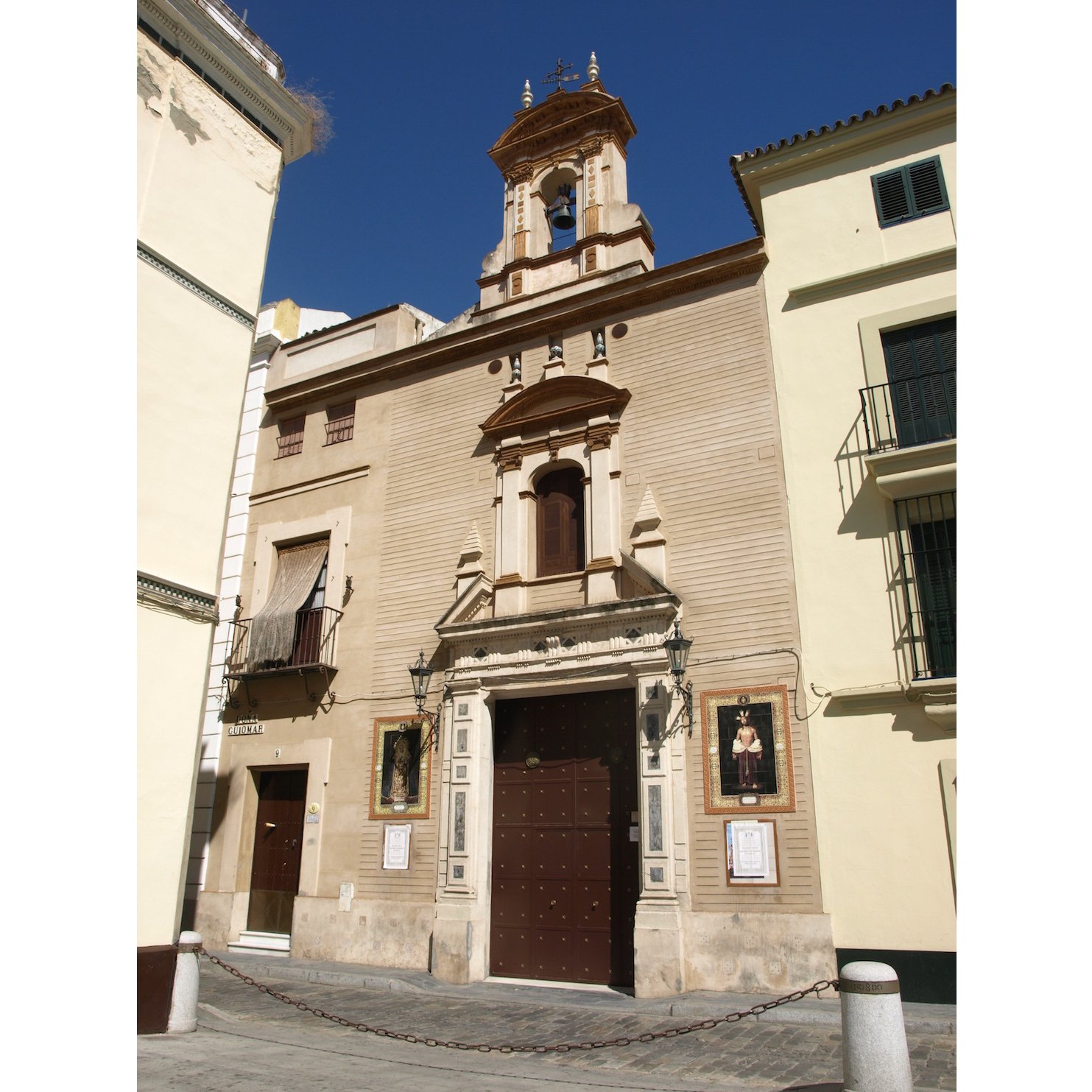
The chapel of the Mayor Dolor is a small 18th century temple located in the Plaza de Molviedro, which is why it is sometimes known as the Molviedro chapel. Today it is the headquarters of the Hermandad de Jesús Despojado, which processes on Palm Sunday.
The area where the chapel is located was known since the Middle Ages as the Laguna or Compás de la Laguna, since it was an unbuilt area within the walled enclosure in which an extension of water of this type was formed. It was also the area where the brothel was historically located, very close to the port, as is usual. This brothel was separated from the rest of the city by a wall, so the area of the Compás was wedged between the city wall and this wall.
-
- *
Very close to the current chapel there was a more modest hermitage, where a brotherhood dedicated to the Holy Cross and Our Lady of the Greatest Sorrow was based. The wrought iron cross on a marble column that is now in the square recalls the location of this primitive hermitage.
The chapel that has survived to this day was built in the second half of the 18th century, within the framework of the general urbanisation that took place in this area of the city. Manuel Prudencio de Molviedro, a merchant from Viana settled in Seville, took over a large part of the neighbourhood and began its redevelopment during the mandate of Pablo de Olavide (1767-1776). Within this transformation, Manuel Prudencio promoted and financed the construction of the chapel, which would be consecrated in 1779. Since 1856 the old Plaza del Compás de la Laguna was renamed Plaza de Molviedro in honour of this Navarrese benefactor.
In 1956, the chapel was ceded to the Congregation of the Claretians, who in turn ceded it to the Brotherhood of Jesús Despojado in 1982.
Outside
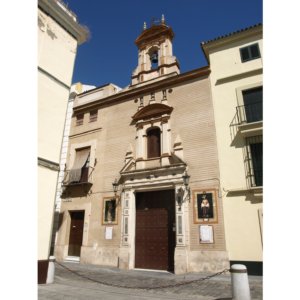
The chapel has a rectangular floor plan with a single nave. It only has one façade on the outside, the one at the foot, which opens onto the square. It is very simple in composition. A large lintelled opening, framed by pilasters and covered by a split triangular pediment. In the centre of the pediment there is a second body, this time topped by a curved pediment, framing a window. In the upper part of the façade there is a simple but elegant belfry, with a single bell and also topped by a curved pediment. On both sides of the façade there are ceramic altarpieces dedicated to Jesús Despojado and to the Virgen de los Dolores y Misericordia, the titulars of the brotherhood that has its headquarters in the chapel. They were made in 2007 in the ceramic workshop of José Jaén in Mairena del Alcor.
Inside
The interior is divided into two sections by pillars: the presbytery and the nave itself, each covered by vaulted ceilings. The altarpiece is the original Baroque from the second half of the 18th century. Today it is presided over by the image of Jesus Stripped of his Garments, carved by Antonio Perea Sánchez in 1939.
It happens that it was made in the provincial prison of Seville, since the sculptor was in prison, accused of having helped the resistance when Franco's troops took Seville in 1936. The sculpture was reworked in 1974 by Antonio Eslava Rubio, who completely remade the body, keeping the head.
In the niche on the left, the image of the Virgin of Sorrows and Mercy is worshipped, made in 1962 also by Eslava Rubio. To the right is the image of Saint John the Evangelist made by Juan González Ventura in 1981. This carving accompanies that of the Virgin on her palanquin during her processional exit every Palm Sunday.
In the centre of the second body of the altarpiece there is a sculptural group with Saint Anne teaching the young Virgin to read. To the right is Saint Basilisca (identified by José Gestoso as Saint Gertrude) and to the left we find Saint Michael. All of them are anonymous carvings made in the 18th century, forming part of the original sculptural decoration of the altarpiece.
The image that presides over the small altarpiece located on the right wall of the nave is from the same century. It is Our Lady of the Greatest Sorrow, the titular image of the temple. It is also an anonymous sculpture that represents the Virgin kneeling at the foot of the Cross.
On the walls, the images of Saint Joseph with the Child, Saint Ferdinand and Saint Genoveva Torres are worshipped, as well as two canvases with copies by Murillo, one with the "Holy Family" and another with "Saint Anthony and the Child".
* : Wikimedia Commons.
