(14th century) His name was Joseph ben Ephraim ha-Levi Benveniste, although he is known as Yuçaf or Jusaph de Écija because he was born in this city in the province of Seville at the end of the 13th century. He held the position of almojarife and advisor to King Alfonso XI, dealing mainly with financial matters. This monarch focused his reign on the fight against the Muslims in the area of the Strait and Granada, so his court was based mainly in Seville.
The Infante Don Felipe de Castilla, son of Sancho IV, recommended Beneviste to his nephew Alfonso XI, since he was captivated by Benveniste's great gifts, his pleasant manners and his talent for music. The king, no less delighted than his uncle, named Benveniste almojarife, a position that entailed the functions of a finance minister. He was also considered the king's most trusted (private) advisor, and thus had a very influential position. He travelled in a state carriage, was escorted by knights on his journeys, and the great dined at his table. This greatness could not fail to arouse envy, and Benveniste had to fight against the conspiracies of his enemies, under whose attacks he eventually fell.
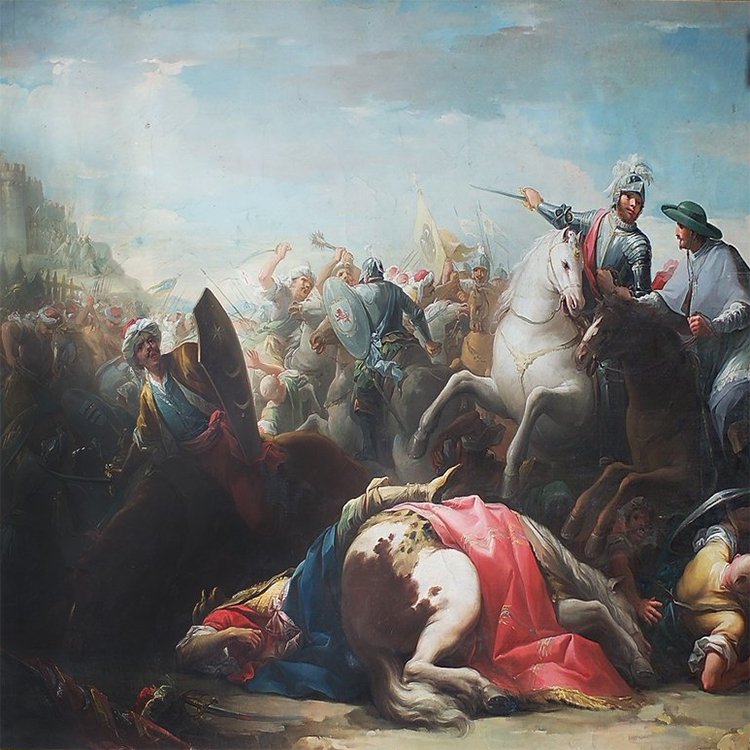
Artistic representation of the Battle of Salado, for which Yuçaf de Écija and other notable Jews contributed funds in support of the Christian king Alfonso XI. The image belongs to an 18th-century oil on canvas by Salvador Maella. The original is preserved in the Casita del Príncipe of the Monastery of El Escorial.
As a sign of his confidence, Alfonso sent him to Valladolid to bring his sister, Doña Leonor, to Toledo (1328). In this city, a mob of people instigated by Benveniste's enemies attempted to kill him and his attendants. The Infanta saved his life by welcoming him into the Alcázar of that city and refusing to hand him over to the rioters.
The plot having failed, Benveniste's enemies resorted to slander. Many complaints against his administration were made to the Cortes of Valladolid; and the king, tired at last of these constant complaints, dismissed Benveniste from the council and the post of almojarife.
Yuçaf apparently maintained a good relationship with the Crown even after his dismissal. It was he who was responsible for the creation of a new synagogue in Seville. The letter from King Alfonso XI to Pope Clement VI requesting permission to recognize this new synagogue as such is preserved. The document is very interesting because the monarch does not hesitate to praise the work of the Jewish community of Seville in his service.
Luciano Serrano Pineda, in an article in the CSIC entitled “Alfonso XI and Pope Clement VI during the siege of Algeciras”, tells us about Yuçaf:
This Minister of Finance had been the soul of the Royal Council in the war against Granada from 1328 to 1332; but overthrown from the privilege by emulators of his own religion, he had to leave the King's house, despite the protection that the latter gave him. Furthermore, if we do not misinterpret the Monarch's request to Clement VI, Jusaph de Écija did not limit himself to advancing him money and taking personal part in the aforementioned war; he continued to give his support for the battle of Salado (1340) and in the preparation of the siege of Algeciras. It is known that during this siege there were Jewish personalities accompanying the king and that they were in charge of advancing the money for the special contribution that the kingdoms had to give in 1343 to the Castilian sovereign. These merits of Jusaph and those that the King attributed to the Hebrews in general, and especially those of Seville due to contributing large contingents to the municipal budget and even being part of the municipal troops against the Moors, were invoked by Coronel on behalf of the Monarch to obtain official recognition from the Pope of the synagogue that Jusaph had built in Seville "for the increase of his race."
In his later years, Benveniste was involved in a network of envy and conspiracies that would ultimately end his life. Samuel ibn Wakar, Alfonso's doctor, enjoyed high royal favor. Alfonso entrusted him with the management of the income derived from the import of goods from the kingdom of Granada. Benveniste, jealous of his coreligionist's influence, offered a larger sum for the right of management of import duties. Samuel, in revenge, privately persuaded the king to stop the Moors' exports, despite the existing treaties. A war with the Moors ensued. Alfonso's treasury being exhausted, Gonzalo Martinez, who had served under Benveniste and had become influential through his recommendation, proposed to purchase from the king ten of the leading Jews, for whom he would pay 800 pounds of silver. The king, compelled by his need of money, consented. Martinez hastened to seize his former benefactor and send him to prison, where he died.