The Carretería chapel is a small 18th-century temple located in the Arenal district of Seville. It is one of the smallest chapels in Seville, with less than 100 square meters. As its name indicates, it is the headquarters of the Carretería brotherhood, which processes on the afternoon of Good Friday.
The location of the temple responds to a miraculous event that tradition points to in this place. Apparently, in the mid-16th century, a member of the barrel guild found an image of the Virgin hidden behind a wall in this area. The image gave off a very bright light, which is why it received the invocation of Our Lady of Light. After this event, it was decided to found the brotherhood, whose germ would be the aforementioned barrel guild (1550).
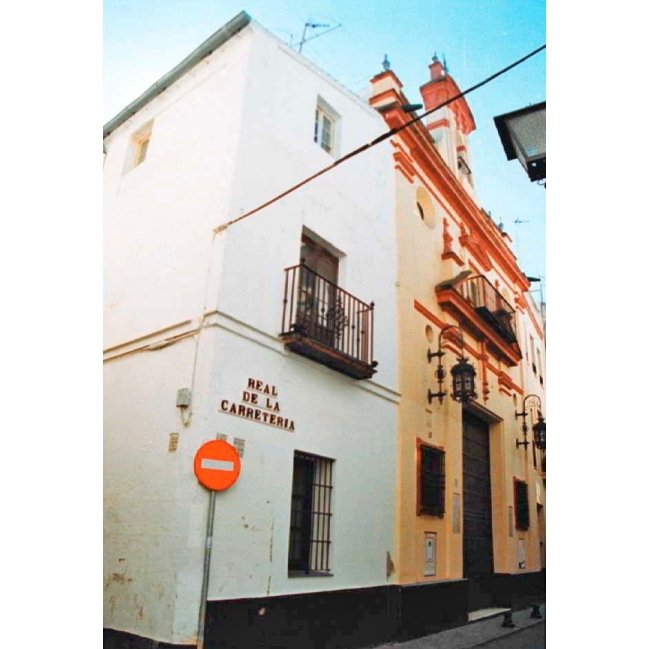
The current chapel was built between 1753 and 1761 based on the plans of Juan Núñez. It has a single nave, covered by a groin vault, except in the presbytery, where the vault is groined. At the end of the 20th century, a new chapel was added to the right to house the image of the Virgin of the Greatest Sorrow in her Solitude.
The façade is neoclassical and very simple. Two pillars frame the entrance and support a split pediment, in the centre of which there is a niche, topped by a triangular pediment. In the centre of the upper part there is a single-bay belfry with the bell.
Inside the chapel, the members of the Carretería brotherhood receive worship. The Cristo de la Salud is an extraordinary carving by an anonymous author that has been dated to the beginning of the 17th century. Although no documentation has been preserved, based on its style, Francisco de Ocampo has been pointed out as its possible author. The Virgin of Light and Saint John are the accompaniers, works from the workshop of Pedro Roldán from around 1677.
In the side chapel there is the image of Our Lady of the Greatest Sorrow in her Solitude. Originally, it was the image of Mary that accompanied the Crucified Christ in the procession of mystery, although since 1885 it has been carried in its own procession of pallium. It is attributed to Alonso Álvarez Albarrán and has been dated to 1629.
We also find a dressed image of the Virgin with the Child, with the invocation of Our Lady of Light (of glory), which it shares with the aforementioned. Traditionally it has been identified with the image that miraculously appeared in this place around 1550. However, a stylistic analysis makes it clear that the image was made in the second half of the 18th century. It is possible that the current image was made from the remains of the original or that, for some reason and at some time that we do not know, it was decided to replace it.