The growing anti-Jewish atmosphere that developed during the 14th century reached its climax in 1391, when a wave of violence that began in Andalusia swept through most of the peninsular territories, leaving numerous Jewish communities destroyed and hundreds of human lives lost.
The initial spark that unleashed this wave of violence was lit in Seville. The Jewish quarter of Seville was one of the most important in Castile, with many of its members in a very advantageous socio-economic situation, which perhaps served as an incentive for the growing hatred among Christians. In this context, there was a person who was especially responsible for what happened. This was the sadly famous Ferrán Martínez, a clergyman who worked as a preacher, fuelling hatred against the Jews. It is known that in numerous public speeches he defended all kinds of theories against the Hebrew people. The basis of his reasoning was to justify all the sufferings of the kingdom with a divine punishment that would come from the fact that the "deicidal people" were allowed to live among Christians. The authorities were aware of the dangerous message and both King John I and Archbishop Gomez Barroso admonished the religious man and required him to put an end to his diatribes. However, the archbishop died in 1390 and the king in 1391, producing a situation of power vacuum that was exploited by the archdeacon to further increase his hate speech.

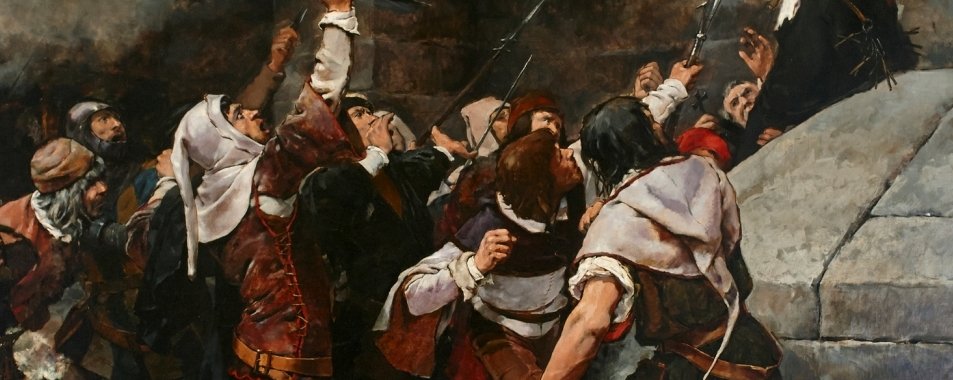
Reenactment of the anti-Jewish massacre of 1391 in Toledo. Vicente Cutanda, "A los pies del Salvador". 1887. Museo del Prado.
Finally, in June 1391, a violent mob broke into the Jewish quarter of Seville and unleashed a terrible massacre. Many Jews were forced to be baptized and many others were killed. It is not possible to know for sure how many people lost their lives; some contemporary sources speak of 4,000 dead, but this figure is clearly exaggerated. However, it is not unreasonable to think that hundreds of Jews lost their lives. The Jewish quarter of Seville, which had been the second most important in the kingdom, disappeared as such after this attack, with many of the Jewish possessions given to members of the court. It is believed that in the following century there were still about fifty Jewish families in the city, but they were dispersed throughout the city and in a state of impoverishment.
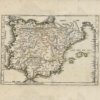
This wave of violence spread like wildfire through the Guadalquivir valley and within a few days similar attacks took place in towns such as Alcalá de Guadaira, Carmona, Écija, Cazalla, Fregenal, Córdoba, Montoro, Andújar, Jaén, Úbeda and Baeza. In Castile, the pogrom was soon reflected in Toledo, the most important Jewish quarter in the kingdom, and from there to Santa Olalla, Huete, Madrid, Segovia and Burgos. In the kingdom of Valencia, the Jewish quarter of the capital was the first to be attacked and from there the violence spread to Alcira, Játiva, Alicante and Orihuela. Practically at the same time, similar attacks took place in the area of Catalonia. Beginning in Barcelona, they multiplied in Tarragona, Gerona, Lérida, Besalú, Camprodón and Perpignan. In the Kingdom of Aragon, the Jewish quarters most affected were those of Tamarite de Litera, Barbastro and Jaca, while in the Kingdom of Majorca the Jewish quarter of its capital was attacked.
The pogroms of 1391 marked a turning point in the history of the Sephardic Jews. Many of them lost their lives and many others had their property taken away, which was plundered by violent assailants. Most of the Jewish quarters entered a phase of slow decline and many others disappeared. There have often been attempts to give a death toll and there are authors who have indicated that there could have been around 400 Jews killed in Seville, 250 in Valencia and around 300 in Barcelona. The reality is that there is no documentation that allows us to give a reliable figure.
But probably the main consequence of the massacres of 1391 was the great wave of conversions to Christianity that took place in the Peninsula. In fact, everything seems to indicate that the pressure on the Jews became so extreme that most of them decided to be baptized. It is logical to think that many of these conversions were not sincere, but were motivated by the terrible situation. In this way, the issue of converted Jews appears to be an increasingly important problem. If there was anything worse than being Jewish in medieval Spain, it was being a Christian who "Judaized," that is, a convert who in reality remained faithful to the Mosaic faith. These were called "marranos" and were the object of great social rejection.