CONVENT OF SANTA MARÍA DE JESÚS

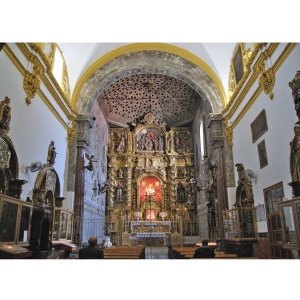
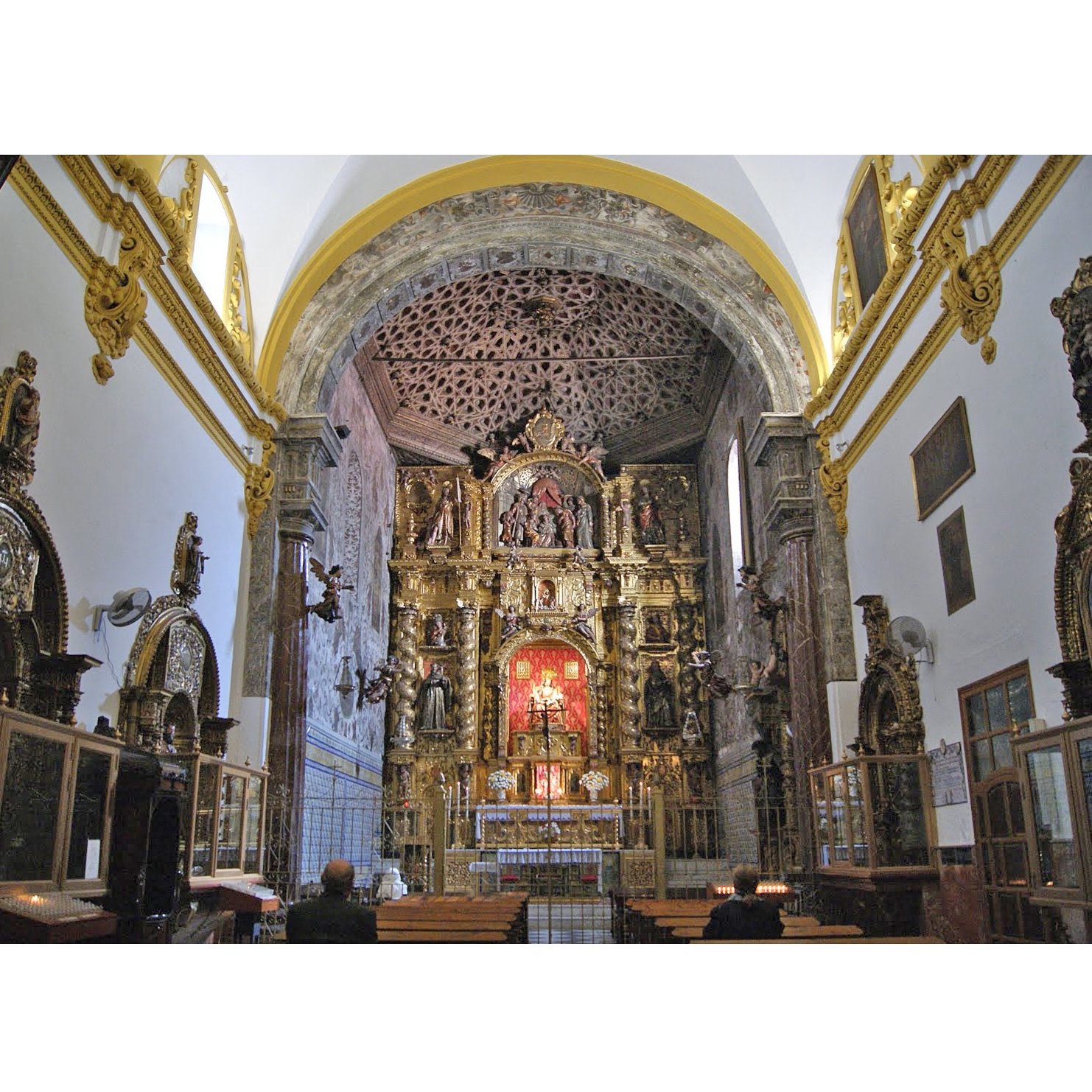
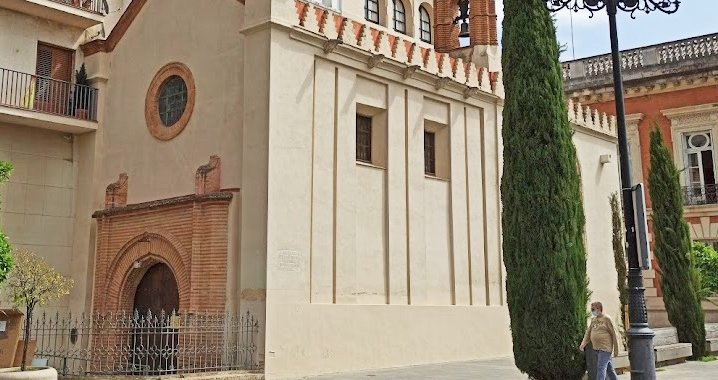
The church of the convent of Santa María de Jesús is the only currently visitable part of a monastic complex of Poor Clare sisters that has been located on Águilas Street since the 16th century. It is a classic “box church” ("iglesia de cajón"), so common in Sevillian convents, which is why it has a rectangular floor plan and a single nave.
History

The convent of Franciscan nuns of Santa María de Jesús was founded in 1502 by Jorge Alberto de Portugal and his wife, Filipa de Melo, who eventually became the first counts of Gelves by concession of Charles V. Since its origin it has been a convent of barefoot nuns of the First Rule of Saint Clare (Franciscan). The construction of the current church was undertaken at the end of the 16th century and was considerably renovated at the end of the 17th century and in the middle of the 19th century.

Another important milestone in the history of this church would be the disappearance in 1996 of the Sevillian Convento de Santa Clara, on Becas Street. The few nuns who remained in the cloister moved to this convent of Santa María de Jesús, bringing with them some of the movable property belonging to the old convent.

Outside

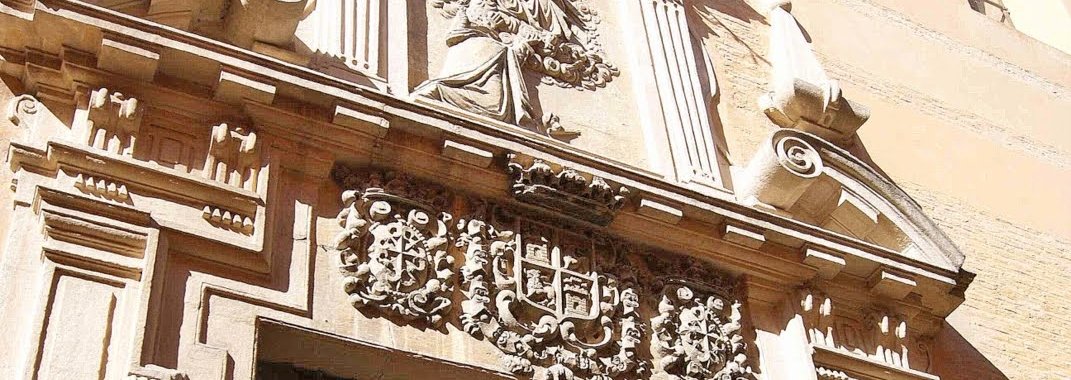
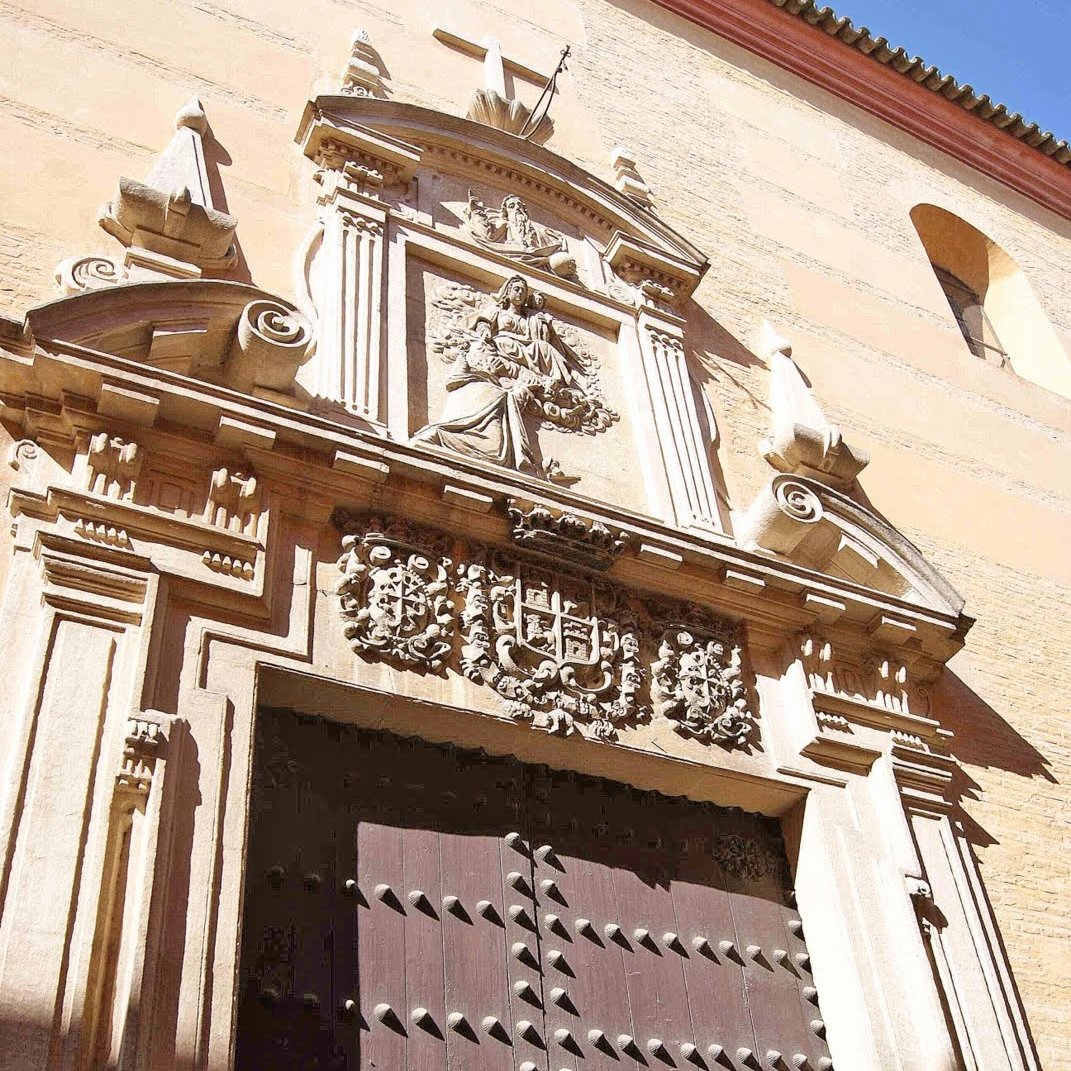
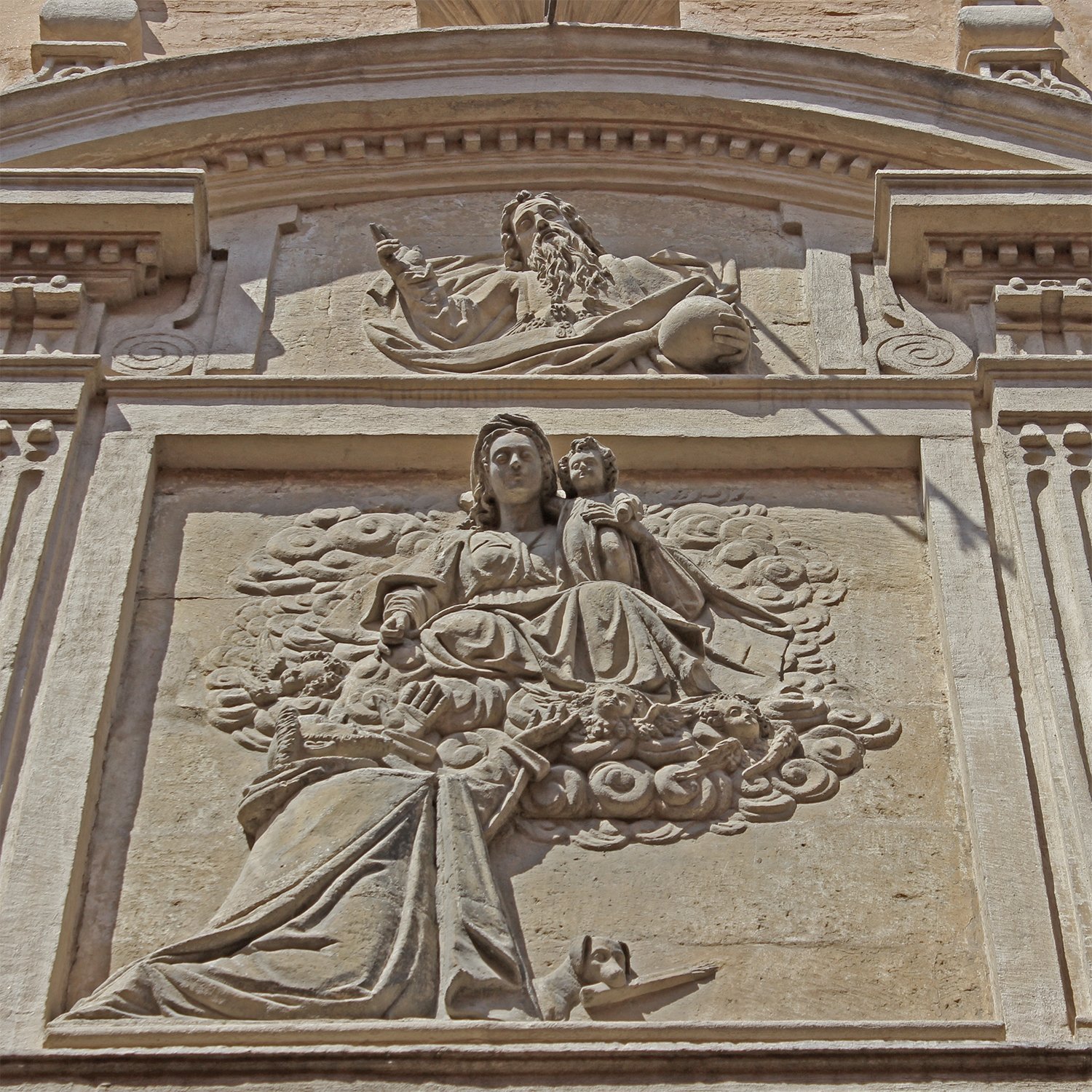
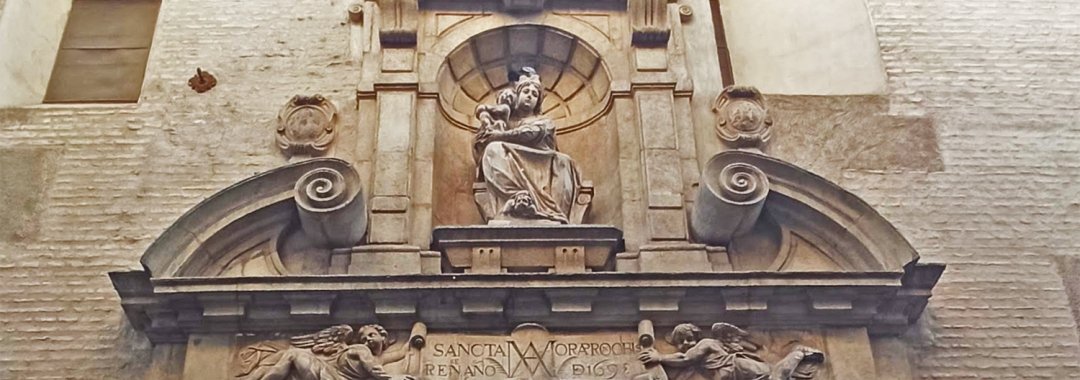
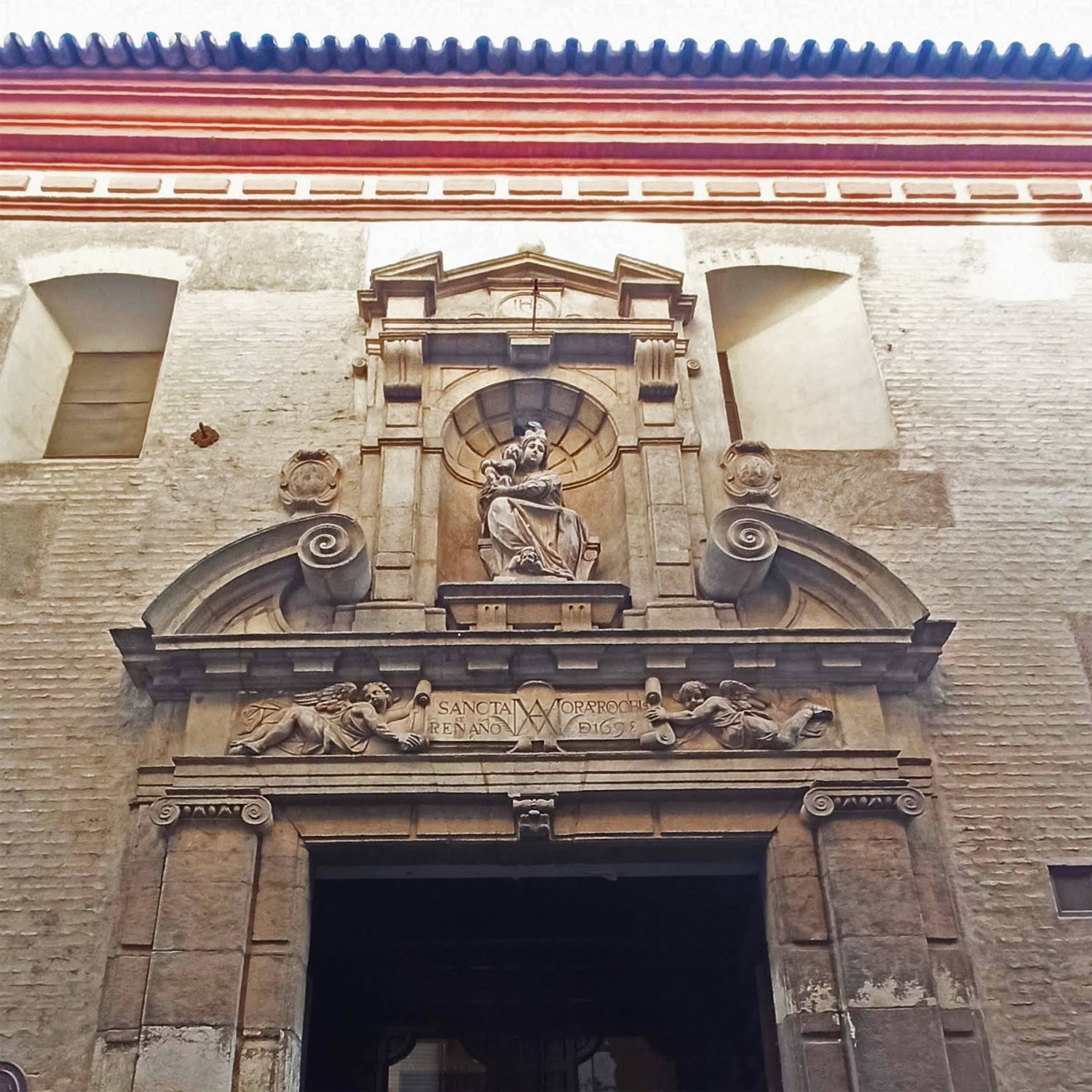
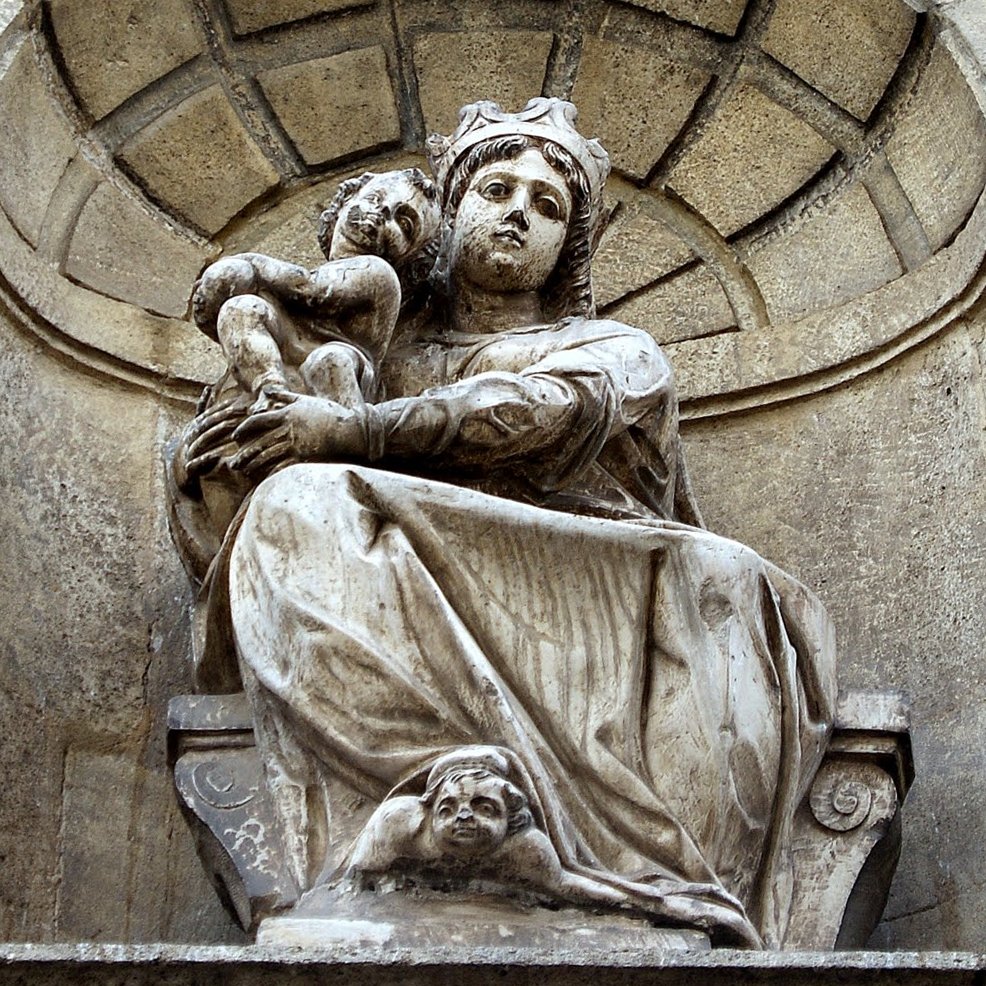
Access from the outside is through a Mannerist doorway open on the left wall, in whose design the architects Juan de Oviedo and Alonso de Vandelvira are known to have participated. It is a lintelled doorway, framed by classic Ionic style pilasters and topped by a split and curved pediment. Above the center is a niche, topped this time by a triangular pediment, which houses a beautiful seated sculpture of the Virgin holding the Child Jesus. On the lintel above the door, two angels hold an inscription that reads "Sancta María ora pro nobis", in which "María" has been replaced by the symbol of the Ave Maria (AM). Just below appears "SE REN. YEAR OF 1695", referring to the date of one of the most important reforms undertaken in the temple.

A few meters to the right of this doorway, you can see another one that is now blocked off and which was once the primitive access to the cloister. In the center of this old entrance there is currently a ceramic altarpiece of San Pancracio that is very popular among Sevillians. It was made in the 40s of the 20th century by Alfonso Chaves Tejada at the Ramos Rejano Factory in Triana.
Inside

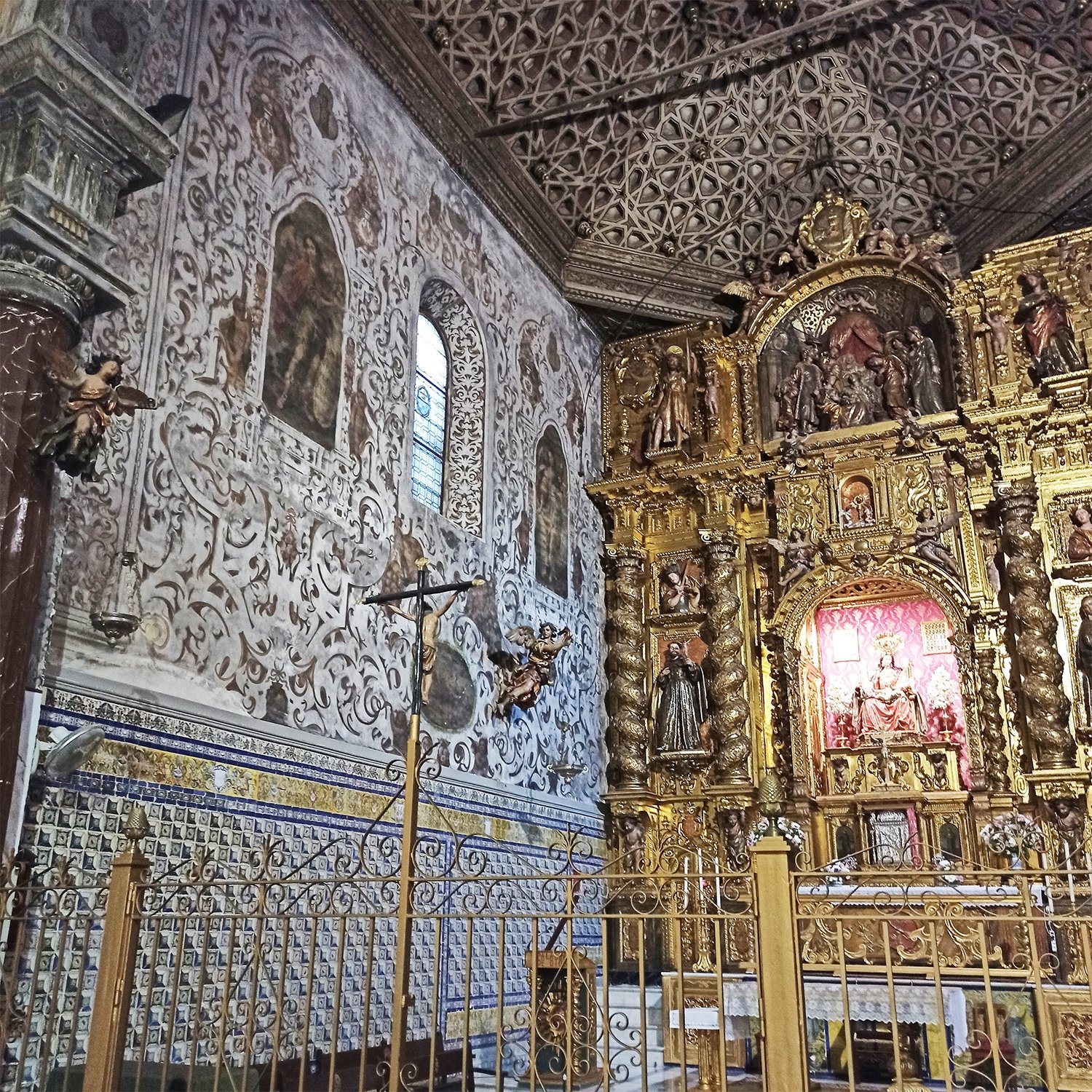
Inside, the nave is covered by a barrel vault with lunettes and transverse arches. Intricate plasterwork decorates the base of the transverse arches, the center of the vaults and the semicircular space under the lunettes. In this area, the plasterwork frames the windows that open onto the street on the Gospel side and a series of canvases from the old convent of Santa Clara on the Epistle side.

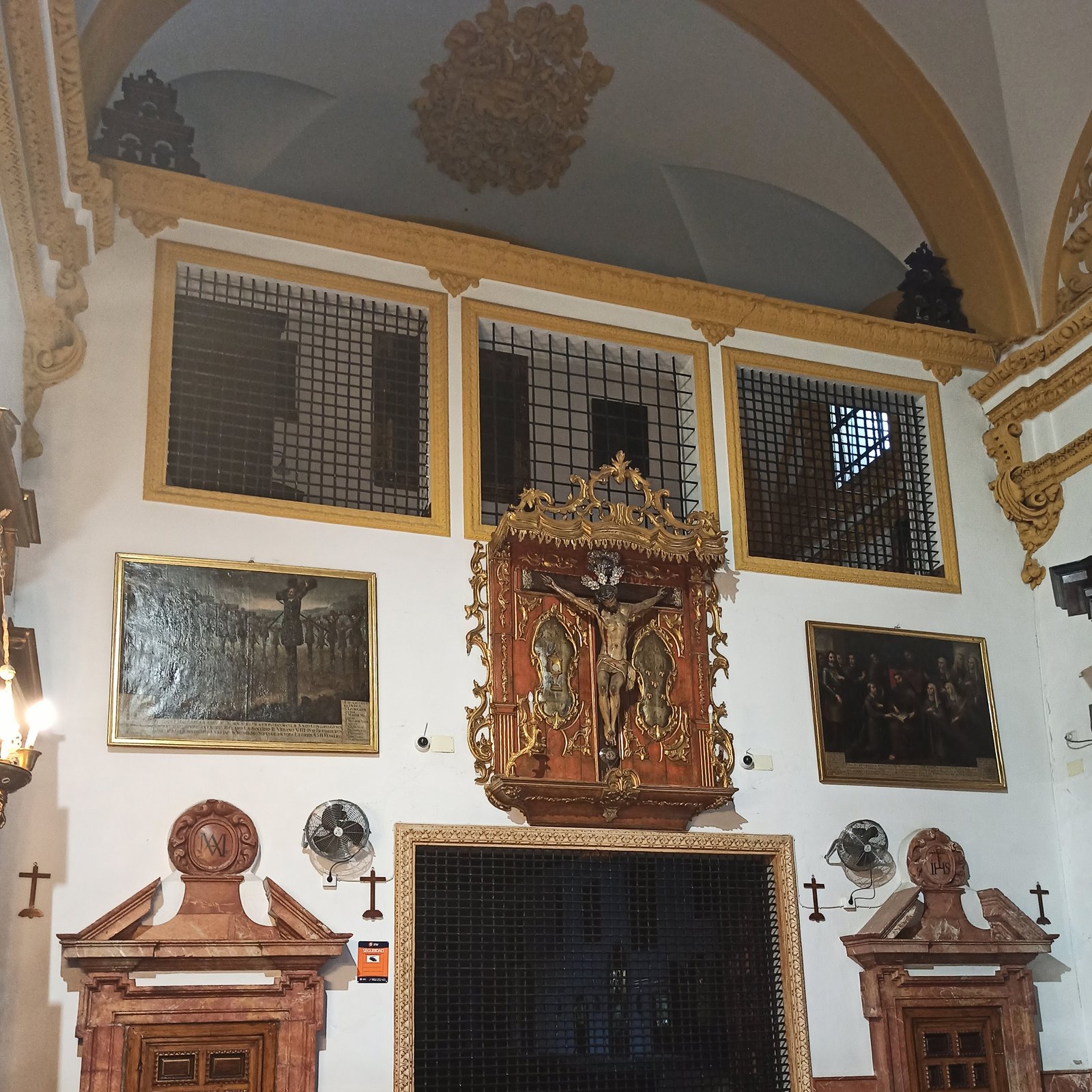
At the foot of the church, there are the upper and lower choirs, reserved for the cloister and separated from the rest of the temple by a wall in which large bars and two side doors open.

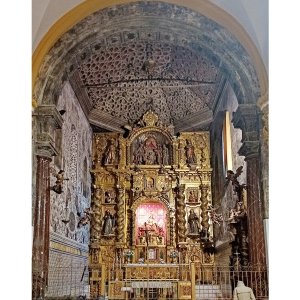
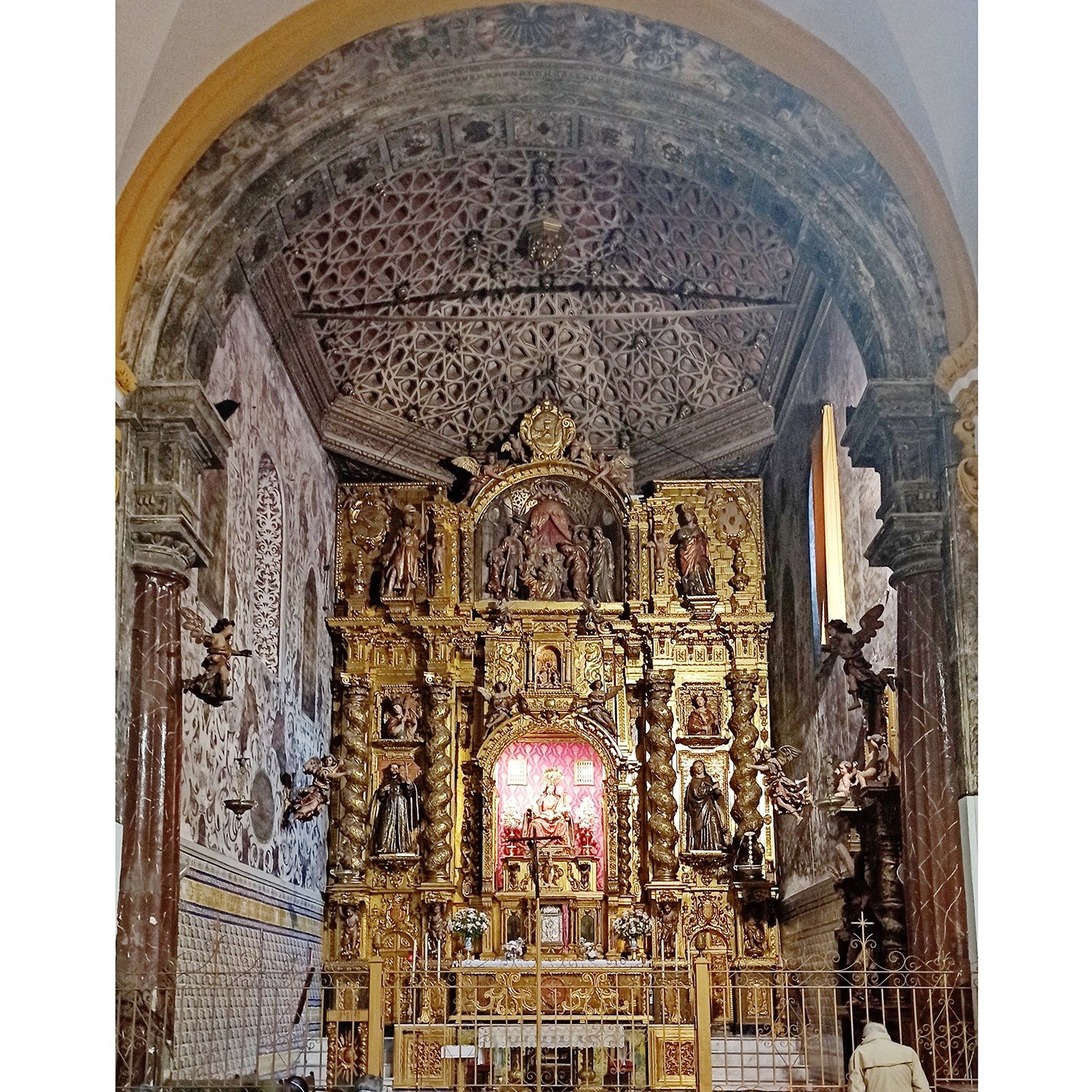
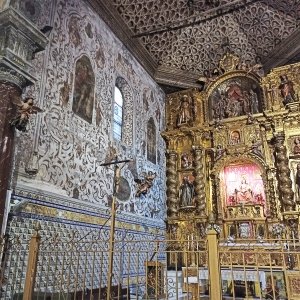
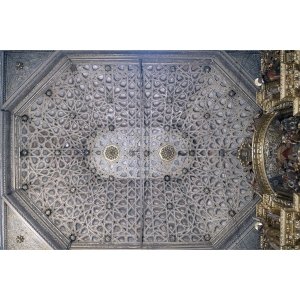
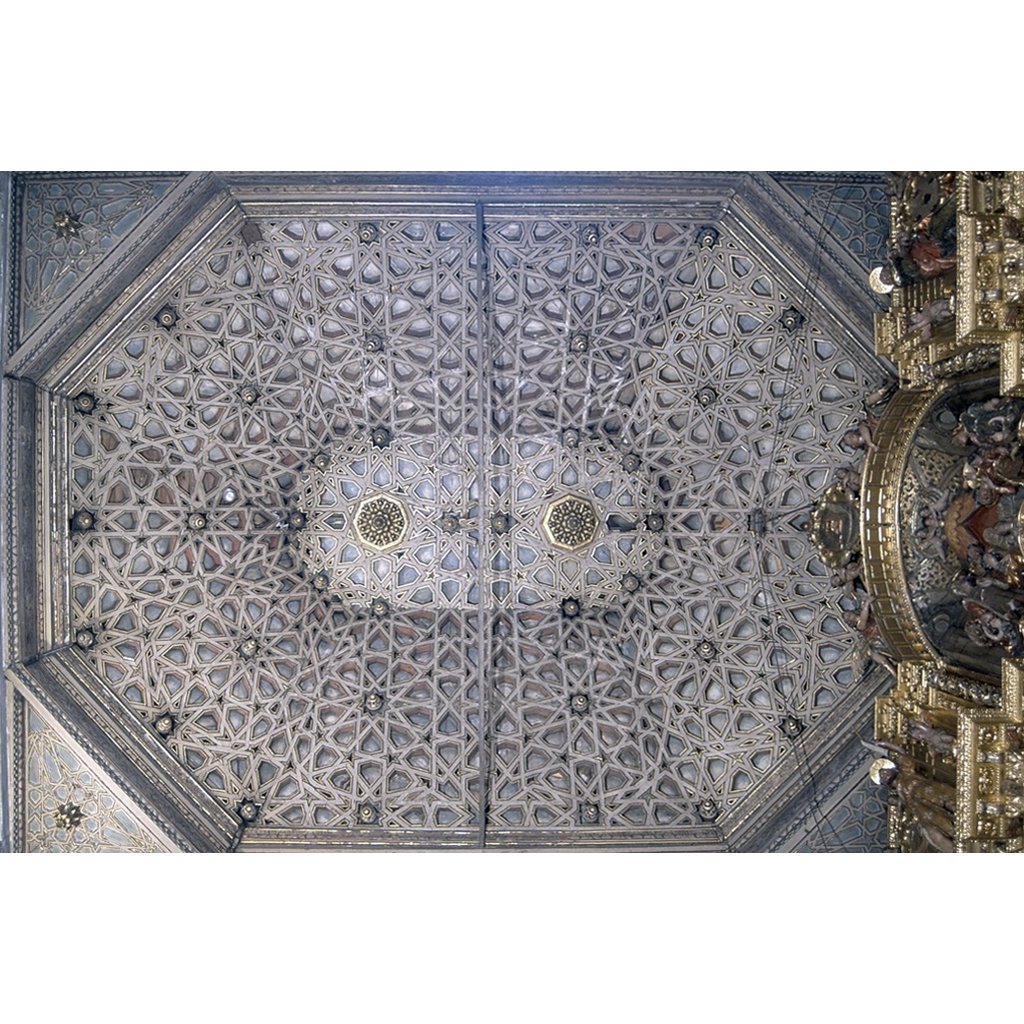
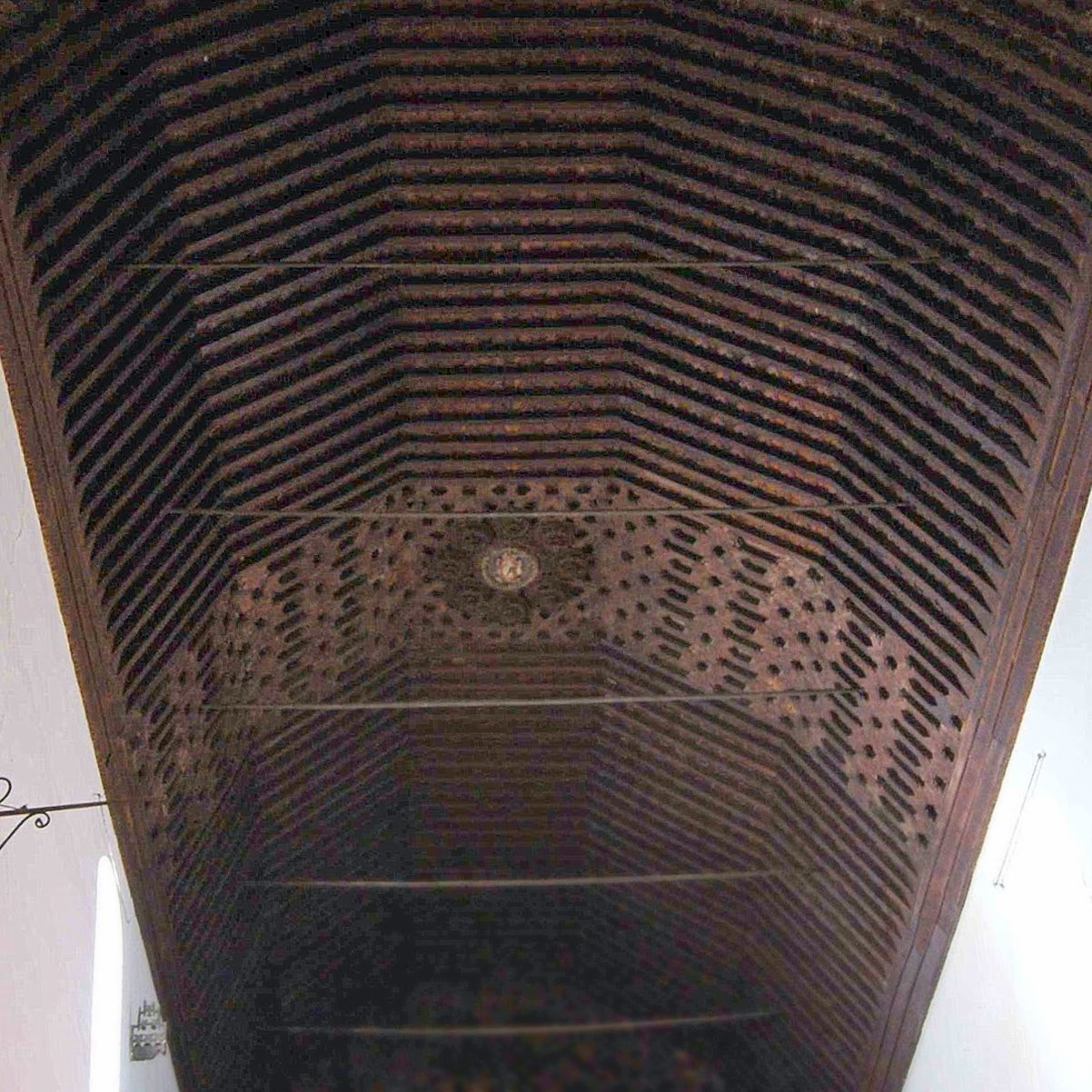
A large main arch on marble columns separates the nave from the presbytery like a triumphal arch. In its lower part, a small fence makes the presbytery an exclusive area for the officiants and the nuns. It is covered by a splendid eight-panel coffered ceiling in the Mudejar style, dating from the end of the 16th century. This characteristic is quite particular to this church, since in general in Sevillian convent churches it is common to cover this area with Gothic-style stone vaults. It has a tile plinth dated 1589 and attributed to the ceramist Alonso García. The walls are profusely decorated with baroque motifs and little angels that frame representations of archangels and allegories of monastic life. They have been dated to the end of the 17th century and their state of conservation is quite poor.

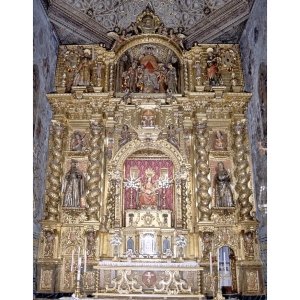
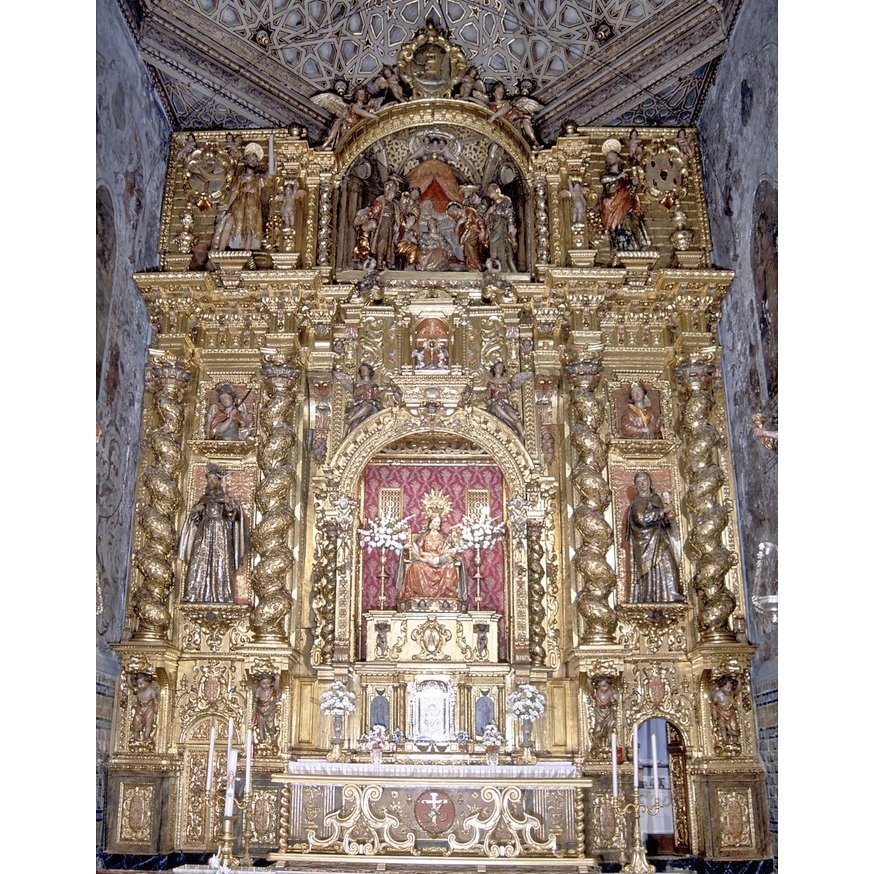
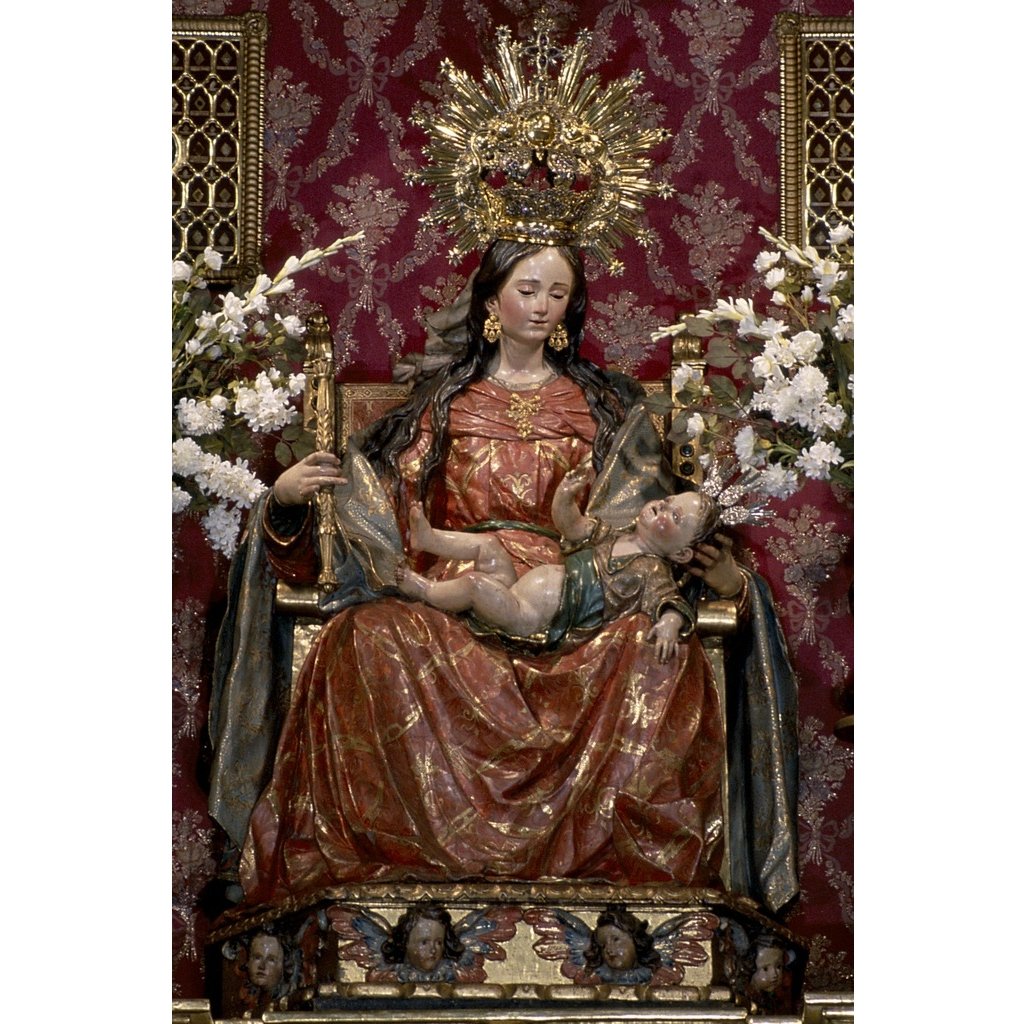
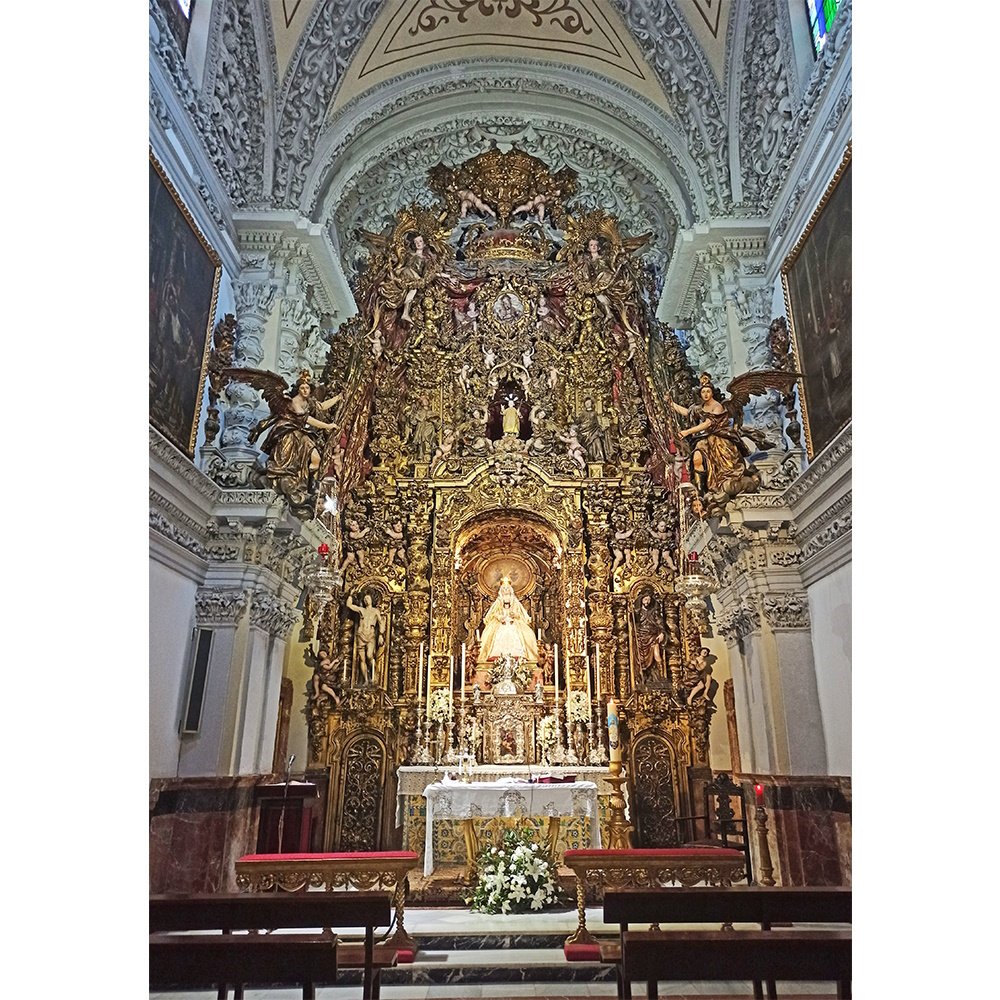
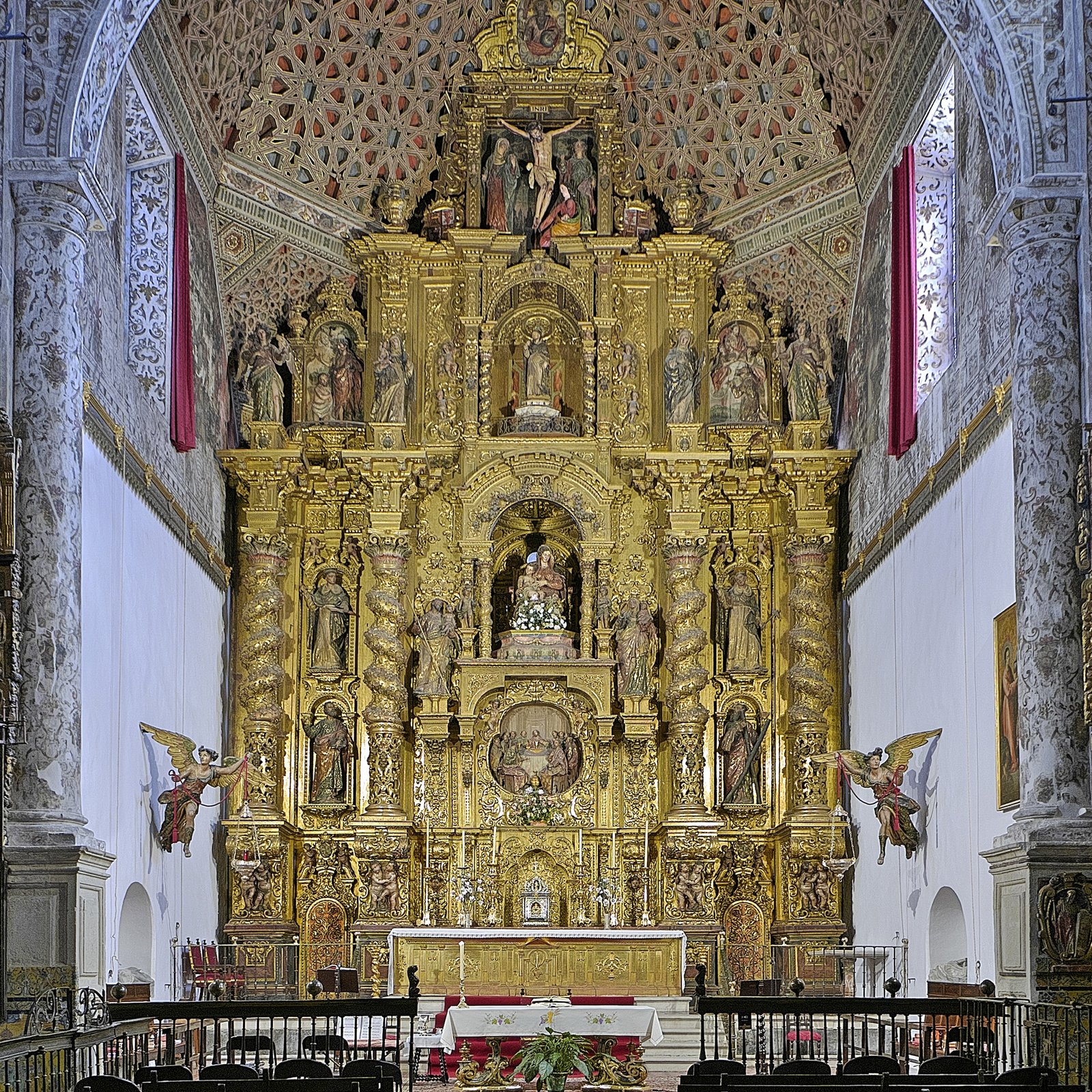
The main altarpiece was also made at the end of the 17th century and is of extraordinary quality. Cristóbal de Guadix was its assembler and Pedro Roldán the image maker, making all the sculptures, with the exception of the Virgin who occupies the central niche that is later. The central body is divided into three streets through four splendid Solomonic columns. On the left we find Saint Francis and, above him, a bust of Saint Michael. In parallel, on the right is Santa Clara and a bust of Santa Catalina. It should be remembered that Saint Francis is obviously the founder of the order that bears his name and Saint Clare the architect of its female branch.

The central street is almost entirely occupied by a large niche that houses a beautiful seated image of the Virgin changing the diapers of the Baby Jesus. Although it lacks reliable documentation, this image has been attributed to Luisa Roldán, la Roldana, based on her stylistic characteristics. Above the niche, a small temple houses a representation of the Eucharist.

In the center of the attic, a high relief represents the Nativity of the Virgin, framed in curious architectural forms that emphasize the sensation of depth of the composition. On both sides, the figures of the "Santos Juanes", San Juan Bautista and San Juan Evangelista, always present in the Sevillian conventual churches.

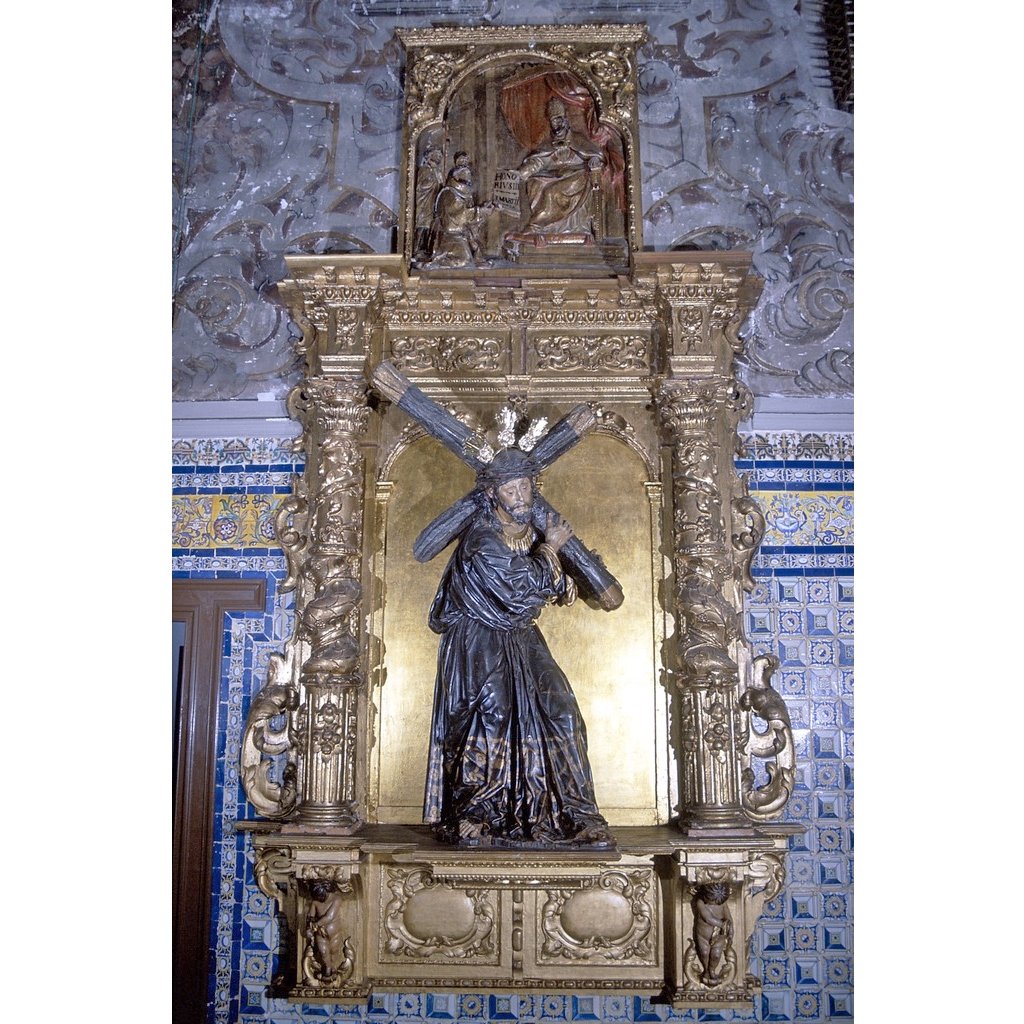
Also inside the presbytery, to the right, is a small altarpiece, framed by Solomonic columns, dedicated to the Jesus of Forgiveness. It is a representation of Jesus with the Cross on his back, from the 17th century and in full size, something quite unusual for the Sevillian Nazarenes. Its authorship is not documented but it has sometimes been attributed to Juan de Mesa himself, author of Gran Poder. In the attic of the altarpiece we find a relief in which Pope Honorius III is represented giving Saint Francis the Rules of the Order.

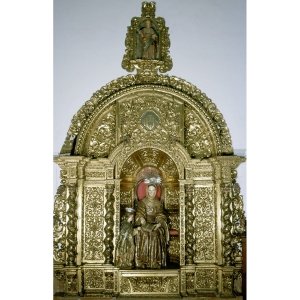
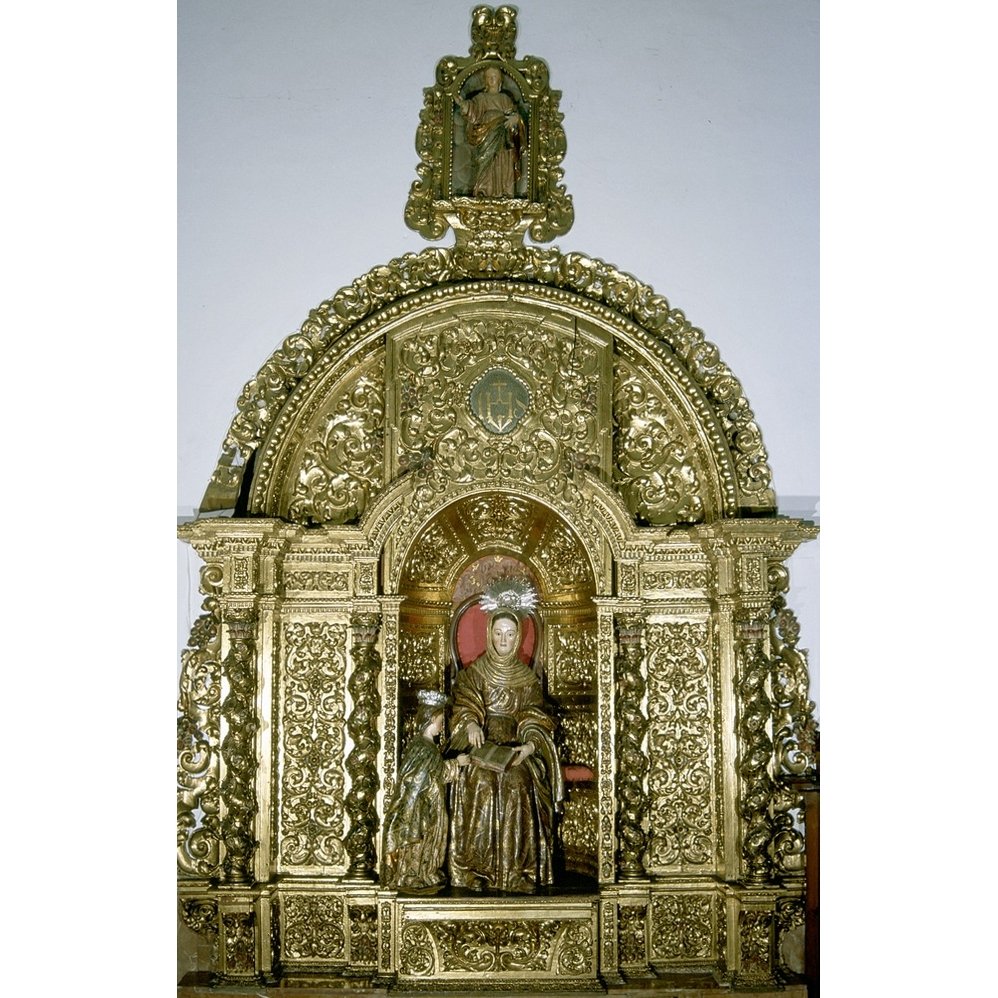
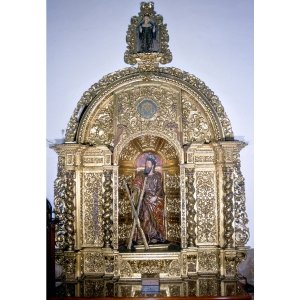
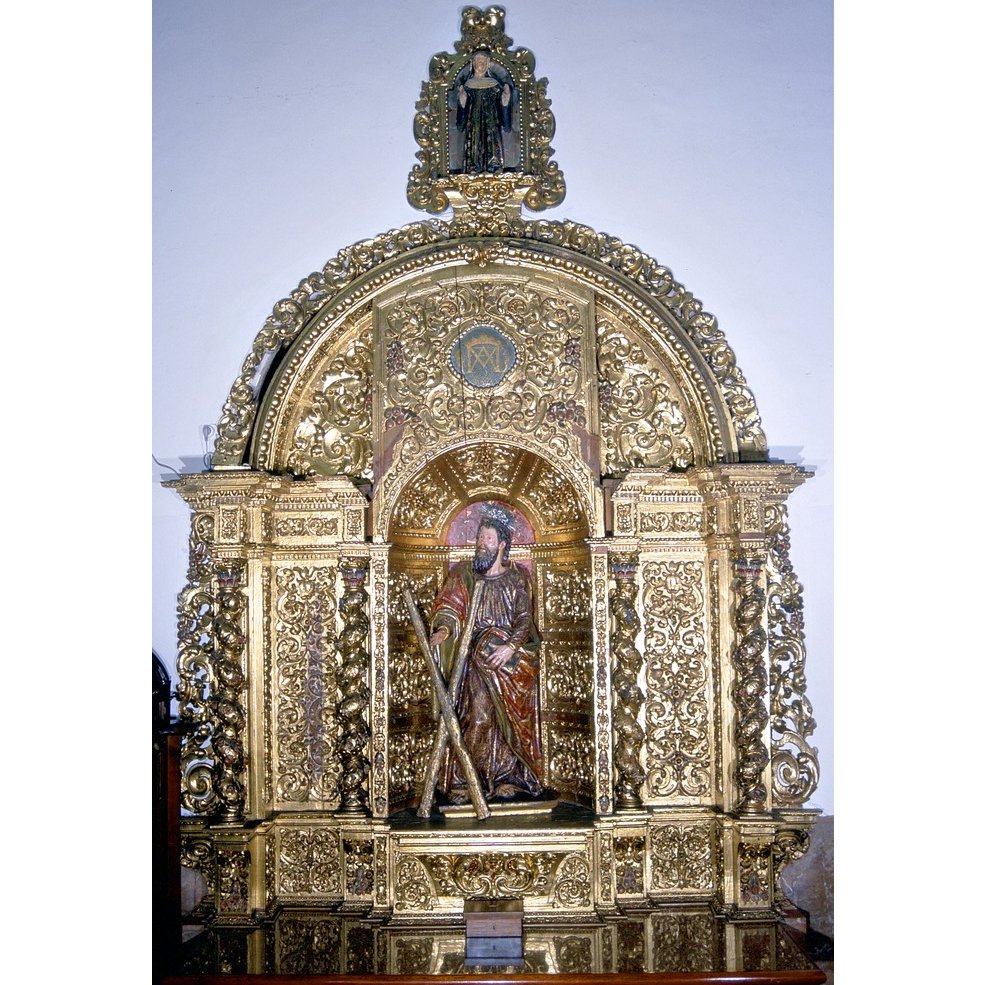
Although the temple does not have side chapels, several altarpieces are attached to its walls as small altars. On the Gospel side, we find two dated to the end of the 17th century and also attributed to Cristóbal de Guadix. They are dedicated respectively to Saint Anne, who appears in the traditional attitude of teaching the Virgin to read, and to Saint Andrew, holding the cross in the shape of a cross on which he was martyred.

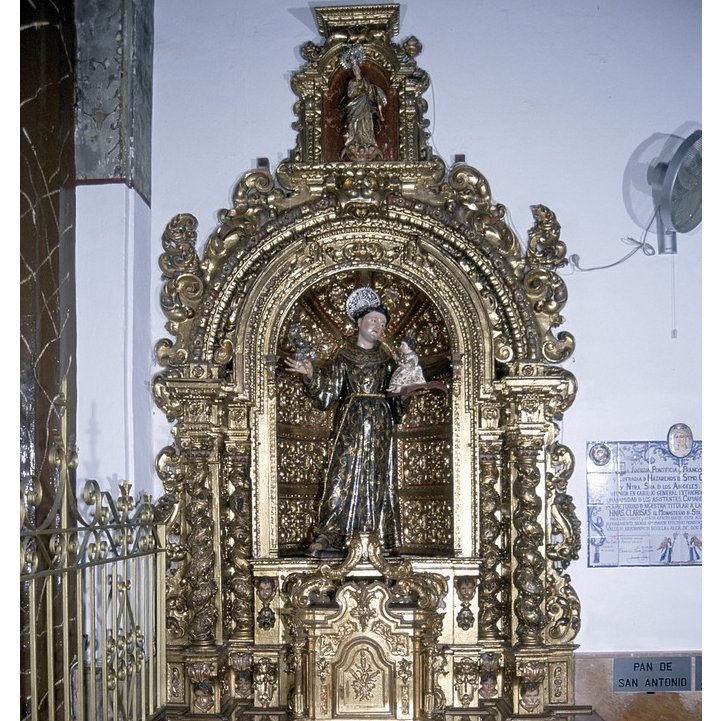
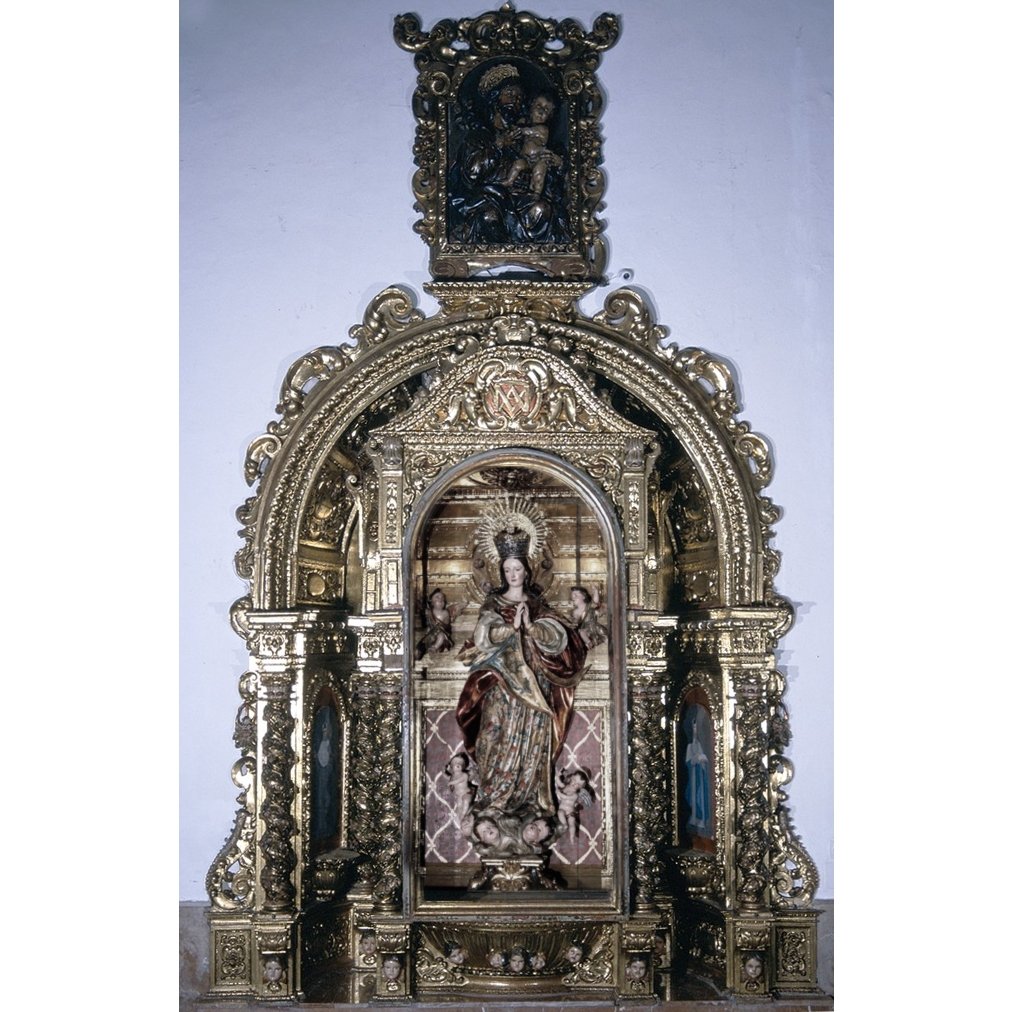
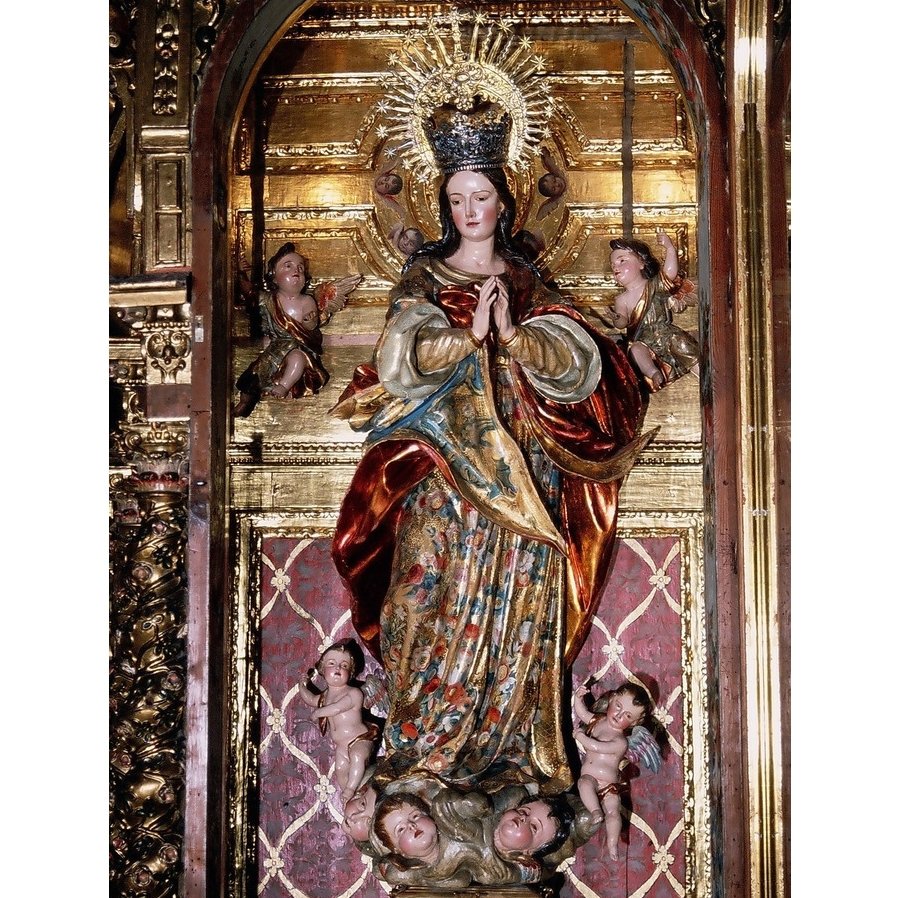
On the opposite wall, the first altarpiece is dedicated to Saint Anthony and is of similar chronology and characteristics to the previous ones. Something later seems to be the next altarpiece, dedicated to the Immaculate Conception, which is presided over by a beautiful carving from the 18th century that has been attributed to both Duque Cornejo and Luisa Roldán.

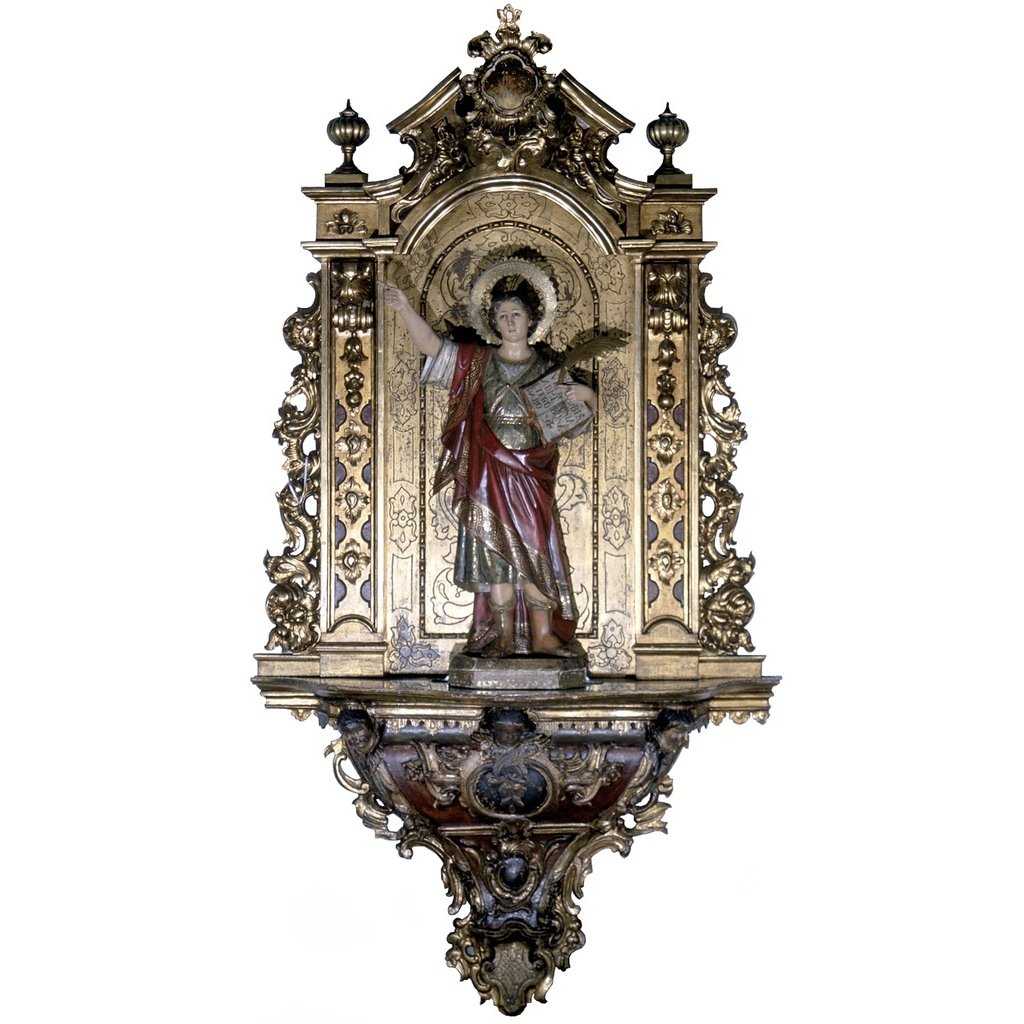
The next altarpiece, just in front of the entrance, is from the 20th century and houses a also modern image of Saint Pancras. It is probably the image with the least artistic value in the church but one of the ones that arouses the most popular fervor, since popular religiosity has been attributing to Saint Pancras the ability to effectively mediate especially in matters related to the work and economic sphere.

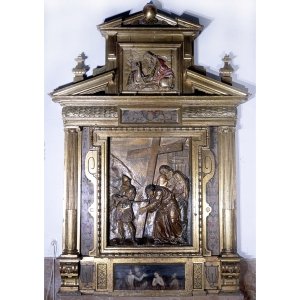
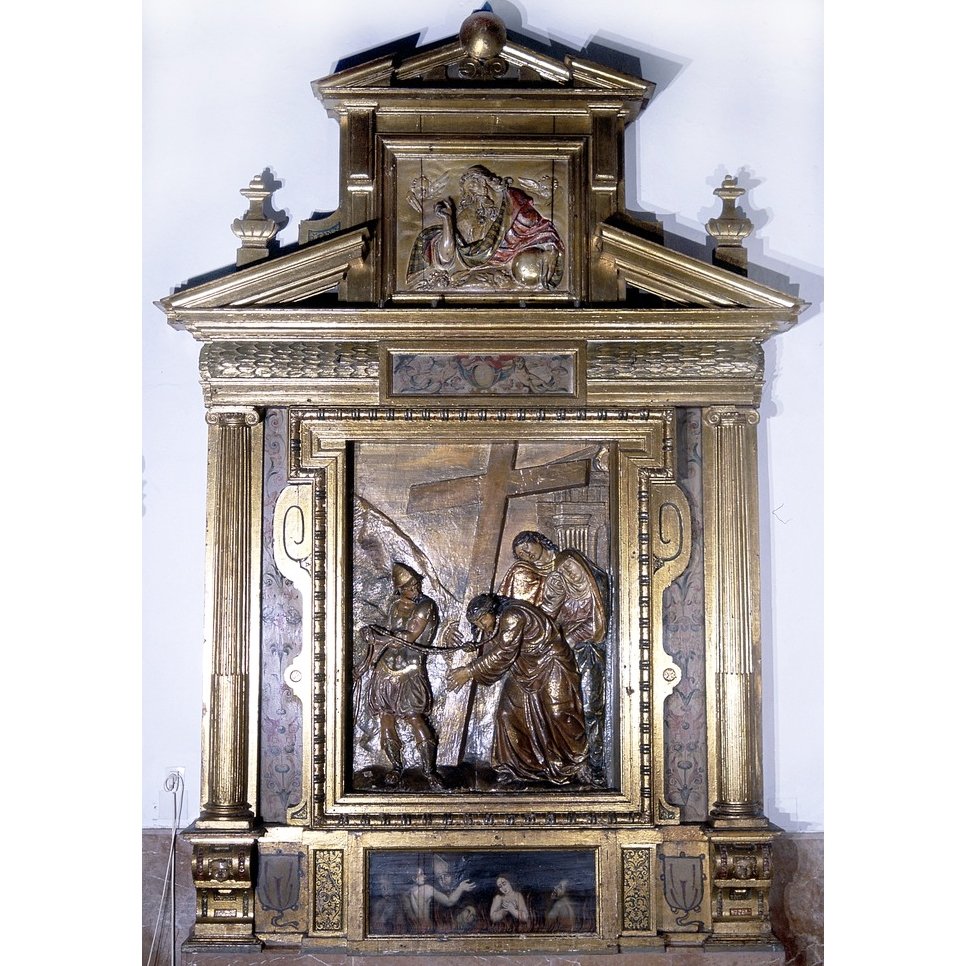
Finally, next to the low choir, the oldest altarpiece in the temple is located. Of Renaissance style, it dates back to 1587 and is the work of Asensio de Maeda and Juan de Oviedo. In the central body, framed by two Ionic columns, there is the relief of Jesus on the way to Calvary, which has the particularity that the Cross is held in a different way than usual, with Christ embracing the longest section, just like the does Our Father Jesus of the Brotherhood of Silence. In the attic there is another relief representing God the Father, probably also from the end of the 16th century, and on the bench we find a painting with the "Souls of Purgatory", already from the 18th century.

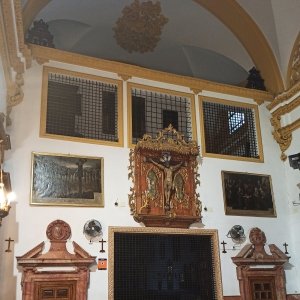
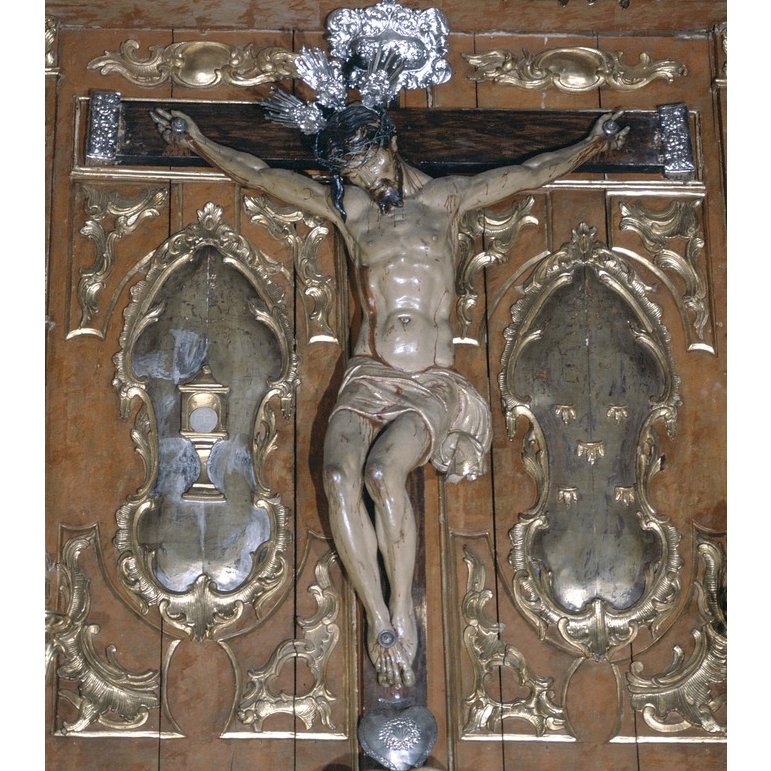
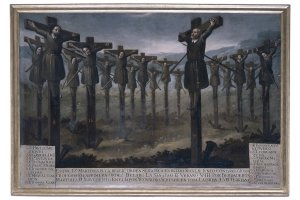
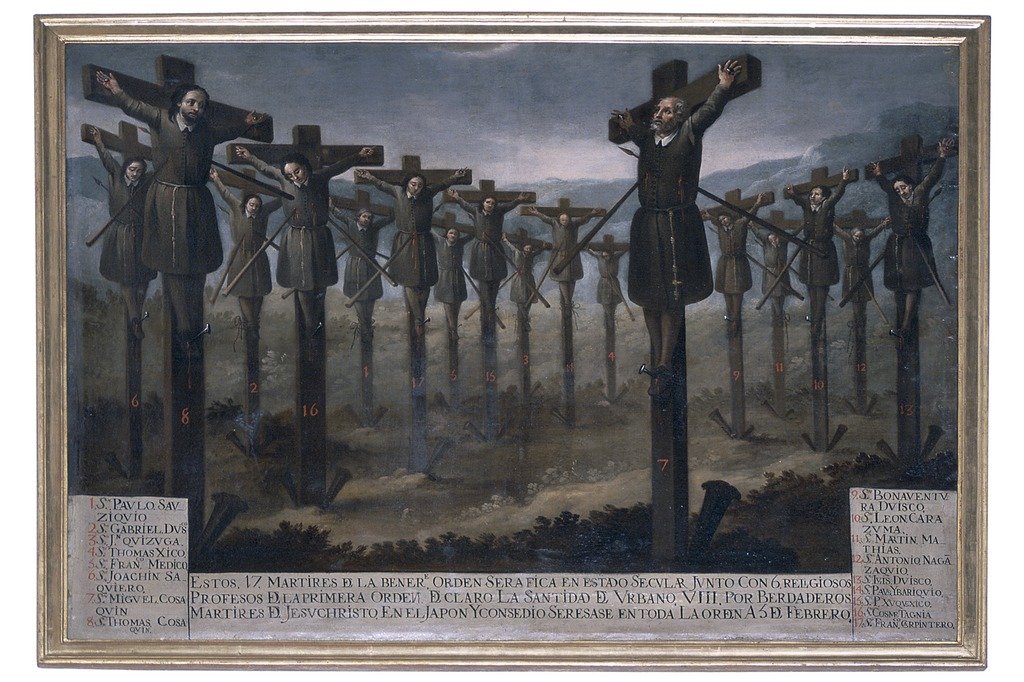
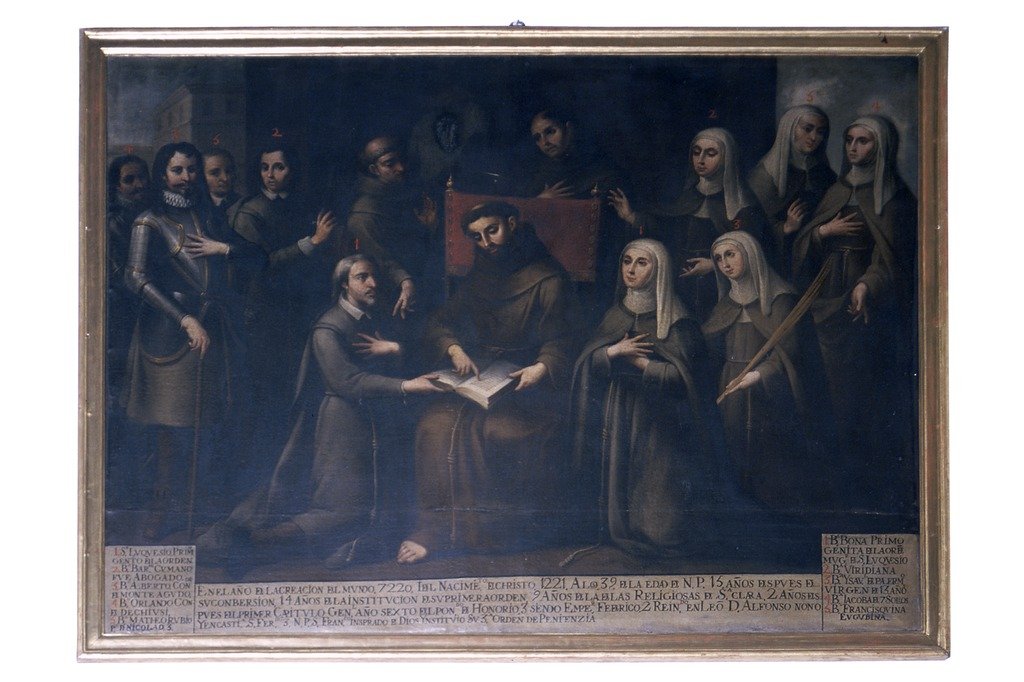
In the center of the wall that separates the nave from the upper and lower choirs, there is a Crucified Christ from the 17th century from the exclaustrated Convent of Santa Clara. It is located in the center of a curious canopy in which the emblems of San Francisco and Santa Clara (Franciscans) can be distinguished. On both sides there are two canvases also from the 17th century with "The Franciscan Martyrs of Japan" and "The Foundation of the Third Order by Saint Francis." In both there are signs with descriptions at the bottom, making their didactic purpose clear.

* Repositorio Gráfico del IAPH : https://repositorio.iaph.es/
CHURCH OF SAN ISIDORO

The church of San Isidoro is one of the medieval parishes of Seville. Several authors much later than its foundation say that it was built on the site that would have been occupied by the family house of San Isidoro during the Visigothic period. Naturally, absolutely nothing could be verified about these statements.

History

We do know that its construction must have begun in the first third of the 14th century, since the cover on the Epistle side is closely linked to that on the side of the Gospel of Saint Anne of Triana, for which the chronology is documented. In this way, both would be among the oldest churches in the city. Furthermore, the urban area in which it is located is the highest with respect to the river and, therefore, the one with the oldest settlement. The forum of Roman Hispalis has traditionally been located in its vicinity, although it is true that without any archaeological basis.

Since the Christian conquest, wealthy families from the city settled in this area and merchants of the most diverse origins settled there from the 16th century onwards. In this way, San Isidoro will be a "rich" parish and this has an inevitable reflection in the architecture and ornament of the temple.

The original 14th century building was notably altered between the 16th and 17th centuries, mainly in the presbytery area. Also in the 18th century, reforms were undertaken, such as the construction of the chapels on the left side.

As it has come down to us, San Isidoro is a rectangular church with three naves, a transept, a choir at the foot and side chapels, which are different in size, style and layout.

Outside

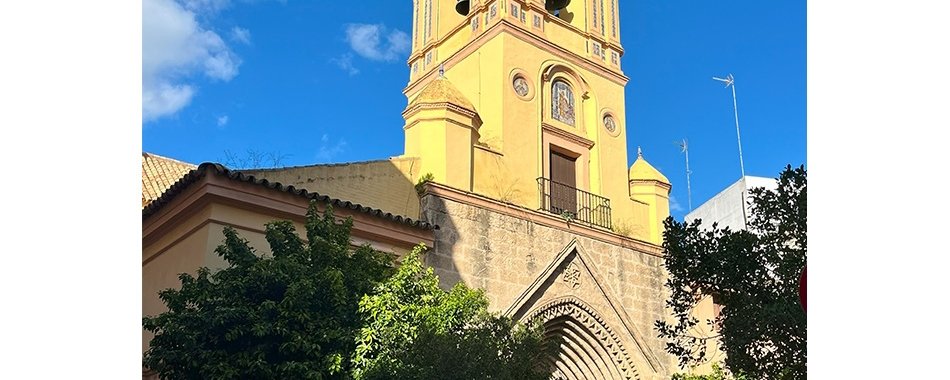
On the outside, the temple has three doors. The one located at the foot is very simple, in the Mudejar style. It consists of a slightly pointed arch framed by an alfiz. Apparently, the arch was initially horseshoe-shaped and was "simplified" to adopt its current appearance sometime between the 16th and 18th centuries.

The door that opens to the left side is the most recent, added in the 18th century in a neoclassical style. It is lintel, with two pilasters supporting a simple entablature. Next to it, we find the most ornamentally rich façade fragment in this church. This is the exterior part of the sacramental chapel, added as we said in the 18th century, which in some way functions as a separate façade. It is made of exposed brick, with a baroque style with very classic lines, and stands out for its reddish color, different from the rest of the temple. It is topped by a triangular pediment and in the center of the wall there is a lobed medallion with an allegorical scene of the “Adoration of the Holy Sacrament”.

Right at the other end, on the Epistle side, the other door opens, dated to the 14th century. It presents the classic forms of the Sevillian Gothic-Mudejar doorways. It consists of a pointed arch with archivolts, the two outermost ones at the top being decorated with geometric motifs: one with saw teeth and the other with diamond points. It is framed by a double alfiz, the first triangular and a larger square one.

At the apex of the triangular alfiz we find a sculpted star of David or Solomon, historically linked to the Hebrew religion. It is the only church in Seville in which we can see this element, which has been the subject of the most diverse interpretations. However, the truth is that this six-pointed star is a symbol that appears quite frequently in medieval religious buildings, apparently as an element of protection. In an article about this cover, Rafael Cómez tells us that "with a talismanic meaning and a spell against the forces of evil, the six-pointed star, inscribed in a circle, must have been made, which is shown to us on the cover of the nave of the Epistle. ".

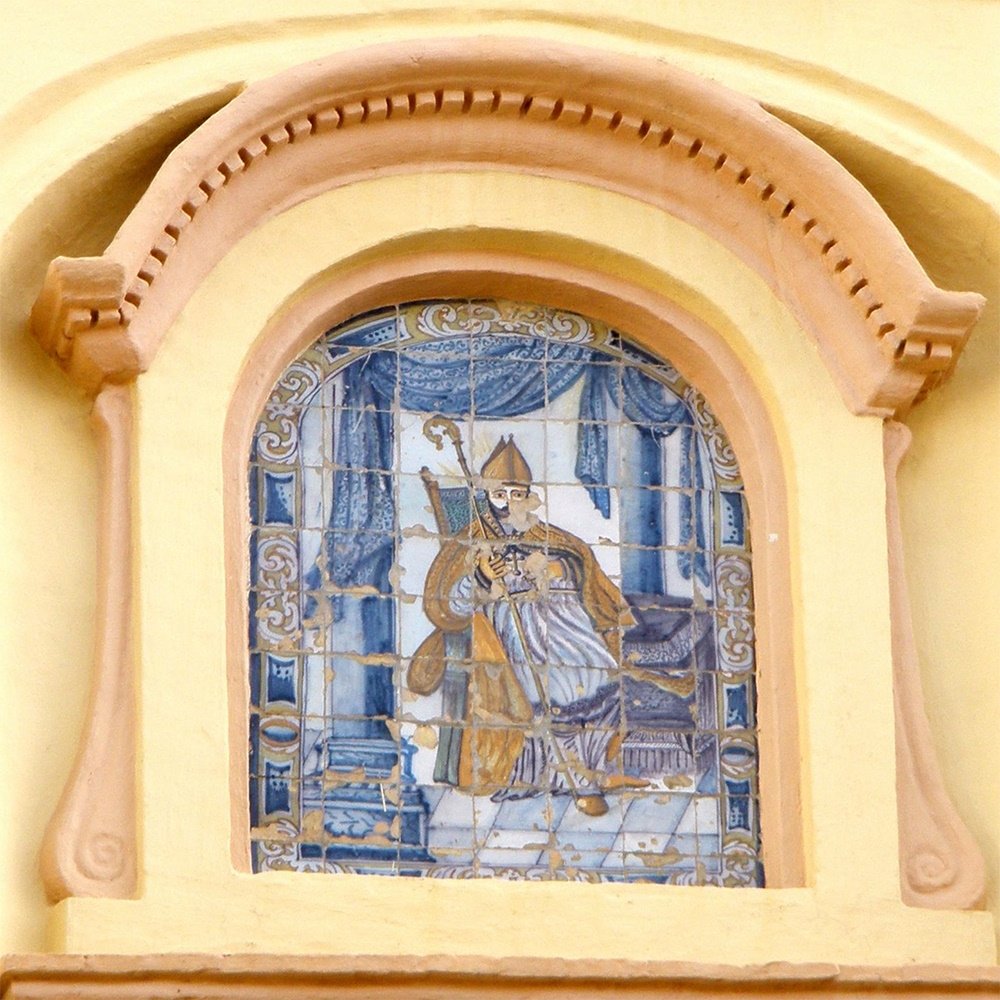
Above this door, a bell tower was built much later, and already in the Baroque style, which preserves the 18th century tiles depicting Saint Isidore and Saint Leandro.

Inside

Inside, the naves are divided by pointed brick arches that rest on cruciform pillars. The roofs are wooden coffered ceilings in the Mudejar style, with the central trough shaped and the side ones hanging. As an exception, the transept is covered with a hemispherical dome on pendentives in its center and with barrel vaults on each of its sides.

The main altarpiece is mainly made up of an excellent canvas that represents the "Transit of San Isidoro", a work by Juan de Roelas from 1613. The frame-altarpiece that houses it is later; It was made around 1752 by Felipe del Castillo. The paintings in the vaults date from the mid-18th century and have been related to the work of Juan de Espinal. They represent fake architectures in which San Fernando and San Hermenegildo are framed.

To the left of the main chapel, at the head of the Gospel nave, is the Maestres chapel, which has an interesting tiled plinth original from the 17th century. A 19th-century neoclassical altarpiece houses the image of the Christ of the Blood, a moving Gothic carving from the mid-14th century. It is the oldest Crucified of those preserved in Seville, comparable only to the Christ of the Million in the Cathedral.

Just on the other side of the main altar, at the head of the Epistle nave, is the Villampando chapel, from the beginning of the 17th century, the date in which the tile plinths and the grille that closes it were made. It is presided over by a baroque altarpiece dedicated to Saint Albert.

On the wall of this same nave there is another baroque altarpiece, this time from the mid-18th century. In its center, an image of Saint Joseph from the same period, the work of José Montes de Oca.

On this right side the church has a single chapel, dedicated to the Virgin of Health. It is the most clearly Mudejar style. It has a hemispherical vault, decorated with geometric motifs and set on squinches. The image of the Virgin has been dated to the beginning of the 16th century, with a transitional style between Gothic and Renaissance. She is full size, although she is generally presented dressed in the baroque style.

On the other side of the church, in the Gospel nave, next to the entrance is the Chapel of Our Father Jesus of the Three Falls, the titular image of the brotherhood based in this church that processions every Good Friday. The Christ is a carving by Alonso Martínez from around 1667. The Virgin of Loreto is the image that accompanies him in this chapel and on his processional exit. It is an anonymous dressing room from the 18th century, although deeply renovated by Sebastián Santos in the mid-20th century. Although it is not found in this chapel, the brotherhood has another image of great value. This is the Cyrenean who helps Jesus with the cross on his path. It is a magnificent carving from 1687 by Francisco Antonio Gijón, an illustrious name in the history of Sevillian art, forever linked to the overwhelming "Puppy" of Triana. The Cirineo of San Isidoro is considered one of the best "secondary" carvings of Holy Week in the city and is generally located in the Epistle nave, close to the entrance.

The most prominent chapel of the church, and one of the most notable in the Sevillian baroque, is the sacramental chapel. It has its origins in the 16th century, the date on which the gate that closes it is dated, although as it has come down to us it is a work from the 18th century.

Above the access to the chapel there is a canvas with the "Allegory of the Eucharist", an interesting work attributed to Lucas Valdés. Once inside, the walls are covered with a series of canvases, mainly with themes related to the Eucharist, such as "The Transfer of the Ark of the Covenant" or "The Delivery of the Propitiation Bread", works also linked to the style by Lucas Valdes.

The cornices and upper part of the walls have a profuse decoration of plasterwork, which reproduces plant and architectural motifs, such as Solomonic columns.

But the element that attracts most attention in the chapel is its spectacular altarpiece, one of the most exuberant examples of Sevillian altarpieces. It is a work by Jerónimo Balbás and Pedro Duque Cornejo, made at the beginning of the 18th century by order of Juan Bautista Melcampo, a merchant of Flemish origin buried in the same chapel. The decorative profusion is such that it is difficult to distinguish the architectural structure. Countless child and youth angels intermingle with vegetal motifs, garlands, stipes and Solomonic columns in a motley and dazzling ensemble.

In the central niche, the Virgin of the Snows is venerated, a seated image that reproduces the scheme of the "Fernandine" Virgins, such as that of the Kings of the Cathedral or that of the Waters of El Salvador. However, it seems that that of San Isidoro is later, at least from the 16th century. On both sides are San Sebastián and San Roque.

In the center of the second body of the altarpiece there is a Child Jesus with the style of Juan Martínez Montañés. On his sides, Saint Thomas Aquinas and Saint Ignatius of Loyola, and above him the figure of God the Father appears from a medallion in an attitude of blessing.

CHAPEL OF SANTA MARÍA DE JESÚS (MAESE RODRIGO’S CHAPEL)

This Puerta de Jerez chapel is the only vestige that remains of the primitive University of Seville, which was founded by Master Rodrigo de Santaella in 1506.

The rest of the buildings of this first university were demolished at the beginning of the 20th century to lay out the current Avenida de la Constitución, within the process of urban remodeling that the city experienced in the years prior to the Ibero-American Exhibition of 1929. The original cover of the The building was dismantled and is currently preserved in the compass of the Santa Clara convent. In the main altarpiece of this chapel you can see a representation of the missing building.

The chapel that has survived to us has a single nave and is stylistically ascribed to late Gothic-Mudejar. It was consecrated in 1506, still unfinished.

On the outside, it has three facades. The rear was renovated in the 20th century and shows a small Mudejar window, made of brick and with a multi-lobed arch. On the side façade there is a beautiful Gothic window with archivolts, plant decoration and tracery in the upper part, forming three oculi. On this same façade there is a marble tombstone that alludes to the foundation in Gothic characters.

At the foot is the main façade, which originally did not face the street but rather an interior patio of the university. It has a simple doorway in the shape of an ogee arch composed of bichrome bricks and framed by an alfiz. Despite its simplicity, it is highly harmonious and stands out for the unusual nature of this type of arch in Sevillian Gothic architecture. On the right side of the chapel, right between the nave and the presbytery, there is a simple belfry, also made of bichrome bricks and topped by stepped battlements.

Inside, the only nave of the church is clearly divided into two areas, differentiated by their coverage. The body of the nave is covered by a wooden cladding, while the presbytery is covered by a Gothic trecelet cross vault. As a transition between both spaces, there is a large central arch, pointed and decorated with cardinas.

Although the temple's original flooring was replaced in the 20th century by the current marble floor, the tile skirting boards on the walls have been preserved, made with beautiful polychrome using the dry rope technique. The front of the altar was made with the same technique, but in this case including golden reflections, a very rare element in ceramic decoration of this type in Seville.

The main altarpiece is a piece of enormous artistic interest, made by the German-born painter Alejo Fernández around 1520. Its structure is clearly Gothic, although his paintings already show a certain Renaissance influence. The theme is linked to the exaltation of wisdom, in relation to the original purpose of the temple as the College chapel.

It is structured from bottom to top in a bench and two bodies. In the center of the bench is the tabernacle, on whose sides there are six tables, three with representations of bishops, an Ecce Homo and an image of the Virgin and Child in the Byzantine style. It is stated that it was brought from Italy by Master Rodrigo himself.

The first body is presided over by a reproduction of the Virgin of Antigua, the original of which is in one of the chapels of the Seville Cathedral. At her feet, Master Rodrigo appears on a smaller scale, giving the Virgin a model that represents the College founded by him. On both sides, the four doctors of the church: Saint Augustine of Hippo, Saint Ambrose, Saint Gregory the Great and Saint Jerome.

In the center of the second body is the representation of "Pentecost". It is in this painting where you can most appreciate the Renaissance influence that we have talked about in the work of Alejo Fernández. Flanking it, from left to right, we see Saint Peter, Saint Gabriel, Saint Michael and Saint Paul.

ROYAL ALCÁZAR

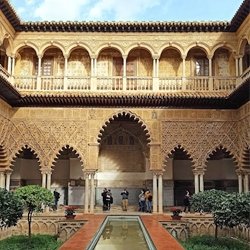
The Alcazar of Seville is one of the most fascinating royal residences in Spain. This is due to the fact that it does not respond to a single project undertaken at a given moment, but rather is the result of numerous construction phases that have taken place throughout its history.

It has been used continuously as a royal palace since its Muslim origins, back in the 10th or 11th century, until today, in which it is still the oldest royal palace in use in Spain and Europe. Throughout its history, the different monarchs who have inhabited here have been adapting the different palaces, courtyards and gardens to the tastes of each era, until configuring the marvelous and diverse complex through which we can walk today.

Although its origin is a set of Muslim palaces, very little remains of this early period of the Alcázar. Most of the palaces that we are going to see correspond to the reforms undertaken in Christian times by:

- Alfonso X the Wise, who built the so-called Gothic Palace in the 13th century.

- Pedro I, called by some the Cruel and by others the Justiciero, who built the wonderful that is the true heart of the Alcázar. It was built in the middle of the 14th century and constitutes the peak of the Mudejar style.

- In the reign of the Catholic Monarchs, the so-called Casa de Contratación was built, of which we will also see some rooms on this side, intended to centralize and organize trade with the Indies, after the discovery of America in 1492.

All this is surrounded by a magnificent set of patios and gardens, which have been added and reformed until very recent times. It must be remembered that a part of the Palace of Pedro I, specifically the upper floor, is still used as the residence of the kings of Spain when they are in Seville.

Thanks to all this, its long history, its beauty and its architecture, the Real Alcázar of Seville was declared a World Heritage Site by UNESCO in December 1987, together with the nearby cathedral and Archivo de Indias.

[mapsmarker map="2"  lat="37.384222" lng="-5.991888" zoom="18" height="300" heightunit="px"]

CONVENT OF SAN AGUSTÍN (OLD)

The Convent of San Agustín was one of the great Sevillian convents during the Middle and Modern Ages, founded according to Ortiz de Zúñiga already in the 13th century, shortly after the Christian conquest of the city. It seems that the religious settled here at the end of the same century and the Augustinian community remained here until 1835, the year in which they were exclaustrated.

After the expropriation of the convent, the property has been put through various uses and gradually reduced its original dimensions. The church and one of the cloisters have disappeared and today only a few rooms remain around what was the main cloister, all in a dilapidated state.

Although the convent had a long construction history between the 13th and 19th centuries, the remains of the cloister that have survived to this day date from the end of the 16th or beginning of the 17th century. It is an enormous porticoed cloister, with semicircular arches on brick pillars on the first floor and carpanel arches on paired columns on the second. ´

In the center of the courtyard are the stone remains of what appears to be a great gate or triumphal arch, deposited there after being dismantled from its original location. It is probably access to the compass of the convent that was designed by the great architect of the Sevillian Renaissance Hernán Ruiz II.

There is currently a project to build a hotel on what remains of the old convent, maintaining the cloister façades.

[mapsmarker map="2"  lat="37.389726" lng="-5.983682" zoom="18" height="300" heightunit="px"]

CONVENT MADRE DE DIOS

Convent of Dominican nuns founded at the end of the 15th century, when Queen Isabella the Catholic ceded a large plot of the old Jewish quarter of Seville to the nuns. Some authors maintain that the convent was partly based on one of the old synagogues in the neighborhood, but this information has not been confirmed. The building that has survived to this day dates from the second half of the 16th century.

The main elements of the convent can be dated to that date: the church, a small patio that acts as a cloister and another larger one that is used as a garden.

The temple is one of the largest convent churches found in Seville and the architects Juan de Simancas and Pedro Díaz Palacios were involved in its construction. It has a rectangular plan, with a square head and high and low choirs at the feet.

The façade is on the Gospel side, accessed through a late Renaissance doorway. The royal coat of arms appears on the lintel, flanked by that of the Dominicans, a symbol of the patronage of the Crown. In the central niche, we see a relief by Juan de Oviedo with a beautiful representation of the Virgin and Child giving a rosary to Saint Dominic de Guzmán, founder of the order. Next to it appears the iconographic element that traditionally identifies it: a dog holding a torch in its mouth. In the attic there is an image of God the Father in an attitude of blessing.

Inside, a large wooden coffered ceiling covers the nave, while a magnificent octagonal vault on tubes, also made of wood, covers the presbytery area. The nave and the presbytery are separated by a large, richly polychrome main arch, a very characteristic element of the Sevillian conventual churches as well.

In the church there are more than twenty burials, among which those of Hernán Cortes's wife, Juana de Zúñiga, and two of her daughters, which are found on the sides of the presbytery, stand out.

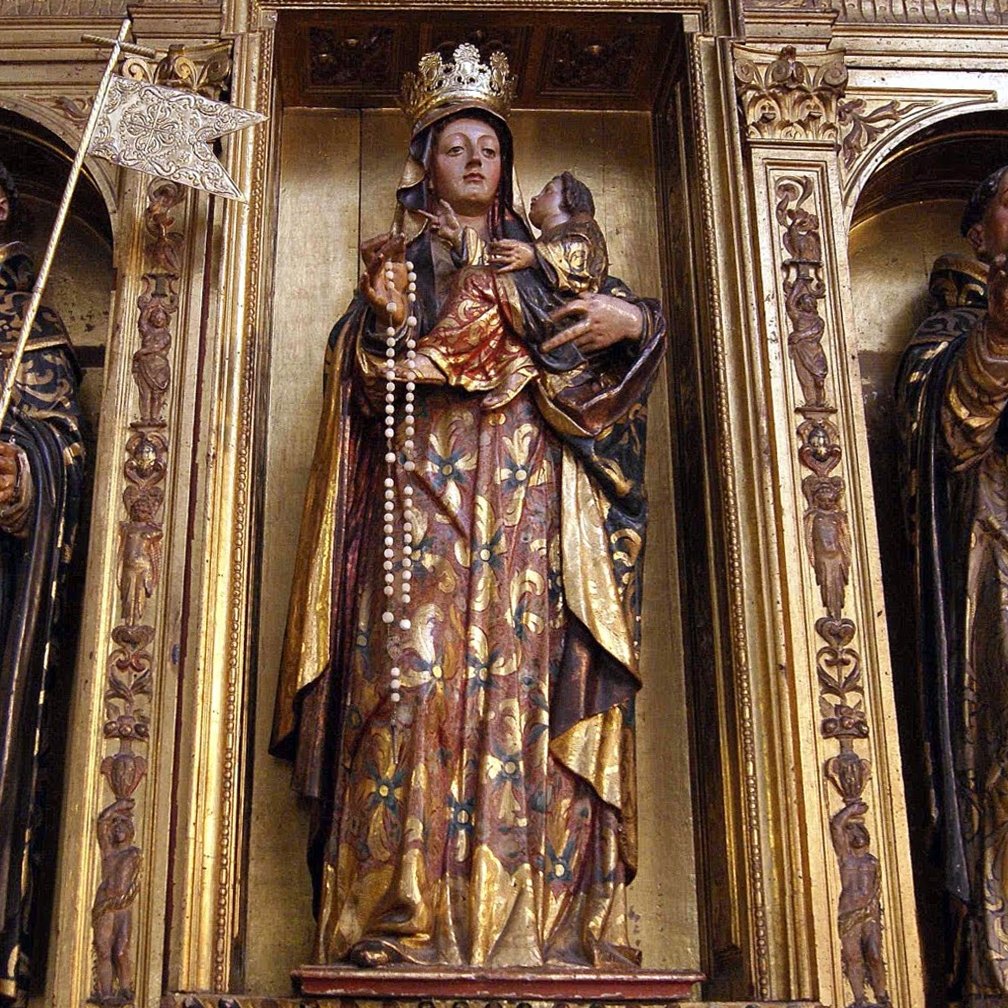
The main altarpiece is the work of Francisco de Barahona from the beginning of the 18th century, made to replace a previous one from the 16th century. Some images of Jerónimo Hernández were preserved from the original, such as the Virgin of the Rosary in the central niche, also called Madre de Dios de la Piedad.

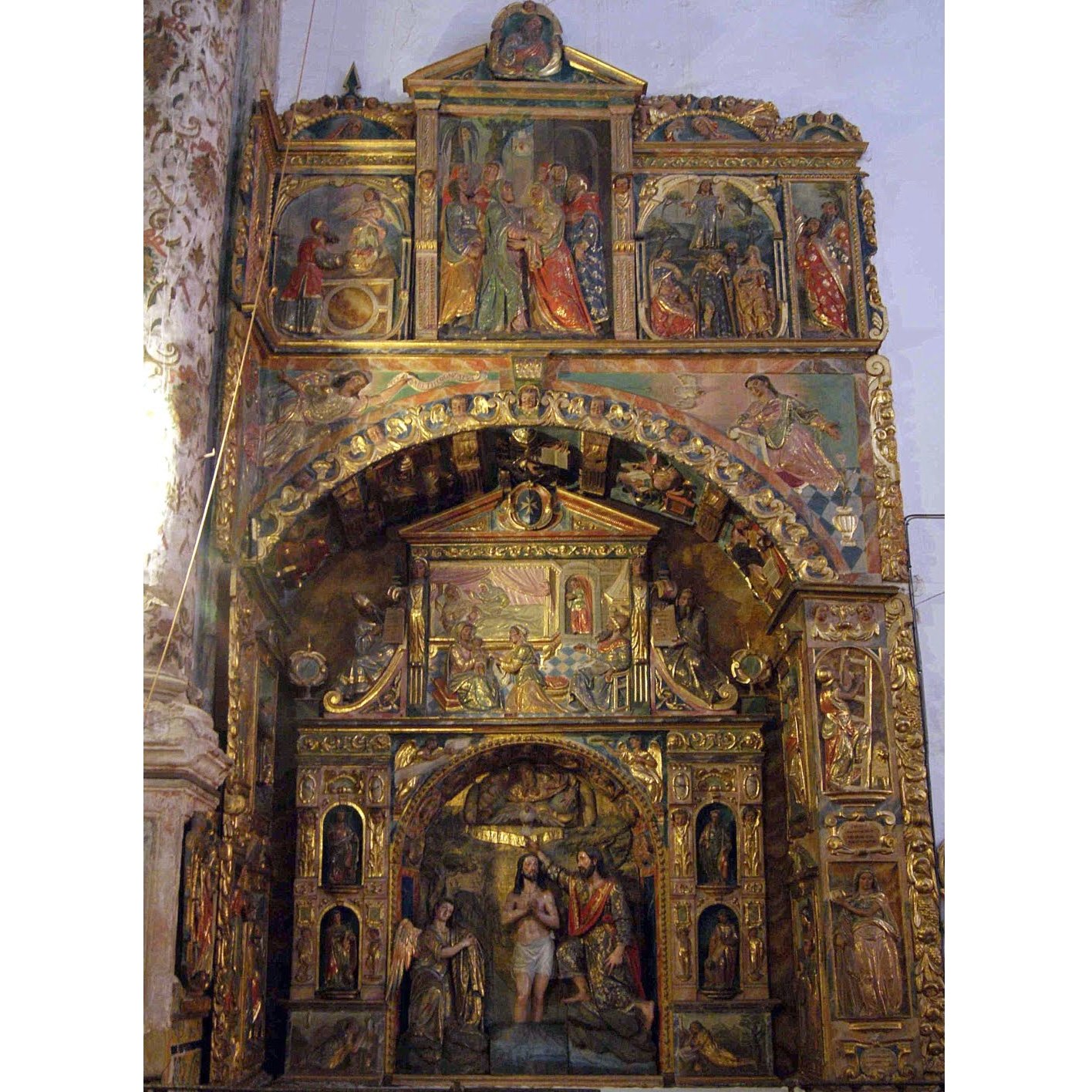
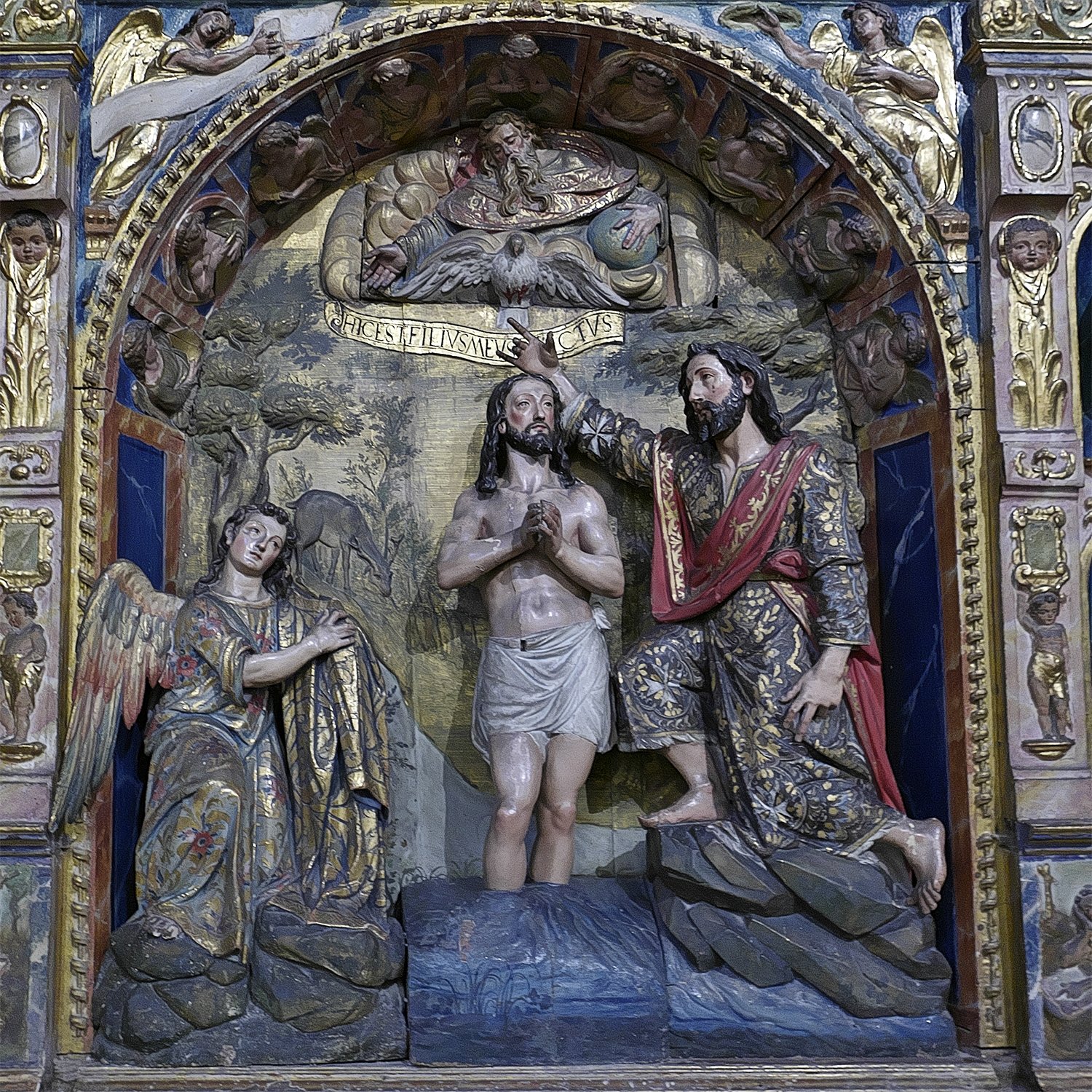
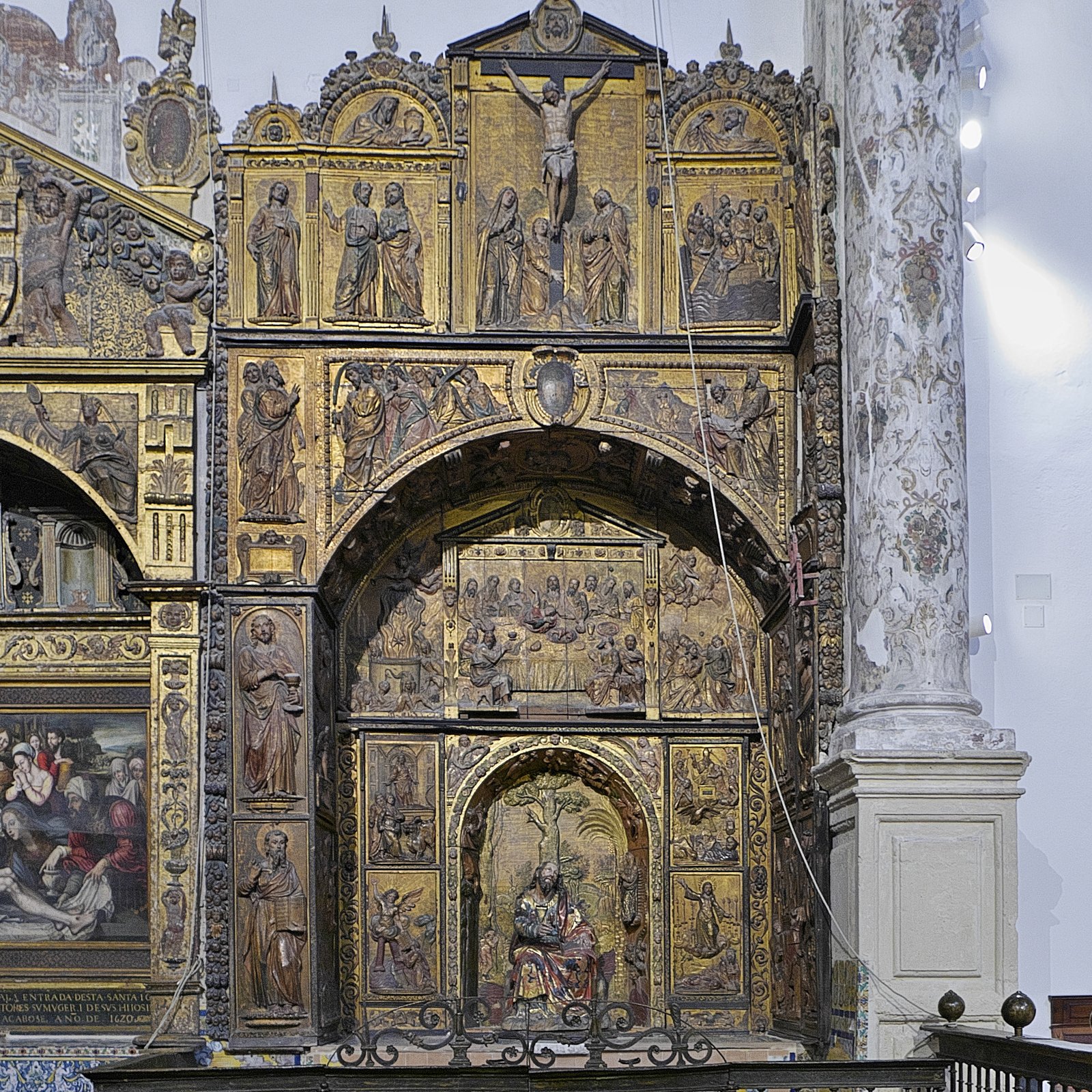
On each side of the presbytery there are two valuable Renaissance side altars from the second half of the 16th century. As usual in Sevillian convent churches, they are dedicated to the 'Santos Juanes', that is, to Saint John the Baptist and Saint John the Evangelist, both the work of the sculptor and altarpiece artist Miguel Adán. However, it was Jerónimo Hernández who carved the image of Saint John the Evangelist, whom he represents at the end of his life, on Patmos, the place where he wrote the Apocalypse. The one dedicated to San Juan Bautista is just opposite and has a very similar structure to the previous one. In its central niche, Miguel Adán represented the scene of the Baptism of Christ.

They are not the only Renaissance altarpieces that the church has.

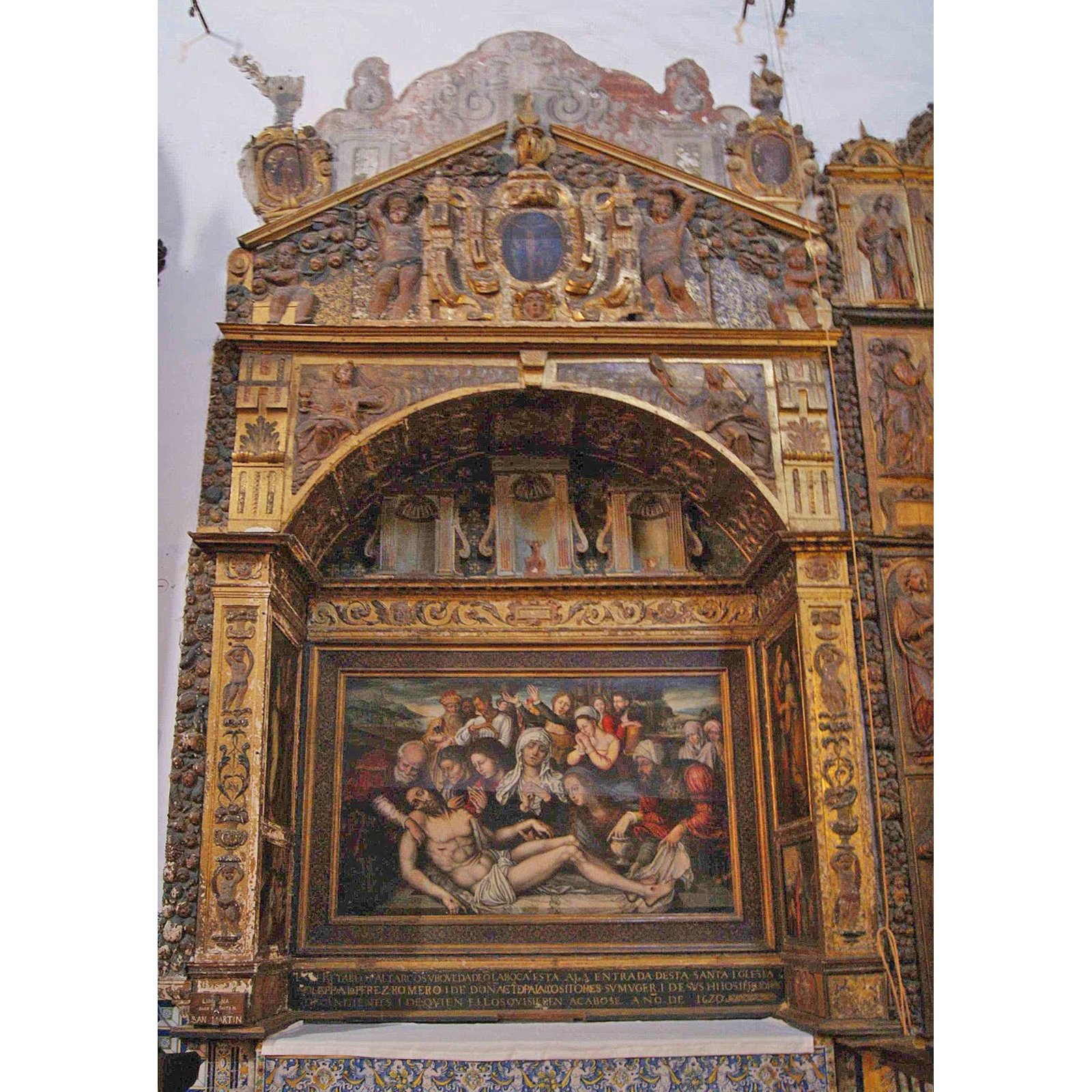
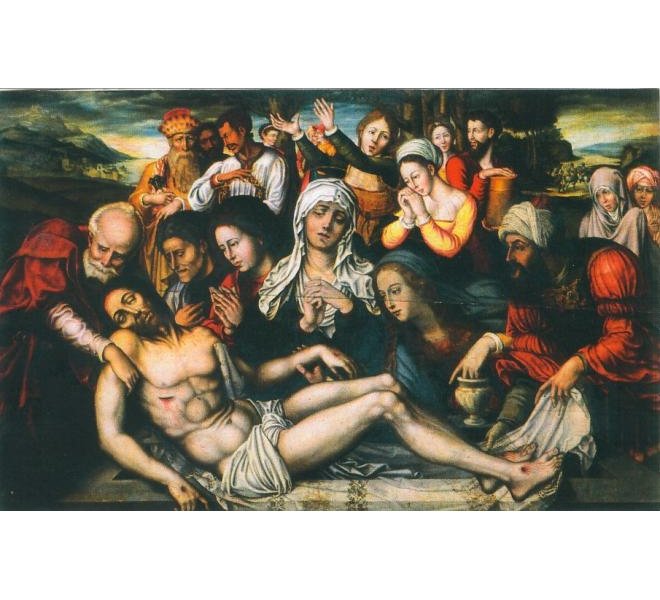
The one next to that of the Evangelist frames a beautiful panel painting with a Flemish-inspired Burial of Christ.

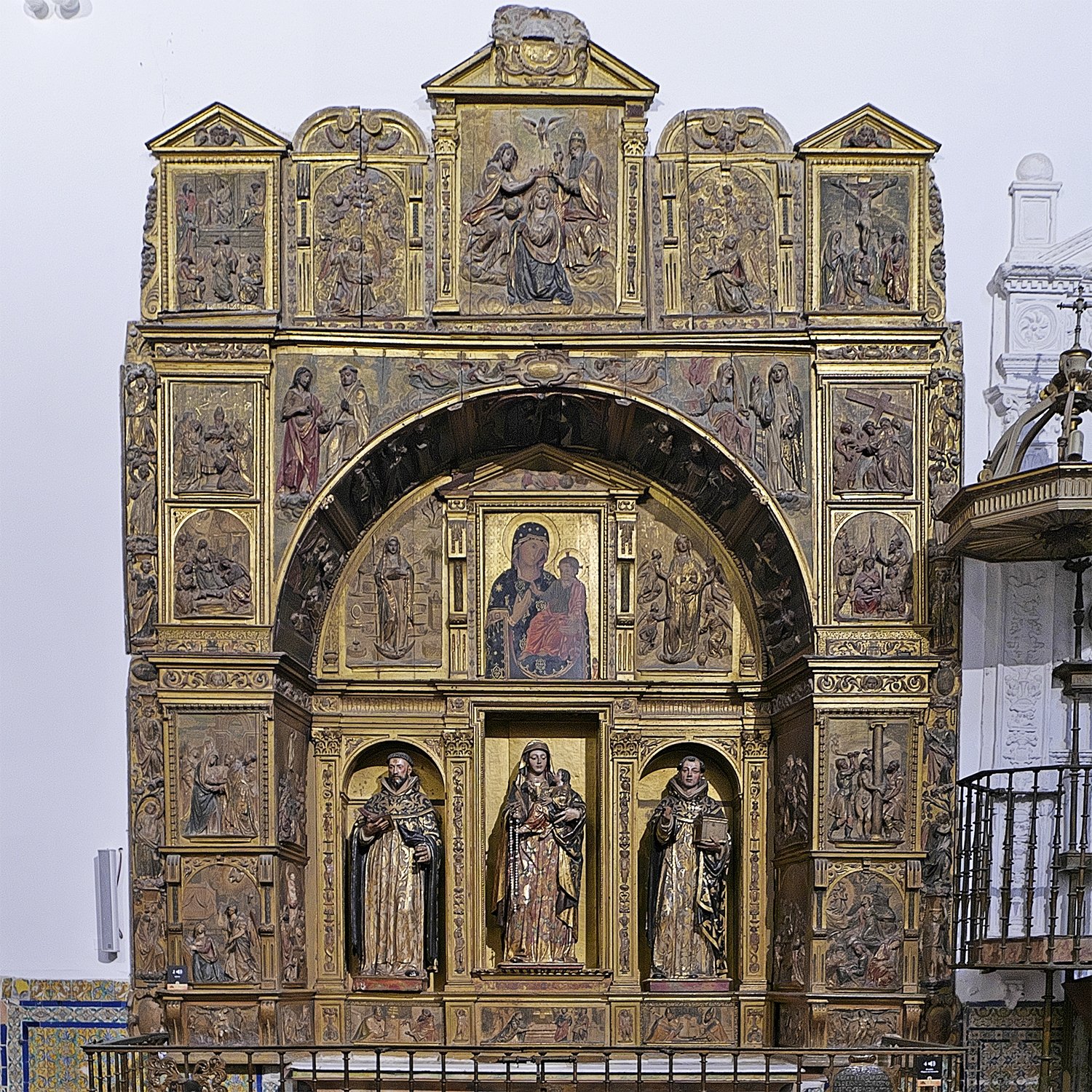
On the opposite side we find the altarpiece of the Virgen del Rosario, anonymous from the 16th century and of great quality. The image of the Virgin, in the center, appears flanked by Santo Domingo and Santo Tomás, while the rest of the altarpiece has a series of reliefs with different scenes from the life of Christ and the Virgin.

In the upper and lower choir space of the church, the nuns have set up a museum space in which a series of high-quality artistic pieces are exhibited, mainly sculptures from the 16th and 17th centuries. To cite just a few of them, we can mention the Virgin and Child by Mercadante de Brittany, a Risen One by Jerónimo Hernández or a Calvary by Cristóbal Ramos.

With the entrance to the museum, you collaborate with the large expenses that the convent has to face for the maintenance of the property and its valuable artistic heritage.

❋ : Leyendas de Sevilla     ✧ : Wikimedia Commons     ✢ : Archidiócesis de Sevilla


CATHEDRAL OF SEVILLE

The Cathedral of Seville is probably the most emblematic monument of the city. Unesco declared it a World Heritage Site in 1987, along with the Alcázar and the Archivo de Indias. It is considered the largest Gothic temple in the world.

Most of its work was done in the late Gothic style during the 15th century, although it retains elements of the 12th-century Almohad mosque on which it sits, such as the Patio de los Naranjos or the Giralda. In addition, in the 16th century the Royal Chapel, the Chapter House and the Greater Sacristy were added in the Renaissance style. Later, during the Baroque period and practically up to the present day, various elements of the cathedral would be added and remodeled, until it became a true compendium of the history of art in the city.

Its floor plan is one of the hall calls, with a flat head and five naves, the central one being taller and wider than the rest. It has numerous side chapels located between the buttresses.

The supports are enormous pillars with a rhomboid section, made of brick and masonry and covered with ashlars. Rib vaults sit on them, so characteristic of Gothic. They are sexpartite in the chapels, quadripartite in the naves, and those corresponding to the transept, in the central part of the temple, are star-shaped.

On the side chapels and on the main axes there is a narrow gallery in the form of a clerestory.

Its construction was approved by the cathedral chapter in 1401. Legend has it that the project would be inspired by the phrase "Let's make a church so beautiful and so great that those who see it carved will consider us crazy" and according to the capitular act of that day the new work should be "one such and so good, that there is no other like it."

In detail: Cathedral of Seville

1. Giralda, 2. Puerta de Palos, 3. Capilla Real,

4. Puerta de Campanillas, 5. Sala Capitular, 6. Sacristía Mayor,

7. Sacristía de los Cálices, 8. Puerta del Príncipe,

9. Sepulcro de Cristóbal Colón, 10. Altar Mayor, 11. Coro,

12. Puerta de San Miguel, 13. Puerta de la Asunción,

14. Puerta del Bautismo, 15. Parroquia del Sagrario,

16. Puerta del Perdón, 17. Patio de los Naranjos.

MORE ABOUT THE CATHEDRAL:

Tumba de Cristóbal Colón, Catedral de Sevilla

THE LAST VOYAGE OF COLUMBUS

Christopher Columbus is one of the most famous characters in the history of mankind. It is true that in the last century the almost epic narrative of his achievements has been nuanced, giving way to a more critical view of the figure of the admiral ...
Santas Justa y Rufina en la Puerta del Bautismo

THE SAINTS JUSTA AND RUFINA IN THE DOOR OF THE BAPTISM

Seville Cathedral is a splendid display of the history of art in the city. It ranges from the Almohad style of the 12th century in which the original mosque was built, and which is visible above all in the first sections of the Giralda, to ...
Portada del Perdón de la catedral de Sevilla

‘CLEANSING OF THE TEMPLE’ AT THE PUERTA DEL PERDÓN

The Puerta del Perdón of the Cathedral of Seville and its surroundings constitute an enclave of great artistic and aesthetic value in which it is possible to read about some of the most significant episodes in the history of the city. To begin with, it ...
GATES OF THE CATHEDRAL OF SEVILLE

GATES OF THE CATHEDRAL OF SEVILLE

The Cathedral has numerous portals towards the exterior:– On the west side, three on the façade at the foot, towards the Avenida de la Constitución, called Baptism, Asunción and San Miguel.– Two on both sides of the transept, called de la Concepción and San Cristóbal ...
Puerta de la Asunción de la Catedral de Sevilla

THE DOOR OF THE ASSUMPTION IN THE CATHEDRAL OF SEVILLE

The Puerta de la Asunción, on Avenida de la Constitución, is the main entrance to the Cathedral of Seville. However, its completion was not addressed until well into the 19th century, at the initiative of Cardinal Cienfuegos Jovellanos. In a first phase, between 1827 and ...
Dibujo de la giralda de Sevilla con detalle del campanario de Hernán Ruiz

THE GIRALDA OF SEVILLE

It measures about 100 meters high, making it the tallest cathedral tower in Spain and was for centuries the tallest building in the country. The lower two thirds of the tower are from the Islamic period, Almohad from the 12th century. It began to be ...

OLD CASTLE OF SAN JORGE

In the place where the Triana Market is located today, a castle was built in the Almohad period (XIII) that would later be known as the castle of San Jorge. It may have been built on previous constructions, even Roman or Visigothic, and that it was refortified after the Muslim defeat in the battle of Las Navas de Tolosa (1212).

‘Annales d'Espagne et du Portugal’, 1741

It had ten towers that articulated a robust fortified space with a rectangular plan. The Christians would establish the headquarters of the Inquisition in Seville there in 1480, so it is certain that it was the scene of numerous episodes of imprisonment and torture throughout its history. Some of the events that occurred there have been narrated as brilliant as the one offered by Beethoven in his opera "Fidelio", which is set in this castle.

It continued to be the seat of the Inquisition until the end of the 18th century, when it was abandoned. Already at the beginning of the 19th century it was demolished and a market was built on its site. At the end of the current market, in the part that faces Castilla street, some of the great walls that belonged to the primitive castle can still be seen today.

[mapsmarker map="2"  lat="37.385606" lng="-6.003191" zoom="18" height="300" heightunit="px"]

PALACE HOUSE AT GUZMÁN EL BUENO STREET 4

We are in front of a 16th century palace house, of which we do not know documentary origin. However, it is clear that it has undergone successive reforms over the following centuries, mainly in the 17th and 19th centuries, as reflected in the inscription on the lintel over the main door: 1560, 1654 and 1856.

CC BY-SA 4.0

The main façade has preserved a beautiful Renaissance portal from the 16th century, framed by Ionic columns with plant decoration on the shafts. They support a lintel on which appear a series of corbels that in turn support the central balcony.

Inside, the model of a Sevillian house is faithfully reproduced, with the rooms distributed around a porticoed patio on all four sides. On the floor below, the arches are semicircular and rest on marble columns with capitals of ribbons or castanets. The arches have the classic Sevillian plateresque decoration, with vegetation and 'candelieri'. Between them, a series of pilasters support a continuous frieze, all with the same decorative motif.

[mapsmarker map="2"  lat="37.387345" lng="-5.990816" zoom="18" height="300" heightunit="px"]

GENERAL ARCHIVE OF THE INDIES

The large Renaissance building that we know today as the Archivo de Indias was originally conceived as the Lonja de Mercaderes, to house and organize part of the commercial activity that arrived in the city during the 16th century. Until its construction, merchants used the spaces around the Cathedral as a market, especially the area known as 'las gradas', towards Alemanes street. The Chapter of the Cathedral was upset with this situation and asked the king for a solution.

Felipe II would attend to the request and commission Juan de Herrera, the famous architect from El Escorial, to design the new building in 1572. Work began in 1584 directed by Juan de Minjares following Herrera's plans. It seems that the building was ready for use in 1598, although there is evidence that the works continued during the 17th century.

When the center of commerce moved to Cádiz, in the 18th century, it was when the building was readapted to house all the documentation generated by the Casa de Contratación. As a result of this new circumstance, new works would be undertaken on the property in order to adapt it to the new use. It would be then, for example, when the monumental main access staircase to the upper floor was built.

It houses all the documentation related to the Spanish administration of the American territories. It was declared a World Heritage Site by UNESCO in 1987, together with the Cathedral and the Alcázar, due to the great historical and artistic values of the complex.

The building is a magnificent sample of the Renaissance in the city, with a more sober and Italianate air than is usual here. It has a square plan, two stories high, articulated around a monumental central patio, porticoed with Doric columns, very similar to the Patio de los Evangelistas in El Escorial.

On the façade, a bichrome color was introduced between the reddish brick panels and the pale stone pilasters. This game of two colors was enormously successful in Seville and we will see it reproduced in numerous buildings in the city for centuries to come.

Inside, the naves around the patio are covered with hollow vaults, with coffers and plant decoration. Practically all the walls are covered by shelves of magnificent quality, made with mahogany and cedar wood brought expressly from Cuba. These shelves were added in the 18th century, when the old Lonja was converted into an Archive.

It was also then that Lucas Cintora designed the monumental staircase behind the main access from Avenida de la Constitución. It is covered with red and greyish black jaspers and above it stands a vaulted ceiling with a central lantern that provides light.

The Archive contains documents of incalculable value. Manuscripts of characters such as Christopher Columbus, Hernán Cortés, Miguel de Cervantes, Felipe II, Felipe IV or George Washington himself, the first president of the United States. In addition, it brings together a magnificent collection of engravings, drawings and maps, authentic jewels for the study of the history of America up to the 19th century.