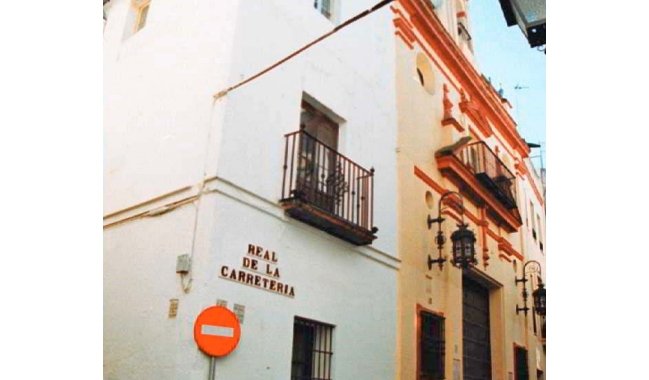
CHAPEL OF LA CARRETERÍA

The Carretería chapel is a small 18th-century temple located in the Arenal district of Seville. It is one of the smallest chapels in Seville, with less than 100 square meters. As its name indicates, it is the headquarters of the Carretería brotherhood, which processes on the afternoon of Good Friday.

The location of the temple responds to a miraculous event that tradition points to in this place. Apparently, in the mid-16th century, a member of the barrel guild found an image of the Virgin hidden behind a wall in this area. The image gave off a very bright light, which is why it received the invocation of Our Lady of Light. After this event, it was decided to found the brotherhood, whose germ would be the aforementioned barrel guild (1550).
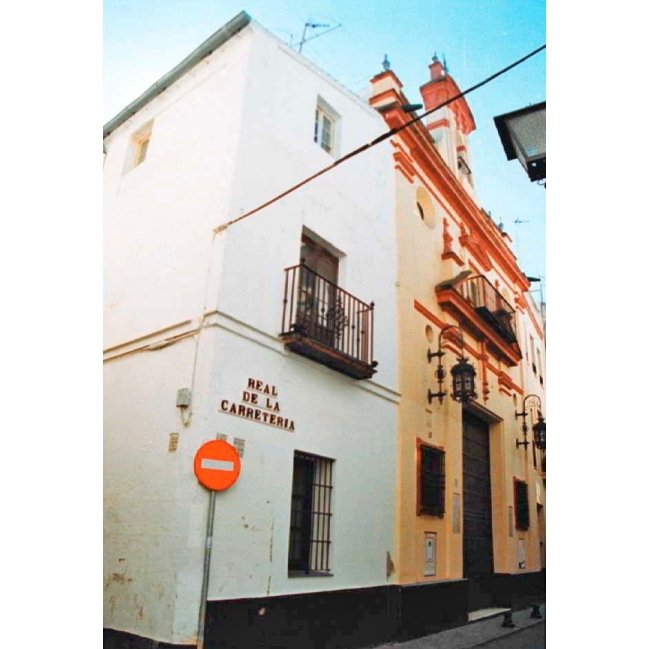
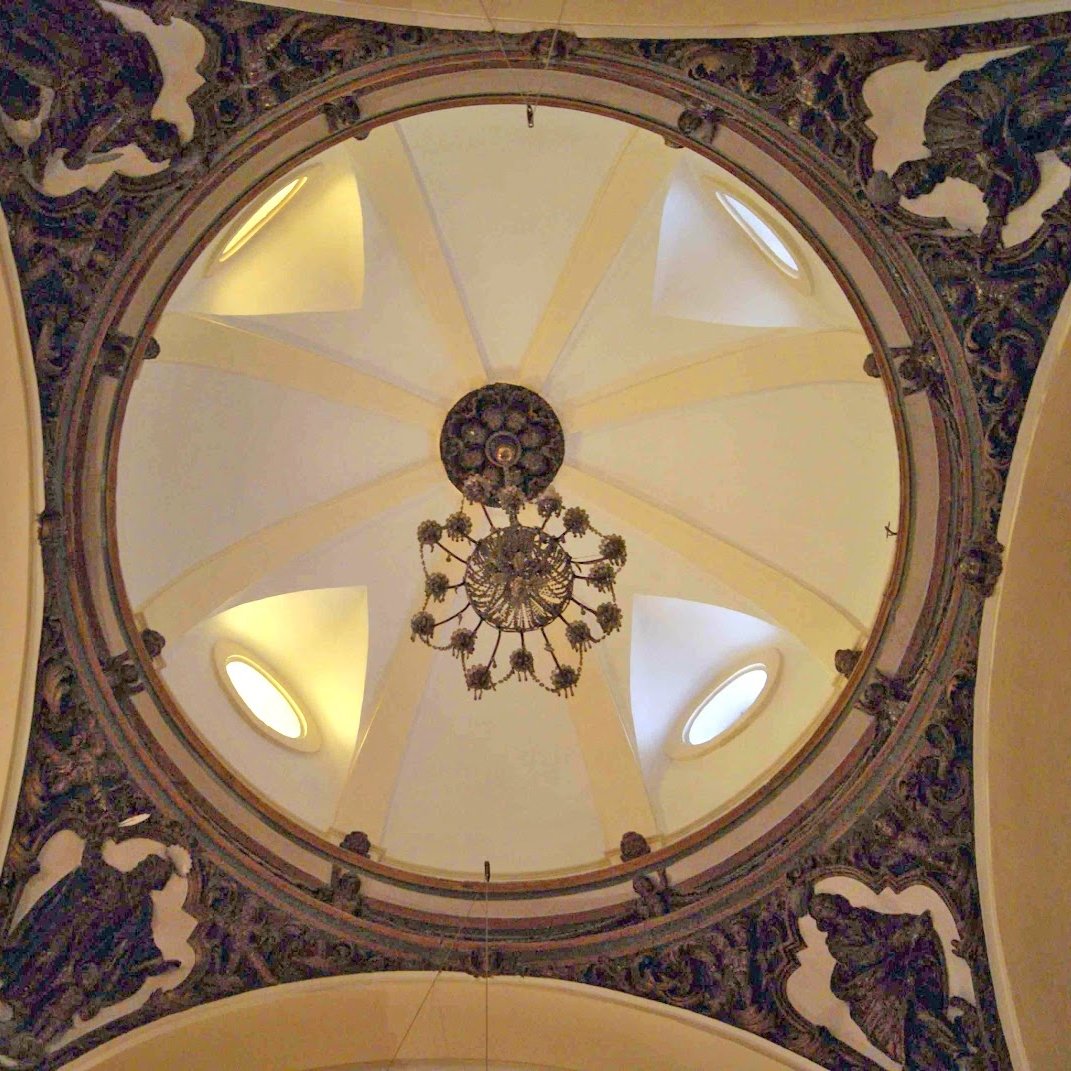
The current chapel was built between 1753 and 1761 based on the plans of Juan Núñez. It has a single nave, covered by a groin vault, except in the presbytery, where the vault is groined. At the end of the 20th century, a new chapel was added to the right to house the image of the Virgin of the Greatest Sorrow in her Solitude.

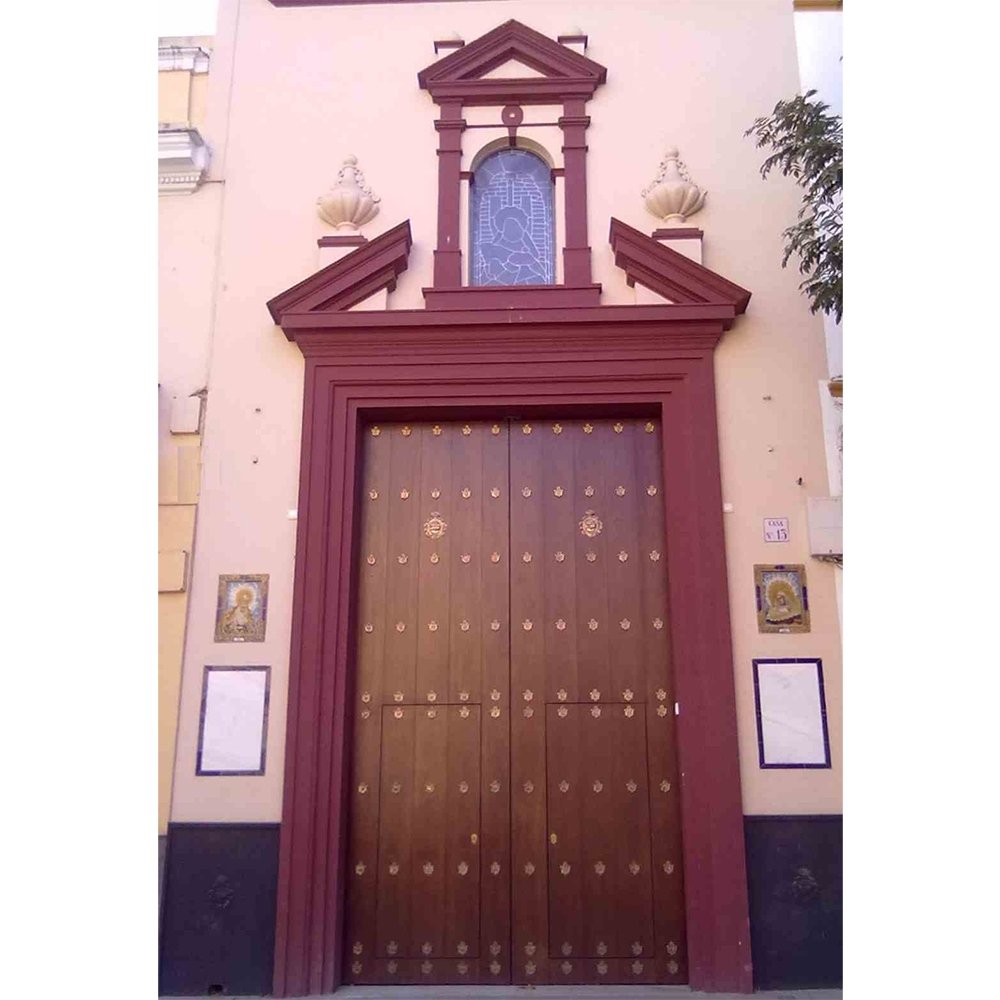
The façade is neoclassical and very simple. Two pillars frame the entrance and support a split pediment, in the centre of which there is a niche, topped by a triangular pediment. In the centre of the upper part there is a single-bay belfry with the bell.

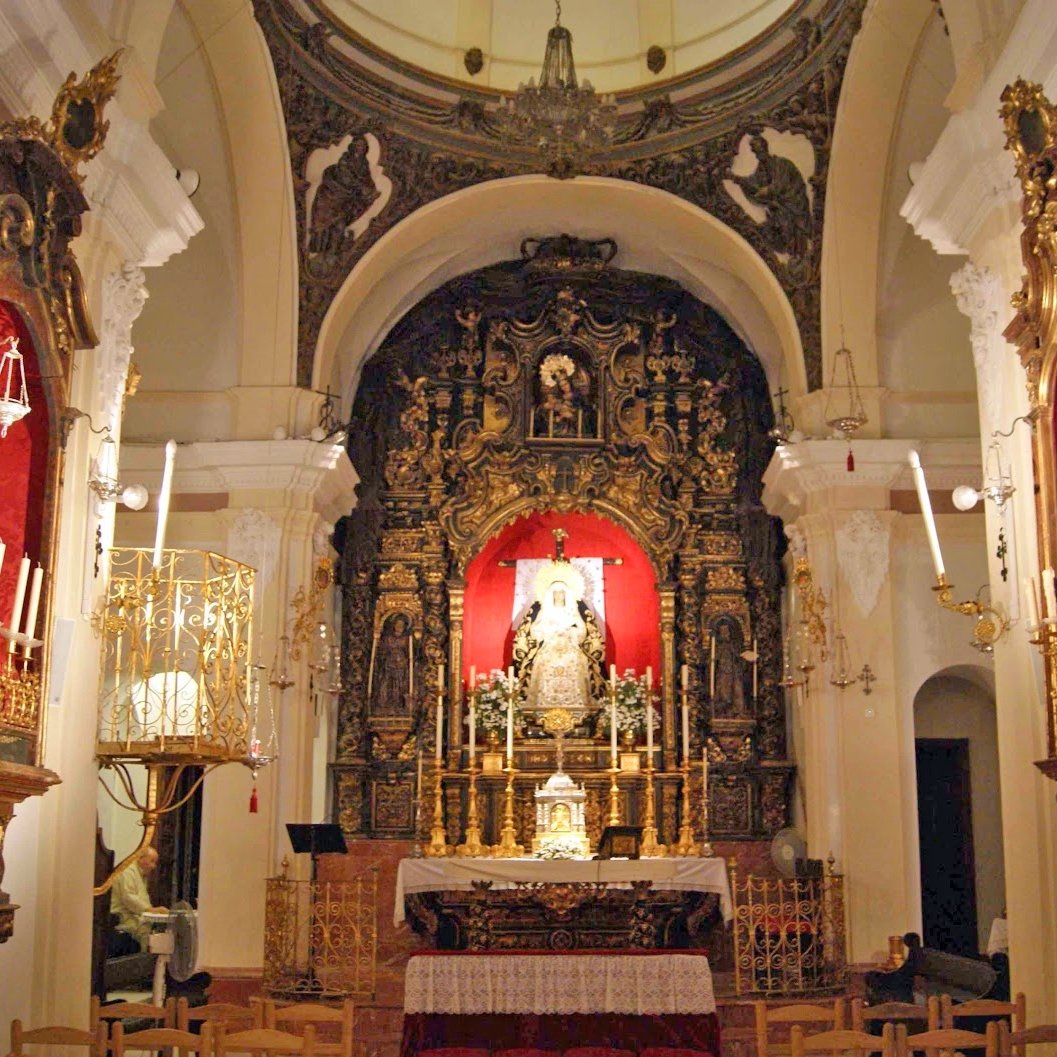
Inside the chapel, the members of the Carretería brotherhood receive worship. The Cristo de la Salud is an extraordinary carving by an anonymous author that has been dated to the beginning of the 17th century. Although no documentation has been preserved, based on its style, Francisco de Ocampo has been pointed out as its possible author. The Virgin of Light and Saint John are the accompaniers, works from the workshop of Pedro Roldán from around 1677.

In the side chapel there is the image of Our Lady of the Greatest Sorrow in her Solitude. Originally, it was the image of Mary that accompanied the Crucified Christ in the procession of mystery, although since 1885 it has been carried in its own procession of pallium. It is attributed to Alonso Álvarez Albarrán and has been dated to 1629.

We also find a dressed image of the Virgin with the Child, with the invocation of Our Lady of Light (of glory), which it shares with the aforementioned. Traditionally it has been identified with the image that miraculously appeared in this place around 1550. However, a stylistic analysis makes it clear that the image was made in the second half of the 18th century. It is possible that the current image was made from the remains of the original or that, for some reason and at some time that we do not know, it was decided to replace it.
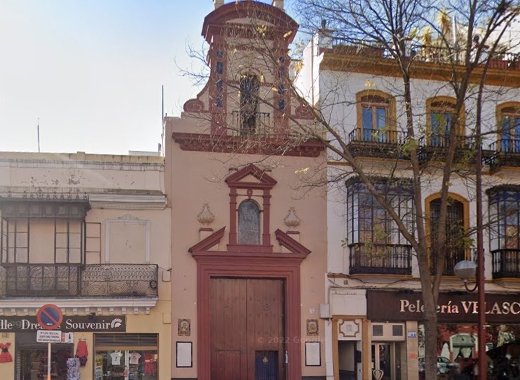
CHAPEL OF LA PIEDAD DEL BARATILLO

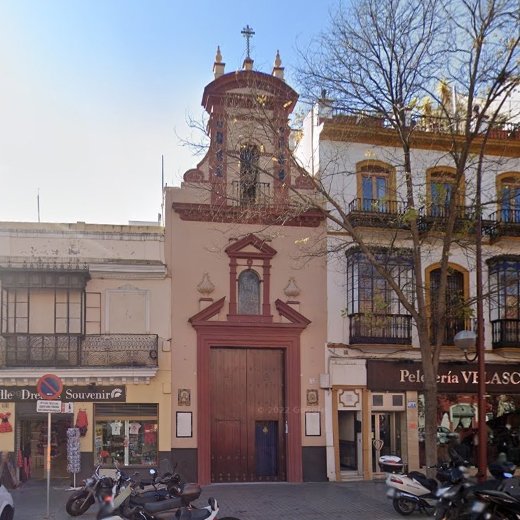
The chapel of La Piedad del Baratillo is a small baroque-style temple located in the Arenal district of Seville. It is the headquarters of the Brotherhood of Baratillo, which takes part in a procession on Holy Wednesday afternoon with two floats (pasos), La Piedad and the Virgen de la Caridad.

Since the mid-17th century, in the place where the chapel is today, there was a small mound on which an iron cross was raised. In that same place, some of the victims of the 1649 epidemic had been buried, which in Seville killed more than half of the population. Around 60,000 people died of "plague" in the city that year.

The Baratillo Cross was awakening an ever-increasing devotion and in 1693 a brotherhood was founded around it and the construction of a chapel was decided.

Its works were completed in 1696 under the direction of Bernardo Bustamante, although in the mid-eighteenth century an extension was carried out directed by Marcos Sancho.

The chapel has a Latin cross plan, with the transept slightly raised, and a single nave. This is covered with a barrel vault and above the presbytery there is an octagonal dome on pendentives. On the outside, the dome is crowned by a metal cross, which is traditionally considered to be the primitive one that was raised on the Baratillo hill in the seventeenth century.

The exterior façade is very simple. It has a doorway with two bodies. In the lower one, the entrance opening is framed under a split pediment, in the centre of which there is a second body, smaller in size. It is flanked by pillars that support a triangular pediment and in its centre there is a contemporary stained glass window, donated to the brotherhood by the Austrian pavilion after Expo 92. The façade is topped by a bell gable under a curved pediment and with a single opening that houses the bell.

Inside are the titular images of the Brotherhood of Baratillo. In the main altarpiece, original from the late 17th century, the Virgin of Mercy is worshipped, a work by Manuel José Rodríguez Fernández-Andes from 1945. In her lap is the Christ of Mercy, made by the sculptor of San Roque Luis Ortega Bru in 1951. In an altarpiece on the right side is the image of the Virgin of Charity in her Solitude, made by the same sculptor as the Piedad, Rodríguez Fernández Andes, in 1931.

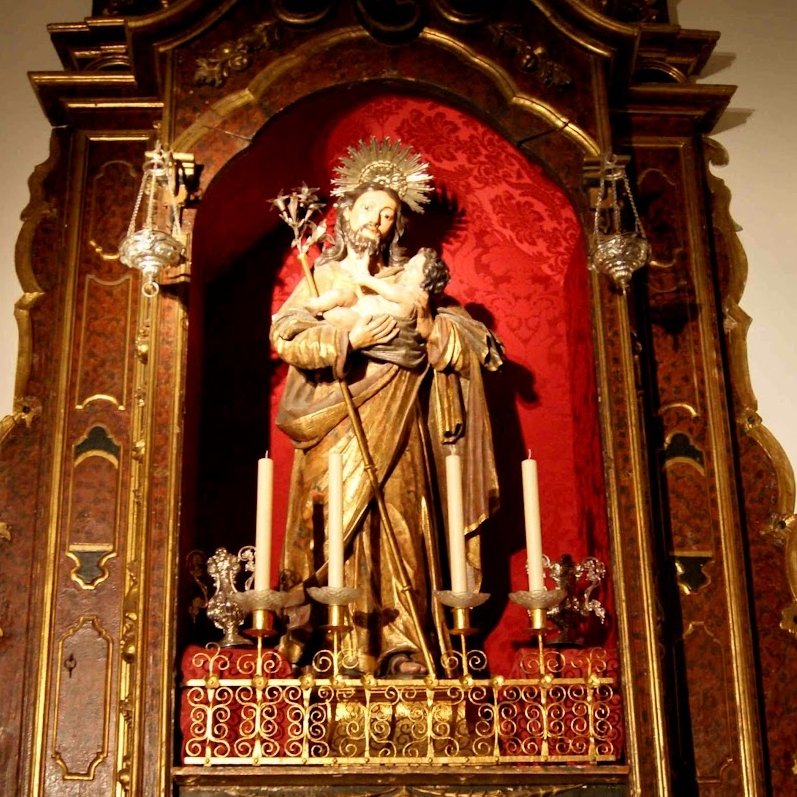
In an altarpiece on the left side is the carving of Saint Joseph with the Child, which is also the titular image of the brotherhood. It has been dated to the second half of the 18th century and, although it is an anonymous author, some authors attribute it to José Montes de Oca. It was donated in 1794 by the bullfighter Pepe Hillo. The brotherhood has historically been closely linked to the world of bullfighting, with many bullfighters linked to it, "either as brothers or out of deep devotion." It should be remembered that the temple is located just a few meters from the Maestranza bullring.

CHURCH OF SAN GREGORIO MAGNO

The Church of San Gregorio Magno, also called the Chapel of the Holy Sepulchre, originally belonged to the English college founded by the Jesuits in the city at the end of the 16th century. Currently, the brotherhood of the Holy Burial is located in the church.

CC BY-SA 4.0

When the Jesuit Order was outlawed in Spain in 1767, the dependencies of the church and the school became dependent on the State, which has used them for various uses ever since. A century later, in 1867, the brotherhood of the Holy Burial settled here and since the 1940s it has housed a Mercedarian fraternity.

The temple has a rectangular plan with three naves, separated by Tuscan columns that support former semicircular arches. Both the central nave and the lateral ones are covered by architrave vaults.

The decoration of the temple is very simple. Outside, we hardly find any neo-Gothic detail added in the 19th century, such as the molding that frames the entrance, a simple rectilinear depressed arch.

Inside, the main altarpiece is a modest 19th-century neoclassical work imitating reddish marble. In its center, an urn also made in the 19th century by Lucas de Prada houses the image of the Holy Reclining Christ, head of the brotherhood of the Holy Burial.

This brotherhood makes its penance station on Holy Saturday with three steps, the Holy Burial, the Triumph of the Holy Cross and the Virgin of Villaviciosa.

The exact date of foundation of the brotherhood is not known. There is an 18th century narrative in which it is stated that it was founded by Fernando III himself after his conquest of the city in 1248 and that the monarch himself would have been his first older brother. However, there is no documentary evidence of such a story.

It is known for sure that the brotherhood already existed around 1570 with headquarters in the convent of San Laureano. After the convent closed in 1810, it passed through different locations until they settled in this church of San Gregorio in 1867. However, they did not go out in procession regularly until they began to do so in Holy Week in 1956.

The first of the steps of the brotherhood is the Triumph of the Holy Cross, one of the most curious of the Sevillan Holy Week. It represents the triumph of the Cross over death, which is represented by a brooding skeleton, which is why the pass is popularly known as 'La Canina'. It is a work from the end of the 17th century attributed to Cardoso Quirós.

The Reclining Christ is a magnificent carving that has not been documented, but which has been attributed to Juan de Mesa and dated around 1620. It parades in an imposing neo-Gothic glass-enclosed urn made in 1880.

In the last step, the Virgin of Villaviciosa parades, an image also by Cardoso Quirós from the late 17th century, who appears comforted by Saint John, the three Marys and the male saints, nineteenth-century works by Juan de Astorga.

[mapsmarker map="2"  lat="37.392888" lng="-5.997116" zoom="18" height="300" heightunit="px"]

CHAPEL OF EL DULCE NOMBRE DE JESÚS

The Vera Cruz Brotherhood has its headquarters in this chapel on Baños street, which makes a penance station every Holy Monday with two pasos, the Cristo de la Vera Cruz and the Virgen de las Tristezas.

The brotherhood was founded in 1448 in the huge Franciscan convent known as Casa Grande de San Francisco, which stood in what is now Plaza Nueva. When the convent was demolished in 1840, the brotherhood had to move to the church of San Alberto. There it entered a phase of decline, to the point that they stopped processing. In 1942 the brotherhood moved to its current headquarters in the Chapel of Dulce Nombre and from there it began to process again in 1844.

The Chapel sits on the grounds of the old Arab baths of Reina Mora, which have been partly preserved as annexes to the current chapel. A convent with the dedication of the Dulce Nombre de Jesús was established there since the 16th century, initially formed as a shelter for “repentant women”, although it is known that by the middle of the 17th century it was already a convent with Augustinian nuns in use. In the 19th century, as part of the confiscation process, the convent was exclaustrated and its rooms were used as barracks. The current Chapel is the only remainder of that disappeared convent that has survived to this day.

The access to the temple is through a simple side doorway on which a belfry stands. Inside, we see that the church has a rectangular floor plan with three naves, the central one being covered by a barrel vault with transverse arches and lunettes, all richly decorated with plant motifs and scrollwork. The central nave is notably higher, which allows for the existence of separate spaces above the lateral naves, which open onto the church behind a series of bars. This element clearly takes us back to the conventual past of the temple, since the nuns could attend services from this elevated position, safe from the gaze of the rest of the faithful.

The main altarpiece of the chapel is an anonymous work from the last third of the 17th century that has been linked to the style of Bernardo Simón de Pineda. The two images that appear in the side niches, San Agustín and Santa Mónica, appear to be from the same period and authorship of the altarpiece.

Artistically, perhaps the most outstanding work in the temple is the head of the brotherhood, the Cristo de la Vera Cruz, a crucified figure by an anonymous author dating from the first half of the 16th century, making it the oldest image of Christ in procession in Holy Week in Seville. It is smaller than life size, and due to its age it retains many features of Gothic sculpture, such as the rigidity of its posture and the accentuated pathos of its expression, which achieves a profoundly moving effect.

The painful image that accompanies Christ in his penance station is the Virgen de las Tristezas, a carving made by Antonio Illanes in 1942 to replace the original, whose whereabouts are unknown. On the brotherhood's website, we can read that 'the image was the result of the author's inspiration, taking his wife Doña Isabel Salcedo as a model.'

[mapsmarker map="2"  lat="37.395229" lng="-5.998373" zoom="18" height="300" heightunit="px"]

CHAPEL OF THE ROSARIO DE MONTE-SION

In this chapel on Calle Feria, the Brotherhood of Monte-Sion has its brotherhood, which makes its penance station every Holy Thursday with two steps, the Lord of Prayer in the Garden and the Virgin of the Rosary.

The Brotherhood was founded in 1560, the result of the union of two previous brotherhoods. Around 1576, construction work began on its current chapel, on a small plot ceded by the old Dominican convent of Nuestra Señora de Montesión.

The exterior of the chapel is very simple, with a large flat door on which the inscription 'REGINA SACRATISSIMI ROSARII' (QUEEN OF THE HOLY ROSARY) stands out. As a curiosity, it can be noted that the door is not the original one, but was enlarged in 1915 to allow exit from the steps through it. On both sides you can see the ceramic altarpieces of the holders of the Brotherhood, both works by Alfonso Chaves from 1960. The large door that is attached to the facade of the chapel is the old access to the disappeared Dominican convent that we have mentioned.

Inside, the chapel is rectangular in plan with a single nave. The wooden roof stands out, an armor made following the original pair and knuckle technique from the end of the 16th century.

The main altarpiece of the chapel is contemporary, since the temple was assaulted in 1936, during the first days of the Civil War, losing part of its heritage.

Artistically, the holders of the Brotherhood stand out. The Virgen del Rosario is an anonymous dolorosa from the late 16th or early 17th centuries, one of the oldest Marian images among those in procession during Holy Week in Seville. For his part, the Lord of Prayer in the Garden was made by Pedro Roldán around 1675.

In an altarpiece on the Gospel side, Cristo de la Salud is venerated, also the head of the Brotherhood, although he does not carry a procession. It was made by Luis Ortega Bru in 1954 to replace a previous one lost during the fire of 1936. Despite being a relatively recent work, it is a crucified figure of great artistic quality, since its sculptor, Ortega Bru, is one of the of the highest quality and originality among those who worked in Seville during the 20th century.

[mapsmarker map="2"  lat="37.396912" lng="-5.991244" zoom="18" height="300" heightunit="px"]

BASILICA OF EL GRAN PODER

The Brotherhood of El Gran Poder has its headquarters in this Basilica in the Plaza de San Lorenzo. They do their penance station in the 'Madrugá' from Thursday to Good Friday, in the midst of absolute silence, being one of the brotherhoods that arouse the most devotion among Sevillians.

CC BY-SA 4.0

Historians trace the foundation of the Brotherhood to the 15th century, initially settling in the Benedictine Convent of Santo Domingo de Silos, of which the current church of San Benito Abad, in Luis Montoto, remains as testimony. From there, it would go through various locations throughout its history.

Already in the fifteenth century it appears located in the Convent of Santiago de la Espada and in the sixteenth century it was moved to a chapel of the Franciscan Convent of Santa María del Valle, where today is the Sanctuary of the Brotherhood of the Gypsies. From the Valley they would move to San Lorenzo at the beginning of the 18th century and the current headquarters would be built in the middle of the 20th century.

The temple was built between 1959 and 1965 in a neo-baroque style with a very classical air inside, following the traces of the architects Antonio Delgado Roig and Alberto Balbontín. The floor plan is that of a large, almost circular space, covered by a large coffered vault, which seems directly inspired by that of Agrippa's Pantheon in Rome. As in the Roman case, this space is preceded by a large rectangular atrium through which it is accessed, covered by a quarter-barrel vault, also coffered.

The temple has been a Minor Basilica since 1992, the result of a concession from Pope John Paul II.

The holders of the Brotherhood are Jesus of Great Power and the Virgin of Greater Pain and Transfer.

Jesús del Gran Poder is an image of Jesus carrying the cross made by Juan de Mesa around 1620. It constitutes a masterpiece of Sevillian Baroque, with a splendid anatomical treatment and an expressionism in the face that manages to convey the sensation of deep suffering and great solemnity at the same time.

The image of the Virgin is an anonymous work from the 18th century, with successive restorations in the 20th century. She is in procession under a canopy accompanied by Saint John the Baptist, an image carved for the Brotherhood by Juan de Mesa at the same time he sculpted the Lord.

[mapsmarker map="2"  lat="37.397147" lng="-5.996298" zoom="18" height="300" heightunit="px"]