BUILDING OF THE SEVILLE CHARITY ASSOCIATION

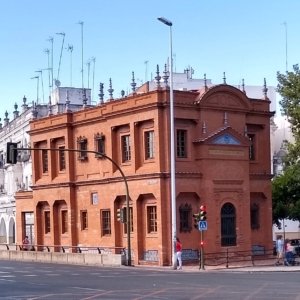
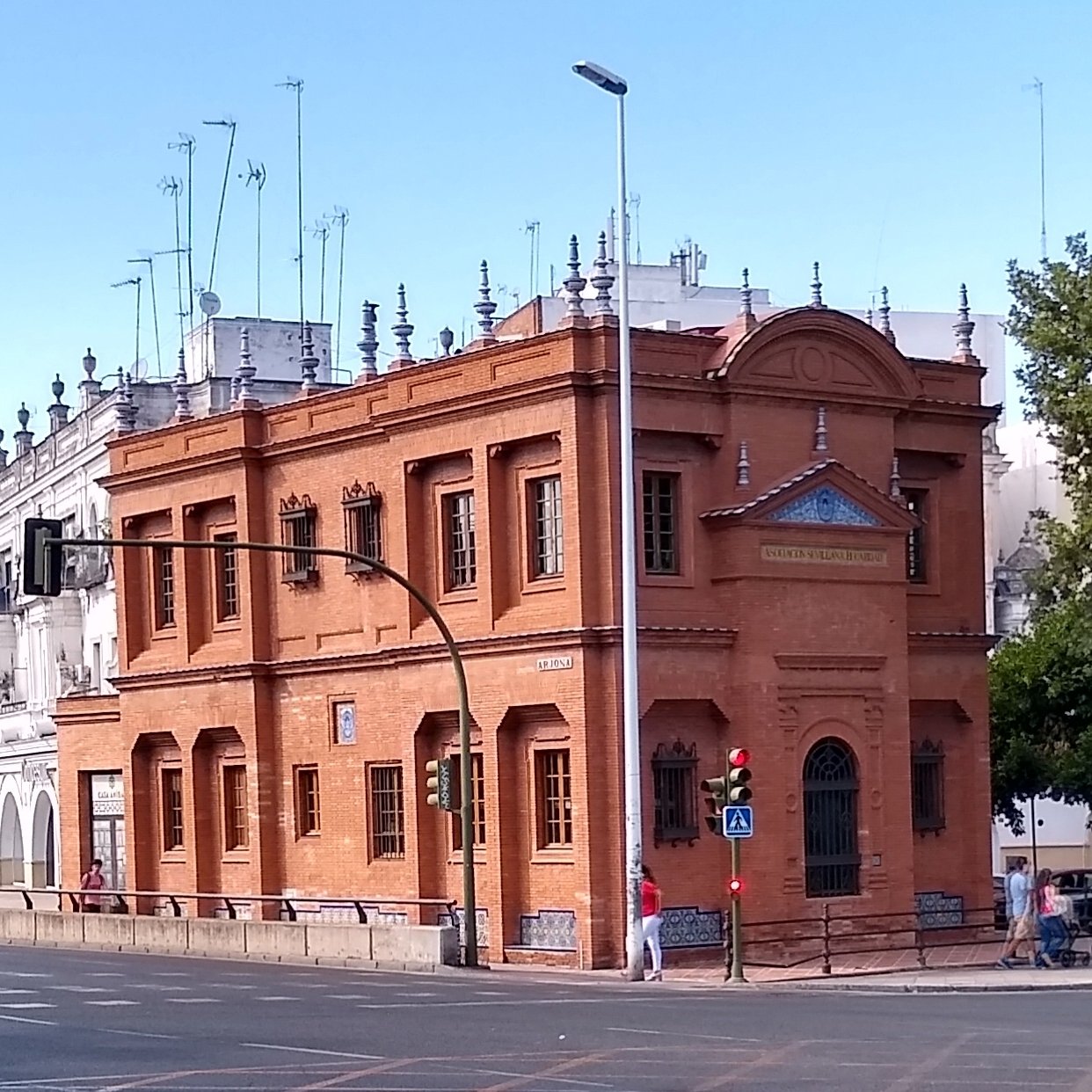
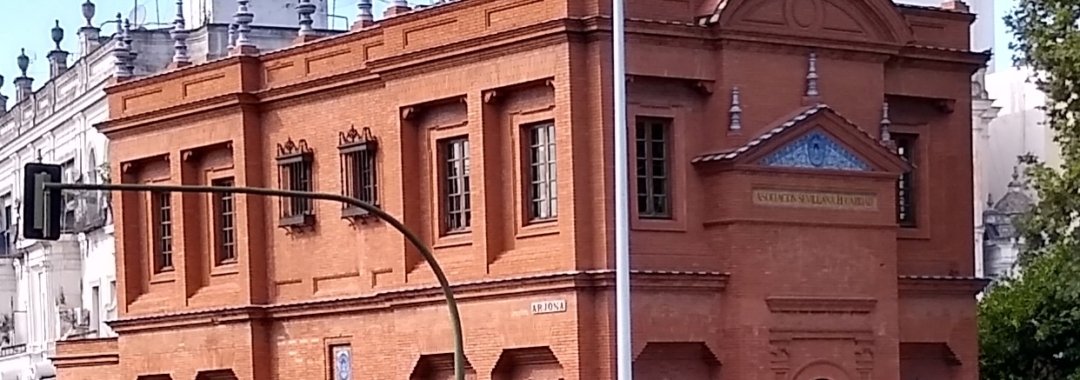
This regionalist building designed by Aníbal González stands at the intersection of Arjona and Reyes Católicos streets. It is known by the name of the organisation that commissioned its construction, the Asociación Sevillana de Caridad. It was built between 1912 and 1914 and originally had only one floor. In 1937, the architect Aurelio Gómez Millán was commissioned to build the upper floor, respecting the original layout as much as possible.

From the outside, the main feature of all the facades is exposed brick, which is abundantly used as one of the most characteristic elements of regionalist architecture. In the upper part, decorative ceramic elements help to break up the monochrome of the whole.

The two main entrances are framed by very classical structures. The one facing Reyes Católicos is flanked by pilasters and topped by a triangular pediment decorated with glazed ceramics. The entrance on Calle Segura is framed by columns, also made of brick, which support an entablature with a curved pediment, also with ceramic decoration.

Today, the building houses a restaurant and a hospitality school, both known as “Casa Aníbal”, in reference to the architect who created the original project.
HOUSE OF FLIES

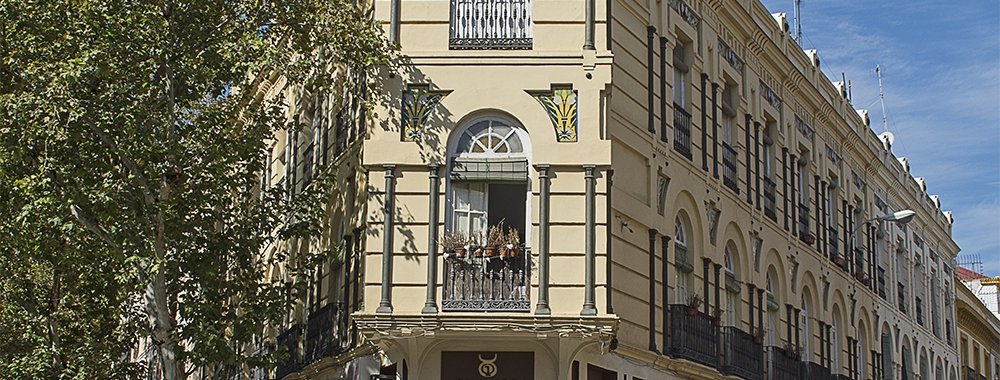
The residential and commercial building located on the corner of Adriano and Pastor y Landero streets is one of the few examples of modernist architecture in Seville. Its design was by the Sevillian architect Antonio Gómez Millán and it is popularly known as the “House of Flies” due to its ceramic decoration featuring insects.

Its design posed the challenge of having to adapt to the characteristics of a completely triangular plot, with two sides forming a façade to the outside and a third adjoining the building next door. The entire space is articulated around a central courtyard, also rectangular in shape, with the sides that have a façade wider than the dividing wall. The corner where the streets meet is harmoniously highlighted with a simple chamfer that stands out from the triangular plan.

The facade is notable for its horizontality and the superposition of semicircular and lintelled openings, which is also found in other works by the same author. Its imaginative decorative elements mean that the building can be classified as modernist. As we said, this style is quite rare in the city, since at the time when this style was developed in other European cities (early 20th century), Seville decidedly opted for Regionalism.

Among the modernist elements, the tile decoration stands out. On a yellow background, very common in Seville workshops, stylised natural elements are arranged, which, on the contrary, are not at all common in the city. Thus, in the spandrels and on the lintels, stylised and beautiful designs are arranged based on natural elements such as leaves, flowers, dragonflies, butterflies and bees.

ROSARY CHAPEL – HERMANDAD DE LAS AGUAS

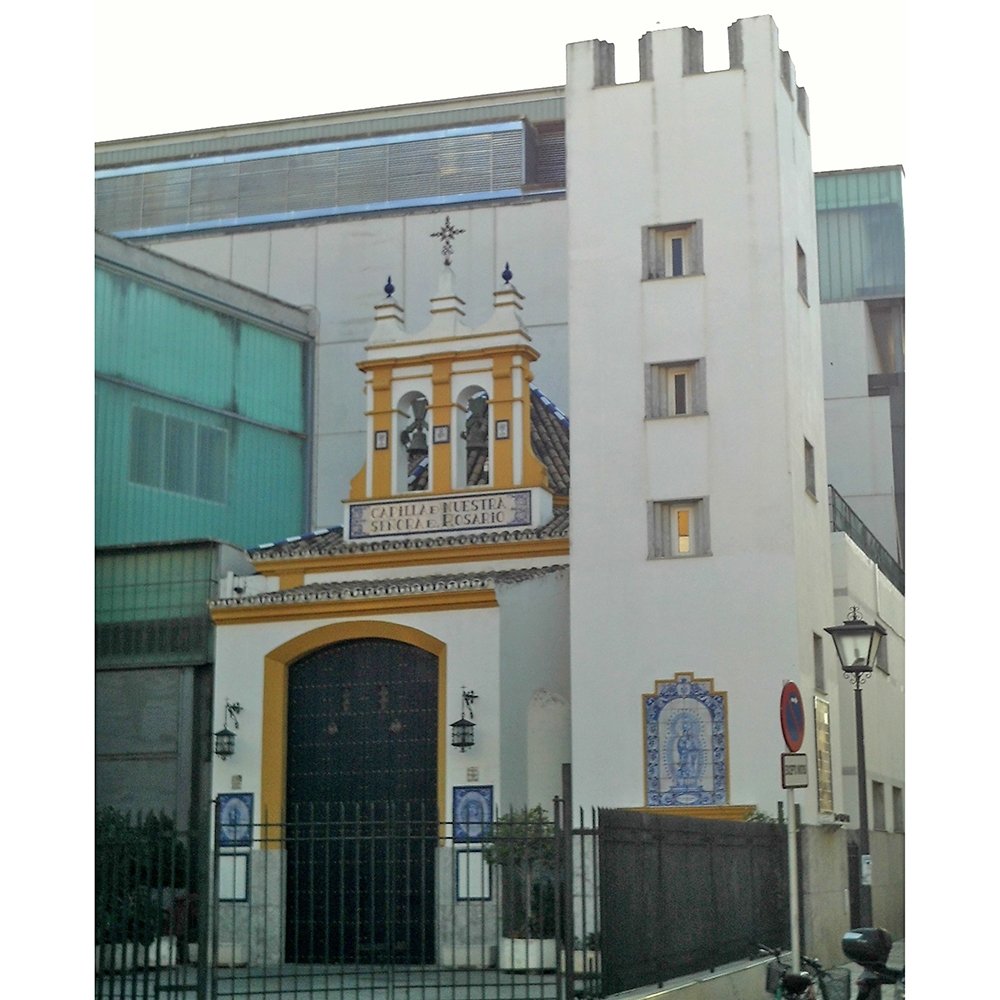
It is a small neo-baroque temple located in the Arenal neighbourhood, the result of the reconstruction in 1990 of a previous chapel that was in a state of ruin. Since 1977 it has been the headquarters of the Hermandad de las Aguas, which processes on the afternoon of Holy Monday.

The original chapel was built at the end of the 17th century. In the following century, part of the Maestranza de Artillería buildings were built around it. When these buildings were demolished to make way for the current theatre, the structure of the chapel was compromised, so the aforementioned reconstruction was necessary, respecting its original appearance.

This project was directed by the architects Luis Marín and Aurelio del Pozo, the same ones who designed the Maestranza theatre. In addition to rebuilding the temple itself, the brotherhood house and tower were built next to it.

The chapel is made up of a single nave with a Latin cross plan, although with the arms barely prominent. The central space is covered by a dome on pendentives, hemispherical on the inside and octagonal on the outside.

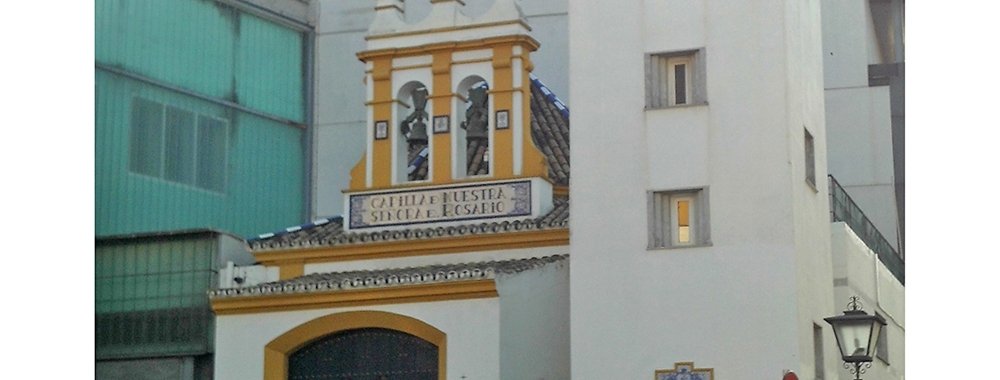
Its main façade is very simple, with a large entrance under a basket-shaped arch that allows the "pasos" to leave and collect. It is protected by a simple eaves. At the top there is a two-span bell gable that houses the bells.

The style of the tower added in 1990 is completely different. It is a simple prism, with three square windows on two sides. At the top, the terrace is surrounded by a battlement in the style of a defensive tower.

HEADQUARTERS OF THE REAL MAESTRANZA

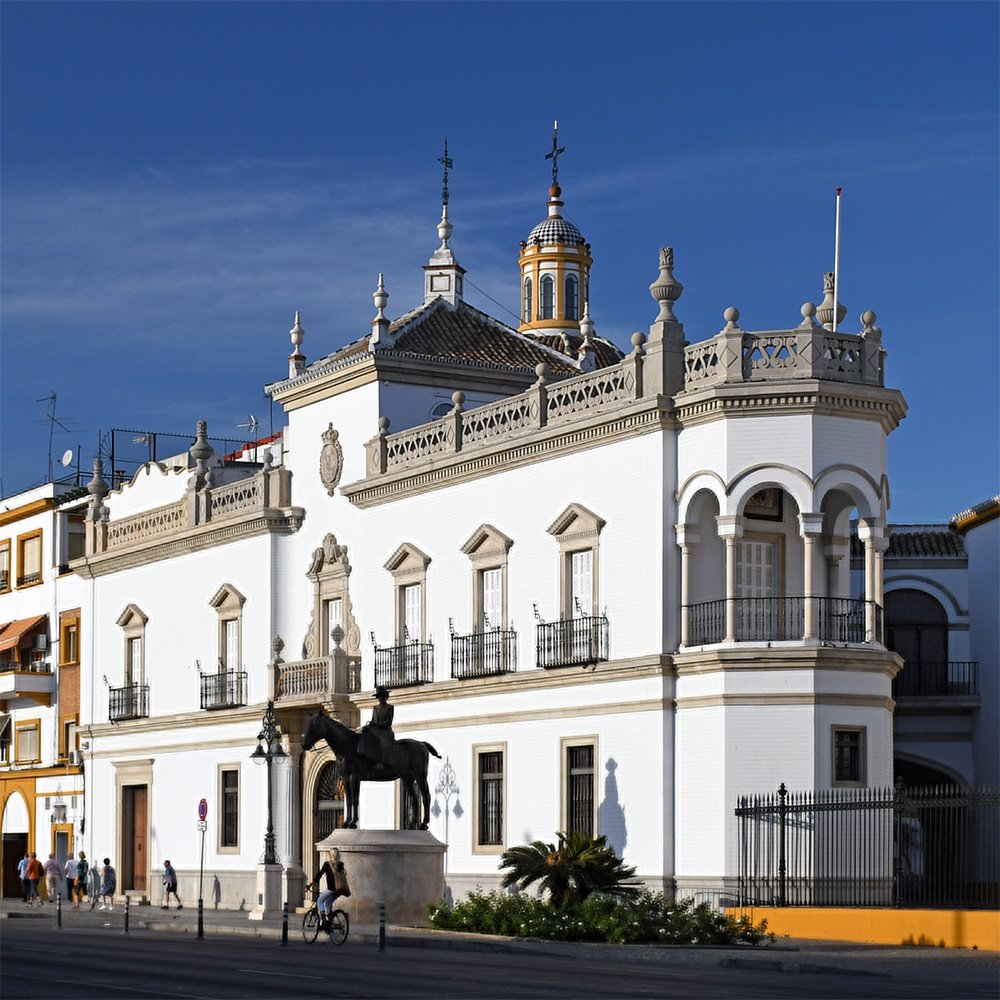
The headquarters of the Real Maestranza de Caballería is located next to the Plaza de Toros, of which this institution is the owner. It is a regionalist building in the neo-baroque style, designed by Aníbal González in 1929.

However, the property would undergo successive renovations and expansions in the following decades. In 1956 the chapel was inaugurated, the construction of which was directed successively by Gómez Millán, Medina and Barquín Barrón. It has a Latin cross plan, with a single nave covered by a barrel vault with lunettes. The central space of the transept has been covered by a lowered dome with a drum and lantern, sitting on pendentives.

The main altarpiece is recomposed taking parts of the primitive altarpiece that occupied the chapel that the Maestranza had in the church of the disappeared convent of Regina Angelorum. It was originally made under the direction of Francisco Dionisio de Ribas in 1668 and its sculptures are the work of Pedro Roldán. In its central niche, a dress image of the Virgin of the Rosary is venerated, a work by Cristóbal Ramos from the 18th century, considered the official patron saint of the corporation.

SEVILLE CITY HALL

The Sevillian town hall has its headquarters in a magnificent 16th century building, which preserves much of its façade traces of the exquisite Plateresque Renaissance style in which it was built.

CC BY-SA 4.0

The building was originally attached to the Casa Grande de San Francisco convent, which originally occupied the entire area of Plaza Nueva and its adjacent blocks. The works began around 1527, coinciding with the stay of Emperor Charles V in the city to celebrate his marriage to Isabel of Portugal. Throughout the century, different architects succeeded one another in directing the works, such as Diego de Riaño, Juan Sánchez, Hernán Ruiz II or Benvenuto Tortello.

In the 19th century, following the disappearance of the San Francisco convent, the building was significantly expanded. It was then that the neoclassical façade facing Plaza Nueva was built, the work of Balbino Marrón (1861) and the extension of the façade towards Plaza de San Francisco, directed by Demetrio de los Ríos (1868).

Towards the outside, the exquisite Plateresque decoration of the part built in the 16th century stands out. We can see a complex iconographic program, full of mythological characters and references to Roman antiquity, mixed with the emblems of Carlos V. In this way, it was intended to exalt the city's past, relating it to the glorification of the figure of the emperor . In this way, the aim was to consolidate Seville as the most important city of that great empire that took shape during the 16th century.

On both sides of the arch that originally gave access to the Convent of San Francisco we see two niches with the figures of Hercules and Julius Caesar. Both characters are considered the mythological and historical founders of the city. The sculptures were added in 1854 one of the extensive restorations undertaken on the building's façade. They are the work of Vicente Hernández Couquet.

[mapsmarker map="2"  lat="37.388712" lng="-5.994695" zoom="18" height="300" heightunit="px"]

WALL OF THE PASEO CATALINA DE RIBERA (CONTEMPORARY)

As part of the urban redevelopment works in this sector of the city, undertaken at the beginning of the 20th century, this wall or fence was built to separate the gardens of the Alcázar from the Paseo de Catalina de Ribera and the Jardines de Murillo. It is almost 400 meters long and is made in the historicist style that was so popular at the time. In fact, it is a crenellated wall, despite the fact that it does not have any defensive purpose.

Also historicist and with a certain monumentality are the two portals that are located at both ends of the Paseo, which today serve as auxiliary accesses to the gardens of the Alcázar.

[mapsmarker map="2"  lat="37.384007" lng="-5.990381" zoom="18" height="300" heightunit="px"]