CHURCH OF CONSOLATION – TERCEROS

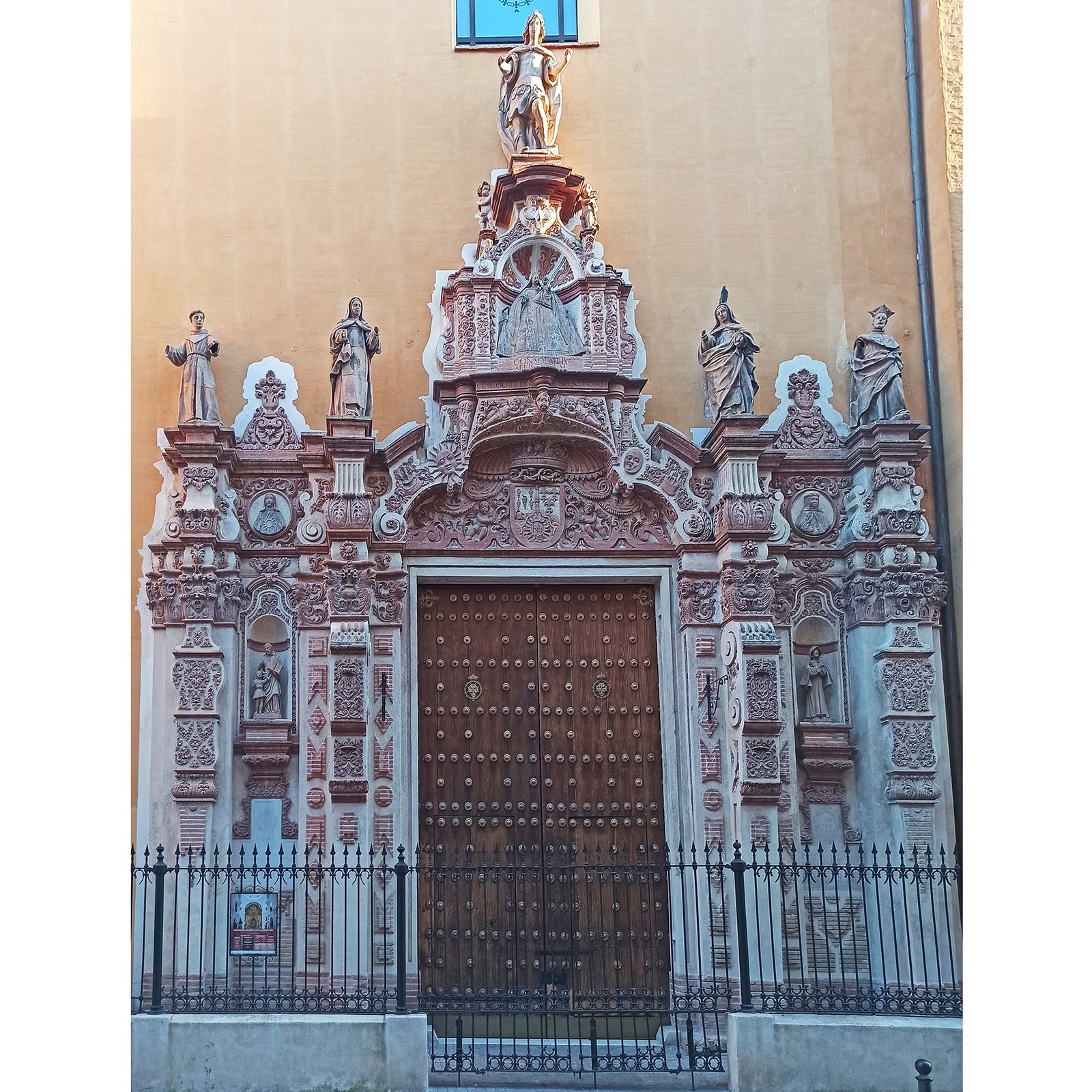
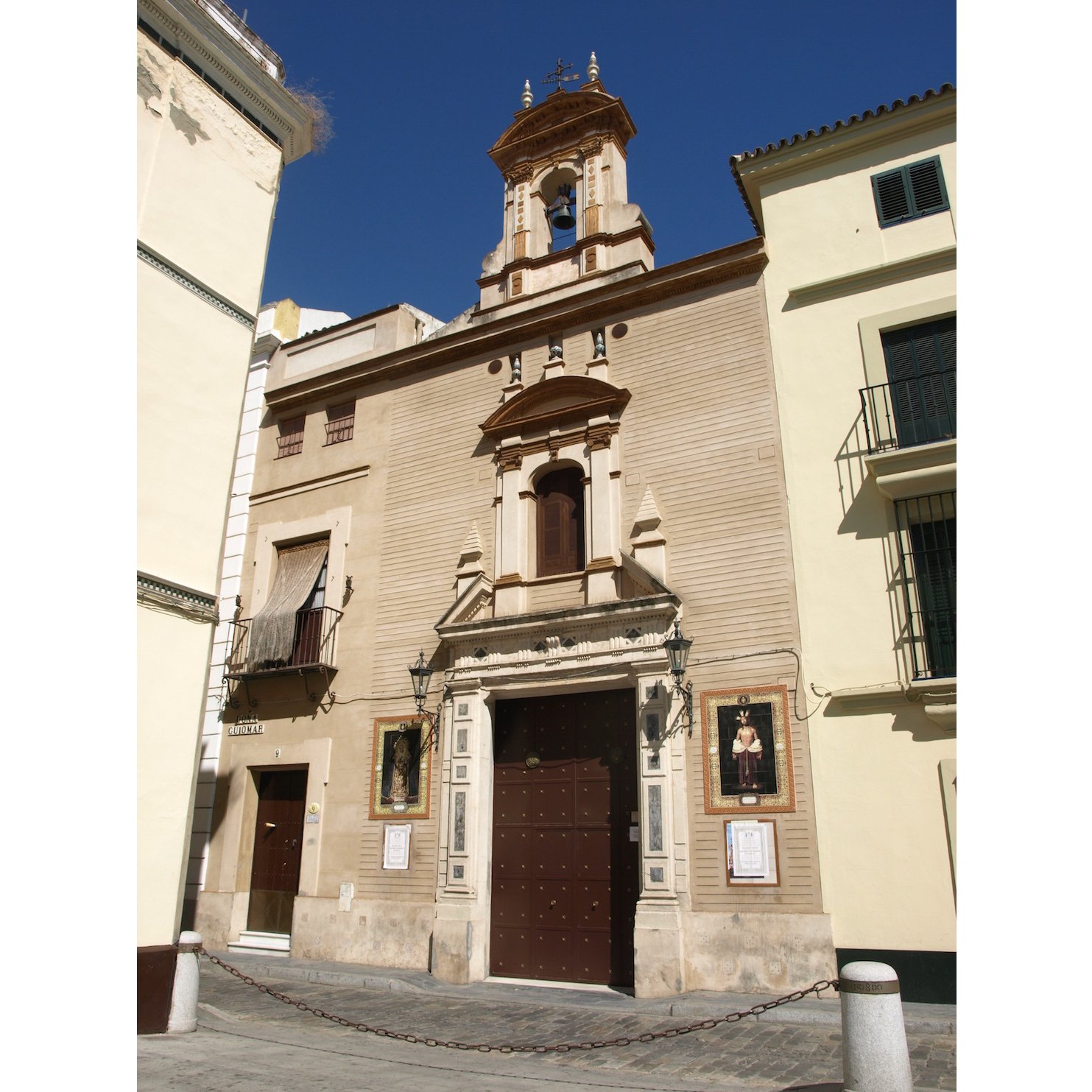
The Church of Our Lady of Consolation, generally known as "los Terceros", is a 17th century Baroque temple that stands on Calle Sol, in the Seville neighbourhood of Santa Catalina. Originally it was the church of the convent of the Third Order of Saint Francis that stood in this area and hence its popular name. It has a Latin cross plan, with a single nave and side chapels. It has only one façade on the outside, the one at the foot, which features an exuberant Baroque doorway. Since 1973 the church has been the headquarters of the Hermandad de la Cena, which processes on Palm Sunday.
History

A group of Franciscan monks belonging to the Third Order moved to Seville from the now defunct convent of San Juan de Morañina, in Bollullos Par del Condado. After arriving in the city, they settled in this area, near an old hermitage dedicated to Saints Cosme and Damián. From their previous convent in Bollullos, the monks brought an image of the Virgin of Consolation that was already greatly worshipped in its place of origin. The popularity of the image continued after its arrival in Seville, becoming the object of growing veneration among the locals. It seems that this was the seed for the construction of the convent and its church to begin in 1648, logically dedicated to the Virgin of Consolation.

The construction of the convent and its church continued until the 18th century and the Franciscans ran it until the French occupation in 1810, when the Napoleonic troops used it as a barracks and proceeded to plunder a large part of its heritage. The following year it was handed over to the Augustinian nuns and in 1819 the Franciscans returned. However, it would not last long, since in 1835 they abandoned it definitively as a consequence of the famous Mendizábal confiscation. A period of abandonment then began, the worst consequence of which was the collapse of the church vaults in 1845.
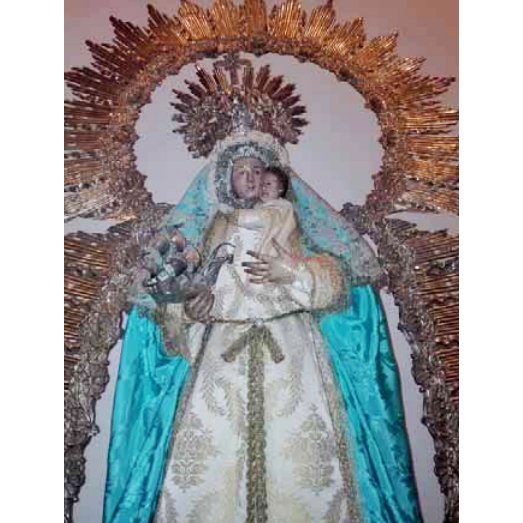
Image of the Virgin of Consolation, formerly the Virgin of Morañina. Image from the article by Adrián Bizcocho Olarte on “Popular religiosity...

A new episode in the history of this convent began in 1888 when the Piarist Fathers took charge of it, carrying out important educational work in the city. They managed it until 1973, when they moved to Montequinto. That same year, Cardinal Bueno Monreal gave the use of the convent church to the Hermandad de la Cena, which has since been responsible for its maintenance and has undertaken the various restorations that have been necessary, such as the renovation of the roofs in 1988.

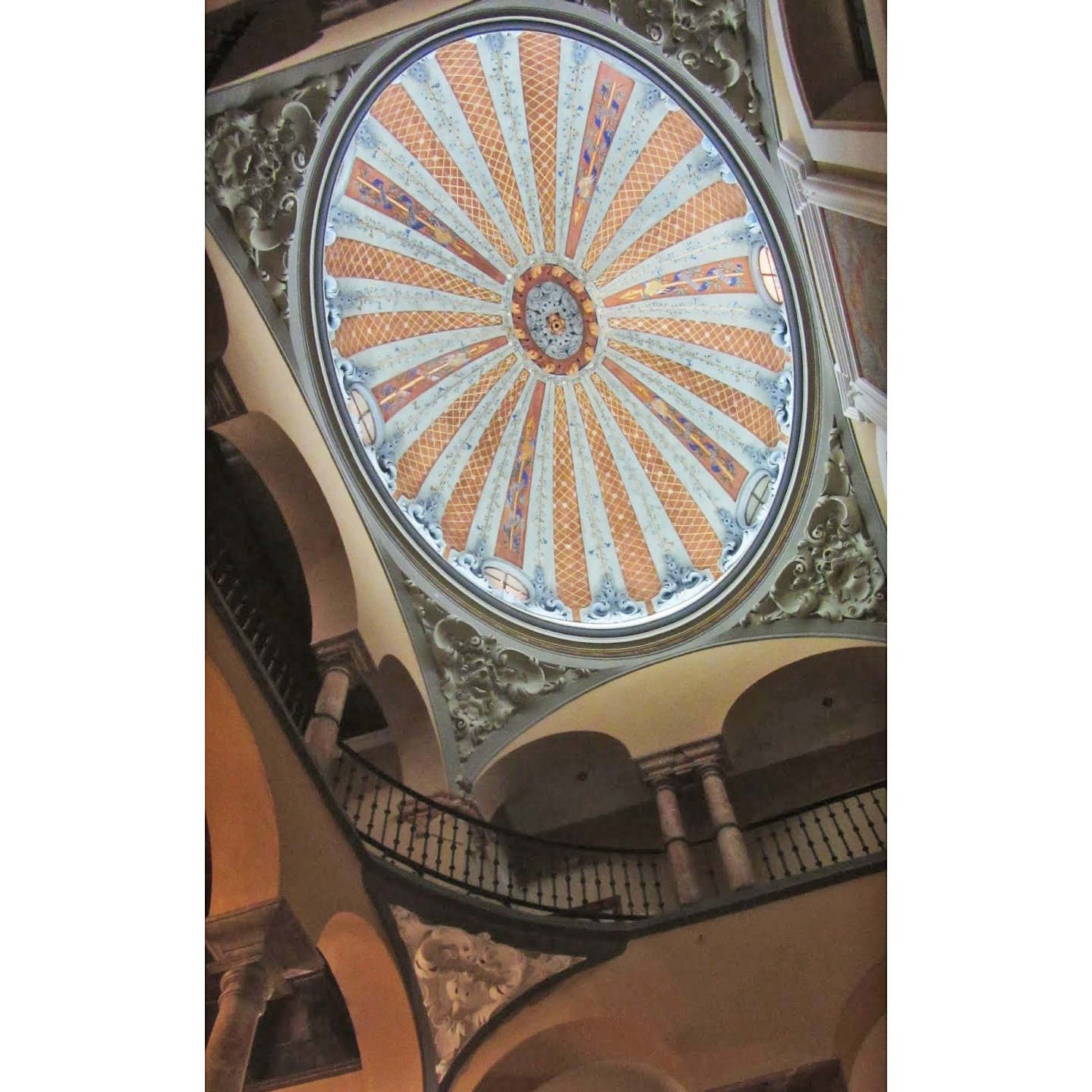
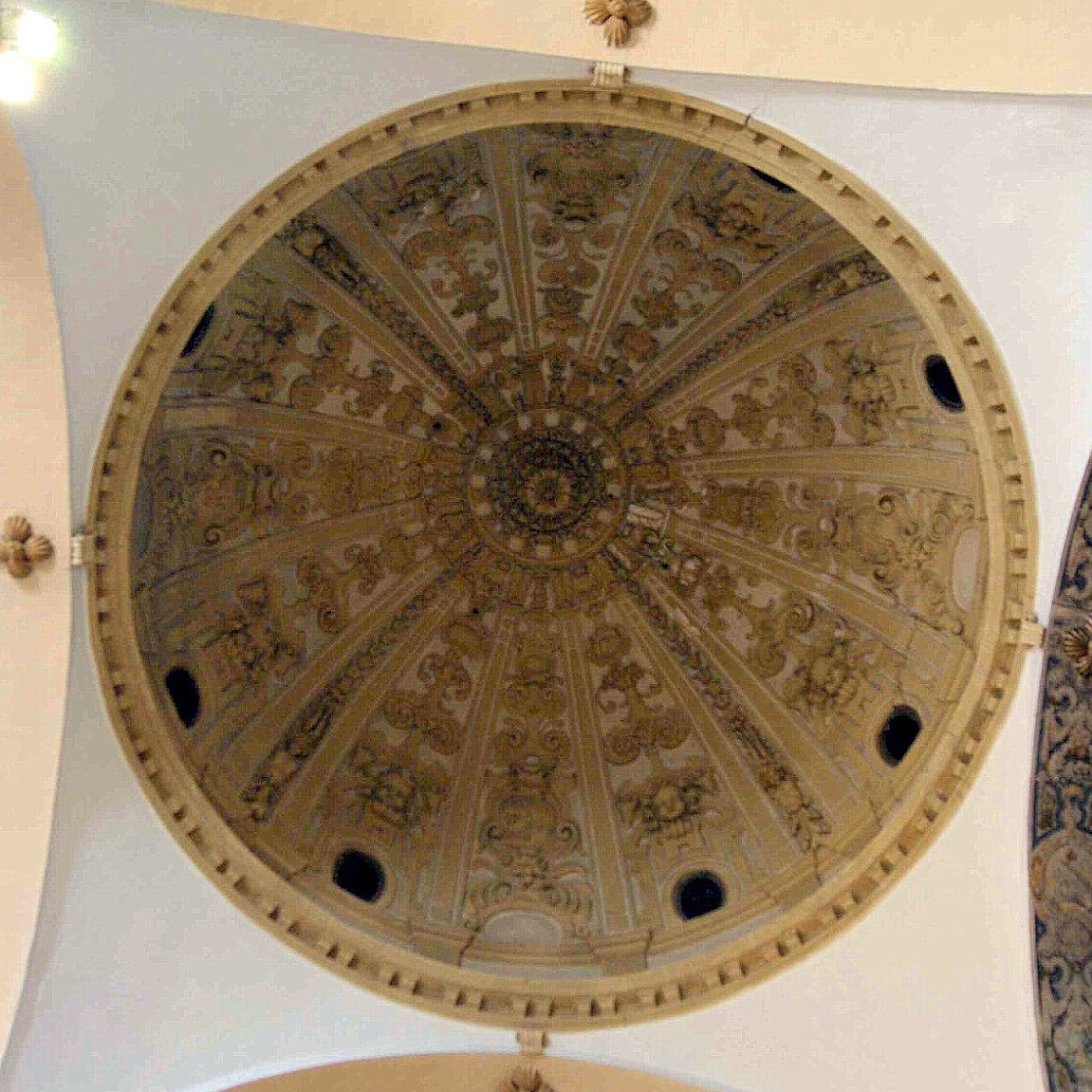
The rest of the convent currently serves as the headquarters of EMASESA, the public company for the management of water in the city. The two cloisters, the main one and a secondary one, are preserved, as well as a majestic monumental staircase designed by Fray Manuel Ramos at the end of the 17th century.
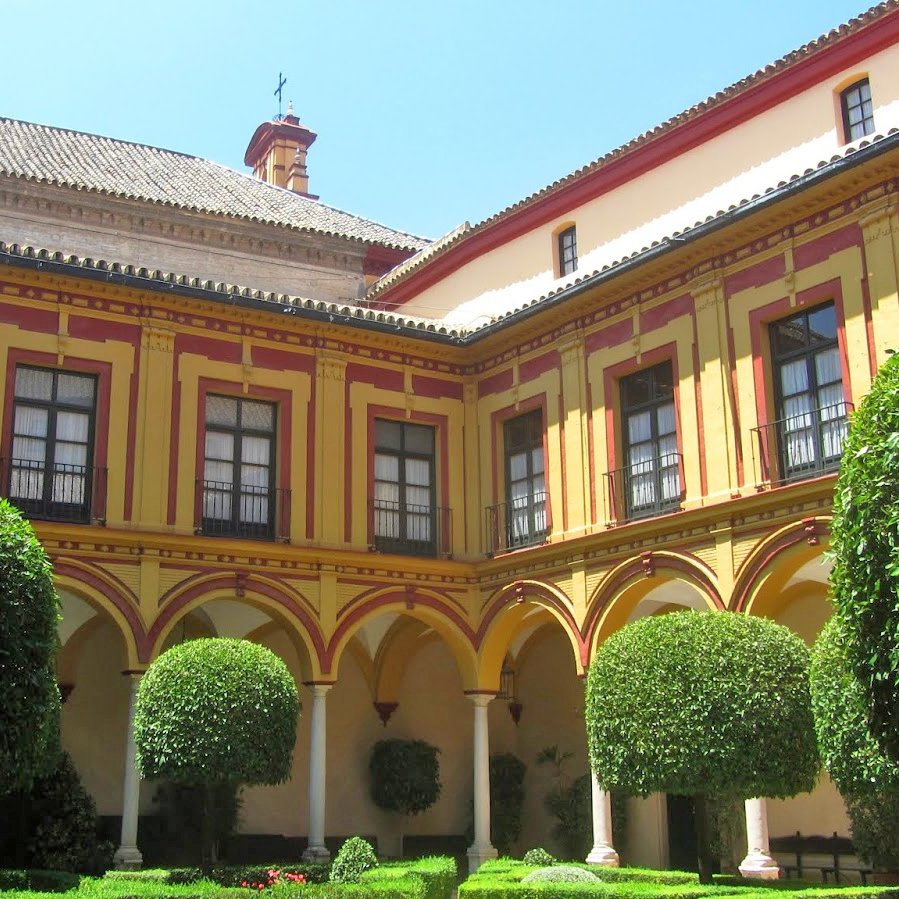
Former convent of the Terceros, today headquarters of EMASESA. Cloisters and dome over the staircase. Images from the blog Siglos de Sevilla.

Outside

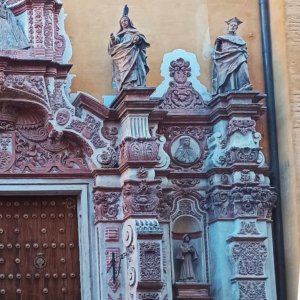
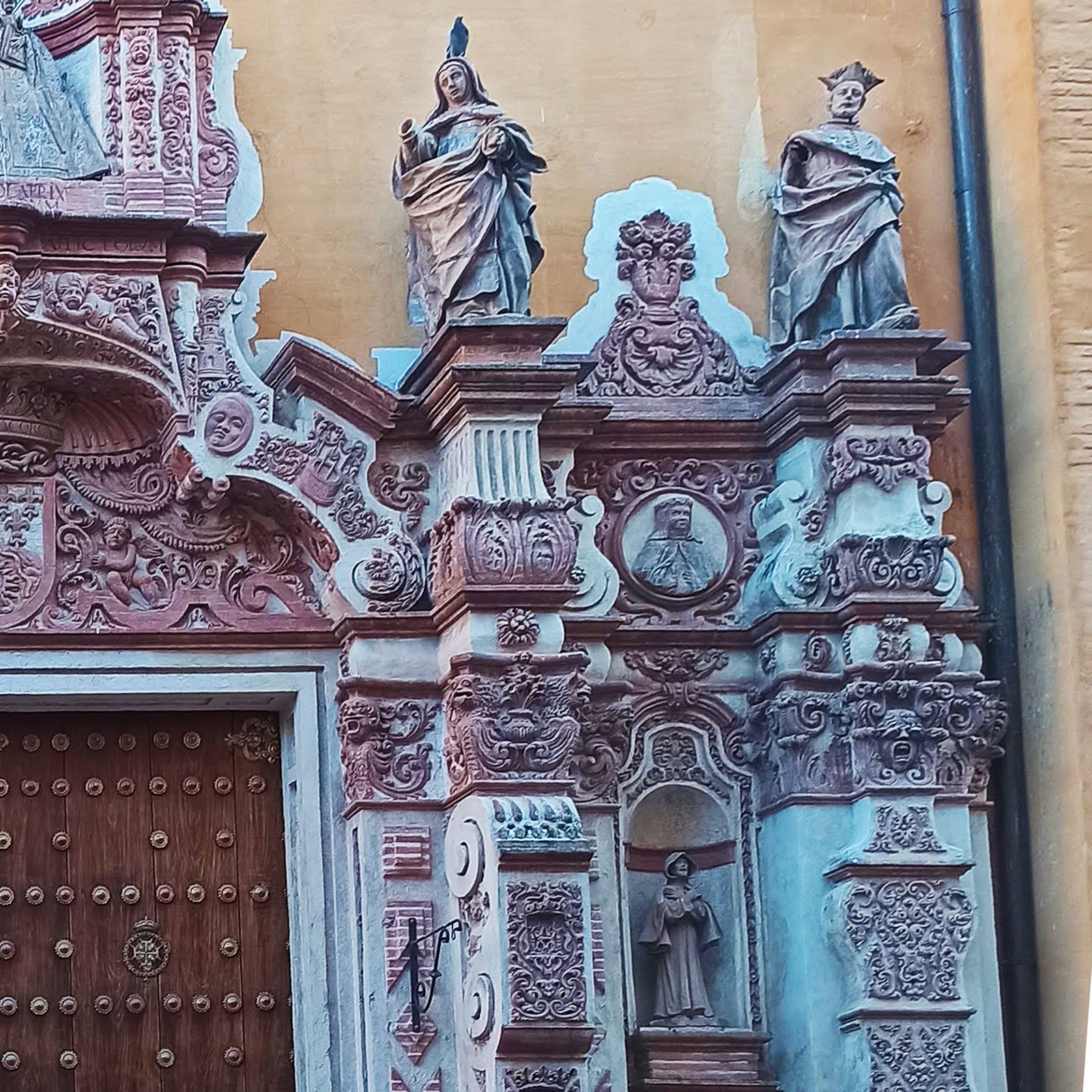
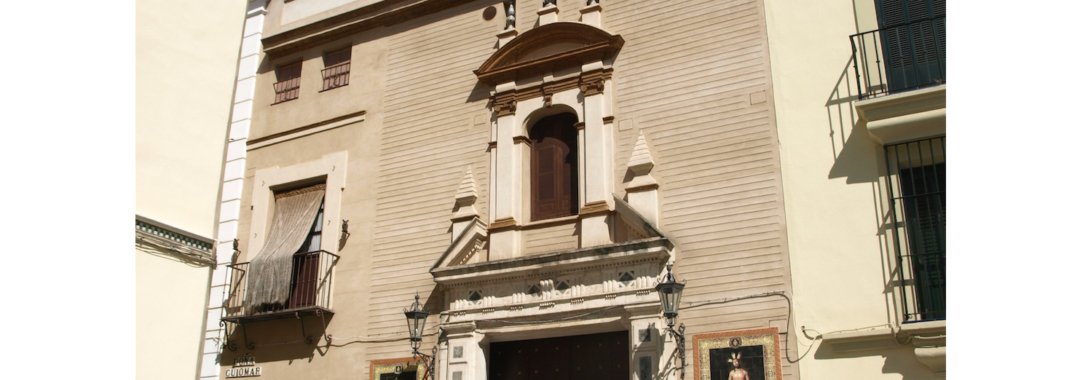
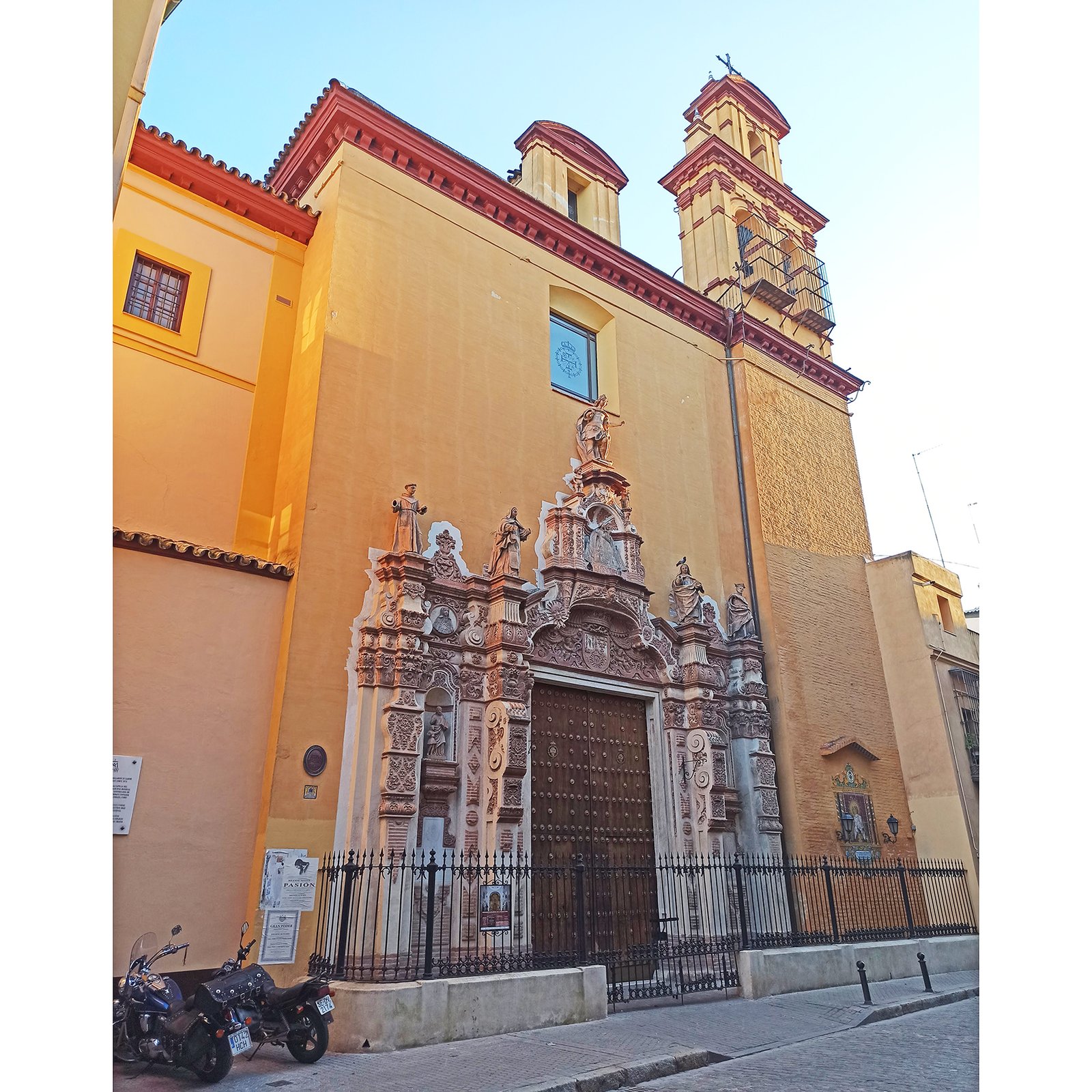
The church has only one façade, located at the foot of the temple, on Calle Sol. It has a very interesting doorway made at the beginning of the 18th century in a baroque style that is very reminiscent of the style developed at the same time in Hispanic America. The authorship of the design is unknown, although it has traditionally been attributed to Friar Manuel Ramos, the creator of the monumental staircase we mentioned when referring to the area of ​​the convent.

The doorway is arranged like a three-lane altarpiece, with the central street occupied by the lintelled opening that is the entrance to the temple itself. The decoration was made using baked clay and exposed brick, with certain characteristics that, as we said, directly allude to Hispanic American baroque: the architectural elements take on curious and imaginative shapes and are filled with meticulous decoration that includes a multitude of symbolic elements.

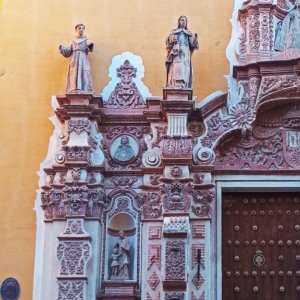
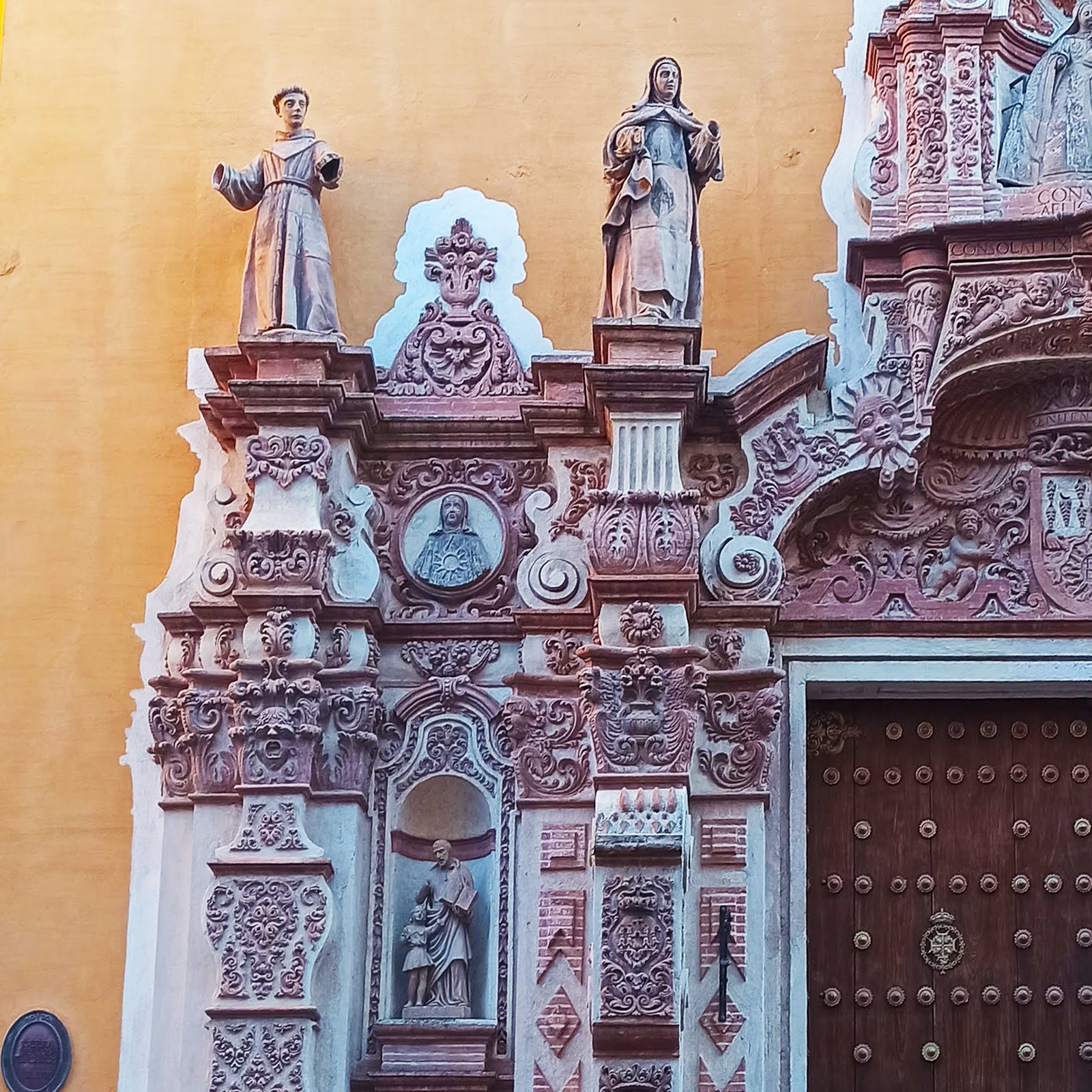
On the side streets there are two niches with the terracotta carvings of Saint Joseph of Calasanz on the left and Saint Francis on the right. The two saints allude to the two main religious orders that have succeeded one another in the management of this temple since its creation: Saint Francis to the religious of the Third Order, founders of the convent, and Saint Joseph of Calasanz to the Piarists, who managed it from the end of the 19th century. This indicates that the sculptures are not the originals of the doorway, but were added much later, most likely already in the 20th century. In addition, their size is somewhat smaller than what would correspond to them according to the niches they occupy.

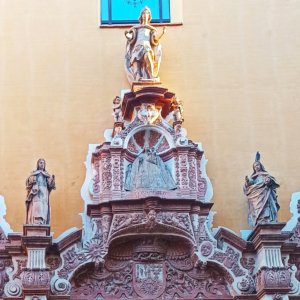
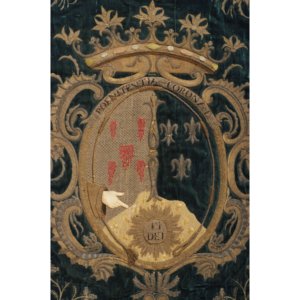
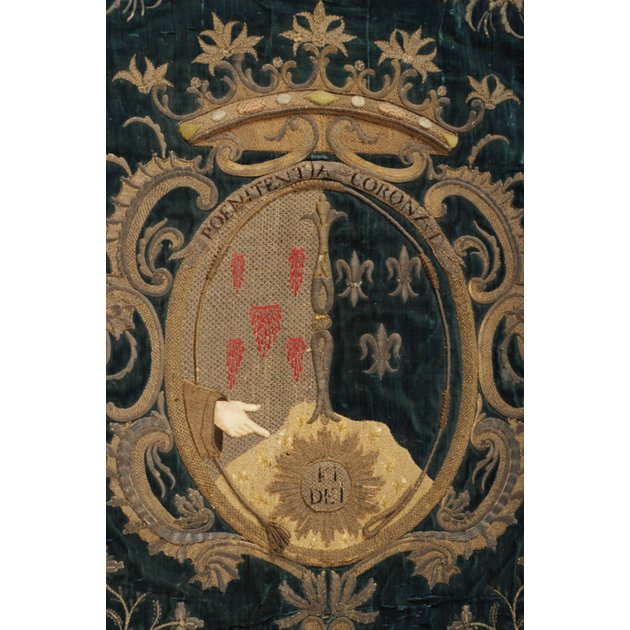
In the upper part of the side streets we find two medallions with the busts of two saints linked to the Franciscans, Saint Clara on the left and Saint Rose of Viterbo on the right. Above the door there is a space like a mixed-linear pediment in the centre of which there is a shield with Franciscan symbols. On the top left are the Five Wounds, the main symbol of the order, and on the right are three fleurs-de-lis. On the bottom, a hand points to a sun on which can be read "FIDEI" (Faith). Above the shield, an open royal crown at the base of which can be read "POENITENTIA CORONAT". We have no further information about the shield, although it must have been the one adopted by this convent as its own. In 2007 the Andalusian Institute of Historical Heritage undertook the restoration of a processional banner found in San Telmo with the same shield, so in all probability it was a banner representing the convent at official events.

On the four pillars that delimit the streets of the doorway are four Franciscan saints: on the left, Saint Anthony of Padua and Saint Elizabeth of Hungary, and on the right, Saint Elizabeth of Portugal and Saint Ivo of Kermartin, patron saint of lawyers. Crowning the central part of the doorway, a niche houses an image of the Virgin of Consolation, reproducing the original carving found inside. Above the Virgin appears a white dove with open wings, representing the Holy Spirit, and crowning the whole is a carving of Saint Michael.

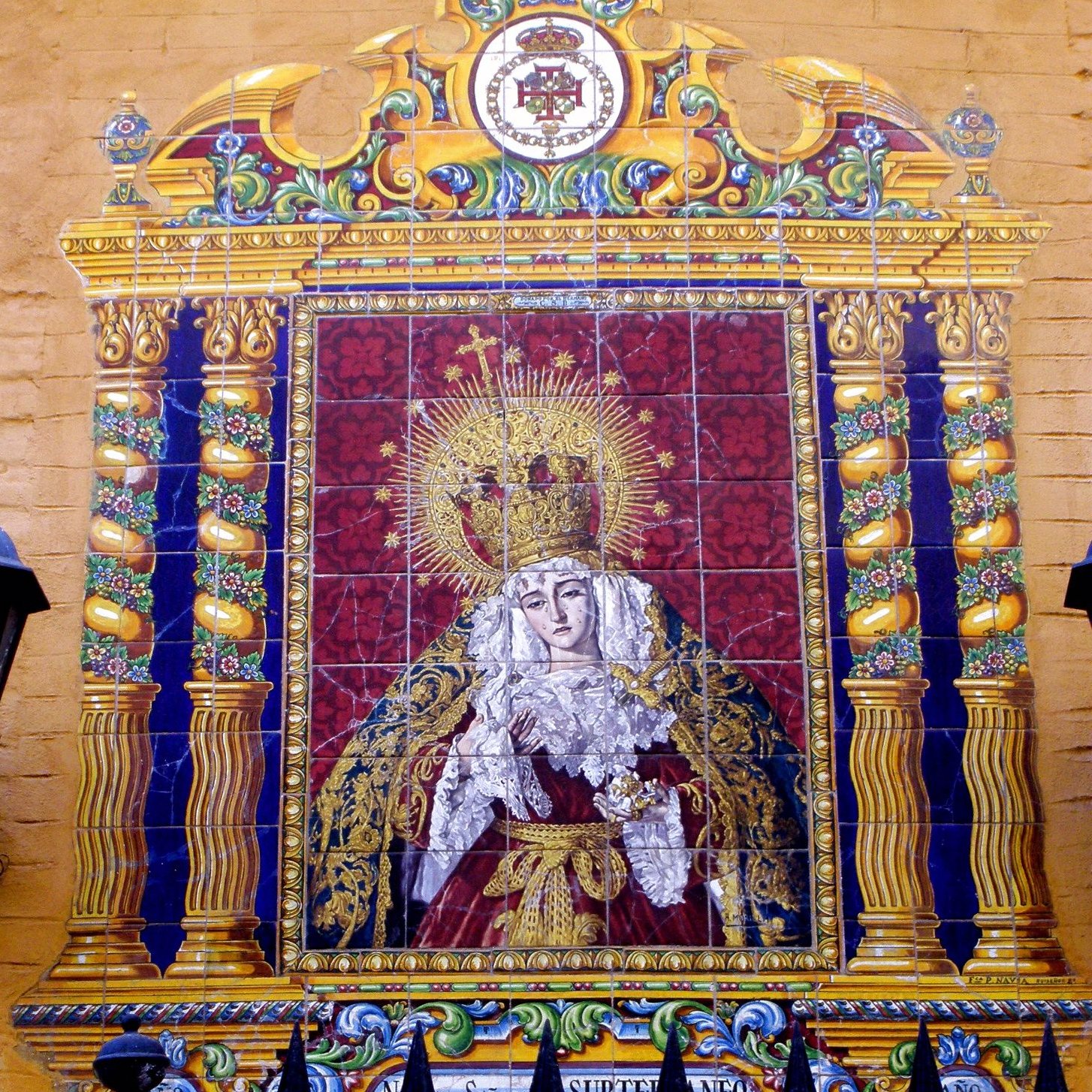
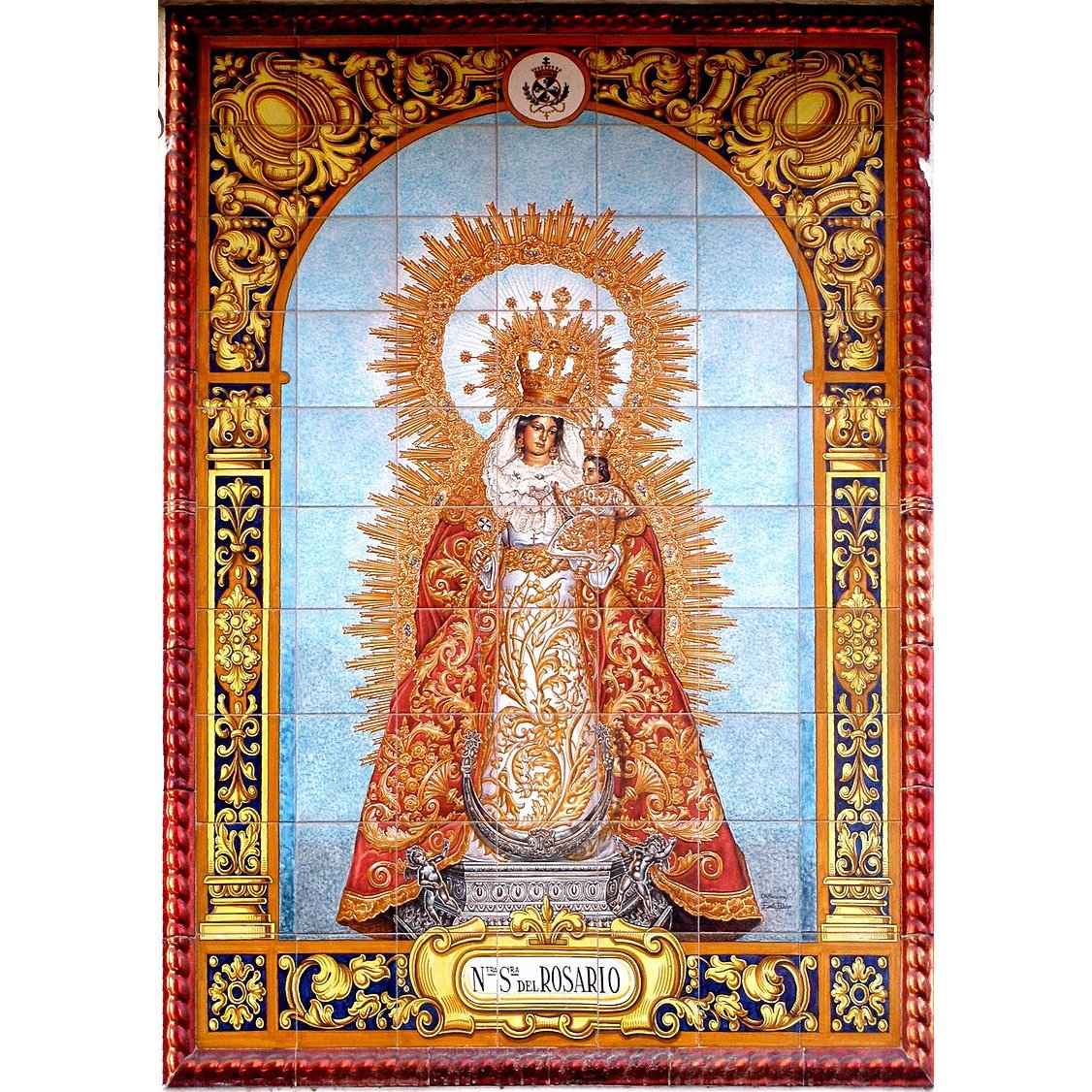
To the right of the doorway is a ceramic altarpiece with the image of the Virgin of the Underground, the Marian patron of the Brotherhood of the Supper. It was made in 1959 in the factory of Nuestra Señora de la Piedad by Antonio Morilla Galea and Manuel García Ramírez.

The façade has a tower on the right, topped by a two-body belfry with two openings for bells in the lower one and a single body in the upper one, topped by a curved pediment.

Inside

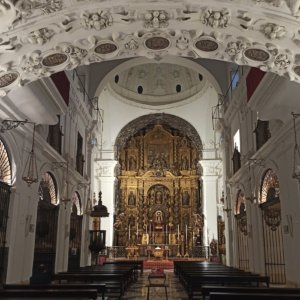
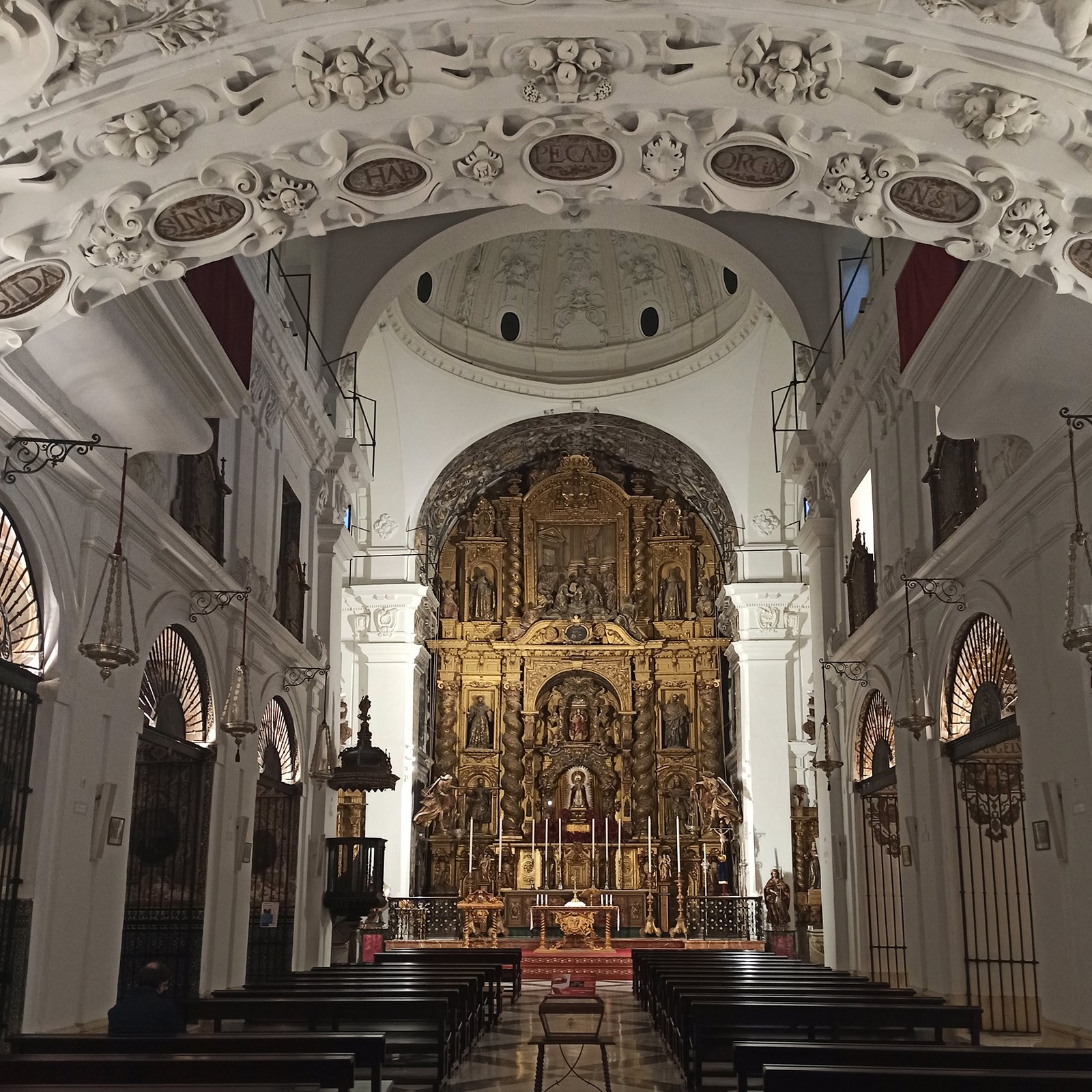
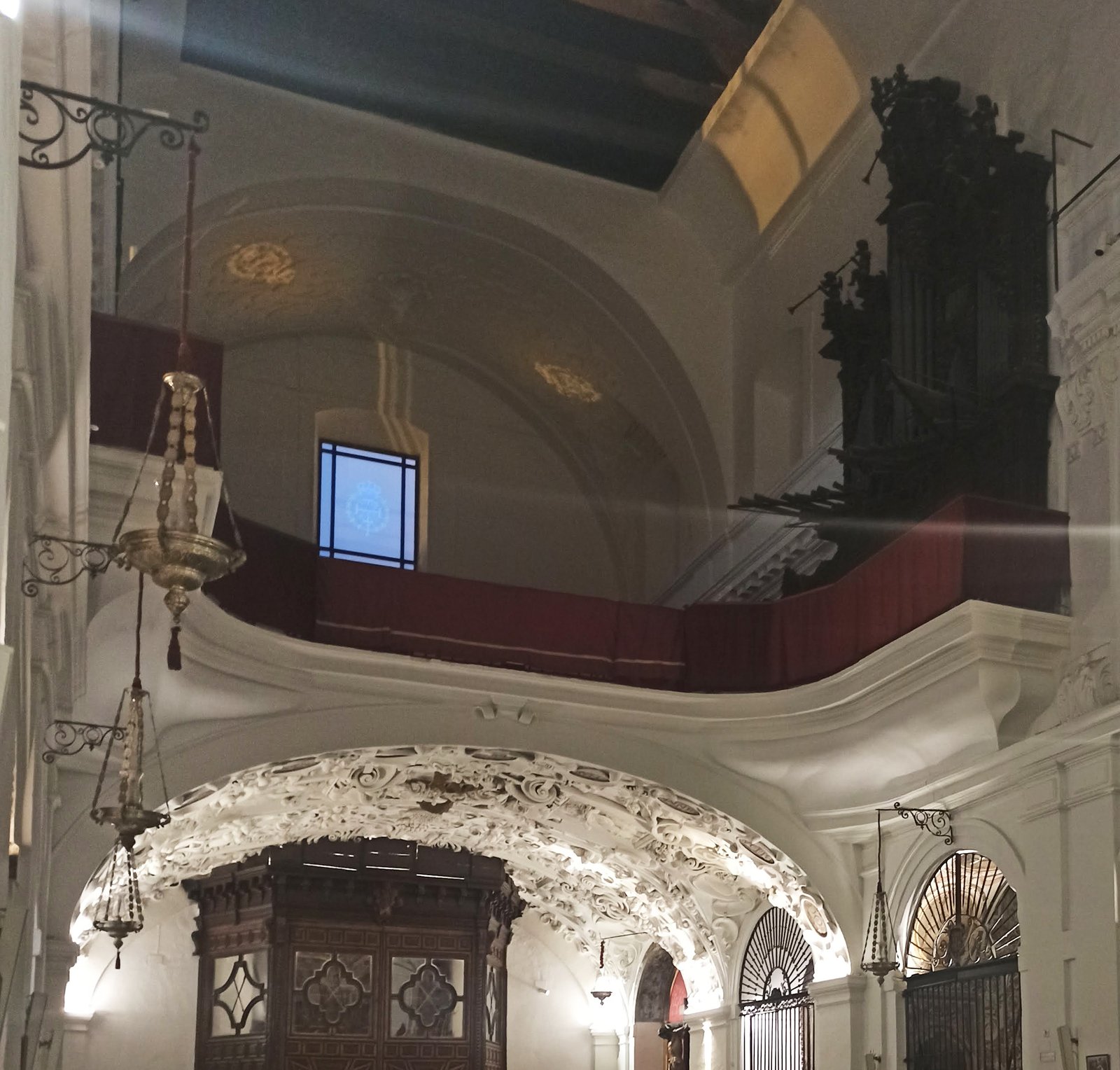
The first thing that catches your attention when you enter the Consolación church is its large size and monumentality, making it one of the most interesting examples of the convent churches of the Sevillian Baroque. It consists of a single nave of great width and in the shape of a Latin cross. On either side of the nave there are a series of side chapels which are accessed through semicircular arches closed by bars. At the foot of the church is the high choir, resting on a profusely decorated segmental vault. On one side of the choir is an organ, original from the first half of the 18th century, which according to Álvaro Cabezas García can be attributed to the altarpiece maker José Fernando de Medinilla. The original roof of the church was made by a large barrel vault that extended throughout the nave. However, this vault collapsed in the mid-19th century and today we find a flat roof. The barrel vault is preserved only over the choir, at the foot of the church, and over the presbytery area, at the head. Above the transept there is a hemispherical dome on pendentives, decorated with plasterwork that reproduces architectural elements, plant decoration, scrolls, angels' heads and other motifs characteristic of the Baroque.

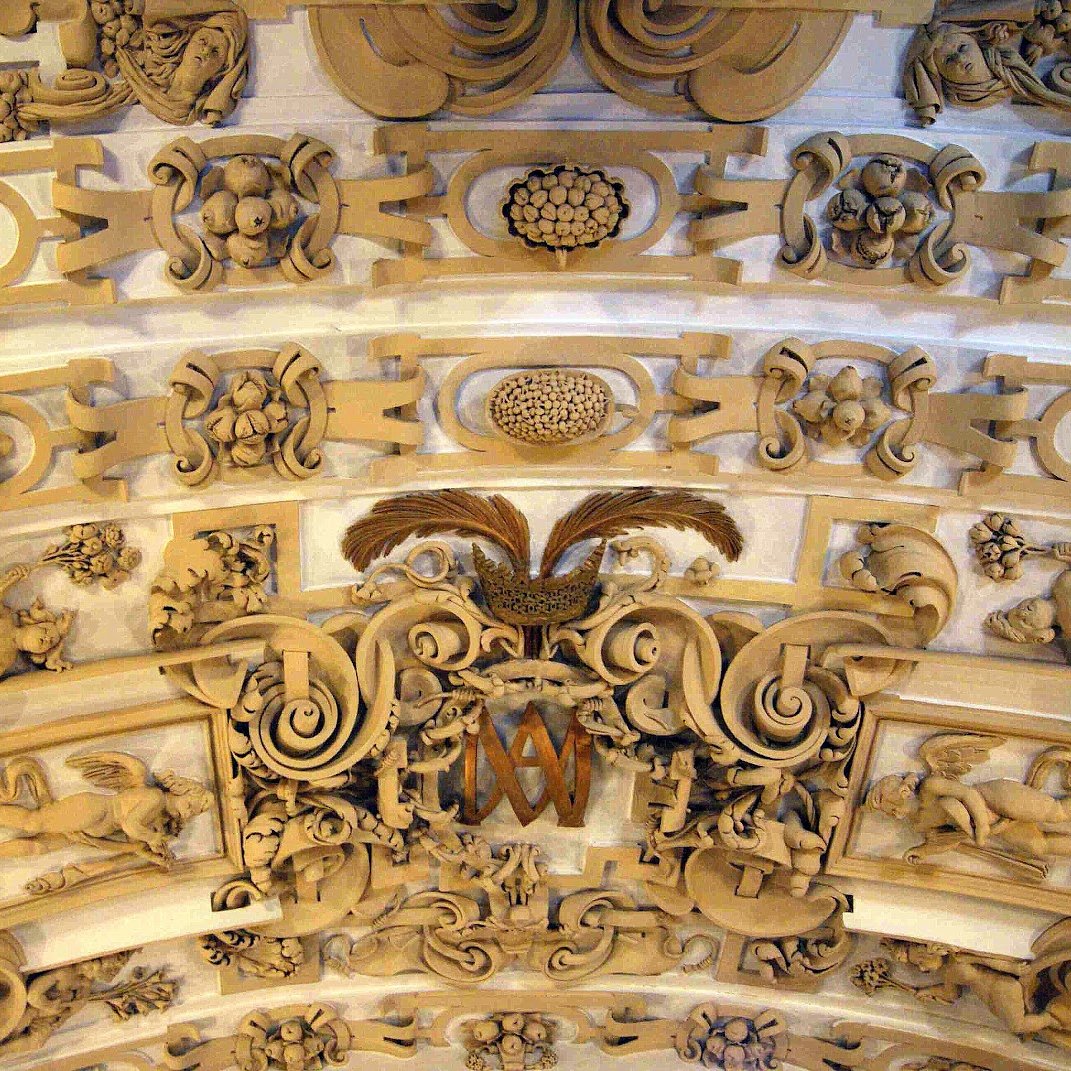
This type of decoration based on plasterwork must have originally extended throughout the vault of the church. The decoration of the vault that supports the choir is especially rich, and in it the curious bunches of various fruits stand out, in a composition articulated by latticework and plant motifs, in which little angels and Marian symbols are mixed. It clearly recalls the plasterwork that we find in Santa María la Blanca, also made in the 18th century.

Presbytery

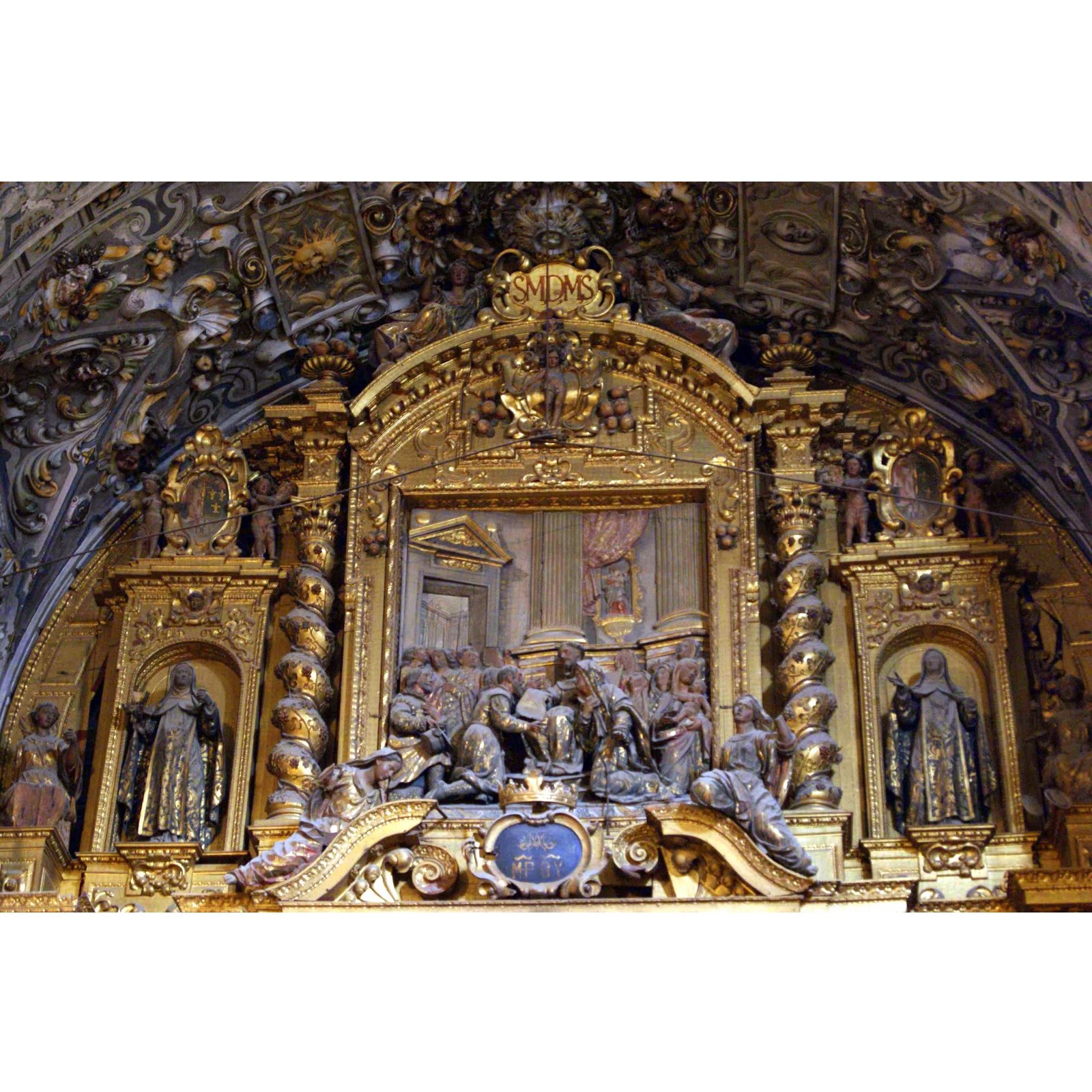
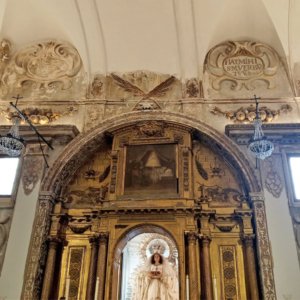
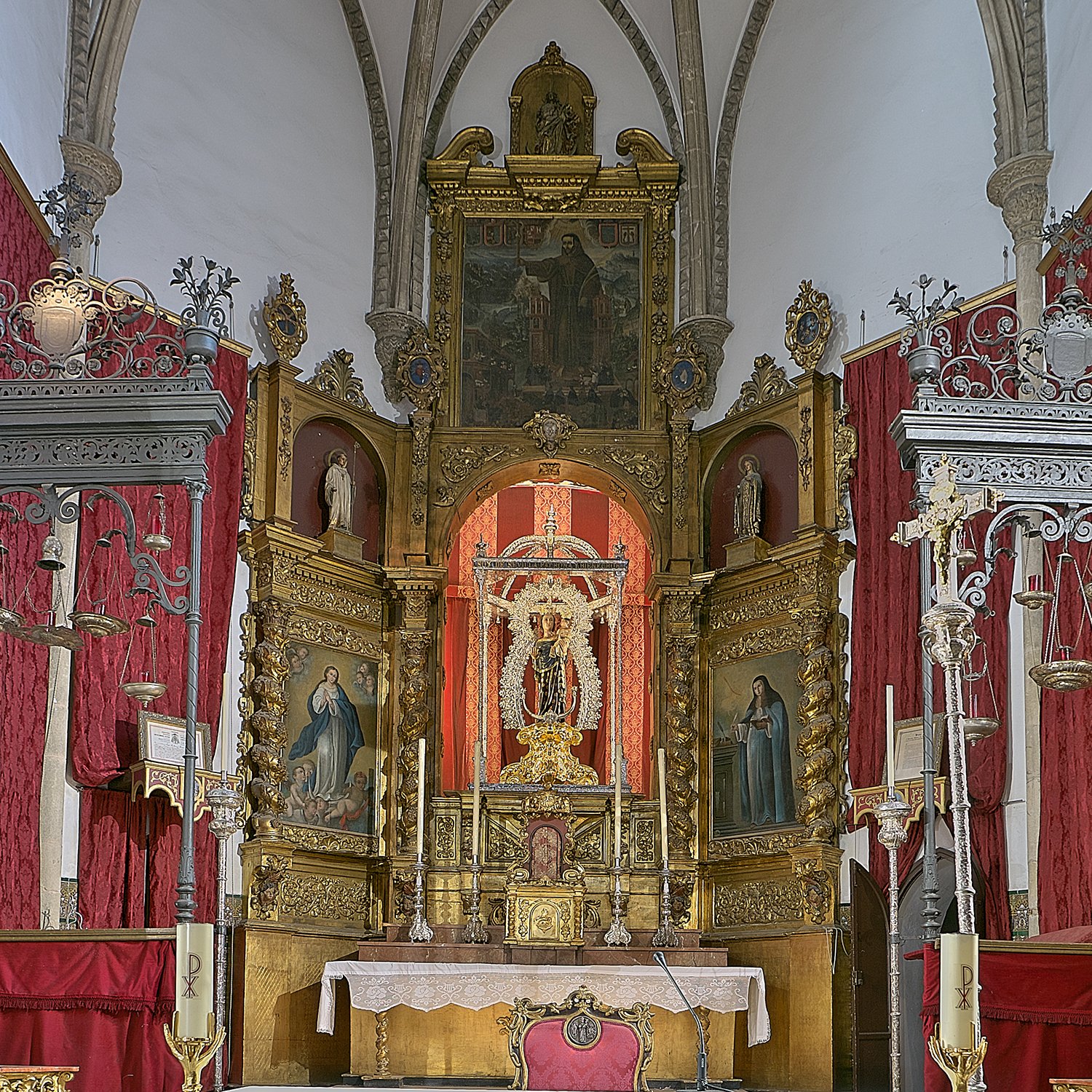
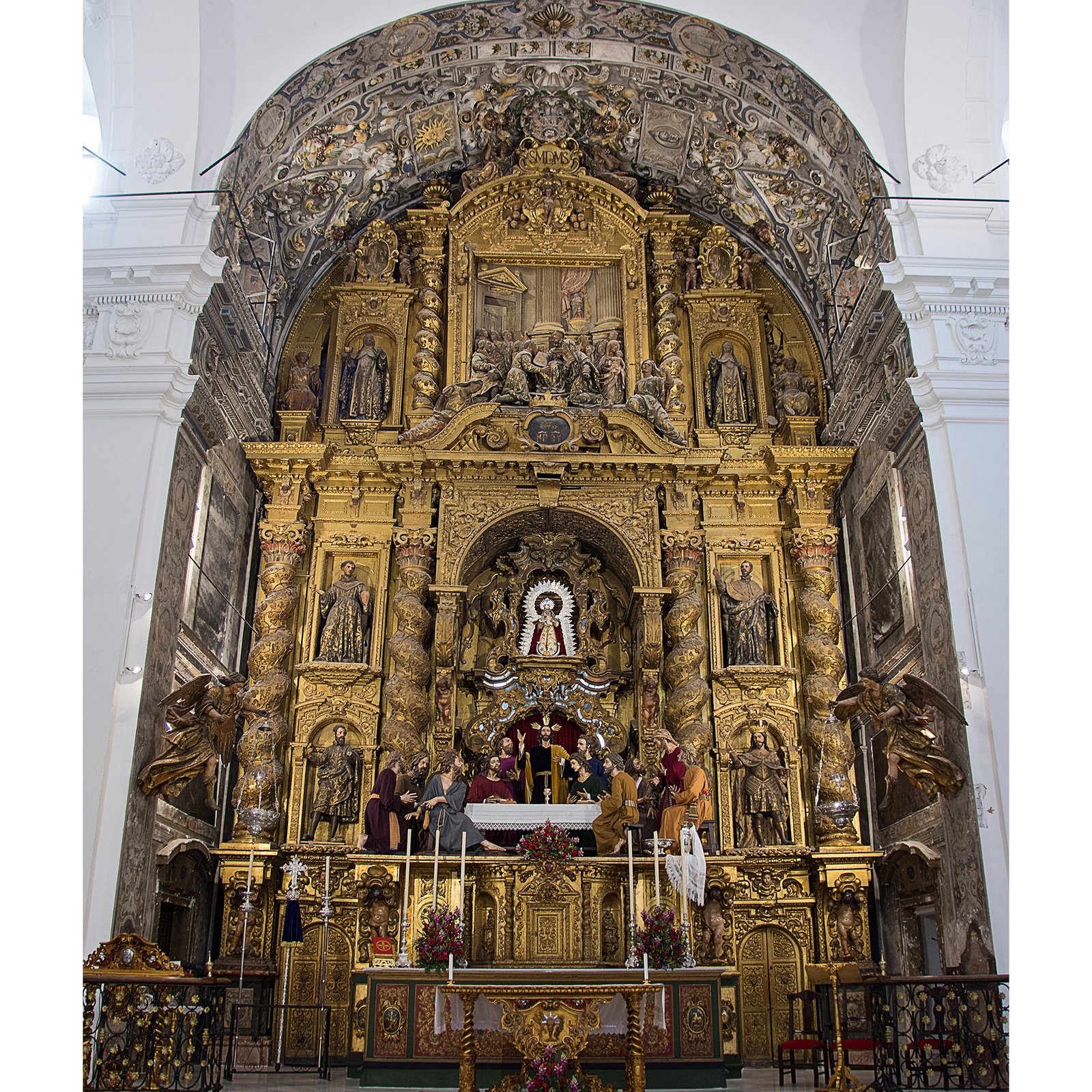
In the presbytery, the main altarpiece is a splendid baroque ensemble made by Francisco Dionisio de Ribas in 1669, which was subsequently renovated on several occasions. It can be considered one of the best examples of 17th century Sevillian altarpieces. It consists of two bodies and three sections, delimited by beautiful Solomonic columns with shafts delicately sculpted with plant motifs. The layout of the central space of the altarpiece was modified to accommodate the sculptural group of the Last Supper after the brotherhood was established in this temple. In the centre appears the figure of Jesus at the moment of the Eucharistic celebration. It was carved by Sebastián Santos Rojas in 1955 and its face is of such beauty that there are authors who point to it as the most beautiful image of Christ among those made for Holy Week in Seville in the 20th century. The apostles are the work of the Cadiz sculptor Luis Ortega Bru, one of the most original and outstanding figures of contemporary Spanish imagery. They were his last work, as they were first performed during Holy Week in 1983, a year after the sculptor's death. When the group is in the altarpiece, only eleven apostles accompany the Lord, as Judas Iscariot is excluded, who is part of the float on the day of the procession.

Above the group of the Last Supper, there is a niche with undulating shapes added to the altarpiece in 1700 to house the Virgin of Consolation, the titular of this temple. It is a small image of the Virgin with Child, which originally had the title of Our Lady of Morañina when it was worshipped in the convent that the Third Order ran in Bollullos Par del Condado before its transfer to Seville. The image dates back to the 14th century, but was thoroughly renovated to adapt it to the Baroque aesthetic, probably in the 18th century.

Continuing along the first level, on the left we find Saint Ivo of Brittany and Saint Elizario, while on the right we find Saint Conrad and Saint Louis of France. In the second level, in the centre there is a relief with "Saint Francis approving the rules of the Third Order". The relief is flanked by Saint Elizabeth of Portugal on the left and Saint Elizabeth of Hungary on the right.
Transept

The presbytery is flanked by two other smaller altarpieces located in the arms of the transept. Both are from the first third of the 18th century and house an image of the Virgin and Child on the left and a Jesus of Nazareth on the right. Originally the altarpieces were dedicated to two high-quality images of Saint Michael and Saint Raphael that are currently usually located in the sacramental chapel.

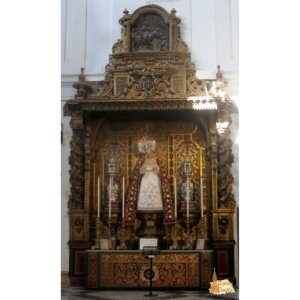
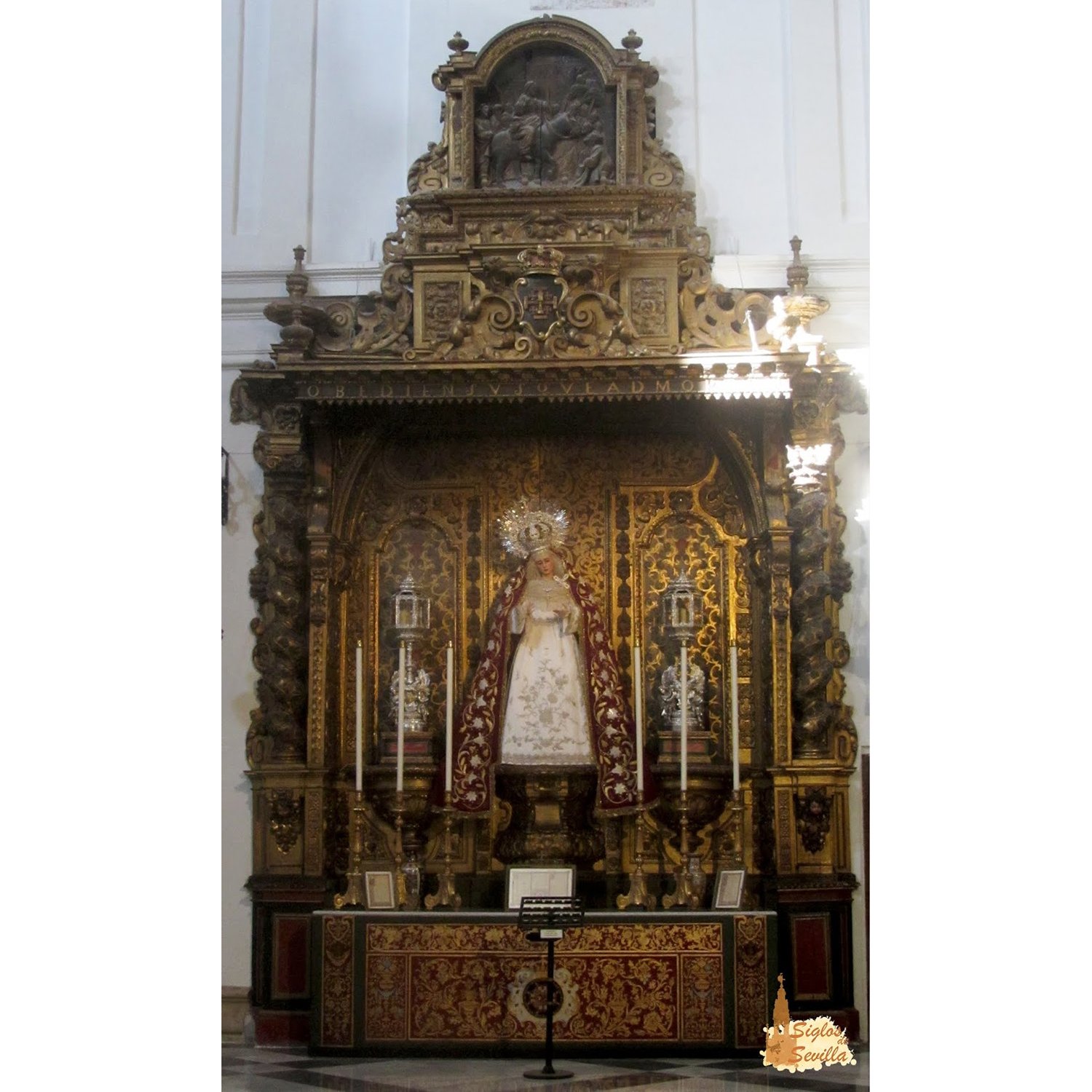
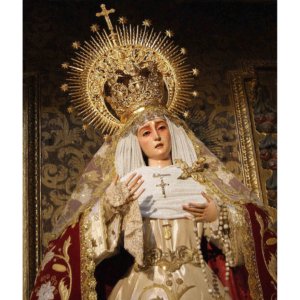
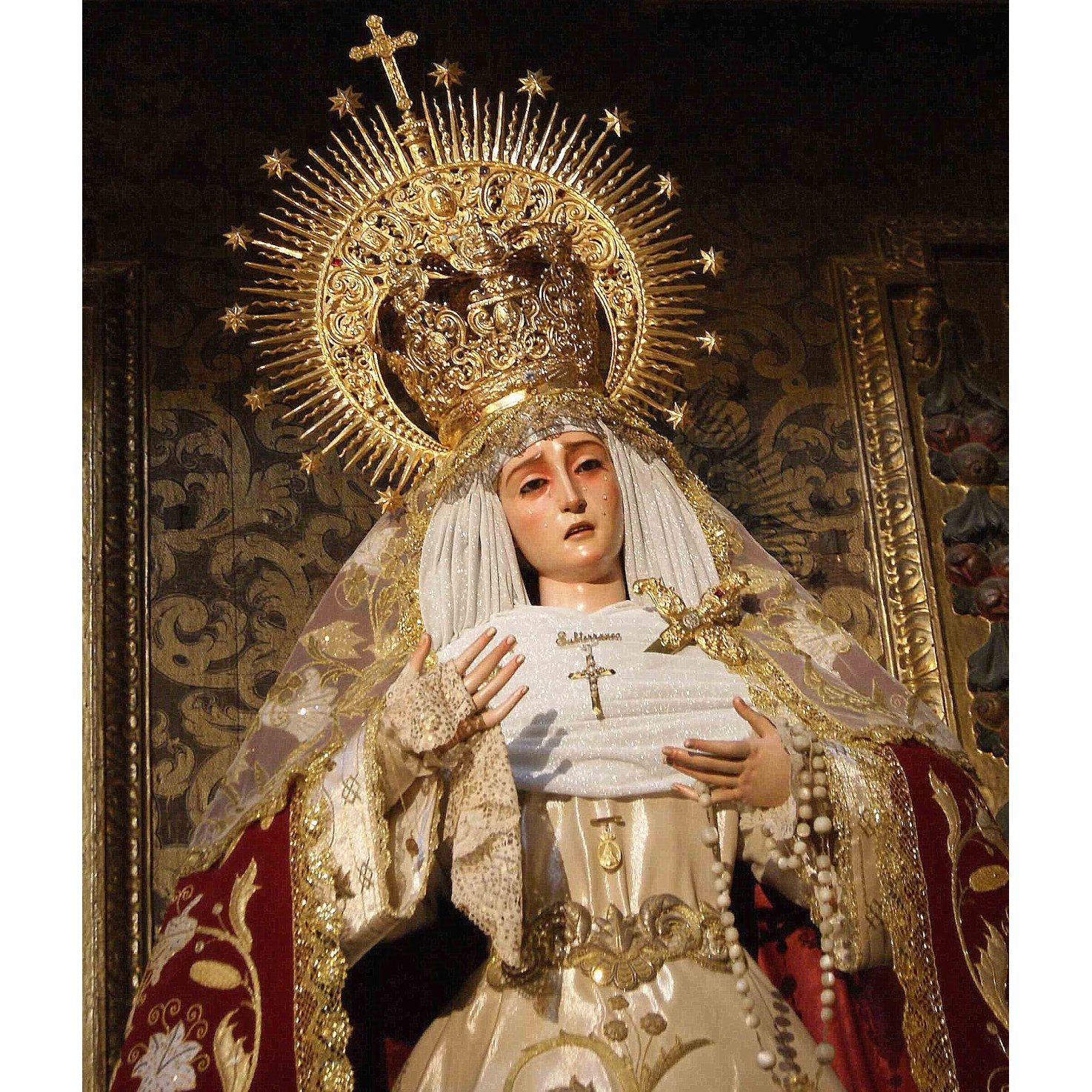
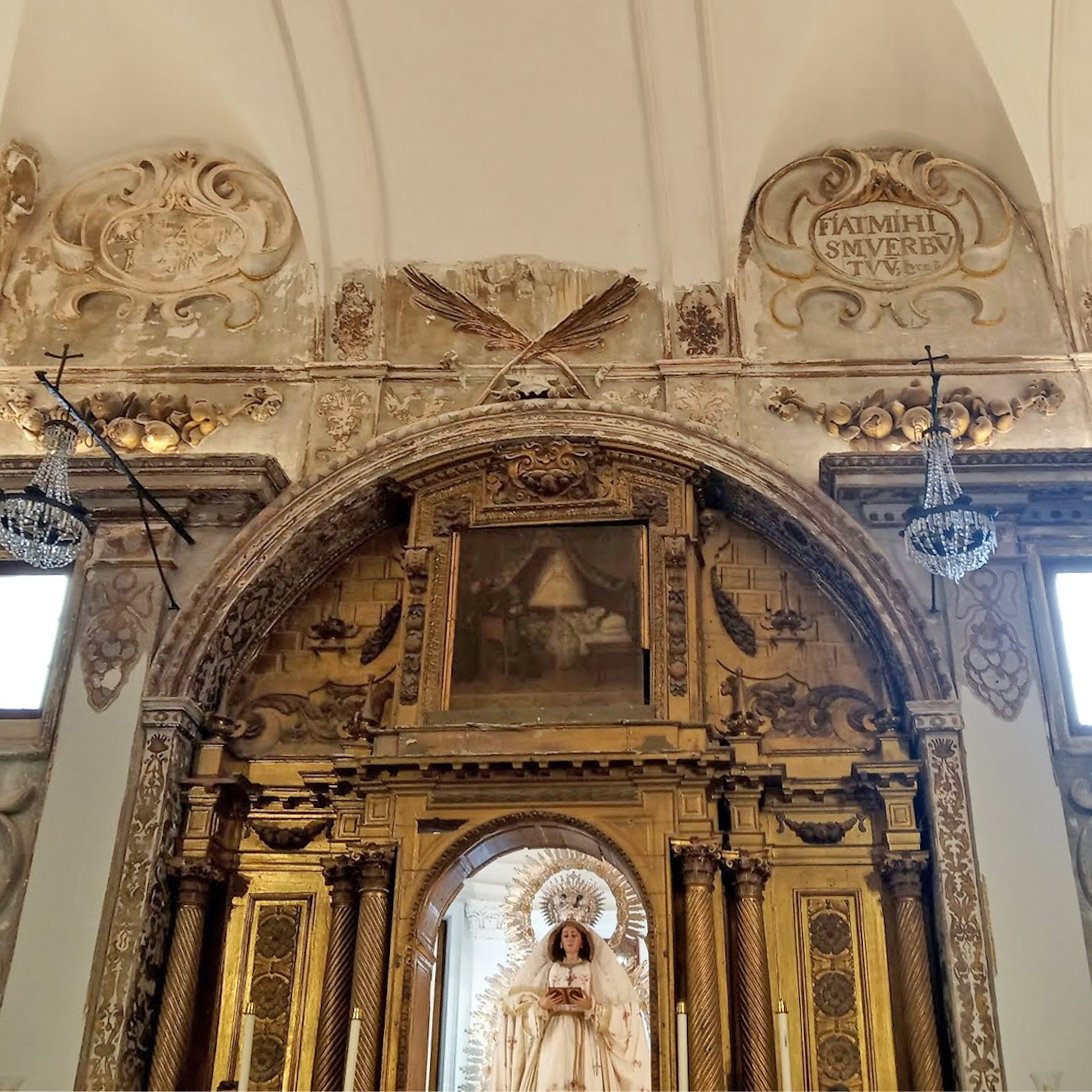
At the left end of the transept there is an altarpiece from the beginning of the 18th century that houses the image of Our Lady of the Underground, Queen of Heaven and Earth, titular of the Brotherhood of the Supper. The image is a painful one to dress that has traditionally been attributed to the 19th century sculptor Juan de Astorga, although due to its stylistic features it cannot be ruled out that it is an older image, probably from the 17th century. The altarpiece in which it is located once belonged to the Brotherhood of Love, which had its headquarters in this church. In fact, behind the Virgin, the shape of the cross that once housed the Christ of Love is visible. It is worth remembering that the Brotherhood of the Holy Entry into Jerusalem was also founded in this church and that it was here that both merged to give way to the Brotherhood of Love that we know today, based in the church of El Salvador. In fact, in the attic of the altarpiece there is a relief that represents precisely the scene of the Entry of Jesus into Jerusalem, riding the famous "little donkey".

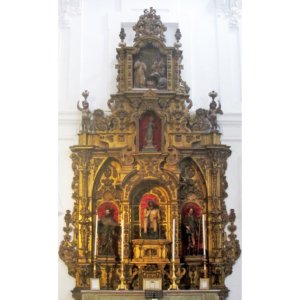
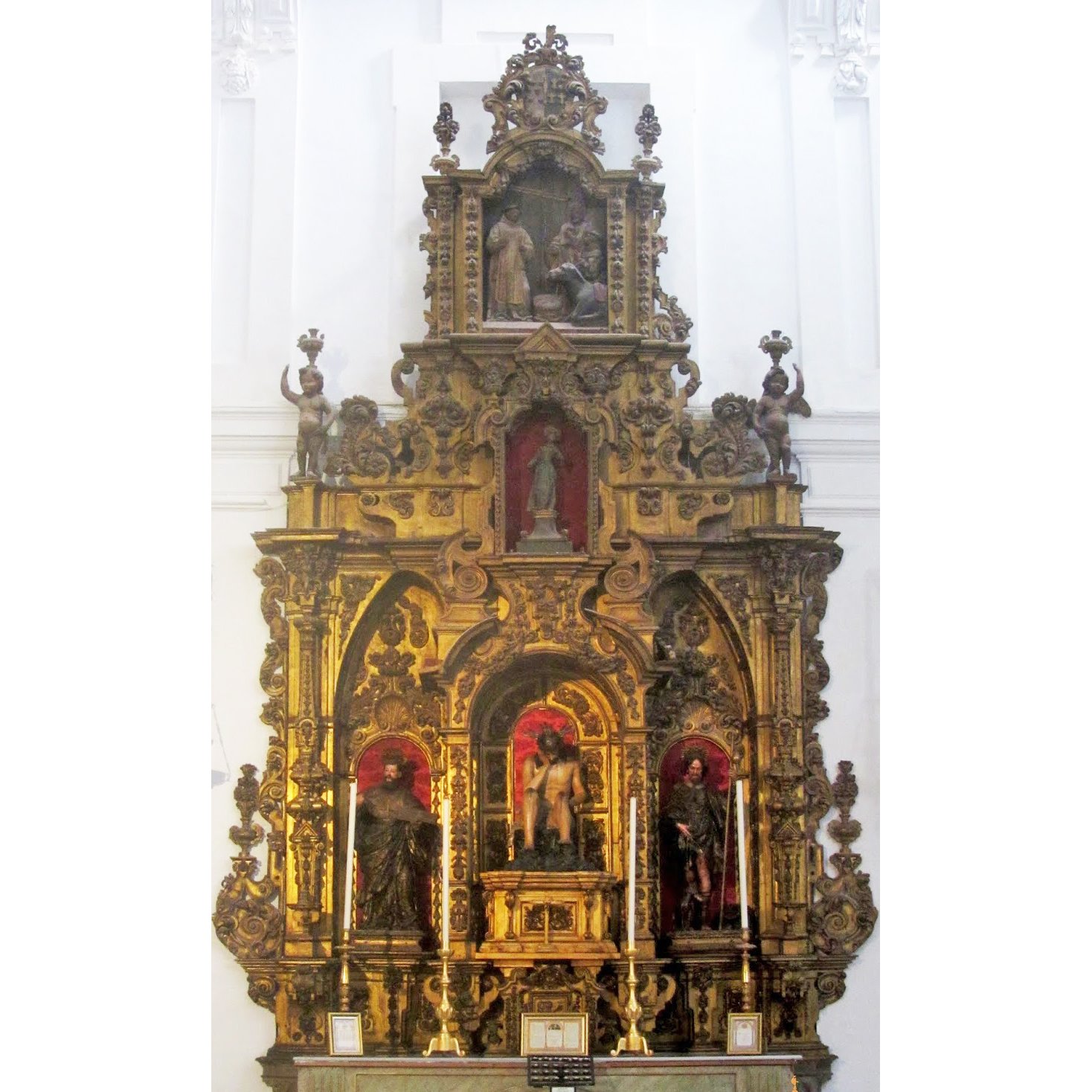
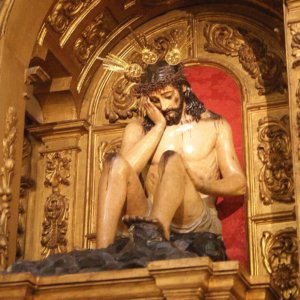
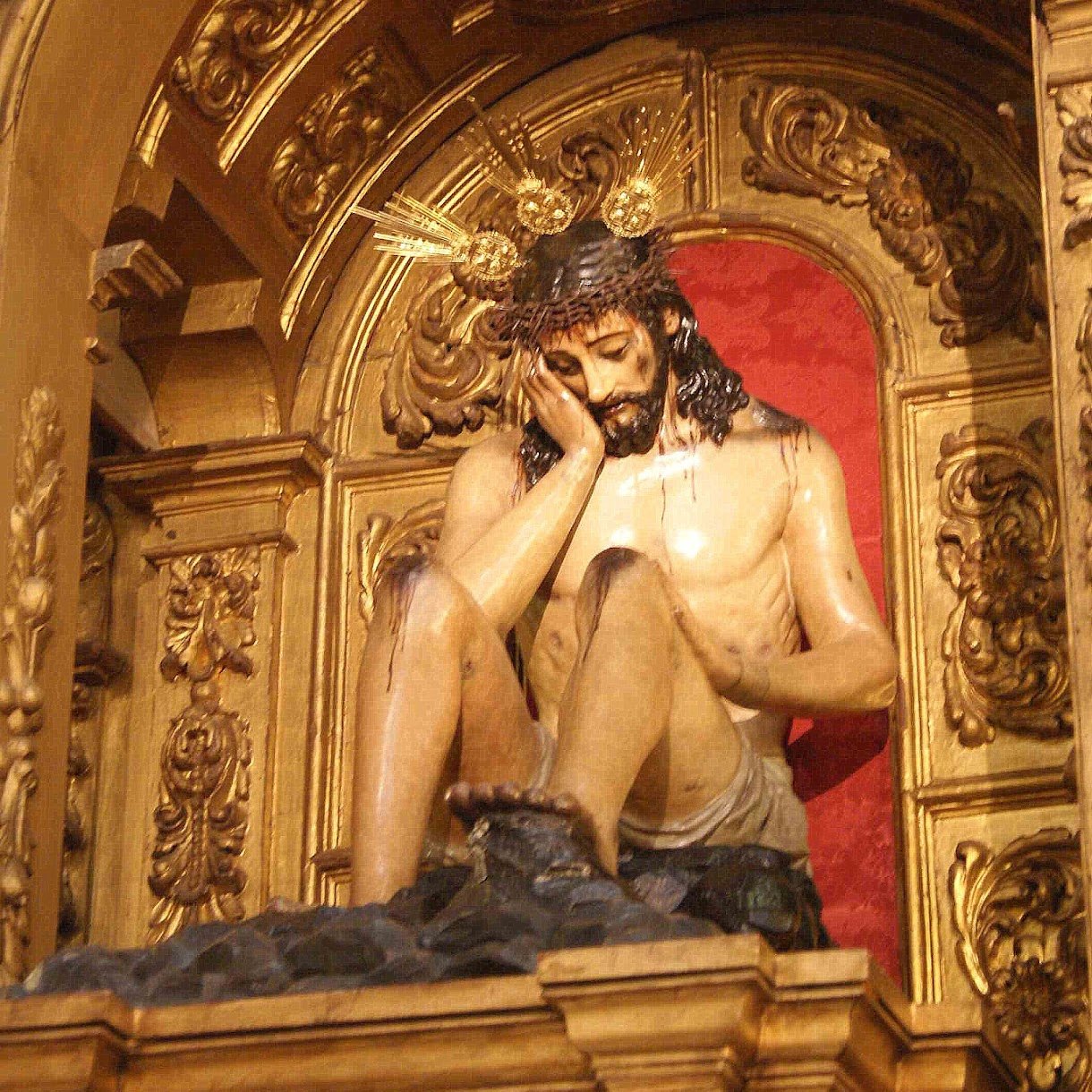
Opposite the altarpiece of the Virgin of the Underground, in the right-hand head of the transept, there is an altarpiece with very dynamic shapes carved by Fernando de Medinilla in 1727. It is presided over by the image of the Christ of Humility and Patience, which is also the titular of the Brotherhood of the Supper, also participating in the procession on its float. The image was made in the 16th century, making it one of the oldest images of Holy Week in Seville. It has the peculiarity of not being made of wood but of glued fabrics. It represents Christ sitting on a rock just before the crucifixion, resting his head on his right hand in a reflective attitude. This iconography has deep roots in Sevillian religiousness since the first carvings were made from an engraving by Dürer in 1511.

Chapels

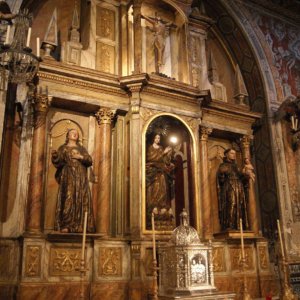
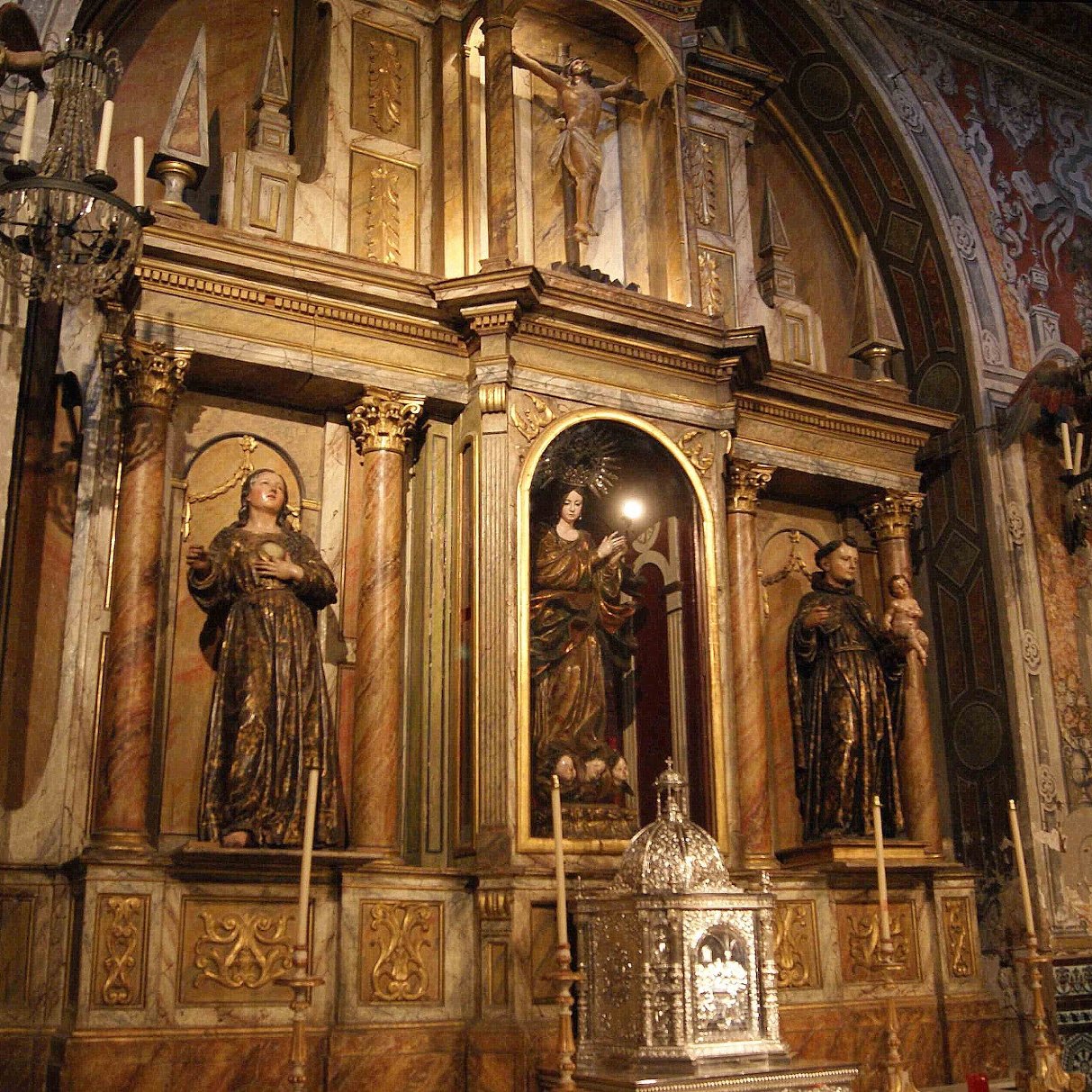
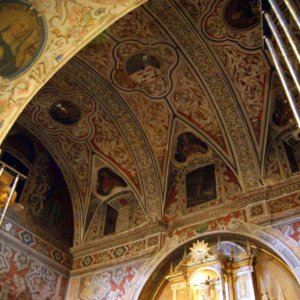
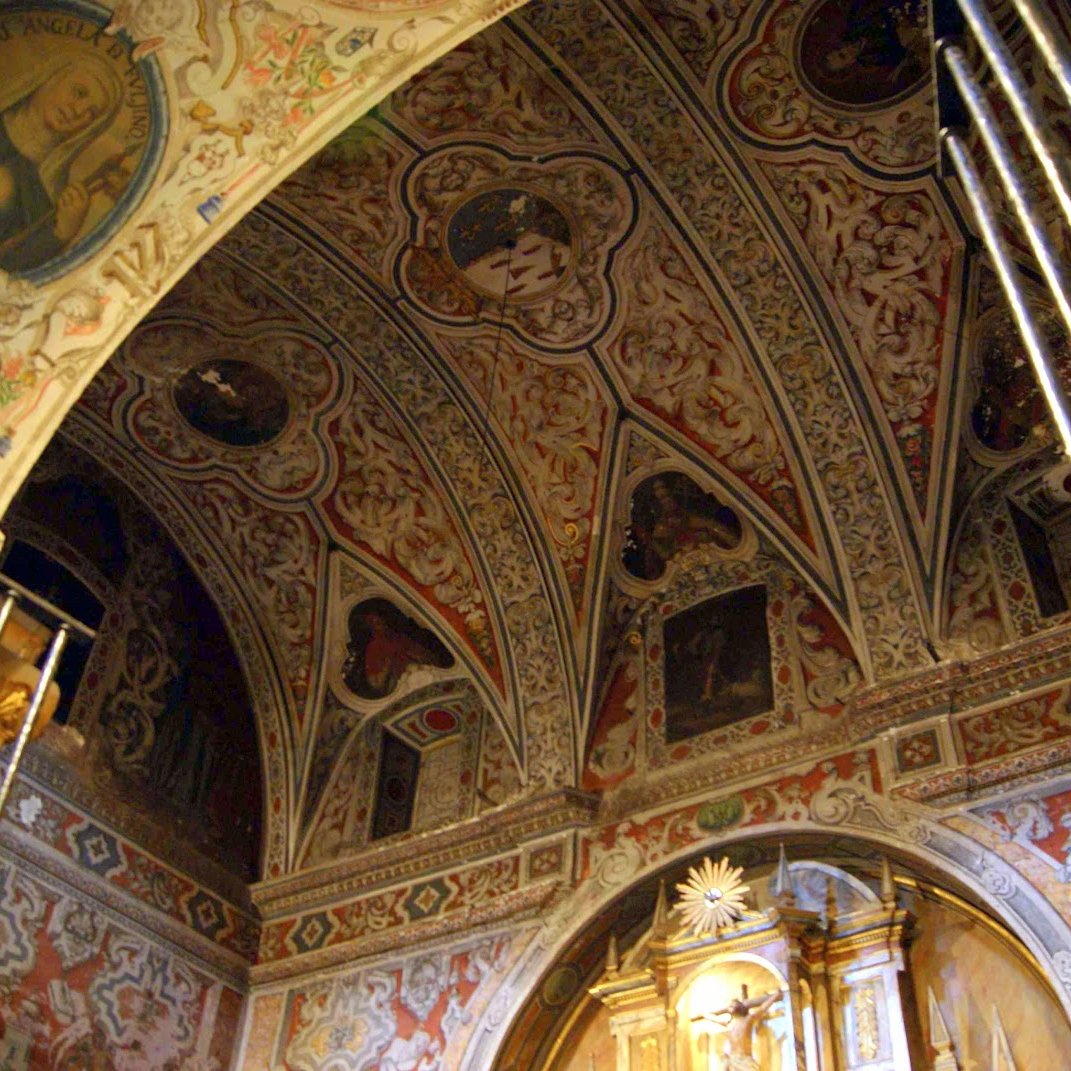
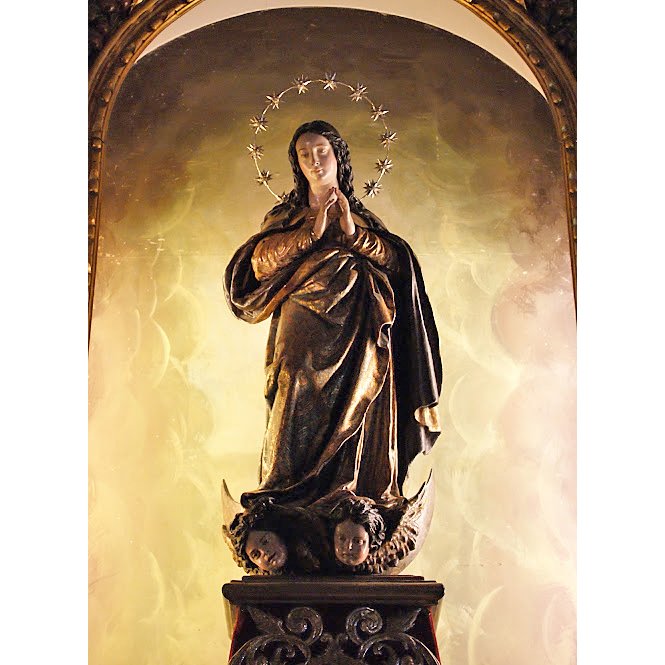
On the Gospel side (left) of the church is the Sacramental Chapel, with a rectangular floor plan and a barrel vault with lunettes. Both the walls and the vaults are profusely decorated with baroque ornamentation from the beginning of the 18th century. It is presided over by a neoclassical altarpiece from the 19th century presided over by an Immaculate Conception. It is flanked by carvings of Saint Mary of Egypt and Saint Anthony of Padua, and in the attic there is a Crucifix. All the carvings are approximately from the beginning of the 19th century, except for the Immaculate Conception, which is from the 17th century. On both sides of the chapel are two altarpieces, also neoclassical, which house the images of Saint Michael and Saint Raphael from the beginning of the 18th century. Also in this chapel is a dressed image of Saint Francis from the 17th century that apparently came out in procession through the streets of the neighbourhood. There is also a crucifix with the dedication of Christ of the Good Death, of remarkable quality, which has been dated to the beginning of the 18th century.

Opposite the sacramental chapel, on the Epistle side (right) is the chapel of Our Lady of the Incarnation. It is presided over by a neoclassical altarpiece that houses the image of the Virgin who is the titular glory of the Brotherhood of the Supper. It is a 17th century carving attributed to Juan de Mesa, although it was deeply renovated later. The chapel remained closed for a long time after suffering a collapse but can be returned to worship after its restoration in 2019.

CHURCH OF SAINT SEBATIAN

The church of San Sebastián is a Gothic-Mudejar temple originally built between the 15th and 16th centuries as a hermitage on the outskirts of the city. It has undergone profound transformations throughout its history, especially during the 19th and 20th centuries, in relation to the appearance of the Porvenir neighbourhood around it. It has a rectangular floor plan divided into three naves by pointed arches. The area of ​​the presbytery and the sacramental chapel stand out from the floor plan, at the head of the Epistle nave. The church is the headquarters of the Hermandad de la Paz, which processes on Palm Sunday.

History

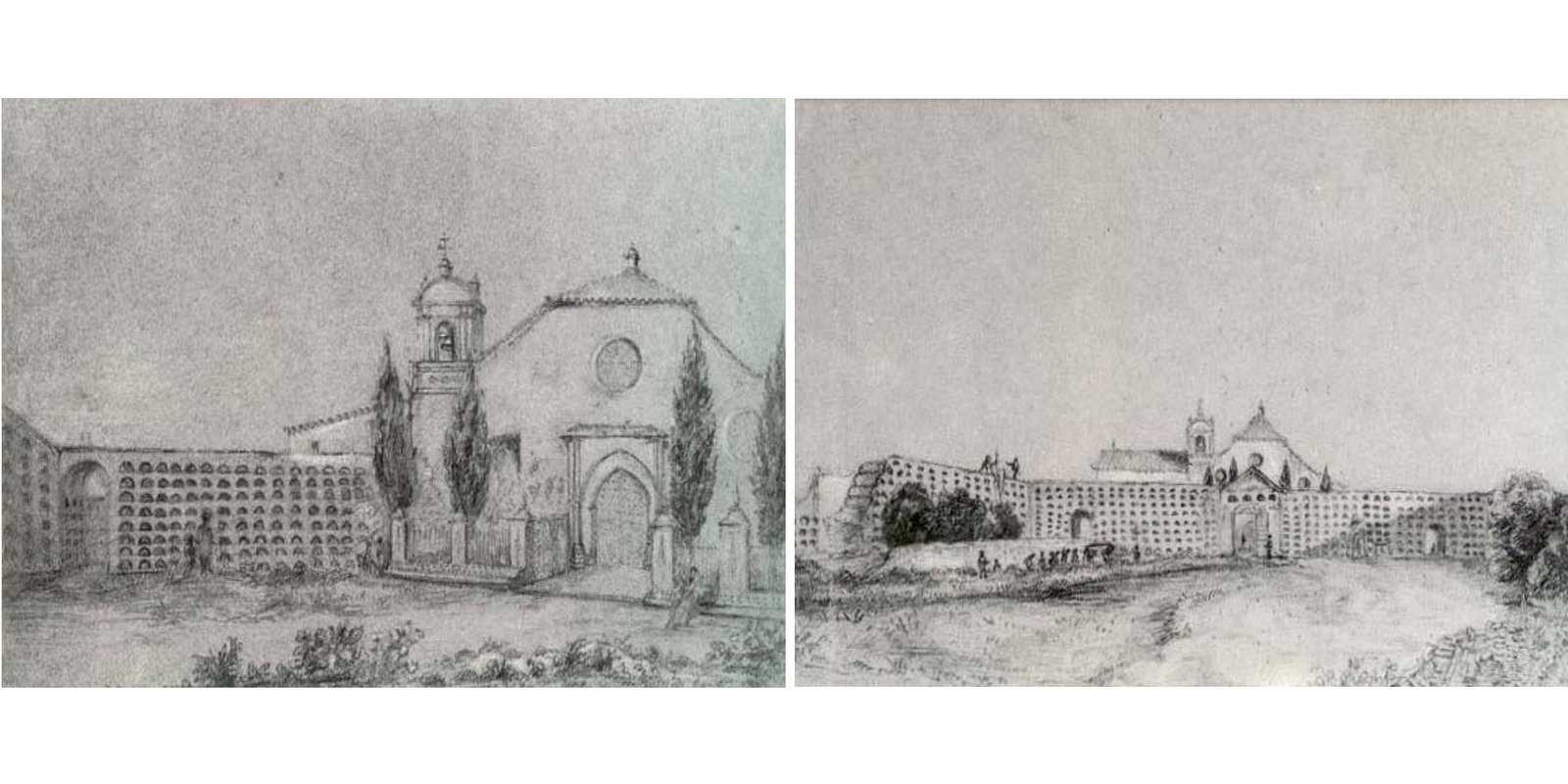
The origin of the church is a hermitage that was built on this site at the end of the Middle Ages in honour of San Sebastián, a saint who was asked for intercession in the event of epidemics. In the 19th century, the first cemetery outside the city walls was built near the hermitage. It should be remembered that for most of our history, burials took place in churches or in their surrounding areas, with the consequent health problems that this practice entailed. There are two drawings by the English traveller Richard Ford made in 1831 in which the cemetery and the primitive hermitage appear. The cemetery of San Sebastián lost importance after the construction of the municipal cemetery of San Fernando in 1852 and ten years later its demolition would begin, as recalled by an inscription at the foot of a cross that is currently located in front of the church as a commemorative monument. After the cemetery disappeared, a reform of the old hermitage was undertaken. It was probably at this time, in the mid-19th century, when the current presbytery was added, since it is known that there was originally a Gothic style one and the current one is covered by a hemispherical dome in the Baroque style.

From the beginning of the 20th century, with the preparations for the Ibero-American Exhibition of 1929, the creation of the Porvenir neighbourhood in the area of ​​the old hermitage was accelerated, with the result that the temple was reformed several times, as it gained importance as an auxiliary to the parish of San Bernardo.

In 1939 the Hermandad de la Paz was founded with headquarters in this church, which entailed new reforms, such as the opening of the south doorway for the exit of the floats or the construction of the brotherhood house, built under the direction of Rafael Arévalo y Carrasco in 1941. In 1956 the church was definitively established as a parish and has come down to our days consolidated as the centre of religious life in the neighbourhood.

Outside

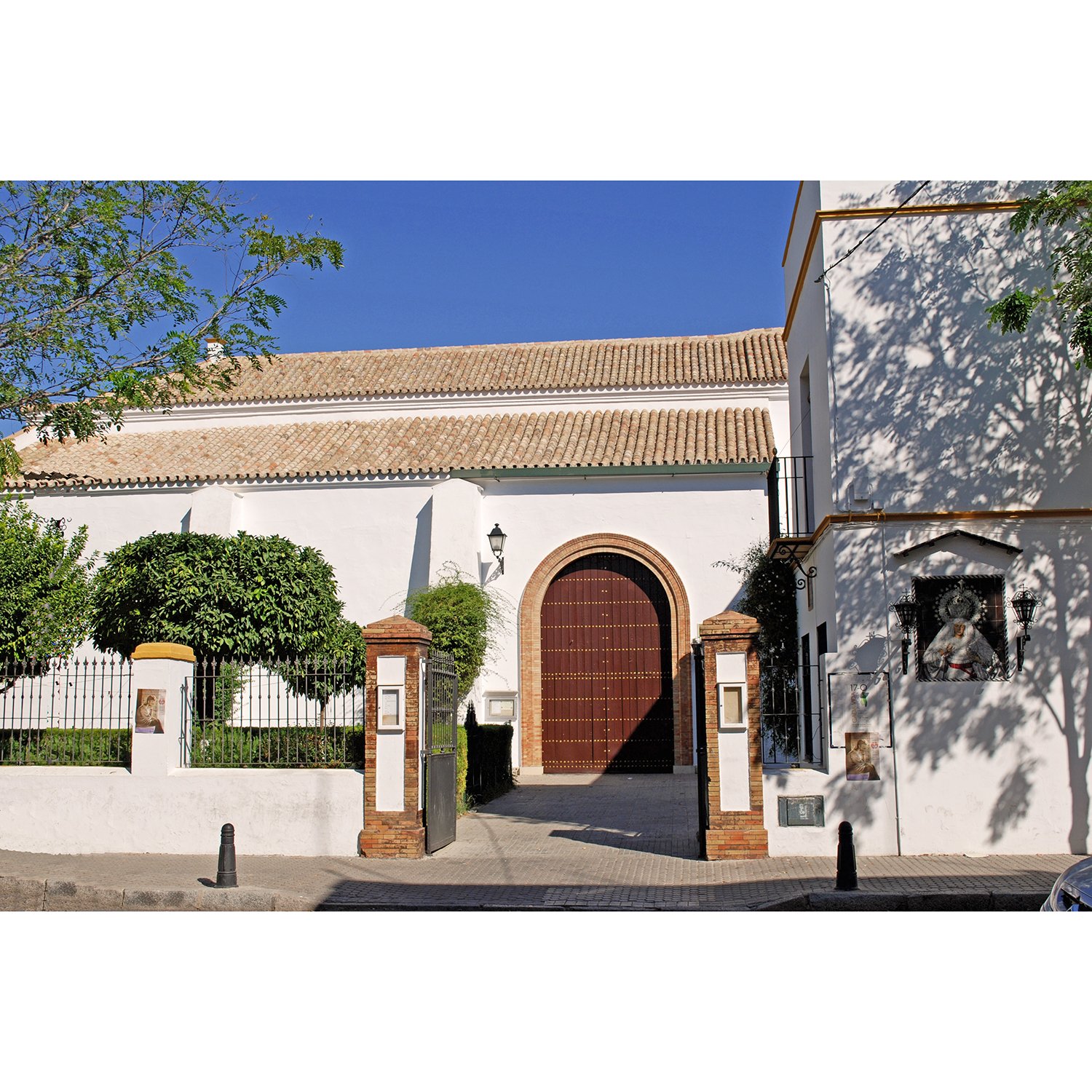
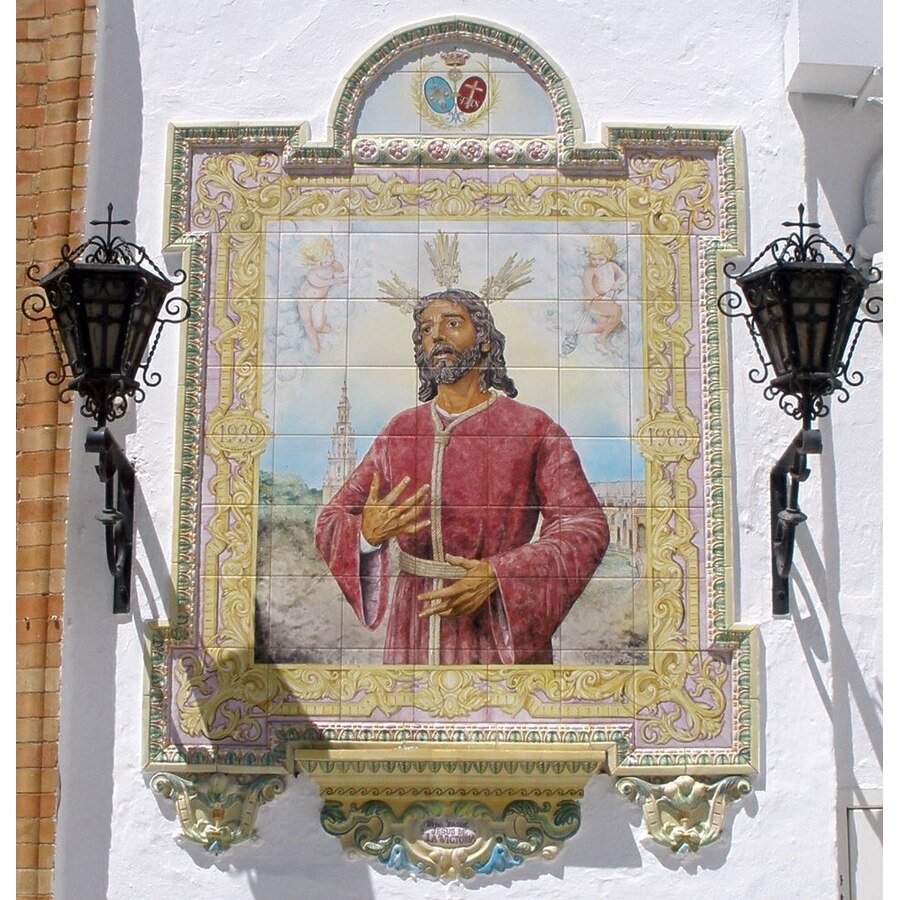
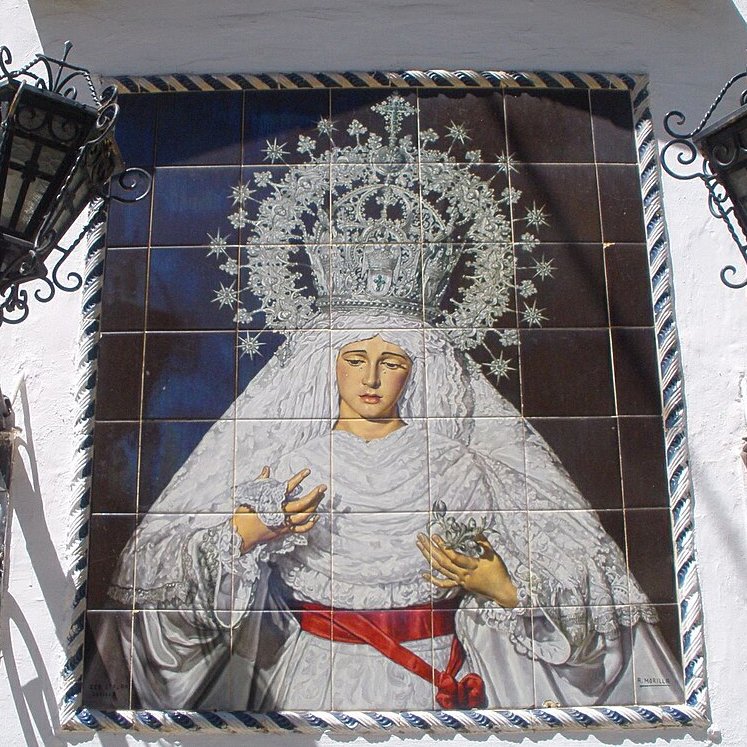
On the outside, the church is surrounded by annex buildings, with only the south and east façades remaining free. On the south side, the buttresses supporting the walls can be seen and it has a simple doorway in the area closest to the head. It was opened in 1940 to allow passage through and is made up of a simple semicircular arch framed by a moulding of exposed brick. To the right of the door is a beautiful ceramic altarpiece with the Christ of Victory, made by Alfonso Magüesín de la Rosa in 1989. In the background there is a landscape in which the silhouette of the Plaza de España can be distinguished. The ceramic altarpiece dedicated to the Virgin is very close, next to the entrance to the fenced area around the church. It was made by Antonio Morilla Galea in 1977 and it highlights the beautiful contrast between the whiteness of the figure of the Virgin and the black background.

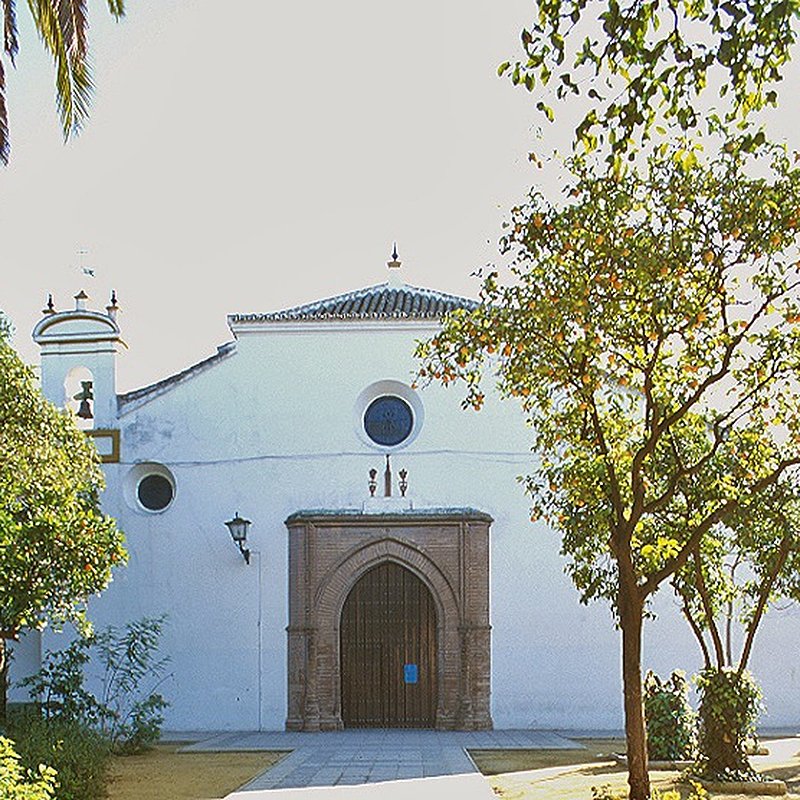
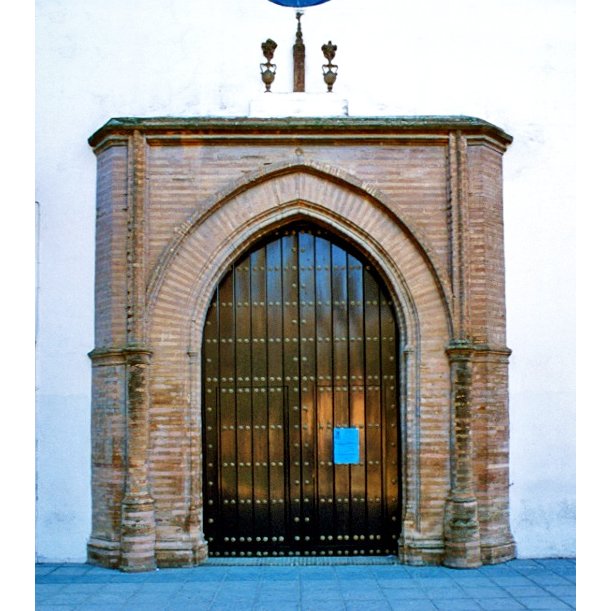
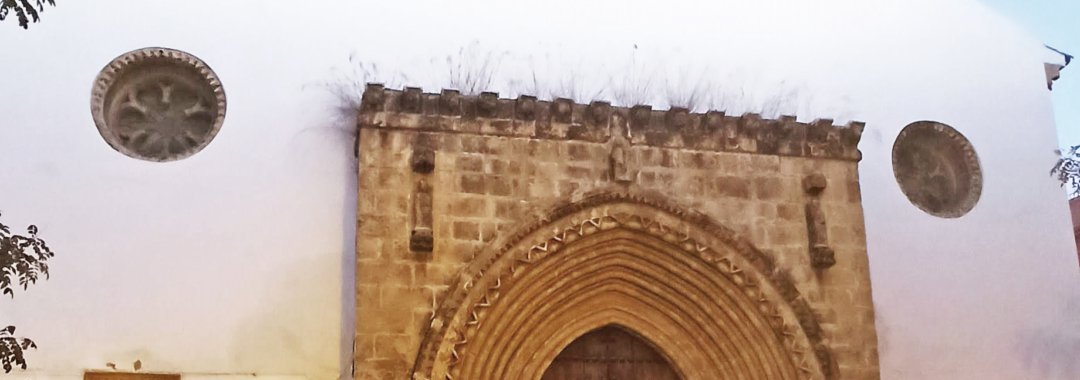
The main façade is the one facing east, at the foot of the church. In its centre we find a magnificent Mudejar doorway, probably built in the 15th century. It is formed by a pointed arch, framed by a structure that stands out from the rest of the façade, built from rows of bricks in alternating colours. It is very beautiful despite its simplicity and is clearly related to other similar doors that we find in Seville, such as that of the church of the convent of Santa Paula or that of the chapel of Santa María de Jesús. Above the door we find the coat of arms of the Cathedral, the Giralda between two jars of lilies, a symbol of the patronage of the cathedral chapter. This emblem does not appear in Richard Ford's drawing of 1831, so it must have been added later.

At the top of the façade there are three oculi, one in the centre and two on the sides, which serve to illuminate each of the naves. On the left stands a simple bell gable, with a single bell and topped with a curved pediment.

Interior

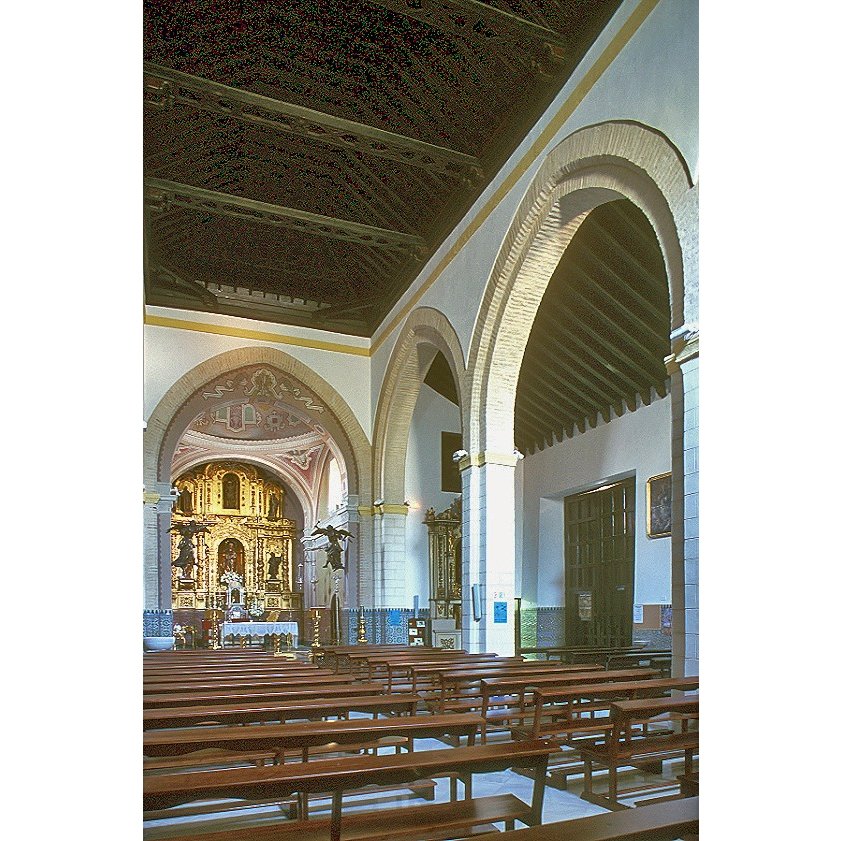
Inside, the space is divided into three naves, with the central one wider and higher than the side ones. Large pointed arches resting on cruciform pillars separate the naves. Another large pointed arch separates the central nave from the presbytery, like a triumphal arch. Most of the walls are plastered in white, with the area of ​​the pillars imitating ashlar and leaving the brickwork on the arches exposed. A 20th-century tiled plinth with geometric shapes runs throughout the interior. The roof is covered by wooden coffered ceilings in the neo-Mudejar style, with a pair and knuckle in the central nave and hanging in the side ones.

From the rectangular space formed by the naves, three spaces stand out at the head. The presbytery is located in the centre, the sacristy at the head of the right nave and the chapel occupied by the Brotherhood of Peace at the head of the Gospel nave.

The presbytery is a quadrangular space covered by a hemispherical dome on pendentives that is not visible from the outside of the temple. In all probability, it was originally covered by a pointed vault, as occurs in most of the Gothic-Mudejar churches in the city. The current dome must have been built during the reforms undertaken in the 19th century. The walls are decorated with contemporary paintings with geometric motifs, plants, fake architecture and angels. The pendentives follow the tradition of serving as a support to accommodate the Evangelists, who are represented by their symbols.

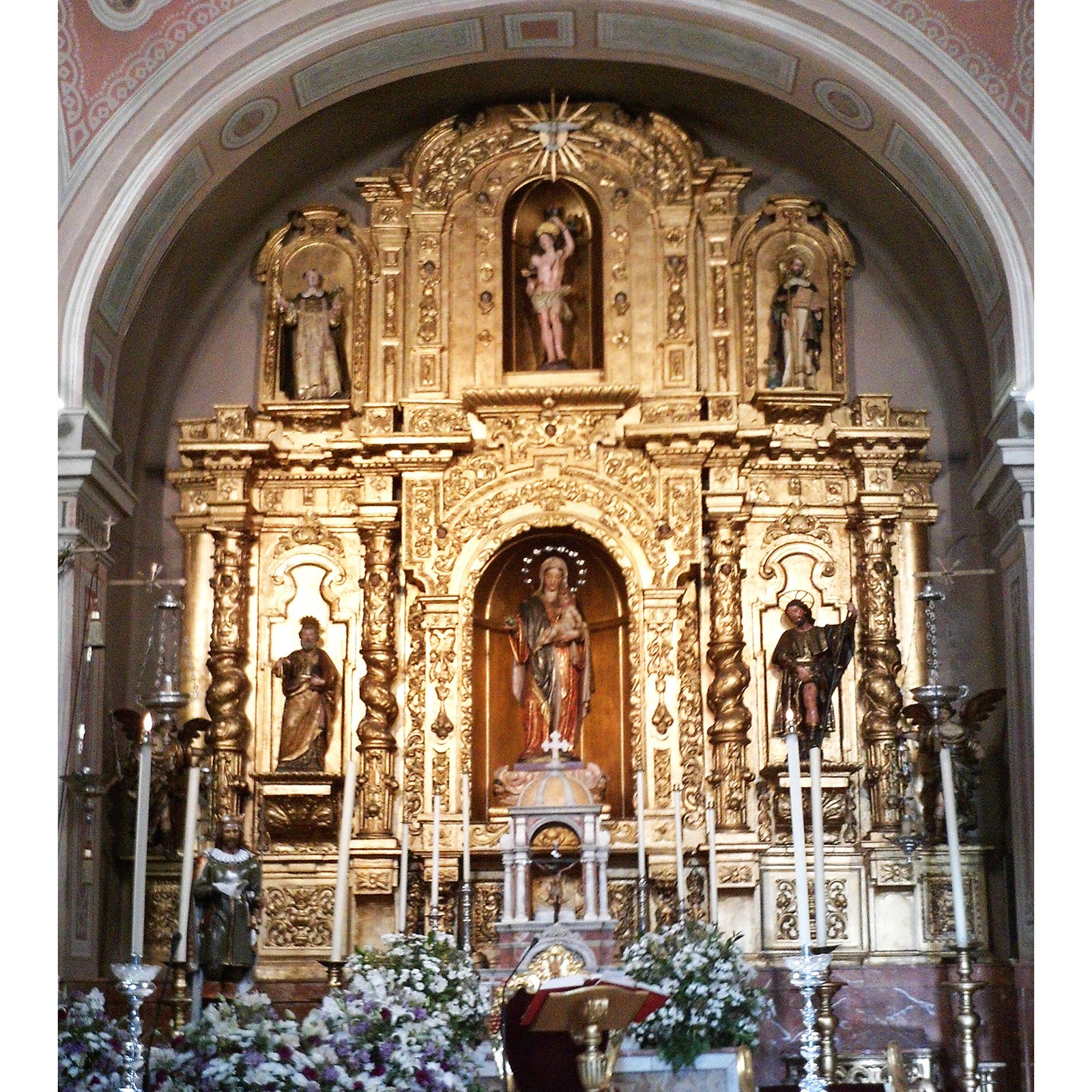
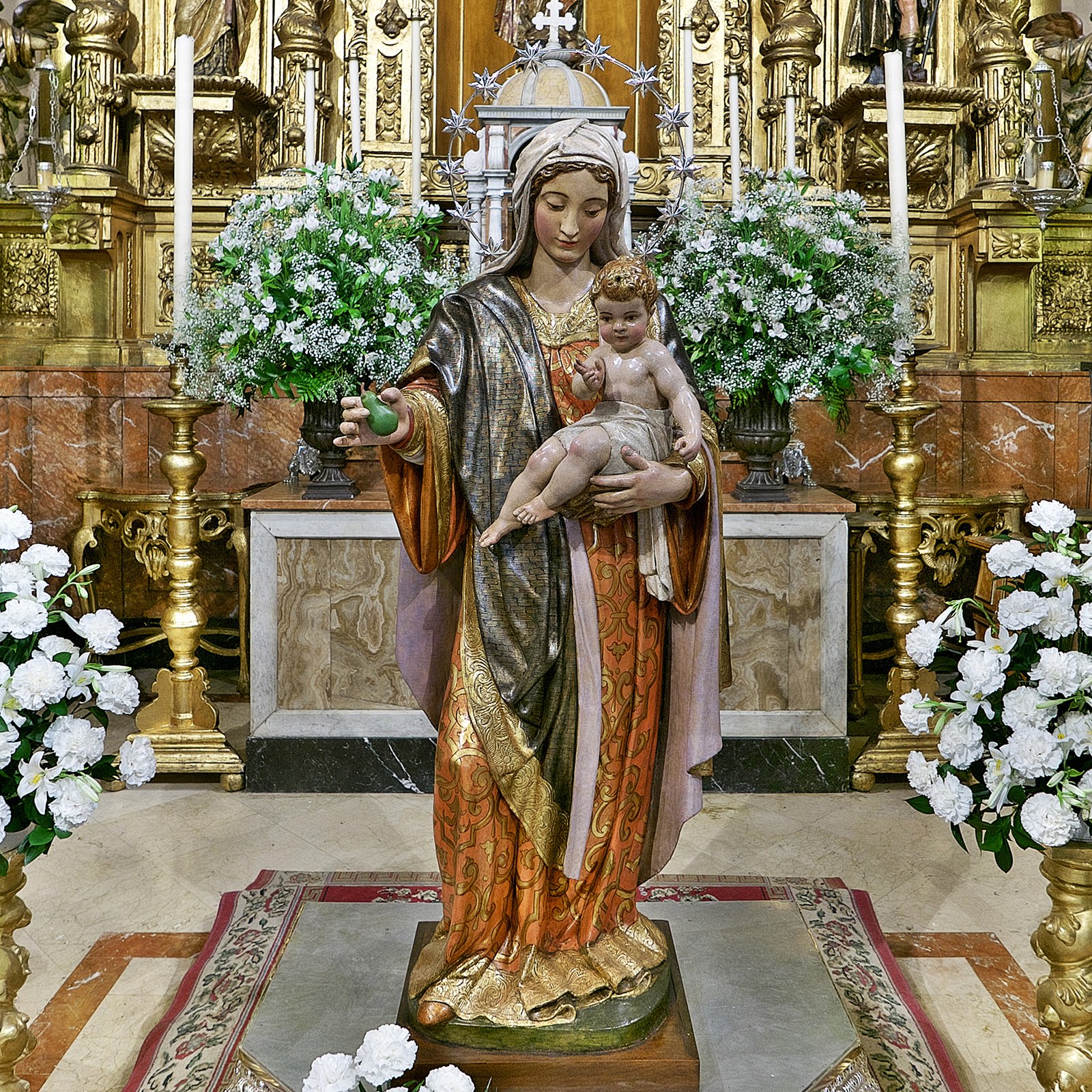
The altarpiece is in neo-baroque style, made in the 20th century. It is divided into three sections and two horizontal bodies. In the main niche we find a magnificent sculpture of the Virgin and Child, known as the Virgin of the Meadow. It was made by Jerónimo Hernández around 1577 and is an outstanding example of Renaissance sculpture in the city. The Child Jesus appears blessing with a sweet gesture while the Virgin holds a pear in her right hand. It should be remembered that this image acted as patron and protector of market gardeners and country people in this area of ​​Seville.

On the side streets are the sculptures of San Pedro and San Roque. In the centre of the second body is San Sebastián, the patron saint of the temple, flanked by San Jacinto and Santo Domingo de Guzmán. All the sculptures seem to be original from the 18th century, although they were probably re-painted later.

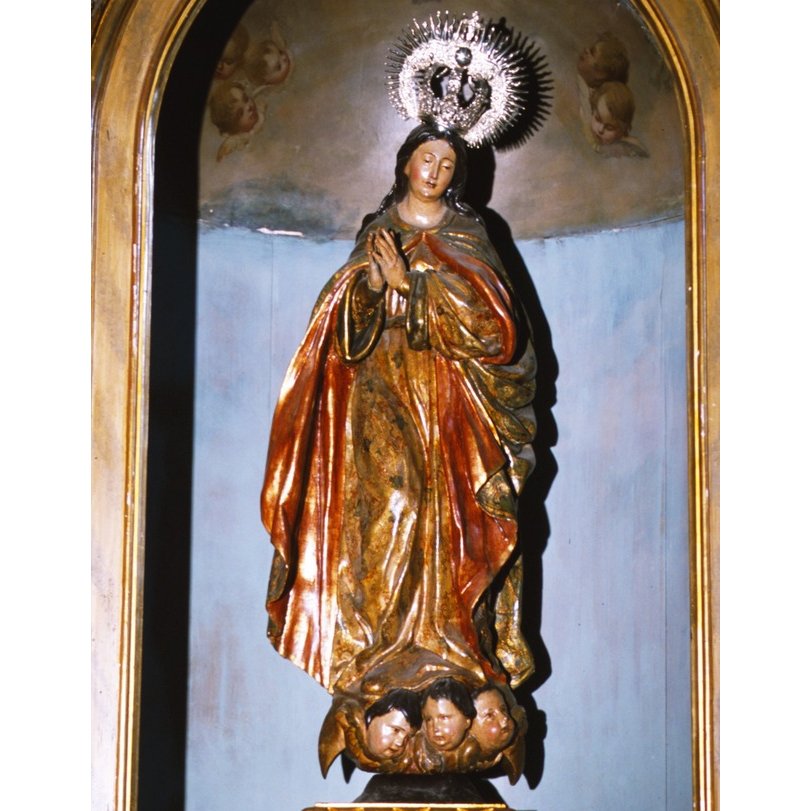
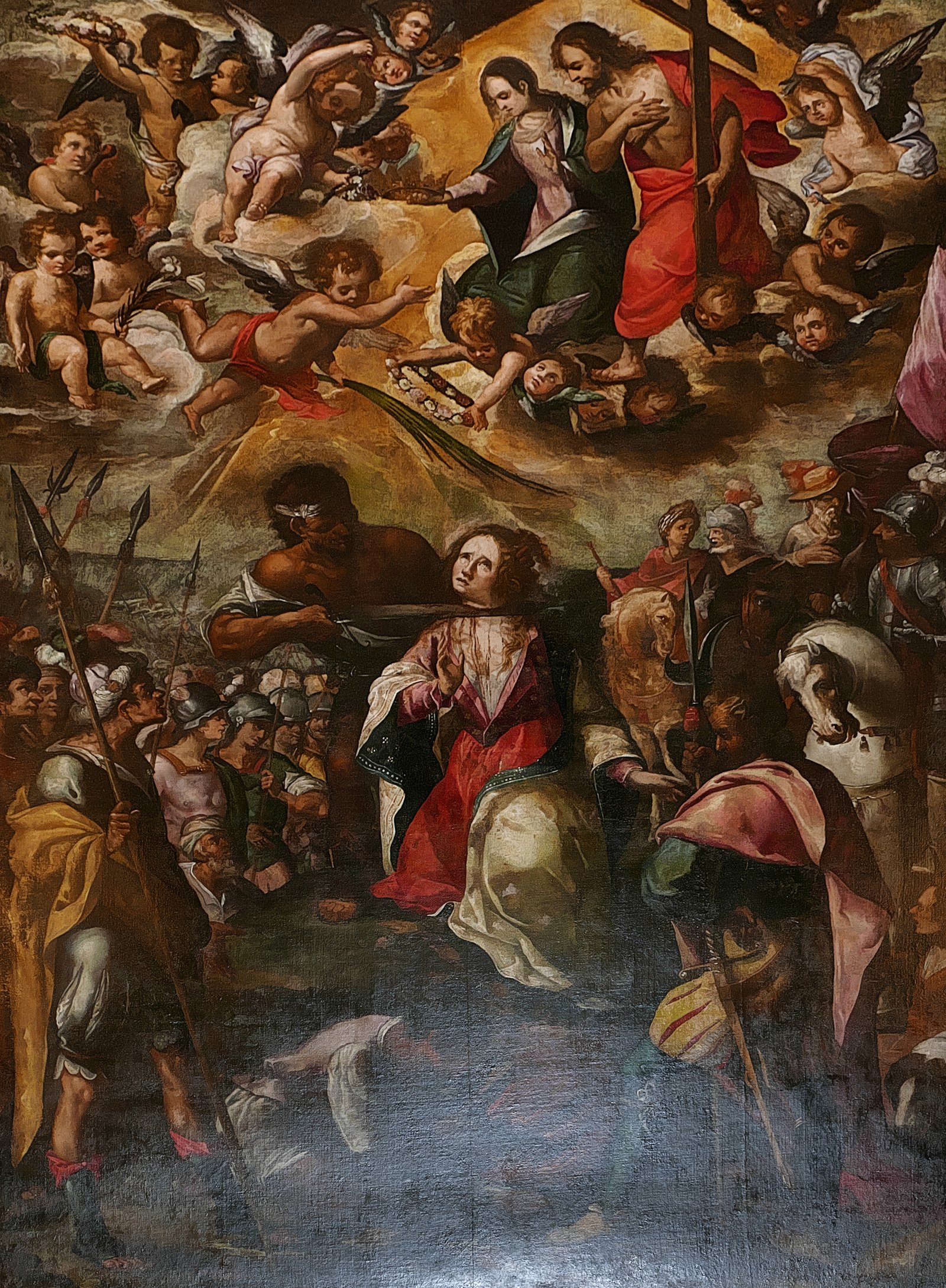
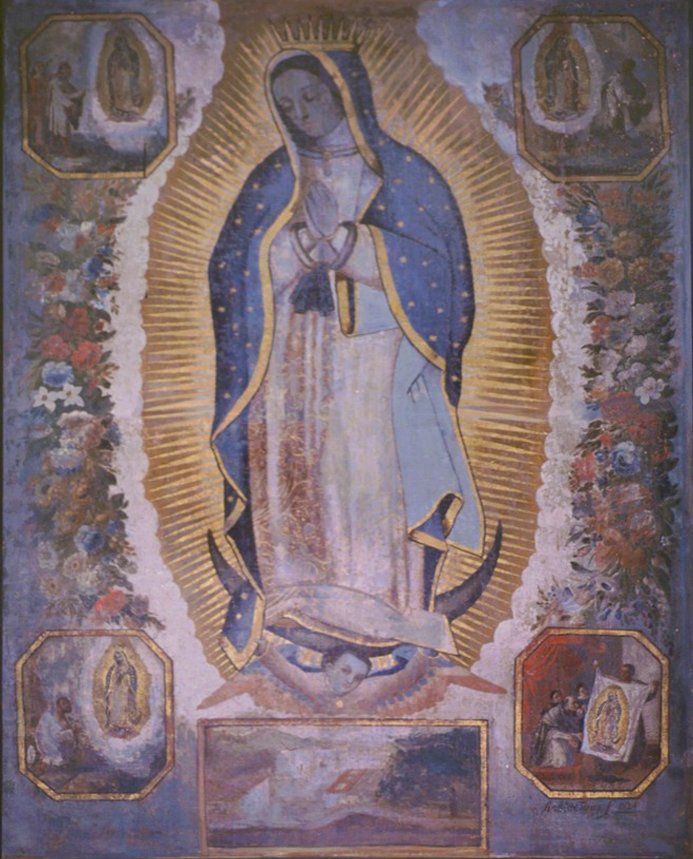
Other sculptures and paintings are displayed on the walls of the naves. One of the most notable is a carving of the Immaculate Conception from the 18th century, which presides over a stucco altarpiece in neoclassical style. There are also some carvings from the 20th century, such as the Sacred Heart, which presides over a neo-Baroque altarpiece. Among the paintings, we find several copies of originals by Murillo and some other Baroque paintings, such as the "Martyrdom of Saint Lucy" (Francisco Varela, c. 1637), the "Annunciation" or the "Marriage of the Virgin". From the same period there are representations of various saints, such as Saint Lawrence, Saint Agnes or Saint Sebastian, and an interesting "Virgin of Guadalupe", a copy of the Mexican original made by Antonio Torres in 1740.

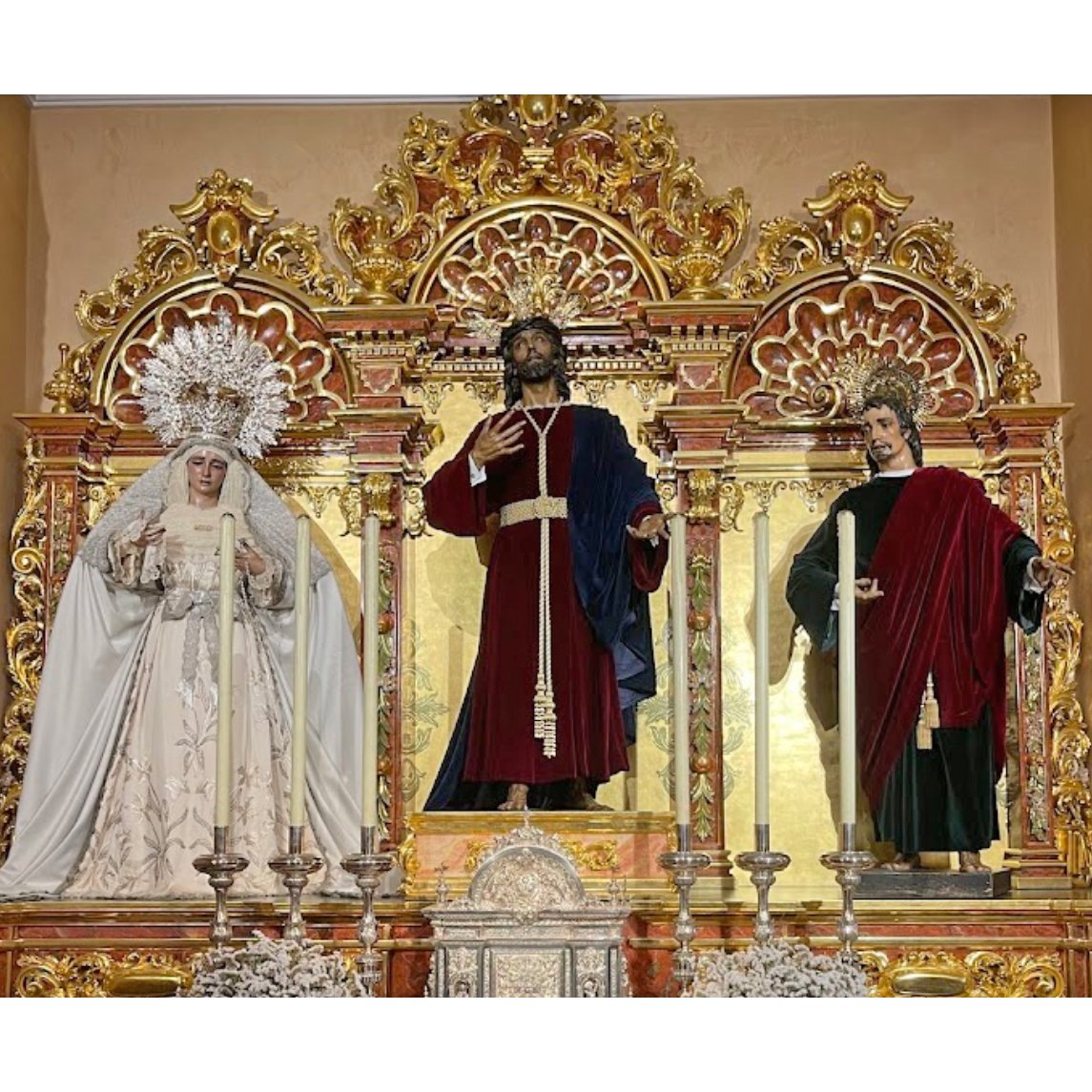
As we said, at the head of the left nave is the sacramental chapel, where the titular images of the Hermandad de la Paz are worshipped. The chapel is covered by a groin vault with a lantern in the centre and presided over by a neo-baroque altarpiece. In the centre we find Nuestro Padre Jesús de la Victoria, a sculpture made by Antonio Illanes Rodríguez in 1940. It forms part of a float in which Jesus is seen taking the cross to carry it on the way to Calvary, although when it is in its chapel the image is logically shown without the cross. On the left is the image of María Santísima de la Paz, made in 1939 also by Antonio Illanes, who is said to have been inspired for the face of the image by the facial features of his wife, Isabel Salcedo. When it comes to the procession, the image stands out for the white and silver tones of its float, both in the canopy and in the figure of the Virgin herself. This whiteness is a clear sign of the devotion to Peace and creates a very unique and iconic image during Holy Week in Seville. The same artist also made the sculpture of Saint John that occupies the niche on the right of the altarpiece.

CHURCH OF SAINT JULIAN

The church of San Julián is a Gothic-Mudejar temple, built mostly in the 14th century, although with important subsequent modifications. It is the headquarters of the Brotherhood of the Hiniesta, which takes part in the procession on Palm Sunday.

It has a rectangular floor plan and three naves, separated by pointed arches resting on pillars. The polygonal head, where the presbytery is located, stands out from the floor plan.

As it has survived to this day, the church is the result of a reconstruction carried out in the mid-20th century, as it was almost completely destroyed in a deliberate fire in 1932. At the end of that same century, the temple was completely restored to replace its roofs, which were in a ruinous state.

History

The church is one of the parish churches of the group of Gothic-Mudejar churches in Seville, built mainly in the northern area of ​​the historic centre between the 13th and 15th centuries. They all share a very similar structure and style and form a typological ensemble of extraordinary interest and beauty.

In the case of San Julián, it is known that it was built in the first half of the 14th century, dedicated to this saint who suffered martyrdom at the beginning of the 4th century together with his wife Basilisca, probably in Antinóopolis (Egypt).

The temple has undergone important modifications throughout its history. In the 17th century, the bell tower and the chapel on the left side occupied by the Brotherhood of the Hiniesta were added. The most complicated moments occurred in April 1932, when the church suffered an intentional fire that almost completely destroyed it. All its roofs and most of its movable heritage were lost, including the titular images of the Brotherhood. In 1989 it had to be closed again until 1994, given the poor condition of its roofs.


Outside

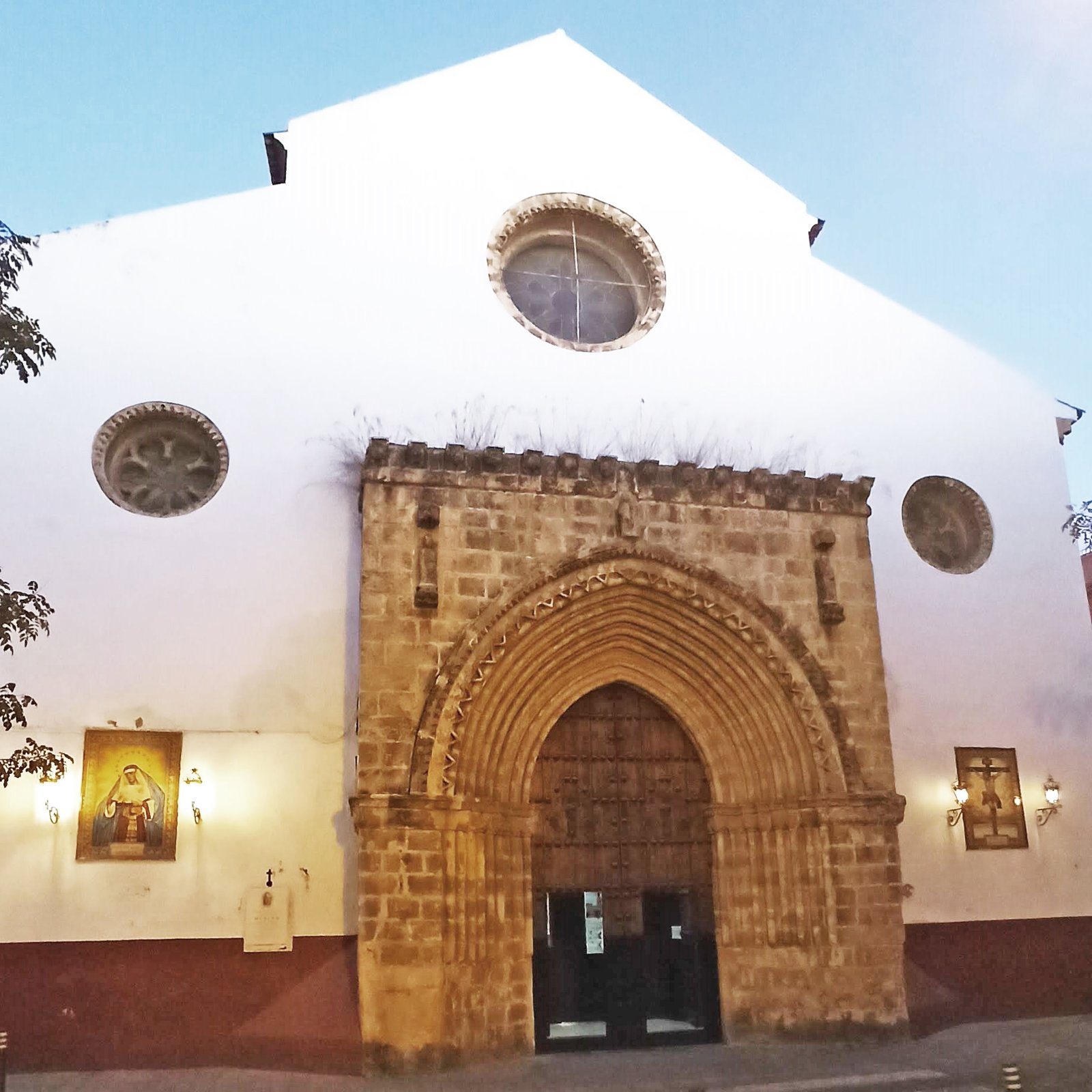
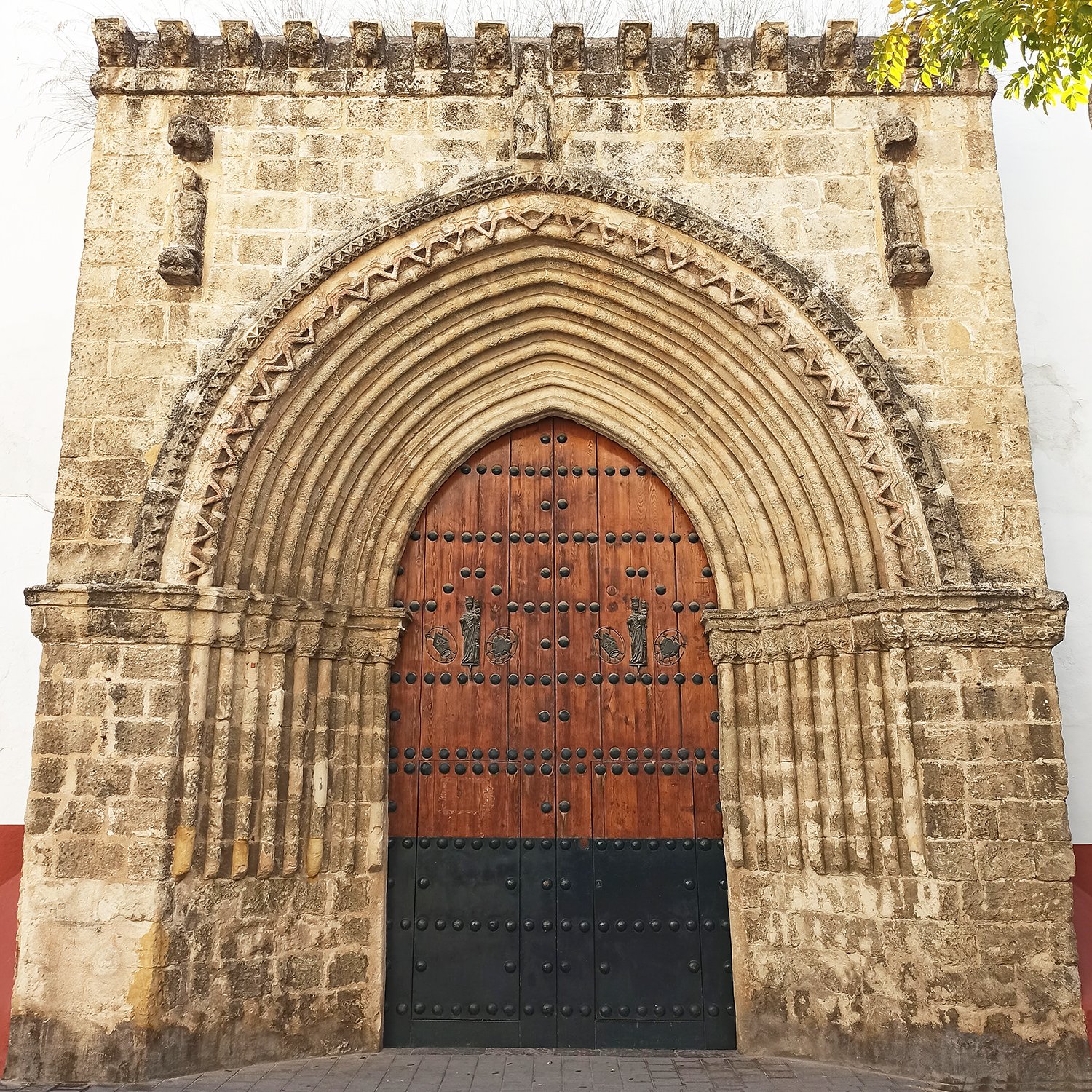
San Julián has two exterior doors, one at the foot and another on the left side, although the second is unfinished and has survived to this day flanked by a brick structure that was to serve as support for a door that was never built. The main door is at the foot and has the classic ogival, flared shape, framed by an alfiz that stands out from the rest of the façade. It has very simple and somewhat rough sculptural decoration, although the high degree of erosion of the stone makes it difficult to assess its original appearance. The arch is decorated on the outside by a moulding with zigzag motifs and another with diamond points. The capitals of the small columns on both sides have plant decoration of vine leaves, which continues outwards under the impost line. Around the entrance arch there are three small sculptures under Gothic canopies. According to art historian Rafael Cómez, the one at the top represents Christ as a judge, the one on the left represents Saint Julian the Bishop and the one on the right represents Saint Julian the Hospitaller. Confusions between saints have been common throughout history and elements of different saints have often been attributed to others with the same name or their characteristics have been different depending on the territory. (Rafael Cómez Ramos, "Iconología de la arquitectura religiosa bajomedieval en Sevilla: la iglesia de San Julián").

At the top there are a series of modillions decorated with lion heads, between which there are a series of horseshoe arches engraved in the stone. The lions symbolised, among other things, royal authority, and we find them in other Sevillian doorways from the same period, such as in San Esteban or in Santa Ana de Triana.

Above the doorway there are three oculi with diamond-shaped moulding, one larger at the top and two, somewhat smaller, one on each side.

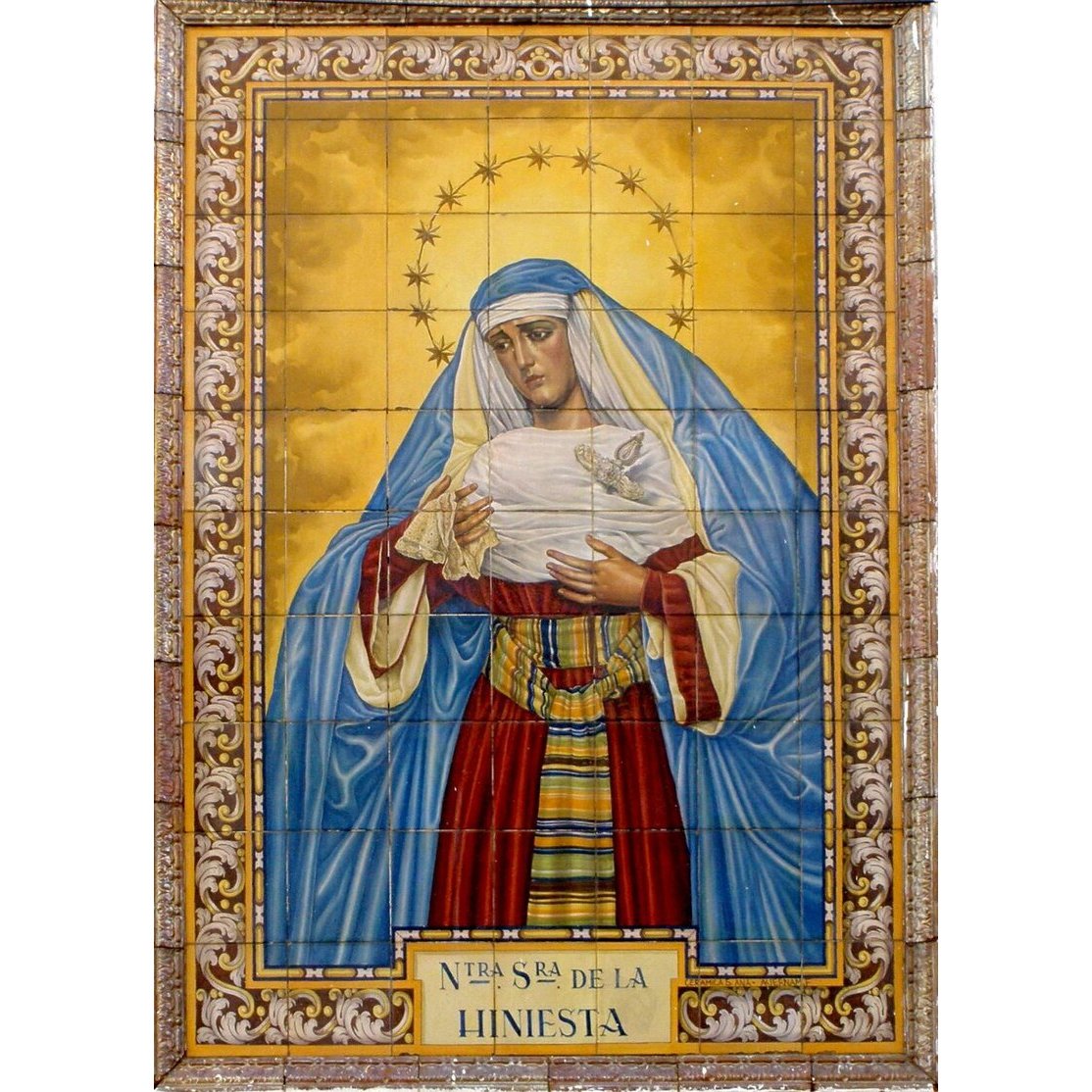
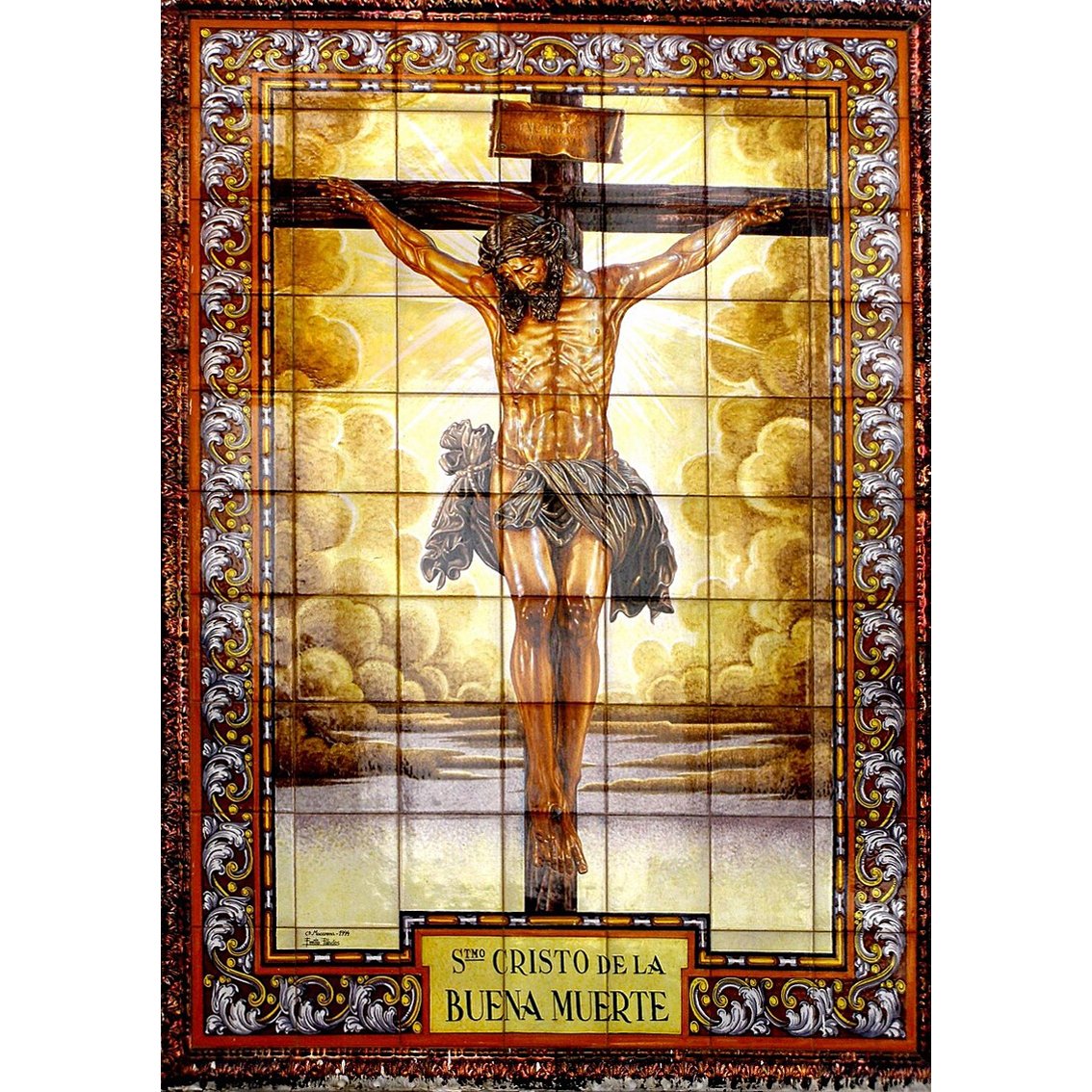
The decoration of this façade is completed by two ceramic altarpieces dedicated to the titulars of the Hermandad de la Hiniesta, which are located on both sides of the doorway. On the left is the one of the Virgin, made by Antonio Kierman Flores in the Santa Ana factory in 1962. On the right we find the Christ of the Good Death and it was made in 1994 by Emilio Sánchez Palacios in his family workshop, Cerámica Macarena.

On the right-hand side, facing Duque Cornejo Street, we find another ceramic altarpiece with the same authorship and date as that of Christ. On this occasion it is dedicated to the Virgin of the Rosary, the titular of her own brotherhood, also based in this temple.

From this same side, the bell tower that stands next to the head of the church is visible. It has a square floor plan, with the body of the bells decorated by simple pilasters, and is topped by a hexagonal spire with ceramic decoration in white and blue.

Inside

The interior of the temple today is the result of the reconstructions that had to be carried out during the 20th century, although an attempt was made to recreate the original appearance as far as possible. The naves are covered by 20th century wooden coffered ceilings in the neo-Mudejar style, while the apse is covered by a ribbed vault that follows the Gothic model. This difference in the type of covering between the naves and the presbytery is very common in the Gothic-Mudejar churches of Seville. The walls are covered by tiled plinths with geometric motifs, also following models that come from the Middle Ages.

In the area of ​​the presbytery, the current altarpiece is the result of a reconstruction from fragments of altarpieces from the 17th and 18th centuries. This is because the previous one was lost in the fire of 1932. In the central niche, the image of Our Lady of the Glorious Hiniesta is worshipped, an image made in 1945 by Antonio Castillo Lastrucci to replace the original Gothic one, also destroyed in the fire. This devotion to the Hiniesta has a very interesting origin and is deeply rooted in the city, to the point that it is officially the patron saint of the City Council of Seville. Professor Francisco S. Ros González tells the legend thus:

…the Catalan knight, Father Per de Tous, was hunting in the mountains of his land one day at the end of the 14th century when his goshawk became paralysed in front of the gorse bushes where the partridges he was pursuing had taken refuge. Surprised by the bird’s behaviour, the knight dismounted from his horse, looked into the undergrowth and discovered an image of the Virgin with the Child in her arms with an inscription at her feet that, in the Latin version by Ortiz de Zúñiga, read: «Sum Hispalis de sacello ad portam quæ ducit ad Corduvam» («I am from Seville, from a chapel next to the gate that leads to Córdoba»). From the text it was deduced that the image was one of those that had been hidden during the Muslim invasion to prevent its desecration and that it had miraculously been preserved intact through the centuries despite being out in the open. Per de Tous took the image to Seville and placed it in the parish church of San Julián, as it was the temple closest to the door in the city walls leading to Córdoba at that time. The fact that the image of the Virgin was found hidden in some broom bushes led to it being called Santa María de la Hiniesta.

(Francisco S. Ros Gonzáles, “La Virgen de la Hiniesta de Sevilla y el movimiento concepcionista”. Universidad de Sevilla, 2005)

On either side we find two anonymous paintings from the 18th century, the one on the left with the Immaculate Conception and the one on the right with Saint Beatrice de Silva, founder of the Order of the Immaculate Conception. Above the paintings, two niches contain small carvings. The one on the left represents Saint Bernard of Clairvaux, while the one on the right could be Saint Therese of Lisieux. Above the central niche, in the upper part of the altarpiece, we find another anonymous painting from the 18th century with Saint Francis Solano. Above it, a small relief with the Immaculate Conception (17th century).

Also in the area of ​​the presbytery, two curious lampstands from around 1672 stand out. Fortunately they were saved from the fire of 1932 and from them hangs a splendid collection of eight silver lamps from the 16th and 17th centuries.


Left Nave

If we begin to describe the walls of the church at the foot of the left nave, the first thing we find is a carving of Saint Joseph with the Child, an anonymous work from the 18th century. Nearby is a ceramic panel in blue tones with the representation of the Baptism of Christ. It is a recreation of the exceptional canvas with the same theme that Murillo painted for the chapel of San Antonio in the cathedral of Seville. The ceramic altarpiece was made by Rafael Cantanero Mesón at the Mensaque Factory in Triana around 1920.

Continuing towards the apse we find a curious altarpiece - pedestal in neo-baroque style, formed by plant motifs. It houses a beautiful carving of Saint Angela of the Cross, a contemporary work by Ricardo Rivera.

The next altarpiece is also contemporary and is made of gilded plaster. It houses an image of the Virgin of the Miraculous Medal, made by Castillo Lastrucci around 1945.

Continuing towards the head, the next altarpiece is also modern and very sober, but it houses one of the great artistic jewels of this temple. It is a carving of the Immaculate Conception, made in the first third of the 17th century and attributed to Alonso Cano. It has notable similarities with works by Martínez Montañés and, in fact, it has sometimes been attributed to him, given its resemblance to sculptures such as the famous "Cieguita" of the cathedral of Seville. Alonso Cano was training with the master Montañés and it is normal that he reproduced his models.

Finally, at the head of the Gospel nave we find a neo-Gothic altarpiece with the dressed image of the Virgin of the Rosary. The image is the title of its own brotherhood of glory and was made in 1937 by José Rodríguez Fernández-Andes.

Right Nave

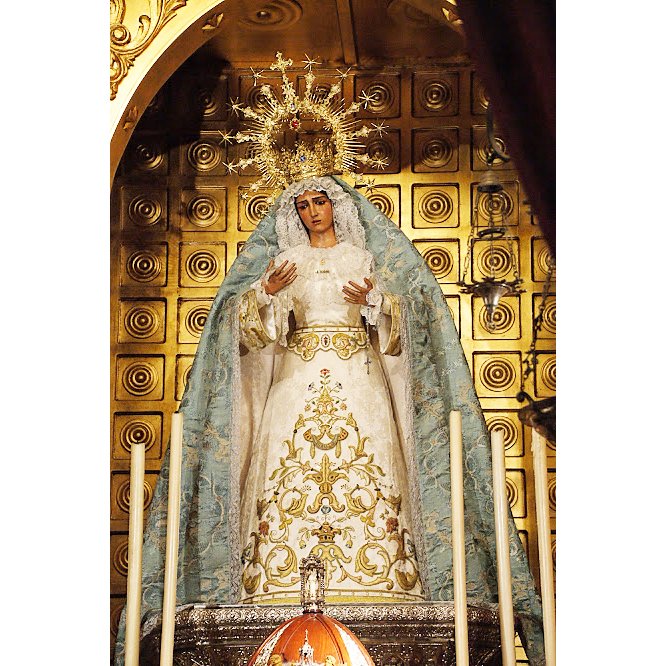
At the head of the right nave is the sacramental chapel, where the image of Our Lady of the Sorrowful Hiniesta, the titular of the Brotherhood of the Hiniesta, is worshipped. It is the third image with this purpose that the Brotherhood has. The first was a baroque Virgin of the Sorrowful from the 17th century, attributed to Martínez Montañés, which was lost in the fire of 1932. To replace it, Castillo Lastrucci made a new Virgin of the Hiniesta, which was destroyed in the fire of San Marcos in 1936, since at that time the Brotherhood was based in this parish. The current one was also made by Castillo in 1937 to replace the missing sculpture that he himself had made.

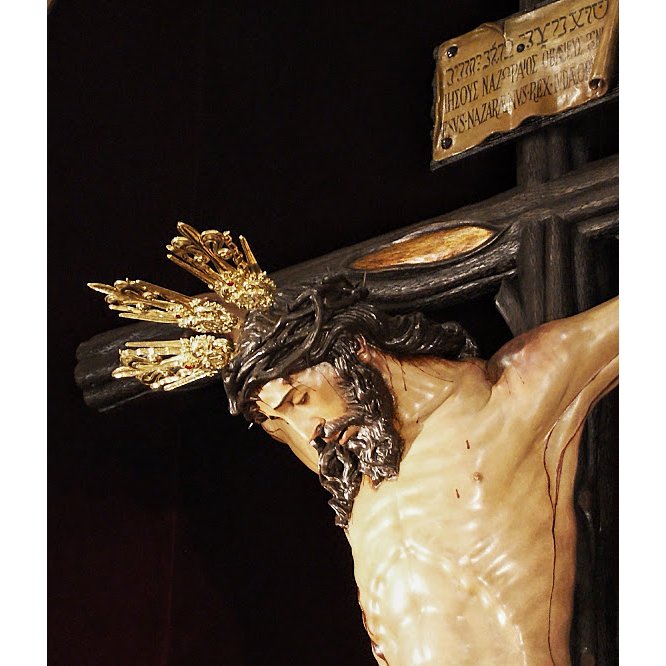
Next to the sacramental chapel, on the epistle wall, a simple arcosolium houses the Most Holy Christ of the Good Death, also the titular of the Hiniesta. It is an imposing crucified figure of 1.76 m. Also made by Castillo Lastrucci in 1938, replacing the original by Felipe de Ribas that disappeared in the fire.

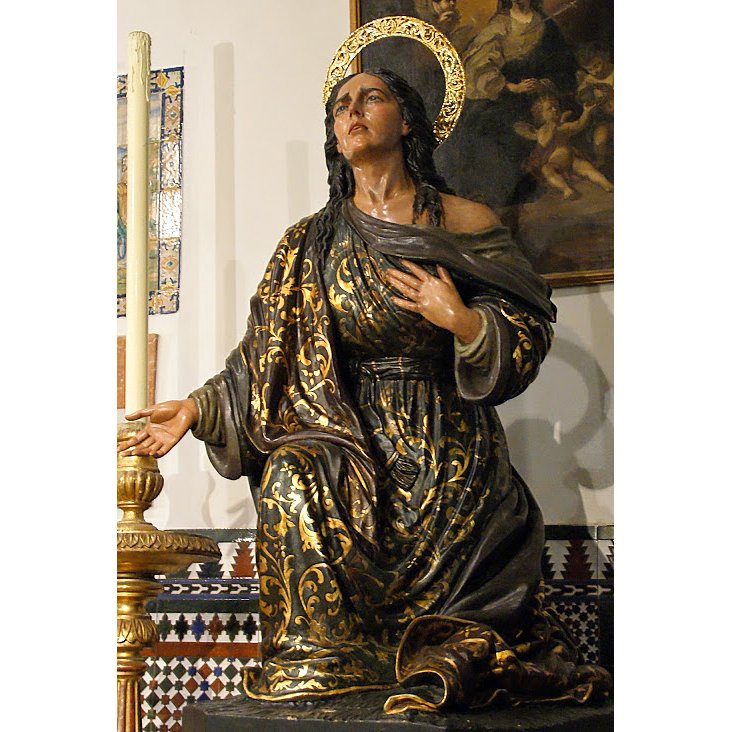
Continuing a little towards the feet, on a pedestal is the sculpture of the Magdalene that Castillo made in 1944 and that accompanies Christ in his procession.

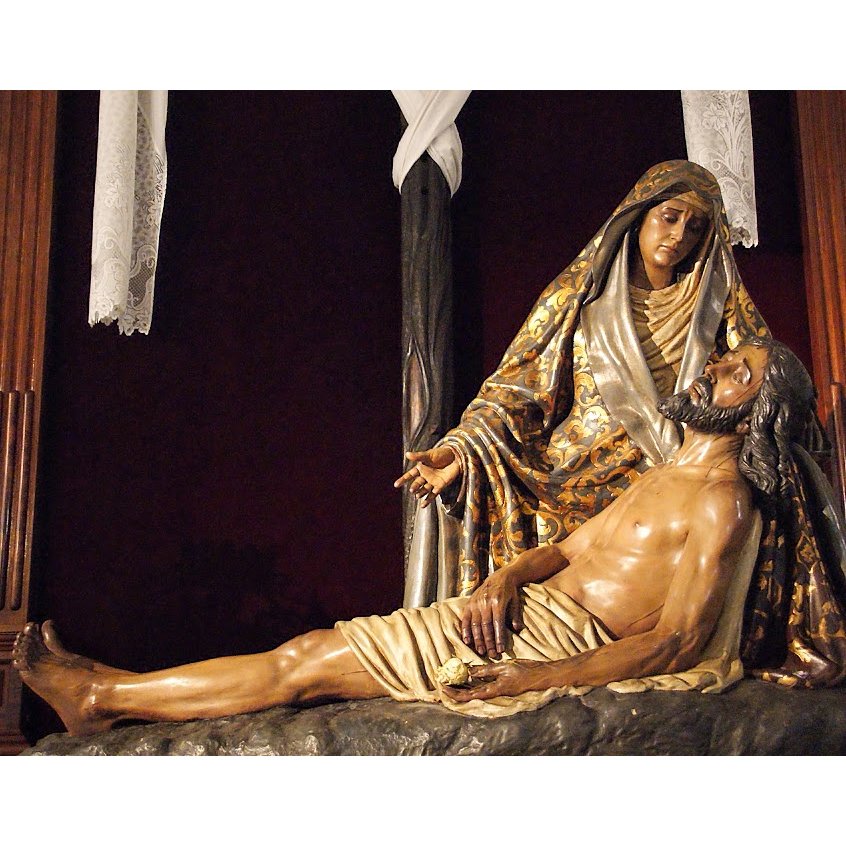
This sculptor so closely linked to the Brotherhood is buried precisely in this church. We find his funerary monument in this same nave of the Epistle. Above it is the sculptural group of the Pietà, which the sculptor made in 1949. On the plaque at the foot of the tomb you can read “Here beneath his most beloved images rests the most illustrious Mr. Antonio Castillo Lastrucci 1882-1967”.


CAPILLA DEL MAYOR DOLOR (VIRGIN OF THE GREATEST PAIN)

The chapel of the Mayor Dolor is a small 18th century temple located in the Plaza de Molviedro, which is why it is sometimes known as the Molviedro chapel. Today it is the headquarters of the Hermandad de Jesús Despojado, which processes on Palm Sunday.

The area where the chapel is located was known since the Middle Ages as the Laguna or Compás de la Laguna, since it was an unbuilt area within the walled enclosure in which an extension of water of this type was formed. It was also the area where the brothel was historically located, very close to the port, as is usual. This brothel was separated from the rest of the city by a wall, so the area of ​​the Compás was wedged between the city wall and this wall.

Very close to the current chapel there was a more modest hermitage, where a brotherhood dedicated to the Holy Cross and Our Lady of the Greatest Sorrow was based. The wrought iron cross on a marble column that is now in the square recalls the location of this primitive hermitage.

The chapel that has survived to this day was built in the second half of the 18th century, within the framework of the general urbanisation that took place in this area of ​​the city. Manuel Prudencio de Molviedro, a merchant from Viana settled in Seville, took over a large part of the neighbourhood and began its redevelopment during the mandate of Pablo de Olavide (1767-1776). Within this transformation, Manuel Prudencio promoted and financed the construction of the chapel, which would be consecrated in 1779. Since 1856 the old Plaza del Compás de la Laguna was renamed Plaza de Molviedro in honour of this Navarrese benefactor.

In 1956, the chapel was ceded to the Congregation of the Claretians, who in turn ceded it to the Brotherhood of Jesús Despojado in 1982.


Outside

The chapel has a rectangular floor plan with a single nave. It only has one façade on the outside, the one at the foot, which opens onto the square. It is very simple in composition. A large lintelled opening, framed by pilasters and covered by a split triangular pediment. In the centre of the pediment there is a second body, this time topped by a curved pediment, framing a window. In the upper part of the façade there is a simple but elegant belfry, with a single bell and also topped by a curved pediment. On both sides of the façade there are ceramic altarpieces dedicated to Jesús Despojado and to the Virgen de los Dolores y Misericordia, the titulars of the brotherhood that has its headquarters in the chapel. They were made in 2007 in the ceramic workshop of José Jaén in Mairena del Alcor.


Inside

The interior is divided into two sections by pillars: the presbytery and the nave itself, each covered by vaulted ceilings. The altarpiece is the original Baroque from the second half of the 18th century. Today it is presided over by the image of Jesus Stripped of his Garments, carved by Antonio Perea Sánchez in 1939.

It happens that it was made in the provincial prison of Seville, since the sculptor was in prison, accused of having helped the resistance when Franco's troops took Seville in 1936. The sculpture was reworked in 1974 by Antonio Eslava Rubio, who completely remade the body, keeping the head.

In the niche on the left, the image of the Virgin of Sorrows and Mercy is worshipped, made in 1962 also by Eslava Rubio. To the right is the image of Saint John the Evangelist made by Juan González Ventura in 1981. This carving accompanies that of the Virgin on her palanquin during her processional exit every Palm Sunday.

In the centre of the second body of the altarpiece there is a sculptural group with Saint Anne teaching the young Virgin to read. To the right is Saint Basilisca (identified by José Gestoso as Saint Gertrude) and to the left we find Saint Michael. All of them are anonymous carvings made in the 18th century, forming part of the original sculptural decoration of the altarpiece.

The image that presides over the small altarpiece located on the right wall of the nave is from the same century. It is Our Lady of the Greatest Sorrow, the titular image of the temple. It is also an anonymous sculpture that represents the Virgin kneeling at the foot of the Cross.

On the walls, the images of Saint Joseph with the Child, Saint Ferdinand and Saint Genoveva Torres are worshipped, as well as two canvases with copies by Murillo, one with the "Holy Family" and another with "Saint Anthony and the Child".