IBN SAHL AL-ISRA'ILI
(c. 1206 - c. 1246)
Also known as Ibn Sahl of Seville, he was a Sevillian poet of Jewish origin, greatly admired in his time and today one of the most outstanding figures of Andalusian poetry.
Apparently his entire family converted to Islam, probably as a result of the religious zeal of the Almohads, who controlled Al Andalus from the mid-12th century. Traditionally, it has been doubted whether it was a sincere conversion and doubts about his authentic faith have been constant in studies of his figure and his work.
Whatever the case, it is clear that Ibn Sahl went to Islamic school and studied with the best Muslim teachers of his time, achieving a complete mastery of Arabic grammar and literature, as well as the Koran and the tradition of the Prophet.
From his youth, the Sevillian poet showed his predilection for male company and many of his poems make clear his homosexual inclinations. In his earlier years, he was inseparable from his fellow student Abū l-Ḥasan Ibn Sa‛īd and in many of his poems he will show his passion for various boys, especially for a young Jewish man named Mūsà, to whom Sahl will dedicate a third of his literary work.
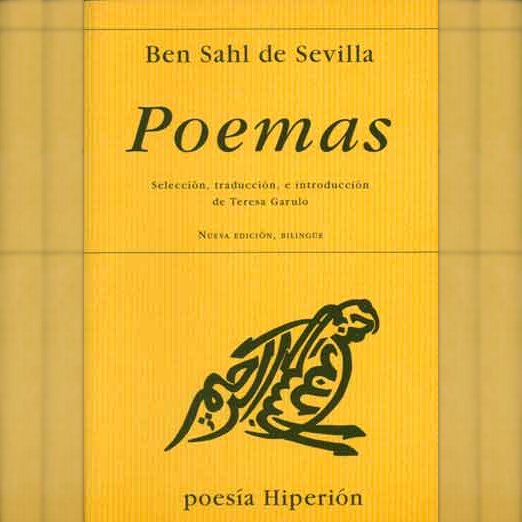
Antología de la obra de Ibn Sahl al-Isra'ili, publicada bajo el título "Ben Sahl de Sevilla. Poemas". Selección, traducción y edición de Teresa Garulo (Hiperión, 1984)
He began to devote himself professionally to poetry at the age of 23 and went to Menorca, where he was part of the literary court of its governor, Sa‛īd b. Ḥakam. After some time, he returned to Seville, where he worked as secretary of the administration in Seville. However, around 1237 he was called by the governor of Ceuta Ibn Jallas to serve as his minister. In this city he surrounded himself with poets, scholars and writers.
In Ceuta, a new boy, this time a Muslim called Muhammad, became the object of Sahl's passions, replacing the Hebrew Mūsà. Some authors have pointed out that both boys could be allegorical representations of Islam and Judaism.
The governor of Ceuta named his son ambassador to Tunisia and sent him to this city with a delegation that included our poet. The ship they were travelling on was shipwrecked and Ibn Sahal lost his life when he was about 40 years old (c. 1247).
His poetic work is among the most important in the history of Al-Andalus. He wrote mainly love poems, although there are also other laudatory or descriptive compositions. He had a sweet and delicate character, as well as a great command of linguistic resources. His fame was such that some of his verses became authentic Andalusian proverbs.