The church of San Bartolomé sits on one of the places in the city where successive worship as a mosque, synagogue and Christian temple has been confirmed throughout history. A mosque was originally located there, which was converted into a synagogue when the Jewish quarter of Seville was created by order of Alfonso X in the second half of the 13th century.
After the pogrom of 1391, the synagogue located here was the only one that survived, since those located in Santa María la Blanca and in the current Plaza de Santa Cruz became Christian churches.
When the expulsion of the Jews was decreed in 1492, this synagogue suffered the same fate and the parish of Saint Bartholomew was moved here from a nearby location that we do not know exactly.
The primitive building was used as a Christian temple for several centuries, until in 1779, given its ruinous state, it was decided to demolish it and build the temple that has survived to this day. Therefore, unlike what happens in Santa María la Blanca, nothing remains in the current church of San Bartolomé of the synagogue that occupied this same place.
The works extended until the first years of the 19th century and were directed by José Echamorro, municipal architect of the Seville city council. It is a neoclassical style temple, with a Latin cross plan, three naves and chapels and side rooms.
The main access to the church is through the left side, through a simple neoclassical doorway, with Tuscan pilasters supporting an entablature, with a frieze of metopes and triglyphs and a straight triangular pediment. Just on the other side of the temple, on the epistle side, there is another doorway very similar to the main one in the structure but made of brick.
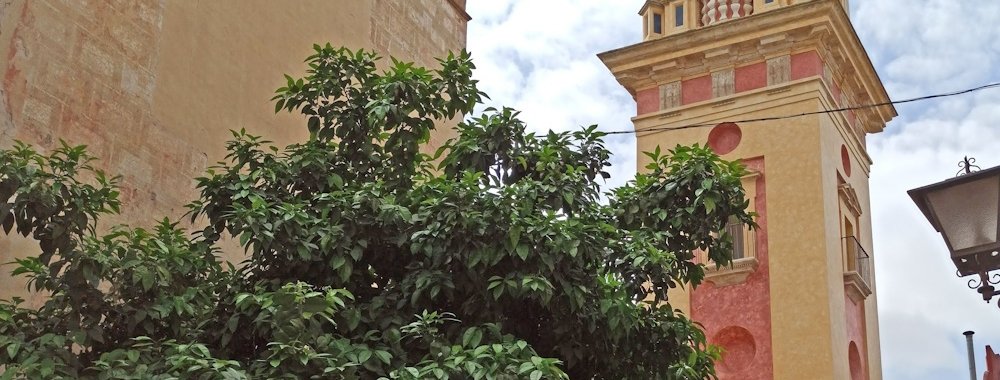
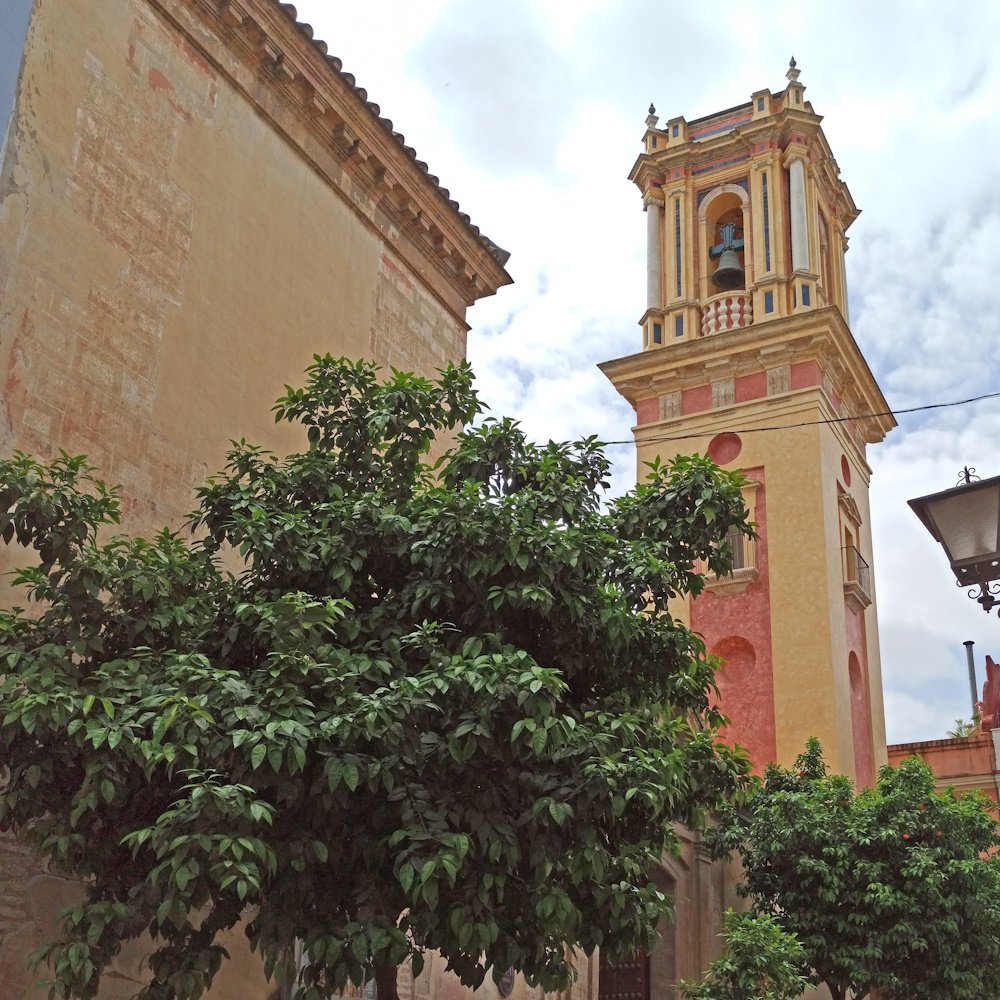
At the foot of the left side is the slender bell tower. Divided into two bodies, its elements also denote its neoclassical character, perhaps masked by its albero and almagra colors, so characteristic of Sevillian architecture. The body of bells is closed by four Ionic columns in the corners. It so happens that this level of the tower is exactly the same in design as what we can find in the towers of San Ildefonso, a temple that was built around the same time as that of San Bartolomé and under the direction of the same architect.
When looking at the tower, it is obvious that some type of finishing is missing from the top. Indeed, it was originally covered by a small dome with a countercurved profile, which collapsed twice. In the last restoration of the tower, its restitution was considered but was finally discarded for technical reasons.
Already inside the temple, the neoclassical air is emphasized by the absence of decoration and the white color of the walls and vaults. The wide naves are separated by arches on pillars. The central nave, notably higher, is covered with a barrel vault with lunettes, which allow the temple to be illuminated through the windows that open at its height. For their part, the side naves are covered by groin vaults.
At the foot of the temple is the high choir with its organ, arranged on a large lowered semicircular arch.
Above the transept, the large gallon dome stands out, with an octagonal drum in which four windows open that contribute to the feeling of clarity of the temple. The dome sits on pendentives, on which four Doctors of the Church are represented: Saint Ambrose, Saint Jerome, Saint Augustine and Saint Gregory.
The main altarpiece is neoclassical in style and dates back to the beginning of the 19th century. It is presided over by an image of Saint Bartholomew, owner of the temple, accompanied on both sides by Saint John Nepomuceno and Saint Cayetano. These are baroque carvings by an anonymous author, dating from the 17th century and therefore prior to the altarpiece. From the same period is the image of the Virgin with the Child that is located in the small temple above the Tabernacle. In the attic there is a theatrical representation of the Trinity flanked by angels.
To the left of the presbytery, at the head of the gospel nave, is the Chapel of the Virgin of Joy, with an attractive neoclassical silver altar. The image of the Virgin that presides over it has a legend that dates back its origins to no less than the 2nd century, although the truth is that it has been attributed to the 16th century sculptor Roque Balduque. It was profoundly remodeled in the 18th century and currently has great devotion among the neighborhood's residents. Flanking her on the altar are nineteenth-century sculptures of her parents, Saint Joachim and Saint Anne.
On the other side of the presbytery, at the head of the epistle nave, is the Sacramental Chapel, closed by an interesting wrought iron grille in which the gilded figures stand out. It is from the 17th century and therefore predates the church. The chapel has an altarpiece from around 1650 that, very unusual in Seville, is ungilded, showing the dark color of its wood. The "Piedad" style that we find in the center is also unusual in Seville. It is by an anonymous author and has been dated to the 16th century, although it is clearly influenced in style by Gothic models from northern Europe.
Accompanying her on the altarpiece are sculptures from the 17th century that represent Saint Francis of Assisi, Saint Ignatius of Loyola, Saint John of the Cross and Saint Anthony of Padua.
Among the remaining altarpieces of the church, the Cristo de las Ánimas stands out, on the right side. It is an altarpiece dated around 1740 structured with stipes, a very characteristic element of 18th century Sevillian altarpieces. The Crucified who presides is a moving and high-quality work that represents Christ already dead on the Cross. It was made at the end of the 16th century by Fernando de Uceda.
At its feet we find a Dolorosa made by Cristóbal Ramos in 1772. Apparently, it was originally conceived to be kneeling, until in the 19th century Juan de Astorga reformed it to its current position. Traditionally, the resemblance of this image to the Virgen de la Estrella (Virgin of the Star) of Triana has been highlighted, despite the fact that the Triana image is from a century earlier. This circumstance has caused it to sometimes be affectionately called the "Little Star" (Estrellita) of San Bartolomé.