The church of San Isidoro is one of the medieval parishes of Seville. Several authors much later than its foundation say that it was built on the site that would have been occupied by the family house of San Isidoro during the Visigothic period. Naturally, absolutely nothing could be verified about these statements.

History
We do know that its construction must have begun in the first third of the 14th century, since the cover on the Epistle side is closely linked to that on the side of the Gospel of Saint Anne of Triana, for which the chronology is documented. In this way, both would be among the oldest churches in the city. Furthermore, the urban area in which it is located is the highest with respect to the river and, therefore, the one with the oldest settlement. The forum of Roman Hispalis has traditionally been located in its vicinity, although it is true that without any archaeological basis.
Since the Christian conquest, wealthy families from the city settled in this area and merchants of the most diverse origins settled there from the 16th century onwards. In this way, San Isidoro will be a "rich" parish and this has an inevitable reflection in the architecture and ornament of the temple.
The original 14th century building was notably altered between the 16th and 17th centuries, mainly in the presbytery area. Also in the 18th century, reforms were undertaken, such as the construction of the chapels on the left side.
As it has come down to us, San Isidoro is a rectangular church with three naves, a transept, a choir at the foot and side chapels, which are different in size, style and layout.
Outside
On the outside, the temple has three doors. The one located at the foot is very simple, in the Mudejar style. It consists of a slightly pointed arch framed by an alfiz. Apparently, the arch was initially horseshoe-shaped and was "simplified" to adopt its current appearance sometime between the 16th and 18th centuries.
The door that opens to the left side is the most recent, added in the 18th century in a neoclassical style. It is lintel, with two pilasters supporting a simple entablature. Next to it, we find the most ornamentally rich façade fragment in this church. This is the exterior part of the sacramental chapel, added as we said in the 18th century, which in some way functions as a separate façade. It is made of exposed brick, with a baroque style with very classic lines, and stands out for its reddish color, different from the rest of the temple. It is topped by a triangular pediment and in the center of the wall there is a lobed medallion with an allegorical scene of the “Adoration of the Holy Sacrament”.
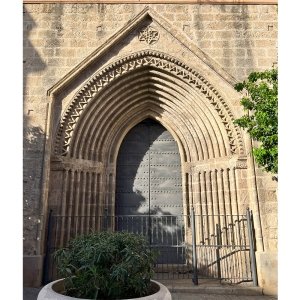
Right at the other end, on the Epistle side, the other door opens, dated to the 14th century. It presents the classic forms of the Sevillian Gothic-Mudejar doorways. It consists of a pointed arch with archivolts, the two outermost ones at the top being decorated with geometric motifs: one with saw teeth and the other with diamond points. It is framed by a double alfiz, the first triangular and a larger square one.
At the apex of the triangular alfiz we find a sculpted star of David or Solomon, historically linked to the Hebrew religion. It is the only church in Seville in which we can see this element, which has been the subject of the most diverse interpretations. However, the truth is that this six-pointed star is a symbol that appears quite frequently in medieval religious buildings, apparently as an element of protection. In an article about this cover, Rafael Cómez tells us that "with a talismanic meaning and a spell against the forces of evil, the six-pointed star, inscribed in a circle, must have been made, which is shown to us on the cover of the nave of the Epistle. ".
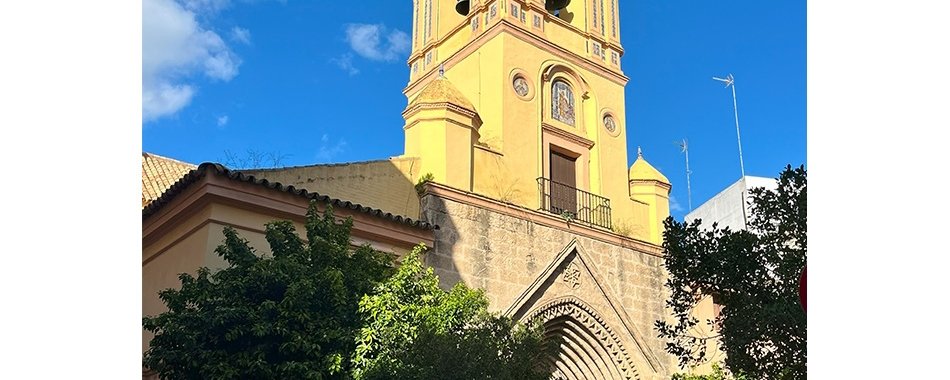
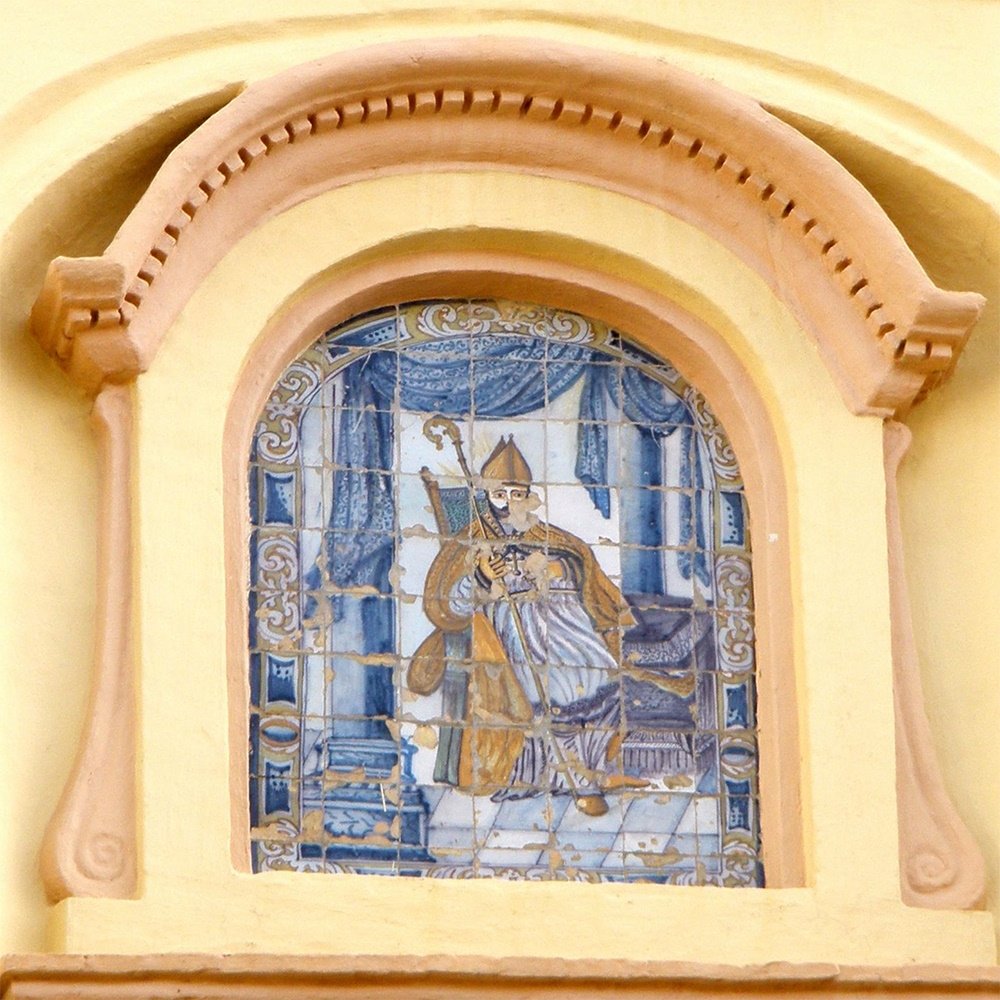
Above this door, a bell tower was built much later, and already in the Baroque style, which preserves the 18th century tiles depicting Saint Isidore and Saint Leandro.
Inside
Inside, the naves are divided by pointed brick arches that rest on cruciform pillars. The roofs are wooden coffered ceilings in the Mudejar style, with the central trough shaped and the side ones hanging. As an exception, the transept is covered with a hemispherical dome on pendentives in its center and with barrel vaults on each of its sides.
The main altarpiece is mainly made up of an excellent canvas that represents the "Transit of San Isidoro", a work by Juan de Roelas from 1613. The frame-altarpiece that houses it is later; It was made around 1752 by Felipe del Castillo. The paintings in the vaults date from the mid-18th century and have been related to the work of Juan de Espinal. They represent fake architectures in which San Fernando and San Hermenegildo are framed.
To the left of the main chapel, at the head of the Gospel nave, is the Maestres chapel, which has an interesting tiled plinth original from the 17th century. A 19th-century neoclassical altarpiece houses the image of the Christ of the Blood, a moving Gothic carving from the mid-14th century. It is the oldest Crucified of those preserved in Seville, comparable only to the Christ of the Million in the Cathedral.
Just on the other side of the main altar, at the head of the Epistle nave, is the Villampando chapel, from the beginning of the 17th century, the date in which the tile plinths and the grille that closes it were made. It is presided over by a baroque altarpiece dedicated to Saint Albert.
On the wall of this same nave there is another baroque altarpiece, this time from the mid-18th century. In its center, an image of Saint Joseph from the same period, the work of José Montes de Oca.
On this right side the church has a single chapel, dedicated to the Virgin of Health. It is the most clearly Mudejar style. It has a hemispherical vault, decorated with geometric motifs and set on squinches. The image of the Virgin has been dated to the beginning of the 16th century, with a transitional style between Gothic and Renaissance. She is full size, although she is generally presented dressed in the baroque style.
On the other side of the church, in the Gospel nave, next to the entrance is the Chapel of Our Father Jesus of the Three Falls, the titular image of the brotherhood based in this church that processions every Good Friday. The Christ is a carving by Alonso Martínez from around 1667. The Virgin of Loreto is the image that accompanies him in this chapel and on his processional exit. It is an anonymous dressing room from the 18th century, although deeply renovated by Sebastián Santos in the mid-20th century. Although it is not found in this chapel, the brotherhood has another image of great value. This is the Cyrenean who helps Jesus with the cross on his path. It is a magnificent carving from 1687 by Francisco Antonio Gijón, an illustrious name in the history of Sevillian art, forever linked to the overwhelming "Puppy" of Triana. The Cirineo of San Isidoro is considered one of the best "secondary" carvings of Holy Week in the city and is generally located in the Epistle nave, close to the entrance.
The most prominent chapel of the church, and one of the most notable in the Sevillian baroque, is the sacramental chapel. It has its origins in the 16th century, the date on which the gate that closes it is dated, although as it has come down to us it is a work from the 18th century.
Above the access to the chapel there is a canvas with the "Allegory of the Eucharist", an interesting work attributed to Lucas Valdés. Once inside, the walls are covered with a series of canvases, mainly with themes related to the Eucharist, such as "The Transfer of the Ark of the Covenant" or "The Delivery of the Propitiation Bread", works also linked to the style by Lucas Valdes.
The cornices and upper part of the walls have a profuse decoration of plasterwork, which reproduces plant and architectural motifs, such as Solomonic columns.
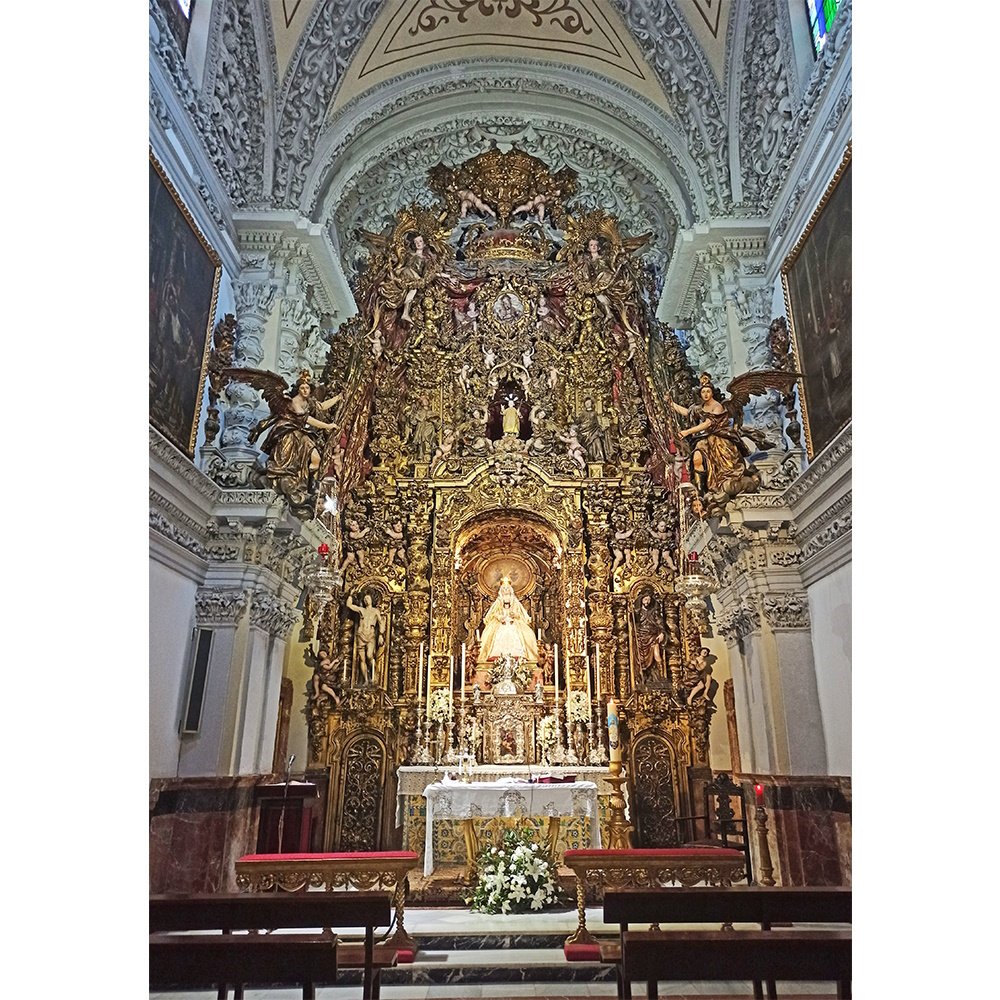
But the element that attracts most attention in the chapel is its spectacular altarpiece, one of the most exuberant examples of Sevillian altarpieces. It is a work by Jerónimo Balbás and Pedro Duque Cornejo, made at the beginning of the 18th century by order of Juan Bautista Melcampo, a merchant of Flemish origin buried in the same chapel. The decorative profusion is such that it is difficult to distinguish the architectural structure. Countless child and youth angels intermingle with vegetal motifs, garlands, stipes and Solomonic columns in a motley and dazzling ensemble.
In the central niche, the Virgin of the Snows is venerated, a seated image that reproduces the scheme of the "Fernandine" Virgins, such as that of the Kings of the Cathedral or that of the Waters of El Salvador. However, it seems that that of San Isidoro is later, at least from the 16th century. On both sides are San Sebastián and San Roque.
In the center of the second body of the altarpiece there is a Child Jesus with the style of Juan Martínez Montañés. On his sides, Saint Thomas Aquinas and Saint Ignatius of Loyola, and above him the figure of God the Father appears from a medallion in an attitude of blessing.
-
- Portada lateral

-

- Detalle exterior
-
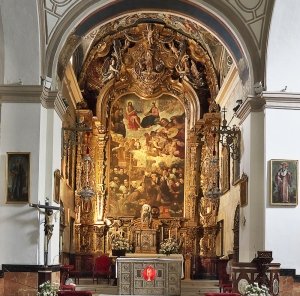
- Retablo mayor

-

- Capilla Sacramental