The church of San Julián is a Gothic-Mudejar temple, built mostly in the 14th century, although with important subsequent modifications. It is the headquarters of the Brotherhood of the Hiniesta, which takes part in the procession on Palm Sunday.
It has a rectangular floor plan and three naves, separated by pointed arches resting on pillars. The polygonal head, where the presbytery is located, stands out from the floor plan.
As it has survived to this day, the church is the result of a reconstruction carried out in the mid-20th century, as it was almost completely destroyed in a deliberate fire in 1932. At the end of that same century, the temple was completely restored to replace its roofs, which were in a ruinous state.
History
The church is one of the parish churches of the group of Gothic-Mudejar churches in Seville, built mainly in the northern area of the historic centre between the 13th and 15th centuries. They all share a very similar structure and style and form a typological ensemble of extraordinary interest and beauty.
In the case of San Julián, it is known that it was built in the first half of the 14th century, dedicated to this saint who suffered martyrdom at the beginning of the 4th century together with his wife Basilisca, probably in Antinóopolis (Egypt).
The temple has undergone important modifications throughout its history. In the 17th century, the bell tower and the chapel on the left side occupied by the Brotherhood of the Hiniesta were added. The most complicated moments occurred in April 1932, when the church suffered an intentional fire that almost completely destroyed it. All its roofs and most of its movable heritage were lost, including the titular images of the Brotherhood. In 1989 it had to be closed again until 1994, given the poor condition of its roofs.
Outside
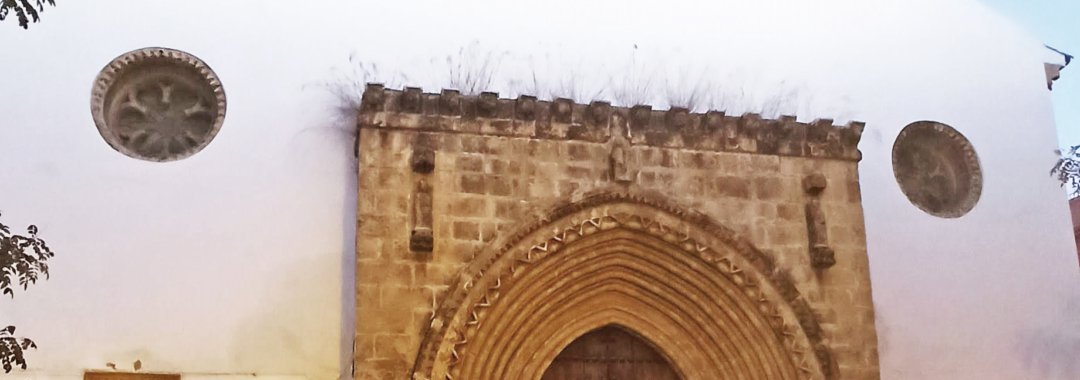
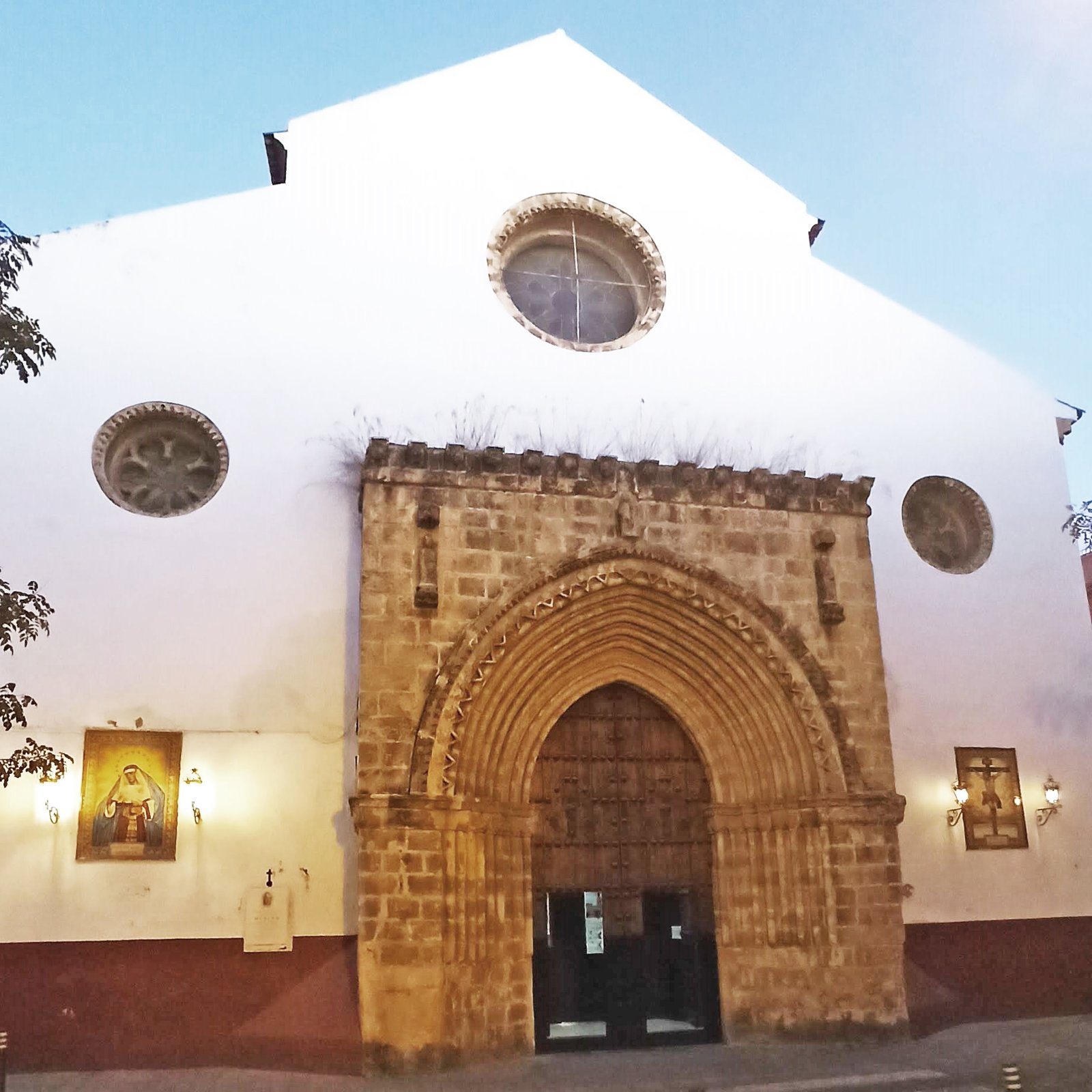
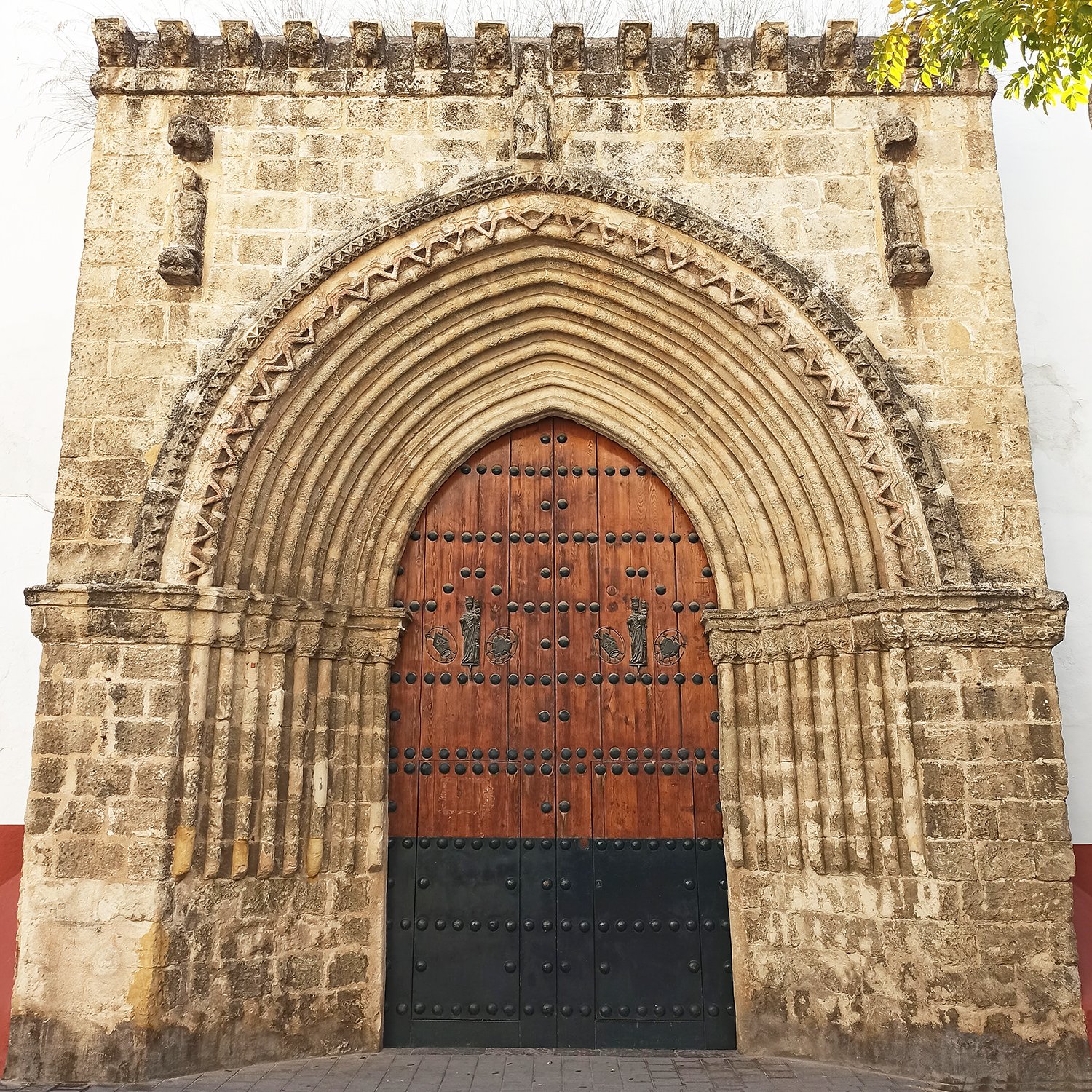
San Julián has two exterior doors, one at the foot and another on the left side, although the second is unfinished and has survived to this day flanked by a brick structure that was to serve as support for a door that was never built. The main door is at the foot and has the classic ogival, flared shape, framed by an alfiz that stands out from the rest of the façade. It has very simple and somewhat rough sculptural decoration, although the high degree of erosion of the stone makes it difficult to assess its original appearance. The arch is decorated on the outside by a moulding with zigzag motifs and another with diamond points. The capitals of the small columns on both sides have plant decoration of vine leaves, which continues outwards under the impost line. Around the entrance arch there are three small sculptures under Gothic canopies. According to art historian Rafael Cómez, the one at the top represents Christ as a judge, the one on the left represents Saint Julian the Bishop and the one on the right represents Saint Julian the Hospitaller. Confusions between saints have been common throughout history and elements of different saints have often been attributed to others with the same name or their characteristics have been different depending on the territory. (Rafael Cómez Ramos, "Iconología de la arquitectura religiosa bajomedieval en Sevilla: la iglesia de San Julián").
At the top there are a series of modillions decorated with lion heads, between which there are a series of horseshoe arches engraved in the stone. The lions symbolised, among other things, royal authority, and we find them in other Sevillian doorways from the same period, such as in San Esteban or in Santa Ana de Triana.
Above the doorway there are three oculi with diamond-shaped moulding, one larger at the top and two, somewhat smaller, one on each side.
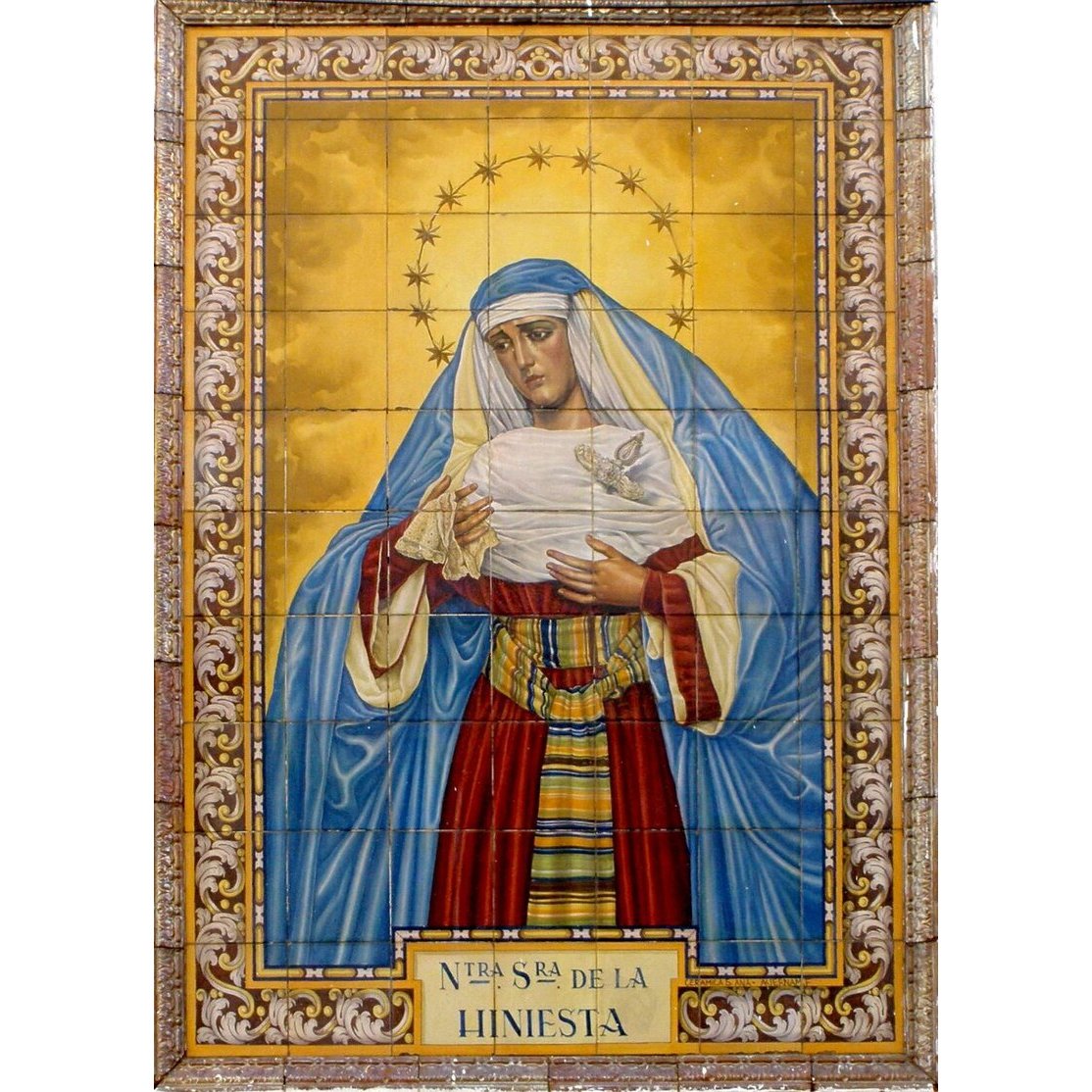
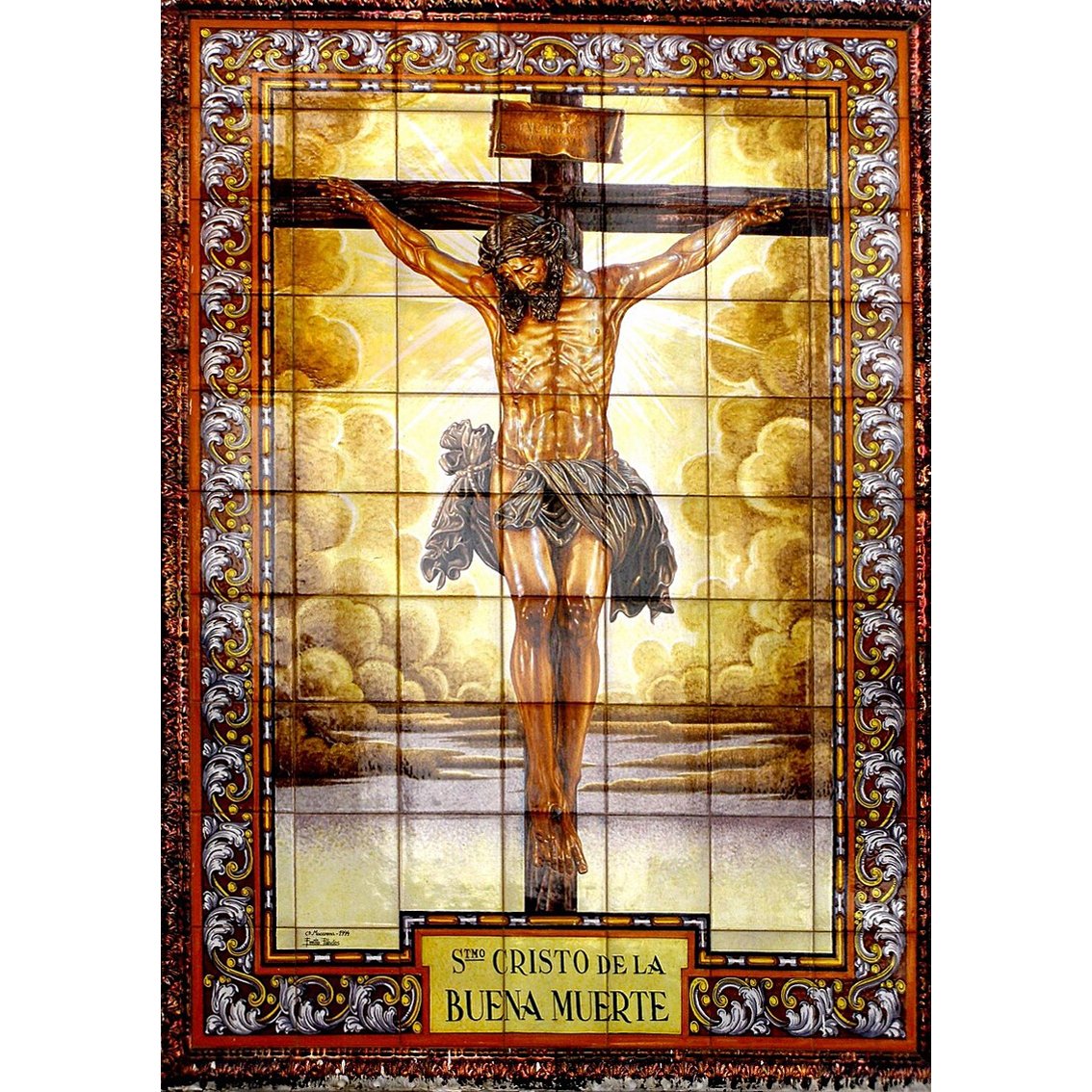
The decoration of this façade is completed by two ceramic altarpieces dedicated to the titulars of the Hermandad de la Hiniesta, which are located on both sides of the doorway. On the left is the one of the Virgin, made by Antonio Kierman Flores in the Santa Ana factory in 1962. On the right we find the Christ of the Good Death and it was made in 1994 by Emilio Sánchez Palacios in his family workshop, Cerámica Macarena.
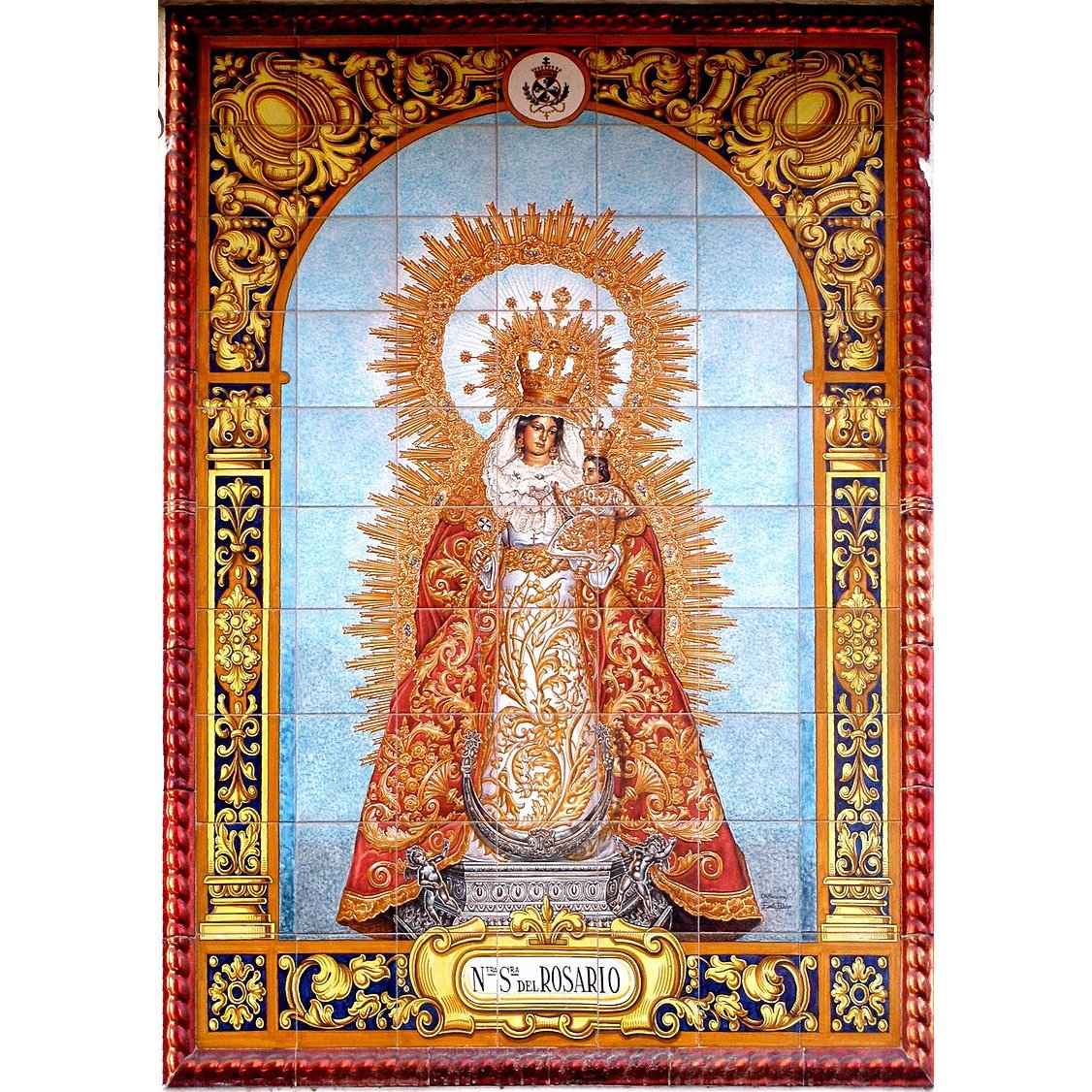
On the right-hand side, facing Duque Cornejo Street, we find another ceramic altarpiece with the same authorship and date as that of Christ. On this occasion it is dedicated to the Virgin of the Rosary, the titular of her own brotherhood, also based in this temple.
From this same side, the bell tower that stands next to the head of the church is visible. It has a square floor plan, with the body of the bells decorated by simple pilasters, and is topped by a hexagonal spire with ceramic decoration in white and blue.
-
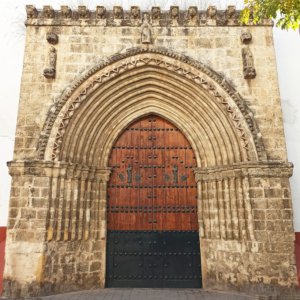
- Portada principal – Main facade
-
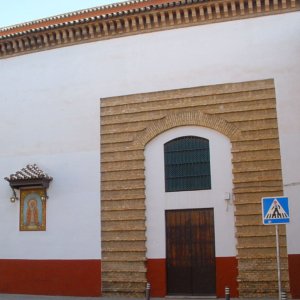
- Fachada lateral – Side facade

-
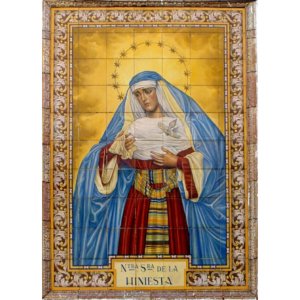
- Virgen de la Hiniesta Dolorosa (Antonio Kierman Flores, 1962)
-
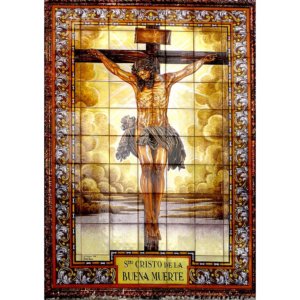
- Cristo de la Buena Muerte (Emilio Sánchez Palacios, 1994)
-
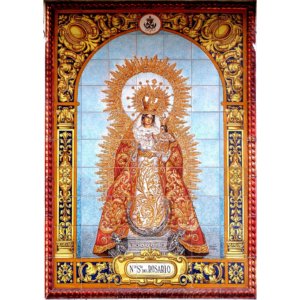
- Virgen del Rosario (Emilio Sánchez Palacios, 1994)
Inside
The interior of the temple today is the result of the reconstructions that had to be carried out during the 20th century, although an attempt was made to recreate the original appearance as far as possible. The naves are covered by 20th century wooden coffered ceilings in the neo-Mudejar style, while the apse is covered by a ribbed vault that follows the Gothic model. This difference in the type of covering between the naves and the presbytery is very common in the Gothic-Mudejar churches of Seville. The walls are covered by tiled plinths with geometric motifs, also following models that come from the Middle Ages.
In the area of the presbytery, the current altarpiece is the result of a reconstruction from fragments of altarpieces from the 17th and 18th centuries. This is because the previous one was lost in the fire of 1932. In the central niche, the image of Our Lady of the Glorious Hiniesta is worshipped, an image made in 1945 by Antonio Castillo Lastrucci to replace the original Gothic one, also destroyed in the fire. This devotion to the Hiniesta has a very interesting origin and is deeply rooted in the city, to the point that it is officially the patron saint of the City Council of Seville. Professor Francisco S. Ros González tells the legend thus:
-
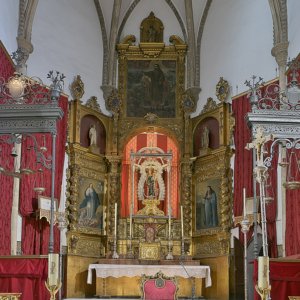
- Presbiterio – Presbytery
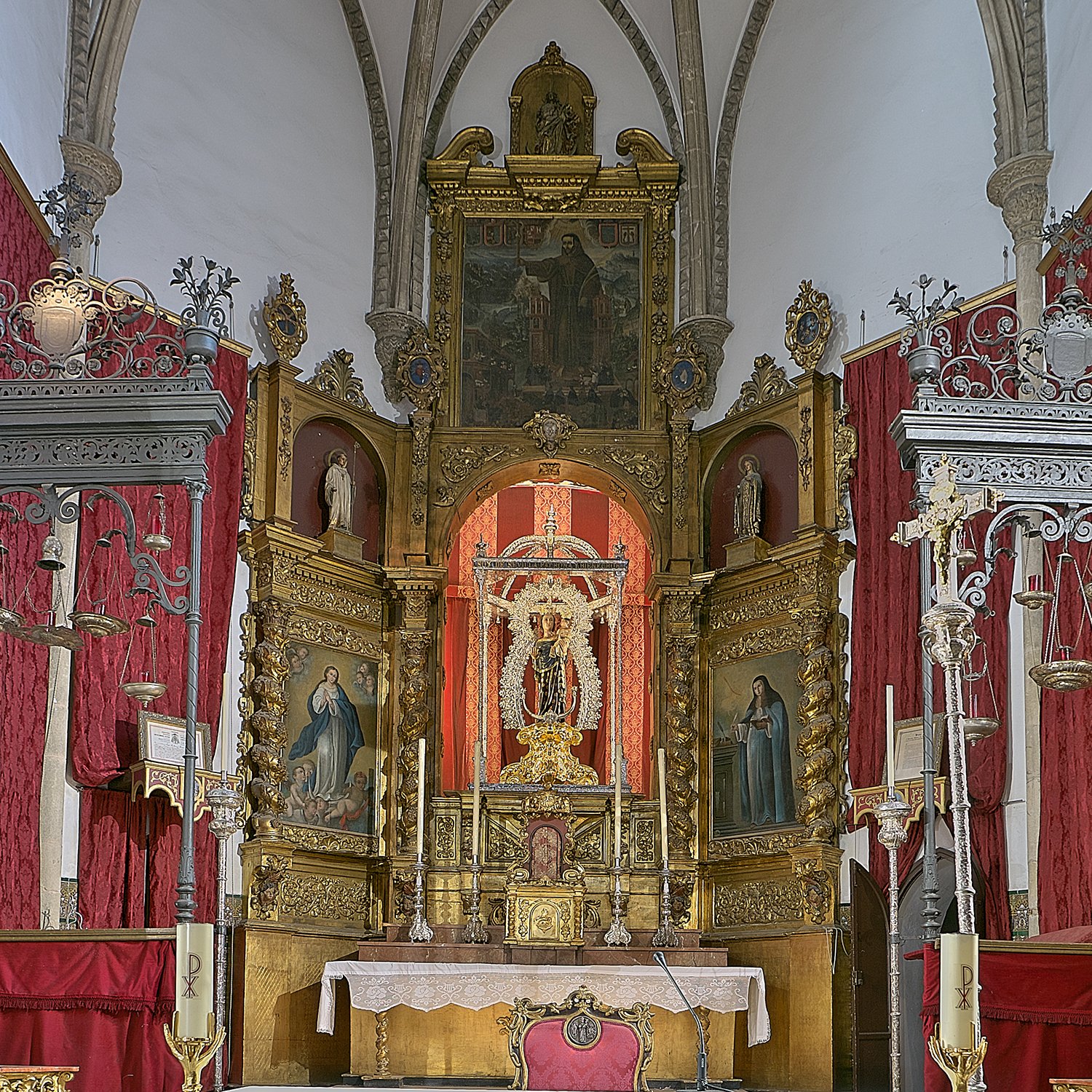
…the Catalan knight, Father Per de Tous, was hunting in the mountains of his land one day at the end of the 14th century when his goshawk became paralysed in front of the gorse bushes where the partridges he was pursuing had taken refuge. Surprised by the bird’s behaviour, the knight dismounted from his horse, looked into the undergrowth and discovered an image of the Virgin with the Child in her arms with an inscription at her feet that, in the Latin version by Ortiz de Zúñiga, read: «Sum Hispalis de sacello ad portam quæ ducit ad Corduvam» («I am from Seville, from a chapel next to the gate that leads to Córdoba»). From the text it was deduced that the image was one of those that had been hidden during the Muslim invasion to prevent its desecration and that it had miraculously been preserved intact through the centuries despite being out in the open. Per de Tous took the image to Seville and placed it in the parish church of San Julián, as it was the temple closest to the door in the city walls leading to Córdoba at that time. The fact that the image of the Virgin was found hidden in some broom bushes led to it being called Santa María de la Hiniesta.
On either side we find two anonymous paintings from the 18th century, the one on the left with the Immaculate Conception and the one on the right with Saint Beatrice de Silva, founder of the Order of the Immaculate Conception. Above the paintings, two niches contain small carvings. The one on the left represents Saint Bernard of Clairvaux, while the one on the right could be Saint Therese of Lisieux. Above the central niche, in the upper part of the altarpiece, we find another anonymous painting from the 18th century with Saint Francis Solano. Above it, a small relief with the Immaculate Conception (17th century).
Also in the area of the presbytery, two curious lampstands from around 1672 stand out. Fortunately they were saved from the fire of 1932 and from them hangs a splendid collection of eight silver lamps from the 16th and 17th centuries.
Left Nave
If we begin to describe the walls of the church at the foot of the left nave, the first thing we find is a carving of Saint Joseph with the Child, an anonymous work from the 18th century. Nearby is a ceramic panel in blue tones with the representation of the Baptism of Christ. It is a recreation of the exceptional canvas with the same theme that Murillo painted for the chapel of San Antonio in the cathedral of Seville. The ceramic altarpiece was made by Rafael Cantanero Mesón at the Mensaque Factory in Triana around 1920.
Continuing towards the apse we find a curious altarpiece - pedestal in neo-baroque style, formed by plant motifs. It houses a beautiful carving of Saint Angela of the Cross, a contemporary work by Ricardo Rivera.
The next altarpiece is also contemporary and is made of gilded plaster. It houses an image of the Virgin of the Miraculous Medal, made by Castillo Lastrucci around 1945.
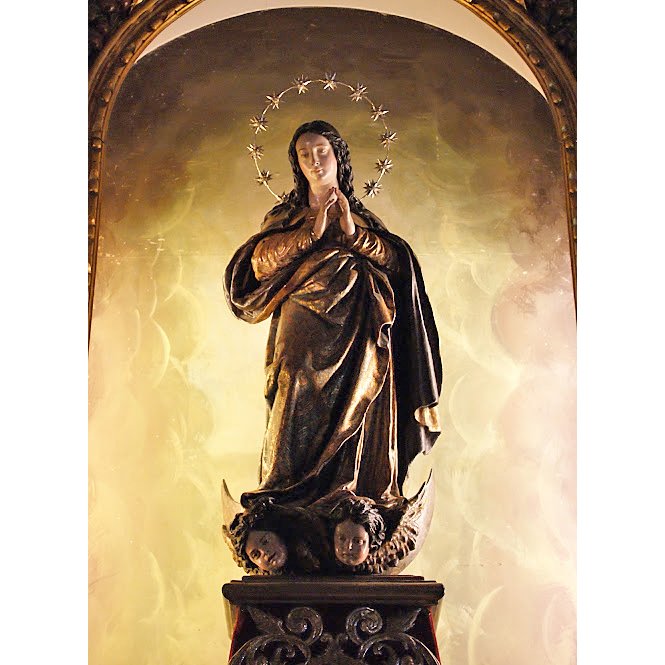
Continuing towards the head, the next altarpiece is also modern and very sober, but it houses one of the great artistic jewels of this temple. It is a carving of the Immaculate Conception, made in the first third of the 17th century and attributed to Alonso Cano. It has notable similarities with works by Martínez Montañés and, in fact, it has sometimes been attributed to him, given its resemblance to sculptures such as the famous "Cieguita" of the cathedral of Seville. Alonso Cano was training with the master Montañés and it is normal that he reproduced his models.
Finally, at the head of the Gospel nave we find a neo-Gothic altarpiece with the dressed image of the Virgin of the Rosary. The image is the title of its own brotherhood of glory and was made in 1937 by José Rodríguez Fernández-Andes.
-
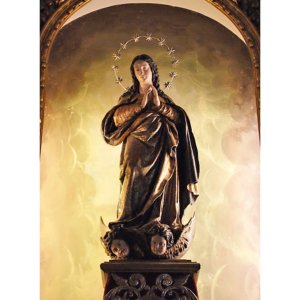
- Inmaculada Concepción. Atribuida a Alonso Cano (primer tercio del XVII)
-
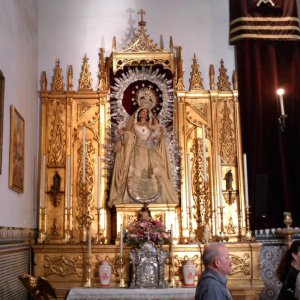
- Retablo de la Virgen del Rosario

Right Nave
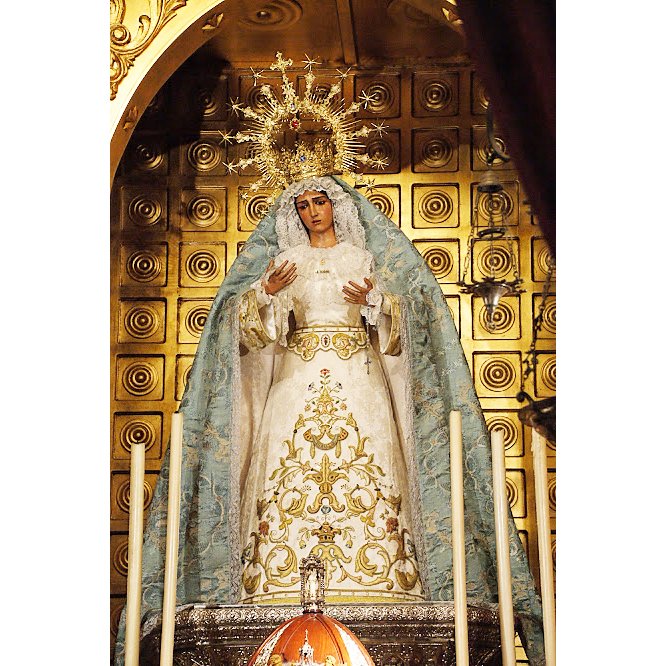
At the head of the right nave is the sacramental chapel, where the image of Our Lady of the Sorrowful Hiniesta, the titular of the Brotherhood of the Hiniesta, is worshipped. It is the third image with this purpose that the Brotherhood has. The first was a baroque Virgin of the Sorrowful from the 17th century, attributed to Martínez Montañés, which was lost in the fire of 1932. To replace it, Castillo Lastrucci made a new Virgin of the Hiniesta, which was destroyed in the fire of San Marcos in 1936, since at that time the Brotherhood was based in this parish. The current one was also made by Castillo in 1937 to replace the missing sculpture that he himself had made.
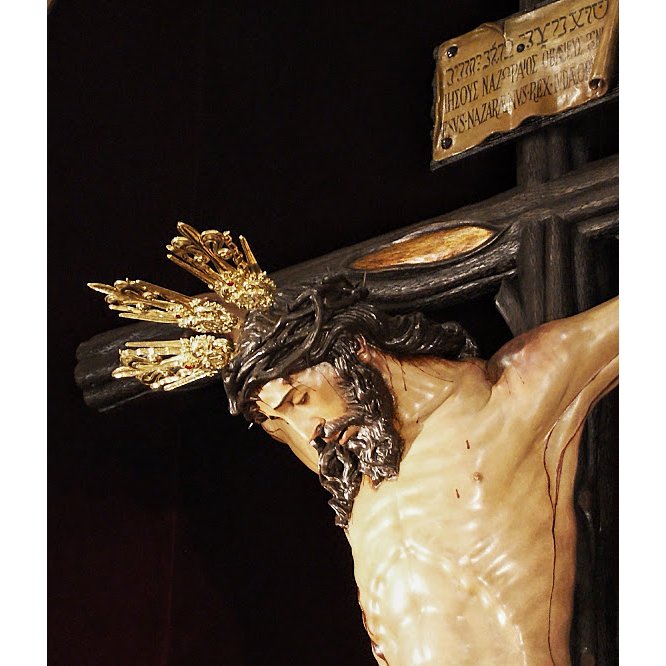
Next to the sacramental chapel, on the epistle wall, a simple arcosolium houses the Most Holy Christ of the Good Death, also the titular of the Hiniesta. It is an imposing crucified figure of 1.76 m. Also made by Castillo Lastrucci in 1938, replacing the original by Felipe de Ribas that disappeared in the fire.
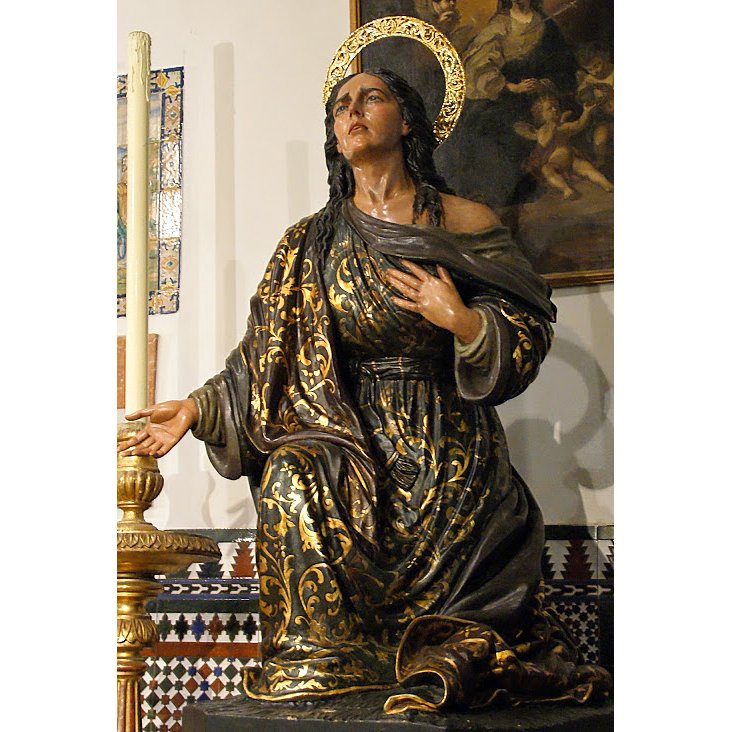
Continuing a little towards the feet, on a pedestal is the sculpture of the Magdalene that Castillo made in 1944 and that accompanies Christ in his procession.
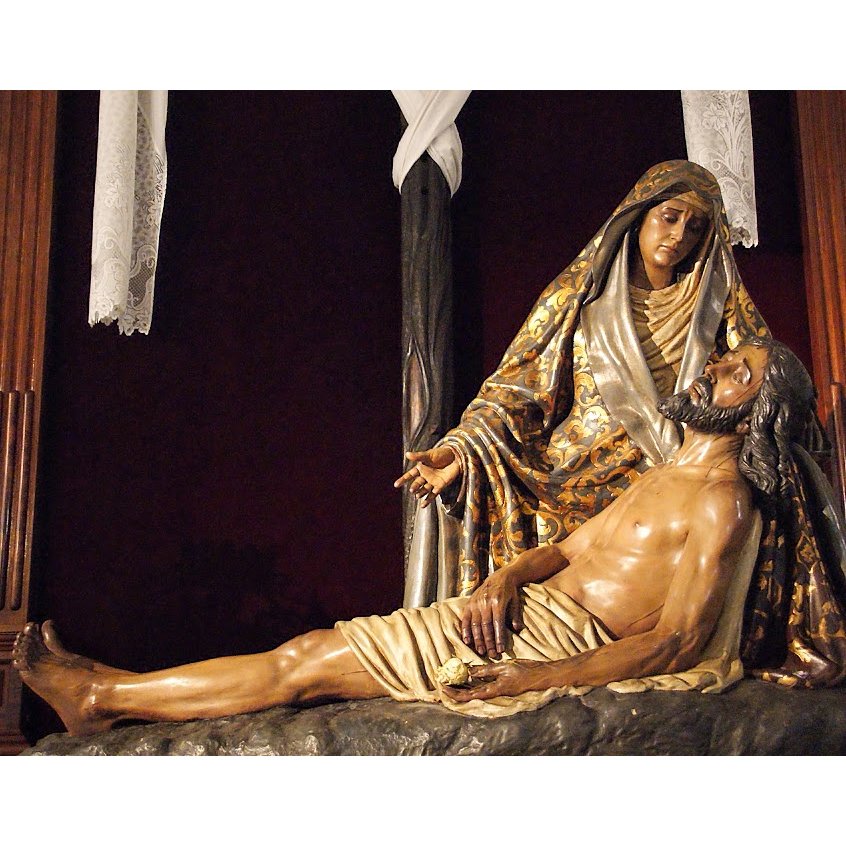
This sculptor so closely linked to the Brotherhood is buried precisely in this church. We find his funerary monument in this same nave of the Epistle. Above it is the sculptural group of the Pietà, which the sculptor made in 1949. On the plaque at the foot of the tomb you can read “Here beneath his most beloved images rests the most illustrious Mr. Antonio Castillo Lastrucci 1882-1967”.
-
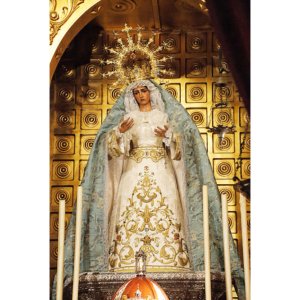
- María Santísima de la Hiniesta Dolorosa (Antonio Castillo Lastrucci, 1937)
-
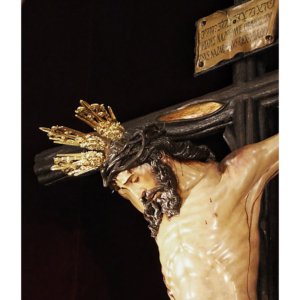
- Santísimo Cristo de la Buena Muerte (Antonio Castillo Lastrucci, 1938)
-
- María Magdalena (Antonio Castillo Lastrucci, 1944)
-
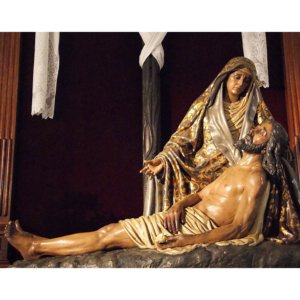
- Piedad (Antonio Castillo Lastrucci, 1949)