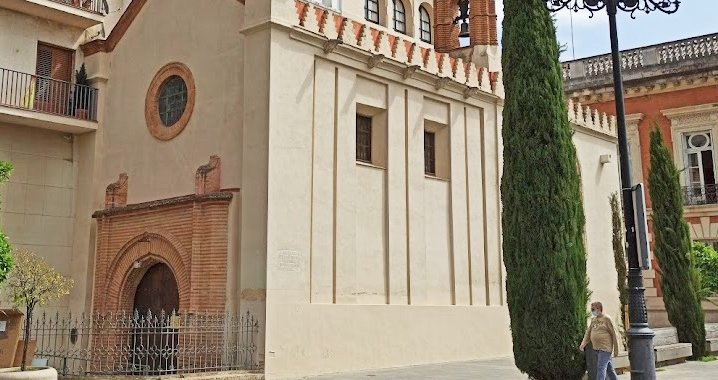
This Puerta de Jerez chapel is the only vestige that remains of the primitive University of Seville, which was founded by Master Rodrigo de Santaella in 1506.
The rest of the buildings of this first university were demolished at the beginning of the 20th century to lay out the current Avenida de la Constitución, within the process of urban remodeling that the city experienced in the years prior to the Ibero-American Exhibition of 1929. The original cover of the The building was dismantled and is currently preserved in the compass of the Santa Clara convent. In the main altarpiece of this chapel you can see a representation of the missing building.

The chapel that has survived to us has a single nave and is stylistically ascribed to late Gothic-Mudejar. It was consecrated in 1506, still unfinished.
On the outside, it has three facades. The rear was renovated in the 20th century and shows a small Mudejar window, made of brick and with a multi-lobed arch. On the side façade there is a beautiful Gothic window with archivolts, plant decoration and tracery in the upper part, forming three oculi. On this same façade there is a marble tombstone that alludes to the foundation in Gothic characters.
At the foot is the main façade, which originally did not face the street but rather an interior patio of the university. It has a simple doorway in the shape of an ogee arch composed of bichrome bricks and framed by an alfiz. Despite its simplicity, it is highly harmonious and stands out for the unusual nature of this type of arch in Sevillian Gothic architecture. On the right side of the chapel, right between the nave and the presbytery, there is a simple belfry, also made of bichrome bricks and topped by stepped battlements.
Inside, the only nave of the church is clearly divided into two areas, differentiated by their coverage. The body of the nave is covered by a wooden cladding, while the presbytery is covered by a Gothic trecelet cross vault. As a transition between both spaces, there is a large central arch, pointed and decorated with cardinas.
Although the temple's original flooring was replaced in the 20th century by the current marble floor, the tile skirting boards on the walls have been preserved, made with beautiful polychrome using the dry rope technique. The front of the altar was made with the same technique, but in this case including golden reflections, a very rare element in ceramic decoration of this type in Seville.
The main altarpiece is a piece of enormous artistic interest, made by the German-born painter Alejo Fernández around 1520. Its structure is clearly Gothic, although his paintings already show a certain Renaissance influence. The theme is linked to the exaltation of wisdom, in relation to the original purpose of the temple as the College chapel.
It is structured from bottom to top in a bench and two bodies. In the center of the bench is the tabernacle, on whose sides there are six tables, three with representations of bishops, an Ecce Homo and an image of the Virgin and Child in the Byzantine style. It is stated that it was brought from Italy by Master Rodrigo himself.
The first body is presided over by a reproduction of the Virgin of Antigua, the original of which is in one of the chapels of the Seville Cathedral. At her feet, Master Rodrigo appears on a smaller scale, giving the Virgin a model that represents the College founded by him. On both sides, the four doctors of the church: Saint Augustine of Hippo, Saint Ambrose, Saint Gregory the Great and Saint Jerome.
In the center of the second body is the representation of "Pentecost". It is in this painting where you can most appreciate the Renaissance influence that we have talked about in the work of Alejo Fernández. Flanking it, from left to right, we see Saint Peter, Saint Gabriel, Saint Michael and Saint Paul.
-
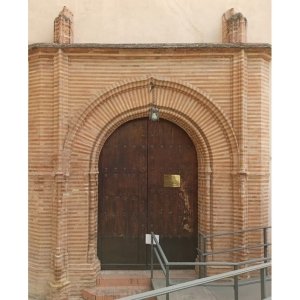
- Main Entrance

-

- Gothic Window

-
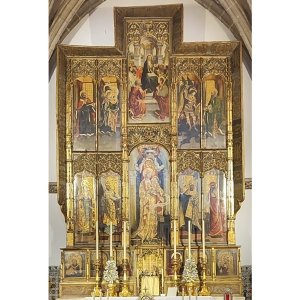
- Main Altarpiece

-
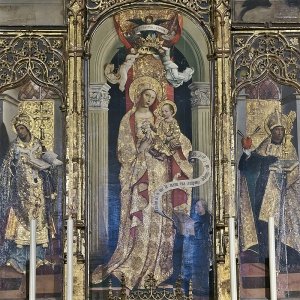
- Virgen de la Antigua