KING’S WOOD WAREHOUSES

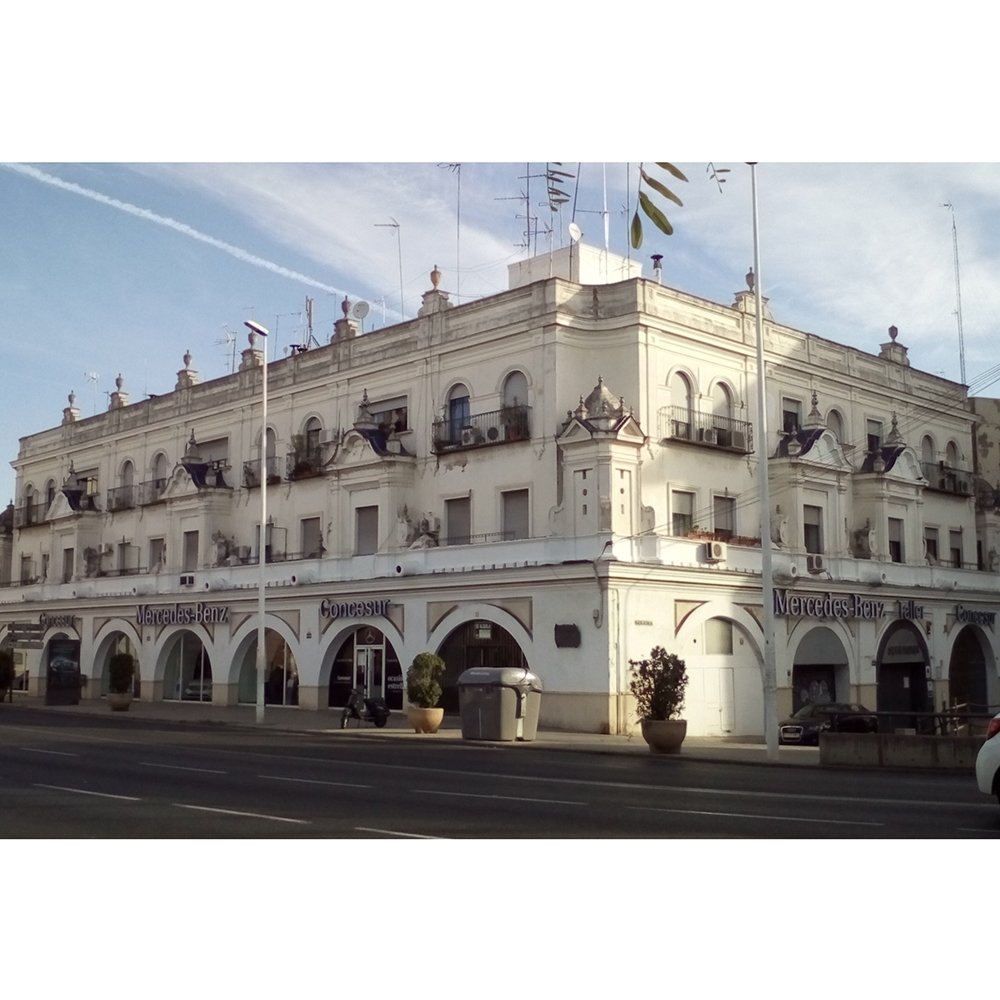
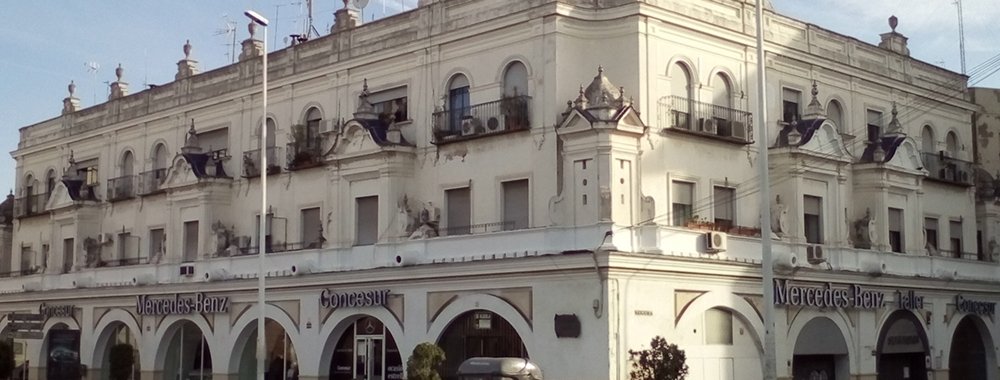
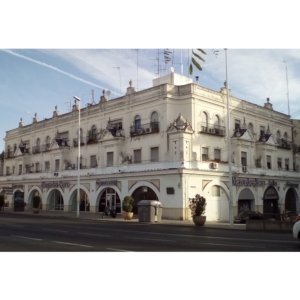
The so-called Almacén del Rey is an old building originally built around 1735. Its purpose was to house the wood that arrived in the city down the Guadalquivir from the Sierra del Segura (Jaén). Its current appearance is far from the original, since between 1950 and 1960 important reforms were undertaken: a floor for residential use was added and the ground floor was transformed for commercial use. The architects Alberto Balbontín de Orta and Antonio Delgado Roig were the architects of these transformations, after which it can be considered that only part of the original building remains.

The building has a rectangular floor plan. On three sides, there are “slightly lowered semicircular arches on the outside, finishing off the construction with towers like sentry boxes and with attic openings in the centre of each side. On the main front, between two of the aforementioned openings, there is a royal coat of arms”.

REALES ATARAZANAS – ROYAL SHIPYARDS

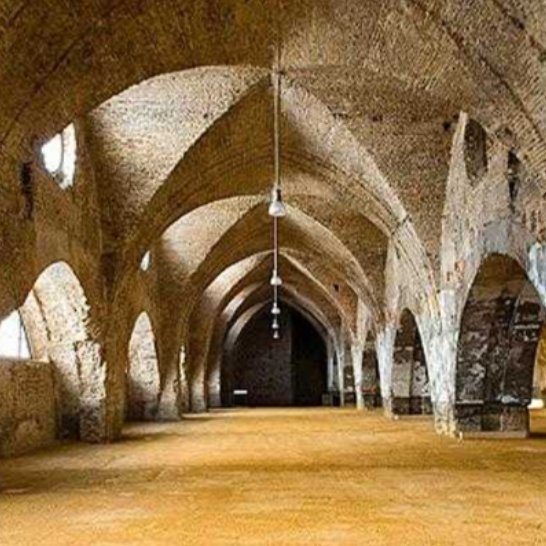
The Royal Shipyards were a large shipyard built in the port area of ​​Seville by order of Alfonso X the Wise (1252), becoming the most important naval base in the history of the Crown of Castile. Today, only a few of its original ships remain, immersed in a comprehensive rehabilitation process to be used for cultural and museum purposes. The author of the project is the Sevillian architect Guillermo Vázquez Consuegra.

The original building occupied a large area of ​​around two hectares and was made up of seventeen naves, separated by lines of monumental arches on pillars, all made of brick. These served not only to support the roof but also to channel the water collected by the ceilings, like aqueducts.

“The arches are slightly pointed and the pillars are rectangular in section, measuring 2.50 m by 1.80 m, spanning 8.5 m, with a height up to the base of the arches of 5 m. Each row of these pillars rests on a continuous footing foundation, the foundation of which is reached at 2 m below the original ground level.”

On its eastern side, the construction rested on the outer wall of Seville, while on the southern side it rested on part of the section of wall that joined the Alcázar and the Torre del Oro. This type of wall, built to join a main fortification with an external point, is known as coracha.

The ships were arranged perpendicular to the river, to facilitate the entry and exit of ships from it.

Throughout history, as the shipyards of Seville lost importance, a good number of its ships were used for other purposes:

- Around 1580 the Customs Office was installed in ships 13, 14 and 15, starting from Dos de Mayo Street towards Santander Street.

- In the mid-17th century, ships 8 to 12 were demolished to build the Hospital de la Caridad, following the designs of Sánchez Falconete and Leonardo de Figueroa.

- During several phases throughout the 18th century, the remaining part of the building underwent a major renovation to house the Artillery Workshop, used for the manufacture and repair of weapons and ammunition. In 1762, a major renovation began, including the construction of the current façade facing Calle Temprado, following an academicist layout.

- In 1945, the five remaining naves to the south were demolished, including those that had been transformed into customs in the 16th century, to build the current building of the Treasury Delegation.

OLD SILO OF THE CATHEDRAL COUNCIL

The Old Silo of the Cathedral Council (Antigua Cilla del Cabildo de la Catedral) is an 18th century building that stands on Santo Tomás Street in Seville. Throughout its history it has undergone various remodeling in relation to the different uses it has received. Currently it is the headquarters of the General Archive of the Indies, a condition it shares with the Antigua Lonja de Mercaderes, which stands just across the street.

Its construction took place in 1770 to serve as a grain warehouse for the Cathedral Chapter. Apparently, the place they had been using for this purpose was seriously damaged in the 1755 Earthquake, so it was necessary to undertake this project. There is no certainty about the architect who directed the work. Some authors point to Pedro de Silva, who was the chief architect of the Archbishopric. However, the Navarrese Lucas Cintora is also mentioned, who would later be mainly responsible for the transformations in the Lonja building to adapt it to its new use as an Archive.

For the construction of the façade, a fragment of the wall that joined the Alcázar with the Torre del Oro was used. In fact, even today we find one of the towers attached to the façade of the building. It is a simple square tower, dating from the late 12th century or early 13th century.

La Cilla lost its use as a warehouse in the 20th century and for a short period was the headquarters of the Royal Asturian Mines Company. In 1972 it was decided to completely renovate the property to make it the headquarters of the Museum of Contemporary Art of Seville. The architect from Cádiz Rafael Manzano Martos was in charge of directing the works on this occasion.

A new stage in the history of the old cilla would begin around the year 2000, when the process began to incorporate it as a complementary headquarters for the General Archive of the Indies. The works were completed in 2005 and the building was then configured with its current characteristics.

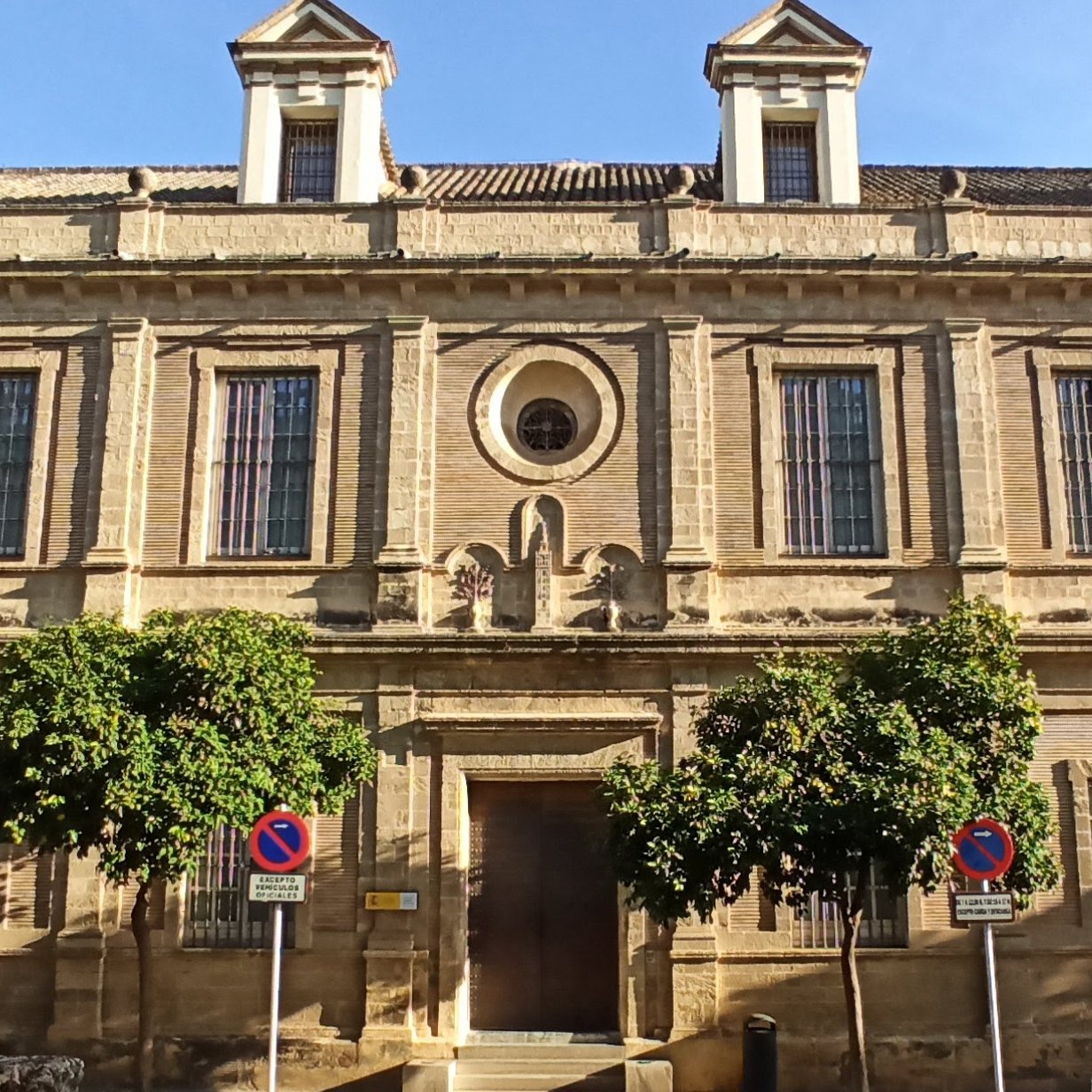
La Cilla was originally designed as a rectangular building with two floors. The naves are covered with hollow vaults supported by rectangular pillars and marble columns. It currently has two more floors, one in the basement and another under the roof, added in successive transformations to adapt the property to a museum and, later, an archive.

The façade repeats the compositional scheme of the Lonja building that is located directly opposite. La Lonja responds to the design of the great Renaissance architect Juan de Herrera and introduced a bichrome on its façade that was enormously successful in Seville.

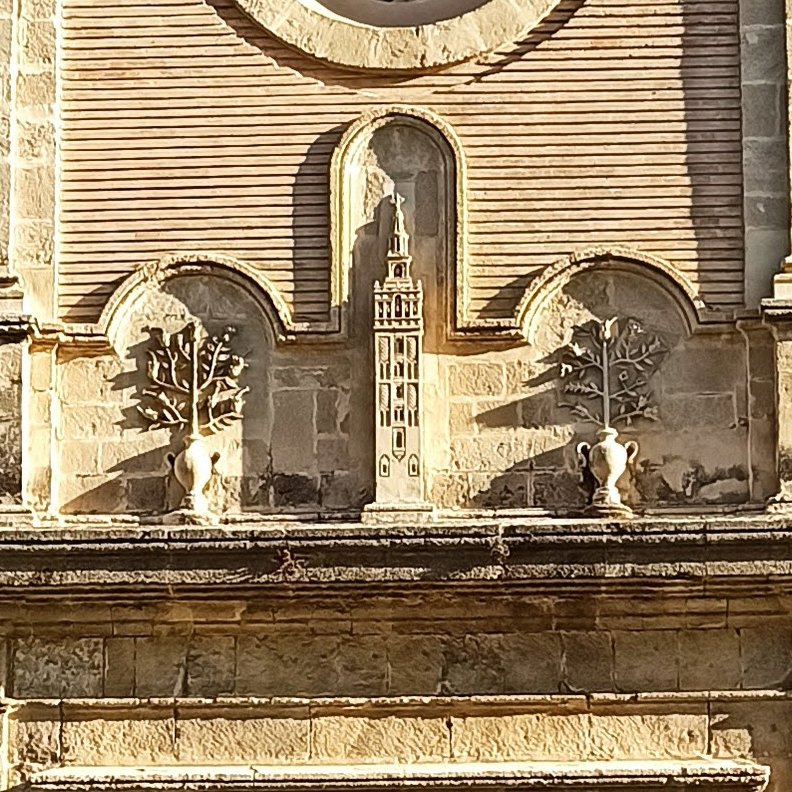
We see this bichrome repeated on the façade of the cilla, with the stone areas in lighter tones and the brick facings with a more reddish color. The two floors of the building are divided into seven equal modules divided by pilasters. In the central module of the first floor there is a simple lintel doorway. Right above it, already on the second floor, is sculpted the emblem of the Cathedral Chapter, the Giralda between two jars of lilies. Above the emblem is a simple oculus that serves to distinguish this central module, since in all the others rectangular windows framed by simple stone moldings open.

The old Cilla del Cabildo was declared a Site of Cultural Interest in 1985 and is currently home to the Reference Department, the Library, a conference room, the research room and other services of the General Archive of the Indies.

MAESTRANZA BULLRING

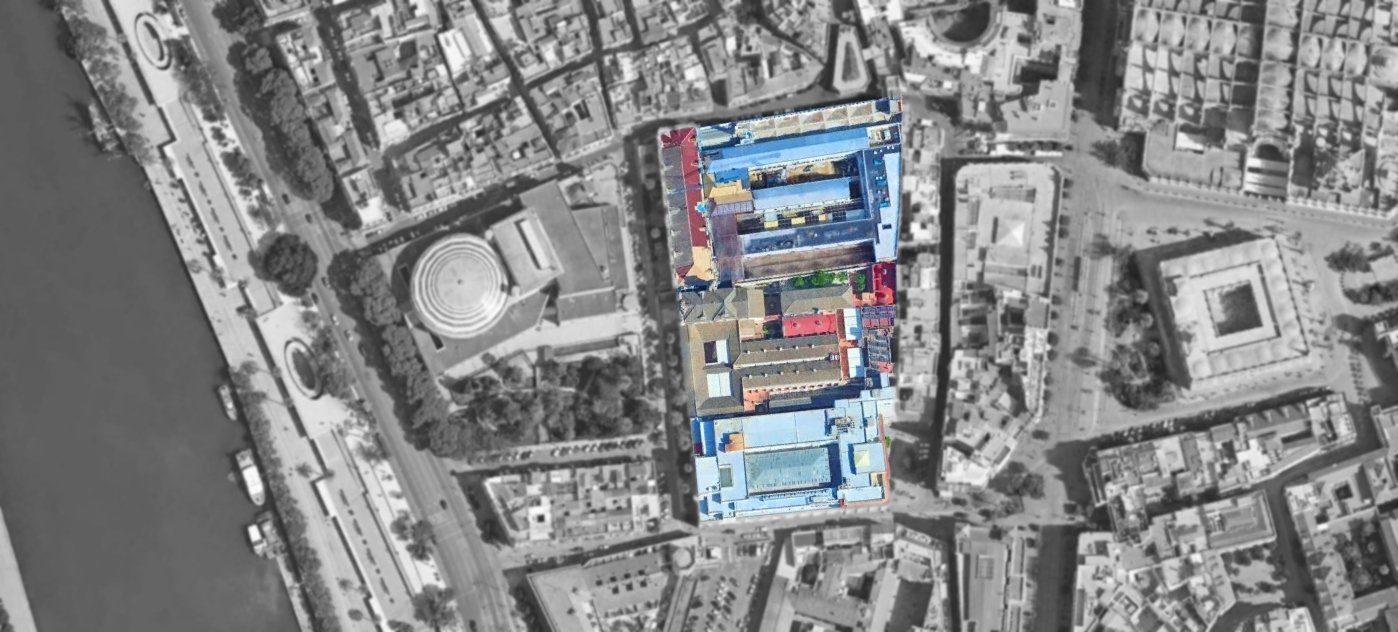
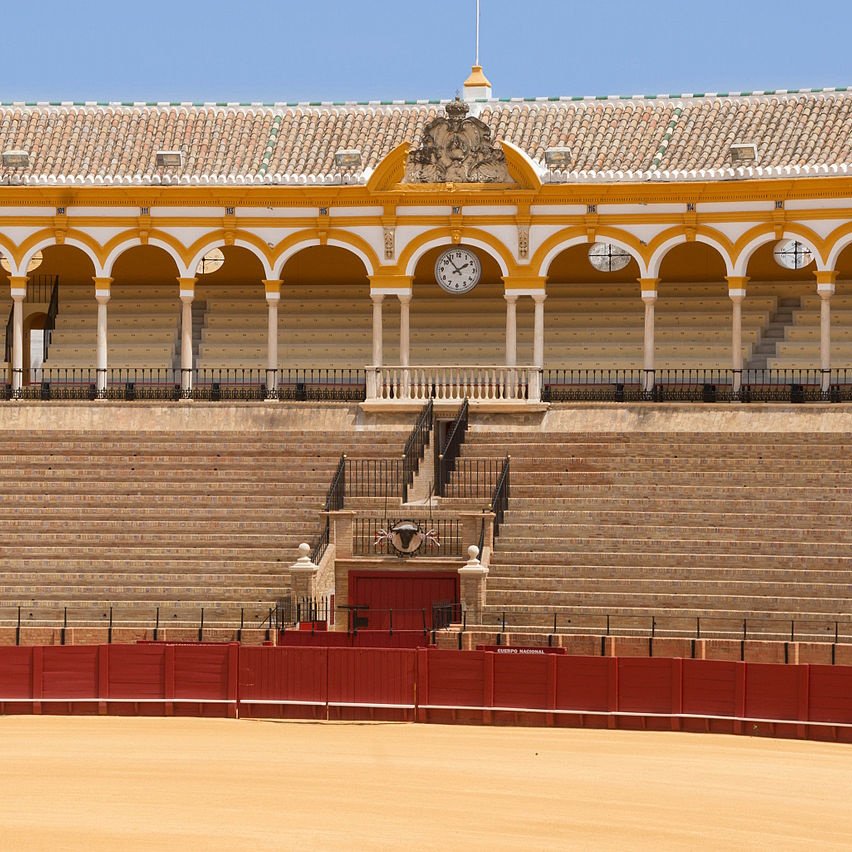
The Plaza de la Maestranza in Seville is among the oldest in Spain and is the most important for the world of bullfighting, along with Las Ventas in Madrid. It has a capacity for 12,000 people and its construction lasted in different phases for more than a century, between 1761 and 1880, the date of the definitive completion of the works.

It is known that in this same neighborhood of Arenal, a previous bullring was built, mainly made of wood and square, which was demolished for the construction of the current one. The initial project is the work of architect Vicente San Martín, and the result was a beautiful complex in a late baroque style with a very classical air.

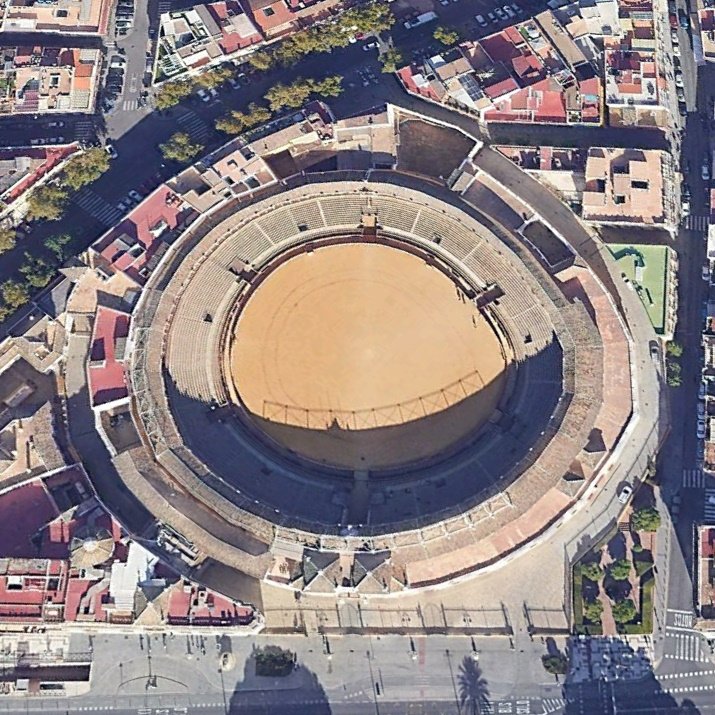
One of the most curious characteristics of the Maestranza is that its plan is not completely circular, but is "flattened" on one of its sides. This circumstance is due to the development of the works in different phases that we already mentioned and because the space between the Arenal hamlet was gradually opened, as they progressed.

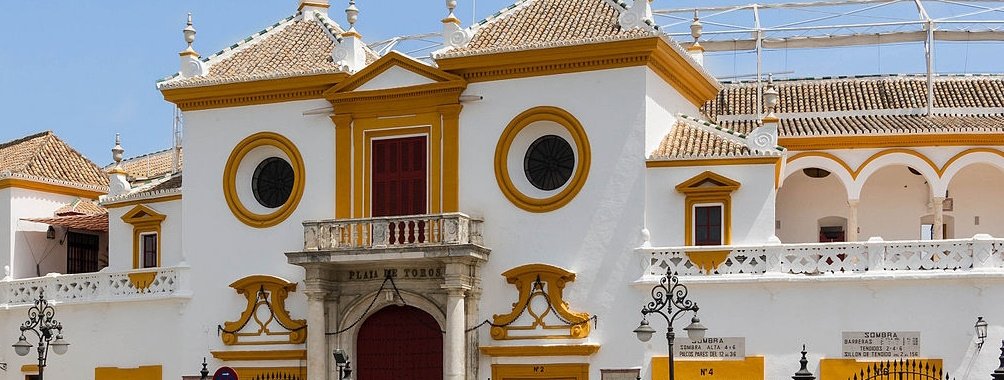
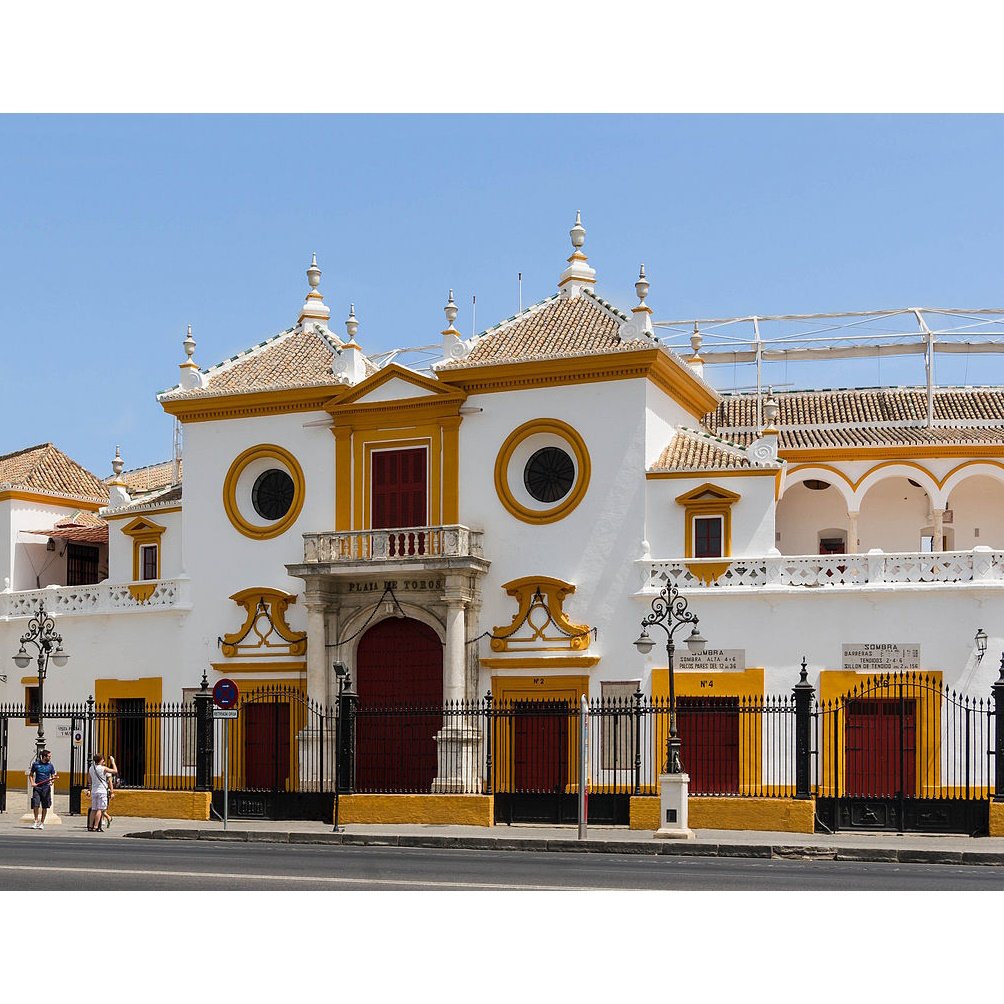
The main façade was built in the first phase and was already completed in 1787. The famous Puerta del Príncipe is a semicircular arch flanked by marble columns, which support a central balcony. The balcony opening is in turn framed by pilasters and under a triangular pediment.

On both sides, the façade extends giving the sensation of having two wide towers as a frame for the main entrance. In the lower part, two smaller doors flank the main one, crowned by two mixtilinear pediments of curious shape. Two large oculuses open above them. Finishing off each side of the façade are hipped tile roofs.

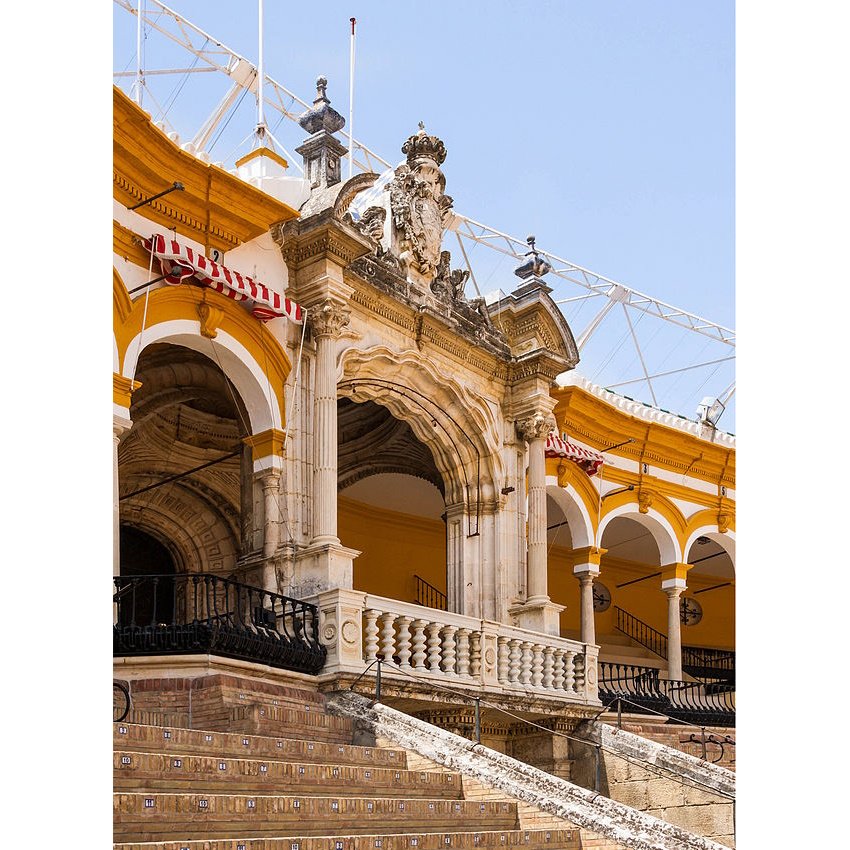
The Royal or Prince's Box also corresponds to the first construction phase of the building. It consists of two bodies. In the first we find a lowered semicircular arch framed by two Ionic columns that support the box itself. On the upper level, the central arch is segmental and has a curious undulating profile. It is flanked by two Corinthian columns, which support a split curved pediment.

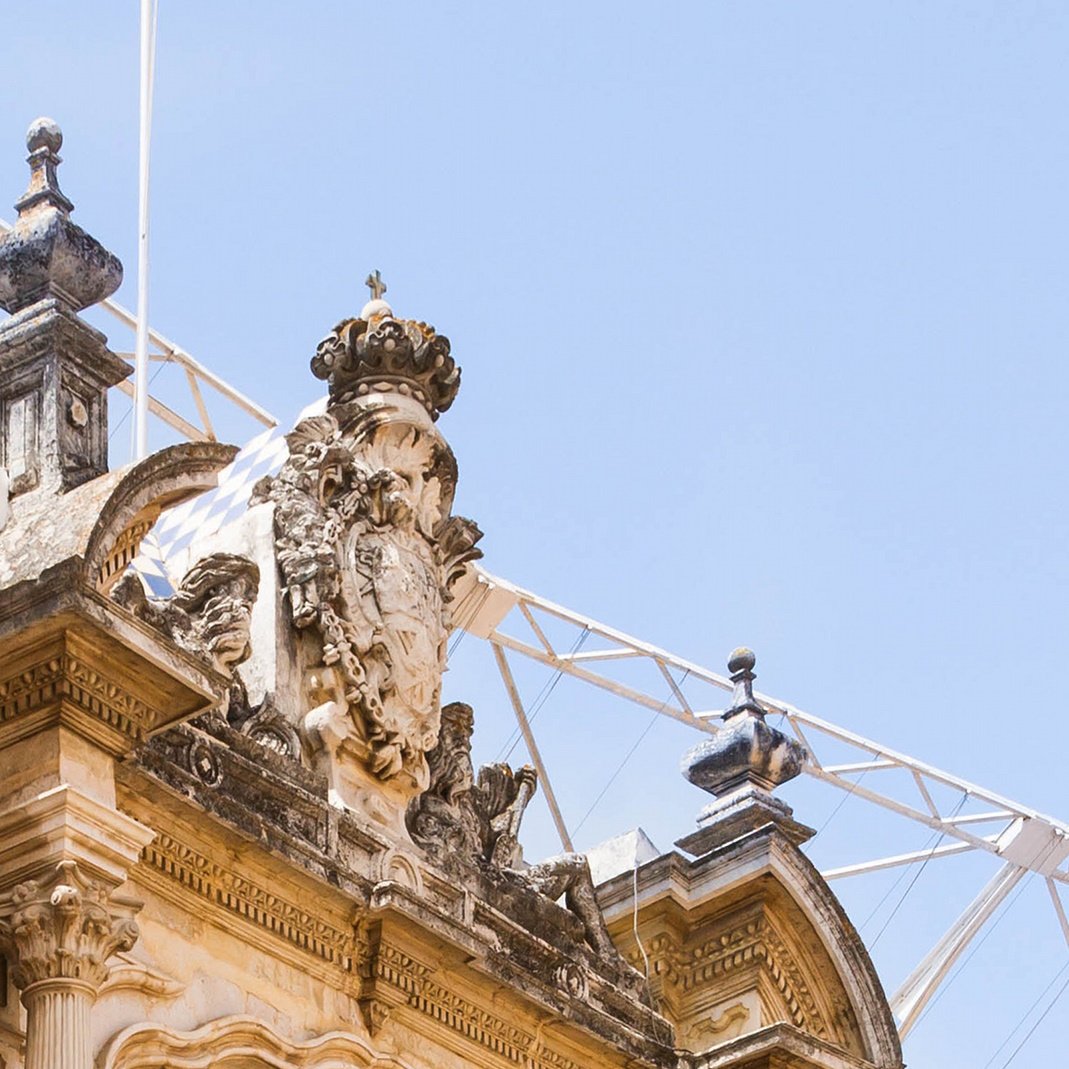
In its center is the royal shield, made by Cayetano de Acosta, who also sculpted the two allegorical figures that are on both sides. These are the allegories of the Po and Guadalquivir rivers, which are represented as bearded and reclining men. The allusion to the Italian river is not clear, but it is probably a reference to the Celtic-Ligurian people of the Taurines, who settled in the upper Po valley. Its capital was called Taurus, the name from which the current Turin derives, which still today has a bull as its symbol.

The lines of the plaza are divided into two levels, low and high. The tall steps are covered by a gabled tile roof that surrounds the entire square and is supported by semicircular arches perched on Tuscan marble columns.

The lower levels were subject to a thorough restoration in 1977, directed by Barquín Barón, who also prepared various auxiliary spaces for the installation of the bullfighting museum.

GENERAL ARCHIVE OF THE INDIES

The large Renaissance building that we know today as the Archivo de Indias was originally conceived as the Lonja de Mercaderes, to house and organize part of the commercial activity that arrived in the city during the 16th century. Until its construction, merchants used the spaces around the Cathedral as a market, especially the area known as 'las gradas', towards Alemanes street. The Chapter of the Cathedral was upset with this situation and asked the king for a solution.

Felipe II would attend to the request and commission Juan de Herrera, the famous architect from El Escorial, to design the new building in 1572. Work began in 1584 directed by Juan de Minjares following Herrera's plans. It seems that the building was ready for use in 1598, although there is evidence that the works continued during the 17th century.

When the center of commerce moved to Cádiz, in the 18th century, it was when the building was readapted to house all the documentation generated by the Casa de Contratación. As a result of this new circumstance, new works would be undertaken on the property in order to adapt it to the new use. It would be then, for example, when the monumental main access staircase to the upper floor was built.

It houses all the documentation related to the Spanish administration of the American territories. It was declared a World Heritage Site by UNESCO in 1987, together with the Cathedral and the Alcázar, due to the great historical and artistic values of the complex.

The building is a magnificent sample of the Renaissance in the city, with a more sober and Italianate air than is usual here. It has a square plan, two stories high, articulated around a monumental central patio, porticoed with Doric columns, very similar to the Patio de los Evangelistas in El Escorial.

On the façade, a bichrome color was introduced between the reddish brick panels and the pale stone pilasters. This game of two colors was enormously successful in Seville and we will see it reproduced in numerous buildings in the city for centuries to come.

Inside, the naves around the patio are covered with hollow vaults, with coffers and plant decoration. Practically all the walls are covered by shelves of magnificent quality, made with mahogany and cedar wood brought expressly from Cuba. These shelves were added in the 18th century, when the old Lonja was converted into an Archive.

It was also then that Lucas Cintora designed the monumental staircase behind the main access from Avenida de la Constitución. It is covered with red and greyish black jaspers and above it stands a vaulted ceiling with a central lantern that provides light.

The Archive contains documents of incalculable value. Manuscripts of characters such as Christopher Columbus, Hernán Cortés, Miguel de Cervantes, Felipe II, Felipe IV or George Washington himself, the first president of the United States. In addition, it brings together a magnificent collection of engravings, drawings and maps, authentic jewels for the study of the history of America up to the 19th century.

HOUSE OF TRADE OF THE INDIES

The House of Trade was an institution founded in 1503 by order of Isabel la Católica, in charge of managing everything related to navigation and commercial exploitation of the new territories of the Crown overseas.

CC BY-SA 4.0

Initially it settled in a space of the old Shipyards, but due to the constant flooding of the river, it was soon moved to the location that it would occupy inside the Alcázar. There it would occupy the space of one of the old Muslim palaces, to the west of the palace of Pedro I, a space that had already been used by the so-called Cuarto de los Admirales. At the beginning of the 16th century, a complete renovation of the facilities began and a new façade was opened towards the current Plaza de la Contratación. However, the building that we can see there today, owned by the Junta de Andalucía, was built in the 1970s. It was then that the old courtyard of the Muslim palace was rebuilt, based on the few archaeological remains found.

From the 16th century Casa de Contratación, some rooms and patios have been preserved, which today can be visited from inside the Alcázar. Among them, we can highlight the Admiral's Room and the Audience Room.

The Admiral's Hall is a large rectangular space covered by a wooden ceiling, with horizontal beams resting on corbels with a design inspired by the work of Sebastiano Serlio. Dating from the end of the 16th century, this ceiling is attributed to the master carpenter of the Alcázar, Martín Infante. The walls are decorated with paintings from the 19th and 20th centuries belonging to National Heritage, the Prado Museum and the collection of the Royal Family. Particularly interesting are the portraits painted by the German Winterhalter of The King and Queen of France, Luis Felipe and Amelia, with their children, and those of Don Antonio and Doña Luisa Fernanda, Dukes of Montpensier.

Opposite, hangs a large painting titled The Aftermath of Fernando III the Saint, signed and dated in Seville by the local painter Virgilio Mattoni in 1887. It is a work owned by the Prado Museum, although it is deposited in the Alcázar due to the great connection of the work with this place, since the event that it narrates, the death of Fernando III, happened here, in the Alcázar. On the back wall, in the central place of the room, we can see the oil painting titled The Ibero-American Exhibition Inauguration, painted by Alfonso Grosso in 1929.

For its part, the Courtroom owes its name to the fact that it was the seat of the Admiralty Court of Castilla. It is a room with a square plan, whose wooden coffered ceiling from the 16th century, richly gilded, presents traces reminiscent of the old Mudejar style.

On the walls appear the coats of arms of several famous admirals in the naval history of Spain, among which is that of Christopher Columbus, right in the center of the wall on the left.

In the central part of the room we see the altarpiece of Nuestra Señora de los Navegantes, made by Alejo Fernández in 1535. It is the first painting in Europe that has the discovery of America as its theme. We cannot identify the figures that appear clearly, but we know that they are Christopher Columbus, Emperor Carlos, Fernando el Católico, Sancho de Matienzo (first treasurer of the Casa de Contratación), Americo Vespuccio, Juan de la Cosa and several indigenous people. , of the recently discovered lands. All of them covered under the mantle of the Virgin of Buenos Aires. At the bottom are several of the types of boats that made the race to the Indies, so the work as a whole offers testimony of incalculable value.
[mapsmarker map="2"  lat="37.383810" lng="-5.991859" zoom="18" height="300" heightunit="px"]

SEVILLE CITY HALL

The Sevillian town hall has its headquarters in a magnificent 16th century building, which preserves much of its façade traces of the exquisite Plateresque Renaissance style in which it was built.

CC BY-SA 4.0

The building was originally attached to the Casa Grande de San Francisco convent, which originally occupied the entire area of Plaza Nueva and its adjacent blocks. The works began around 1527, coinciding with the stay of Emperor Charles V in the city to celebrate his marriage to Isabel of Portugal. Throughout the century, different architects succeeded one another in directing the works, such as Diego de Riaño, Juan Sánchez, Hernán Ruiz II or Benvenuto Tortello.

In the 19th century, following the disappearance of the San Francisco convent, the building was significantly expanded. It was then that the neoclassical façade facing Plaza Nueva was built, the work of Balbino Marrón (1861) and the extension of the façade towards Plaza de San Francisco, directed by Demetrio de los Ríos (1868).

Towards the outside, the exquisite Plateresque decoration of the part built in the 16th century stands out. We can see a complex iconographic program, full of mythological characters and references to Roman antiquity, mixed with the emblems of Carlos V. In this way, it was intended to exalt the city's past, relating it to the glorification of the figure of the emperor . In this way, the aim was to consolidate Seville as the most important city of that great empire that took shape during the 16th century.

On both sides of the arch that originally gave access to the Convent of San Francisco we see two niches with the figures of Hercules and Julius Caesar. Both characters are considered the mythological and historical founders of the city. The sculptures were added in 1854 one of the extensive restorations undertaken on the building's façade. They are the work of Vicente Hernández Couquet.

[mapsmarker map="2"  lat="37.388712" lng="-5.994695" zoom="18" height="300" heightunit="px"]

ROYAL AUDIENCE OF SEVILLE

The Royal Court was the highest judicial institution in the city and settled in this space since the beginning of the 16th century, when it moved from its previous headquarters in the Casa de Pilatos. The current building would be built in the Renaissance style at the end of the same century by order of Felipe II.

However, the building that we can see today is far from the original, due to the numerous historical vicissitudes it has gone through.

In 1918 there was a great fire that destroyed it to a large extent and forced the transfer of the courts to Almirante Apocada street, to the place where the General Archive of Andalusia is located today.

After the fire, Aníbal González was in charge of remodeling the property, giving it its current appearance. In the 1970s it underwent another important transformation with the aim of making it the headquarters of the old Caja de San Fernando. Today it houses the headquarters of the CajaSol Foundation.

[mapsmarker map="2"  lat="37.388961" lng="-5.993980" zoom="18" height="300" heightunit="px"]