MURILLO GARDENS

The Murillo Gardens and the Catalina de Ribera promenade form one of the most interesting garden areas in the city of Seville, both historically, artistically, scenically and environmentally. They are fully involved in the life of the city and preserve interesting botanical species as well as architectural and sculptural samples and original street furniture elements from the time of their formalisation in the first quarter of the 20th century.
Juan Talavera y Heredia, a well-known representative of regional historicism, designed the Murillo Gardens in 1911 on land donated by the Crown, which had previously formed part of the Huerta del Retiro del Alcázar. They have a more secluded layout and a more intimate air, in contrast to the longitudinal layout of the Paseo de Catalina de Ribera.

The composition of this space is based on grid-like paths formed by hedges and paving which, at their intersections, create octagonal roundabouts in which there are central fountains and factory benches covered with tiles. The resulting flowerbeds are occupied by dense masses of vegetation that give the area an intimate atmosphere.

Among the open spaces, the gazebo dedicated to the painter José García Ramos stands out. It is bordered by entrance arches and low walls with tiled panels that recreate famous works by the artist, executed by other painters in the master's circle such as Miguel del Pino, Santiago Martínez, Alfonso Grosso, Manuel Vigil, and Diego López.

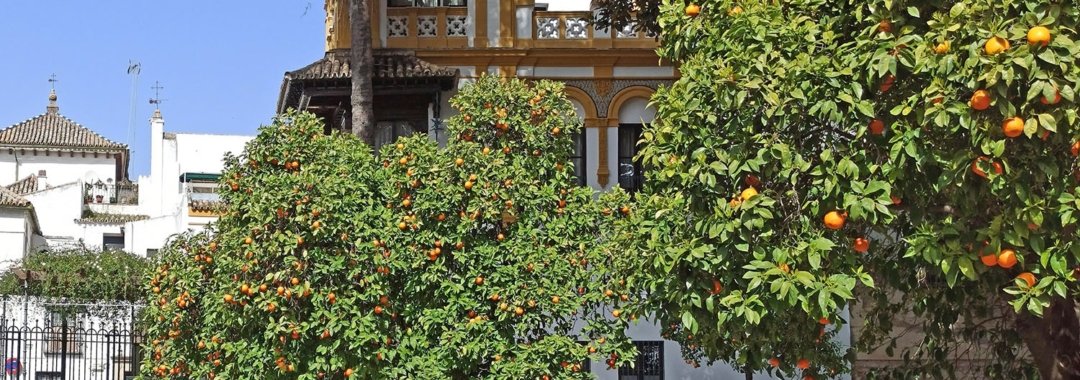
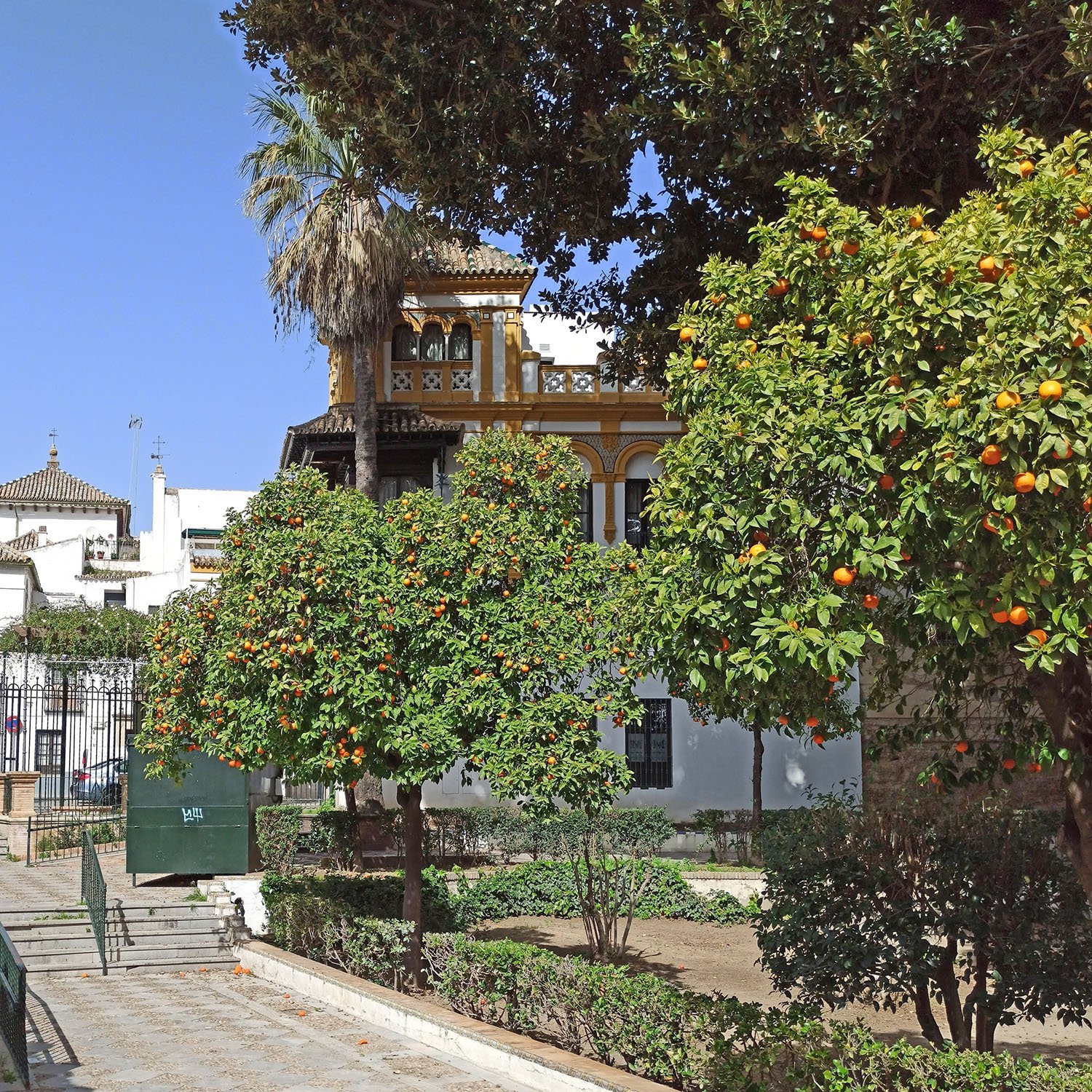
Nearby there is a regionalist style building used as a home. In these gardens you can find a great variety of plant species, with Magnolia Grandiflora, Cupresus Sempervivens Estricta, Ficus Magnoloides Religiosa, Platanus Hibrida, etc. standing out for their age and development.

Text of the BIC declaration, 12-03-2002.

! The Murillo Gardens appear by mistake as "Jardín de las Tres Fuentes" on Google Maps, while where you can read "Jardines de Murillo" it is actually the Paseo Catalina de Ribera.
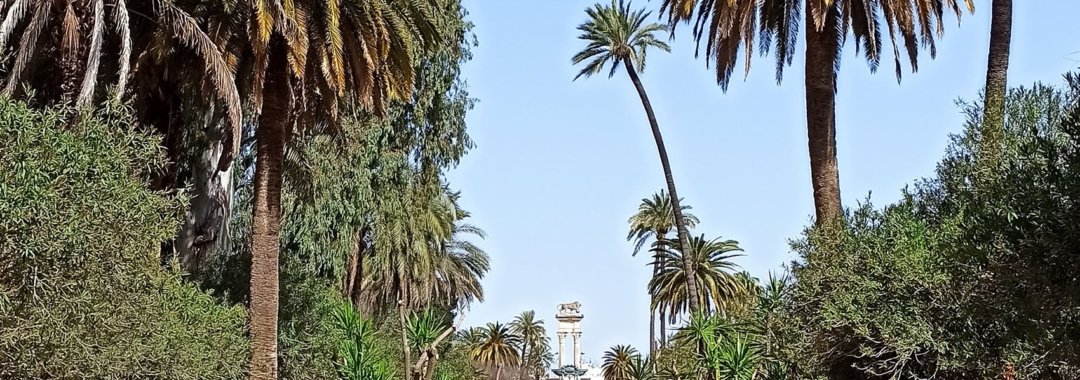
CATALINA DE RIBERA PROMENADE

The Paseo de Catalina de Ribera (promenade) and the Murillo Gardens make up one of the most interesting garden areas in terms of history, art, landscape and environment in the city of Seville. They are fully involved in the life of the city and preserve interesting botanical species as well as architectural and sculptural samples and original street furniture elements from the time of their formalisation in the first quarter of the 20th century.

The current Paseo de Catalina de Ribera has its remote origin in the transfer, in 1862, of part of the Huerta del Retiro del Alcázar. This new public space, which was intended to attenuate the narrowness of the urban layout of the neighbouring neighbourhoods, did not yet have a special layout. At the end of the 19th century, a first project was undertaken for landscaping and furnishing what was then called the "Paseo de los Lutos" and, in 1920, on the occasion of the interventions carried out in view of the Ibero-American Exhibition, the architect Juan Talavera y Heredia, formalised the layout preserved today.

This same architect, a well-known representative of regionalist historicism, had designed a few years earlier the adjacent Murillo gardens, also the result of a transfer (1911) of another portion, located to the north-west, of the Huerta del Retiro del Alcázar. The layout of the Paseo de Catalina de Ribera has a clear longitudinal arrangement, designed for traffic, while the Murillo Gardens respond, due to their location and design, to a more secluded enclosure.

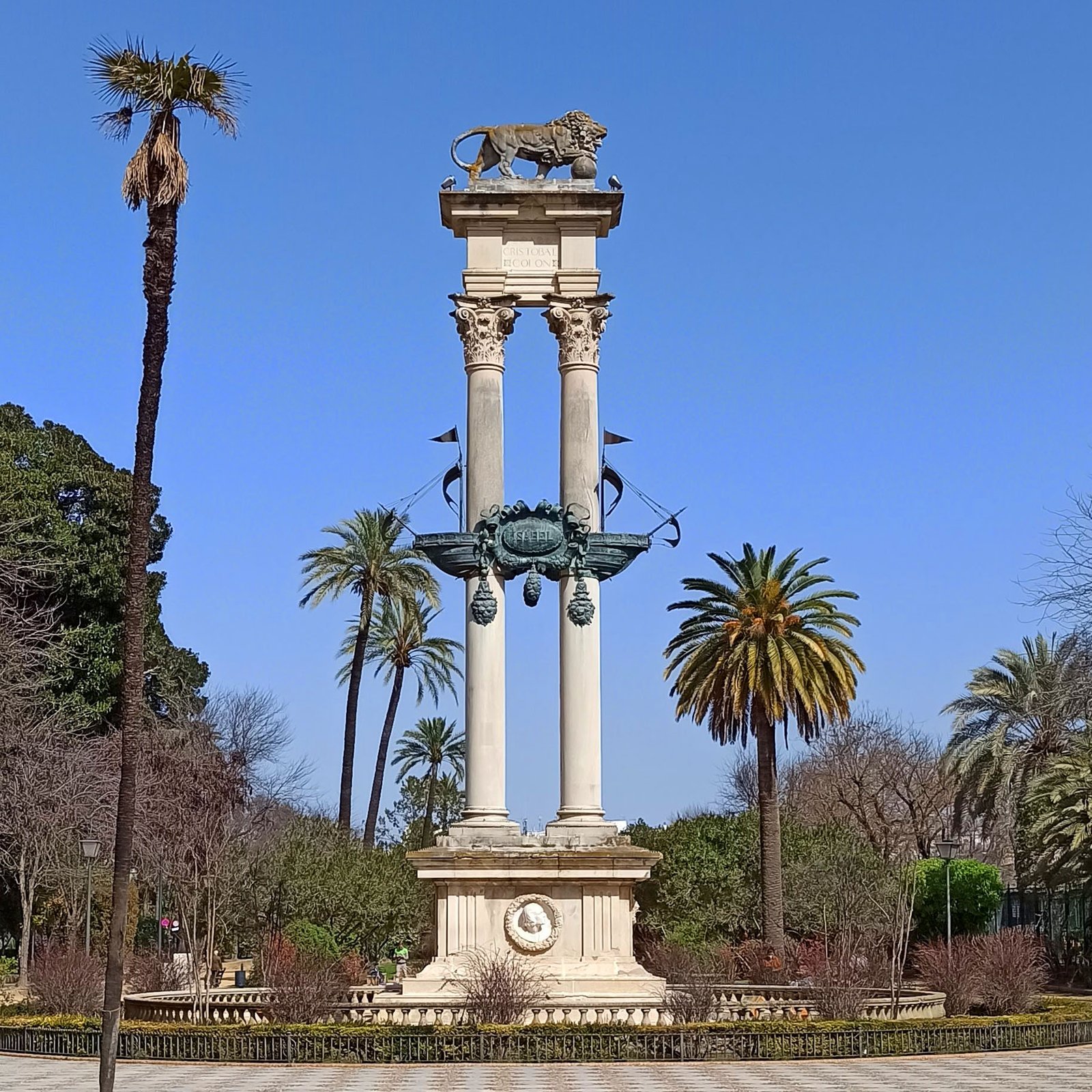
The walk is structured by a central axis and two secondary axes, parallel to the latter and arranged on both sides, which are made up of flowerbeds delimited by factory and tiled parapets. The central axis is interrupted at its midpoint by a large circular space centred by a fountain, also circular, on which, above a pedestal with busts of Columbus and the Catholic Monarchs, two columns stand, supporting an entablature crowned by the figure of a lion and, at mid-shaft, the prows of the caravels.

The monument, which provides the vertical element of compositional compensation to the promenade, was designed by the architect Talavera and executed by the sculptor Lorenzo Coullaut-Varela, and is dedicated to Christopher Columbus, in keeping with the events of the Ibero-American Exposition of 1929, when it was held.

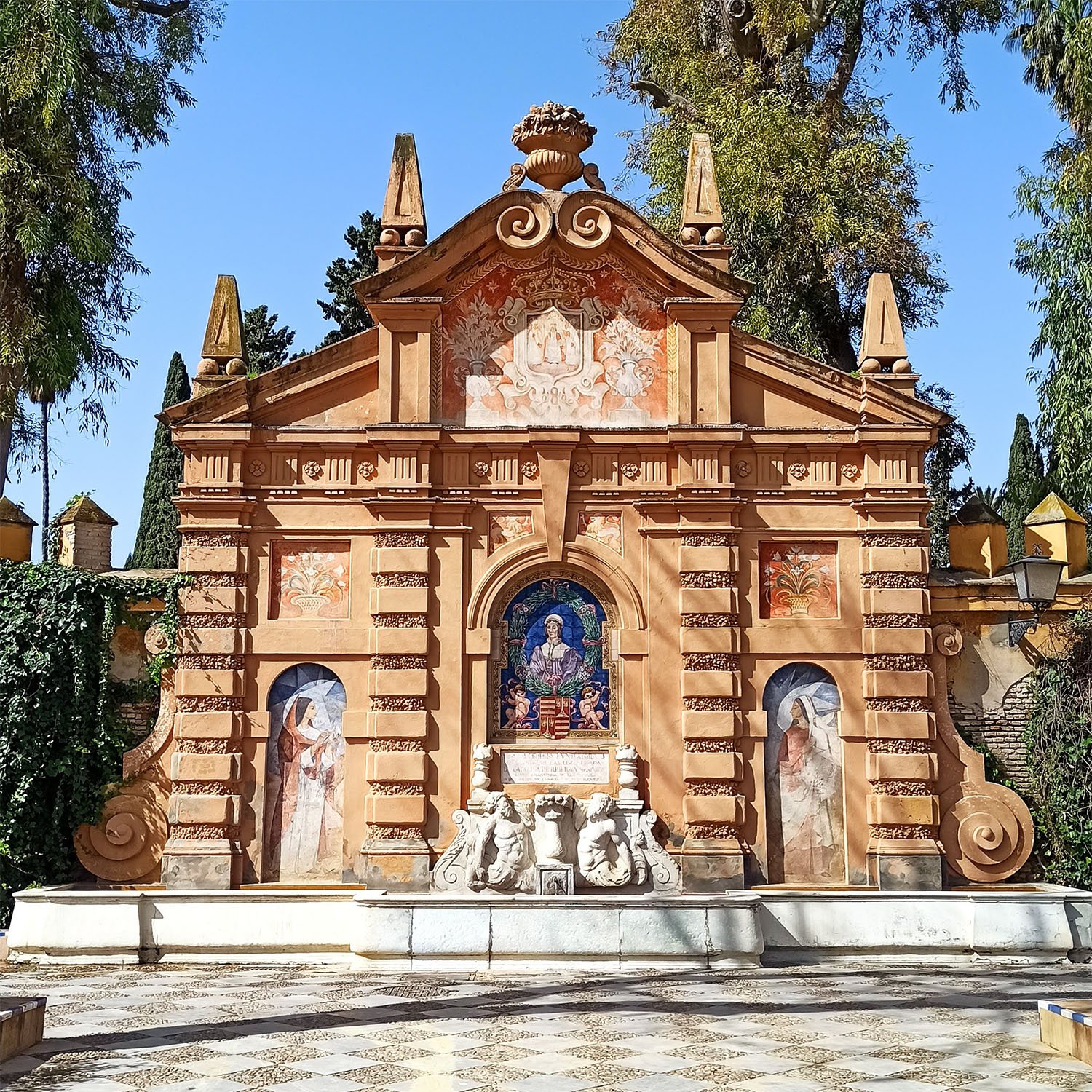
Very close to the monumental fountain is the parietal fountain, attached to the enclosure wall of the Alcázar gardens, dedicated to Catalina de Ribera, benefactor of the city with the foundation of the Hospital de las Cinco Llagas. It has an architectural structure in neo-mannerist style designed by Talavera and Heredia himself with paintings alluding to the lady, plus the remains of another fountain from the 16th century.

Text of the BIC declaration, 12-03-2002.

Jardín de las Delicias de Sevilla con el Pabellón de Argentina al fondo

JARDÍN DE LAS DELICIAS (GARDEN OF DELIGHTS)

The Garden of Earthly Delights is one of the oldest public gardens in Seville. It was called Arjona's Garden of Earthly Delights, since it was set up during the mandate of the Seville Mayor José Manuel de Arjona y Cubas, between 1825 and 1835.

They were made within the general remodeling process of the eastern bank of the river. With the same objective, the wall that linked the Torres del Oro and Torres de la Plata crossing the current Paseo Colón was demolished, and the Jardines de Cristina were created in front of the Palacio de San Telmo.

Since their creation they have undergone various modifications. Artistically, the most significant occurred around 1864, when a series of Italian sculptures from the 18th century were brought in. They came from the Archiepiscopal Palace of Umbrete, which had suffered a fire in 1862. Some of them can still be seen in the garden, but most of them were replaced by replicas in 2006, while the originals were returned to Umbrete. For the arrangement of the sculptures in the palace, the Portuguese-born sculptor Cayetano de Acosta made a series of pedestals that we can also see today in the Garden.

The Garden gained great prominence as a result of the celebration of the Ibero-American Exhibition of 1929, since it became one of the landscaped spaces around which the event was held. In fact, it lost part of its original dimensions when the pavilions of Argentina and Guatemala were arranged to the North and that of Morocco to the South, pavilions that fortunately have survived to this day.

[mapsmarker map="4"  lat="37.370967" lng="-5.989689" zoom="18" height="300" heightunit="px"]