CHAPEL OF SANTA MARÍA DE JESÚS (MAESE RODRIGO’S CHAPEL)

This Puerta de Jerez chapel is the only vestige that remains of the primitive University of Seville, which was founded by Master Rodrigo de Santaella in 1506.

The rest of the buildings of this first university were demolished at the beginning of the 20th century to lay out the current Avenida de la Constitución, within the process of urban remodeling that the city experienced in the years prior to the Ibero-American Exhibition of 1929. The original cover of the The building was dismantled and is currently preserved in the compass of the Santa Clara convent. In the main altarpiece of this chapel you can see a representation of the missing building.

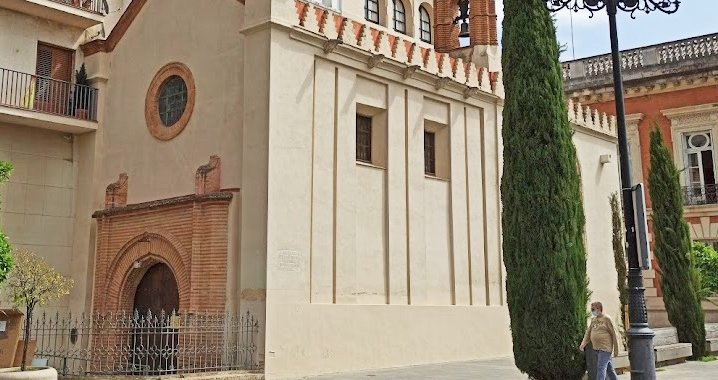
The chapel that has survived to us has a single nave and is stylistically ascribed to late Gothic-Mudejar. It was consecrated in 1506, still unfinished.

On the outside, it has three facades. The rear was renovated in the 20th century and shows a small Mudejar window, made of brick and with a multi-lobed arch. On the side façade there is a beautiful Gothic window with archivolts, plant decoration and tracery in the upper part, forming three oculi. On this same façade there is a marble tombstone that alludes to the foundation in Gothic characters.

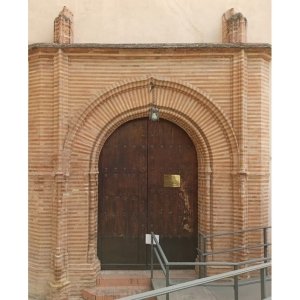
At the foot is the main façade, which originally did not face the street but rather an interior patio of the university. It has a simple doorway in the shape of an ogee arch composed of bichrome bricks and framed by an alfiz. Despite its simplicity, it is highly harmonious and stands out for the unusual nature of this type of arch in Sevillian Gothic architecture. On the right side of the chapel, right between the nave and the presbytery, there is a simple belfry, also made of bichrome bricks and topped by stepped battlements.

Inside, the only nave of the church is clearly divided into two areas, differentiated by their coverage. The body of the nave is covered by a wooden cladding, while the presbytery is covered by a Gothic trecelet cross vault. As a transition between both spaces, there is a large central arch, pointed and decorated with cardinas.

Although the temple's original flooring was replaced in the 20th century by the current marble floor, the tile skirting boards on the walls have been preserved, made with beautiful polychrome using the dry rope technique. The front of the altar was made with the same technique, but in this case including golden reflections, a very rare element in ceramic decoration of this type in Seville.

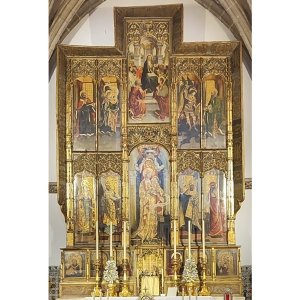
The main altarpiece is a piece of enormous artistic interest, made by the German-born painter Alejo Fernández around 1520. Its structure is clearly Gothic, although his paintings already show a certain Renaissance influence. The theme is linked to the exaltation of wisdom, in relation to the original purpose of the temple as the College chapel.

It is structured from bottom to top in a bench and two bodies. In the center of the bench is the tabernacle, on whose sides there are six tables, three with representations of bishops, an Ecce Homo and an image of the Virgin and Child in the Byzantine style. It is stated that it was brought from Italy by Master Rodrigo himself.

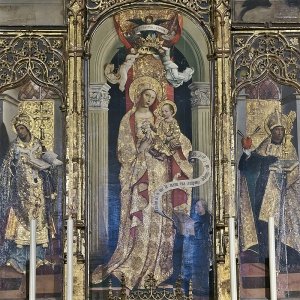
The first body is presided over by a reproduction of the Virgin of Antigua, the original of which is in one of the chapels of the Seville Cathedral. At her feet, Master Rodrigo appears on a smaller scale, giving the Virgin a model that represents the College founded by him. On both sides, the four doctors of the church: Saint Augustine of Hippo, Saint Ambrose, Saint Gregory the Great and Saint Jerome.

In the center of the second body is the representation of "Pentecost". It is in this painting where you can most appreciate the Renaissance influence that we have talked about in the work of Alejo Fernández. Flanking it, from left to right, we see Saint Peter, Saint Gabriel, Saint Michael and Saint Paul.

MAESTRANZA BULLRING

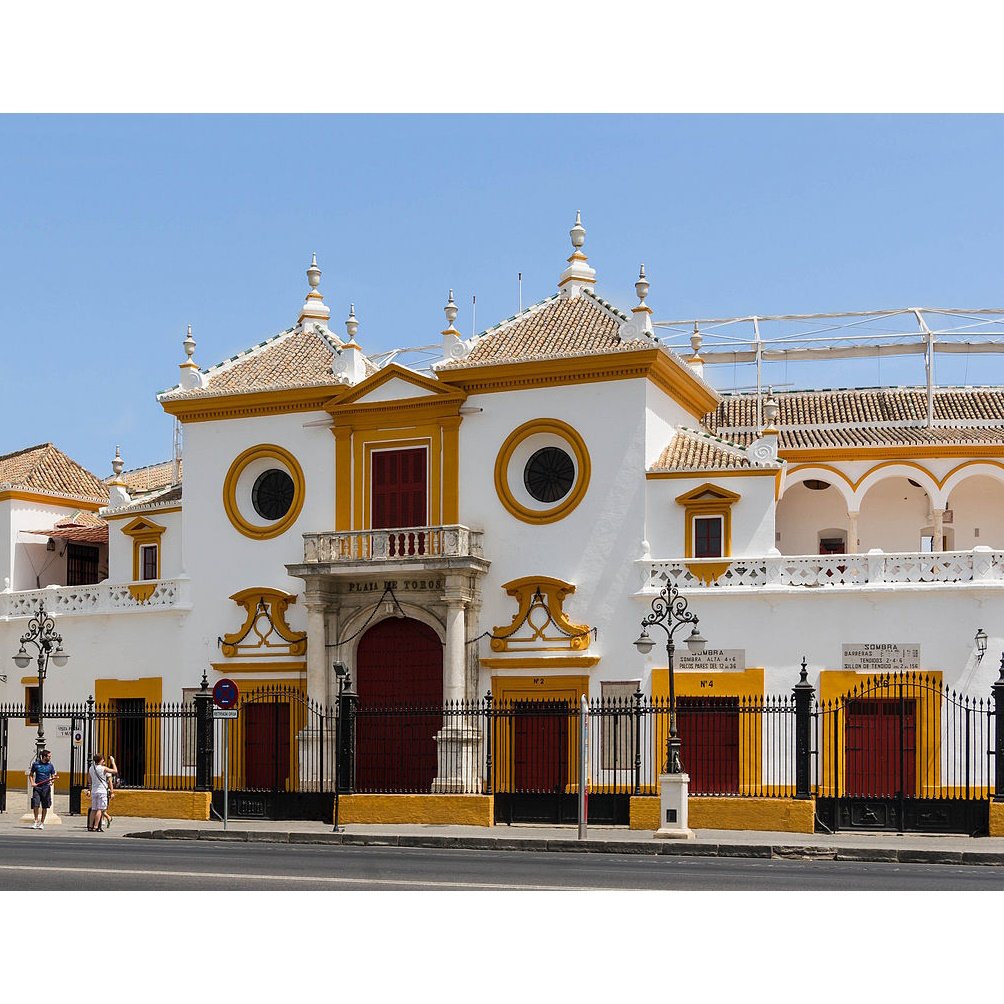
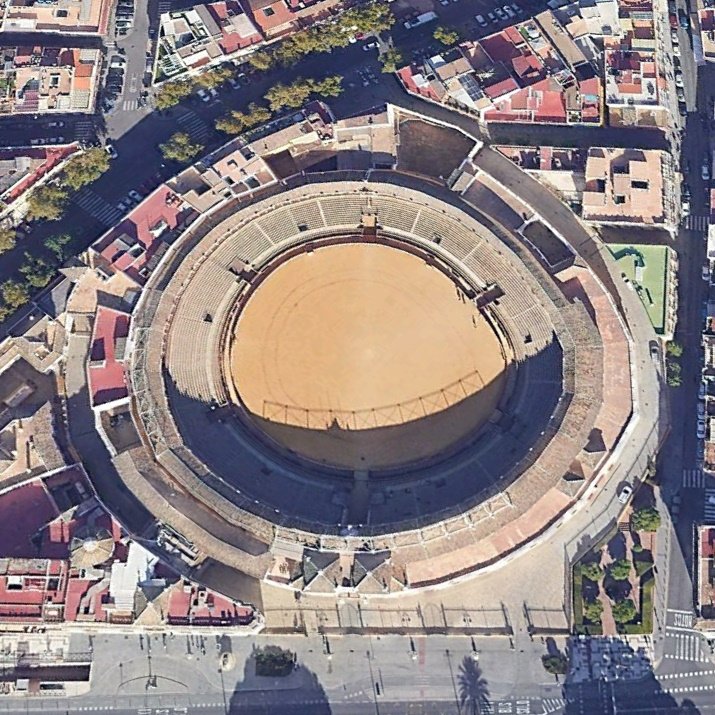
The Plaza de la Maestranza in Seville is among the oldest in Spain and is the most important for the world of bullfighting, along with Las Ventas in Madrid. It has a capacity for 12,000 people and its construction lasted in different phases for more than a century, between 1761 and 1880, the date of the definitive completion of the works.

It is known that in this same neighborhood of Arenal, a previous bullring was built, mainly made of wood and square, which was demolished for the construction of the current one. The initial project is the work of architect Vicente San Martín, and the result was a beautiful complex in a late baroque style with a very classical air.

One of the most curious characteristics of the Maestranza is that its plan is not completely circular, but is "flattened" on one of its sides. This circumstance is due to the development of the works in different phases that we already mentioned and because the space between the Arenal hamlet was gradually opened, as they progressed.

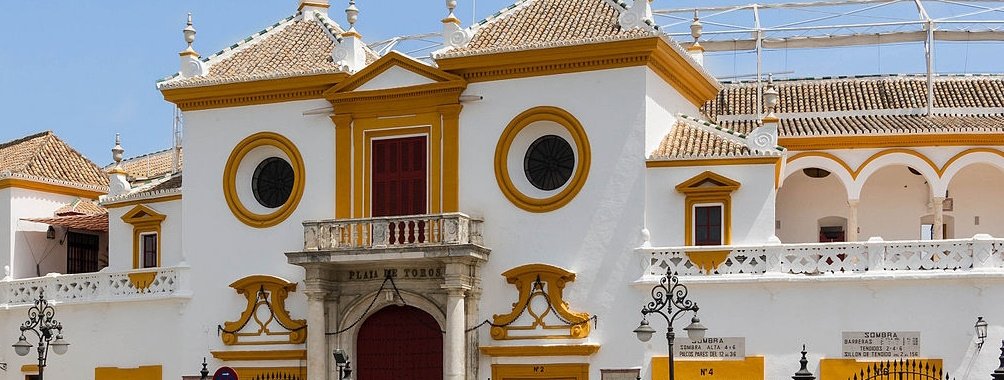
The main façade was built in the first phase and was already completed in 1787. The famous Puerta del Príncipe is a semicircular arch flanked by marble columns, which support a central balcony. The balcony opening is in turn framed by pilasters and under a triangular pediment.

On both sides, the façade extends giving the sensation of having two wide towers as a frame for the main entrance. In the lower part, two smaller doors flank the main one, crowned by two mixtilinear pediments of curious shape. Two large oculuses open above them. Finishing off each side of the façade are hipped tile roofs.

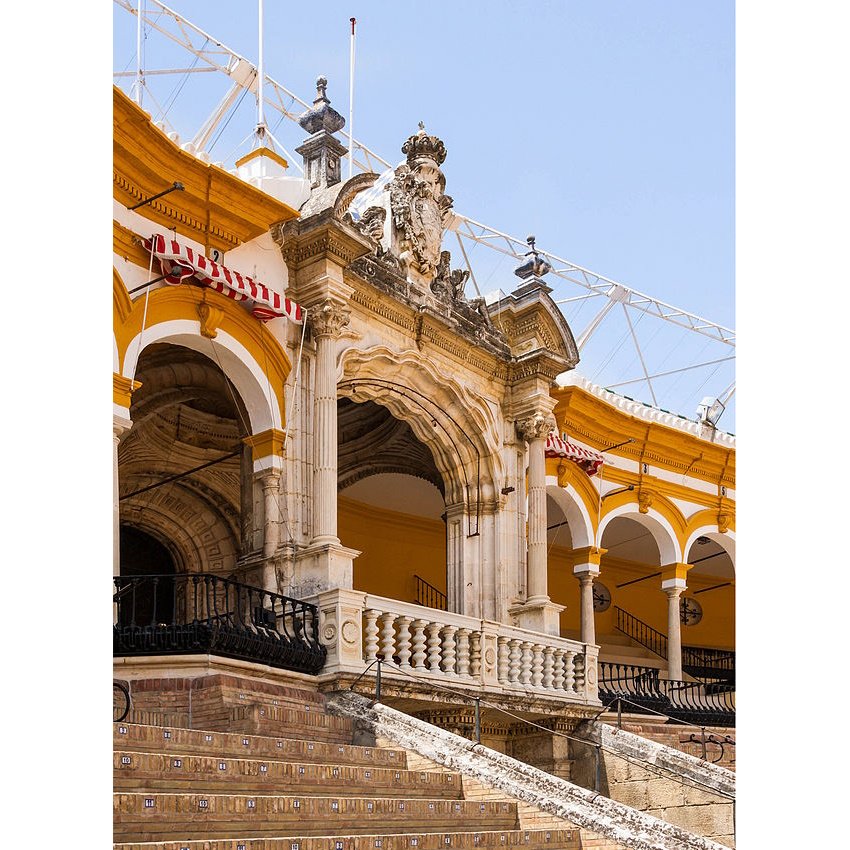
The Royal or Prince's Box also corresponds to the first construction phase of the building. It consists of two bodies. In the first we find a lowered semicircular arch framed by two Ionic columns that support the box itself. On the upper level, the central arch is segmental and has a curious undulating profile. It is flanked by two Corinthian columns, which support a split curved pediment.

In its center is the royal shield, made by Cayetano de Acosta, who also sculpted the two allegorical figures that are on both sides. These are the allegories of the Po and Guadalquivir rivers, which are represented as bearded and reclining men. The allusion to the Italian river is not clear, but it is probably a reference to the Celtic-Ligurian people of the Taurines, who settled in the upper Po valley. Its capital was called Taurus, the name from which the current Turin derives, which still today has a bull as its symbol.

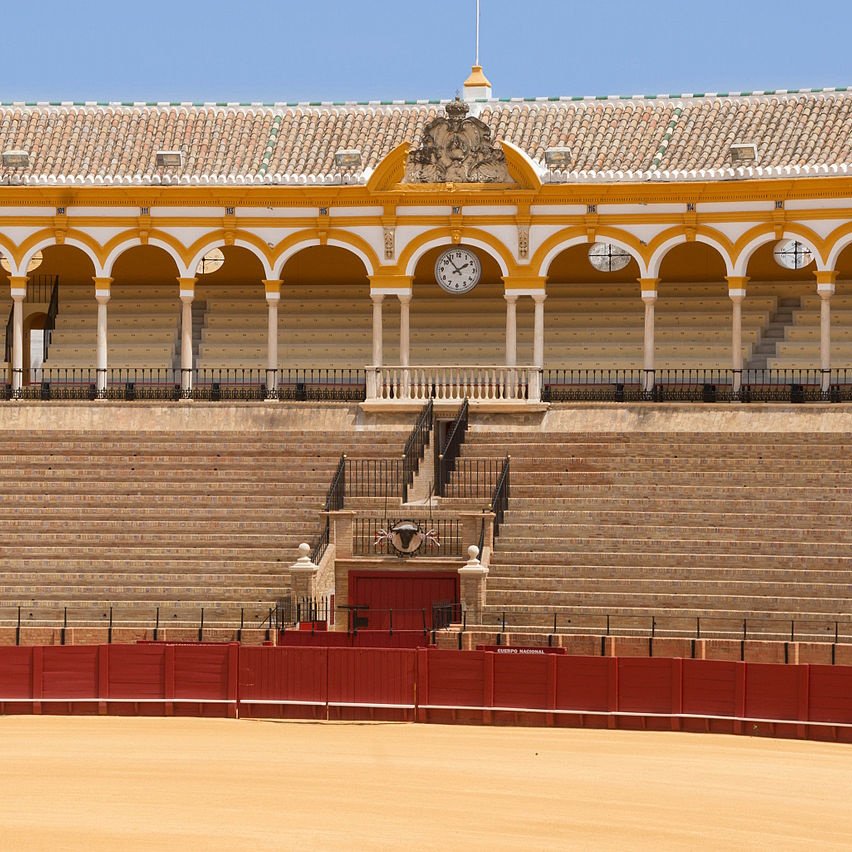
The lines of the plaza are divided into two levels, low and high. The tall steps are covered by a gabled tile roof that surrounds the entire square and is supported by semicircular arches perched on Tuscan marble columns.

The lower levels were subject to a thorough restoration in 1977, directed by Barquín Barón, who also prepared various auxiliary spaces for the installation of the bullfighting museum.

HEADQUARTERS OF THE REAL MAESTRANZA

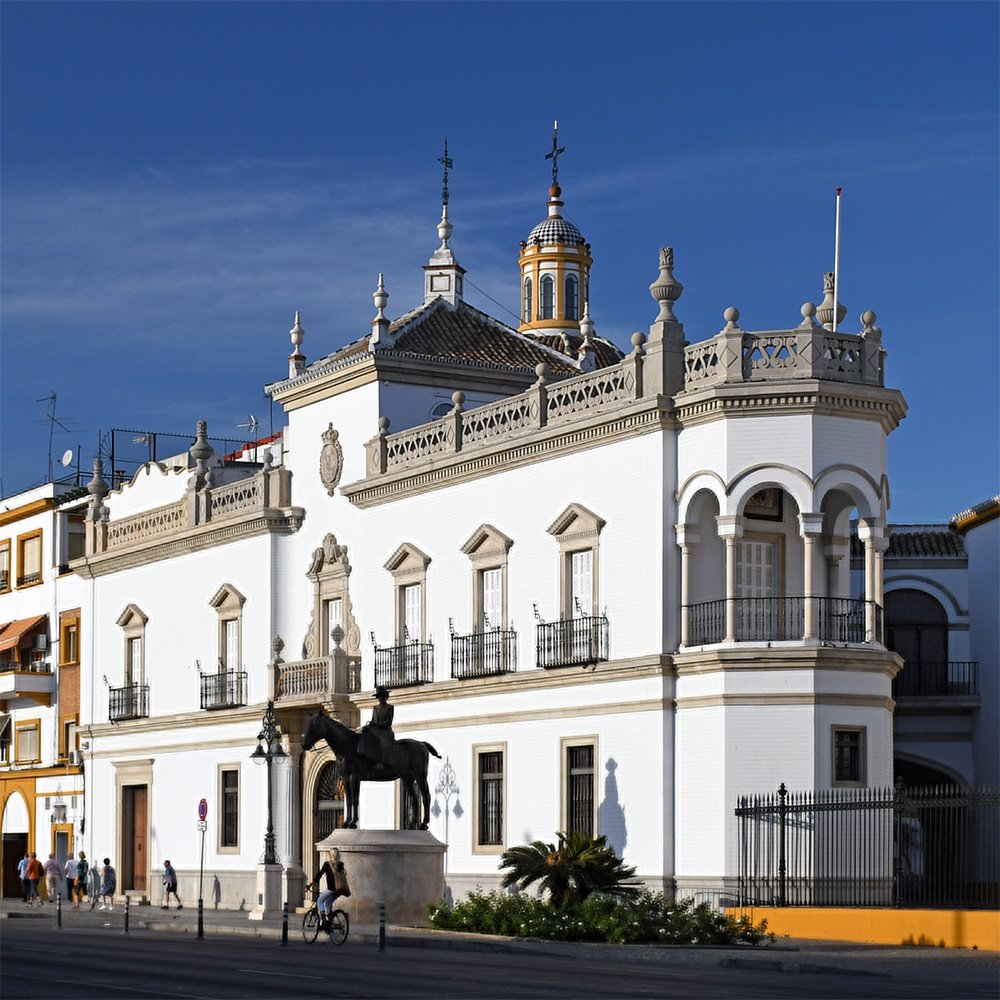
The headquarters of the Real Maestranza de Caballería is located next to the Plaza de Toros, of which this institution is the owner. It is a regionalist building in the neo-baroque style, designed by Aníbal González in 1929.

However, the property would undergo successive renovations and expansions in the following decades. In 1956 the chapel was inaugurated, the construction of which was directed successively by Gómez Millán, Medina and Barquín Barrón. It has a Latin cross plan, with a single nave covered by a barrel vault with lunettes. The central space of the transept has been covered by a lowered dome with a drum and lantern, sitting on pendentives.

The main altarpiece is recomposed taking parts of the primitive altarpiece that occupied the chapel that the Maestranza had in the church of the disappeared convent of Regina Angelorum. It was originally made under the direction of Francisco Dionisio de Ribas in 1668 and its sculptures are the work of Pedro Roldán. In its central niche, a dress image of the Virgin of the Rosary is venerated, a work by Cristóbal Ramos from the 18th century, considered the official patron saint of the corporation.

HOSPITAL DE LA CARIDAD (CHARITY HOSPITAL)

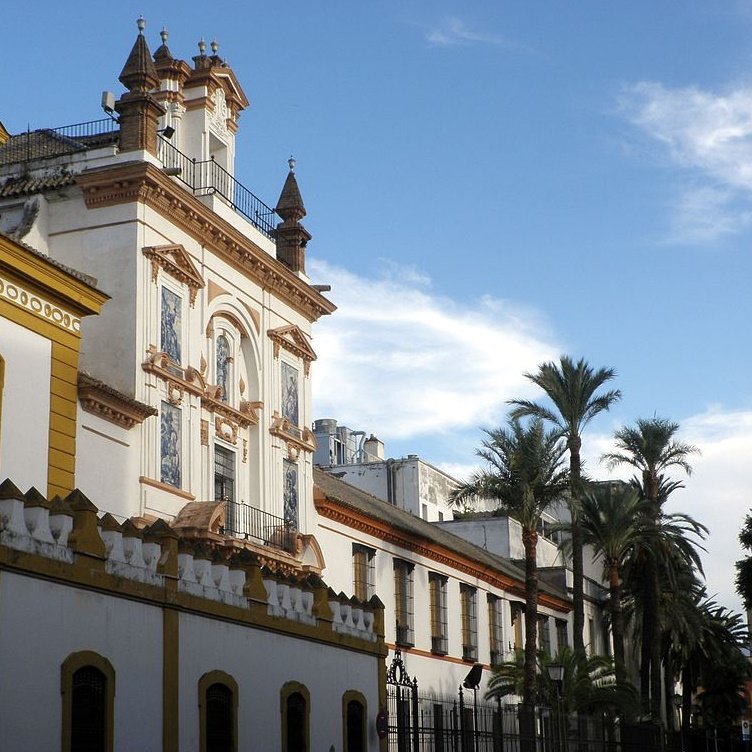
The Hospital de la Caridad is the headquarters of the brotherhood of Santa Caridad, whose purpose is to assist sick people with few resources. It was founded in the 15th century and still carries out valuable healthcare work in Seville today. The architectural complex that has survived to us is mostly dated to the 17th century.

CC BY-SA 3.0

HISTORY

In its origins, the brotherhood was mainly dedicated to paying for the burial of those executed and drowned in the river, functions that expanded over time, increasingly focused on assisting the sick without resources. In the 16th century it is known that they had their headquarters in a small chapel dedicated to Saint George, which was in the same location as the current temple.

It is a space that was part of the old Royal Shipyards of Seville, an immense area of seventeen ships dedicated since the 13th century to the construction, repair and storage of ships. 

In the middle of the 17th century, it was decided to replace the original chapel with a new church and the adjacent construction of a large hospital to care for the sick. For this, the space of three of the ships of the old shipyards was given to them.

The works began in 1645 under the direction of Pedro Sánchez Falconete and received a notable boost when Miguel de Mañara entered the brotherhood, who would be elected elder brother in 1663. 

Mañara was a wealthy Sevillian merchant who found meaning in his life in Santa Caridad after the death of his wife. Various testimonies from the time, including some references from himself, speak of him leading a very disorderly life in his youth, which is why since the 19th century he has been linked to the figure of Don Juan Tenorio, the most universal literary archetype. from among those who emerged in Seville. Tradition has wanted to see in Miguel de Mañara the character on which Tenorio is based, although currently we know that neither the facts of his biography nor his chronology allow us to support this statement.

What is certain is that his arrival to the leadership of the brotherhood was a great boost for it, managing to attract large sums of money donated by the best-placed families in the city, among which Mañara was used to moving. 

The Hospital complex consists of two enormous elongated rooms for caring for the sick, more than 40 meters long, which run perpendicular to Temprado Street. Before them, a rectangular porticoed patio opens, divided in two by a gallery in the center. To the left, and also perpendicular to the street, is the church, with a single nave. It has its main façade at the foot and a side access from the patio.

HOSPITAL

On the outside, the only part that has decoration is the one that corresponds to the church. The rest of the façade is very austere, with hardly any decoration, with the exception of the two pilasters that flank the main door and that support the projection of a small balcony.

After a small hall, you access the first of the two patios, separated only by the passage supported by a gallery of columns that we have mentioned. In all probability they were designed by the great architect of the Sevillian baroque, Leonardo de Figueroa, who is known to have been master builder of La Caridad since 1679.

Both have porticoes on three sides, with the exception of the one that faces the large naves of the hospital. They do so through semicircular arches supported by Tuscan marble columns on the first floor. The second floor is closed, although large protected windows with a small balcony open to the patio, coinciding in location with the arches on the ground floor.

In the center of each patio we find two monumental fountains with allegorical representations of Faith and Charity. They were made in Genoa and it is documented that he commissioned them for this hospital in 1682. 

On the walls of the patio you can admire a set of seven tile panels in shades of blue on white that represent various scenes from the Old and New Testament. They were made in Holland, probably in Delft, at the end of the 17th century and arrived at the hospital as a donation from the Descalzos convent of Cádiz.

CHURCH OF SAINT GEORGE

Facade

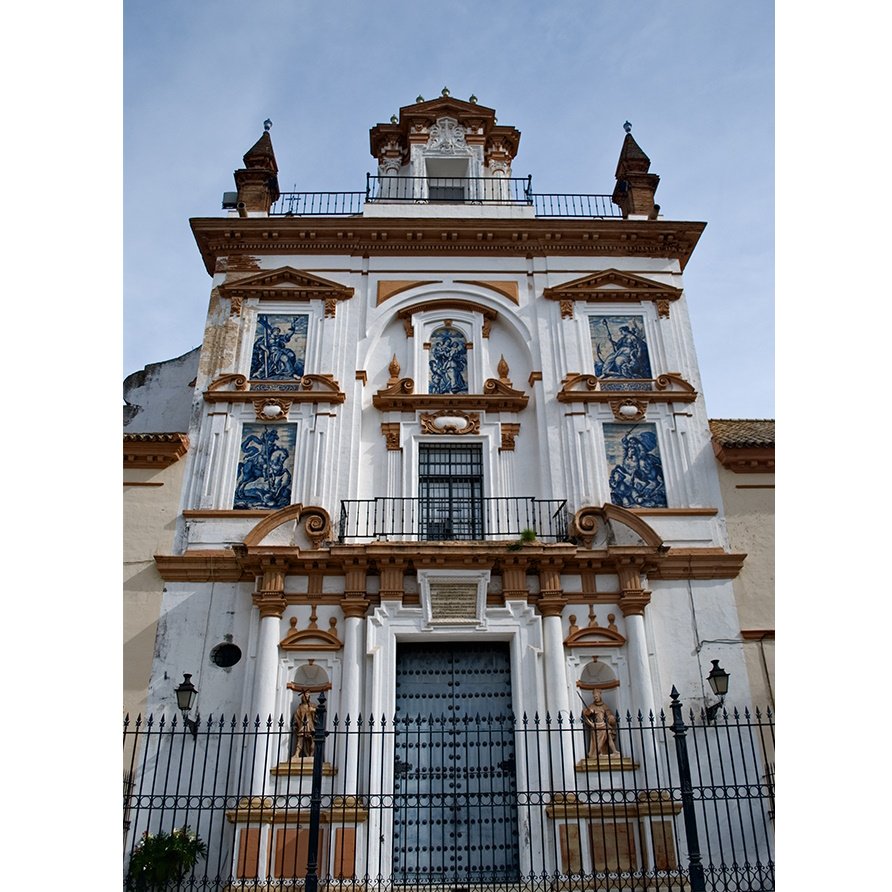
The hospital temple maintained the dedication of Saint George, to whom the primitive chapel around which the brotherhood was founded was dedicated. Its façade stands out from the rest of the hospital for its height and decorative richness, despite its relative simplicity, especially in comparison with the decorative exuberance that we will see inside.

It is arranged following the logic of an altarpiece, articulated on two levels and the architectural elements, such as pilasters and pediments, constitute the main decorative element. Despite its classic lines, it is a façade of great originality, achieved through the combination of white and ocher surfaces, between which five ceramic panels in blue and white tones are arranged.

CC BY-SA 3.0

In the first body, the access door is framed by two pairs of attached columns that support an entablature with a split curved pediment. Between each pair of columns are the baked clay figures of San Fernando and San Hermenegildo, the two saints traditionally considered "patrons" of the Spanish Crown.

On the second level, a balcony framed by Corinthian pilasters opens in the center of the split pediment of the first floor. Above it, a niche houses the central ceramic panel, with an allegorical representation of Charity.

On each side are two other ceramic panels, the lower ones finished with a curved pediment and the upper ones with a straight pediment. On the first level, "Saint Michael against the dragon" and "James defeating the Saracens" are represented. Saint George is the patron saint of the hospital in memory of the chapel around which it was founded and Santiago is the patron saint of Spain. They are arranged here symbolizing saints who "fight against the forces of evil to impose the Christian faith." Above them, the ceramic panels of Faith and Hope, which with that of Charity that we mentioned before complete the three theological virtues. Traditionally, the design of the five ceramic panels has been attributed to Murillo, although due to its formal characteristics it does not seem that this statement has a historical basis.

The façade is topped by a central attic with a straight pediment and two lateral brick pinnacles. These forms are quite common in the Sevillian baroque and their similarity to works by Leonardo de Figueroa has led to at least the completion of the façade being attributed to him.

Attached to the head of the left side of the church is a small bell tower, not very visible given its location. It was built in 1721 under the direction of Leonardo de Figueroa. In it, the architectural elements described on the temple's façade are repeated, on a smaller scale. The original spire is striking, abundant in sculptural and ceramic decoration despite its small dimensions.

Inside

The church has a very simple, rectangular plan, with a single nave and a flat head. It is covered by a barrel vault, except in the central space before the presbytery, which is covered with a hemispherical vault on pendentives, as wide as the nave itself. At the foot there is a high choir, supported by three arches on Tuscan marble columns, the lateral ones semicircular and the central one lowered and wider.

The main entrance is located at the foot and upon entering the church we realize that we are facing one of the most exceptional complexes in the history of art in the city. It is not only a collection of singular works of great merit, but together they form a homogeneous and perfectly coherent discourse with the Baroque world in which it was created.

CC BY-SA 3.0

Iconographic program: works of mercy as a path to salvation

The iconographic program was designed by Miguel de Mañara, with the aim of transmitting the idea of the transience of life and the irrelevance of achievements and material possessions when the last moment comes. It tells us that we are all headed to the same end and only the practice of Christian virtues, among them charity, guarantees the salvation of the soul. The aim was to stir the conscience of anyone who entered the church and promote donations through fear of eternal damnation.

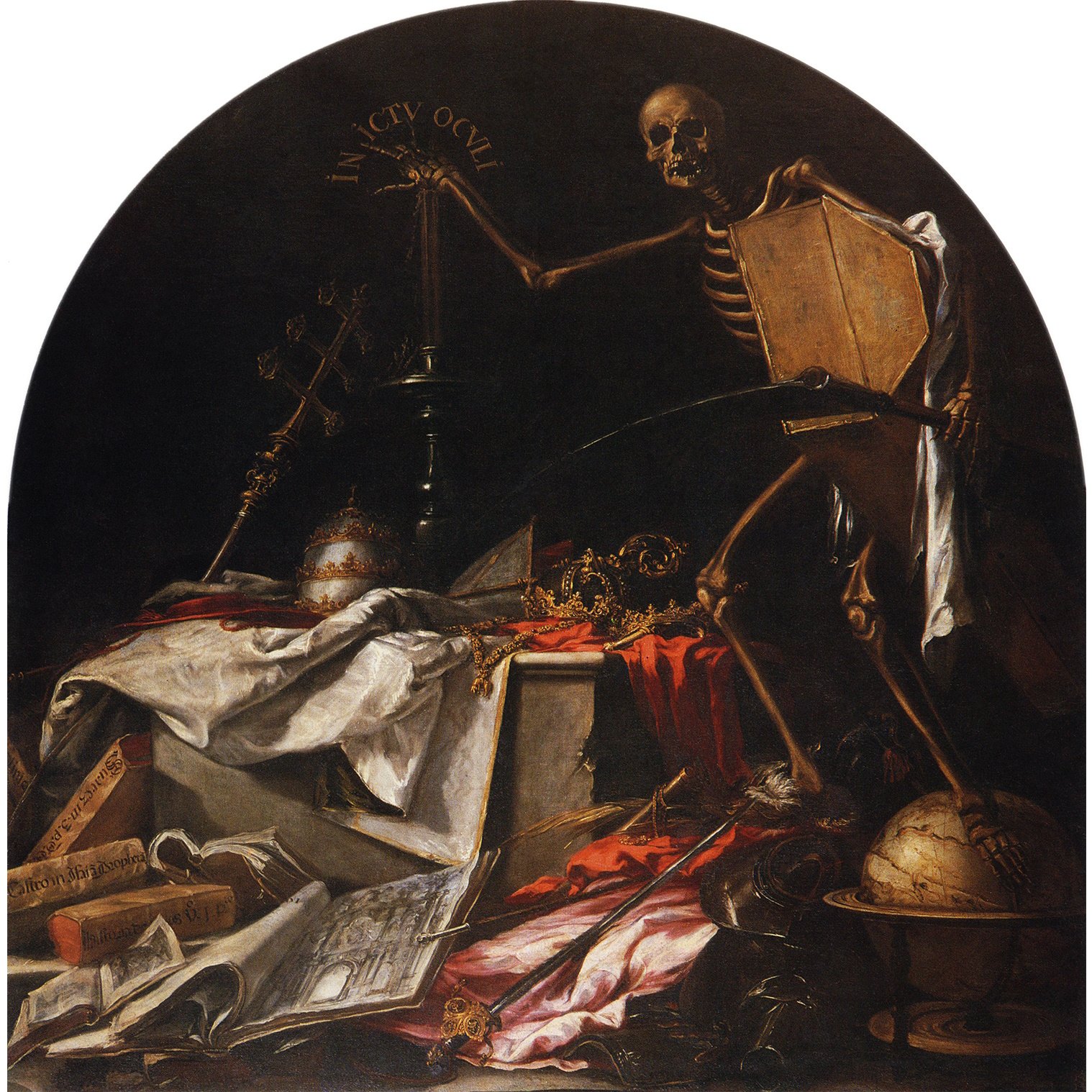
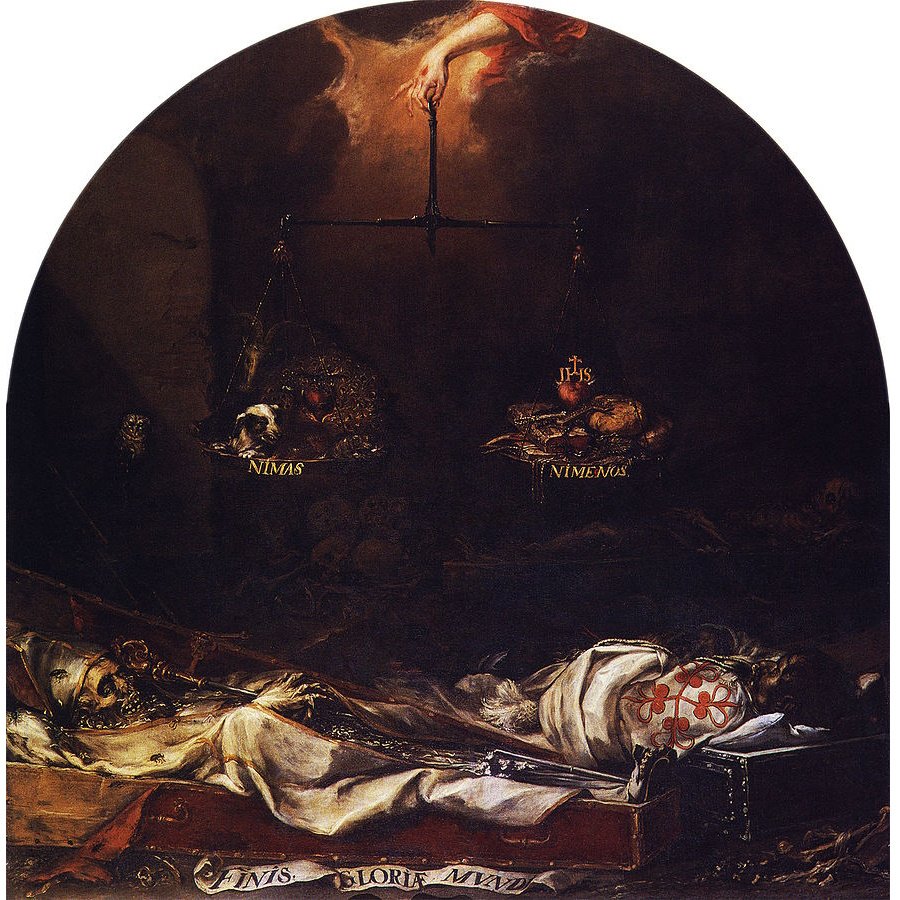
The speech begins with the two canvases that are on both sides as soon as you enter the temple, on two access doors to side rooms. These are two works by Juan Valdés Leal from 1672 that have death as their central theme. They are of such quality that it is not unreasonable to define them as the best works with this theme in the entire history of universal art.

The first is titled "In ictu oculi", which could be translated as "in the blink of an eye". It shows a skeleton holding a scythe in one hand while with the other he extinguishes the flame of a candle, symbolizing that it takes only an instant to go from life to death. Next to him, a series of symbols of earthly glory are piled up: luxurious clothing, a royal crown, a papal tiara, colorful books, scepters, armor... None of all that matters when the final moment comes, death is carried away without respects both for a supreme pontiff and for a humble peasant.

The second painting, located directly opposite, is titled "Finis Gloriae Mundi" ("The End of the Glory of the World"), as can be read on a cloth banner that appears in the foreground. It is set inside a tomb and we see the decomposed corpses of a bishop and a knight of the Order of Calatrava. Despite the deterioration, both show off their richest clothing. From the top, the arm of Christ emerges, recognizable by the stigma in the palm of the hand, holding a scale with two plates. One of them reads "NI MÁS" (no more) and the symbols of the capital sins rest on it. The other reads "NI MENOS" (no less) and holds the symbols of Christian virtues. The message is clear, when the final moment comes, titles, honors or material possessions are of no use, only good and bad actions will be taken into account. He is thus encouraged to do everything possible so that, when that moment comes, the plate of virtues outweighs that of sins.

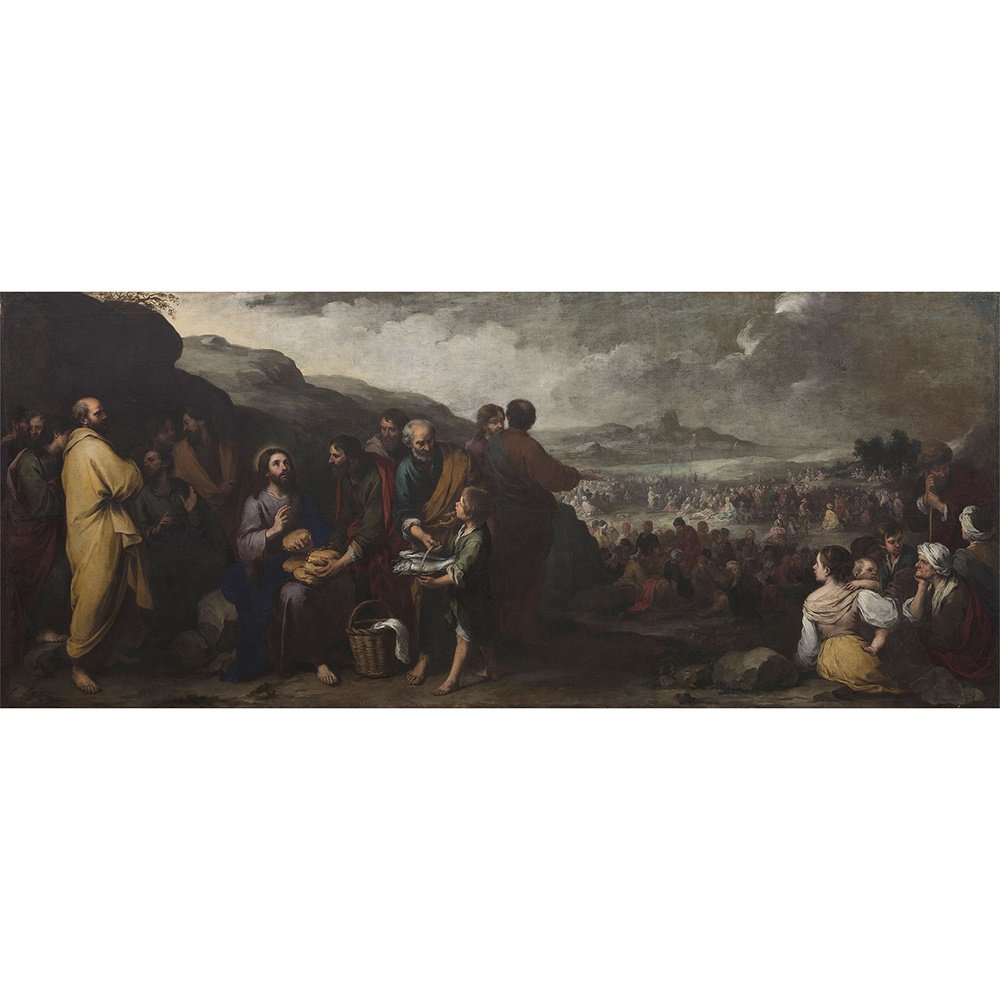
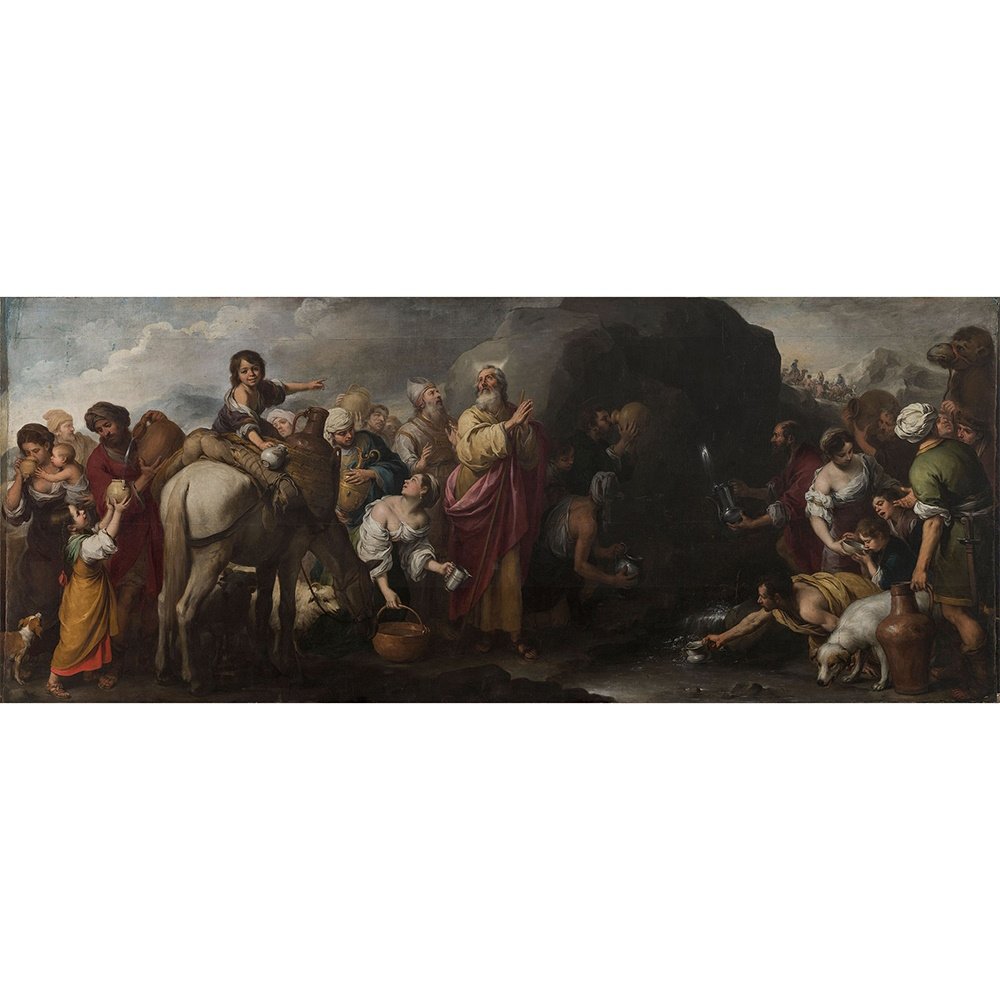
El siguiente hito de esta narración consiste en mostrar el camino a la salvación a través de las obras de misericordia, que nos permiten ejercer la caridad ayudando al prójimo. La doctrina católica define siete obras de misericordia “corporales” y se encargó a Murillo la realización de seis lienzos para representar las seis primeras. Esto es debido a que la séptima, “enterrar a los difuntos”, quedaría representada por el retablo mayor del que hablaremos más tarde.

Hoy las podemos contemplar a ambos lados, en la parte superior de los muros de la nave y del ante-presbiterio. Sin embargo, las cuatro obras originales que se encontraban más cercanas a la entrada fueron sustraídas en 1810 durante la ocupación napoleónica de la ciudad y en la actualidad se hallan repartidas por diversos museos del mundo. De hecho, la talla de los museos en los que se encuentran es un buen indicativo de la calidad artística del conjunto original. Hoy se encuentran dispersas entre la National Gallery de Londres, el Museo de Ottawa, la National Gallery de Washington y el Museo del Ermitage en San Petersburgo.

Desde 2007 se pueden contemplar en la iglesia una serie de copias fidedignas realizadas a mano. En el muro de la derecha se sitúan "La curación del paralítico", que alude a la práctica de atender a los enfermos, y "San Pedro liberado por el ángel", que hace referencia a la obligación de redimir al cautivo. Justo enfrente, en el muro de la izquierda, encontramos "El regreso del hijo pródigo", en referencia al mandato de vestir al desnudo, y "Abraham y los tres ángeles", que alude a la obligación de dar posada al peregrino.

El ciclo dedicado a las obras de misericordia continúa con los dos grandes lienzos situados en la parte superior de los muros del ante-presbiterio. Afortunadamente, en este caso sí que estamos ante los originales de Murillo. A la izquierda vemos a "Moisés haciendo brotar el agua de la Roca", que hace alusión a la obligación de dar de beber al sediento. Justo enfrente, se representa "La multiplicación de los panes y los peces", en referencia al mandato de dar de comer al hambriento.

Main altarpiece

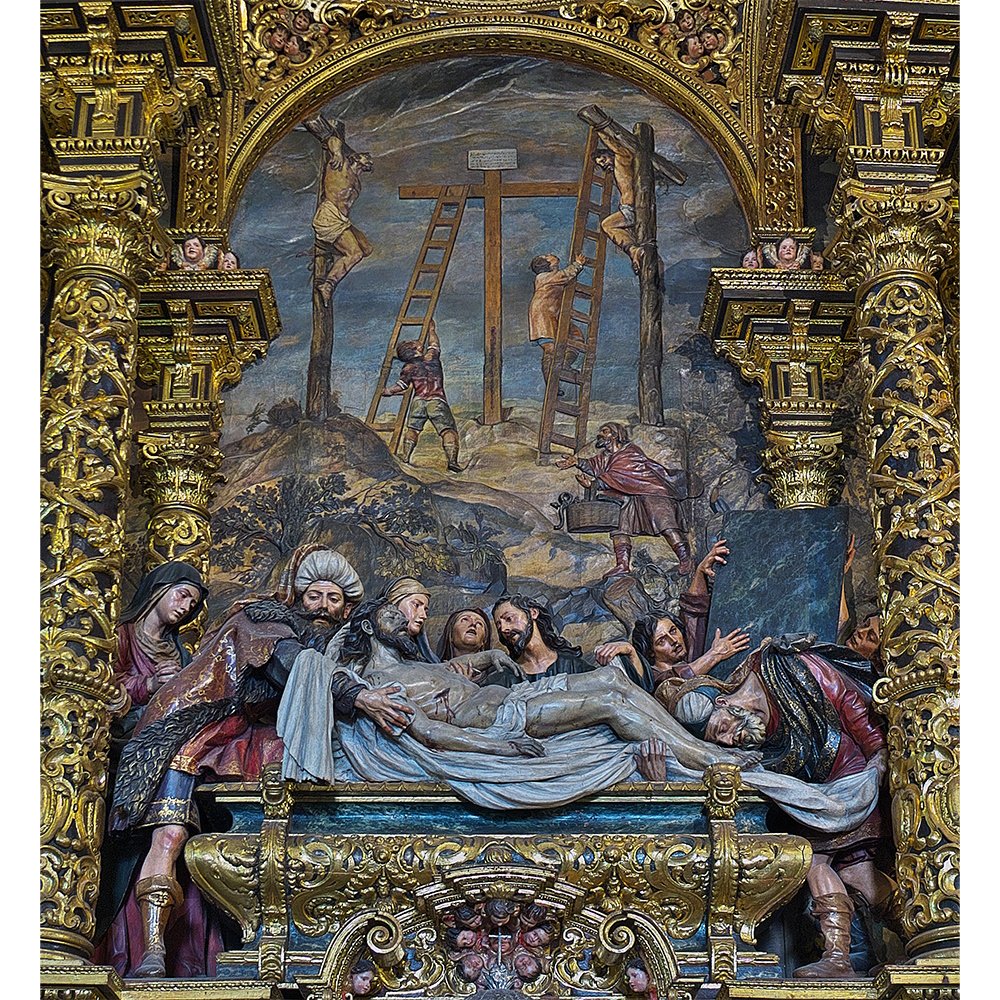
As we said, the seventh work of mercy, "burying the dead", is represented in the church by the central scene of the main altarpiece. It is a set made by Bernardo Simón de Pineda between 1670 and 1674, making up one of the most outstanding altarpieces of all of the Spanish Baroque. 

It is divided into three streets delimited by four beautiful Solomonic columns. The entire center is occupied by the scene of the "Holy Burial of Christ", made by Pedro Roldán, who here executes one of the most accomplished works of his long career. He manages to transmit through the gestures and postures of the characters a great compositional harmony that does not detract from the drama of the scene represented. In the background, and in low relief, there is a dark Mount Calvary, which in a very effective way conveys the sensation of depth and compositional unity of the entire complex.

In the side streets there are San Jorge and San Roque and in the attic the allegories of the three theological virtues appear, from left to right: faith, charity and hope. The entire altarpiece is dotted with a large number of cherubs, child and youth angels, sometimes acting as caryatids, which help to emphasize the sensations of dynamism and decorative exuberance. Crowning the entire complex, a group of four angels hold a cartouche with the name of God in Hebrew.

Other altarpieces and canvases

As we said, the church of the Hospital de la Caridad is distinguished by the high quality of its altarpieces and paintings. The four side altarpieces of the church, like the main altarpiece, are the work of Bernardo Simón de Pineda, a sculptor from Antequera who is among the best sculptors of altarpieces of the 17th century in Seville. The most outstanding canvases are, like those already mentioned about the works of mercy, the work of the brilliant Murillo, who created one of his most outstanding pictorial sets for this church.

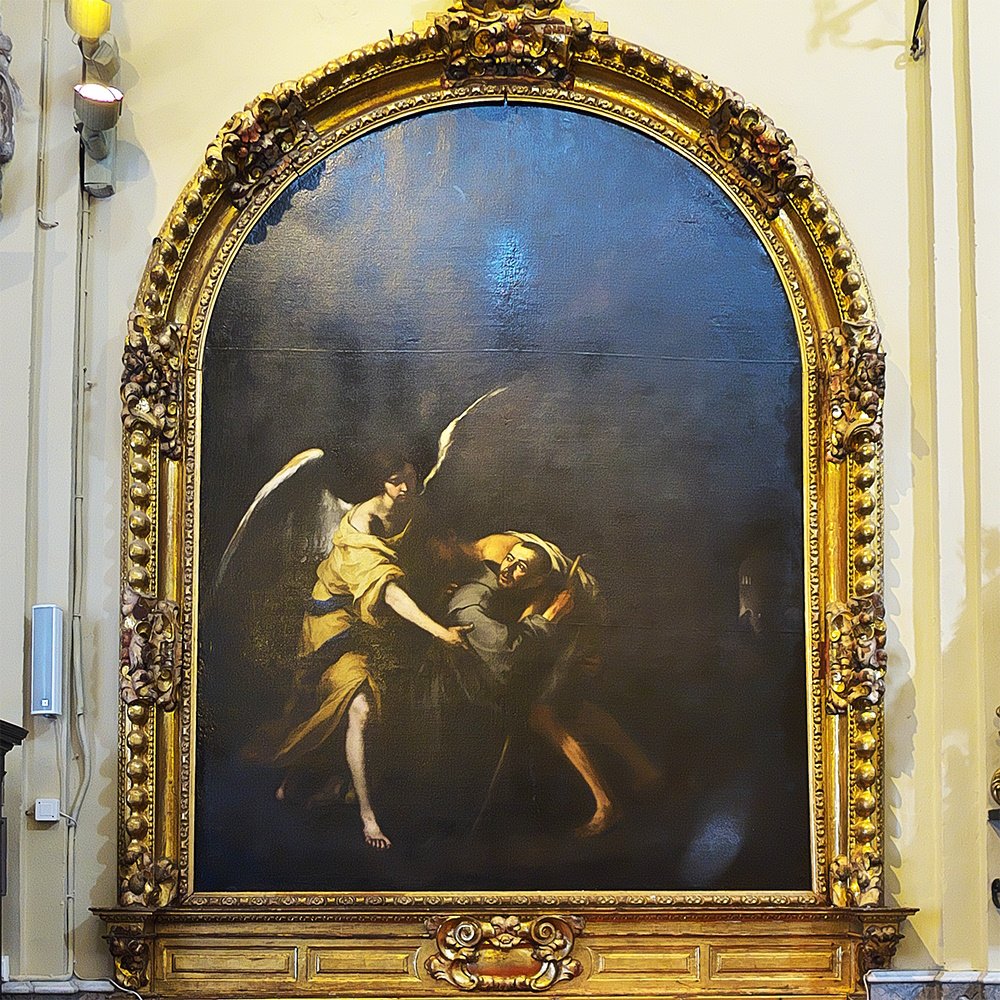
On the left wall, starting from the entrance, there is the canvas of "Saint John of God carrying a sick man", a work by Murillo from around 1662. It is a beautiful canvas that shows an angel helping the saint in his work. assistance to the sick, in a topic closely linked to the function of the hospital.

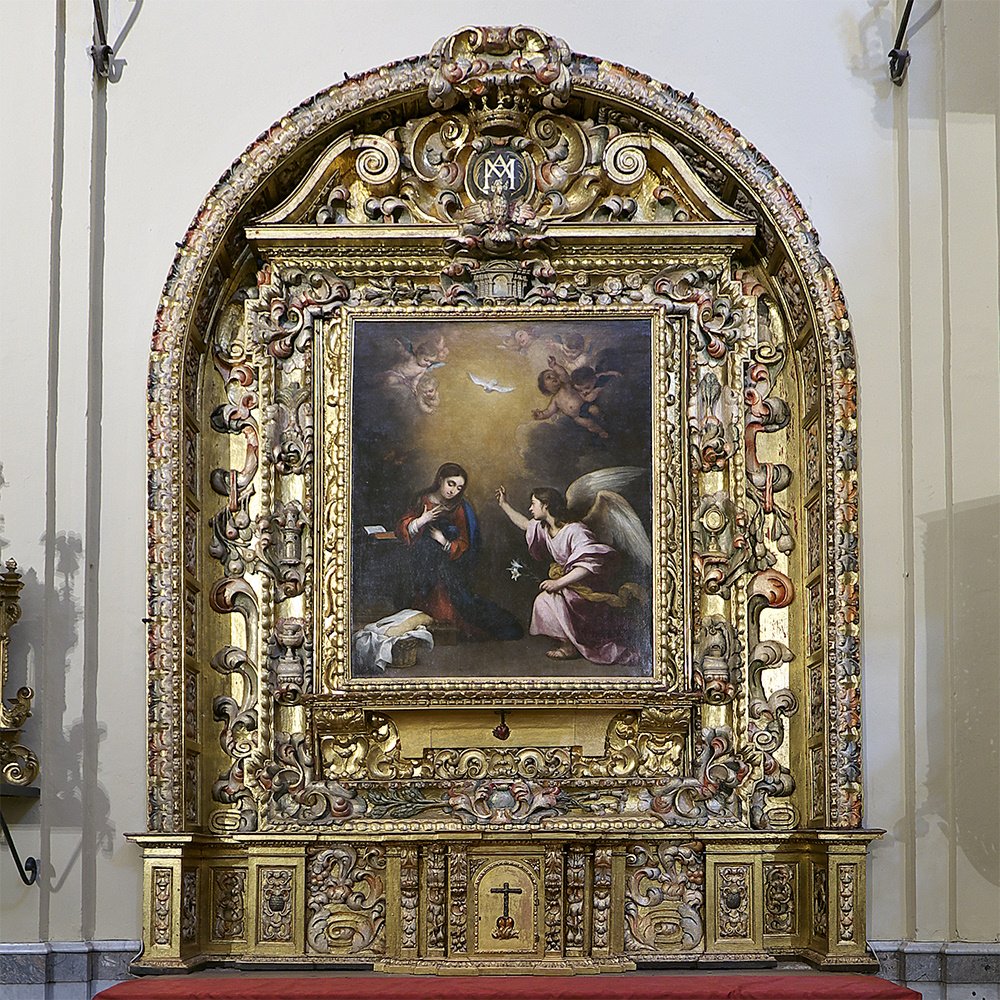
Next is an altarpiece that frames the canvas of "The Annunciation", also a masterful work by Murillo dated around 1670.

Between the nave and the ante-presbytery there is an iron and wood pulpit that stands out for its beautiful design. Culminating it, an allegory of Pedro Roldán's Charity appears and a curious monstrous animal is represented holding the ladder. It is a representation of the conquered evil sculpted by Bernardo Simón de Pineda.

Next, in the ante-presbytery, there is the altarpiece of the Virgin of Charity, presided over by an anonymous image of the Virgin and Child dated to the beginning of the 16th century, in which certain features of the late Gothic period are still noticeable. . In the attic, there is a small canvas by Murillo with the "Salvador Niño", from around 1671, which has been described as one of the most beautiful children's prototypes of his production.

On the right wall, starting again from the foot of the church, we find a beautiful composition by Murillo that represents "Saint Elizabeth of Hungary caring for the stinging." It is dated 1672 and refers to the second obligation of the brotherhood, after that of burying the dead, which was to care for the sick.

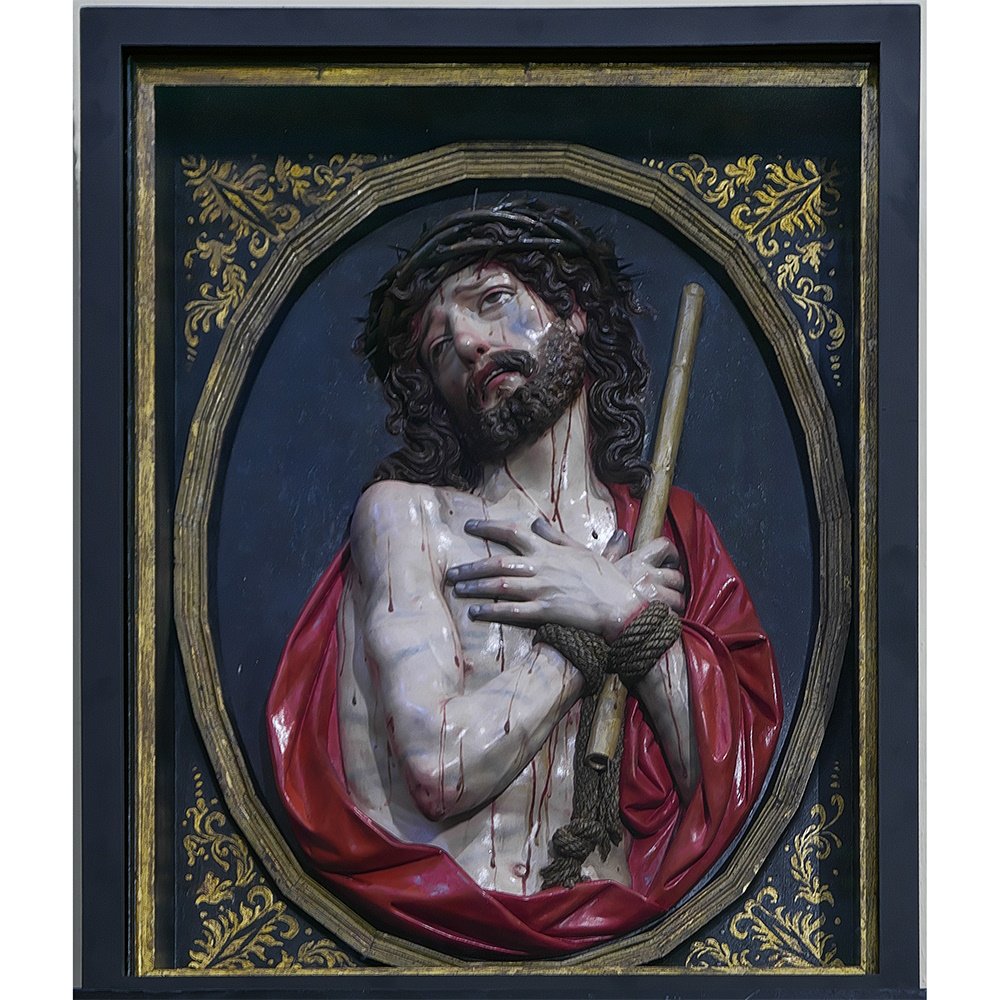
Next we find the small relief of Ecce Homo, made in baked clay by the García brothers from Granada at the beginning of the 17th century.

The next altarpiece is that of the Christ of Charity, presided over by a work by Pedro Roldán that shows Christ kneeling, looking towards heaven, praying in the moments before the Crucifixion. It stands out for its moving face, one of the most accomplished in the sculptor's career.

Already in the ante-presbytery, there is the altarpiece of San José, with an image of the saint carved by Cristóbal Ramos in 1782. The chronological difference with the altarpiece, which is a century earlier, and the small size of the sculpture with respect to the niche, show that it is not the work originally intended for this place. Historically, this altarpiece was occupied by a beautiful carving of Saint Joseph from the 17th century from the circle of Pedro Roldán, which is currently located in one of the Hospital's rooms, the so-called Sala de San José. 

In the attic you can admire another of the jewels that Murillo left in this church, a small canvas of "San Juan Bautista Niño", of extraordinary and tender beauty.

Tempera paintings on the dome and walls

Between 1678 and 1682, Juan Valdés Leal was in charge of the pictorial decoration of the upper part of the walls and the dome of the antepresbytery. 

Under the arches that support the dome, flanking the windows, are represented four "alms" saints, whose holiness derives from their assistance to the poor: Saint Martin, Saint Thomas of Villanueva, Saint Julian and Saint John Almoner. The four Evangelists are represented on the pendentives and on the dome's gallons there are eight beautiful angels carrying symbols of the Passion of Christ.

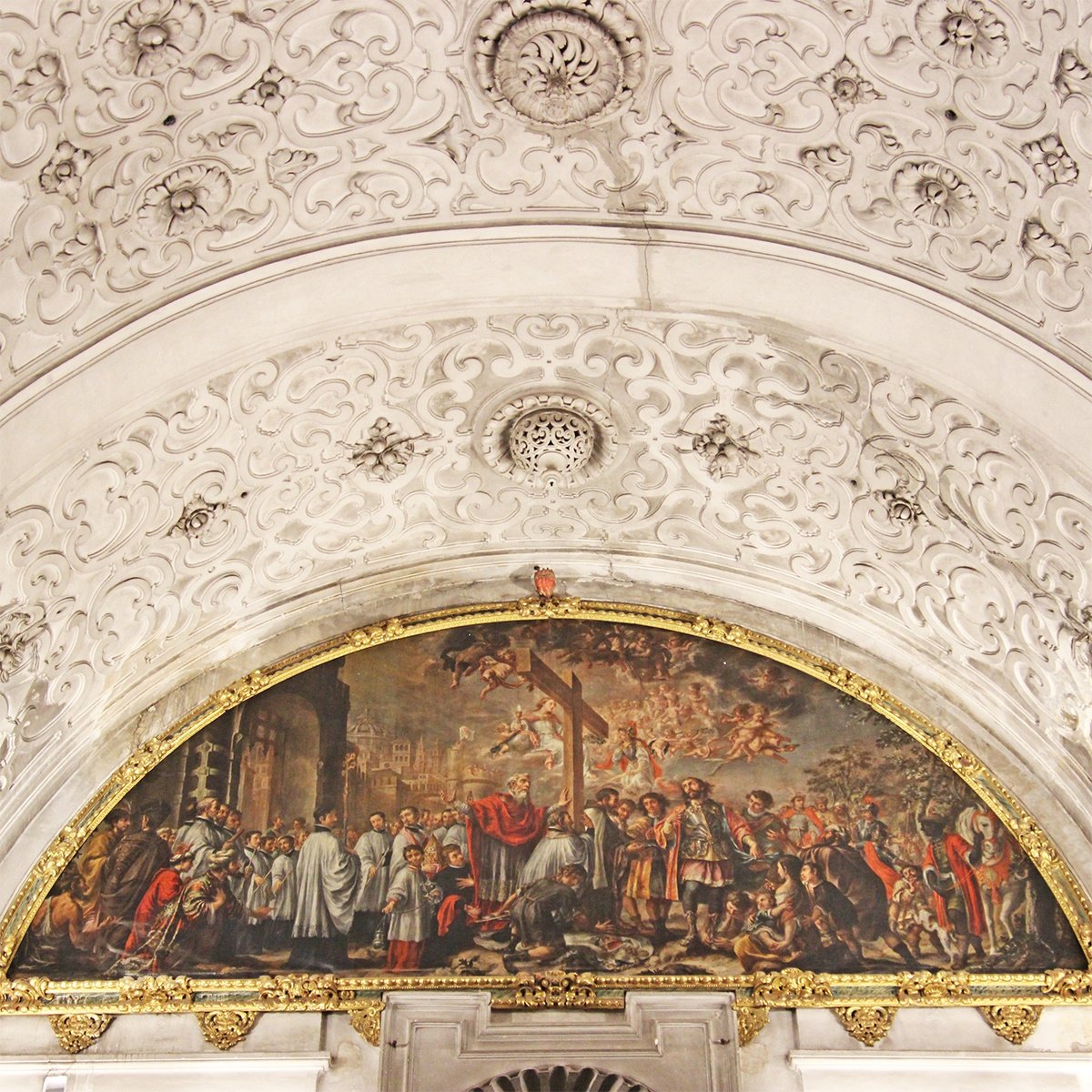
If we look up when leaving the church we can admire one last masterpiece of this church. This is the tempera painting "The Exaltation of the Cross" that Valdés Leal made in 1685 on the semicircular wall under the vault, just above the high choir. His message comes to complete the iconographic discourse that we have been observing in the church. The central idea is the statement derived from the Gospel that no rich man will enter through the gate of the kingdom of heaven. The explanation of the episode represented is quite complex. It is based on a passage from the Golden Legend that Enrique Valdivieso describes like this in the "Guide to Holy Charity":

...tells the moment in which the emperor of Byzantium, Heraclius, after having rescued the Cross of Christ that the Persian monarch Khosrau had stolen from Jerusalem, appears before the gates of this city with the intention of entering triumphantly into she. At that moment several prodigies occurred, first noticing that thick blocks of stone began to fall from the wall and the gates of the city, interrupting the passage of the procession. Also at that moment an angel appeared to the emperor Heraclius and his entourage, telling him that through that door Christ had entered Jerusalem riding on a donkey and accompanied by his humble procession of Apostles, and that he could not make ostentation by entering with his imperial court. dressed in luxurious finery.

The angel's clear and direct message was immediately understood by the emperor Heraclius and therefore he proceeded to take off his clothing, a gesture that his entire procession imitated, as he prepared to enter the city with modesty in his attire and inner recollection; In this way they managed to enter Jerusalem and return the Cross of Christ. The plot of this story, reflected in the painting, points out that in the same way that Heraclius cannot enter the city clothed in his pomp and pageantry, no one will enter Paradise with his riches.

Iglesia de San Bartolomé Sevilla

CHURCH OF SAN BARTOLOMÉ

The church of San Bartolomé sits on one of the places in the city where successive worship as a mosque, synagogue and Christian temple has been confirmed throughout history. A mosque was originally located there, which was converted into a synagogue when the Jewish quarter of Seville was created by order of Alfonso X in the second half of the 13th century.


After the pogrom of 1391, the synagogue located here was the only one that survived, since those located in Santa María la Blanca and in the current Plaza de Santa Cruz became Christian churches.

When the expulsion of the Jews was decreed in 1492, this synagogue suffered the same fate and the parish of Saint Bartholomew was moved here from a nearby location that we do not know exactly. 

The primitive building was used as a Christian temple for several centuries, until in 1779, given its ruinous state, it was decided to demolish it and build the temple that has survived to this day. Therefore, unlike what happens in Santa María la Blanca, nothing remains in the current church of San Bartolomé of the synagogue that occupied this same place.

The works extended until the first years of the 19th century and were directed by José Echamorro, municipal architect of the Seville city council. It is a neoclassical style temple, with a Latin cross plan, three naves and chapels and side rooms.

The main access to the church is through the left side, through a simple neoclassical doorway, with Tuscan pilasters supporting an entablature, with a frieze of metopes and triglyphs and a straight triangular pediment. Just on the other side of the temple, on the epistle side, there is another doorway very similar to the main one in the structure but made of brick.

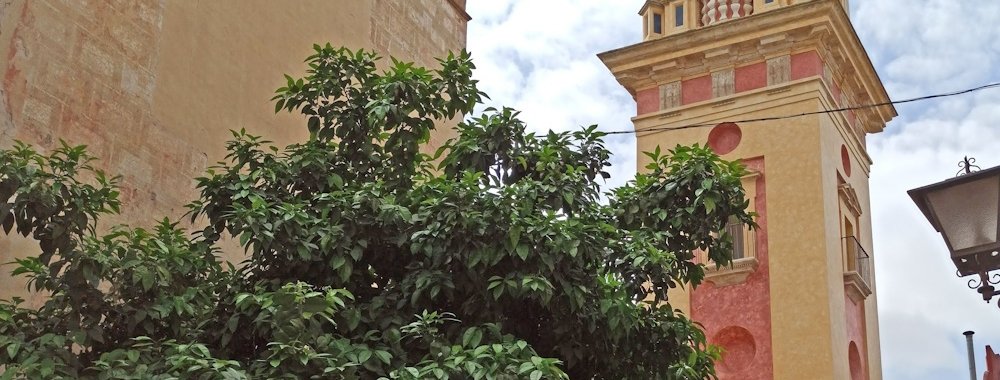
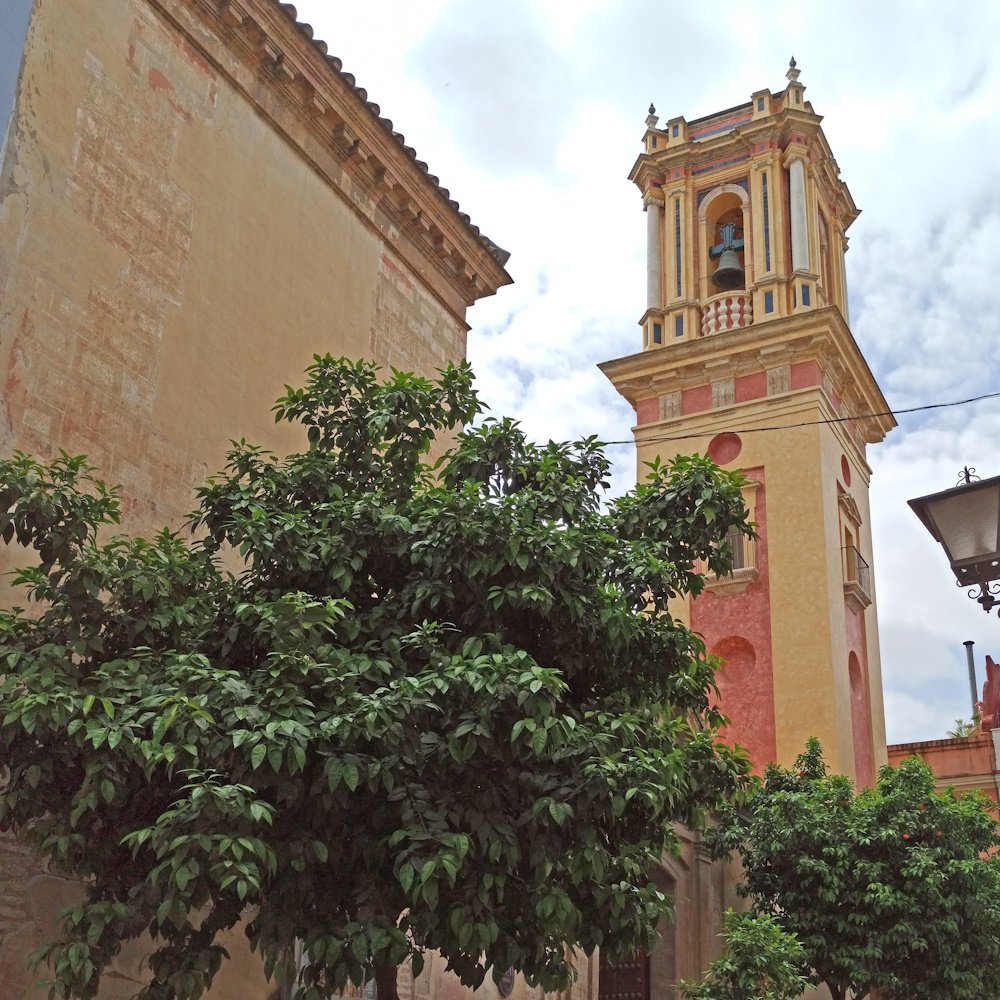
At the foot of the left side is the slender bell tower. Divided into two bodies, its elements also denote its neoclassical character, perhaps masked by its albero and almagra colors, so characteristic of Sevillian architecture. The body of bells is closed by four Ionic columns in the corners. It so happens that this level of the tower is exactly the same in design as what we can find in the towers of San Ildefonso, a temple that was built around the same time as that of San Bartolomé and under the direction of the same architect.

When looking at the tower, it is obvious that some type of finishing is missing from the top. Indeed, it was originally covered by a small dome with a countercurved profile, which collapsed twice. In the last restoration of the tower, its restitution was considered but was finally discarded for technical reasons.

Already inside the temple, the neoclassical air is emphasized by the absence of decoration and the white color of the walls and vaults. The wide naves are separated by arches on pillars. The central nave, notably higher, is covered with a barrel vault with lunettes, which allow the temple to be illuminated through the windows that open at its height. For their part, the side naves are covered by groin vaults.

At the foot of the temple is the high choir with its organ, arranged on a large lowered semicircular arch. 

Above the transept, the large gallon dome stands out, with an octagonal drum in which four windows open that contribute to the feeling of clarity of the temple. The dome sits on pendentives, on which four Doctors of the Church are represented: Saint Ambrose, Saint Jerome, Saint Augustine and Saint Gregory. 

The main altarpiece is neoclassical in style and dates back to the beginning of the 19th century. It is presided over by an image of Saint Bartholomew, owner of the temple, accompanied on both sides by Saint John Nepomuceno and Saint Cayetano. These are baroque carvings by an anonymous author, dating from the 17th century and therefore prior to the altarpiece. From the same period is the image of the Virgin with the Child that is located in the small temple above the Tabernacle. In the attic there is a theatrical representation of the Trinity flanked by angels.

To the left of the presbytery, at the head of the gospel nave, is the Chapel of the Virgin of Joy, with an attractive neoclassical silver altar. The image of the Virgin that presides over it has a legend that dates back its origins to no less than the 2nd century, although the truth is that it has been attributed to the 16th century sculptor Roque Balduque. It was profoundly remodeled in the 18th century and currently has great devotion among the neighborhood's residents. Flanking her on the altar are nineteenth-century sculptures of her parents, Saint Joachim and Saint Anne. 

On the other side of the presbytery, at the head of the epistle nave, is the Sacramental Chapel, closed by an interesting wrought iron grille in which the gilded figures stand out. It is from the 17th century and therefore predates the church. The chapel has an altarpiece from around 1650 that, very unusual in Seville, is ungilded, showing the dark color of its wood. The "Piedad" style that we find in the center is also unusual in Seville. It is by an anonymous author and has been dated to the 16th century, although it is clearly influenced in style by Gothic models from northern Europe.

Accompanying her on the altarpiece are sculptures from the 17th century that represent Saint Francis of Assisi, Saint Ignatius of Loyola, Saint John of the Cross and Saint Anthony of Padua.

Among the remaining altarpieces of the church, the Cristo de las Ánimas stands out, on the right side. It is an altarpiece dated around 1740 structured with stipes, a very characteristic element of 18th century Sevillian altarpieces. The Crucified who presides is a moving and high-quality work that represents Christ already dead on the Cross. It was made at the end of the 16th century by Fernando de Uceda. 

At its feet we find a Dolorosa made by Cristóbal Ramos in 1772. Apparently, it was originally conceived to be kneeling, until in the 19th century Juan de Astorga reformed it to its current position. Traditionally, the resemblance of this image to the Virgen de la Estrella (Virgin of the Star) of Triana has been highlighted, despite the fact that the Triana image is from a century earlier. This circumstance has caused it to sometimes be affectionately called the "Little Star" (Estrellita) of San Bartolomé.


CHURCH OF SAN NICOLAS DE BARI

The current temple of San Nicolás de Bari was built in the 18th century on the site of a previous 16th-century church, which in turn replaced a previous medieval one. The church is located next to what was one of the entrances to the Jewish quarter during the 13th and 14th centuries. It is a site linked to numerous traditions without archaeological confirmation. It is said, for example, that a Visigothic church was already located in this same place and that it could even survive as a Mozarabic temple during the Islamic period.

CC BY-SA 4.0

In any case, we know that the current church was blessed in 1758 and that a good part of its works were paid for by a patron from the neighborhood, Juan de Castañeda.

It is a temple with five naves, the only one we can find in Seville with this layout, with the exception of the cathedral.

To the outside, it has two entrances. The main one, at the foot, is framed by a simple cover in a baroque style with a very classic air. Two Tuscan-style pilasters support a split pediment, in the center of which is a niche with the image of Saint Nicholas, head of the temple. On both sides, the ceramic altarpieces of the holders of the Brotherhood of Candelaria are practically the only decorative motifs on the façade.

As for the side cover, on the left side, it presents characteristics very similar to the main one but on a smaller scale. In this case, in the central niche we can see a stone image of the Virgen del Subterráneo, which is venerated inside the church.

Inside, the five naves are separated by semicircular arches that rest on 18 reddish marble columns of Genoese origin. The naves are covered with semicircular vaults with transverse arches and at the foot of the church there is a high choir, which preserves the stalls and two original organs from the 18th century.

The main altarpiece is in the Baroque style, from the mid-18th century, attributed to Felipe Fernández del Castillo. In it, the Virgin of the Subterranean is venerated over the manifestor. It is a small size by an anonymous author and dates from the 15th century, although it was reformed on various occasions, such as during the 18th century, when the crown and the burst of silver were added.

Tradition has it that this image was found in a cave under the church when works were being carried out in it around 1492. From this circumstance would come the invocation of her as Virgin of the Underground. It shares this nickname with the Dolorosa de la Hermandad de la Cena, currently in the church of Los Terceros, since apparently this brotherhood had its headquarters in this parish during the 16th century.

Continuing with the main altarpiece, the image of San Nicolás de Bari, head of the temple, is located in the central niche, with San Pedro and San Pablo in the side streets. In the attic there is another niche, smaller than the main one, with a Christ on the Cross. The ensemble is finished off by a large royal crown on a glued curtain, an element used in the late Baroque period to emphasize theatricality. The wall paintings in the presbytery are original from the 18th century and reproduce scenes from the life of Saint Nicholas.

On the left side of the church is the Sacramental Chapel, which, in a neo-Baroque altarpiece from the 20th century, houses the titular images of the Brotherhood of Candelaria. In the center, our Father Jesús de la Salud, a work of full size and somewhat smaller than life size, attributed to Francisco de Ocampo around 1615. To his right, the Virgin of Candelaria, a dress image made by Manuel Galiano Delgado in 1924 and remodeled in 1967 by Antonio Dubé de Luque. On the left is a San Juan by José Ruíz Escamilla from 1926.

On the walls of the Chapel there are some interesting canvases, such as the one that represents the Virgin of Guadalupe, the work of the Mexican painter Juan Correa from 1704, or the one of "San Carlos Borromeo giving communion to the plague victims of Milan", the work of Juan de Espinal from 1750.

Returning to the nave, we can see how practically all the walls of the church are covered by a series of altarpieces, mostly Baroque from the 18th century, which give the temple an atmosphere of great monumentality and decorative exuberance.

At the head of the naves on the left there are two 18th century altarpieces dedicated to the Virgen del Patrocinio and the Virgen de los Dolores or "del Camino", an image that probably comes from the old "Ecce Homo" brotherhood, which disappeared in the eighteenth century.

On the other side of the presbytery, at the head of the naves on the right, there are two altarpieces also dating from the mid-18th century. The first of them is dedicated to Saint Joseph, and is presided over by a beautiful carving of the saint made in 1678 by Francisco Ruiz Gijón, famous for being the author of the Christ of the Expiration, the "Cachorro" of Triana. In the mural paintings next to the altarpiece we find two passages from the life of Saint Joseph made by Pedro Tortorelo in 1760.

The other altarpiece is dedicated to San Carlos Borromeo and on its surrounding walls you can see scenes with the life of the saint, made by Vicente Alanís in 1760. The same author painted the vault with a representation of the Trinity between angels.

[mapsmarker map="2"  lat="37.388549" lng="-5.989307" zoom="18" height="300" heightunit="px"]

SANTA MARÍA LA BLANCA

The church of Santa María la Blanca, in the San Bartolomé neighbourhood, is a precious jewel of Sevillian Baroque. It is known that a mosque was built in this same place during the Islamic period and some authors have pointed out that this mosque could have been built on top of a previous Christian church from the Visigothic period. The columns that today frame the small side doorway of the church on Calle Archeros come from this primitive Visigothic temple, although this possibility has not been archaeologically verified.

What is known with certainty is that the mosque was transformed into a synagogue after the Christian conquest of the city. By order of Alfonso X, a Jewish quarter was established in this area of the city, which approximately occupied the area of the current neighborhoods of Santa Cruz and San Bartolomé. In Santa María Blanca one of the three or four main synagogues of the Jewish quarter would be found.

For a long time it was thought that the current temple was completely built in the 17th century, without conserving anything from the previous building. However, various archaeological and restoration work on the building in recent decades have refuted this claim. Apparently, although the baroque reform of which we have spoken completely masked any decorative aspect of the primitive temple, the truth is that the floor plan of the current church and that of the synagogue on which it stands coincide in essentials. And apparently a good part of the walls and arches of the current church also correspond to the primitive work, although their aesthetics were intensely altered by the Baroque reform. This is how the architect Óscar Gil Delgado explains it in “A unveiled synagogue in Seville: architectural study” (2011):

“These prescriptions clearly imply that the walls of the naves of the church were not demolished and that, for this reason, the Mudejar blind arches are found today in the coronation of said walls. No new arches were turned over the new "red jasper" columns, the arches of the central nave were simply lowered, the old columns, which had no stylistic relationship with the new work, were removed and the new ones were placed. Surely the arches of the nave are the same as those of the "Mudejar" synagogue, trimmed, rounded and covered with plaster mouldings, according to the new taste”.

The synagogue would be transformed into a Christian church at the end of the 14th century, after the violent assault on the Jewish quarter in 1391. It would be at this time that the Gothic doorway would be added, which is still accessed today. However, the church that has come down to us responds mostly to the project for its remodeling promoted by Canon Justino de Neve. The works began in 1662 under the direction of Pedro Sánchez Falconete, who undertook the complete remodeling of which resulted in the baroque temple that we can see today.

It is a church with three naves divided by ten Tuscan columns that support semicircular arches. It is accessed through a tower entrance that opens at the foot of the central nave and has a rectangular floor plan. This is altered by a protruding front, in which the main altar is located, and by three side chapels: the baptismal one at the foot of the temple, the sacramental one on the epistle side, and that of San Juan Nepomuceno on the of the gospel of the head.

The main façade of the church is occupied on its first level by a Gothic portal, with the classic characteristics that this type presents in Sevillian churches: archivolts and diamond-tipped decoration. On this body, you can read the Latin inscription "HAC EST DOMUS DEI ET PORTA COELI 1741" (This is the House of God and the Gate of Heaven). The year 1741 refers to the date of certain minor reforms undertaken in the church, when the façade was also embellished and the inscription was added.

On this first level, in a second body, there are two long windows topped by semicircular arches. Above them is a classic belfry with two levels and behind openings for the bells.

The church has a much simpler front facing Archeros street. It is a simple semicircular arch supported by two stone columns with Late Antique capitals, clearly carried and probably used successively in the preceding mosque and synagogue.

Inside, what most attracts our attention is its intense decorative program, in which every last corner is covered with a combination of plasterwork, painting and sculpture, until configuring a space that as a whole appears as the clearest definition of the famous "horror vacui" of the baroque.

Justino de Neve entrusted the pictorial decoration to Murillo himself and the elaboration of the plasterwork to the brothers Pedro and Borja Roldán. The work begins shortly after the Pontifical Brief of Alexander VII of 1661 was promulgated, in which the devotion and cult of the Immaculate Conception was reaffirmed.

In this way, the iconographic program is as a whole an exaltation of the Eucharist and the Immaculate Virgin, as can be seen as soon as you enter the arch that supports the choir, where it reads Without original sin in the first moment of its being. . Murillo intervened with the realization of five canvases, of which only the oldest, "La Santa Cena", is preserved in the church. The others came to complete the iconographic program we have been talking about, with the "Immaculate Conception", "The Triumph of Faith" and two canvases that narrated the history of the foundation in Rome of the basilica of Santa María de las Nieves, a dedication to which is also dedicated to our church.

Today magnificent copies of the originals can be seen in situ, which unfortunately were the object of the savage looting suffered by the city with the arrival of Napoleonic troops in 1810. Among the stolen works were the four that he stole from Santa María la Blanca . Most of what was looted never returned to the city and is now scattered in museums around the world.

The main altarpiece of the church is Baroque and dates back to around 1690. Its main architectural element is two large Solomonic columns, so characteristic of the Sevillian altarpieces of the 17th century. In the central niche is the titular image of the temple, Nuestra Señora de las Nieves, a dress image made by Juan de Astorga at the beginning of the 19th century.

At the lateral ends, the eighteenth-century carvings of Saints Justa and Rufina, patron saints of the city, are located on corbels. In the center of the attic there is another niche that currently houses a rich golden cross, at the foot of which you can see a representation of the Giralda.

At the head of the right hand side we find a Baroque altarpiece from the mid-18th century presided over by the image of "San Pedro en la Cátedra". We see the saint with all the attributes that identify him as the first pontiff of the Church, framed by two child angels holding two of his attributes: the patriarchal cross of the popes and the keys of the Church.

On the wall on this same right side there is a neoclassical altarpiece from the 19th century, presided over by an imposing ensemble of the Trinity. It is the work of the Valencian-born sculptor Blas Molner. On the bench is an interesting small-format Pietà dating from the 18th century.

Also on the right is the sacramental chapel, presided over by an 18th century altarpiece that generally has an image of Saint Joseph from the 17th century in its central niche. On both sides and on a smaller scale, we find the images of Santa Ana and San Joaquin. The altarpiece bench houses a touching "Nativity Scene" made in terracotta, attributed to Cristóbal Ramos.

In the same chapel there is an altarpiece made up of pieces from a previous retable that had been readapted. It houses the images that originally belonged to the old brotherhood of the Sacred Lavatory, which disappeared in 1672 when it merged with the Sacramental of this church. In the center, the Cristo del Mandato, a work in pulp wood, made by Diego García de Santa Ana at the end of the 16th century. On both sides, Nuestra Señora del Pópulo and San Juan, both anonymous images from the 17th century.

In the center of the wall of the left nave (or of the Gospel) we find a valuable original altarpiece from the 16th century, although quite reformed in the 18th century. It frames a large canvas with the representation of "La Piedad", although it has also been identified at times as a "Descent". It is one of the most outstanding artistic pieces in the church, the last known work of Luis de Vargas, one of the most outstanding painters of the Renaissance in Seville. It is dated 1564 and the altarpiece is framed by paintings of San Juan Bautista and San Francisco, also works by Luis de Vargas. At the foot of the altarpiece you can see the tombstone of the family that financed it.

On the same wall is the only work by Murillo that has been preserved in the church: "La Santa Cena", dated 1650. It is possible that the French did not take it away because the truth is that the work is quite far from the traditional painter's style. Here Murillo uses a powerful chiaroscuro, which makes the canvas a tenebrist painting, with the light of the candles as the only illumination on the faces.

On the same wall we find another altarpiece with a modern Sacred Heart and at the bottom of this Gospel nave there is a small chapel behind a grill. In it there is a Baroque altarpiece from the 17th century, with a central image of San Juan Nepomuceno from the same period. On the walls of the chapel there is an interesting "Ecce Homo" from the 16th century, made by an anonymous follower of Luis de Morales. In front of him, an "Annunciation" by Domingo Martínez from the first third of the 18th century.

[mapsmarker map="2"  lat="37.386589" lng="-5.987513" zoom="18" height="300" heightunit="px"]

HOSPITAL OF THE VENERABLE PRIESTS

The Hospital de los Venerables Sacerdotes was built at the end of the 17th century at the request of Canon Justino de Neve, as a place of care and shelter for elderly and underprivileged clergy. Its works began in 1675 under the direction of Juan Domínguez, but in 1687 Leonardo de Figueroa, the most outstanding architect of the Sevillian Baroque, took charge of the project. He would direct the works until the conclusion of the Hospital around 1697.

CC BY-SA 4.0

Currently, the Hospital is the headquarters of the Focus Foundation and the Velázquez Center is located in its rooms, dedicated to the dissemination of the Sevillian painter, exhibiting some works of his authorship along with some magnificent pieces by contemporary authors, such as Murillo, Valdés Leal , Juan Martínez Montañés and Pedro Roldán, among others.


Cloister

The building is articulated around a main patio surrounded by a porticoed gallery with marble columns that support semicircular arches on the first floor. The upper galleries are closed and open onto the patio through large windows with wrought iron balconies, framed between reddish brick pilasters.

In the center of the patio, its original fountain stands out, which is located at a lower level with respect to the rest of the patio. It is accessed through decreasing concentric steps. The explanation of its location is due to the difficulty in the existing water supply in Seville in the past. This location allowed water to enter directly and safely inside. The tiles in the fountain are original from the period, forming a multitude of geometric shapes in blue and yellow tones, very characteristic of Andalusian heritage ceramic art.


Church

The design of the church was drawn up by Leonardo de Figueroa, the great architect of the Sevillian Baroque, to whom such notable works in the city are due as the Church of La Magdalena, El Salvador or San Luis de los Franceses.

In the case of Los Venerables, the temple responds to the traditional form of Sevillian churches from the second half of the 17th century, with a single nave covered by a barrel vault with lunettes and transverse arches. In the presbytery there is a transept, slightly marked on the floor plan of the building, covered in the center by a semicircular vault, ribbed and without drum. This dome is not visible from the outside, as it is covered by a hipped roof.

Although the structure of the church is quite simple, its profuse pictorial decoration based on frescoes, as well as the richness of the works of art that it treasures, make it one of the most important ensembles of the Sevillian Baroque.

The paintings in the church respond to the design of the great Sevillian painter Valdés Leal, although his advanced age meant that a large part of them were executed by his son, Lucas Valdés. In general, those located in the presbytery, in the area closest to the main altar, are considered to respond to the direct execution of Valdés Leal, while those in the rest of the church would have been undertaken by his son Lucas Valdés, although following the design created by his father.

The technique used for the execution of all of them is that of tempera painting, which had already been used by Valdés Leal at the Hospital de la Caridad, with touches in oil.

The iconographic program focuses on the exaltation of the priesthood, in relation to the purpose for which the Hospital de los Venerables was built, as a residence for elderly priests. We also find numerous references to San Pedro and San Fernando, as titular saints of the temple. We see that a very characteristic pictorial effect of Baroque art is used profusely: trompe l'oeil. It is about recreating scenes in illusory spaces extended beyond the architectural space that contains them. Thus, a reality full of light and movement is created, through garlands, fruit sets, vases, jaspers and ovals. Through painting, other materials are simulated, such as tapestries, metal medallions or stone sculptures.

A monograph would be necessary to describe the set of paintings in the church of Los Venerables. As an example, we can cite those located in the vault of the presbytery, above the main altar. There Valdés Leal located a 'Christ the Savior, triumphant of his Passion and Death', represented with great success in the treatment of perspective. He is framed by a triangle, symbol of the Trinity and crowned by the name of Christ in Hebrew. The lower vertex of the triangle falls on the center of a circle, which symbolizes eternity. Located at the feet of Christ, open, the Book of the seven seals, in an image that resembles that of the apocalyptic Lamb. At the sides of Christ, two elderly priests dressed in pontifical adore and incense his body. From the elements of martyrdom located at the feet of these characters, an inverted cross and an anchor, it can be deduced that they are Saint Peter and Saint Clement Pope, which is confirmed by the papal iconographic symbols located in the corners. The allegories of Charity and Humility close this set. These are two virtues that must adorn the priesthood.

The current main altarpiece has nothing to do with the first one that was built in the church; although if it conserves some works that conformed it. The altarpiece that we see today was completed in 1889, being the work of Vicente Ruiz. This is not a particularly fortunate altarpiece in its composition, taking advantage of abundant material from carrying in its structure, especially from the previous altarpiece.

In the main body is the large canvas of the 'Last Supper', which, like the tabernacle, belonged to the old altarpiece. This work, previously considered to be from the first third of the 17th century, belongs to the production of Lucas Valdés. It has a style that is quite different from traditional Sevillian painting, with a rather archaic composition and a gloomy atmosphere.

The upper body of the altarpiece contains three niches with pictorial representations. In the central one there is a canvas with 'The Apotheosis of San Fernando', a work also by Lucas Valdés, although in this case of great quality. Fernando III appears on a pedestal next to the weapons and clothing of the defeated Muslims. San Fernando is flanked by two young matrons who can be identified with Seville liberated and La Paz. On the sides, in the smaller niches, there are two canvases of San Clemente and San Isidoro, made by the Sevillian painter Virgilio Mattoni in 1891.

On the walls of the church, among its rich tempera decoration, there are a series of altarpieces made between the 17th and 19th centuries, which stand out more than for their intrinsic quality because they house a series of interesting sculptural and pictorial works.

To mention just a few, we can talk about two of the altarpieces on the right side. One dedicated to the Immaculate Conception, presided over by a canvas by José María Ruiz y García, from the beginning of the 17th century, or the one dedicated to Saint Joseph, with a beautiful sculpture from the end of the same century and by an anonymous author.

On both sides of the main door, at the foot of the temple, there are two magnificent seated works that represent San Clemente and San Fernando. They are works by Pedro Roldán from 1698 and both were polychromed by Lucas Valdés.


Sacristy

From the right side of the transept there is access to a small sacristy that houses one of the jewels of this Hospital. It is about the paintings of the vault, one of the masterpieces of Valdés Leal. The painter creates an imaginary architecture here, in which angels descend under the balustrade carrying the Holy Cross. Despite the small dimensions of the space, the author manages to convey the sensation of three-dimensionality, to which is added the enormous skill in representing the different textures.


Velazquez Center

The Velázquez Center, promoted by the Focus Foundation, exhibits in some of the rooms of the Hospital practically the only works of the great Sevillian painter that can be seen in his hometown.

Among them, we find an Immaculate Conception that constitutes one of the first known works of Velázquez, who already showed here his enormous capacities despite his young age. The Virgin appears represented following the patterns dictated by her father-in-law Francisco Pacheco and stands out for the great naturalism of the image. Next to it, by the same author are an 'Imposition of the chasuble on San Ildefonso' and a beautiful and masterful 'Santa Rufina', which is perhaps the most emblematic work of the Hospital de los Venerables.

In addition to Velázquez's works, there is a selection of high-quality paintings by contemporary artists. Authors such as Francisco Pacheco, Zurbarán or Murillo are represented, of whom we can admire a magnificent 'Penitent Saint Peter', originally painted for the church of this hospital. The work was stolen by the French during the Napoleonic invasion and returned to Seville in 2014 thanks to its acquisition by the Focus Foundation.

In the same room there is also a View of Seville by an anonymous author and dated around 1660. It is one of the most beautiful historical panoramic views of the city among those that have survived to this day.

Added to the pictorial works are two sculptures by Martínez Montañés, one of the great masters of the Sevillian Baroque, of which an Immaculate Conception and a youthful Saint John the Baptist are on display. Both come to complete the extraordinary artistic collection of the 17th century exhibited in the Hospital.


Upper gallery of the Cloister

In the upper gallery of the cloister, a series of pictorial works are exhibited, mainly also from the 17th century, focused on biblical and landscape themes. Due to their historical value, those located leaving the stairs to the right can be highlighted. They are two works by Lucas Valdés, related to the history of the Hospital de los Venerables. Scenes of assistance to poor priests are represented by valuable gentlemen, who humbly provide this assistance service. Contrast, as can be seen, the presence of high lineage dresses with the threadbare smocks of the elderly priests who seek lodging and care within the walls of the hospital.


Old Nursing

An interesting collection of contemporary painting from the 20th and 21st centuries has been located in the rooms of the primitive infirmary of the hospital.

In it, the works of the Sevillian artist Carmen Laffón stand out in the first place, with her sketches for the official poster of Holy Week, illustrating a detail of the passage of the popular Virgin of Candelaria. In addition, we can see her work Woman seated from behind.

Among other authors, we can also highlight the watercolors of the Murcian painter Ramón Gaya.


In general, it can be a collection that allows us to appreciate the new conception of art in our days, far removed from the baroque themes that are exhibited in the rest of the Hospital's dependencies.
[mapsmarker map="2"  lat="37.385101" lng="-5.989846" zoom="18" height="300" heightunit="px"]

SANTA CRUZ CHURCH

The current temple on Mateos Gago street was originally the church of the Espíritu Santo convent, of the Clérigos Menores congregation. The primitive church of Santa Cruz was located in the current square of the same name, but its demolition began during the Napoleonic invasion, initially moving the parish to the Hospital de los Venerables and in 1840 to its current location.

The church was built between 1665 and 1728 and we know that at least for a while the works were directed by the master José Tirado. It has three naves, with a transept and a flat head.

Its only façade opens at the foot and remained unfinished until the 20th century. Within the general embellishment of the Santa Cruz neighborhood that took place in the years prior to the Ibero-American Exposition, the great regionalist architect Juan Talavera y Heredia designed the current façade, which was carried out between 1926 and 1929.

It is made in a neo-baroque style of great classicism, following the model of some of the Sevillian Mannerist portals, such as the one in the Convent of Santa María de Jesús or the side of the church of San Pedro. The decorative elements also include garlands of flowers and fruit at the top of the pilasters and some ovals framed by the characteristic Baroque rockeries.

In the central niche above the entrance there is a wrought iron cross reminiscent of the 'Cruz de las Sierpes' that today is found in the nearby Plaza de Santa Cruz. Above it, a shield again reproduces a tree cross on a stone Calvary and on both sides, two shields profusely decorated with the symbols of Jesus and Mary.

To finish off the façade, the architect devised a stylized belfry with two heights and three openings for bells. It is practically the same height as the great dome that is located on the transept, which gives the church a characteristic profile.

Inside, the first thing that catches the attention of the church is its great monumentality and neoclassical air, characteristics highlighted by its white color and sparse decoration, a very unusual feature in Sevillian churches.
The central nave is taller than the lateral ones and is covered by a barrel vault with transverse arches and lunettes. The lateral ones are accessed through deep semicircular arches on thick pilasters. A clerestory runs over the side naves, which opens onto the church with wrought iron balconies. This is quite a common feature in conventual churches, since it allowed the religious to attend the ceremonies while preserving their privacy. Above the entrance to the temple, we find a high choir supported by a large lowered semicircular arch.
The wide transept of the church is covered with a semicircular vault on pendentives. The circumstance occurs that the dome has a drum that is very hidden from the inside, even giving the impression that it is a dome without a drum, while it is very marked seen from the outside. Four large windows open in it, which added to those located in the lantern, give the whole a great luminosity.

The head of the temple is flat and has been covered by a barrel vault. At its end, an arch supports the space in which the church organ is located, in a very unusual location in Sevillian temples. It is a magnificent neoclassical organ designed by Antonio Otín Calvete around 1810. In its upper part, there is a beautiful group of angels sculpted in stone holding different musical instruments. Under the organ, there are choir stalls, made at the end of the 18th century, also in neoclassical style.

At the end of the 18th century, within an academic atmosphere rejecting what were considered excesses of the Baroque, it was decided to replace the original altarpiece of the church, which apparently stood out for its profuse decoration and theatricality. Some authors, such as Santiago Montoto in his collection of articles on the "Parishes of Seville", point out that the previous altarpiece was burned down in a fire. In any case, it was replaced by the neoclassical temple that we can see today, made in 1792 by Blas Molner.

It is a dome supported by Corinthian columns, forming a polychrome complex to imitate marble. An allegorical image of Faith is located on the dome and the temple houses the image of the Virgin of Peace, a magnificent Renaissance image attributed to Jerónimo Hernández and dated around 1579. It comes from the old Convent of San Pablo, current church of La Magdalena , and represents the classic iconography of the Virgin with Child enthroned in the manner of Roman matrons. It seems that it was originally conceived as a Virgin of the Rosary and that it acquired the current dedication of Peace when it was transferred to this parish in 1835.

Along the walls of the church there are a series of altarpieces, mostly from the 17th and 18th centuries, which house some pieces of notable artistic value.

You can start by mentioning the altarpiece of the Cristo de las Misericordias, which is on the left side, in the front of the transept. The image is a beautiful anonymous carving from the 17th century, which represents Christ still alive with his gaze directed towards heaven. It has traditionally been located in the circle of Pedro Roldán and due to its composition it is related to the Christ of the Expiration of Triana. He is the owner of the Brotherhood of Santa Cruz, which carries out a procession on Holy Tuesday through the streets of the city.

On that same side of the church, two 17th-century altarpieces made by Bernardo Simón de Pineda can be highlighted, one dedicated to Santa Ana and the other to the Immaculate Conception (although the Immaculate Conception that currently centers the altarpiece is later, from the 18th century). . Along with them, we can mention the altarpiece dedicated to San Francisco Caracciolo, founder of the Minor Clerics. Both the altarpiece and the image of the saint are attributed to Pedro Duque Cornejo, one of the most outstanding sculptors of the 18th century in Seville.

On the right side, we can highlight the altarpiece of the Virgen del Mayor Dolor, designed in the 17th century by Bernardo Simón de Pineda and polychromed by Juan Valdés Leal, although it was reformed in the 18th century adding Rococo-style decorative elements. The image of the Virgin that presides over the altarpiece is a kneeling Soledad also dated from the 18th century, while on the bench there is an interesting painting with the representation of Christ Recumbent.

[mapsmarker map="2"  lat="37.386789" lng="-5.989602" zoom="18" height="300" heightunit="px"]

CHURCH OF SAN BUENAVENTURA

The church of San Buenaventura is a temple built in the 17th century as part of the former Colegio de San Buenaventura and is currently the church of the Franciscan Fraternity that is annexed on its west side.

CC BY-SA 4.0

This article is an excerpt from the extensive description of the temple made for the website of the Brotherhood of Soledad de San Buenaventura.

It is documented that the works of the current temple began in 1622, following the project of the architect Diego López Bueno. However, the church would undergo numerous modifications throughout its history, especially during the tumultuous 19th century. As it has come down to us, it has a rectangular floor plan, with a large central nave and another nave, much less in height and width, on the epistle side.

The exterior is very simple, with hardly any decoration. The entrance is framed by a series of bands in hollow relief, probably initially conceived as a support for a stone doorway that was never built. On the cornice of the main façade there is a space with sloping ceilings, like a belfry, topped by a curved pediment.

The beautiful ceramic altarpiece of the Virgen de la Soledad located to the right of the entrance is practically the only decorative element on the outside of the temple. It was placed in 1952 and is a work of the painter, ceramicist and sculptor Enrique Orce Mármol, constituting one of the most beautiful examples within this art, standing out for its magnificent molding, sculpted by the same author.

Inside, we find a wide main nave, covered by a barrel vault with lunettes, reinforced by five semicircular arches. These rest on very marked cornices, which in turn sit on robust classical pilasters that run along the walls of this central nave. Between them, there is a series of semicircular arches that house five altars on the gospel side and that communicate with the smaller nave on the epistle side.

The area of the presbytery presents a slight widening as a transept and is covered by a hemispherical dome on pendentives, with 24 meters at its highest point and only visible from the inside. At the other end, over the entrance to the temple, stands a large and luminous high choir, supported by very wide lowered arches.

This nave has preserved its rich original decoration based on plasterwork and frescoes, devised by Francisco Herrera el Viejo. The set was carried out between 1626 and 1627, constituting one of the best examples of interior decoration of the Sevillian Baroque. The plasterwork was executed by master builders Juan Bernardo de Velasco and Juan de Segarra, who materialized Herrera's designs based on plant and geometric motifs, interspersed with cherub heads, cartouches, and garlands of flowers and fruit. These reliefs were partially enriched with traces of gold paint, which contribute to enriching and making the interior of the temple more attractive.

Herrera el Viejo himself executed the fresco paintings that, although badly deteriorated, have survived to this day. In the dome, around a central medallion with a relief representation of the Holy Spirit, he arranged the main saints of the Franciscan order: Saint Buenaventura, Saint Anthony of Padua, Saint John of Capistrano, Saint Louis of Tolosa, Saint Peter of Alcántara, San Jacobo de la Marca, San Bernardino de Siena and San Francisco de Asís himself. On the pendentives that support the dome, Herrera has four cartouches with the shields of the Mañara family, a family that exercised important patronage for the construction of the church.

In the center of each of the five sections into which the vault that covers the main nave is divided, we can see ovals with allegorical motifs that allude to the path to communion with God proposed by Saint Buenaventura in his philosophical work, based on a conjunction between knowledge and holiness.

On both sides of each of these symbolic motifs, there is a series of ten portraits of Franciscan theologians and philosophers, such as Alejandro de Sales or Juan Duns Escoto.

The original iconographic program was completed by a series of eight canvases, four by Herrera el Viejo and four by Zurbarán, alluding to the life of San Buenaventura and originally located on the side arches of this main nave. They were looted by the French during the Napoleonic invasion and today they are scattered throughout various museums around the world. The canvases that we can see today in its place are works by various authors, from the 18th and 19th centuries. In general, they represent scenes related to the Franciscan order and, like the frescoes, they are in a much better state of preservation.

The main altarpiece that presides over the church today is not the original, which was also destroyed during the French invasion. The one we can see today is a magnificent Baroque altarpiece from the last third of the 18th century, from the convent of San Francisco de Osuna. It was brought here in the middle of the 20th century and had to be adapted to its new location, smaller than the original, giving the whole a certain concave air.

It stands out for its predominance of curved lines and for the profusion of sculptures of angels and saints, which come to replace the columns as architectural elements to articulate the altarpiece. We see, for example, San Roque, San Pascual Bailón, San Miguel, as well as other saints linked to the order, such as San Buenaventura and San Francisco themselves.

In the center of the base there is a large silver demonstrator temple, framed by the figures of San Juan Nepomuceno and San Lorenzo. In the central niche, an image of the Immaculate Conception known as La Sevillana is venerated, a valuable work by Juan de Mesa from the now-defunct convent church of San Francisco in Seville. In the attic, we can see high reliefs with the Assumption and the Coronation of the Virgin.

As we have already mentioned, on the gospel side, between the pilasters and embedded in semicircular arches, there is a series of five altarpieces, made between the 19th and 20th centuries to replace those that occupied the original chapels, also destroyed during the French occupation.

The first of them, the closest to the High Altar, houses the titular image of the Brotherhood of Soledad de San Buenaventura, a work by Gabriel de Astorga from 1851. Behind it we can see the Holy Cross on Mount Calvario or Cruz de Caño Quebrado, a valuable forge work from the 17th century, around which the Brotherhood was founded in 1656.

The next altarpiece houses a dress image of the Virgen del Carmen, from the 18th century, popularly known as "de la Batata". Originally, this image was worshiped in a small chapel that has now disappeared near the Postigo del Aceite. Apparently, the brotherhood that was in charge of his cult was so humble that to obtain income they auctioned sweet potatoes and other products from the field. That would be the origin of the curious name of this image.

Also from the 18th century are the magnificent high relief of the Coronation of the Virgin and the Immaculate Conception that occupy two of the remaining altars. Both works are of extraordinary quality, especially the Immaculate Conception, which occupied the central niche of the main altarpiece until it was replaced by "la Sevillana". It is a precious image that some authors have located in the circle of the sculptor Cayetano de Acosta, although due to its physiognomy the Italian origin seems more likely than other accounts.

As for the small nave on the epistle side, it shows architectural characteristics that are clearly differentiated from the rest of the temple and is covered by greatly reduced groin vaults. Its current appearance corresponds to the reforms undertaken in the church at the end of the 19th century, coinciding with the construction of the current headquarters of the Franciscan Fraternity of San Buenaventura.

Traditionally it has been affirmed that the church originally had three naves and that the one on the gospel side is currently missing, since it disappeared due to the reforms carried out during the 19th century to create the current Bilbao street.

This was stated by Antonio Martínez Ripoll in his work "La Iglesia del Colegio de San Buenaventura" (1976) and since then it has been collected in various publications, including the "Artistic Guide of Seville and its Province", published by the Diputación.

However, a careful analysis of the temple from the formal point of view, combined with the documentary testimonies that we have from the 17th century, allows us to affirm that the original church had a single large nave with side chapels, a very frequent appearance. in conventual churches during the Baroque.

It would already be at the end of the 19th century, when the Franciscan community returned to take over the temple, when the small nave on the epistle side that has survived to this day would be built.

In it is located, in the first section next to the entrance, the Holy Christ of Salvation, co-owner of the Brotherhood of Soledad de San Buenaventura. It is an image by Manuel Cerquera Becerra from 1935 that clearly draws on the tradition and style of the crucified masters of the Sevillian Baroque.

At the other end of the nave, at the head of the temple, is the current sacramental chapel. It has two neoclassical altarpieces dating from the 19th century, to which María José del Castillo attributes a possible authorship by José Fernández. In the center, a Virgin of Guadalupe is venerated, made by Juan Abascal Fuentes in 1960, a replica of the patron saint of Extremadura and head of her own brotherhood, also based in this church. It is flanked by an anonymous image of San José from the 18th century and a San Francisco from the 17th century, which Matilde Fernández Rojas identifies as coming from the now-defunct convent church of San Francisco, where he would receive worship at one of the side altars that were located at the base. of the main arch that framed the presbytery.

The side altarpiece of this chapel is presided over by a beautiful Baroque carving of the Virgen del Patrocinio, dating from the 17th century and also from the now-defunct convent of San Francisco.

[mapsmarker map="2"  lat="37.389127" lng="-5.997427" zoom="18" height="300" heightunit="px"]