Dibujo de la iglesia de san juan de la palma de Sevilla, portada principal

SAINT JOHN OF THE PALM CHURCH

The church of San Juan Bautista in Seville, generally known as San Juan de la Palma, is located at the beginning of the emblematic Calle Feria. It is one of the temples in the city that have a medieval origin and it is still possible to glimpse some of its Mudejar elements, although today it retains very little of its original appearance.

It is likely that it is located on the site of an old mosque and that during the first centuries of Christian domination the Islamic building continued to be used, adapted to the needs of the new cult. Although architecturally the church does not preserve any remains of that theoretical previous mosque, there are some indications that lead us to think that it actually existed.

The most notable is an inscription, in Arabic and Kufic script, dated around the year 1100, which was found in the church tower until the end of the 19th century and is now kept in the Archaeological Museum. It is a commemorative plaque that recalls the construction of the minaret of the mosque. Says so:

Basmala. Tasliyya. Ha ordenado la gran señora Umm Rasid Abu-l-Husayn Ubayd Allah, hijo de al-Mu´tamid `alá Allah, al-Mu`ayyad bi-nasri-llah, Abu-l-Qasim Muhammad b. ´Abbad (que Dios le ayude asistiéndole y apoyándole, e ilumine a ambos), la erección de este alminar en su mezquita (Dios le guarde), buscando una generosa recompensa. Se terminó, con la ayuda de Dios, bajo la dirección del visir y secretario Abu-l-Qasim b. Hayyay (Dios le favorezca) en el mes de sa`ban del 478. 

[OLIVA ALONSO, Diego; GÁLVEZ MÁRQUEZ, Eugenia; VALENCIA RODRÍGUEZ, Rafael. Fondos epigráficos del Museo Arqueológico de Sevilla. Al-Qantara. 1985, 6 (1-2), p. 451 pp. 462-463, nº 9, lám. V.]

In addition, in an archaeological excavation in the nearby Jerónimo Hernández street, some remains dated around the 11th century appeared and identified as part of a palace from the Taifa period, specifically it was proposed that it could be the mythical al-Mukarram, which is mentioned in the sources as one of the residences of King Al Mutamid.

So it is possible that the hypothetical mosque prior to San Juan de la Palma was linked to this palace and that this specific area was an environment of certain monumentality as a focus of power within the Muslim Isbiliya.

In any case, as we already said, nothing remains of that primitive mosque. The oldest remains that are preserved belong to the Mudejar church, which was built between the 14th and 15th centuries. Specifically, from that time the main portal is barely preserved, towards Calle Feria, the lower body of the tower and the vault of the sacramental chapel. The rest of the building corresponds to successive later modifications, especially in the Baroque period.

It has a floor plan of three naves, separated by five semicircular arches, which sit on brick pillars with a cruciform section. The roofs are made of wood, following the Mudejar model, with the exception of the head, which in addition to being somewhat elevated with respect to the rest of the temple, is covered with a Baroque dome on pendentives. Both the pilasters and the walls of the naves are covered by a base of tiles from Triana, now contemporary. It has three chapels that stand out from the rest of the building, two of which, annexed to each other forming the Sacramental Chapel, are located on the side of the Gospel nave, one of them preserving the original Mudejar vault, although quite modified. The other chapel is dedicated to San José and is located at the head of this same nave.

It has two covers. The main one, at the foot, overlooks Calle Feria and we know the date on which it was commissioned, 1420. It is a Gothic door, ogival and flared. It presents sculptural decoration on the running capitals of the baquetones, with the figures of two lions in the part of the imposts closest to the entrances. The figure of the lion appears repeated in the corbels that support the cornice of the facade. On each side of the entrance arch we find a multi-lobed niche with Mudejar reminiscences, both framed by Gothic canopies. In the center of the façade, above the key, a third niche, this time in the shape of a semicircular. All of them currently empty. On both sides of the entrance, the upper half of the façade is run by adjoining columns, profusely decorated and resting on the heads of animals, one on that of a lion and the other on that of a bull.

The side portal, towards San Juan de la Palma street, is much later, in a baroque style very close to neoclassicism. It has an upper body in the form of a belfry, which serves to house a ceramic panel in which a biblical quote to the figure of the head of the church can be read in Latin. Specific:

NON SURREXIT INTER NATOS MULIERUN MAIOR IOANNE BAPTISTA. MATH XI 11.

(No one greater than John the Baptist has arisen from among those born of women. Mt 11 11)

The church was burned in the events of July 1936, when it lost a large part of the decoration and the belongings that it was hoarding. The main altarpiece, for example, is a rococo work from the 18th century, but it was transferred and adapted here from the church of San Felipe de Carmona, already in 1959. Its central niche houses the image of the Virgen de la Amargura accompanied by San Juan Evangelista, both works by Benito de Hita and Castillo from the second half of the 18th century, although the face of the Virgin is older, probably from the beginning of the same century, and by an anonymous author.

On both sides there are two images of the Child Jesus and Saint John the Baptist, also as a child. Both are high quality images, especially the first, a 1644 work by Francisco Dionisio Ribas, while the second is attributed to his workshop. In the atrium of the altarpiece there is again an image of the Baptist, from the 18th century, this time already represented in adulthood and with his classical attributes.

The church has an important number of valuable artistic works, especially baroque, both sculptural and pictorial. Among them, we can highlight a beautiful anonymous Immaculate Conception from the 18th century, which presides over an altarpiece in the Sacramental Chapel. It has the peculiarity of being originally a high relief, being later modified as a round sculpture.

Another image that we could highlight is that of Nuestro Padre Jesús del Silencio, who presides over the main altar of the same chapel. It is a work attributed to Pedro Roldán from the late seventeenth century and is co-owner of the Brotherhood of Bitterness.

This Brotherhood is one of the most emblematic of Seville and has its headquarters in this church since 1724, being founded in 1696 in San Julián. Some of the ceramic altarpieces that decorate the exterior of San Juan de la Palma make reference to it. Specifically, the one located on Calle Feria, dedicated to Our Father Jesús del Silencio, is the work of Alfonso Orce Villar and was placed in 1996 in commemoration of the third centenary of the presence of the brotherhood in the temple. In the direction of Calle Regina there is another beautiful ceramic altarpiece, under a strong roof tile. In this case, the Virgin of Bitterness appears accompanied by Saint John, a work by Manuel de la Lastra y Liendo from 1918.

To finish this brief review, it seems essential to us to refer to the name by which the temple is generally called. If the church is dedicated to San Juan Bautista, why does everyone know it as San Juan de la Palma. The answer is given by Diego Ortiz de Zúñiga, a seventeenth-century Sevillian historian, who in his Annals on the City tells us that this name comes from a palm tree that was next to it.

Our author goes deeper and includes the narration of a miracle, which happened around this palm, which would support its inclusion in the name of the church. The historical setting for the event would be that of the times of the Counter-Reformation, when both the Catholic hierarchy and the Monarchy were very determined to stifle any focus of Protestantism, heresy or deviation from the official canon.

Apparently, in this environment of religious persecution, a person of different ideas dared to proclaim in front of the aforementioned palm that Mary had not remained a virgin after giving birth, thus contravening the official dogma of the Church. It turns out that this palm tree next to the church was at the time in the middle of the cemetery that surrounded the temple at that time.

Although the protagonist of the story believed himself absolutely alone in that cemetery when he gave his opinion about the Virgin, the next day an old man appeared before the authorities of the Inquisition to denounce him.

The agents of the Court later went to the address that the complainant had given as his address, but only found a young man living there. From the descriptions, the boy realized that the accuser was his grandfather, despite the fact that he had died years ago, finding his remains buried at the foot of the San Juan palm tree.

The conclusion they drew was that this man rose from the dead and went to report to the Inquisition the affront that had occurred on the honor of the Virgin Mary. Faced with the evidence of the miracle, the accused had no choice but to acknowledge the facts, which did not save him from being convicted and executed as a heretic.

Ortiz de Zúñiga himself narrates it like this:

En el cimenterio desta Iglesia, á donde al presente esta la Cruz, antiguamente estaba una palma, al pie de la qual están enterradas muchas personas que en años de pestes se han sepultado allí, donde pasó el milagro siguiente: En años pasados quando hubo en Sevilla muchos hereges, predicó en esta Iglesia un Frayle de la Orden de San Francisco , ei qual dixo que nadie delinquiese contra la Fe, porque las paredes tenían ojos y oidos i la noche siguiente en punto de las doce un Herege que oyó este sermon , haciendo burla de lo que el Predicador había dicho , se llegó á la palma y le dixo: Palma, la Madre de Dios no quedó virgen despues del parto. Otro día por la mañana fué á la Inquisición un hombre anciano, y denuncio contra este Herege, el qual Herege prendieron los Señores Inquisidores, y le tomáron su confesion, y negó: envío la Inquisición en casa del denunciador para que se ratificase, y yendo á buscarlo á su casa dixo un nieto del denunciador, que ese hombre que buscaban había ochenta años que era muerto, y que estaba sepultado al pie de la palma del cementerio de San Juan  con lo qual volvieron á la Inquisición, y dixeron ai Herege lo que pasaba, el qual dixo que era verdad, y que Dios habia permitido que aquel muerto se levantase porque castigaran su pecado, y los Señores lo penitenciáron; Este milagro está escrito en la Santa Inquisición de esta Ciudad.


Dibujo del Laboratorio Municipal de Sevilla, con los nombres de algunos científicos que aparecen en su fachada, como Jenner, Pasteur o Ferrán

THE MUNICIPAL LABORATORY AND THE PIONEERS OF VACCINATION

The Municipal Laboratory of Seville has its main headquarters in María Auxiliadora Street, which is part of the so-called “historic round” of the city. It is a building inaugurated in 1912, the work of the architect Antonio Arévalo Martínez.

It is built in a very original eclectic style and stands out among the surrounding buildings for its monumentality and rich decoration. In it we find elements of clear modernist influence, such as the wavy cresting that runs along the upper part of the central body or the upper semicircular “pediment” on the central balcony, with a curious decoration based on circles. Historicist elements also appear, especially of the Neo-Plateresque type, which at the time was the style preferred by the City Council for public buildings. We see its influence, for example, in the large flames that appear on the upper cornice, or in the richly ornamented "balustraded" columns that frame the main openings of the upper floor.

The Laboratory was created in 1883 in order to ensure the health of the city of Seville, carrying out functions related to hygiene and food. It was about putting a stop through laboratory analysis to the increasing adulterations and counterfeits in food products that had been detected and that led to important health problems. To the analysis of water and food, the functions of the Laboratory include the control of pests, the collection of abandoned animals or the fight against rabies.

At present, this building in María Auxiliadora continues to be the headquarters of some sections of the Laboratory, such as the administration, or the Clinical Analysis and Epidemiology section and the Assurance and Quality Analysis section. In addition, it has a more recent headquarters on the Malaga road, the Municipal Zoosanitary Center. There are the sections related to animal protection and pest control.

The façade of the historic headquarters is covered by a series of eleven posters that collect the names of eleven scientists, noted for their contribution in the field of public health and the fight against infectious diseases. Among them are some of the essential names for the development and application of vaccines since the 18th century.

This is the case of the Englishman Edward Jenner (1749-1823), who based on previous work and practices, was the first to systematically apply a vaccine against smallpox in humans, based on the inoculation of the cowpox virus, a version less severe disease. Jenner made his discovery after observing that milkers who suffered from the bovine version of the disease by contact were later immune to the human variant.

Almost a century later, the Frenchman Louis Pasteur (1822-1895), created a vaccine against cholera in birds based on the previous weakening of the bacteria that causes the disease. In addition, he decided to call it a “vaccine” in honor of Jenner, who published an initial description of his findings in a work called An Inquiry intro the Causes and Effects of the Variolæ Vaccinæ. or bovine). Years later, Pasteur applied the same principle to weaken the pathogenic principle that causes rabies, in this case a virus. He thus developed the first vaccine against rabies in 1885. In these investigations he had the collaboration of the doctor and researcher Émile Roux (1853-1933), who is another of the scientists whose name appears on the facade of the Laboratory.

The Spanish Jaime Ferrán (1851-1929) is another of those honored on the façade. In this case, using very limited resources and closely following Pasteur's research, Ferrán developed the first vaccine against cholera, based on the weakening of the bacteria that causes it, and is also the first bacterial vaccine applied in humans.

In addition to these four scientists, especially prominent in the field of immunology, the names of seven others appear on the cartels, with important contributions in the global field of improving public health. In chronological order, we can mention:

- Antoine Lavoisier (1743-1794), French chemist and biologist, considered the “father of modern chemistry”. His scientific contribution is enormous and he addressed subjects as diverse as animal respiration, photosynthesis or the oxidation of bodies. He enunciated the so-called "Law of conservation of matter" or "Lomonosov-Lavoisier law": matter is neither created nor destroyed, it is only transformed.

- The Swedish chemist Jöns Jacob Berzelius (1779-1848) is also considered one of the "fathers" of modern chemistry. He devised the modern chemical notation system and discovered three elements: thorium, cerium, and selenium.

- The Frenchman Marcellin Berthelot (1827-1907) is one of the most relevant figures in the origins of organic chemistry, when he managed to synthesize numerous organic compounds in the laboratory, such as methane, acetylene and benzene. The important work of him in the beginnings of thermodynamics can also be highlighted, since he was the first to describe the difference between exothermic and endothermic reactions.

-Robert Koch (1843-1910) was a German physician and microbiologist, Nobel Prize in Medicine in 1905. He discovered the tuberculosis and cholera bacillus and established the direct relationship between infection by a microorganism and the development of a disease .

- The year after Koch's, the Nobel Prize in Medicine would go to the Spanish Santiago Ramón y Cajal (1852-1934), considered by many “father of neuroscience”. He stood out above all for his study of nerve cells or neurons, describing for the first time their morphology and connective processes.

- The German doctor and bacteriologist Paul Ehrlich (1854-1915) stood out above all for creating the first effective treatment against syphilis, for which he defined the concept of chemotherapy for the first time.

-Pierre Curie (1859-1906) was a French physicist, pioneer in the study of radioactivity, together with his wife, Marie Curie. Among its practical applications, there are some very important in the field of medicine, such as diagnostic aid, by allowing the obtaining of images of the interior of the body, or the treatment of certain tumor diseases through the application of radiation.

In short, the names on the façade of the Municipal Laboratory of Seville serve us to make a small history of medicine between the mid-18th and early 20th centuries, in addition to serving as a well-deserved tribute to those who, with their work, have helped to save so many lives.

Capilla del Carmen en Triana, Sevilla, Aníbal González

THE CHAPEL OF CARMEN IN TRIANA

The Carmen de Triana chapel stands like a small lighthouse next to the bridge, constituting one of the most recognizable and appreciated architectural elements in the neighborhood.

It is one of the last works of Aníbal González, who completed it in 1928, just a year before his death. This architect is probably the one who has most influenced the appearance of Seville that has come down to us. After some initial works with a certain modernist character, from 1909 it turned to historicism and became the main example of regionalist architecture, which would mark the prevailing aesthetics in the city during the first decades of the 20th century.

His most recognizable and famous works are those made for the Ibero-American Exposition of 1929, such as the current headquarters of the Archaeological and Popular Customs museums, the Royal Pavilion and, above all, the Pavilion and the Plaza de España. This last set, in a spectacular neo-baroque style that combines the use of elements such as brick, ceramic or wrought iron, has become one of the undisputed architectural icons of the city, despite the fact that it is less than a century old. of existence.

The City Council commissioned the architect for this chapel to replace a previous one with the same dedication that existed in the vicinity, where today are the access stairs to the Triana Market. It was a building, also small in size, built in the 19th century to house a small anonymous canvas representing the Virgen del Carmen. When the widening of the bridge platform was undertaken, the road was also widened by the Altozano and for this it was decided to demolish the old chapel in 1918. To preserve the neighborhood's devotion to this image of the Virgen del Carmen, the small temple that has survived to this day. In it, that canvas of the Virgin is worshiped, which was already the object of devotion in the disappeared chapel.

The current temple has two main elements. In the first place, the chapel itself, covered by a hemispherical dome, which in turn is finished off by a small temple that houses the images of Santas Justa and Rufina holding the Giralda between them. On the other hand, there is a small octagonal bell tower. Between them, a rectangular space serves as a connection which, like the main cylindrical space, has its own access.

The entire set is made of exposed brick, some parts of which are arranged forming geometric decorative motifs reminiscent of the sebka panels of the cathedral tower. Both the dome and the temple and tower finishes are tiled with Triana ceramics, with a rich decoration that includes the coat of arms of the Carmelite order, among vegetal motifs and scrolls. The ceramicist from Triana, Emilio García García, collaborated in this work, as he would do with the work of Aníbal González in the Plaza de España.

In the work by Víctor Pérez Escolano dedicated to Aníbal González in 2017, the author describes our chapel like this: This third religious work by the architect is a very interesting work. Of tiny dimensions, it is almost an ideogram, dome and tower, idea of ​​sacred space and idea of ​​call and elevation; we are before some spatial symbols but extracted from their true power, from their real space in short. The Capilla del Altozano, more than a chapel, is a cross of term, a humilladero, a religious memory to the passage of the passer-by who crosses from Triana to Seville.

As we mentioned, the chapel regularly houses the canvas of the Virgen del Carmen, an anonymous work from the 18th century, which had previously been worshiped in the church of Santa Ana and in the disappeared chapel of Altozano. The main body of the Aníbal González temple has a wide entrance that always allows the painting to be seen from the outside. Even today the custom of many Sevillians to cross themselves before it every time they pass through the Triana bridge persists.

Fachada de la casa de Pilatos de Sevilla

THE RENAISSANCE GATE OF THE HOUSE OF PILATOS

The Casa de Pilatos is one of the most outstanding examples of 16th century civil architecture in Andalusia, constituting a beautiful synthesis of Italian Renaissance art and the Sevillian Mudejar style.

Its construction began at the end of the 15th century by the Adelantado Mayor of Andalusia Pedro Enríquez and his wife, Catalina de Ribera, although the bulk of their work was undertaken in the time of their son, Fadrique Enríquez de Ribera, first Marquis of Rate.

He carried out a pilgrimage to the Holy Land in 1518, traveling through much of Italy both on his way out and on his return, a fact that would largely mark the appearance of the palace. He was able to admire great works of the Italian Renaissance in cities like Venice, Milan, Rome or Genoa. In this last city he would commission the sculptor Antonio María Aprile, the tombs of his parents that are in the Monastery of the Cartuja and that would be the first work of Renaissance sculpture that could be seen in the city.

To this same sculptor the magnificent portal that constitutes the main access to his palace. It is made of white marble and reproduces the shape of a Roman triumphal arch, with Corinthian pilasters framing a semicircular arch. In the spandrels there are two classic medallions with the effigies of Julius Caesar and Trajan, both closely linked to the city. In the frieze, between the family's coats of arms, there is a large inscription with metal characters inserted in marble, alluding to the construction of the palace and to this particular portal:

NISI DOMINUS EDIFICAVERITT DOMUN IN VANUM ABORAVERUNT QUI EDIFICANT EAM. SVB UMBRA ALARVM TUVARUM PROTEGE NOS ESTA CASA MANDARON HACER LOS YLUSTRES SEÑORES DON PEDRO ENRIQUEZ ADELANTADO AYOR DEL ANDALUZIA Y DOÑA CATALINA DE RIBERA SV MUGER Y ESTA PORTADA MANDO HAZER SU HIJO DON FADRIQUE ENRIQUEZ DE RIBERA PRIMER MARQUÉS DE TARIFA ASSI MESMO ADELANTADO AÑO DE 1533


The façade is topped by a Gothic-style crest, which apparently comes from a previous palace that the family owned in Bornos. In the central part of this balustrade, there are three pillars, each with a Jerusalem cross and the inscription "4 DAYS OF AUGUST, 1519. HE ENTERED HIERUSALEM", alluding to Don Fadrique's pilgrimage to the Holy Land.

From this pilgrimage, which apparently deeply marked the Marquis of Tarifa, in all probability comes the name of Casa de Pilatos with which the palace is generally known. For a long time there was a legend that the Marquis had reproduced in his home the traces of the palace of the Roman Praetorium Pontius Pilate in Jerusalem and that the name would come from there. In fact, the portico that faces the exterior on the first floor next to this façade is sometimes referred to as the "Ecce Homo" balcony, since it supposedly would reproduce the space where Jesus was shown to the people in the famous biblical passage.

The slightest formal and stylistic analysis of the palace makes it clear that this theory is nothing more than a legend. What does seem more likely is the relation of the popular name of the palace with the famous Via Crucis that starts from it and reaches the temple of the Cruz del Campo, which is still preserved in the current Luis Montoto street.

According to tradition, the Marquis of Tarifa, on his pilgrimage to Jerusalem, would have measured the exact distance that went from the palace of the praetorium where Jesus was tried to the mount of Calvary where he was crucified. This distance would coincide with that between the facade of the palace and the aforementioned temple.

The niche to the left of the main portal, made in the 17th century with colorful marbles of different colors, alludes to this circumstance. It houses a cross, also made of marble, on the sides of which there are two ovals in which it can be read:

In Santa Cruz the Season begins and in that of the Field a very plenary jubilee is won, a plenary indulgence of all sins granted to all the people who, confessed and communed, pray devoutly before the Cross of the Field on the Fridays of Lent. To have the Bull of the Holy Crusade this year

The Hon. Mr. Fernando Afan de Ribera and Enríquez Duque de Alcalá, being an Extrahordin Ambassador. To give obedience to the Holiness of Urban VIII, he granted this jubilee and being Viceroy and Captain General of the Kingdom of Naples, he had this Holy Cross dedicated on this site to start the Station in the Year of MDCXXX

The route between this cross and the humilladero de la Cruz del Campo was marked by crosses with bases that marked the fourteen stations of the Via Crucis. The popularity of this route reproducing the Lord's way to Calvary was such that some authors have related it to the origin of Holy Week in Seville, pointing out that it is possible that this was the itinerary of the first "processions" that took place in the city.

At present, the Casa de Pilatos belongs to the Casa de Medinaceli, and continues to constitute one of the visits of greatest artistic and historical interest among those that can be made in the city of Seville, since fortunately the palace has been preserved as a magnificent artistic synthesis, of which this splendid cover, in a pure Italian Renaissance style, is just a beautiful example.

THE HEAD OF KING DON PEDRO

Pedro I of Castile, called "the Cruel" by his detractors and "the Justiciero" by his supporters, reigned between 1350 and 1366, being one of the monarchs most historically linked to Seville. He established his capital in this city for a good part of his reign and his strong and conflictive character have made it possible to narrate numerous legends linked to his passing through the city even today.

One of the most famous is the one that has left its mark with the name of Cabeza del Rey Don Pedro street and the bust with the figure of him that can be seen in a niche at number 30 of the same. Legend has it that in one of his usual nocturnal raids, Don Pedro met a member of the rival Guzmanes family, supporters of the king's half-brother, Enrique de Trastámara, in the dispute between them for the throne of Castile.

Apparently, they got into a brawl and Don Pedro ended up killing his opponent, fleeing after him, confident that no one had witnessed the event. But an elderly neighbor from the same street was leaning out of her window, lighting herself up with a lamp and she was a witness to the events. The woman could not make out the faces of the knights, but she did recognize the king when he left, since the monarch suffered a slight limp and his knees produced a kind of squeak when he walked that was known to everyone in the world. town.

The following day, the Guzmanes went to the Alcazar demanding justice and, to quell rumors, Don Pedro offered a large reward to whoever was able to identify the author of the deadly attack. He further promised that he would place the killer's head in a niche above the crime scene.

The old woman responded to the appeal, but asked the king for privacy when revealing the information he had. When they were alone, she showed the monarch a mirror and indicated that in it she could see the perpetrator. The king was amazed, she declared that indeed the woman had revealed the responsibility of the crime and that she would comply by placing the murderer's head in the place that she had promised. However, she argued that the murderer was a very important person in the city and that his public exposure could cause disorder, so she arranged for the head to be placed in an oak box protected by a thick fence.

When in 1366, Enrique II managed to seize the throne after killing his brother in Montiel with his own hands, the Guzmanes rushed to open the box to find out the true identity of his murdered relative. It was then that all of Seville was perplexed when they saw that what the box housed was the stone effigy of Pedro I himself, who had used this ruse to fulfill his promise and protect his innocence at the same time.

Finally, it was decided that the monarch's bust would remain, now exposed, in the same place where we can see it today, as a testimony of what happened.

However, the original house where the king's head was located was demolished at the end of the 16th century and the figure of the monarch that we can see today is much later than the events narrated in the legend. It is a bust made by Marcos Cabrera around 1630, commissioned by the city council with the aim of perpetuating the memory of what happened. The sculptor represents Don Pedro in half body, in a pose of great dignity, wrapped in a cape and displaying the royal attributes: the crown, the sword and the scepter.

The original head was rescued from the demolition by the Adelantado Mayor of Andalusia Fernando Enríquez de Ribera, owner of the Casa de Pilatos, and can still be seen today in a niche at the halt of this emblematic Sevillian palace. In this case, the effigy, which is very deteriorated by the passage of time, shows a greater simplicity in its features. You can still glimpse the aquiline nose, a pronounced jaw and short hair that falls in two halves with bangs, covered by a kind of bonnet. The pedestal on which it is located, on which the arms of León and Castile and the name of the king appear, is certainly later.

As a summary, we can say that the head of this Castilian monarch is the central nucleus of one of the many and exciting legends that populate the streets of Seville, enlivened in this case by the stone busts that have survived to this day: both the original , today in the Casa de Pilatos, as the reconstruction of the seventeenth century, located in the place where the events were effectively framed.

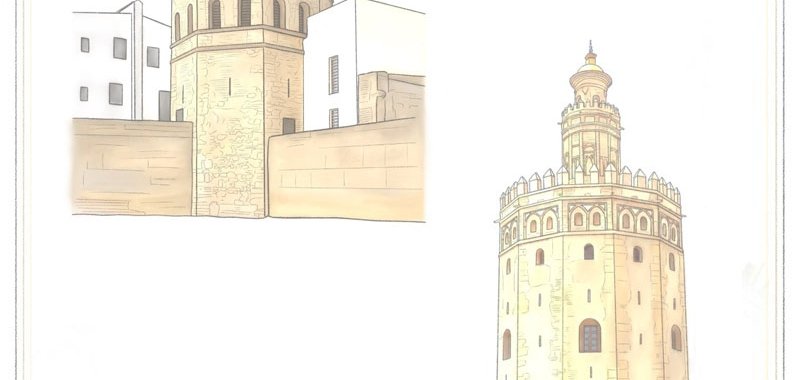
THE GOLD AND SILVER TOWERS

The walls of Isbiliya were notably increased during the last stage of the Muslim rule. Specifically, between the twelfth and thirteenth centuries, the city's walled enclosure was expanded, fully encompassing what is now the old town. Some authors indicate that it was by Almoravid initiative, although it seems that the bulk of the group would already be Almohad. The main fragments that have come down to us are from this period, such as the section that goes from the Arco de la Macarena to the Puerta de Córdoba or the visible canvas in the Jardines del Valle.

Around 1220 the surroundings of the Alcázar were fortified in turn. As part of this process, the Torre del Oro was built to reinforce the defense of the port. It was linked by a wall canvas to the Alcázar complex, so it was possible to get there from the palaces without stepping on the street. Forming part of this fragment that disappeared almost in its entirety would be the towers of La Plata and Abdelaziz, which we can see today on Santander Street and on Constitution Avenue respectively.

The Torre del Oro is the most famous of those that have survived from the walled enclosure of Seville. It was built between 1220 and 1221 and apparently owes its name to the golden effects that its color produced when it reflected with the river, the result of the lime and straw mortar with which it was originally completely covered.

Archaeological studies suggest that only the first body of the tower corresponds to the initial Almohad phase, the plan of which is a twelve-sided polygon. Its upper part is crossed by a frieze with paired windows, today blinded, framed by pointed horseshoe arches, supported by brick pilasters.

It is probable that the series of battlements that top this body are already from the Christian period, probably from the reign of Alfonso X the Wise. There are also doubts about the chronology of the second body of the tower, although in general its construction tends to be attributed to the reign of Pedro I, already in the 14th century. It is documented that this body had direct access from the Alcázar through the upper part of the wall, without the need to go down to the street. Apparently, King Don Pedro made use of this circumstance to use the Torre del Oro as a setting for his encounters with one of his lovers. Given this use that we know, it is likely that he himself ordered the construction of this second level.

In any case, the second body also has a twelve-sided plan, like the main body, but smaller. It presents a beautiful decoration based on polylobed blind arches, alternating on their faces the couplets with the simple ones.

Finally, the body that tops the tower, with its small dome of golden tiles, was added as early as the 18th century, as part of the work undertaken by the engineer Sebastián Van der Borcht to strengthen and embellish the tower after the damage suffered by the Lisbon earthquake of 1755.

From its Islamic origins, the main purpose of the Torre del Oro was to serve as a defensive bastion at the entrance to the Port of Seville. It should be remembered that during most of its history the port stretched between the tower and the Bridge of Barcas, in the place that today occupies the Bridge of Isabel II. Currently, the tower al berga is a Naval Museum, focused on highlighting the link between Seville and navigation, with numerous pieces such as instruments, engravings, nautical charts or models.

For its part, the so-called Torre de la Plata is located in the current Santander Street, and was originally linked to that of Oro by a wall canvas that has now disappeared. They were part of the defensive complex to the south of the city, the port and the surroundings of the Alcázar, along with other towers such as Abdelaziz, which is still preserved on Avenida de la Constitución.

It has an octagonal plan and is simpler than the Gold in its structure and decoration, although in all probability they were built around the same time. What does seem likely is that it was already grown in Christian times, in the time of Alfonso X, during the second half of the 13th century. We know that in Christian times it was also called Torre de los Azacanes. Azacán is a word of Arabic origin that designated those who were dedicated to carrying water using animals. It is probable that on a regular basis he entered the city through the shutter that was next to this tower and that this is where the name comes from.

CHURCH OF THE DIVINE SAVIOR

The church of the Divine Savior (iglesia del Divino Salvador) in Seville is the second largest temple in the city, only after the Cathedral. It is one of the great architectural jewels of the city and inside it houses a magnificent sculpture collection, with works by the most prominent Sevillian Baroque authors.

We know that in the space it occupies today was the so-called Ibn Adabbas mosque, created around 830 as the aljama or main mosque of the city. It held this rank until the new great mosque was built in the 12th century, on the site that is now occupied by the Cathedral.

Some elements of the mosque that was located in El Salvador have been preserved, such as part of its patio and the start of its minaret, which corresponds to the lower part of the tower that we find at the north end, on Córdoba Street.


Once the city was conquered by the Christians in 1248, the mosque began to be used as a church, while maintaining the essentials of its structure. Thus it remained for centuries, with the architectural characteristics of an Islamic temple but serving for Christian worship, as it continues to happen today, for example, with the Mosque-Cathedral of Córdoba.

However, after the seventeenth century, it seems that its condition was quite dilapidated and the construction of a new temple was decided. The works began around 1674, but when the closing of the vaults was being undertaken, a resounding collapse occurred that forced a rethinking of a large part of the project.

Leonardo de Figueroa, the best architect of the Sevillian Baroque, who also took part in other projects such as San Luis de los Franceses or La Magdalena, was commissioned to lead the works. In this case, Figueroa was in charge of closing the vaults, constructing the great dome and finishing the interior of the building. The works were not completed until 1712.

The result is a huge and majestic temple with three naves. The transept stands out notably in height over the rest, although it is not perceptible on the floor of the building, which is called hall.

The main façade has very classic baroque lines, close to the Renaissance forms. The succession of stone pilasters and reddish brick panels achieve the classic bichromy that is so characteristic of many Sevillian buildings since the Lonja, today the Archive of the Indies, was built in the 16th century. Despite its monumentality, the façade of El Salvador stands out for its scant decoration, which contrasts sharply with the interior. The plateresque decoration that runs along the pilasters and some of the moldings is relatively recent, from the end of the 19th century.

But in addition to its architecture, the Church of El Salvador, which was Collegiate until 1852, stands out for the magnificent collection of art that it treasures. It has some of the most outstanding works of the Sevillian altarpiece, starting with the main altarpiece, dedicated to the Ascension of the Lord. It is a work directed by Cayetano de Acosta around 1779, which conceives an exuberant altarpiece, with a baroque profusion close to the Rococo.

Also magnificent is the altarpiece of the Virgen de las Aguas, on the right side of the transept, a work by José Maestre from 1731 presided over by this Marian image of the so-called “Fernandinas”, dated around the 13th century but much remodeled later. They are just two examples of the great collection of altarpieces that this church houses.

And it is that the representation in the temple of great masters of sculpture is exceptional. In all probability, the two great figures of the Sevillian baroque are Juan Martínez Montañés and his disciple Juan de Mesa.

Of the first, El Salvador preserves a colossal sculpture of San Cristóbal, reminiscent of Michelangelo for its monumentality and beauty. But the most outstanding work of this author in El Salvador is surely Our Father Jesus of the Passion, a moving image of the Lord with the cross on his shoulders, which marvelously shows the classicism of Montañés' baroque, by managing to convey all the sentiment and the emotion of the moment, but in a contained, elegant and solemn way. He presides over the silver altarpiece of the Sacramental Chapel and goes out in procession every Holy Thursday. We are not exaggerating when we say that it is one of the most successful representations of Jesus Nazareno in the Spanish Baroque.

From the other great Sevillian baroque master, Juan de Mesa, we find the Christ of Love, who also processions from this temple at Easter, this time on Palm Sunday. It is an exceptional carving of a crucified man, already dead, with a masterful treatment of the anatomy, the hair and the cloth. An exceptional work within the production of its author, which seems to have taken into account for its realization the model that his teacher Montañés made a few years before with the Christ of Mercy that we find in the Cathedral.

Along with these teachers, the list of great artists with works in this church of El Salvador is almost innumerable. We could cite, for example, Duque Cornejo, José Montes de Oca or Antonio Quirós. But for now we finish here this little sketch about the authentic living museum of the Sevillian baroque that is the old collegiate school of El Salvador. We will have more in future deliveries.

And remember that if you are interested in taking a guided tour so as not to miss any of the details, you can get in touch by the way you prefer from this website.

PUREZA STREET IN TRIANA

Pureza street is one of the most emblematic of Triana and surely one of the first that the neighborhood had (Pureza literally means 'Purity'). This is due to the fact that it joined two of its main and oldest landmarks: the Barcas bridge, which was located for centuries where the Isabel II bridge is today, and Santa Ana, the main temple of Triana, ordered to be built by Alfonso X to late 13th century.

The layout of this street is the shortest path between both points, so it is very likely that it was one of the main axes around which the inhabitants of the neighborhood settled their homes.

In fact, we have news that it was already an inhabited area since Islamic times. Archaeological excavations have shown that it was an area with numerous workshops and pottery kilns. In the first centuries of the Muslim Isbiliya, these activities were based mainly around Puerta Jerez and the south of the Avenida de la Constitución, where some authors even place a "potters' neighborhood" due to the amount of remains found.

However, as the palatial rooms of the Alcázar grew larger, these artisans were pushed to more remote areas, since the rulers did not like having them so close to their homes. It must be remembered that pottery was a fairly polluting activity for the time, especially because of the smoke that the kilns would give off.

So surely it was in this context that the potters began to settle on the other side of the river. In addition, with the construction in 1171 of the Barcas bridge, the traffic of both people and their goods between both banks was facilitated.

Apparently, clay work continued to be a characteristic activity of the neighborhood and specifically of this area after the arrival of the Christians. In fact, it would receive a new boost from the end of the 15th century, when the famous Niculoso Francisco Pisano settled on land at the current number 44 of the street.

This ceramist of Italian origin is an essential figure to understand the history of Triana and Seville ceramics. He introduced a new technique that consisted of painting directly on glazed tiles in white before firing, as if done on a canvas, which meant a greater formal and thematic variety. In this way, not only geometric or plant motifs could be represented, but also more complex scenes, with landscapes and characters. In fact, Pisano is considered one of the first introducers of Renaissance art in the city. The commemorative panel that we can see in the aforementioned building recalls it like this:

At the end of the 15th century, the ceramist Niculoso Francisco Pisano established his workshop and furnaces on the grounds that this building occupies. The pioneer introducer of the Renaissance and of a new ceramic painting technique that made Triana and Seville famous for the perfection achieved in this industry.

In the church of Santa Ana, located not far from this site, we find the first conserved work of Pisano. It is about the mysterious sepulchral lauda of Íñigo López. In it, his character appears reclining, with his hands crossed at the waist and a cross on his chest. He supports his head with a white cushion with tassels in the corners and in the frame you can read the name of the author, that of the figure represented and the year of his realization (1503). The part in which the profession, title or position of the deceased could be read was erased since ancient times, which caused the appearance of legends about his origin. The most commented is the one that identifies him with a slave who was murdered by his owner. The latter, repentant of his action, would have commissioned Nicoloso Pisano to bury him in the main church of Triana. From this story comes the custom of calling Íñigo the Negro from Santa Ana.

For some strange reason, for a time it was customary for women wishing to find a partner to hit him in the face with a shoe, following a rare superstition. This caused a great deterioration in this part, which fortunately could be partially rebuilt with the deep restoration that was undertaken in 2016.

In addition to the pottery activities, the proximity to the river made activities related to fishing and navigation very important in the area from very early on. In fact, at the end closest to the current Troya street, a fishermen's neighborhood was located that became known as the San Sebastián neighborhood. With the discovery of America and the new overseas vocation of Seville, these activities would be increased with the work in the repair of ships and the transport of goods. There are several engravings from the 16th and 17th centuries where large ships appear stranded in the area of ​​what is now Calle Betis, while they are undergoing repairs.

In fact, in this same street the university of Mareantes would have its first headquarters, which was created in 1556 by guilds of mareantes to provide training in tasks related to navigation. It was thus a question of coping with the growing demand for labor in these areas, produced by the expansion of American trade.

It was located on the site that today occupies the Casa de las Columnas. However, the magnificent baroque and neoclassical building that we see today is a palace built in the 18th century, once the university had moved to the San Telmo palace.

The street has other buildings from the 18th and even the 17th, but most of them are from the 19th and 20th centuries. In any case, even in the most recent reforms, buildings have generally been given a fairly uniform aesthetic sense around nineteenth-century houses, which endows the street as a whole with a certain very beautiful harmony.

There is a beautiful example of Mannerist architecture, which almost always goes unnoticed among its facades. It is the so-called Quemá house, at number 72. It is a late 16th century palace, now converted into a housing corral. It could be the residence of some position of the Inquisition, or even the seat of one of the offices that depended on the central headquarters, in the castle of San Jorge. It has even been said that Torquemada himself lived there and that the nickname of Casa Quemá would come from there.

In any case, its cover is a beautiful example of mannerism in Sevillian civil architecture. It is composed of a large lintel span, with a frame of padded ashlars. In the upper part, a frieze of triglyphs and metopes and a split curved pediment, with each of the parts forming scrolls. Above it, a covered attic with a triangular pediment. In the center, two angels in beautifully mannerist postures hold an ornate but empty oval shield.

Finally, we could refer to the name of the road, Purity. Although it existed since before, the first mentions of the name of the street that appear are from the early sixteenth century, when it was called Calle Ancha de Santana. With this name it remained for centuries, until at the beginning of the 19th century it began to be called Larga de Santana.

It was renamed Calle Purza in 1859, on the fifth anniversary of the proclamation of the dogma of the Immaculate Conception of Mary. However, Seville was long before a firm defender of the belief that the Virgin came into the world without the original sin with which we mortals come. So she was conceived pure, undefiled, Immaculate.

On the facade of the Chapel of the Sailors there is a beautiful reference to this dedication of the street. It is a small clay sculpture of an Immaculate Conception, which is located in the central niche above the door. It is a work by Antonio Illanes Rodríguez from 1962. This sculptor stood out above all as an image maker and from him we can admire works in procession during Holy Week in many parts of Andalusia. For example, in Seville the Christs of the Waters and of the Lanzada are his works, as well as the Virgen de la Paz of the brotherhood of El Porvenir.

In this case, Illanes depicted a Virgin in youth, with rounded and simple shapes that achieve a very sweet harmony. As attributes of the Immaculate, she shows her hands gently crossed over her chest and at her feet there is a crescent moon, which is barely visible at the foot of the street.

It was located there at the completion of the reform works that allowed the brotherhood of Esperanza se Triana to return to its old headquarters, which it had had to abandon in 1868. During the intervening period, the brotherhood was located in San Jacinto. When choosing the theme for the central niche of its façade they wanted to refer to one of its headlines, since its full title is Pontificia, Real e Ilustre Hermandad y Archicofradía de Nazarenos del Santísimo Sacramento y de la Pura y Limpia Concepción de la Blessed Virgin Mary, of the Holy Christ of the Three Falls, Our Lady of Hope and Saint John the Evangelist. So the little Inmaculada de Illanes has all the coherence in the façade of the chapel, not only as the holder of the brotherhood, but as an invocation to which the street on which it is located is dedicated.

Over the years, the Capilla de los Marineros has become the main visitor attraction on Pureza Street, because the beautiful image of Esperanza de Triana is one of the main Marian invocations of Seville and the that more faithful moves in his neighborhood. Coming to visit it at its headquarters is always an opportunity to enjoy the historical and artistic wealth of the emblematic environment in which it is located.

Dibujo de la giralda de Sevilla con detalle del campanario de Hernán Ruiz

THE GIRALDA OF SEVILLE

It is about 104 meters high, making it the tallest cathedral tower in Spain and was the tallest building in the country for centuries.

The lower two thirds of the tower are from the Islamic period, Almohads from the 12th century. It began to be built using reused ashlars from Roman, Visigoth and Abbasid monuments, but it was soon decided to continue it in brick.

Each of its sides is decorated with sebka, which form a kind of rhomboid geometric interlacing. In the central axis of each side there are a series of openings with a central mullion framed by arches with different shapes.

Around 1198, four large bronze spheres, superimposed and of unequal size, were placed at the top, which were placed by order of the Caliph Abu Yaacub al-Mansur, to commemorate the victory over the Christians in the Battle of Alarcos. They finished the tower until 1356, when they collapsed due to a great earthquake. By then, the city had already been in Christian hands for more than a century.

The Giralda has two clear stylistic references in Morocco: the minaret of the Koutoubia mosque in Marrakech and the Hasan Tower in Rabat, both also built in the 12th century.

The upper third is in the Renaissance style and was built in the 16th century under the direction of Hernán Ruíz el Joven. It also has several bodies, the first of which houses 24 bells and is topped by the so-called terrace of the lilies, by the four large jars of lilies made of bronze placed in each of its corners. A little higher up is the bell of San Miguel de las Victorias. Dated in 1400, it is the oldest that the cathedral has and is in charge of giving the hours of the clock.

Topping the body that houses it, there is a frieze that reads TURRIS - FORTISSIMA - NOMEN DNI - PROVERB 18 (The strongest tower is the Name of the Lord, Proverbs 18).

The whole of the tower owes its name to the weather vane that culminates it and that today we know as Giraldillo. It was made in 1568 and is an allegory of the Christian victory over the Arabs, although throughout history it has been called in descriptions in various ways, such as the Victorious Faith or the Triumph of the Church.

Dibujo del cuerpo central de la Plaza de España de Sevilla

THE PLAZA DE ESPAÑA IN SEVILLE

The Plaza de España in Seville rises majestically at one end of the María Luisa Park, constituting a beautiful space in the city and one of its essential visits, despite being less than a century old. Its construction began in 1914 with the aim of serving as the central area for the Ibero-American Exposition of 1929. It is the most monumental work of the brilliant architect Aníbal González, who directed his works until 1926, and is probably the most outstanding example of regionalism.

The building is the largest of those built in Seville during the 20th century and is built in a style reminiscent of the Renaissance and Baroque. It takes place around a large semi-elliptical plaza, with more than 30,000 m2 of surface, symbolizing the embrace of Spain to the Ibero-American peoples.

It consists of a central building from which the two arcaded wings that delimit the square start, with two beautiful neo-baroque towers 74 meters high at each end. The construction of these towers was very controversial at the time, since from some sectors they were considered excessively high and it was believed that they could compete with the Giralda in its dominance over the landscape of the city.

In the central part of each of the wings there are two buildings that balance their great length and give the whole a great harmony despite its enormous dimensions. The rest of the building is covered by a porticoed gallery, with semicircular arches supported by paired marble columns, which give the complex a Renaissance air.

The square is crossed on its edge by a channel of 515 meters, navigable with small pleasure boats. It is crossed by four bridges with rich ceramic decoration, which are named after the four historical kingdoms that made up Spain: Castilla, León, Aragón and Navarra.

The building was built mainly in exposed brick and shows like no other the trait of regionalist architecture that makes it turn to local industries and crafts for decoration. In this way, in it we can admire wonderful examples of sculpture, glazed ceramics, carpentry or forging. It must be remembered that the Ibero-American Exhibition as a whole represented a notable boost for these traditional Sevillian sectors, as they needed a huge production to deal with the construction and ornamentation of the numerous pavilions that made up the exhibition.

The plinths of the square are crossed by a series of 48 benches, each one dedicated to a Spanish province, with ceramic representations of its territory on the ground and a relevant historical scene alluding to it on the wall. The province of Seville does not appear, which is represented in different ceramic panels that show scenes from its history in the spaces that separate the sections of provincial banks. Nor do we find the provinces of Las Palmas and Tenerife, but rather the whole of the archipelago such as the Canary Islands, since at the time the building was designed, it had not yet been divided into two provinces.

In the spandrels of the arches of the porticoed gallery there are 48 medallions with the busts of illustrious figures in the history of Spain. A total of 52 appear, since the Pinzón brothers share a medallion, on the one hand, and Fray Luis de León and Fray Luis de Granada, on the other, who appear labeled as “Los dos Luises”. In total there are 50 men and only two women: Isabel la Católica and Santa Teresa de Ávila.

These medallions are the work of the sculptor Pedro Navía, author of most of the sculptural decoration in the square. He is also responsible for elements such as the coats of arms of Seville that are located on the doors of Aragon and Navarra, the 24 imperial coats of arms of Carlos V that appear distributed on the façade or the four heralds that are located on one of the cornices of the central body , representing the ancient peninsular kingdoms.

At present, the headquarters of the Captaincy General of Seville and various dependencies of the State Administration in the City are located in the Plaza de España. The beauty and originality of the set has made it the setting for numerous international film productions, such as "Lawrence of Arabia" or Episode II of "Star Wars". Not surprisingly, in 2017 it was declared a Treasury of Film Culture by the European Film Academy (EFA).

In conclusion, we can say that the Plaza de España is the most precious gift of the many that Aníbal González left in Seville. With his work, this architect contributed to the beautification of the city like no other. As a token of appreciation, a monument was erected in his honor right in front of this square in 2011. The sculpture that represents him seems to contemplate in wonder, like just another visitor, the majestic beauty of his work.