(1077-1141) A rabbi and Talmudist born in Seville who became the head of the school of Lucena, a city that experienced a true splendour of Jewish culture between the 9th and 12th centuries. His family was from Granada, which is why some authors claim he was born in this city, but it is clear that Ibn Migas spent his childhood in Seville.
As a child, he began to show his inclination for the study of the Talmud and at the age of 12 he was sent to Lucena, where he was trained for 14 years. The rabbi who directed this academy, Isaac Alfasi, named him his successor in 1103, passing over his own son, which shows the worth of Ibn Migas. He was at the head of the study centre in Lucena for thirty-eight years, during which time he increased the fame of the school of Lucena and his own prestige. Among his students were personalities such as Maimun, the father of the famous Maimonides.
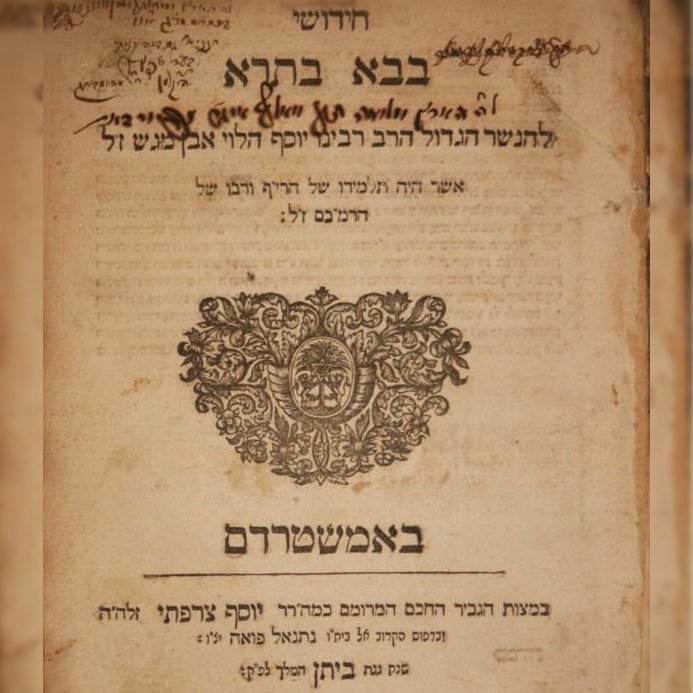
First edition of Joseph ibn Migash's commentary on the Bava Batra treatise (Amsterdam, 1702)
Among his works the following may be noted:
- Responsa (Saloniki, 1791; Warsaw, 1870), two hundred and fourteen of which were collected by Joseph Elijah ha-Levi, partially translated from the Arabic and published from a poor manuscript. Many of his responsa are found in Bezaleel Ashkenazi's "Shiṭṭah Meḳubbeẓet" and in Azulai's "Birke Yosef"; and a few appear in Maimonides' collection of letters "Pe'er ha-Dor" (nos. 211 et seq.).
- Commentaries on the Talmud (Menahem Meïri, "Bet ha-Beḥirah", in Neubauer, "M. J. C." ii. 228), of which the following have been preserved:
- Novellæ on Baba Batra, quoted among others by Zerahiah ha-Levi and by Solomon ben Adret
- Ḥiddushim on Shebu'ot, mentioned in the "Pe'er ha-Dor", No. 145 (first printed in Prague, 1809, in "Uryan Telitai"; together with other novels, ib. 1826).
Migash's work is characterized by an emphasis on clarity and intelligibility, sometimes giving two or more explanations of the same passage. He argued that it would be impossible to obtain religious decisions directly from the Talmud without using those of the Geonim ("Teshubot"). As an example of the fame he achieved, we can quote Maimonides, who in the introduction to his commentary on the Mishnah (Pococke, "Porta Mosis", p. 108), said of him:
The Talmudic erudition of this man astonishes everyone who understands his words and the depth of his speculative spirit; so much so that it could almost be said of him that there has never been an equal.