JOSEPH PICHON
(14th century)
His name is also transcribed as Yuçaf Picho. He was almojarife and chief accountant of the city and archbishopric of Seville. He was appointed in 1369 by Henry II of Castile, who highly esteemed him for his honesty and intelligence. But, following accusations brought by some rich coreligionists who had also been admitted to the court, Pichón was imprisoned by order of the king and sentenced to pay 40,000 doubloons. After paying this large sum within twenty days, he was released and reinstated in his position; in turn, he brought a serious accusation against his enemies, either in revenge or in self-justification.
Meanwhile, Henry had died and his son, John I, was his successor. Many rich and influential Jews had gathered from different parts of the country for the auction of the royal taxes in Burgos, where John's coronation took place. These Jews conspired against the life of Pichón, who was very popular with the Christians and had received considerable attention from the courtiers. It is not known whether he can be blamed in any degree for the extraordinary tax of 20,000 doubloons which Henry had imposed on the Jews of Toledo; but, be that as it may, some prominent Jews, representatives of various communities, went to the king on the day of the coronation and, explaining to him that there was among them a "malsin," that is, an informer and traitor who deserved death according to the laws of their religion, asked him to authorize the royal officers to execute the offender.
It is said that some of the king's henchmen, bribed by the Jews, induced Juan to give the order. The delegation then carried this order, together with a letter from several Jews who were the leaders of the community, to Fernán Martín, the king's executioner. The latter did not hesitate to carry out the royal order. On August 21, 1379, early in the morning, he went with Don Zulema (Salomon) and Don Zag (Isaac) to the residence of Pichón, who was still asleep. Pichón was awakened on the pretext that they were going to seize some of his mules; and, as soon as he appeared at the door, Fernán grabbed him and, without saying a word, beheaded him.
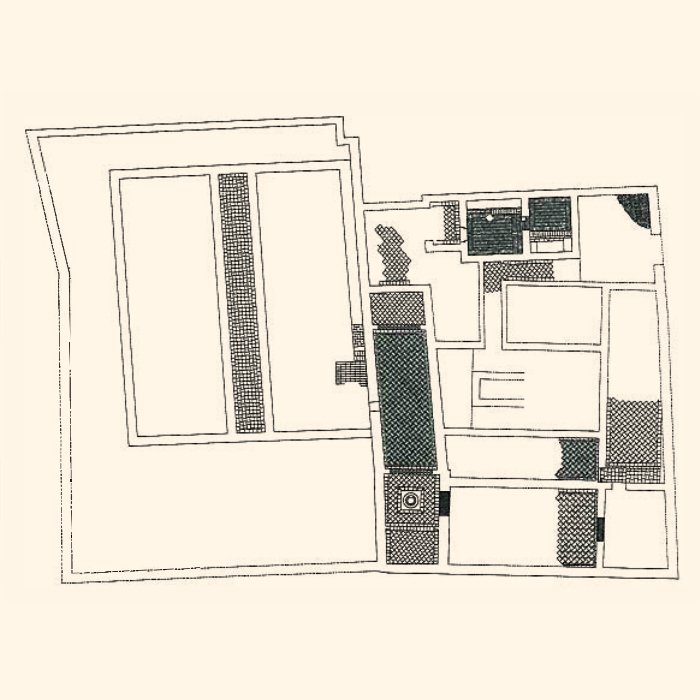
Plan of José Pichón's house in the Jewish quarter of Seville, according to the archaeological findings in the framework of the restoration of the Altamira palace. As we can find in "La restauración del palacio de Altamira" (Junta de Andalucía, 2005): The house built on plot C, with a surface area of almost 1,000 m², was distributed on two parallel terraces with a difference in level of one metre between them, determining two areas differentiated by their use, each of 500 m². The highest one was used as a garden-orchard and the other as useful built surface. The entrance with a façade on the Dos Hermanas alley gave access to service areas, following at the back the noble rooms with the large open-air recreational space.
The execution of Pichon, whose name had been kept from the king, created an unpleasant sensation. The monarch was extremely angry at having been tricked into signing the death warrant of a respected and popular man who had faithfully served his father for many years. He had Zulema, Zag, and the chief rabbi of Burgos, who was in on the plot, beheaded; and Martin was to have suffered the same fate, but was saved by the intercession of some knights. He paid for his haste in the matter, however, by the loss of his right hand. As a consequence of Pichon's execution, the Cortes deprived the rabbis and the Jewish courts of the country of the right to decide criminal cases. The affair had the most disastrous consequences for the Jews of Spain, stimulating hatred of the population against them and contributing to the great massacre of 1391.
Joseph lived in Seville in a luxurious house that stood where the Altamira Palace is today, in the most central area of the Seville Jewish quarter. During the archaeological excavation that took place at the end of the 20th century as part of the restoration of the palace, the structure of this house and its rich Mudejar decoration could be seen.