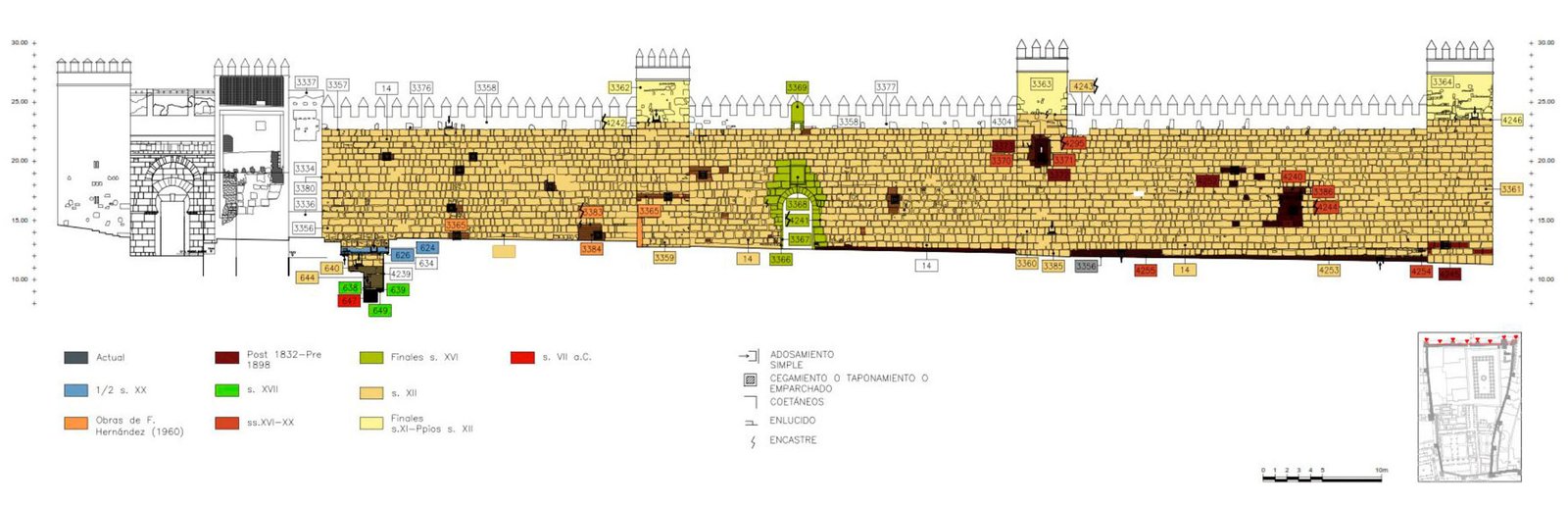
The exact chronology of this stretch of walls has been the subject of academic debate on numerous occasions. Traditionally, they have been identified with those that protected the "Dar al Imara" or "House of the Governor", a fortified palace that some sources mention was built in Seville during the Caliphate period (20th century).
However, archaeological research and study of the materials, led mainly by Professor Miguel Ángel Tabales Rodríguez, place the construction of this northern wall of the Alcázar in the Taifa period, already in the 11th century.
It is true that the use of ashlars to build defences in the cities of Al Andalus was a common practice, especially during the Caliphate period. But when the disintegration of the Caliphate took place, the resulting taifa kingdoms "saw in the construction of large walls imitating the caliphal ones an argument to reinforce their aspirations for domination, showing in each case the limitations in the use of the characteristic technique of each region in the absence of state programs and the decrease in the personnel and resources of a large state, now reduced to the control of municipalities and small states that were very deficient.
This is the case of Seville, a city with aspirations during the Abbadi dynasty, but very limited by its size and population, at least at the beginning of the works; yes, with the enormous advantage of having as construction material the magnificent quarry of blocks, already carved, as was the Roman wall of the city. In any case, the construction and implementation systems used were of proven solvency and resorted to solutions already known since Antiquity." (Tabales Rodríguez, M.A., Gurriarán Daza, P. "The construction of the Alcázar of Seville". Construction reports, nº563, 2021)
A series of seven rectangular towers, also built with ashlars, have been preserved in the wall. In both the towers and the wall, the section that was later raised but still in the Islamic period, probably in the 12th century, can be seen at the top. The upper part, including all the crenellations topped by pyramidal pieces, seems to be a recent addition, from the 19th century.
In this section of wall we find two doors. The closest to the Plaza de la Alianza is the Puerta de la Herradura, now blocked off. It owes its name to its horseshoe arch shape, framed by an alfiz. Apparently, it originally gave access to a guard post or tower.
In the Plaza del Triunfo we find the Puerta del Patio de Banderas, probably opened in the Almohad period (12th-13th century), as the two columns with capitals from this period that flank it on the patio side seem to attest. However, the materials that make up this entrance today seem to come from a reform undertaken at the end of the 16th century.
The wall in which the Puerta del León is located today was also built in the Almohad period. The towers that flank this door are, therefore, from different periods. The one on the left side, built with ashlars, is from the Taifa period (11th century), while the one on the right was built in the Almohad period (13th century), mostly in brick. Next to this second one, and facing Miguel de Mañara street, you can see the original entrance to the Almohad Alcázar, blocked when it was replaced by the current Puerta del León, opened during the reign of Pedro I (14th century).