WALLS OF ALCAZAR

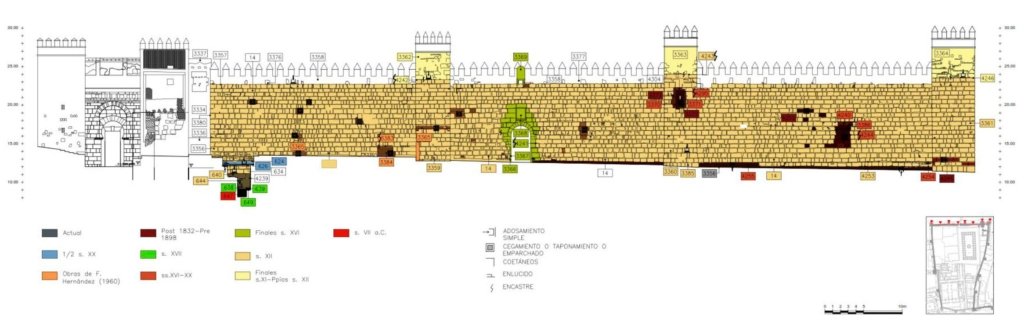
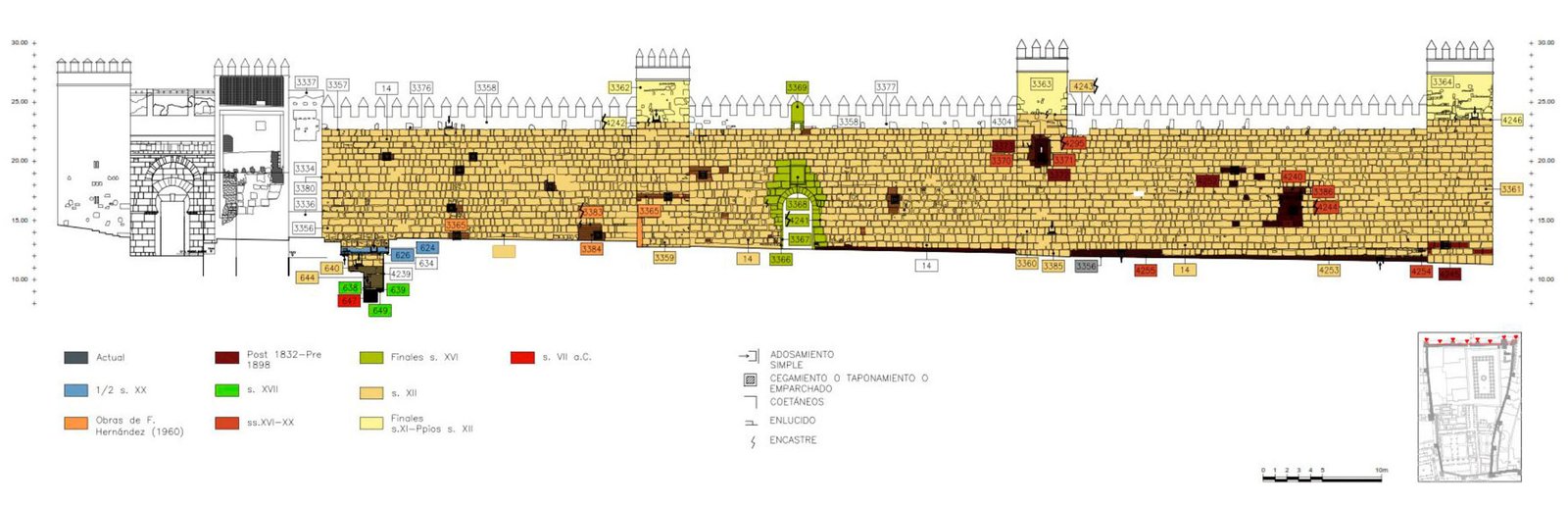
The walls that enclose the Alcázar of Seville on its northern side, towards the Plaza del Triunfo, are the most monumental and beautiful of those preserved in the city. Unlike the rest of the walls of Seville, here they were built using enormous stone ashlars, many of them from the old Roman walls, which were not in use due to the differences in height and dimensions between the Roman and Islamic city.

The exact chronology of this stretch of walls has been the subject of academic debate on numerous occasions. Traditionally, they have been identified with those that protected the "Dar al Imara" or "House of the Governor", a fortified palace that some sources mention was built in Seville during the Caliphate period (20th century).

However, archaeological research and study of the materials, led mainly by Professor Miguel Ángel Tabales Rodríguez, place the construction of this northern wall of the Alcázar in the Taifa period, already in the 11th century.

It is true that the use of ashlars to build defences in the cities of Al Andalus was a common practice, especially during the Caliphate period. But when the disintegration of the Caliphate took place, the resulting taifa kingdoms "saw in the construction of large walls imitating the caliphal ones an argument to reinforce their aspirations for domination, showing in each case the limitations in the use of the characteristic technique of each region in the absence of state programs and the decrease in the personnel and resources of a large state, now reduced to the control of municipalities and small states that were very deficient.

This is the case of Seville, a city with aspirations during the Abbadi dynasty, but very limited by its size and population, at least at the beginning of the works; yes, with the enormous advantage of having as construction material the magnificent quarry of blocks, already carved, as was the Roman wall of the city. In any case, the construction and implementation systems used were of proven solvency and resorted to solutions already known since Antiquity." (Tabales Rodríguez, M.A., Gurriarán Daza, P. "The construction of the Alcázar of Seville". Construction reports, nº563, 2021)

A series of seven rectangular towers, also built with ashlars, have been preserved in the wall. In both the towers and the wall, the section that was later raised but still in the Islamic period, probably in the 12th century, can be seen at the top. The upper part, including all the crenellations topped by pyramidal pieces, seems to be a recent addition, from the 19th century.

In this section of wall we find two doors. The closest to the Plaza de la Alianza is the Puerta de la Herradura, now blocked off. It owes its name to its horseshoe arch shape, framed by an alfiz. Apparently, it originally gave access to a guard post or tower.

In the Plaza del Triunfo we find the Puerta del Patio de Banderas, probably opened in the Almohad period (12th-13th century), as the two columns with capitals from this period that flank it on the patio side seem to attest. However, the materials that make up this entrance today seem to come from a reform undertaken at the end of the 16th century.

The wall in which the Puerta del León is located today was also built in the Almohad period. The towers that flank this door are, therefore, from different periods. The one on the left side, built with ashlars, is from the Taifa period (11th century), while the one on the right was built in the Almohad period (13th century), mostly in brick. Next to this second one, and facing Miguel de Mañara street, you can see the original entrance to the Almohad Alcázar, blocked when it was replaced by the current Puerta del León, opened during the reign of Pedro I (14th century).

TOWER OF ABDELAZIZ

Also called Torre de Santo Tomás. It was built in the Almohad period, in the 13th century, as part of the canvas of the wall that linked the Alcázar with the Torre del Oro. It has a hexagonal floor plan and is about 15 meters high, being solid in the first 8 meters.

It is built with brick, reinforced with ashlars at the base and at the corners. In its upper half, it is crossed by the two horizontal stripes so characteristic of the Almohad towers. Each wall is decorated at the top with polylobed blind arches framed by alfices.

[mapsmarker map="2"  lat="37.384020" lng="-5.993563" zoom="18" height="300" heightunit="px"]

GATE OF ABDELAZIZ

Also called Arco de la Plata or Arco de Mañara. It is one of the entrance doors through which the walled enclosure that surrounded the Alcázar was accessed. It was built in the Almohad period, probably already in the 13th century, like the Torre del Oro. From the Islamic construction, the original horseshoe arch, framed by an alfiz, can still be seen from the Avenida de la Constitución.

However, most of what has come down to us responds to the reform undertaken in the fourteenth century, in Christian times. It was then that the Gothic rib vault that covers it today was arranged.

[mapsmarker map="2"  lat="37.383801" lng="-5.993399" zoom="18" height="300" heightunit="px"]

WALL OF SAN GREGORIO STREET

This fragment of barely 20 meters of wall was built in the Almohad period, in the middle of the 12th century, forming part of the so-called third enclosure of the Alcázar. It was built when the Alcázar was enlarged to be configured as a citadel, doubling its original surface. It is built in mud, like most of the Sevillian walls, although in this case we can see how the original construction was increased at some later time with brick.

[mapsmarker map="2"  lat="37.383193" lng="-5.993023" zoom="18" height="300" heightunit="px"]

TOWER OF SILVER

The Torre de la Plata is located in what is now Santander street, and was originally linked to the Torre del Oro by a stretch of wall, most of which has now disappeared. Both were probably built at the same time, in the Almohad period, around 1220. They were part of the defensive complex to the south of the city, the port and the surroundings of the Alcázar, together with other towers such as that of Abdelaziz, which is still preserved on Constitution Avenue.

It has an octagonal plan and is simpler than the Gold in its structure and decoration, although in all probability they were built at approximately the same time. What does seem probable is that it already grew in Christian times, in the time of Alfonso X, during the second half of the 13th century. We know that in Christian times it was also called Torre de los Azacanes. Azacán is a word of Arabic origin that designated those who were dedicated to carrying water using animals. It is probable that he habitually entered the city through the shutter that was next to this tower and that is where the name comes from.

Next to the tower, a fragment of the wall of about 80 meters is preserved, which adopts an 'L' shape to enter the spaces historically occupied by the dependencies of the Casa de la Moneda.

In Detail → GOLD AND SILVER TOWERS

[mapsmarker map="2"  lat="37.383203" lng="-5.995406" zoom="18" height="300" heightunit="px"]

TOWER OF GOLD

The Torre del Oro is the most famous of those that have survived from the walled enclosure of Seville. It was built in the Almohad period, between 1220 and 1221 and apparently owes its name to the golden effects produced by its color when reflected in the river, the result of the lime and straw mortar with which it was originally completely covered.

Archaeological studies suggest that only the first body of the tower, whose plan is a twelve-sided polygon, corresponds to the initial Almohad phase. Its upper part is crossed by a frieze with paired windows, today blinded, framed by pointed horseshoe arches, supported on brick pilasters.

It is probable that the series of battlements that finish off this body are already from the Christian period, probably from the reign of Alfonso X el Sabio. There are also doubts about the chronology of the second body of the tower, although in general its construction tends to be attributed to the reign of Pedro I, already in the 14th century. It is documented that this body had a direct access from the Alcázar through the upper part of the wall, without having to go down to the street. Apparently, King Pedro made use of this circumstance to use the Torre del Oro as a setting for his meetings with one of his lovers. Given this use that we know of, it is likely that he himself ordered the construction of this second level.

In Detail → GOLD AND SILVER TOWERS

[mapsmarker map="2"  lat="37.382402" lng="-5.996316" zoom="18" height="300" heightunit="px"]

WALL OF THE PASEO CATALINA DE RIBERA (CONTEMPORARY)

As part of the urban redevelopment works in this sector of the city, undertaken at the beginning of the 20th century, this wall or fence was built to separate the gardens of the Alcázar from the Paseo de Catalina de Ribera and the Jardines de Murillo. It is almost 400 meters long and is made in the historicist style that was so popular at the time. In fact, it is a crenellated wall, despite the fact that it does not have any defensive purpose.

Also historicist and with a certain monumentality are the two portals that are located at both ends of the Paseo, which today serve as auxiliary accesses to the gardens of the Alcázar.

[mapsmarker map="2"  lat="37.384007" lng="-5.990381" zoom="18" height="300" heightunit="px"]

GATE OF THE WATER

Also called Postigo del Alcázar or Postigo de la Huerta del Retiro. It is a small door in the wall, one of the few that have been preserved from the medieval layout in Seville. It was erected in the Almohad period, between the 12th and 13th centuries, remodeling an original tower gate from the Caliphate period. Apparently, it was the door used by the emirs to leave the city towards the rural area of La Buhaira.

[mapsmarker map="2"  lat="37.384007" lng="-5.990381" zoom="18" height="300" heightunit="px"]

WALL IN THE CALLEJÓN DEL AGUA

The beautiful Callejón del Agua in the Barrio de Santa Cruz runs alongside a stretch of wall about 140 meters long. It is original from the 12th century, built using mud walls and today it appears much lower than it originally was due to the elevation in ground level.

Three rectangular towers have been preserved in this section. Next to the one closest to the Plaza de Alfaro, you can see the ends of the two large clay pipes that run along the wall in this section. Originally they were conceived to conduct water from the Puerta de Carmona to the gardens of the Alcázar. The water came to this door from some sources in Alcalá de Guadaira through an aqueduct known as the Caños de Carmona, of which some scattered fragments have been preserved on Luis Montoto street and on Avenida de Andalucía.

[mapsmarker map="2"  lat="37.384497" lng="-5.989357" zoom="18" height="300" heightunit="px"]

WALLS IN JARDINES DE MURILLO

Next to the Murillo gardens, several sections of the wall have been preserved, interrupted by the openings opened at the beginning of the 20th century to connect the Santa Cruz and Alfaro squares with the gardens. In total there are about 50 meters of wall, of which the crenellations have not been preserved.

These fragments are dated from the 12th century and were built with mud and brick. Three rectangular towers have also been preserved. Of one of them, the closest to the Plaza de Refinadores, only the first solid body has been preserved. The other two, on both sides of Nicolás Antonio street, have been highly modified on their upper floors, reused for residential purposes.

The preserved towers have a rectangular floor plan and are separated by about 45 meters. Like those preserved in the Macarena, they are solid up to the height of the parapet, while they present a vaulted space on the top floor from which the roof is accessed.

[mapsmarker map="2"  lat="37.384910" lng="-5.988235" zoom="18" height="300" heightunit="px"]