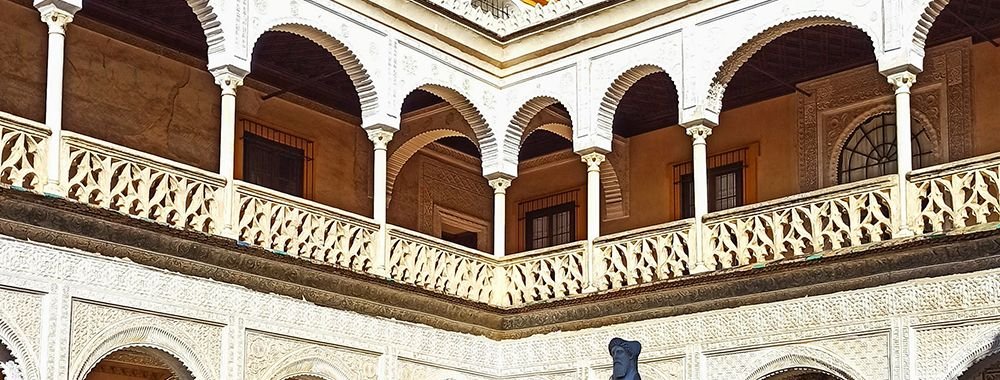
Patio principal con Jano bifronte

HOUSE OF PILATOS

The Casa de Pilatos is one of the most outstanding examples of 16th century civil architecture in Andalusia, constituting a beautiful synthesis of Italian Renaissance art and the Sevillian Mudejar style.

CC BY-SA 4.0

Its construction began at the end of the 15th century by the Mayor of Andalusia Pedro Enríquez and his wife, Catalina de Ribera, although the bulk of its work was undertaken in the time of their son, Fadrique Enríquez de Ribera, first Marquis of Rate.

He carried out a pilgrimage to the Holy Land in 1518, touring a large part of Italy both on his way out and on his return, a fact that would greatly mark the physiognomy of the palace. He was able to admire great works of the Italian Renaissance in cities like Venice, Milan, Rome or Genoa. In this last city he would commission the sculptor Antonio María Aprile, the magnificent portal that constitutes the main access to his palace. It is made of white marble and reproduces the shape of a Roman triumphal arch, with Corinthian pilasters framing a semicircular arch. In the spandrels there are two classic medallions with the effigies of Julius Caesar and Trajan, both closely linked to the city. On the frieze, between the family coats of arms, there is a large inscription with metal characters inserted in marble, alluding to the construction of the palace and this doorway.

The façade is topped by a Gothic-style cresting, which apparently comes from a previous palace that the family owned in Bornos. In the central part of this balustrade, there are three pillars, each one with a Jerusalem cross and the inscription "4 DAYS OF AUGUST 1519. ENTERED HIERUSALEM", alluding to Don Fadrique's pilgrimage to the Holy Land.

From this pilgrimage, which apparently deeply marked the Marquis of Tarifa, most likely comes the name Casa de Pilatos by which the palace is generally known. For a long time the legend existed that the marquis had reproduced in his home the traces of the palace of the Roman praetorian Pontius Pilate in Jerusalem and that this is where the name would come from. In fact, the portico that faces outwards on the first floor next to this façade is sometimes referred to as the “Ecce Homo” balcony, since it would supposedly reproduce the space where Jesus was shown to the people in the famous Biblical passage.

The slightest formal and stylistic analysis of the palace makes it clear that this theory is nothing more than a legend. What does seem more probable is the relationship of the popular name of the palace with the famous Via Crucis that starts from it and that reaches the Cruz del Campo temple, which is still preserved in the current Luis Montoto street.

According to tradition, the Marquis of Tarifa, on his pilgrimage to Jerusalem, would have measured the exact distance that went from the praetorium palace where Jesus was tried to Mount Calvary where he was crucified. This distance would coincide with the one between the façade of the palace and the aforementioned temple.

The niche with a cross that is to the left of the main portal, made in the 17th century with colorful marbles of different colors, alludes to this circumstance. This cross would mark the first station of the aforementioned Way of the Cross, as can be read in the inscriptions that appear on the sides.

Inside, the space of the palace is articulated around a series of patios and gardens, generating a very complex layout.

The peculiar stylistic diversity of this space, which harmoniously brings together Gothic, Mudejar, Renaissance and Romantic elements, is the product of successive interventions on a rectangular courtyard, centered on the chapel and porticoed only on its short sides, built at the end of the s. XV by Pedro Enríquez and Catalina de Ribera. His son Fadrique, the pilgrim to Jerusalem, began his Renaissance transformation: he enlarged its dimensions making it quadriform, opened galleries on its four sides, replaced the brick pillars with Genoese columns and placed in its center the marble fountain also acquired in Genoa. Fadrique was inherited in 1539 by his nephew Per Afán, who, in addition to enriching its corners with the four main pieces of his sculpture collection (see no. 4), arranged around it a gallery of busts of ancient characters that, as a historical mirror, it reinforces the idea of continuity between the founding of Rome and the new empire of Carlos V. Already in the s. In the XIX century, novelties to the romantic taste are introduced, such as the opening of an access in its center, the replacement of the clay floor by marble and the placement of new pseudo-Nazarite mullioned windows.

The central and most emblematic element of the palace is the central patio. It has a marked Renaissance air, despite the profuse Mudejar decoration and the presence of Gothic elements. This is due to the profuse use of marble in columns and flooring, and the splendid collection of Roman pieces on display in the courtyard. For example, in each of the corners there are four Roman female sculptures, all original from the 1st and 2nd centuries. They represent Pallas Pacifera, Pallas as a warrior, Copa Syrisca and Faustina the Less deified as Fortuna. In the center of the patio, a marble fountain with a bust of Jano Bifronte, also original from the 1st century. In addition, the patio walls are crossed by a series of niches in which a magnificent collection of busts of original emperors is exhibited. one of the best private collections that exist of this matter.

These works are just a part of the magnificent sculptural collection that can be admired on a visit to the palace. The main nucleus of the complex was made up of Per Afán de Ribera, 1st Duke of Alcalá, mainly with works from the Viceroyalty of Naples, where he even financed excavations. The pieces have been exhibited in various rooms of the palace and many of them next to the so-called Jardín Chico, one of the two beautiful garden spaces that flank the palace.
The interior rooms generally adopt names related to the aforementioned identification of the palace with the house of Pilatos. In this way, we have the Praetorium Hall, the Chapel of the Flagellation or the Pilate's Cabinet.

The Salón del Praetorio, between the main patio and the Jardín Chico, preserves all its original elements from the 16th century, including the magnificent wooden coffered ceiling and the tile covering on the basin and edge of the walls.

The Chapel of the Flagellation, located on one side of the main patio, is considered the oldest room in the palace, built in a Mudejar Gothic style. In its center is a column, which tradition identifies with the one used in the flagellation of Jesus and hence the name of the chapel. On the altar there is a paleo-Christian sculpture from the 4th century that represents Jesus as the Good Shepherd. Perhaps this is the oldest image of Jesus among those that can be seen in Seville.

The Pilatos Cabinet, located under the tower, has a square plan and an octagonal fountain in its center, elements that relate it to the 'qubbas' of Mudejar architecture. It is covered by an imposing wooden coffered ceiling. It is made of "street and rope" lacework made up of ten-sided wheels that have a ten-pointed star as their center, forming a composition that symbolically alludes to the celestial vault.

For its part, the upper floor was ordered to be built by Fadrique Enríquez de Ribera in the 16th century and was decorated with a series of illustrious characters from Antiquity and with an allegorical composition on the Triumph of the Four Seasons. Later, Francisco Pacheco, Velázquez's father-in-law, painted the ceilings with a series of mythological themes. Currently, a series of pieces from the Medinaceli collection are exhibited in these spaces, which include not only furniture and tapestries, but also paintings by artists such as Goya, Lucas Jordán or Carreño Miranda.

In detail: The Renaissance Gate of the Casa Pilatos


[foogallery id="8531"]

[mapsmarker map="2"  lat="37.389996" lng="-5.987222" zoom="18" height="300" heightunit="px"]

HOUSE OF OLEA

This is a palace house that was originally built in the 14th century, but has undergone numerous modifications throughout its history, especially in the 16th, 18th and 19th centuries. The main façade, in neoclassical style, corresponds to this last period. Currently, it serves as the headquarters of the San José de la Montaña school.

Inside, the house is articulated around a porticoed patio, with peralted arches with Plateresque decoration, which rest on marble columns. In the corner, as is usual in Sevillian mansions, a splendid staircase gives access to the second floor.

Some of the rooms in the medieval palace have been preserved, such as the so-called 'girls' room' and a square-shaped room used today as a chapel. The elements of greatest artistic value are preserved there, such as the tiled plinths with loop wheels, similar to those of the Alcázar, or the beautiful plasterwork with ataurique decoration, Kufic and scallop inscriptions. The octagonal wooden vault that originally covered the space was lost and today it has a contemporary cover that reproduces the shape of the original.

The upper floors are the result of the 19th century reform and have lounges decorated in English style.

[mapsmarker map="2"  lat="37.387106" lng="-5.990295" zoom="18" height="300" heightunit="px"]

HOUSE OF THE PINELO

Splendid Sevillian palace house from the early 16th century that mixes Gothic, Mudejar and Renaissance elements in its style.

It owes its name to the fact that it was built by the Pinelo family, merchants of Genoese origin. In 1524 it would be donated by the family to the chapter of the Cathedral, which would hold its property until the 19th century. By then, the result of the confiscation would return to private hands, passing through various owners and uses. In the 60s of the 20th century it was acquired by the City Council, which ended up ceding the property to the General Directorate of Fine Arts in 1972. It then began a profound reform directed by Rafael Manzano Martos. It is currently the headquarters of the Royal Academy of Fine Arts of Santa Isabel de Hungría and the Royal Sevillian Academy of Good Letters.

The main façade is quite simple and in it the different floors can be clearly distinguished, with the ground floor raised with ashlars and the first floor with brick. On the upper floor there is a viewing gallery with semicircular arches on marble columns, seated in turn on a Gothic-style balustrade.

The interior of the building is articulated around two patios. The first, smaller, served as a halt and is porticoed with carpanel arches on marble columns. The second is a magnificent Renaissance courtyard, also porticoed, but this time with semicircular arches resting on columns of castanets. The arches are richly decorated with Plateresque reliefs. In the spandrels there are a series of medallions with characters of the time, among which are the original owners of the palace. The arches on the upper floor are also supported by marble columns and are similarly decorated, although in this case they are lowered arches.

Among the rooms that surround the patio, a good part of the original wooden coffered ceilings from the 16th century have been preserved. It is also noteworthy the beautiful garden at the back of the house, very renovated in the restoration of Manzano in the 70s.

[mapsmarker map="2"  lat="37.387596" lng="-5.991113" zoom="18" height="300" heightunit="px"]

HOUSE OF TRADE OF THE INDIES

The House of Trade was an institution founded in 1503 by order of Isabel la Católica, in charge of managing everything related to navigation and commercial exploitation of the new territories of the Crown overseas.

CC BY-SA 4.0

Initially it settled in a space of the old Shipyards, but due to the constant flooding of the river, it was soon moved to the location that it would occupy inside the Alcázar. There it would occupy the space of one of the old Muslim palaces, to the west of the palace of Pedro I, a space that had already been used by the so-called Cuarto de los Admirales. At the beginning of the 16th century, a complete renovation of the facilities began and a new façade was opened towards the current Plaza de la Contratación. However, the building that we can see there today, owned by the Junta de Andalucía, was built in the 1970s. It was then that the old courtyard of the Muslim palace was rebuilt, based on the few archaeological remains found.

From the 16th century Casa de Contratación, some rooms and patios have been preserved, which today can be visited from inside the Alcázar. Among them, we can highlight the Admiral's Room and the Audience Room.

The Admiral's Hall is a large rectangular space covered by a wooden ceiling, with horizontal beams resting on corbels with a design inspired by the work of Sebastiano Serlio. Dating from the end of the 16th century, this ceiling is attributed to the master carpenter of the Alcázar, Martín Infante. The walls are decorated with paintings from the 19th and 20th centuries belonging to National Heritage, the Prado Museum and the collection of the Royal Family. Particularly interesting are the portraits painted by the German Winterhalter of The King and Queen of France, Luis Felipe and Amelia, with their children, and those of Don Antonio and Doña Luisa Fernanda, Dukes of Montpensier.

Opposite, hangs a large painting titled The Aftermath of Fernando III the Saint, signed and dated in Seville by the local painter Virgilio Mattoni in 1887. It is a work owned by the Prado Museum, although it is deposited in the Alcázar due to the great connection of the work with this place, since the event that it narrates, the death of Fernando III, happened here, in the Alcázar. On the back wall, in the central place of the room, we can see the oil painting titled The Ibero-American Exhibition Inauguration, painted by Alfonso Grosso in 1929.

For its part, the Courtroom owes its name to the fact that it was the seat of the Admiralty Court of Castilla. It is a room with a square plan, whose wooden coffered ceiling from the 16th century, richly gilded, presents traces reminiscent of the old Mudejar style.

On the walls appear the coats of arms of several famous admirals in the naval history of Spain, among which is that of Christopher Columbus, right in the center of the wall on the left.

In the central part of the room we see the altarpiece of Nuestra Señora de los Navegantes, made by Alejo Fernández in 1535. It is the first painting in Europe that has the discovery of America as its theme. We cannot identify the figures that appear clearly, but we know that they are Christopher Columbus, Emperor Carlos, Fernando el Católico, Sancho de Matienzo (first treasurer of the Casa de Contratación), Americo Vespuccio, Juan de la Cosa and several indigenous people. , of the recently discovered lands. All of them covered under the mantle of the Virgin of Buenos Aires. At the bottom are several of the types of boats that made the race to the Indies, so the work as a whole offers testimony of incalculable value.

[mapsmarker map="2"  lat="37.383810" lng="-5.991859" zoom="18" height="300" heightunit="px"]

CHURCH OF SAN GREGORIO MAGNO

The Church of San Gregorio Magno, also called the Chapel of the Holy Sepulchre, originally belonged to the English college founded by the Jesuits in the city at the end of the 16th century. Currently, the brotherhood of the Holy Burial is located in the church.

CC BY-SA 4.0

When the Jesuit Order was outlawed in Spain in 1767, the dependencies of the church and the school became dependent on the State, which has used them for various uses ever since. A century later, in 1867, the brotherhood of the Holy Burial settled here and since the 1940s it has housed a Mercedarian fraternity.

The temple has a rectangular plan with three naves, separated by Tuscan columns that support former semicircular arches. Both the central nave and the lateral ones are covered by architrave vaults.

The decoration of the temple is very simple. Outside, we hardly find any neo-Gothic detail added in the 19th century, such as the molding that frames the entrance, a simple rectilinear depressed arch.

Inside, the main altarpiece is a modest 19th-century neoclassical work imitating reddish marble. In its center, an urn also made in the 19th century by Lucas de Prada houses the image of the Holy Reclining Christ, head of the brotherhood of the Holy Burial.

This brotherhood makes its penance station on Holy Saturday with three steps, the Holy Burial, the Triumph of the Holy Cross and the Virgin of Villaviciosa.

The exact date of foundation of the brotherhood is not known. There is an 18th century narrative in which it is stated that it was founded by Fernando III himself after his conquest of the city in 1248 and that the monarch himself would have been his first older brother. However, there is no documentary evidence of such a story.

It is known for sure that the brotherhood already existed around 1570 with headquarters in the convent of San Laureano. After the convent closed in 1810, it passed through different locations until they settled in this church of San Gregorio in 1867. However, they did not go out in procession regularly until they began to do so in Holy Week in 1956.

The first of the steps of the brotherhood is the Triumph of the Holy Cross, one of the most curious of the Sevillan Holy Week. It represents the triumph of the Cross over death, which is represented by a brooding skeleton, which is why the pass is popularly known as 'La Canina'. It is a work from the end of the 17th century attributed to Cardoso Quirós.

The Reclining Christ is a magnificent carving that has not been documented, but which has been attributed to Juan de Mesa and dated around 1620. It parades in an imposing neo-Gothic glass-enclosed urn made in 1880.

In the last step, the Virgin of Villaviciosa parades, an image also by Cardoso Quirós from the late 17th century, who appears comforted by Saint John, the three Marys and the male saints, nineteenth-century works by Juan de Astorga.

[mapsmarker map="2"  lat="37.392888" lng="-5.997116" zoom="18" height="300" heightunit="px"]

CHAPEL OF EL DULCE NOMBRE DE JESÚS

The Vera Cruz Brotherhood has its headquarters in this chapel on Baños street, which makes a penance station every Holy Monday with two pasos, the Cristo de la Vera Cruz and the Virgen de las Tristezas.

The brotherhood was founded in 1448 in the huge Franciscan convent known as Casa Grande de San Francisco, which stood in what is now Plaza Nueva. When the convent was demolished in 1840, the brotherhood had to move to the church of San Alberto. There it entered a phase of decline, to the point that they stopped processing. In 1942 the brotherhood moved to its current headquarters in the Chapel of Dulce Nombre and from there it began to process again in 1844.

The Chapel sits on the grounds of the old Arab baths of Reina Mora, which have been partly preserved as annexes to the current chapel. A convent with the dedication of the Dulce Nombre de Jesús was established there since the 16th century, initially formed as a shelter for “repentant women”, although it is known that by the middle of the 17th century it was already a convent with Augustinian nuns in use. In the 19th century, as part of the confiscation process, the convent was exclaustrated and its rooms were used as barracks. The current Chapel is the only remainder of that disappeared convent that has survived to this day.

The access to the temple is through a simple side doorway on which a belfry stands. Inside, we see that the church has a rectangular floor plan with three naves, the central one being covered by a barrel vault with transverse arches and lunettes, all richly decorated with plant motifs and scrollwork. The central nave is notably higher, which allows for the existence of separate spaces above the lateral naves, which open onto the church behind a series of bars. This element clearly takes us back to the conventual past of the temple, since the nuns could attend services from this elevated position, safe from the gaze of the rest of the faithful.

The main altarpiece of the chapel is an anonymous work from the last third of the 17th century that has been linked to the style of Bernardo Simón de Pineda. The two images that appear in the side niches, San Agustín and Santa Mónica, appear to be from the same period and authorship of the altarpiece.

Artistically, perhaps the most outstanding work in the temple is the head of the brotherhood, the Cristo de la Vera Cruz, a crucified figure by an anonymous author dating from the first half of the 16th century, making it the oldest image of Christ in procession in Holy Week in Seville. It is smaller than life size, and due to its age it retains many features of Gothic sculpture, such as the rigidity of its posture and the accentuated pathos of its expression, which achieves a profoundly moving effect.

The painful image that accompanies Christ in his penance station is the Virgen de las Tristezas, a carving made by Antonio Illanes in 1942 to replace the original, whose whereabouts are unknown. On the brotherhood's website, we can read that 'the image was the result of the author's inspiration, taking his wife Doña Isabel Salcedo as a model.'

[mapsmarker map="2"  lat="37.395229" lng="-5.998373" zoom="18" height="300" heightunit="px"]

CHAPEL OF SAN ONOFRE

This small chapel was originally part of the now-defunct Casa Grande de San Francisco, a huge Franciscan convent that was located until the 19th century in what is now Plaza Nueva and its adjoining areas. In fact, it can be considered that it is the only vestige that has reached our days of the disappeared convent.

On the outside, the chapel does not have a façade, since it was inserted in one of the buildings that surround Plaza Nueva. Inside, we see that it has a rectangular plan with a single nave, covered by a barrel vault with transverse arches and lunettes.

The main altarpiece was made by Bernardo Simón de Pineda around 1680 and the sculptures that appear in it have been linked to the workshop of Pedro Roldán. In the central niche appears an Immaculate Conception, flanked on both sides by San Fernando and San Hermenegildo.

The chapel has other altarpieces, among which the one dedicated to San Onofre stands out, at the beginning of the Gospel side, made at the beginning of the 17th century. Its sculptural part was made by the great Martínes Montañés, while Francisco Pacheco, Velázquez's father-in-law, was in charge of the paintings. The image of San Onofre is by Pedro Díaz de la Cueva from 1599.

[mapsmarker map="2"  lat="37.388228" lng="-5.995320" zoom="18" height="300" heightunit="px"]

CHAPEL OF THE ROSARIO DE MONTE-SION

In this chapel on Calle Feria, the Brotherhood of Monte-Sion has its brotherhood, which makes its penance station every Holy Thursday with two steps, the Lord of Prayer in the Garden and the Virgin of the Rosary.

The Brotherhood was founded in 1560, the result of the union of two previous brotherhoods. Around 1576, construction work began on its current chapel, on a small plot ceded by the old Dominican convent of Nuestra Señora de Montesión.

The exterior of the chapel is very simple, with a large flat door on which the inscription 'REGINA SACRATISSIMI ROSARII' (QUEEN OF THE HOLY ROSARY) stands out. As a curiosity, it can be noted that the door is not the original one, but was enlarged in 1915 to allow exit from the steps through it. On both sides you can see the ceramic altarpieces of the holders of the Brotherhood, both works by Alfonso Chaves from 1960. The large door that is attached to the facade of the chapel is the old access to the disappeared Dominican convent that we have mentioned.

Inside, the chapel is rectangular in plan with a single nave. The wooden roof stands out, an armor made following the original pair and knuckle technique from the end of the 16th century.

The main altarpiece of the chapel is contemporary, since the temple was assaulted in 1936, during the first days of the Civil War, losing part of its heritage.

Artistically, the holders of the Brotherhood stand out. The Virgen del Rosario is an anonymous dolorosa from the late 16th or early 17th centuries, one of the oldest Marian images among those in procession during Holy Week in Seville. For his part, the Lord of Prayer in the Garden was made by Pedro Roldán around 1675.

In an altarpiece on the Gospel side, Cristo de la Salud is venerated, also the head of the Brotherhood, although he does not carry a procession. It was made by Luis Ortega Bru in 1954 to replace a previous one lost during the fire of 1936. Despite being a relatively recent work, it is a crucified figure of great artistic quality, since its sculptor, Ortega Bru, is one of the of the highest quality and originality among those who worked in Seville during the 20th century.

[mapsmarker map="2"  lat="37.396912" lng="-5.991244" zoom="18" height="300" heightunit="px"]

CAÑOS DE CARMONA

The 12th century aqueduct that carried water from the nearby town of Alcalá de Guadaira to the city is known as Caños de Carmona. The name 'de Carmona' comes from the fact that the aqueduct reached the city next to the Puerta de Carmona. From there, some clay pipes that ran inside the walls carried the water to the Alcázar.

It seems that the pipes were built reusing the layout of an ancient Roman aqueduct, in the Almohad period, during the reign of Yusuf. Originally they were about 17 kilometers long and would have around 400 arches, raised on robust brick pillars. Depending on the unevenness of the terrain, in some areas a simple arcade was arranged and in others a double one was necessary. Currently, only a few scattered fragments remain along the axis of Luis Montoto street. The remains are frequently misidentified with a Roman aqueduct.

[mapsmarker map="2"  lat="37.387713" lng="-5.981322" zoom="18" height="300" heightunit="px"]

BASILICA OF EL GRAN PODER

The Brotherhood of El Gran Poder has its headquarters in this Basilica in the Plaza de San Lorenzo. They do their penance station in the 'Madrugá' from Thursday to Good Friday, in the midst of absolute silence, being one of the brotherhoods that arouse the most devotion among Sevillians.

CC BY-SA 4.0

Historians trace the foundation of the Brotherhood to the 15th century, initially settling in the Benedictine Convent of Santo Domingo de Silos, of which the current church of San Benito Abad, in Luis Montoto, remains as testimony. From there, it would go through various locations throughout its history.

Already in the fifteenth century it appears located in the Convent of Santiago de la Espada and in the sixteenth century it was moved to a chapel of the Franciscan Convent of Santa María del Valle, where today is the Sanctuary of the Brotherhood of the Gypsies. From the Valley they would move to San Lorenzo at the beginning of the 18th century and the current headquarters would be built in the middle of the 20th century.

The temple was built between 1959 and 1965 in a neo-baroque style with a very classical air inside, following the traces of the architects Antonio Delgado Roig and Alberto Balbontín. The floor plan is that of a large, almost circular space, covered by a large coffered vault, which seems directly inspired by that of Agrippa's Pantheon in Rome. As in the Roman case, this space is preceded by a large rectangular atrium through which it is accessed, covered by a quarter-barrel vault, also coffered.

The temple has been a Minor Basilica since 1992, the result of a concession from Pope John Paul II.

The holders of the Brotherhood are Jesus of Great Power and the Virgin of Greater Pain and Transfer.

Jesús del Gran Poder is an image of Jesus carrying the cross made by Juan de Mesa around 1620. It constitutes a masterpiece of Sevillian Baroque, with a splendid anatomical treatment and an expressionism in the face that manages to convey the sensation of deep suffering and great solemnity at the same time.

The image of the Virgin is an anonymous work from the 18th century, with successive restorations in the 20th century. She is in procession under a canopy accompanied by Saint John the Baptist, an image carved for the Brotherhood by Juan de Mesa at the same time he sculpted the Lord.

[mapsmarker map="2"  lat="37.397147" lng="-5.996298" zoom="18" height="300" heightunit="px"]